Ethiopia has a vision: within twenty to twenty-five years, her citizens will become middle-income. Like China and the Five Tigers' visions. So she is going to be there.Footnote 1
I truly think Meles wants to be the Deng [Xiaoping] of Ethiopia. He would like history to look back on him as the person who finally pulled Ethiopia out of the poverty of the past 100 or 150 years.Footnote 2
If political ideas can be said to have ‘tipping points' – moments when their hitherto-limited expression reaches a critical threshold and begins to spread exponentially – the ‘China Model's’ own such moment surely came in May 2004. On the 26th and 27th of that month, over one thousand developing country policymakers gathered in Shanghai to share best practices and lessons in poverty reduction. The ‘Scaling Up Poverty Reduction’ conference marked the culmination of a year-long ‘global learning process’ sponsored by the World Bank and hosted by the government of the People's Republic of China. The conference may have covered a dozen country case studies and numerous cross-national thematic cases, but all eyes returned again and again to the development experiences of one country in particular – that of China. ‘The conference venue in Shanghai is symbolic of the progress that China has made in lifting 400 million people out of poverty since 1981’ wrote the World Bank Institute (2004: 16) of the event, explaining that ‘China's willingness to share its experiences [had] led to the idea of inviting policymakers and people working on poverty programs in other developing countries to learn from each other’.
The same month also saw the birth of the term ‘the Beijing Consensus’ in a provocative working paper of the same name, written by Goldman Sachs advisor Joshua Cooper Ramo (Reference Ramo2004). In the years that followed, Ramo's assertion that China's post-reform development experiences were transforming global development practices by encouraging imitation in areas as far afield as Africa and Latin America sparked a wave of speculation in the media and in policy fora. The discussion also made its way into academic debates regarding the desirability, the features and the very existence of a distinctly Chinese exemplar for developing country policymakers.
A decade on, the question of the transferability and attractiveness of China's development trajectory seems to be losing its force, despite the existence of a now fairly sizeable literature on the subject. This article argues that the decline of scholarly discussion on China's development ‘model’ is due less to a fundamental flaw in the notion that policymakers in developing countries view China as an example for emulation than it is due to key weaknesses in the China Model literature – weaknesses that have caused it to buckle under the weight of sceptics’ criticisms. Rather than jettisoning the concept of lesson-drawing between China and other developing countries entirely, I contend, scholars should undertake rigorous empirical research in order to understand precisely why and how development models ‘land’ in certain foreign settings. One such setting, Ethiopia under the later rule of Meles Zenawi, provides a compelling example that challenges many of the assumptions of the China Model literature but ultimately demonstrates the continuing utility of the concept.
THE DEBATE ON THE CHINA MODEL AND THE BEIJING CONSENSUS
Within the relatively short period since their emergence in the early 2000s, terms such as the China Model and the Beijing Consensus have generated a substantial body of analysis and conjecture on the extent to which other countries in the Global South can draw lessons from China's post-reform development trajectory. Few major Western news and policy outlets have failed to weigh in on the discussion: The Economist has hosted an online debate on the motion that ‘China offers a better development model than the West’ (The Economist 2010), for example, while the Financial Times in 2005 named developing-country emulation of China ‘the biggest ideological threat the west has felt since the end of the cold war’ (Leonard Reference Leonard2005). The topic has also been been openly, if somewhat ambivalently, discussed in China itself, where caution over being perceived as prescriptive and arrogant abroad is tempered by the recognition that emulation of China strengthens the country's soft power (see, for example, the frequency and eagerness with which China's state media has reported expressions of interest in the country's development trajectory emanating from foreign elites (e.g. Xinhua 2012)). Such expressions have indeed been frequent, with African leaders in particular often quoted expressing their desire to draw lessons from China. Newspaper editorials with titles such as ‘Chinese medicine just the tonic for developing countries’ (Kaluba Reference Kaluba2004) have accompanied pronouncements by African policymakers such as Nigerian Senate President Ken Nnamini's assertion that ‘China has become a good model for Nigeria in its quest for an authentic and stable development ideology’ (quoted in Shelton & Paruk Reference Shelton and Paruk2008: 25).
A final arena in which these concepts have been discussed and contested is in the academic literature, where opinion has tended to fall into three camps. Advocates have viewed emulation of China as both a real and a positive development in developing countries looking to achieve rapid economic growth and industrialisation. In this vein, Ramo (Reference Ramo2004: 26) attests to the existence of numerous ‘nations examining China's rise and trying to see what pieces of this miracle they might make manifest in their own land’, while Peerenboom (Reference Peerenboom2007), Li et al. (Reference Li, Brodsgaard and Jacobsen2009) and Zhao (Reference Zhao2010) all construct lists of broad lessons – such as a gradualist approach to political and economic reform and investment in science and technology – that China is said to offer. Opponents, such as Halper (Reference Halper2010) and Kurlantzick (Reference Kurlantzick2007), on the other hand, have primarily argued that this lesson-drawing has had dangerous consequences for human rights and democratic governance.
A third group, of sceptics, have argued that China's model is either too internally flawed, too historically and culturally specific or (conversely), too generic to constitute a unique yet transferable model. In The Myth of the Beijing Consensus, Kennedy (Reference Kennedy2010) summarises many of these objections. He argues that such terms imply a long-term coherence and unity that has simply not been present in China's post-reform political establishment and the policies it has enacted. In addition, he argues, whether these concepts are employed to refer to an export-oriented growth strategy, a general departure from the Washington Consensus or a trajectory of authoritarian growth, neither is sufficiently unique to constitute a model. Similarly, Dirlik (Reference Dirlik2006, Reference Dirlik2011) accuses Ramo's characterisation of Chinese development of utopianism, given the vast environmental and socio-economic problems associated with the reform era.
Despite the important role that all three groups of scholars have collectively made in interrogating and exploring the question of the transferability of China's domestic development trajectory, the literature is marked by several key flaws. Some of these are theoretical in nature: a small number of authors have recently begun to cast the debate in theoretical terms, but these span numerous disciplines and therefore differ widely in the conceptual lenses they employ and the level of analysis in which they engage. Many others contribute to the discussion by listing discrete policies in a more ad hoc manner, giving much of the analysis a descriptive and somewhat disjointed nature. A second major shortcoming lies in the anecdotal and media-driven nature of much of the writing on the subject, with very few texts situating their analysis in a large body of systematically collected empirical data.
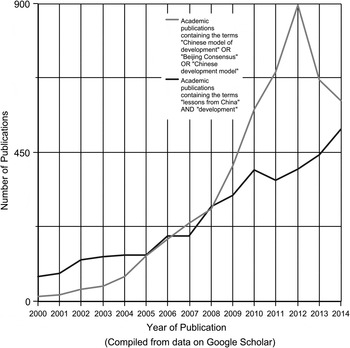
Given these shortcomings, it is not surprising that a meta-analysis of this body of literature seems to confirm sceptics' suspicions that the China Model debate is faddish and short-lived. As Figure 1 illustrates, academic writing on the subject rose sharply throughout the 2000s, peaked in 2011 and then began to decline. At the same time, the same figure suggests that there has been a more gradual – and continued – increase in the notion that a variety of discrete and isolated lessons can be drawn from China in a broad range of sectors related to development.
Trends in the literature on emulation of China

This article shares sceptics' concerns about the term ‘Beijing Consensus’. It is the more polarising of the two concepts, containing within it a de facto assertion that China's approach to development is fundamentally different from that of the West. It is the preferred term both in the most positive account of the Chinese example (Ramo Reference Ramo2004) and the most negative (Halper Reference Halper2010), leading Chinese scholars in particular to view it as overly combative and divisive (Kennedy Reference Kennedy2010: 473). Finally, the phrase is often used in a way that elicits considerable confusion: analysts frequently use it also to refer to China's mode of engagement with Africa and the developing world, particularly as this contrasts with the approach of traditional donors (e.g. McKinnon Reference McKinnon2010).
Such reservations need not necessarily apply to the China Model, however. If, in line with a constructivist approach, models are defined as ‘mental schemata by which policymakers necessarily simplify and abstract reality in order to transfer aspects of this reality to a foreign setting’ (Fourie Reference Fourie2014), a polity becomes a model when others perceive it as such. No intrinsic coherence, merit or uniqueness is therefore required – what is important is the extent to which decision-makers elsewhere genuinely wish to apply aspects of the polity's perceived broad developmental trajectory to their own domestic policy settings.
A constructivist approach that focuses on the mental frameworks of those tasked with influencing and formulating developmental policy has a number of compelling logics for those wishing to understand the wider impact of a putative China Model. Firstly, it grounds the spate of recent speculation in the broader theoretical literature on lesson-drawing and emulation. The former term is often used in political science to denote a process that is both purposive and voluntary – as opposed to ‘policy diffusion’ that may be the result of impersonal structural forces (Bennett Reference Bennett1991: 221) and ‘policy transfer’ that may stem from adherence to externally imposed conditionalities (Dolowitz & Marsh Reference Dolowitz and Marsh1996: 344). The latter term is more commonly found in sociological analyses that have explored the myriad ways in which elites have used certain modern nations as ‘reference societies’ (Bendix Reference Bendix1980: 292) in the articulation and formulation of national identities (Greenfeld Reference Greenfeld1993), and in the spread of modern institutions such as the nation-state. Westney (Reference Westney1987: 7), for example, has notably used the concept of ‘cross-societal emulation’ – ‘the purposeful observation and incorporation of elements of societal and cultural organization from other cultures and societies into a particular culture’ – to illustrate Meiji Japan's selective incorporation of modern patterns of organisation from three Western powers. Taken together, the two concepts may fruitfully be applied to illustrate the often-overlooked historical pedigree of ‘models’ such as those recently provided by China, as well as to assist scholars in understanding the factors that enable and constrain the reception of this model beyond its borders.
A reflexive approach that views ideational structures as important components of social reality suggests the use of a methodology that seeks to directly ascertain the receptivity towards a Chinese Model of those tasked with influencing and formulating policy in other developing countries. In drawing on 46 semi-structured, qualitative interviews conducted among governmental and non-governmental elites in one such country – Ethiopia – this paper wishes to begin to remedy the second key weakness of the recent literature on the Chinese exemplar, namely its anecdotal nature. Written discourses, in the form of party literature and official documents, were also used to supplement and triangulate findings.
Despite an increasing awareness that emulation is thus the norm rather than the exception, the phenomenon remains understudied. Although outright imitation is very rare and lesson-drawing thus almost always involves selectivity and innovation, emulation remains somewhat stigmatised and carries connotations of weakness and intellectual piracy (Westney Reference Westney1987: 9). For this reason, elites are still at times reluctant to include overt references to foreign models in official documents and pronouncements lest they are seen as out of touch with the specificities of their own societies. At the same time, convergence of the policies or trajectories of several developing countries does not by itself demonstrate that emulation has taken place. This makes emulation a challenging area of study and renders causality difficult to establish. Yet the need for empirical data to replace anecdotal speculation or politicking on the issue of China's example should not outweigh the fear of the limitations such data is likely to have. My ideational and discursive focus led me to an understanding of Ethiopian elites' perceptions of the domesticability of the Chinese example rather than a list of micro-level policies derived from the Chinese example. This understanding, I argue, nonetheless shows what the Chinese Model looks like when it ‘lands’ in the minds and policy programmes of those who are ultimately at the centre of the China Model debate. As such, it salvages the concept from those sceptics who would see the term permanently retired, while demonstrating the need for caution among both those who cheer and those who fear the indelible influence of the Chinese example on development paradigms around the world.
THE MODEL IN PRACTICE: ETHIOPIA FROM 2005 TO 2012
The previous section has argued that researchers interested in understanding the ideational impact of the Chinese example would do well to focus on the ways in which policy elites in specific case studies conceive of this potential model and its transferability. Ethiopia is one case where China's post-reform development trajectory has indeed been influential in shaping policymakers' developmental goals and strategies. As the analysis below demonstrates, the final seven years of former Prime Minister Meles Zenawi's rule, in particular, were marked by a clear desire to draw broad lessons from China's success.Footnote 3
Ethiopia is not here meant to serve as a typical case for the rest of the developing world; the fact that my research reveals a key group of Ethiopian elites to have followed what may be termed a Chinese Model (albeit a modified and partial version of this model) does not thus imply that elites in other countries will necessarily be doing the same. Nevertheless, the Ethiopian case illuminates the forces that enable, shape and condition emulation of China in a country where this process is indeed taking place. Ethiopia can therefore tell us the following about what the Chinese Model actually looks like when it touches down in a foreign locale.
A. Prior historical affinities, modes of economic/political organisation and attitudes to emulation play a key role
Ethiopia's use of China as an example for its own development is deeply rooted in enabling historical factors. One such factor is Ethiopia's tradition of what Wehler (Reference Wehler1989: 343) has called ‘defensive modernisation’, which has long led the country's ruling elites to draw lessons from ‘front-runner’ countries in the hope of defusing political pressures from below and military defeat by more ‘modern’ foreign powers. Long before the rise to power of the Ethiopian People's Revolutionary Democratic Front (EPRDF), the coalition Meles headed from 1991 to 2012, modernisation and globalisation had been viewed as double-edged swords by the country's centralising emperors. In the 19th and early 20th centuries, in particular, a series of foreign incursions threatened the religious and political unity that leaders such as Tewodros II, Menelik II and Haile Selassie had sought to construct in extensive and hegemonic nation-building projects. Lacking the colonial history of its African neighbours, Ethiopia's elites sought to construct a modern nation state themselves – often with the help of invited experts from France, the UK and others (Uhlig Reference Uhlig2007: 121). The resulting institutions included a system of modern education, national banks, a bureaucracy, a permanent standing army and a formal constitution.
This emulation was not limited to Western models. Most notably, the ‘Japanisers’, a group of progressive intellectuals prominent particularly in the 1920s and early 1930s, urged the adoption of a ‘Japanese Model’ due to the speed with which Meiji Japan had been able to transform itself from a feudal to an industrial power (Bahru Reference Bahru2001; Clarke Reference Clarke2004). It was a prominent Japaniser, for example, who drafted the country's 1955 constitution, modelling it so closely on the Meiji Constitution of 1889 that numerous clauses found in the latter survived transition to the former more or less intact (Bahru Reference Bahru2001: 110). Haile Selassie himself expressed similar sentiments, provoking a visiting British Minister to remark that the Emperor's wishes to emulate Japan ‘however incredible it may seem to foreign observers – lead him to dream of Ethiopia as the Japan of Africa’ (Bahru Reference Bahru2001: 7).
Even Ethiopia's highly repressive Derg dictatorship, in place from 1974 to 1991, drew upon similar motivations. When Haile Selassie's attempts at statebuilding and modernisation were seen to fail the country, it was the Soviet model that stepped in to fill the breach – with disastrous consequences. Under the Derg's Marxist-Leninist inspired military junta, rural and urban land was nationalised, foreign firms were brought under national control, and much of the rural population was forcibly relocated into large, collectivised farms. As Christopher Clapham (Reference Clapham2006: 138) explains in his analysis of the Derg's emulation of Soviet Russia, ‘Ethiopia's development trajectory can correspondingly be seen as a series of attempts by ‘modernising’ Ethiopians to identify the mechanisms of developmental success of countries perceived as having some similarity to their own. The idea was to draw from these countries' experiences in order to recreate Ethiopia in the resulting image of modernity.'
In light of these historical processes, the desire of Meles and others in the EPRDF to emulate China is not unexpected. When the EPRDF ousted the Derg in 1991, it found itself at a critical juncture: the various rebel groups that comprised it had all been founded and run on communist principles, yet the ideology had now become unpopular both globally and within the country. One such group was the Tigrayan People's Liberation Front (TPLF), a movement stemming from student- and peasant-based guerrilla resistance to the Derg. The TPLF had itself been highly influenced by a foreign model, namely Enver Hozha's Albanian variant of communism that emphasised independence from both Soviet and Western ‘imperialism’. With Hoxhaism discredited both in its Albanian homeland and abroad, the TPLF had lost its ‘guiding light’ (Clapham Reference Clapham1992: 117).
The result of these upheavals was a period of relative ideological uncertainty in Ethiopia. The next fourteen years saw Meles (who himself hailed from the TPLF) partially accede to donor requests to institute political and economic reform while simultaneously increasing his control over the coalition and thereby cementing his personal dominance over the government. Central to these aims was a process of tedahiso (‘renewal’) launched in May 2001 to re-orient the EPRDF towards a (then still-unspecified) degree of economic and particularly political liberalisation. Exploiting the fissures that had begun to appear between his ‘reformist’ supporters and ideological ‘hardliners’ stemming from the party's dominant Tigrayan ethnic group, Meles accused his enemies of Bonepartism and had them expelled, denounced and (in several cases) imprisoned on charges of corruption. As Africa Confidential (2001: 5) reported at the time, ‘the third prong of attack is political liberalisation (such as it is), devolution and the federal experiment. Provided the kernel of power remains in Tigrayan hands, Meles supports a greater role for the regional state than do his critics'.
My interviews indicate that China was at this point already approached as a source of potential lessons, and indeed that sporadic attempts at emulation had begun as early as the mid-1990s. Yet despite Meles' ideological re-orientation of the EPRDF, Ethiopia in 2001 remained a country in flux: donor demands and geopolitical pressures competed with a variety of potential models for dominance and China had not yet begun to project itself as a model of development. There is little to suggest that Meles in 2001 viewed China as anything other than a lucrative future source of material and political support and as one of a number of non-Western countries that had managed to combine economic development with resistance to neoliberalism.
The reemergence of a clear programme of concerted lesson-drawing was therefore difficult to discern until 2005, when Ethiopia's most democratic elections to date ended in chaos and contestation. There is evidence to suggest that the government, shocked at the extent of its losses during the initial counting process, had attempted to manipulate the results in at least some areas of the country (Abbink Reference Abbink2006: 12). The violent crackdown on the opposition that followed led to the deaths of 193 protesters at the hands of security forces. In addition, 131 opposition politicians and other members of civil society were arrested and charged with treason, inciting violence and intention to commit genocide, although these prisoners were later pardoned following international pressure (Aalen & Tronvoll Reference Aalen and Tronvoll2009: 197).
The result of this fiasco, in the final phase of Meles' rule, was the implementation of a policy of gradual but noticeable economic liberalisation accompanied by rapid economic growth but an almost complete halt in measures to democratise the country. Economic growth in Ethiopia thus coincided with the EPRDF's consolidation of its hold on power and restriction of domestic dissent. As one international NGO summarises this disjuncture, although ‘many Ethiopians have benefited from the economic modernisation of the past eighteen years … democratic rhetoric has not been matched by democratic practice’ (ICG 2009: 1, 5).
My findings indicate that the events of 2005 prompted Meles and his fellow leaders in the EPRDF to look to a foreign model that would again allow the country to more cautiously navigate the demands of globalisation and liberalisation: processes that were seen as inevitable and perhaps even desirable, but also threatening and highly volatile. The belief that the electoral violence was a result of Ethiopia having tried to liberalise too much and too soon militated for a model that would allow the state to reap the rewards of the global market while remaining firmly in the hands of a strong and authoritarian ruling party. This model was China, the exemplar that elites within the EPRDF mentioned most frequently when asked whether there was any country whose overall development trajectory they wished their country to emulate:Footnote 4
We are twenty years behind China, and we're trying to do what they did to get where they are. Maybe twenty years from now, we'll be following where China is [then], and so on!Footnote 5
On an aggregate level … we place an emphasis on China.Footnote 6
We need a Cultural Revolution like China had.Footnote 7
In contrast, non-governmental elites in the media, the private sector and what remained in 2010 of Ethiopia's political opposition lacked a clear, coherent agenda on lesson-drawing; these interviewees cited instead a number of potential models, deferred to the government on the matter of emulation or eschewed the use of models altogether. Whereas all governmental elites answered broadly in the affirmative when asked whether China constituted an example of successful development, this was not true of those outside the government. In addition, many non-governmental elites viewed China as the government's main source of lessons, and this tendency was particularly pronounced in those elites most critical of the government:
Really, Meles wants the Chinese model because staying in power is his sole, ultimate goal … As far back as 1994, 1995, Meles sent a delegation to China, to look very closely at the way China is developing, and especially how to deal with diversity the Chinese way and how to effectively use democratic centralism … he sent the number two, number three [most senior] people to China.Footnote 8
Theorists of lesson-drawing have generally agreed that lesson-drawers are rarely the ‘rational shoppers’ (Westney Reference Westney1987) that they believe themselves to be, and that they instead use a number of cognitive or heuristic ‘short-cuts’ in selecting potential models (Jacoby Reference Jacoby2001: 24; Weyland Reference Weyland2006). The most commonly proposed shortcuts tend to centre around elites' exposure to a particular model, the prestige that is seen to accompany certain high-profile models, and models' perceived ease of use. A final set of shortcuts can be grouped together under the heading of historical, cultural and ‘social psychological’ similarity. The latter term originates from Rose (Reference Rose1993: 107), who uses it to explain the tendency of British policymakers to overlook Ireland and France as exemplars in favour of the US, Canada, Australia and other Anglo-Saxon countries.
In the case under discussion, potentially problematic geographic distances, language barriers and cultural differences did not appear to hamper the transfer of lessons. Prestige is more difficult to measure, and elements of this factor were certainly present in the discourse, as was made clear by Ethiopian planners' use of labels such as ‘middle-income status’ in national development strategies that they admitted to me were heavily influenced by the Chinese example.Footnote 9 Similarly, elites' increased levels of contact with China – facilitated by the study visits and intergovernmental ‘lesson-sharing’ initiatives that have become a central plank of China's engagement with many African countries – may indeed play a role. The majority of senior governmental interviewees had visited China, whereas most non-governmental employees had not. A senior representative from the Chinese Embassy in Addis Ababa estimated that the number of Ethiopian ministers who visit China annually doubled from 2000 to 2010, and viewed these exchanges as one of the most important mechanisms driving the ‘sharing’ of experiences.Footnote 10 It is difficult to know conclusively whether study visits directly improved elites' perceptions of a country, however, or whether the causality ran in the opposite direction – particularly as many of the most senior and powerful interviewees had played some role in initiating this contact themselves.
Instead, the factor that appeared to play the largest role in prompting the EPRDF's choice of model was that of historical and ‘social psychological’ similarity. Much of the discourse and policy of the Chinese Communist Party (CCP) and the EPRDF has remained steeped in the influence of Marxism. To name just a few examples, the EPRDF (2011: 5) openly admits to following the Leninist principle of ‘democratic centralism’; this is the ‘basic organizational principle and mode of operation’ of the CCP (PRC 2005) also. Both parties describe themselves as ‘vanguard’ parties (EPRDF 2006: 67; CPC 2007) that solve their internal differences through regular sessions of self-criticism, both came to power through rural-based revolutions, and both preside over mixed (but formerly socialist) economies. These past and present similarities stem from a shared history, and appear to facilitate the transfer of lessons from the more developed to the less developed of the two countries. The EPRDF also has strong historical party-to-party ties with the CCP that facilitates lesson-drawing on a track parallel to more conventional forms of state-to-state lesson-drawing.Footnote 11 It is not surprising, therefore, that the EPRDF's parliamentary whip in 2010 (currently the Prime Minister) cited strategies of maintaining party discipline as among the key lessons that could be drawn from China.Footnote 12
Ethiopia's communist legacy has also provided the EPRDF with a mode of governance that makes the drawing of lessons from China particularly likely. Since 1975, Ethiopia's smallest units of local government (and arguably its most important) have been its kebeles, peasant associations that comprise around 500 families. The high level of control that the tightly organised national network of EPRDF cadres exercise over kebele administrations is well documented, as is the suppression of rural dissent that these units – which have their own militias and prisons – are able to exercise (ICG 2009: 18; HRW 2010: 17–19). Access to basic services such as agricultural extension, education and health care is also funnelled through this intricate and extensive infrastructure, particularly in rural areas.
Meles occupied the pinnacle of this structure of governance in the decade before his death, when he was the ‘unchallenged intellectual and ideological guide of the party and the government’ (Medhane Tadesse & Young Reference Medhane and Young2003: 401). The ardour with which the most junior party cadres I met expressed their admiration for their party leader and his ideas spoke volumes about the extent to which he almost single-handedly drove party policy in 2010. This top-down approach to government made it possible for Meles to diffuse lessons drawn from a handful of key exemplars such as China to the lowest level of governance, and to mirror the statist modernism so often associated with the Chinese post-reform development trajectory. Whereas leaders in more pluralist political systems may be daunted by models seen to require a relatively strong level of centralised control, the EPRDF was able to embrace such a model in the years under discussion, speaking often of the boons of a one-party dominant political system and the centrality of political stability for development (Meles Reference Meles2006).
China is, of course, not the only country in which political stability and one-party dominance have been used to achieve developmentalist aims. Meles greatly admired East Asia's so-called ‘developmental states’ – polities ruled by the firm but business-friendly hand of an elite bureaucracy (Johnson Reference Johnson1982; Amsden Reference Amsden1992). Key documents authored by the former Prime Minister and used to train party cadres and senior leadership alike express a desire for Ethiopia to replicate the perceived successes of South Korea, Taiwan and Japan (EPRDF 2006; Meles Reference Meles2006). In a developmental state, state interventionism and investment-oriented economic policies combine to produce the ‘economic development, defined in terms of growth, productivity, and competitiveness, [that] constitutes the foremost and single-minded priority of state action’ (Onis Reference Onis1991: 111). The goals that stem from these priorities ‘are rendered concrete by comparison with external reference economies which provide the state elites with models for emulation’ (Onis Reference Onis1991: 111). It is not surprising, therefore, that interviewees often nested China's model within a broader project of East Asian modernisation, and viewed the country as a recent and prominent example of a broader regional phenomenon.
How are we to reconcile this latter finding with the assertion that China's feudal and communist past were uniquely inspirational to Ethiopian leaders such as Meles? Although these elites may indeed have viewed China as itself following a larger East Asian model, it is this country in particular with which lesson-sharing mechanisms have proliferated most rapidly. It is also this country that has demonstrated to elites the possibility of creating a capitalist developmental state from a feudal and communist past. As Ethiopia's current Prime Minister phrased it, ‘We can learn from China how a developmental state should act’.Footnote 13 The lessons that China is seen to offer in this regard are explored in Section C.
B. Even where China is viewed as a model, its lessons are selectively incorporated and perpetually in competition with other influences
If the Chinese experience exercised an influence over Ethiopian development strategies from 2005 to 2012, it was by no means the only factor to do so. By definition, emulation distinguishes itself from imitation or ‘copying’ by its selective nature. This selectivity is sometimes intentional and borne of policymakers' desires to adapt foreign lessons to local particularities. Rivera's (Reference Rivera2004) study of attitudes to emulation among Russian elites distinguished between ‘pure voluntarists’ (those who favoured a single regional or national model for emulation), ‘quasi-voluntarists’ (those who wished to draw from several or many models) and ‘traditionalists’ (those who largely eschewed the use of models). Traditionalists were virtually non-existent among the Ethiopian elites that I interviewed, but the former two categories were roughly equally represented among respondents. Even those who admired China were thus often careful to qualify their responses:
Like us, China was largely a feudal, peasant society, with a lot of ancient history and good leadership. But it is not a democracy.Footnote 14
On the developmental side, we look like the Chinese. On the democratic, we differ.Footnote 15
I would not like to imply that if we do everything that they did we would be like them. It's foolish, in my mind. You start where you are – you identify the specificities of your situation, the specificities of the change you want, and then you can learn from the experiences of other countries and other people. But you can't copy what other countries have done.Footnote 16
Elites inside (or sympathetic to) the government frequently emphasised the need to draw economic lessons from China whilst distancing themselves from the country's political situation. Given Ethiopia's own suppression of political pluralism – often directly drawn from Chinese strategies of technological surveillance of the internet and mobile telephony (Gagliardone Reference Gagliardone2014) – it is highly likely that this reported selectivity was vastly overstated for the purposes of external consumption.
This does not mean, however, that Ethiopian elites were able, or willing, to transfer every aspect of the Chinese trajectory – real or perceived – to their domestic situations. The Chinese Model must compete with alternative development paradigms and a range of material constraints. The domestic policy arena under Meles was so ideologically cohesive that the former constraint tended to emanate primarily from the ‘traditional’ donors from which Ethiopia received almost $2 billion in 2010 (OECD 2014). Governments also do not act on ideational considerations alone, with constraints such as corruption, self-interest and a lack of state capacity intervening in efforts to emulate foreign models.
The clearest example of both sets of constraints working to dilute the influence of the Chinese Model in Ethiopia can be found in the EPRDF's agricultural policy, and specifically in its decision to lease over one million hectares of land to foreign investors between 2005 and 2012 (Keeley et al. Reference Keeley, Seide, Eid and Kidewa2014: 1). This envisioned shift from smallholder agriculture towards large-scale export-based commercial agriculture is at odds with the EPRDF's longstanding policy of Agricultural-Development Led Industrialisation (ADLI), a strategy that has emphasised food security and the transfer of agricultural outputs into local industry (MoFED 1993), albeit with disappointing results. It is also at odds with the experiences of China (and other East Asian countries), whose export-led, manufacturing-oriented economies were all preceded by variations on a process whereby the labour and technical expertise created by agricultural extension and other rural reforms ‘spilled over’ into industrial development (Ravallion Reference Ravallion2008; Grabowski Reference Grabowski2009). There is considerable evidence that ADLI was in fact modelled on the East Asian experience: interviewees from the EPRDF frequently noted this, as does a key Japanese advisor to the Ethiopian government, who writes that the policy is largely inconsistent with the traditional political and economic conditionalities of the Western donors' and ‘shares more commonalities with … development strategies in East Asia’ (Ohno Reference Ohno2009: 4).
The fact that the EPRDF began to move away from such an approach in the period under consideration may indeed be partially due to the demands of donors, who had been particularly critical of its reliance on a land tenure system (all land is government-owned) that critics felt discouraged farmer investment in land improvement (e.g. IMF 1998). The EPRDF may itself have become disillusioned with the slow progress of its earlier smallholder-based model and desperate for foreign currency (Lavers Reference Lavers2012). The lack of transparency accompanying these deals has also led many to suspect that Meles' personal connections with key investors such as dual Saudi-Ethiopian citizen Mohammed Al-Amoudi have played a role (Lavers Reference Lavers2012; Pearce Reference Pearce2012: 16). Whatever the motivation behind this shift, it is clear that the Chinese example did not play a role. Even in countries like Ethiopia where elites clearly look to China for broad development lessons, circumstances invariably intervene to make this lesson-drawing incomplete and selective.
It should also be noted that China is far from the only player from the traditional Global South to intensify its economic and political ties with Ethiopia in recent years. Investors from Turkey and India, for example, have profited from these recent land acquisitions to a greater extent than have Chinese investors (Landmatrix.org 2015). With the entry of competing foreign powers into Ethiopia, Ethiopian elites have in the past decade had a wider range of models and influences to choose between than was previously the case. The China–Ethiopia story forms part of a broader ‘South-South' story, components of which both challenge and reinforce Ethiopian emulation of China.
C. The Chinese development trajectory can nonetheless be a potent influence for states seeking to negotiate the forces of globalisation and attain modernity
The abovementioned caveats notwithstanding, China has nevertheless provided policymakers in certain countries with a model of development that ostensibly allows them to steer and control processes of globalisation and liberalisation that they view as both threatening and inevitable. These processes began in Ethiopia when the global fall of communism after the Cold War coincided with the ousting of the Derg; they were then further implemented by Western donors and – to a certain extent – by the Prime Minister himself. At the same time, premature political liberalisation was viewed by the ruling elite as having led to the chaos of the 2005 elections, while premature economic liberalisation was blamed for having turned Ethiopia's neighbours into failed states (Meles Reference Meles2006). The gradual and piecemeal nature of Chinese reform, then, illustrates to countries like Meles' Ethiopia the necessity of retaining what Gallagher (Reference Gallagher2005) calls domestic ‘policy space’. To the EPRDF, the model provided a vivid illustration not just of the desirability, but also of the importance and the possibility of greater self-reliance:
The lesson and the motivation that I personally derive [from China] is that you can still build a national economy that is generally sovereign. This is the general lesson that I am taking.Footnote 17
You wouldn't say the Chinese accepted Western help. They were even blocked and condemned. I have said there are parts of the Chinese model I don't like, but what it tells me is the internal policies are the decisive ones. This is what I learnt.Footnote 18
Development is basically a local act.Footnote 19
In broad terms, the Chinese example thus encouraged elites to take an endogenous view of development. Those respondents who viewed China and other East Asian countries as models were most likely to blame Ethiopia's lack of development on domestic constraints such as a tradition of feudalism, and to emphasise freedom from foreign assistance as a long-term policy goal. This freedom, embodied in the minds of an older generation of TPLF fighters by Hoxha's Albania, was now embodied by the more pragmatic and globalist example of contemporary China. In more practical terms, this emulation has often served as justification and inspiration for policies of selective state intervention in the economy.
As in other areas of emulation, Ethiopia's strategy of state-guided industrial development has not stemmed from the Chinese example alone. The country's extensive industrial policy under Meles included the creation of an export steering committee and government-allied economic research council along South Korean lines, as well as the introduction of the Japanese concept of Kaizen. An extensive and very high-level programme of dialogue between the Japan International Cooperation Agency (JICA) and the top EPDRF leadership was created at the request of Meles Zenawi in 2008 with the express purpose of learning from East Asian experiences of industrial development.Footnote 20 The discourse of interviewees nevertheless accorded a key role to China, as the most recent country – and the country most similar to ‘feudal’ Ethiopia itself – to have achieved state-guided but business-friendly industrialisation within a ‘neoliberal’ global order.
Many other aspects of Ethiopia's lesson-drawing from China overlap with the literature on ‘latecomer’ emulation of more modern ‘reference societies’, as theorised by economic historians such as Gerschenkron (Reference Gerschenkron1962) and sociologists such as Bendix (Reference Bendix1980). Thus one key lesson that Meles and his policymakers drew from China's experience was the notion that development occurred in a series of discrete stages that could nevertheless be expedited through the actions of a visionary and skilful leadership. These stages occurred along a single, irreversible trajectory from the traditional to the modern; it thus made sense to emulate those countries that had recently occupied a similar stage of development. A metaphor derived from athletics was often used, and development conceived of as a competition or a race. When asked why he mentioned China as an exemplar, the Deputy Whip of the Ethiopian House of People's Representatives explained that ‘Of course it would be nice to be like the UK or US one day, but we have to be like a marathon runner. We need to focus on achievable goals first.’Footnote 21 Accordingly, critiques towards Western development interventions tended to stress the West's own modernist history rather than argue for an alternative, pluralistic vision of development. Bismark's GermanyFootnote 22 and ‘the early days of the West’Footnote 23 were mentioned more frequently as models than were contemporary Germany, Europe or the US. According to Bereket Simon, one of Meles' most senior advisors:
Western countries which have developed for 300 or 400 years have reached a very high stage. We're not aiming to reach that stage. Those that have transformed their countries in the last 30, 40, 50 years are nearer to us than those that have transformed their countries hundreds of years before.Footnote 24
Aside from what may be termed these foundational repercussions of China's example, the use of this particular country as a template of modernity has several more specific consequences for Ethiopia. One is the enormous emphasis placed on projects of physical infrastructure. The GTP articulated the EPRDF's goal to grow the national road network from 49,000 to 136,000 kilometres by 2015 (MoFED 2010: 17), and a number of very large hydro-electric dams began to transform Ethiopia's rivers in the mid-2000s. Government elites were firm in attributing China's success to the prioritisation of this sector:
Without infrastructure you can do nothing. They just gave priority to infrastructural development.Footnote 25
I also saw fast growth [on a visit to China] – they concentrated on the development of basic infrastructure, which is a prerequisite for development.Footnote 26
There is evidence that the visibility of Chinese construction – exemplified both by the presence of Chinese labourers and the rapid appearance of new roads funded or built by China – directly contributes towards this lesson-drawing, with China's economic engagement in Ethiopia coalescing with the less tangible ideas such engagement brings to the country. These projects also contain a large element of what Baruah (Reference Baruah2006: 62), in reference to China, has called ‘developmental monumentalism’, whereby infrastructure serves symbolic as well as practical reasons.
Dams are a particularly potent symbol of modernity. Highly visible, large-scale attempts to harness technology and mobilise natural resources, they bring about industrialisation and control over the natural environment, but also have high social costs, at least initially. The construction of projects such as Ethiopia's ‘Grand Ethiopian Renaissance Dam’ and the Gibe III dam have been accompanied by many of the same discourses and issues that accompanied the building of China's Three Gorges Dam a decade previously. Accusations from Western NGOs that Gibe III would disrupt the livelihoods of up to a million Ethiopians (Sharife Reference Sharife2010) were rebuffed by the EPRDF's claims that such critics wanted Ethiopians to remain ‘undeveloped and backward to serve their tourists as a museum’ (Meles quoted in Moszynski Reference Moszynski2011) and that such projects would ‘enable Ethiopia to erect heavy industrial plants such as steel mills and iron smelting factories, enabling it to become an industrial giant of East Africa’ (Shumay Reference Shumay2011).
A further consequence of Ethiopia's use of China as a model of modernity is the desire for double-digit economic growth that would allow the country to reach ‘middle-income status’ and to ‘catch-up’ as rapidly as possible. Indeed, the academic literature has posited that ‘catch-up growth’, whereby countries use technology transfer to achieve a level of rapid growth that comes to rival the originator of the technology, is primarily achieved through the mechanisms of emulation and lesson-drawing (Ozawa Reference Ozawa2005: 8). In Meles' Ethiopia, this prioritisation manifested itself most visibly in the country's ambitious short- and medium-term development plans. The Plan for Accelerated and Sustained Development to End Poverty (PASDEP) made ‘a massive push to accelerate growth’ the second of its central pillars, and aimed to achieve an annual average of seven to ten per cent growth in real GDP from 2006 to 2010 (MoFED 2006: 165, 63). Its even more optimistic successor, the Growth and Transformation Plan, aimed to double the country's gross domestic product from 2010 to 2015 (MoFED 2010). Several policymakers admitted that their priorities had shifted from redistribution to capital accumulation. According to Bereket,
Twenty years ago, I was of the opinion that we were going to build a system whereby priority is given to distribution, and we were more inclined to see distribution as justice taking place. Over time, we came to the conclusion that the first thing was to ensure rapid economic development.Footnote 27
The belief that technology transfer is indispensible in bringing about ‘catch-up growth’ underpins the immense attention given to the development and implementation of Ethiopian Technological and Vocational Education and Training (TVET) and Agricultural TVET programmes. Each has had substantial input from Chinese technical experts; the former brought 190 Chinese trainers to Ethiopia from 2001–2011, while the latter saw the influx of 290 trainers in a comparable timeframe (King Reference King2011: 101). China's role in this regard is virtually unparalleled, particularly ‘at a time when many Western donors have moved away from a reliance on technical experts’ (King Reference King2011: 101). Ethiopia's decision in 2009 to build thirteen new public universities that would focus on TVET and its goal for 70 per cent of students to graduate with degrees in science and technology illustrate the technological optimism underpinning the country's vision of development. According to the Minister of Water and Energy, then, scientific progress is ‘the single most versatile solution to Africa's development challenges’ (Alemayehu Tegenu Reference Alemayehu2010).
A challenging and controversial question concerns the extent to which the emulation of China affected the EPRDF's thinking on political governance under Meles, particularly given the importance that both advocates and critics of the China model accord to the model's departure from liberal democratic principles. The EPRDF is highly sensitive to accusations of authoritarianism, and retributions from the party leadership can be severely punitive for recalcitrant members and non-members alike. While it is thus particularly difficult for an interview methodology to uncover the precise extent to which political repression in Ethiopia was directly drawn from the Chinese example, more limited political lessons did nevertheless emerge. One was the notion of what Zhao (Reference Zhao2010: 435) and others writing on the Chinese Model have termed ‘performance legitimacy’, whereby citizens have been content to sacrifice claims for political freedoms in exchange for material increases in their living standards and evidence of an overarching governmental developmentalist agenda. ‘Of course [the Chinese] lost some part of their rights, but there has not been a big complaint’, according to Bereket, ‘so … as [long as] there is good governance, and as [long as] that state is a developmental state, for me that is possible’.Footnote 28 A closely related political lesson taken from China concerned the belief that development required a single, strong ruling party to preside over a lengthy nation-building project. Time and again, the need to ensure stability and avoid the fractious nature of liberal representative democracy was emphasised in the discourse of the ruling party. ‘We do democracy’, noted one senior bureaucrat, ‘but not anarchism’.Footnote 29
These political lessons from China constitute subtle reorientations in emphasis and self-understanding rather than entirely new societal programmes. As has already been noted, the EPRDF's methods of rural control and democratic centralism stem from its history as a Marxist-Leninist guerrilla movement rather than from any recent foreign influences. The EPRDF's understanding of the term ‘democracy’ has shifted and evolved throughout the party's tenure in government (see Tronvoll Reference Tronvoll, Tronvoll and Hagman2012), but has never resembled what might reasonably be termed liberal democracy by outside observers. Nevertheless, the post-2005 period was notable for the emphasis that Meles and other EPRDF leaders accorded to performance legitimacy and single party dominance. Unmoored from its revolutionary roots as a tool of mass mobilisation (Tronvoll Reference Tronvoll, Tronvoll and Hagman2012), democracy became a distant goal to be subordinated to considerations of stability and economic growth. The example of China, a country where ‘everyone, instead of politics, actually concentrates on development'Footnote 30 was now viewed as vastly preferable to the model, promoted by Western donors, that had forced Ethiopia to liberalise too soon.
Despite the clear message it sent to donors, this discursive shift should not be viewed as entirely mercenary. To be sure, it was often couched in language clearly meant for Western consumption, hence Meles' (2006) assertion that ‘the so-called dominant party democracies’ such as Japan and certain Scandinavian countries (rather than China or other authoritarian states) could ‘point to one way out' of underdevelopment. Behind such rhetorical devices, however, lay exemplars that elites knew would be less palatable to donors. Thus the strong party-to-party links between the EPRDF and the CCP were mentioned more frequently in interviews than in official documents, including by a representative from the Chinese embassy in Addis Ababa, who stated that the two parties often exchanged lessons on ‘nation-building, on economic development, on how to push forward a national strategy’.Footnote 31 The EPRDF's emphasis on consensus and national mobilisation is thus not a new phenomenon. It is in its use for the purposes of economic growth within a global capitalist system, however, that this lesson's particularities were more recent, and inspired by China.
Meles' desire to avoid numerous written references to the Chinese example also lends credence to the notion that the EPRDF's invocation of the China model – when it did occur – was more than a merely instrumental ex post facto justification of prior decisions. If the Chinese model acted to legitimise the EPRDF's authoritarianism in the eyes of Western critics, one would imagine more references to China in those official and party documents that instead emphasised classic developmental states such as Japan or South Korea. What interviews and the proliferation of China–Ethiopia study visits make clear, however, is that the Chinese model under Meles was more important than elites proclaimed publicly, not less. Certainly, this was the view of some of the EPRDF's most vehement critics:
[T]he political model is going to be that of the Chinese model – they don't say that, but that's what we see.Footnote 32
If you talk to our Prime Minister, he talks about the South Korean model, the Taiwan model, but he is copying China.Footnote 33
Ultimately, China's example provided the Meles regime with evidence that a move from communism to capitalism need not result in societal and political breakdown, as long as this transition is managed by a technocratic and pragmatic elite. In this sense, economic and political lessons cannot be separated but are in fact two sides of the same coin of modernisation.
In this regard, in few countries do unapologetically modernist discourses and policies hold sway to the extent that they do in China and Ethiopia. In the former, bodies such as the government-funded China Center for Modernization Research periodically rank each country (as well as each of China's regions) by the level of cultural, economic, political and social ‘progress’ each has attained (He Reference He2011). According to the most comprehensive English-language review of Chinese discourse on the subject (Wheeler Reference Wheeler2005: 18), in recent decades the ‘center of modernization theorizing has followed the center of the process itself … to China’. In the words of another observer, modernisation is ‘a meta-narrative informing common explanations and predictions of China's development trajectory’ to which ‘all aspects of human life … are commonly viewed as adjuncts’ (Barabantseva Reference Barabantseva2012). In Ethiopia, similarly, most interviewees viewed modernisation (however each wished to define it) as a positive development; this tendency was more pronounced among members of the EPRDF, and most pronounced of all among those who named China as a model. For the Director of the government's Environmental Protection Agency, ‘Modernisation is dealing with the industrial culture … and adapting to it’,Footnote 34 while for another elite ‘we have to be modern because we live in a globalised world and we have to compete … We become modernised through development’.Footnote 35 The common desire to modernise has thus become an overarching national project binding Ethiopian and Chinese ruling elites in a process of lesson-sharing and emulation.
CONCLUSION
In June 2010, Ethiopia's leading English-language newspaper, Addis Fortune, published an editorial entitled ‘EPRDF Aims for Chinese Model Legitimacy not Democracy’ (Addis Fortune 2010). In it, an unidentified commentator accused the ruling party of imitating the Chinese economic and political systems and of thereby deriving its legitimacy from material prosperity and nationalism rather than from democracy. The EPRDF's blistering rebuttal (MoFA 2010) fervently rejected accusations of authoritarianism, but did not directly refute the notion that it was indeed adopting broad lessons from China's development trajectory.
Analysis of interview and documentary sources illustrates that governmental elites have indeed wished to emulate China, and that this notion was so thoroughly disseminated from its origin in the personal ideology of Meles Zenawi downwards throughout the EPRDF structure that it could be said to constitute official party policy until Meles' death in 2012. This tendency was not true for elites in other sections of society, however, with the latter group both more critical of emulation, and more likely to choose from a wide range of exemplars. The Addis Fortune debate demonstrates the extent to which emulation of China has been one of the central pillars of ideological and political contestation in Ethiopia: under Meles, to admire China was to admire the EPRDF and its vision for the country's future.
As the case of Ethiopia illustrates, the notion of a Chinese Model for other developing countries cannot be dismissed as mere hype. As advocates and critics suggest, policymakers in certain countries do indeed wish to reproduce China's perceived ‘successes’ in their own polities, in the process borrowing not only isolated economic strategies but also broader socio-political attitudes and strategies of modernisation. This resonates with theories on cross-societal emulation and lesson-drawing – a literature that would enrich observations of China's ideational influence on the developing world but which has thus far been underutilised.
If empirical analysis helps us to understand what shape the Chinese Model takes when it ‘lands’ in a developing country, it also elucidates the limits of such a model. It demonstrates, for example, that the scepticism some have expressed in regard to a uniquely Chinese set of lessons is shared by emulating elites. In Ethiopia, China's neighbours in the region have also been important as exemplars. China's particularity is thus seen to lie in its historical trajectory – from feudalism, to communism, to authoritarian and gradual capitalism – rather than its uniquely developmental nature. The role of history is therefore crucial, both as regards prior attitudes to emulation in the ‘recipient’ country and as concerns the perception that the ‘model’ country occupies a similar social-psychological space. Countries seen as occupying a comparable or slightly higher level of development are preferred. In Ethiopia, a country slowly emerging from a history of communism and isolationism, a strong and ideologically unified ruling party therefore looked to the Chinese example for strategies on combining statist and modernist interventions with a graduated transition to globalisation and reform. Elites in other developing countries may well seek to do likewise, but it should not be assumed that such an approach will be equally popular in countries with radically different economic and political legacies.
The above findings suggest that is premature to jettison the notion of the China Model entirely, and that it retains utility when embedded in a broader regional and historical context. The history of global modernity is inseparable from processes of emulation and selective incorporation, and that history is still being lived today. Thus viewed, the current debate on the China Model may survive the fractious debate between its advocates, opponents and sceptics, and thereby attain both depth and nuance.