1 IntroductionFootnote 1
Examples of -ity and -ness derivatives that the Oxford English Dictionary (OED) records as twentieth-century neologisms are provided in (1).Footnote 2
(1)

Two empirical facts have posed a challenge to researchers. The first concerns the contemporary distribution of the two nominalisers in Modern English, which is neither complementary nor fully random. For example, both -ity and -ness are found to attach to morphologically simplex adjectival bases and to bases ending in Latinate suffixes (e.g. connectable ◆ connectabil-ity, accept-able ◆ acceptable-ness). By contrast, only -ness combines with adjectival bases ending in Germanic suffixes (e.g. exciting ◆ exciting-ness). It thus seems that -ness is less restrictive than -ity in the sense that it can attach to more different bases. In most descriptions of English word-formation this is interpreted as a difference in productivity between the two suffixes. Intriguingly, however, it has also often been noted that for some bases to which both -ity and -ness can attach in principle, -ity constitutes the preferred option (e.g. Anshen & Aronoff Reference Anshen and Aronoff1981; Romaine Reference Romaine1983; Lindsay Reference Lindsay2012), and it is as yet unclear how this is compatible with the above observation. Nor is it clear empirically which types of bases indeed show a preference towards -ity. An uncontroversial case is the behaviour of adjectival bases ending in -able in contemporary English, for which it has been shown in both experimental and corpus-based studies that speakers clearly prefer -ity as a nominalising suffix (Anshen & Aronoff Reference Anshen and Aronoff1981; Romaine Reference Romaine1983; Lindsay Reference Lindsay2012). For other bases the situation is less clear.
The second empirical fact that has attracted attention in the literature concerns the diachronic development of the two nominalising suffixes. Etymologically, the pair constitute a showpiece example of the stratification of English derivational morphology. -ness is a Germanic suffix, which has been productive in English since Old English times. -ity, by contrast, is a Romance suffix, which entered the English language during the Middle English period (about the fourteenth century; see Riddle Reference Riddle and Fisiak1985: 451). Both suffixes have been used productively in English since then (see esp. Riddle Reference Riddle and Fisiak1985). The central question that emerges, then, is how productivity of -ity evolved, and how the development of -ity's productivity diachronically affected that of its rival -ness. Here recent research has worked under the assumption that one driving force in the development of rival affixes is synonymy avoidance. On the basis that -ity and -ness can indeed be synonymous in English (see Riddle Reference Riddle and Fisiak1985; Bauer et al. Reference Bauer, Lieber and Plag2013: ch. 12; Baeskow Reference Baeskow2012 for evidence for tendencies of semantic differentiation), Mark Lindsay (Reference Lindsay2012; Lindsay & Aronoff forthcoming) has recently proposed an interesting model which incorporates formal, morphological properties of potential bases into a model of the development of the rivalry (see section 2.2 below for detailed discussion). The model's historical focus is on Middle English, in which period Lindsay considers the massive influx of loanwords ending in -ity to be the major trigger of the development. For later periods in history, however, it is empirically unclear how the rivalry developed. Furthermore, the model proposed by Lindsay is vague about what the predictions would be for such later stages.
Based on the two empirical challenges outlined above, rivalry between -ity and -ness provides an interesting testing ground for current theories of productive word-formation. Whereas some theories in the generative tradition have worked from the assumption that productivity of a morphological process is inversely correlated with lexical listedness (for pertinent claims about -ity and -ness see e.g. Aronoff Reference Aronoff1976; Embick & Marantz Reference Embick and Marantz2008), many recent approaches have incorporated a lexical mechanism that generates word-formation patterns that are to some extent productive (often termed an associative component; see e.g. Anshen & Aronoff Reference Anshen and Aronoff1988, Reference Anshen and Aronoff1999; Bermúdez-Otero & McMahon Reference Bermúdez-Otero, McMahon, Aarts and McMahon2006; Bermúdez-Otero Reference Bermúdez-Otero and Trommer2012 for pertinent claims about -ity). In both strands of theories, -ity is expected to be less productive than -ness. The fact, however, that -ity is preferred to -ness in certain domains does not emerge in a straightforward way. Nor do these theories say much about diachronic change in the relative distribution of the two rival suffixes.
One class of theories that seems to be particularly suited to doing just that (i.e. predicting more fine-grained productivity differences and predicting diachronic change) is found in analogy-based theories of word-formation. Such theories assume that affix selection happens online based on pertinent distributions in the mental lexicon. Variants are exemplar-based or analogical theories as proposed, for example, in Derwing & Skousen (Reference Derwing, Skousen, Booij and van Marle1989), Skousen (Reference Skousen1989et seq.) or Daelemans et al. (Reference Daelemans and van denBosch2005et seq.). Crucially, such theories do not embrace a stratal distinction between a rule-based and an associative component of grammars. Furthermore, they are based on the assumption that derived words are available as stored instances in the lexicon. This type of approach has not been tested on -ity and -ness rivalry. However, there is quite an extensive body of research that shows that such models are capable of predicting different productivity profiles of rivals or allomorphs. Much of the literature has concentrated on English past-tense formation (see esp. Eddington Reference Eddington2000; Keuleers Reference Keuleers2008; Chandler Reference Chandler2010 for recent contributions), but there is also a growing body of literature concerned with phenomena in word-formation (see e.g. Chapman & Skousen Reference Chapman and Skousen2005; Eddington Reference Eddington, Wiebe, Libben, Priestly, Smyth and Wang2006; Arndt-Lappe & Bell Reference Arndt-Lappe and Bell2014). Furthermore, as Chapman & Skousen (Reference Chapman and Skousen2005) have convincingly shown for negative prefixation in English, an analogical approach is also capable of modelling diachronic dynamics in affix rivalry. However, the exact details about what exactly is the basis for the prediction of change still remain somewhat opaque.
The model proposed by Lindsay (Reference Lindsay2012) and Lindsay & Aronoff (forthcoming) is difficult to place among the groups of models outlined above. The reason is that pertinent texts are vague about what mechanism they exactly assume to be operative. Thus, Lindsay suggests that the synchronic productivity of -ity in specific morphological classes is an effect of principles that can be likened to those of natural selection in biology. Due to a perturbation of the system that was caused by the massive influx of Romance words ending in -ity in late Middle English, -ity was able to become productive in niches. Apart from the metaphor of natural selection, however, it is unclear what mechanism decides on which affix is selected and, in particular, which mechanism is responsible for the retreat of -ness in certain domains. A potential role of exemplars is indeed mentioned in the text (e.g. Lindsay Reference Lindsay2012: 192, 196; Lindsay & Aronoff forthcoming: sections 1.1, 1.2), but the theory is not spelled out.
The present article has two aims, one empirical and one theoretical. Empirically, the article seeks to contribute to a better understanding of both the contemporary and the diachronic division of labour between -ity and -ness. I will present a quantitative analysis of the distribution of -ity and -ness among neologisms found in the Oxford English Dictionary, focusing on issues concerning both the productivity and the historical development of the two nominalisers. For productivity, the study will look at all pertinent twentieth-century neologisms. Results largely confirm the findings of Lindsay's recent corpus-based analysis, but suggest that -ity preference with certain bases seems even more widespread than documented in Lindsay's study. To assess diachronic development, the study will look at neologisms in the three centuries leading up to the present day (the eighteenth, nineteenth and twentieth centuries). The analysis will thus complement earlier research, which has mainly focused on Middle English as a crucial period. It will be shown that the development that began with the introduction of -ity in Middle English exhibits an ongoing dynamics also in later periods. Specifically, we observe a consistent diachronic extension of -ity usage into domains that have hitherto been dominated by -ness.
The theoretical aim of the article is to explore in how far -ity/-ness rivalry can be accounted for in an analogical model. Analogical modelling (AM) (Skousen & Stanford Reference Skousen and Stanford2007) will be used as a computational implementation to predict both the synchronic distribution of the two nominalisers and their diachronic development. We will see that, indeed, AM is able to successfully predict the distribution in all experiments, solely on the basis of the phonological makeup of the two base-final syllables and some rudimentary syntactic information. A detailed analysis of the model will be provided to see which predictions exactly are made concerning pertinent lexical distributions and mechanisms. With respect to productivity, we will see that the different productivity profiles of the two nominalisers emerge from differences in terms of the bases of pertinent analogies. -ity is assigned on the basis of more local analogies than -ness. This is fully in line with findings from work in analogical modelling of other morphological phenomena (discussed in detail esp. in Keuleers Reference Keuleers2008; Arndt-Lappe & Bell Reference Arndt-Lappe and Bell2014). With respect to diachronic development, the model predicts that two aspects are especially relevant for change. These are the (relative) locality of the generalisation and the probabilistic nature of the prediction. Whereas overall the model makes good predictions for the diachronic data, it remains a task for future research to test whether these predictions are borne out.
The article is structured as follows: section 2 will review current approaches to -ity and -ness rivalry, focusing on problems of productivity and diachronic development. Section 3 will then provide a quantitative analysis of the OED data in light of the issues raised in section 2. Sections 4 and 5 will be concerned with the theoretical proposal: the analogical model will be introduced in section 4; section 5 will present the results of the simulation studies with the OED data. The article ends with a concluding section (section 6).
2 Current approaches to -ity/-ness rivalry
2.1 Synchronic accounts: degrees of productivity
The productivity of an affix is taken to mean here, in a very general sense, the likelihood that new words are coined with that affix. Scholars generally agree that -ity and -ness are both productive in contemporary English. At the same time, however, it is often pointed out that there is a productivity difference between them, with -ness being the more productive nominaliser overall. Several issues, some of which are theory-dependent, bear on the question how productivity of -ity and -ness is assessed in the literature.
Thus, in stratum-based generative theories, lower productivity of -ity is expected given its stratal affiliation (esp. Kiparsky Reference Kiparsky, van der Hulst and Smith1982a, Reference Kiparsky and Yang1982b; Giegerich Reference Giegerich1999). -ity is a class 1 suffix, -ness is a class 2 suffix. This is evidenced not only by differences in productivity, but also by a variety of morphophonological alternations that are found with -ity, but not with -ness. A common segmental alternation is velar softening (Chomsky & Halle Reference Chomsky and Halle1968), where base-final [k] alternates with [s] in the derivative as in the pair electri[k] ◆ elektri[s]ity and opa[k] ◆ opa[s]ity). On the prosodic level, -ity suffixation causes stress shift to the antepenultimate syllable of the derivative (see Liberman & Prince Reference Liberman and Prince1977; Hayes Reference Hayes1982). Examples are pairs like nordícity and nórdic or prescriptívity and prescríptive. Another metrical effect is trisyllabic laxing (Chomsky & Halle Reference Chomsky and Halle1968), an optional process where base-final tense vowels are changed into lax vowels (as in ser[iː]ne ◆ ser[e]nity vs ob[iː]se ◆ ob[iː]sity; see e.g. Bauer et al. Reference Bauer, Lieber and Plag2013: ch. 9 for discussion of the optionality of the process).
A second issue that bears on productivity is that, in terms of the bases to which the two suffixes can attach, the distribution of -ity and -ness is semi-systematic. Discussions of this fact in the theoretical literature have almost exclusively focused on words derived from suffixed adjectival bases, for which it is commonly assumed that the morphological category of the base is relevant for the selection of the nominalising suffix. A systematic difference between -ity and -ness in this respect is that bases with Germanic suffixes exclusively take -ness, whereas bases with Latinate suffixes show variability between -ity or -ness. The context in which most pertinent discussion is found is the literature on affix ordering, modelled in terms of selectional restrictions (esp. Fabb Reference Fabb1988; Plag Reference Plag1996, Reference Plag1999) or lexical strata (esp. Kiparsky Reference Kiparsky, van der Hulst and Smith1982a, Reference Kiparsky and Yang1982b; Giegerich Reference Giegerich1999). Apart from the categorial, hence systematic distinction between Germanic and Latinate bases, however, the distribution of -ity and -ness is semi-systematic in the sense that, within the group of adjectival bases which allow -ity, there are preference patterns that seem to depend on the morphological category of the adjectival base. A seminal study to show this is Anshen & Aronoff's (Reference Anshen and Aronoff1981) experimental investigation of nominalisations based on adjectives ending in -able/-ible, where subjects in an acceptability judgement task consistently preferred -ity over -ness for such bases. For other adjectival classes, especially those ending in -ive and -ous, preferences are debated in the literature (see Romaine Reference Romaine1983; Anshen & Aronoff Reference Anshen and Aronoff1988, Reference Anshen and Aronoff1999; Baayen & Renouf Reference Baayen and Renouf1996). In a recent corpus-based study of rival pairs with -ity and -ness that is based on Estimated Total Hits (ETM) values in Google, Lindsay (Reference Lindsay2012) finds strong support for the non-uniform productivity of -ity and -ness. In particular, there is a sharp contrast between, on the one hand, a clear preference for -ness (reflected in higher ETM frequencies for pertinent -ness words) on a general level, and, on the other hand, a clear preference for -ity with certain types of bases. These types of bases have commonly been described in terms of morphological classes. These are adjectives ending in -able, -al, -ic and -ar. Lindsay refers to these bases as ‘niches’, in which -ity is productive.
Another factor that has been argued to influence productivity of -ity and -ness is the syntactic category of the base. Again the distribution is semi-systematic. Whereas both suffixes predominantly attach to adjectival bases, the literature also reports cases where the suffixes attach to other bases. This is particularly true for -ness, which may occur on nouns (e.g. appleness), phrases (e.g. at-homeness), or other categories (aboveness, alwaysness, there-ness; all examples are from Bauer et al. Reference Bauer, Lieber and Plag2013: ch. 12). -ity, by contrast, seems to be more selective in terms of the word class of the base. However, also -ity can occur with non-adjectival bases. A frequent type are bound bases (e.g. disparity, amenity), but the literature also documents cases of nominal bases (e.g. nerdity, scholarity, spherity, all examples are from Bauer et al. Reference Bauer, Lieber and Plag2013: ch. 12).
Finally, studies employing quantitative productivity measures have shown that, also in terms of established corpus-based productivity measures, -ness seems to be more productive than -ity. In particular, -ness is usually found to have a larger number of hapaxes in corpora than -ity (see esp. Baayen & Renouf Reference Baayen and Renouf1996; Plag Reference Plag, Aarts and McMahon2006). Note that this holds for an overall comparison of the two nominalisers, not for the cases of localised productivity outlined above.
In sum, the productivity profiles of the two rival suffixes -ity and -ness are interesting for an account of suffix competition. Thus, we see that -ity is productive, but in general more restricted than -ness. Moreover, however, -ity suffixation is subject to restrictions of different degrees. There are domains where it seems to be excluded categorically (such as adjectival bases ending in Germanic suffixes), domains where it is highly productive (such as adjectival bases ending in -able and bound bases) and domains where its productivity seems to be subject to negotiation with its competitor -ness. -ness, by contrast, is globally productive in the sense that, with the notable exception of bound bases, it is never excluded categorically, but can attach, in principle, to almost any eligible base. In their discussion of nominalising suffixes in English, Bauer et al. (Reference Bauer, Lieber and Plag2013) thus come to the conclusion that
-ness seems in effect to serve as a sort of default way of forming abstract nouns from non-verbal categories in contemporary English. (Bauer et al. 2013: 246)
In other domains where -ity is productive, however, productivity of -ness is restricted.
The literature on the productivity of -ity and -ness also raises questions that are important for a general understanding of the competition. These especially concern the empirical foundations. First of all, the discussion in the literature has largely concentrated on specific domains, whereas for other domains the situation is unclear. Some domains, such as unsuffixed adjectival bases and nominal bases, are hardly ever addressed in discussions of the rivalry. For other domains, preference patterns are debated. Whereas, for example, it is pretty uncontroversial that -ity is the predominant nominaliser for bases ending in -able, for other bases preference patterns are largely unclear.
A further problem is that the few empirical studies that are available are based on existing words. This holds for Lindsay's (Reference Lindsay2012) corpus study as well as Romaine's (Reference Romaine1983) experimental study. An obvious problem for this type of data is that, given that it is well known that outputs of derivation may be stored in the lexicon regardless of the degree of productivity of the suffix, it is difficult to control for the effect of established, lexicalised words.
Other questions concern the status of pertinent domains as morphological domains. In other words, the question is whether -ity or -ness selection is based on the morphological category of its base or whether it is based on purely formal aspects of the base. The former assumption is the one that is tacitly assumed to be true in most of the literature. However, at the same time there exists a large body of literature that shows that derivational affixation in general is subject to purely formal constraints or patterns. On the one hand, many selectional restrictions in affixation have been shown to be best captured in terms of output-oriented phonological constraints (see esp. Plag Reference Plag1999; Raffelsiefen Reference Raffelsiefen, Booij and van Marle1999; Zamma Reference Zamma2012 for English). This crucially also holds for effects which have traditionally been described with the help of morphological domains (see esp. Plag Reference Plag1999: 190ff. on stem truncation). On the other hand, it has been shown also outside the constraint-based literature that formal characteristics of bases often fully suffice to explain affix selection (see e.g. Chapman & Skousen Reference Chapman and Skousen2005; Eddington Reference Eddington, Wiebe, Libben, Priestly, Smyth and Wang2006; Lindsay & Aronoff forthcoming on -ic vs -ical Footnote 3 and -ize vs -ify). Often no reference to the meaning-based aspect of morphological categories is needed. For -ity and -ness, it seems at present impossible to say whether pertinent domains are best described in terms of morphological categories or in terms of only the form of the base. The reason is that evidence that would enable us to distinguish between these two types of domain is currently lacking. Such evidence would, for example, show that either of the two suffixes is or is not selected if the base formally resembles a morphological category but does not belong to that category. A potential piece of evidence in favour of a form-based view could be found in words like perspectivity (◆ perspective, n., OED, twentieth century). As will be shown in this article, -ity constitutes the preferred rival for bases ending in -ive among twentieth-century neologisms. In the base perspective, however, the string [iv] does not have a morphological status. Given the many unresolved issues about preference patterns for -ity and -ness (see above), however, it would be premature to draw conclusions from this one datum.
A final issue that has not been resolved yet is the question of the relevance of meaning-related factors. These can be semantic (see esp. Riddle Reference Riddle and Fisiak1985; Plag Reference Plag2003: 66–7; Baeskow Reference Baeskow2012) or related to pragmatic and register-related factors (see esp. Guz Reference Guz2009; Säily Reference Säily2011; Bauer et al. Reference Bauer, Lieber and Plag2013: 245ff.). With the exception of Säily's and Guz's corpus-based studies of gender and register influences, evidence for semantic or pragmatic differences between the two nominalisers has been based so far on isolated examples; systematic empirical studies are lacking. What has emerged from existing work is that differences are likely to exist in terms of pragmatic factors rather than in terms of denotation (see Bauer Reference Bauer, Lieber and Plag2013et al.: 257ff. for discussion).
2.2 The diachronic dimension
Research on the diachronic development of rivalry between -ity and -ness has so far largely concentrated on the effects of the introduction of -ity in the Middle English period and its successive establishment as a productive suffix. In particular, there is an ongoing debate about the role of loanwords, borrowings, calques and their morphological integration (see Dietz in press for a comprehensive recent summary that is not specific to -ity).
A recent approach that tries to account for the development is the one proposed by Lindsay and Aronoff (Lindsay Reference Lindsay2012; Lindsay & Aronoff forthcoming). On the basis of a series of recent empirical studies of derivational suffixes in English based on data from the OED, they argue that natural selection processes are an adequate metaphor to describe the development of Romance suffixes in English: After their introduction as parts of loanwords, such suffixes have occupied ‘niches’, which are defined in terms of potential bases, and their fate as productive or unproductive suffixes in the course of history depends on the availability of pertinent bases in the lexicon. For -ity, Lindsay proposes that the increase in its productivity was triggered by the influx of Romance loanwords in late Middle English, and his analysis seems to imply that the types of bases for which -ity suffixation became productive subsequently were those where such loanwords were particularly large in number so that speakers were able to generalise. One problem that this approach faces is to explain how -ness lost ground compared to -ity in the niches in which -ity became productive. The explanation suggested by the authors is the avoidance of synonymy, which they consider to be the ‘primary driving force behind competition in the lexicon of a language’ (Lindsay & Aronoff forthcoming: 2). The idea that type blocking is a pervasive mechanism in the English derivational system, however, is controversial (see e.g. Plag Reference Plag1999: 227ff.; Bauer et al. Reference Bauer, Lieber and Plag2013: 575ff. for detailed discussion of counterevidence).
A different approach is taken by Riddle (Reference Riddle and Fisiak1985). Contrary to Lindsay and Aronoff, she proposes that integration of -ity into the English morphological system involved semantic differentiation. In her view, the process was triggered by the high proportion of -ity words denoting (often abstract) entities that came with French and Latin loanwords in specific areas of language use (most notably religion). As a consequence, she argues, -ness lost its entity sense in many cases, for which -ity came to be the dominant marker. The development of the rivalry following Middle English is then interpreted as involving a process of lexical diffusion. Crucially, however, she assumes that the semantic difference is subtle, and that other, mostly sociolinguistic factors played a role as well. It is therefore not entirely clear how her view is compatible with the evidence cited in other publications that, synchronically, -ity and -ness derivative pairs are often synonymous (see esp. Bauer et al. Reference Bauer, Lieber and Plag2013: ch. 12). Furthermore, it is unclear how the semantic phenomena reported by Riddle are related to the niche behaviour of the productivity of -ity that is reported by Lindsay (Reference Lindsay2012).
Apart from the cited approaches that conceptualise the effects of -ity's integration into the morphological system of English, not much is known about the development of the division of labour between the two suffixes in the history of the language. This is particularly true for later periods, for which we find general remarks in the literature about the role of well-known sociological factors in lexical change, but where systematic empirical studies of -ity and -ness formation are scarce (an exception is Säily & Suomela's Reference Säily, Suomela, Renouf and Kehoe2009 study on gender influences in Early Modern English). An interesting period in this respect is the recent history of the language, specifically the period known as Late Modern English (eighteenth to early twentieth century; recent surveys can be found e.g. in Beal Reference Beal2004, Reference Beal, Bergs and Brinton2012; Tieken-Boon van Ostade Reference van Tieken-Boon Ostade2009). The chief reason is that Late Modern English is uncontroversially a period of large-scale lexical expansion and change (for an overview see e.g. Dossena Reference Dossena, Bergs and Brinton2012). It has often been claimed on general grounds that this has had consequences also for the development of the productivity of word-formation patterns, which especially affected Latinate affixes in the learned vocabulary. Systematic empirical studies which test this assumption, however, are lacking.
3 Synchronic productivity and its recent history: the OED data
In this section the issues discussed in the present article will be investigated on the basis of neologisms gathered from the OED for three centuries (the eighteenth, the nineteenth and the twentieth). The focus of the analysis will be on the twentieth-century situation, and the diachronic data will be used to analyse the emergence of that situation in the two earlier centuries.Footnote 4
The purpose of the analysis is to assess the empirical basis of the claims discussed in section 2 about differences between the productivity profiles of the two rival suffixes. In particular, the study will investigate how far major factors that have been used in the literature to describe differences between domains for -ity and -ness affixation are reflected in the pertinent relative distributions of -ity and -ness derivatives in the OED. These factors are (a) the syntactic category of the base, (b) the morphological category of adjectival bases and (c) the semantics. The analysis will be monovariate, comparing the proportions of -ity and -ness derivatives in the relevant subsets. The reason why only a monovariate analysis is conducted is that, as we will see, the morphological category of adjectival bases is the only parameter that produces a convincing split in the data. Syntactic category information, by contrast, is in these data only relevant in terms of a very basic distinction between bases that have word status and those that do not and are either bound forms or larger constructs. Semantic information, which can be coded here only in terms of a very rudimentary classification, does not seem to play a role. The analysis will pave the way for the analogical model to be described in section 4, which uses only formal aspects of the base and a basic word class specification as its information source.
The section is structured as follows. The extraction of data and the coding will be described in section 3.1. Section 3.2 will be concerned with productivity in the twentieth-century data; section 3.3 will deal with the Late Modern English data.
3.1 Data and coding
The database comprises the full set of -ity and -ness derivatives for which the OED records a date of first attestation between the eighteenth and the twentieth centuries. Data collection involved extraction of all headwords ending in the strings ‘ity’ and ‘ness’ (using the ‘Advanced Search Mode’ of the OED online editionFootnote 5) and the manual cleaning of pertinent lists. In the course of the latter procedure, an effort was made to remove all items for which it was not clear that they were transparent -ity/-ness derivatives at the time of their first attestation. In particular, this meant the exclusion of words which have entered the language as whole-word borrowings. This was assumed to be the case if (a) the OED lists a foreign word as the word's etymon, and if (b) the base of -ity/-ness suffixation is not attested in the OED earlier than the derivative. The total number of derivatives in the final data set is 2,771.
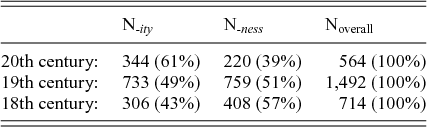
Table 1 provides an overview of the distribution of derivatives among centuries. Two things are particularly noteworthy. The first thing is the disproportionately high number of neologisms from the nineteenth century. The differences between the nineteenth century on the one hand and the eighteenth and twentieth centuries on the other hand are fully in line with the general distribution of first attestations in the OED, which can, for example, be examined on the OED Timelines page (www.oed.com/timelines, accessed on 18 June 2013). The second thing that is noteworthy about table 1 is that the type frequencies attested in the OED clearly do not reflect the greater general productivity of -ness as documented in the literature. Not only are -ity and -ness derivatives in general represented by quite similar type frequencies; there is even a consistent increase of -ity's share in the distribution from the eighteenth century onwards.
OED neologisms: general overview
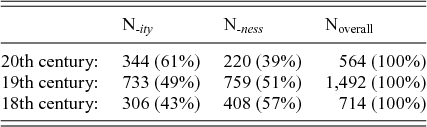
It is clear that type frequencies gleaned from dictionary data are not a very good measure of overall productivity (see e.g. Baayen & Renouf Reference Baayen and Renouf1996; see Plag Reference Plag1999: 98 for quantitative evidence that -ness words are not so likely to make it into a dictionary).Footnote 6 Nevertheless, the analysis to follow will show that the proportionate distribution of the two suffixes undergoes consistent changes over the three centuries under scrutiny. This will be interpreted as indicative of changes in the productivity profiles of the two suffixes.
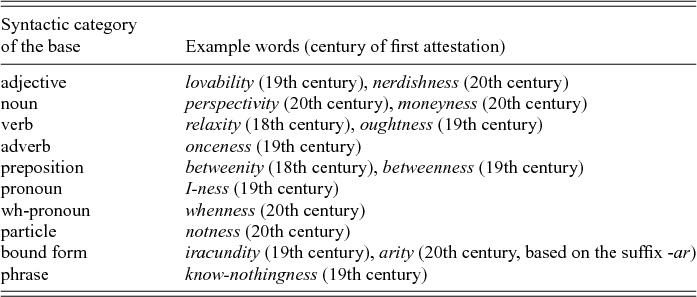
In order to test the claim that -ness is less restrictive than -ity in terms of the syntactic category of its bases, all data were coded manually for the syntactic category (word class) of the base. Pertinent categories were taken from the OED classification of the base of the -ity or -ness derivative, with the addition of two minor categories. These are ‘bound form’ and ‘phrase’. The category ‘bound form’ was used in cases in which, according to the OED, the base of the nominal derivative is not attested as an independent word in English. There are two types of bases where this is the case: the first type comprises bound roots as, for example, in the word iracundity. The second type comprises bases involving adjectival suffixes which only occur in the nominal derivative. An example is the word randomicity, where the base ?randomic (ending in the adjectival suffix -ic) is unattested.Footnote 7 The category ‘phrase’ comprises combinations of words that are not listed by the OED to be words of English. The list of coded syntactic categories is given in table 2.
Coding: syntactic category of the base

In order to investigate the influence of morphological category information on deadjectival formations, adjectival bases were coded for the pertinent adjectival suffix or, in cases in which there was no suffix, for its absence. The coding will henceforth be referred to as the ‘morphological category’ of the adjectival base. The definition of morphological complexity that underlies the coding was as generous as possible. A base was coded as containing an adjectival suffix if (a) its syntactic category is an adjective, and (b) the form of the suffix is known to be a common adjectival suffix in English. This meant, then, that roots could be bound (as, for example, in words like arable ◆ arability, comical ◆ comicality, didactic ◆ didacticity; cf. Bauer et al. Reference Bauer, Lieber and Plag2013: ch. 3.2 for discussion).
Finally, the data were broadly coded in terms of the transparency of their first attested meaning. The purpose of that coding was to test whether -ity and -ness can be used as synonyms in the sense that they both denote transparent properties. This is important in order to assess claims in the literature that avoidance of synonymy plays a role in the competition between the two nominalisers. This idea is a crucial aspect of the framework proposed by Lindsay & Aronoff (forthcoming) and Lindsay (Reference Lindsay2012), and an implication of the account by Riddle (Reference Riddle and Fisiak1985). ‘Transparency’ in the present analysis means that the derivative encodes a property or state derived from the meaning of the base word. Technically, the coding was done semi-automatically on the basis of the description of its first attested meaning in the OED (cf. Hay Reference Hay2001, Reference Hay2003, who uses a very similar methodology). If the meaning description contained the words ‘property’, ‘quality’, ‘state’ or ‘condition’, the derivative was coded as ‘clearly transparent’. In all other cases the transparency of the derivative was coded as ‘unclear’. Examples of meaning descriptions for the two values of the variable ‘transparency’ are given in (2). All data in (2) are twentieth-century neologisms.
(2)
Whereas we can safely assume that all data coded as ‘clearly transparent’ are indeed transparent in the above-described sense, it is clear that the group of items like those in (2b) constitutes a heterogeneous group with respect to their transparency. Quantitative analysis of these data can therefore only be used to compare the proportion of clearly transparent items among -ity and -ness neologisms. Crucially, however, they cannot be used to estimate the overall degree of transparency of each suffix.
3.2 Productivity of -ity and -ness in twentieth-century English
This section will investigate in how far the coded factors account for significant differences in the distribution of -ity and -ness. We will see that the distribution of the two nominalisers is fully complementary for some factors whereas other factors can be used to describe only relative preference patterns. Yet other factors turn out not to be convincingly supported by the data. In what follows each factor will be discussed in turn.
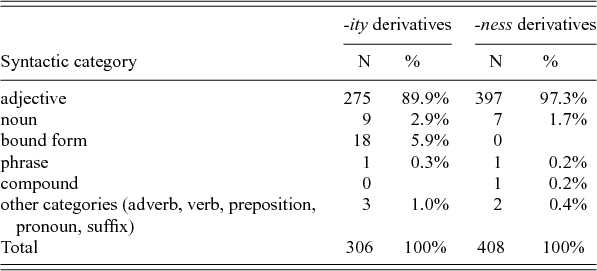
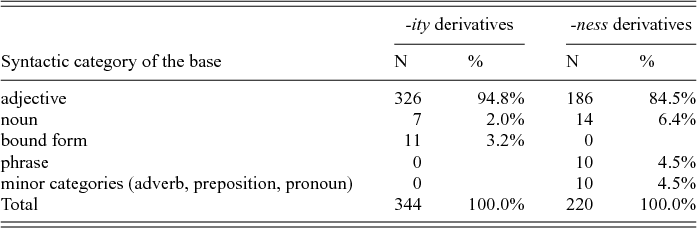
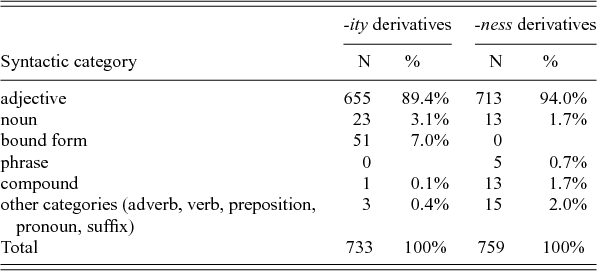
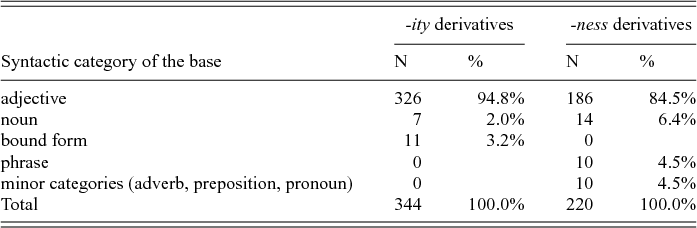
Table 3 provides an overview of the distribution in terms of the syntactic category of the bases. Due to the small number of occurrences, the syntactic categories ‘adverb’, ‘preposition’ and ‘pronoun’ are summarised as ‘minor categories’. The table shows that the distribution of -ity and -ness is complementary for bound and phrasal bases as well as the group labelled ‘minor catgories’. For nominal and adjectival bases we find both -ity and -ness words attested. As expected, both nominalisers occur predominantly with adjectival bases. Differences between the proportions of nominal bases among -ity and -ness derivatives are statistically significant (Yates’ χ2 = 5.858, df = 2, p < 0.05), but subject to the obvious caveat that pertinent numbers are rather small. Examples of -ity and -ness derivatives with non-adjectival bases are provided in (3) and (4).
(3)
(4)

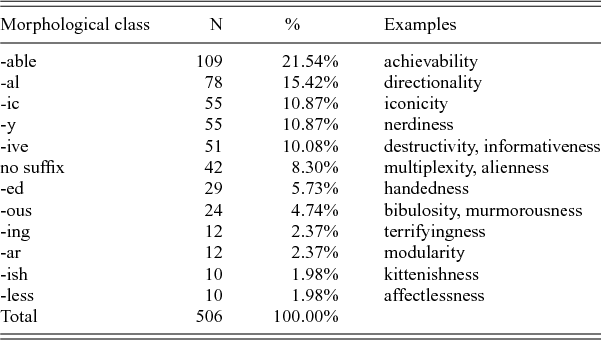
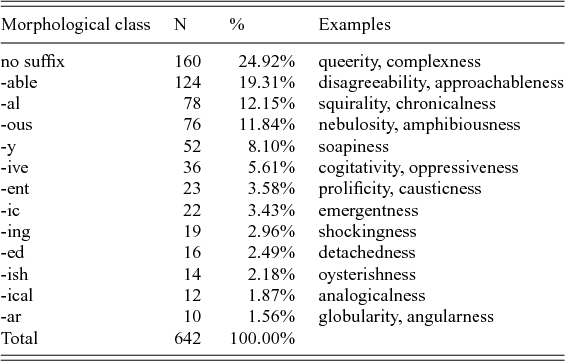
The focus of discussion will now be restricted to derivatives with adjectival bases, to test the claim frequently made in the literature that the choice between -ity and -ness is influenced by the morphological category of adjectival bases. Table 4 provides a first overview of how these morphological categories are represented in the database. Note that only those classes are listed which are represented by at least ten derivatives in the database (N = 545).
-ity/-ness derivatives by syntactic category of the base, twentieth century
Morphological classes of bases, twentieth century
The vast majority of bases (464 of 506 bases, i.e. 91.70%) contain adjectival suffixes. Furthermore, not all adjectival suffixes are equally well represented in the database, with -able clearly forming the largest group. Also note that Germanic affixes are not well represented – we only find -y and -ed in numbers that are somewhat substantial.Footnote 8
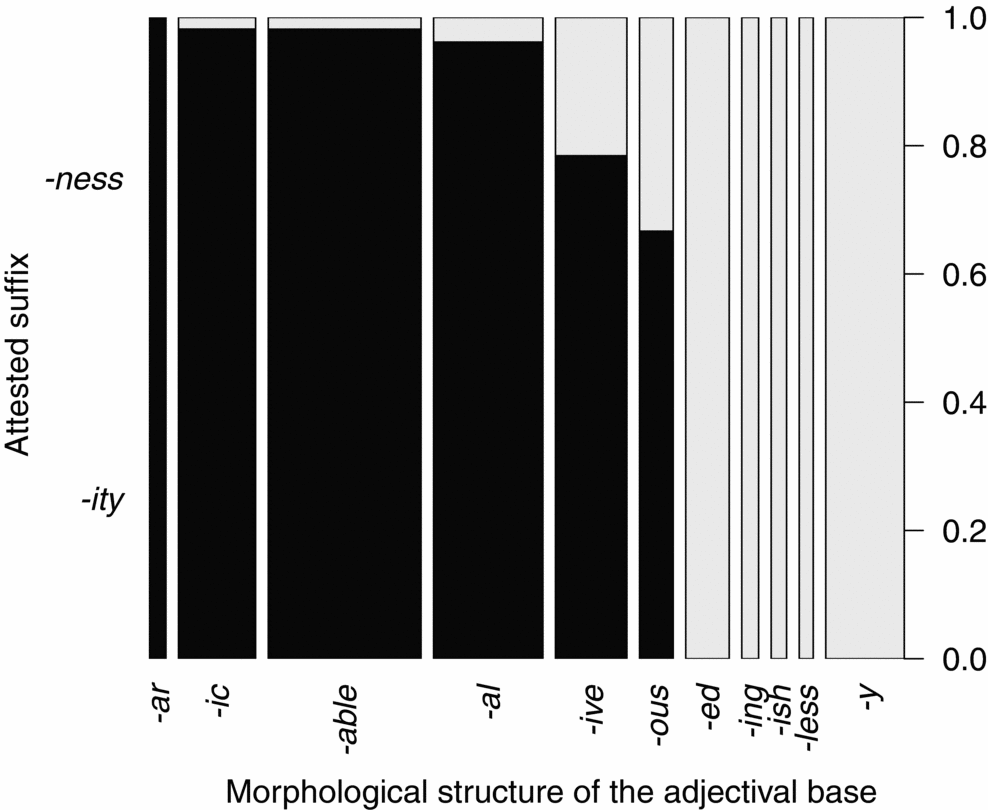
The mosaic plot in figure 1 shows how -ity and -ness are distributed for bases with an adjectival suffix. Again, only morphological categories with a minimum of ten attestations are taken into account. The bar plot represents the proportion of -ity and -ness derivatives as dark and light grey areas respectively, which are scaled to 100 per cent on the y-axis. Each bar corresponds to a morphological category (labelled on the x-axis), and the width of the bars is proportionate to the pertinent number of observations.
Twentieth century: attested distribution of -ity and -ness by morphological category of the base, N=445
As is to be expected, -ness is the only nominaliser that occurs on bases ending in -ed, -ing, -ish, -less and -y. With the exception perhaps of -ar bases, -ity never occurs categorically in any of the remaining classes. However, it is very strongly preferred to -ness with bases ending in -ic, -able and -al. -ity also clearly constitutes the most frequent nominaliser for adjectival bases ending in -ive and -ous. The very strong preference of -ity for bases with the above-mentioned suffixes provides a challenge to theories that explain rivalry between -ity and -ness in terms of overall differences in productivity. The -ity preferences found for some of the morphological categories in the OED data receive independent support from the findings of recent corpus-based work (Lindsay Reference Lindsay2012; Lindsay & Aronoff forthcoming), which has documented a clear -ity preference for the suffixes -al, -able and -ar on the basis of the distribution of token frequencies among rival word pairs.
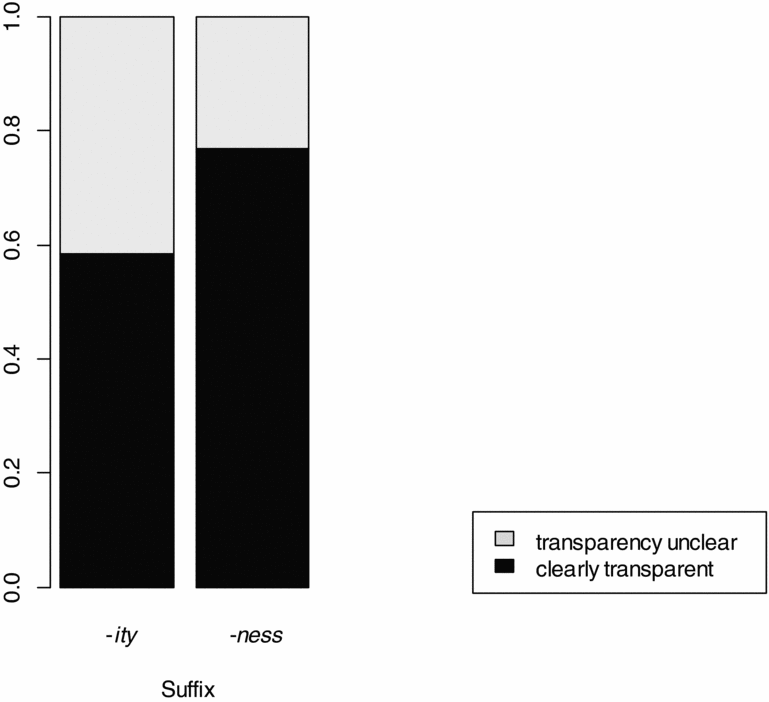
The final factor to be looked at in this section is the semantics. Figure 2 plots the proportion of clearly transparent items in the twentieth-century data set. The clear majority of both -ity and -ness derivatives in the data set denote a property or state derived from the base word (-ity: 58.5%, -ness: 76.8%). This shows that -ity and -ness are productively used as synonymous suffixes. The second observation is that the proportion of clearly transparent items is significantly higher for -ness than for -ity (Yates’ χ2 = 17.07, df = 1, p = 3.611e--05). This provides support for the view that there are differences between -ity and -ness which can broadly be characterised as semantic. What these differences might be, however, is still far from clear. Given the very crude and superficial coding of transparency here, it is a matter for future research to investigate in more detail the motivation of this difference.
Transparency of -ity and -ness derivatives, twentieth century (N = 564)
The following section will trace the development of the distribution of -ity and -ness in the twentieth-century neologisms by looking at the corresponding distributions of neologisms from the eighteenth and the nineteenth centuries.
3.3 Diachronic development, 1700‑2000
The main thing to be learned from a comparison of the variation between -ity and -ness neologisms found in the twentieth century with that in the eighteenth and nineteenth centuries is that the twentieth-century patterns constitute only one step in a consistent development that has taken place during the three centuries. This development seems to be form-based rather than meaning-based. In particular, it is most visible when we look at the distribution of nominalisers among adjectival bases belonging to different morphological categories. Recall, however, that the morphological category of the base is used here as a convenient label to refer to similarity relationships between words which may in fact be purely form-based. No commitment is made here to the theoretical claim that it is indeed the morphological category that is decisive (see section 2 above for discussion).
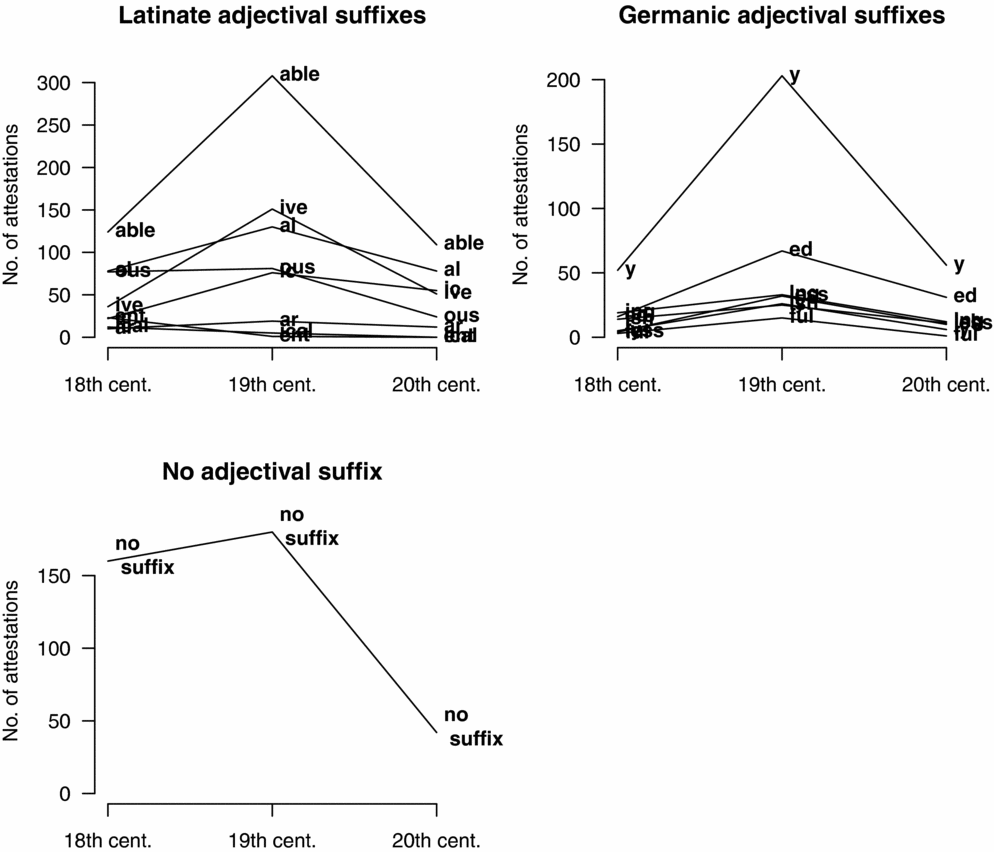
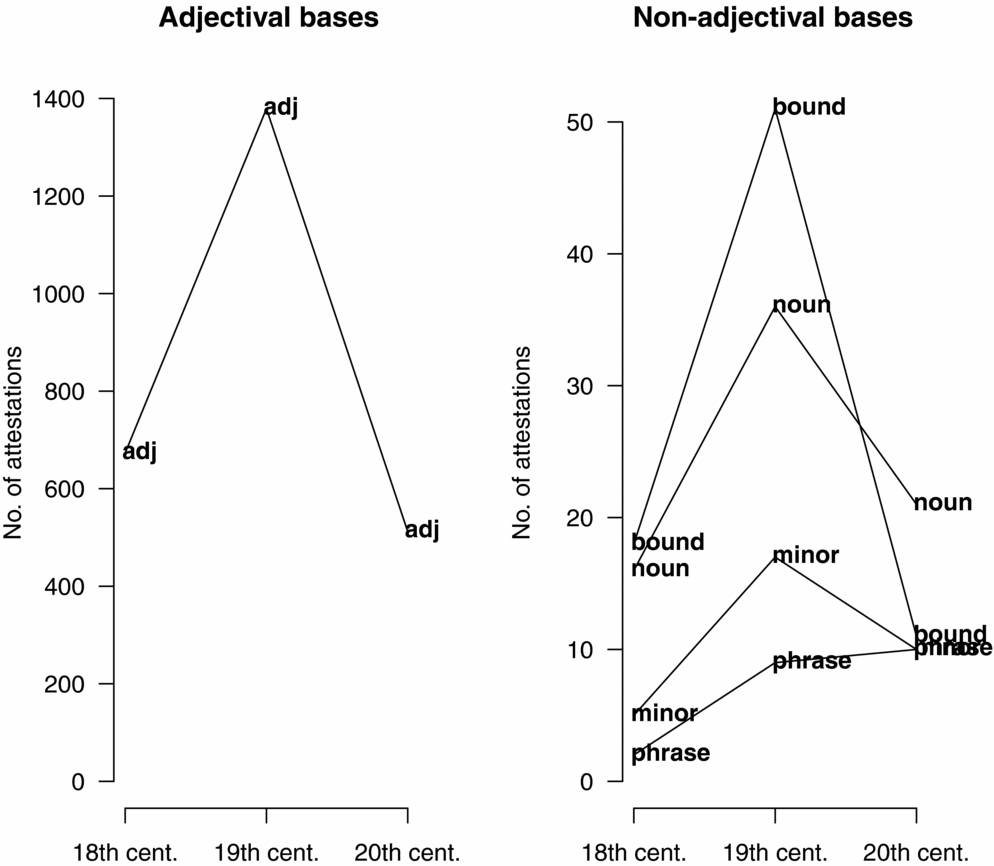
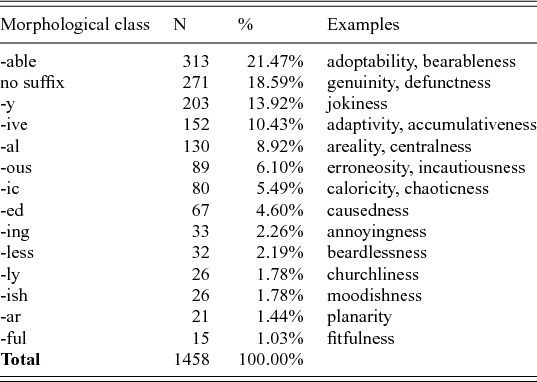
Figure 3 provides an overview of how morphological categories are distributed among adjectival bases in the three data sets, plotting their overall frequencies for each of the three centuries under investigation. For reasons of readability, separate plots are drawn for bases with Latinate adjectival suffixes (upper left panel), Germanic adjectival suffixes (upper right panel), and for unsuffixed bases (lower left panel). Note that different scales are used in the y-axes of the three plots. For the eighteenth- and nineteenth-century data, the numbers underlying the plot are provided in the appendix to this article. Pertinent numbers for the twentieth-century data can be found in table 4 above.
Morphological categories of adjectival bases, diachronically (N18th cent. = 673; N19th cent. = 1,379; N20th cent. = 512)
Adjectives ending in -able form the largest group of complex adjectival bases in all centuries. Furthermore, we see that the disproportionate size of the nineteenth-century data set is reflected as peaks in the distribution especially of the frequent base categories. Interesting differences between the different centuries can be found especially for the relative frequency of unsuffixed adjectival bases, which are strikingly frequent in the eighteenth-century data if compared to the more recent data. Among Latinate adjectival suffixes, we see a decline in frequency of -ous, and a rise especially of -ic.
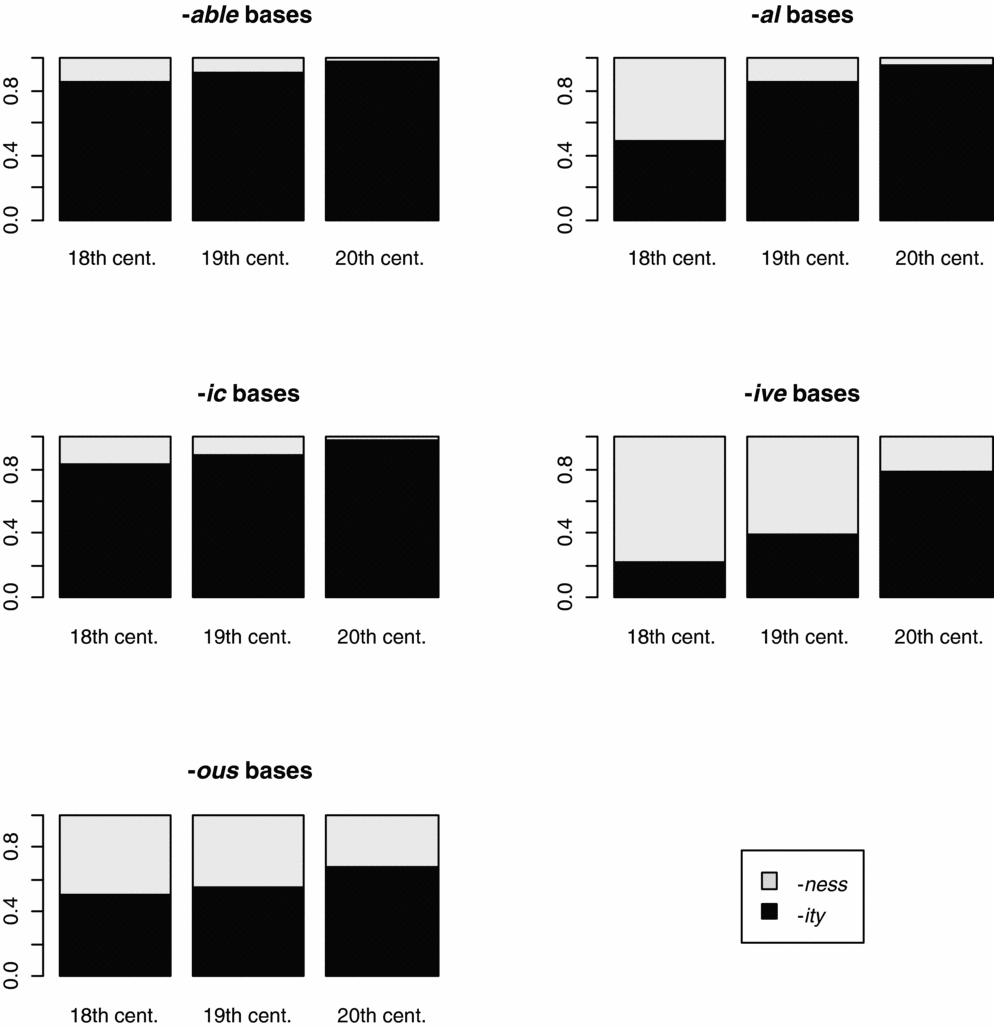
Comparing the distributions of -ity and -ness for the morphological categories of bases, we see that bases with frequent Latinate suffixes show a consistently increasing tendency to take -ity rather than -ness. By contrast, no variation is observed for -ness.Footnote 9
Figure 4 provides a pertinent overview for the Latinate suffixes. Note that it only incorporates classes with a minimum of ten attestations for each century. For all Latinate suffixes, figure 4 shows a steady and consistent increase of -ity's share in the distribution over the last three centuries, so that in the twentieth-century data, there is a very clear majority for -ity in all pertinent morphological categories. Furthermore, note that morphological classes differ in terms of the degree of their -ity preference. Whereas -ity is almost categorical for -able, -al and -ic bases in the twentieth-century data, variation is considerably larger among -ive and -ous bases. This variation is contrasted with the eighteenth century, where -ity forms already constitute a clear majority among -able and -al bases, but where -ness is still the clear majority nominaliser for -ive bases and choice of -ity or -ness seems to be more or less random among -ic and -ous bases. The tendencies observed here are difficult to reconcile with the idea that the development of the division of labour between -ity and -ness is a reflex of developments that have been triggered by whole-word borrowings in the Middle English period. Especially for -al, -ive and -ous the trend towards -ity seems to be a development that has taken place much later.
The distribution of -ity and -ness neologisms among frequent Latinate categories, diachronically (N = 1,425)
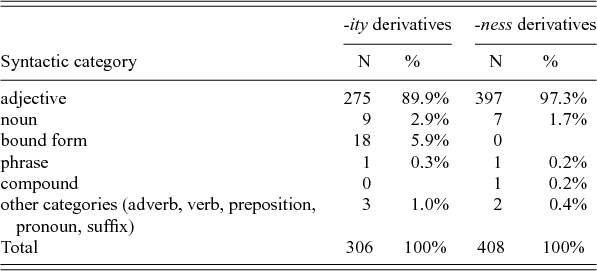
With respect to the syntactic category of the base, not much seems to have changed in the last three centuries in terms of how -ity and -ness derivatives are distributed among different types of bases. What has, however, changed to some extent is the overall distribution of base categories. The latter change is illustrated in figure 5, where adjectival bases and non-adjectival bases are plotted in two different panels for convenience. A table containing the pertinent numbers can again be found in the appendix of the article.
Syntactic categories of bases, diachronically (N18th cent. = 714; N19th cent. = 1,492; N20th cent. = 564)
We see that the absolute number of adjectival bases represented in the OED data drops from 673 in the eighteenth century to 512 in the twentieth century. The proportion of adjectival bases in the overall set of bases thus drops from 94.3 per cent in the eighteenth-century data set to 90.8 per cent of the 564 bases in the twentieth-century data set. This drop in adjectival bases is compensated for by a rise in number of derivatives that are based on nouns, phrases and the categories labelled ‘minor’ in this article (verb, adverb, preposition, pronoun, wh-pronoun and particle).
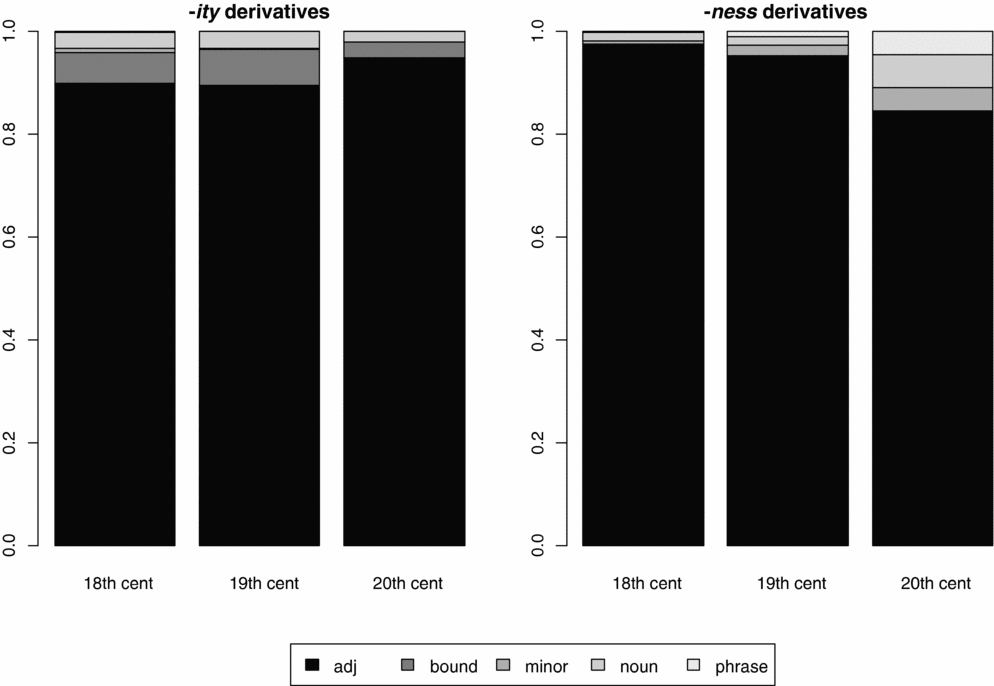
Figure 6 provides an overview of the diachronic distribution of -ity and -ness for these base categories. The graph suggests that unlike -ity, -ness has diversified in terms of its potential bases; in particular, it has increasingly been attested as a nominaliser for phrases, nouns and the categories listed as minor categories.Footnote 10 By contrast, the decrease in the proportion of non-adjectival bases of -ity derivatives is mainly due to a decrease in the share of bound bases in the distribution. Note, however, that, even if pertinent numbers are small, also bases labelled ‘minor categories’ were more frequent with -ity in the historical than in the contemporary data. Particularly convincing examples are the items from the eighteenth century, which show that -ity could be attached to prepositions (betweenity) and verbs (relaxity, flexity).
Syntactic category of bases, diachronically (N = 2,770)
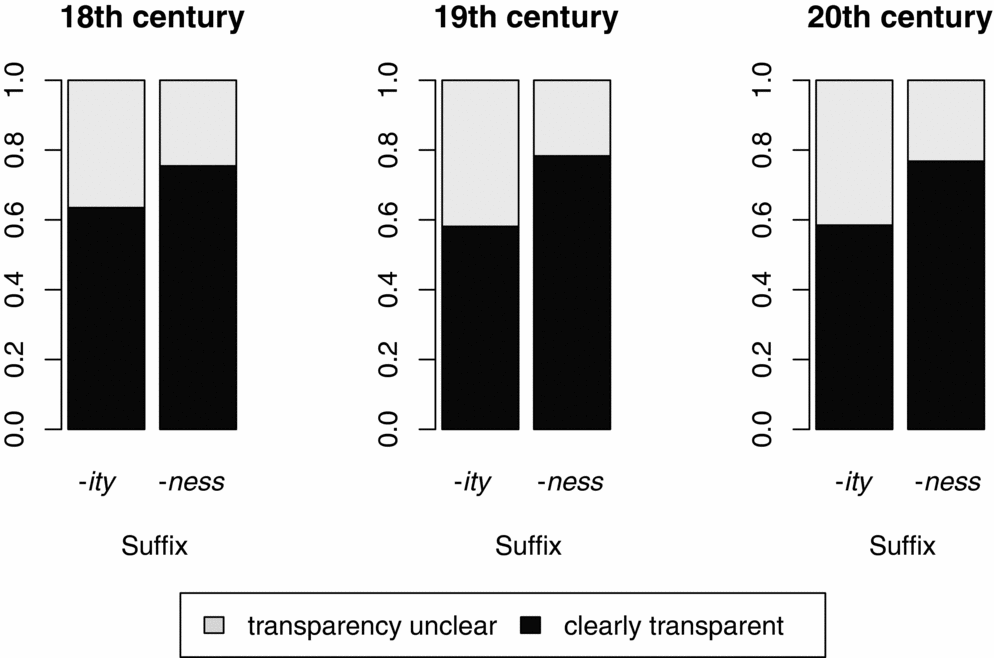
The final issue to be addressed in this section concerns semantic transparency. Figure 7 plots the proportion of clearly transparent items for all three centuries. The figure includes figure 2 for convenience. The graphs illustrate the fact that distributions of -ity and -ness neologisms from the three centuries are highly similar in terms of the proportion of clearly transparent items in the sense defined in this article. The proportion of clearly transparent items among -ity neologisms is 63.60 per cent for the eighteenth century, 58.23 per cent for the nineteenth century and 58.49 per cent for the twentieth century. The proportion of transparent items among -ness neologisms is 74.75 per cent for the eighteenth century, 78.28 per cent for the nineteenth century and 76.80 per cent for the twentieth century.
Transparency of -ity and -ness derivatives, diachronically (N = 2,775)Footnote 11
In sum, the analysis of the diachronic data in this section has provided evidence for a developmental dynamics in the division of labour between -ity and -ness. Crucially, this dynamics does not support an explanation in terms of a simple regularisation of the system. Thus, -ity develops to become the dominant nominaliser for adjectival bases ending in -able, -al, -ic and -ive (and maybe -ous). However, the development cannot be explained in all cases as the majority nominaliser taking over the morphologically defined class of bases. A case in point is bases ending in -ive and -al, for which the majority nominaliser is -ness in the eighteenth century, and where we see a subsequent increase in variation and a decrease in the predictability of nominaliser selection. With respect to the syntactic categories of potential bases, we have seen the converse situation. Thus, -ity seems to be more restricted in terms of its bases nowadays as compared to the eighteenth century. -ness, by contrast, seems to have undergone the opposite development. Bases of -ness suffixation are more diverse in the twentieth century than they were in the eighteenth century. Again, the evidence speaks against regularisation as the motor of the development because such an assumption could not explain why bases of -ness suffixation become more unpredictable over time.
3.4 Section summary
Two important things emerge from the findings in this section. The first is that the OED data are a valid resource for the analysis of the division of labour between -ity and -ness. The twentieth-century distribution is fully in line with what the few available corpus studies show about the domain-specificity of the two nominalisers. Thus, Baayen & Renouf (Reference Baayen and Renouf1996) as well as Lindsay (Reference Lindsay2012) find that -ity is more productive than -ness in some domains involving Latinate suffixes. However, the present analysis suggests that the productivity difference may be even more pronounced than hitherto assumed. Furthermore, the distribution of -ness confirms earlier corpus-based findings in Baayen & Renouf, who show that -ness is particularly productive with adjectival bases ending in -y, and much less productive with bases ending in other Germanic suffixes such as -ed and -ing. The close correspondence of findings between the present study and that corpus study show that -ness derivatives are reasonably well represented in the OED data to allow for a comparison with -ity.
The data on diachronic development are fully in line with Riddle's claim that -ity formations tend to be less likely to have a transparent property meaning than -ness formations. However, we saw that the clear majority of both groups of nominalisations have clearly transparent meanings in both the synchronic and the diachronic data. This indicates that even though meaning differences may be a factor in the competition between the two nominalisers, the importance of this factor is a relative one. Furthermore the diachronic data are in line with what Lindsay (Lindsay Reference Lindsay2012; Lindsay & Aronoff forthcoming) hypothesises about the development of niche productivity in general. Again, however, the development may in fact be more pronounced than hitherto noted. Given that the data reflect the more recent history of the language, they show that the process has not lost its historical dynamics after Middle English. This is particularly true for the behaviour of adjectival bases ending in -al and -ive, where we observe a drastic change in their preferences. Also, the results presented here suggest that it is unlikely that the developments are still the consequence of the developments in Middle English. Instead, more research is needed to establish whether the development is due to factors that have arisen much later.
4 Introducing an analogical approach to -ity/-ness rivalry
In what follows I will propose and test an analogical model of -ity and -ness selection. The task of the present section is to provide a general introduction to the basic mechanisms of the model. The details that are necessary to understand synchronic productivity patterns and diachronic development in rivalry will then be discussed in connection with the concrete findings of the present model in section 5. Note that the description here will not incorporate technical details but focus on a rather broad, conceptual level. For the mathematical and technical details the interested reader is referred to pertinent descriptions in the literature, especially those in Skousen (Reference Skousen, Skousen, Lonsdale and Parkinson2002a, Reference Skousen, Skousen, Lonsdale and Parkinson2002b, Reference Skousen, Köhler, Altmann and Piotrowski2005, Reference Skousen, Blevins and Blevins2009).
The particular framework used in the present study (Analogical Modelling, Skousen Reference Skousen1989, Reference Skousen1992; Skousen et al. Reference Skousen, Lonsdale and Parkinson2002et seq.) constitutes an instantiation of what I will henceforth refer to as an analogy-based approach to linguistic categorisation (or ‘analogical approach’, for short). The claim on which the approach is based is by no means new. For word-formation, the assumption is that new words are formed on the basis of existing similar words. More specifically, new complex words are formed from their bases on the basis of existing base-derivative pairs in the mental lexicon (see e.g. Becker Reference Becker1990; Bauer Reference Bauer2001: 75–96; Anttila Reference Anttila, Joseph and Janda2003; Arndt-Lappe in press for an overview of the basic tenets of analogical approaches to word-formation). The crucial characteristic here is that analogy happens online in linguistic tasks. This view is different from many current, especially generative theories in that such theories often place an emphasis on the rule as the central mechanism of linguistic generalisation. Rules, in turn, are abstractions that are assumed to operate independently of individual exemplars in the lexicon in such approaches.
The term ‘analogy-based approach’ can thus be seen as a cover term for quite a variety of different approaches which are united by the view that linguistic generalisation happens online on the basis of the lexicon. The most prominent among these are exemplar-based theories (see overviews in e.g. Gahl & Yu Reference Gahl and Yu2006; Wedel Reference Wedel2006), computational analogical approaches of different types (in morphology, especially: AM: Skousen Reference Skousen1989, Reference Skousen1992; Skousen et al. Reference Skousen, Lonsdale and Parkinson2002et seq.; TiMBL: Daelemans et al. Reference Daelemans, Zavrel, van derSloot and van denBosch1999et seq.; Daelemans & van den Bosch Reference Daelemans and van denBosch2005, Reference van den Bosch and Daelemans2013; Minimal Generalization Learner: Albright & Hayes Reference Albright and Hayes2003; Albright Reference Albright, Blevins and Blevins2009), and, to some extent, construction-based theories (esp. Booij Reference Booij2010). Note that the term ‘exemplar-based approaches’ is often also applied to the computational approaches cited above. In this article, the term ‘analogical approach’ is preferred because in recent linguistic work much discussion of exemplar-based models is centred around the role of phonetic detail in exemplar representation. By contrast, in work applying computational analogical models to morphological phenomena, there is a tendency to focus on more abstract components of lexical representations. In this sense, then, the term ‘analogical approaches’ is chosen in order not to invite any biases with regard to the structure of representations.
In the present model, -ity and -ness selection is viewed as a classification task. For each new base word that is given to the algorithm as a test item, the algorithm decides between two different outcomes, ‘ity’ and ‘ness’, on the basis of the distribution of similar items bearing either -ity or -ness in the lexicon. Similarity is computed on the basis of the set of coded features that is assigned to each exemplar in the lexicon by the researcher. In our model, two types of information will be used: information on the form of the base and syntactic information. The form information consists of six features which encode the phonemic makeup of the two last syllables of the base. Information on the morphological category of the base is therefore implicit in this coding, which allows for a more fine-grained comparison of the formal properties of exemplars than a comparison that is based on membership in a morphological category. The coding of syntactic information covers those syntactic categories that have emerged in section 3.2 to be most relevant for -ity and -ness selection. The classification encodes whether the base is a word in English (collapsing the categories ‘adjective’, ‘noun’ and ‘minor’ from section 3 into one umbrella category) or whether it is a bound form or a phrase.
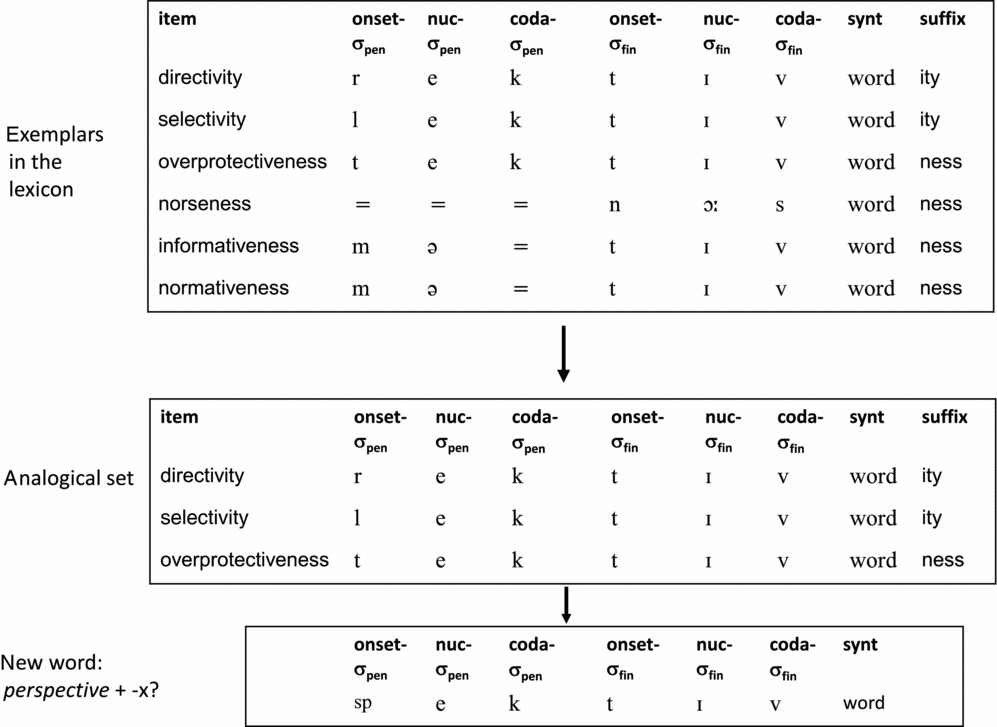
Figure 8 provides a graphical illustration of the general architecture, using the base perspective as an example. For perspective, the OED lists perspectivity as a twentieth-century neologism. The lexicon represented in figure 8 constitutes a heavily simplified version of the lexicon that will be used in the synchronic simulation study in section 5.
The general architecture of an analogical model
The central component of the system is the lexicon, i.e. the set of stored exemplars. In the lexicon each item is represented as a structured set of coded features. In our case, the set involves eight features, six of which represent the phonemic makeup of the last two syllables of the base. Each feature represents a syllabic constituent (onset, nucleus, and coda), and the symbol ‘ = ’ indicates that the position is not filled by a segment (similar representations have been employed frequently in similar tasks, e.g., in Eddington Reference Eddington2002; Chapman & Skousen Reference Chapman and Skousen2005; Daelemans & van den Bosch Reference Daelemans and van denBosch2005; Keuleers Reference Keuleers2008; Chandler Reference Chandler2010; van den Bosch & Daelemans Reference van den Bosch and Daelemans2013). Another feature encodes the syntactic category of the base; this coding broadly distinguishes words (i.e. free forms) from bound forms and phrases. In figure 5, all items in the lexicon are derivatives based on words. The last feature in the set specifies whether the attested nominaliser is -ity or -ness.
If a new word is to be classified, the system extracts from the lexicon a group of exemplars which are similar to the new word. This group is known in the AM literature as the analogical set. The exemplars in the analogical set serve as analogues on the basis of which the nominal suffix will be assigned to the new word. In the example in figure 8, all exemplars in the analogical set share as many as six of the seven coded features with the new word (i.e. all items end in /ektiv/ and are attested as words in English) and are thus all equally similar to the target. An obvious question is how the system determines which exemplars end up in the analogical set. For example, the small lexicon in figure 8 also contains two exemplars, informativeness and normativeness, which are reasonably similar to the new word (sharing three phonological features and the word class with the target), but are not included in the analogical set. The crucial feature that distinguishes AM from many other pertinent models is that the degree of similarity that is relevant for exemplars to be included in the analogical set is decided for each new word individually. The rationale that underlies the procedure is that while the model will always incorporate maximally similar items, items with lower degrees of similarity will be incorporated only if that incorporation does not lead to greater uncertainty with respect to the classification task.Footnote 12 As we will see in section 5.2 below, this is relevant for an explanation of how the different productivity profiles of -ity and -ness emerge from the model.
On the basis of the analogical set, the nominalising suffix for the new word is predicted. This prediction is probabilistic, reflecting the distribution of nominalising suffixes in the analogical set. Specifically, the algorithm gives the probability of each possible value being assigned, based on the distribution of these values amongst exemplars in the analogical set. In calculating these probabilities, AM takes into account the degree of similarity between an exemplar and the new item, as well as the number of exemplars with a particular set of features. The more similar an exemplar is to the new item, the more weight it receives, and the more exemplars that share a particular set of features, the greater the weight assigned to each of them. The latter fact is particularly important in cases where a feature constellation is particularly frequent in the lexicon. In a classification task where exemplars sharing that feature constellation are part of the analogical set, they may outweigh exemplars that are more similar to the target word but that are smaller in number.
In order to better assess the overall performance of the model, probabilistic outcome predictions are often translated into categorical predictions for each new word. This means that probabilities of a given outcome that are greater than 50 per cent are taken to be a categorical prediction for that outcome to occur. This procedure is well established in the literature applying analogical models to linguistic tasks (see e.g. papers in Skousen et al. Reference Skousen, Lonsdale and Parkinson2002, Daelemans & van Bosch Reference Daelemans and van denBosch2005, for examples and discussion). In the discussion of the simulation study in this article reference will be made sometimes to the probabilistic predictions and sometimes to the transformed categorical predictions.
5 The simulations
In what follows I will report on a series of simulation experiments with AM that use the OED data to test how the analogical model accounts for the patterns and developments observed in the analysis in section 3. After a brief introduction to the general setup of the simulations in section 5.1, section 5.2 will provide an overview of the overall predictive power reached in the simulations. Section 5.3 will then explain how the AM simulation accounts for the productivity profiles of -ity and -ness in the twentieth-century simulation. Section 5.4 will focus on the modelling of diachronic change from the eighteenth to the twentieth century.
5.1 Coding and general setup
In all simulation experiments, AM was set the task of predicting the nominalising suffix for bases of -ity and -ness derivatives from the OED data set. As a lexicon, the algorithm used a corresponding set of -ity and -ness derivatives from the OED data set. The basic shape of the coding has already been exemplified in figure 8. The phonological coding was based on the machine-readable transcription which can be accessed in the OED online version by clicking on the IPA transcription. The transcriptions were then edited manually to reduce inconsistencies. It is important to note that alignment of the phonological features was position-specific. This means that onsets, nuclei and codas of the penultimate and the final syllable were always compared only with corresponding onsets, nuclei, and codas from the same syllable. Furthermore, the symbol ‘ = ’, which indicates that the relevant syllabic position is not occupied by a segment (see figure 8 for illustration), was treated as a valid feature value. The effect was that the model was able to incorporate into the computation of similarity some effects that take place on a higher level of structural organisation than the phonemic makeup. One constellation that produced a noteworthy effect here was the absence of a coda in the penultimate syllable of the base, another was the constellation with three ‘ = ’ values for the features of the penultimate syllable, which indicated that the item is monosyllabic.
For the coding of morphosyntactic category, the coding introduced in section 3.1 was transformed into broader categories. In particular the categories ‘adjective’, ‘noun’, ‘verb’, ‘adverb’, ‘preposition’, ‘pronoun’, ‘wh-pronoun’ and ‘particle’ were conflated to create a general category labelled ‘word’. This category then comprises all bases which are minimal free forms in English. Note that the reasons for the conflation of word categories were purely practical in nature in that, in terms of the predictive power of the model, nothing could be gained from a more fine-grained distinction. This is almost certainly due to the fact that, apart from ‘adjective’ and ‘noun’, pertinent numbers are far too small as to allow any relevant predictions. The other possible values of the morphosyntactic feature are ‘bound form’ and ‘phrase’ as defined in section 3.1.
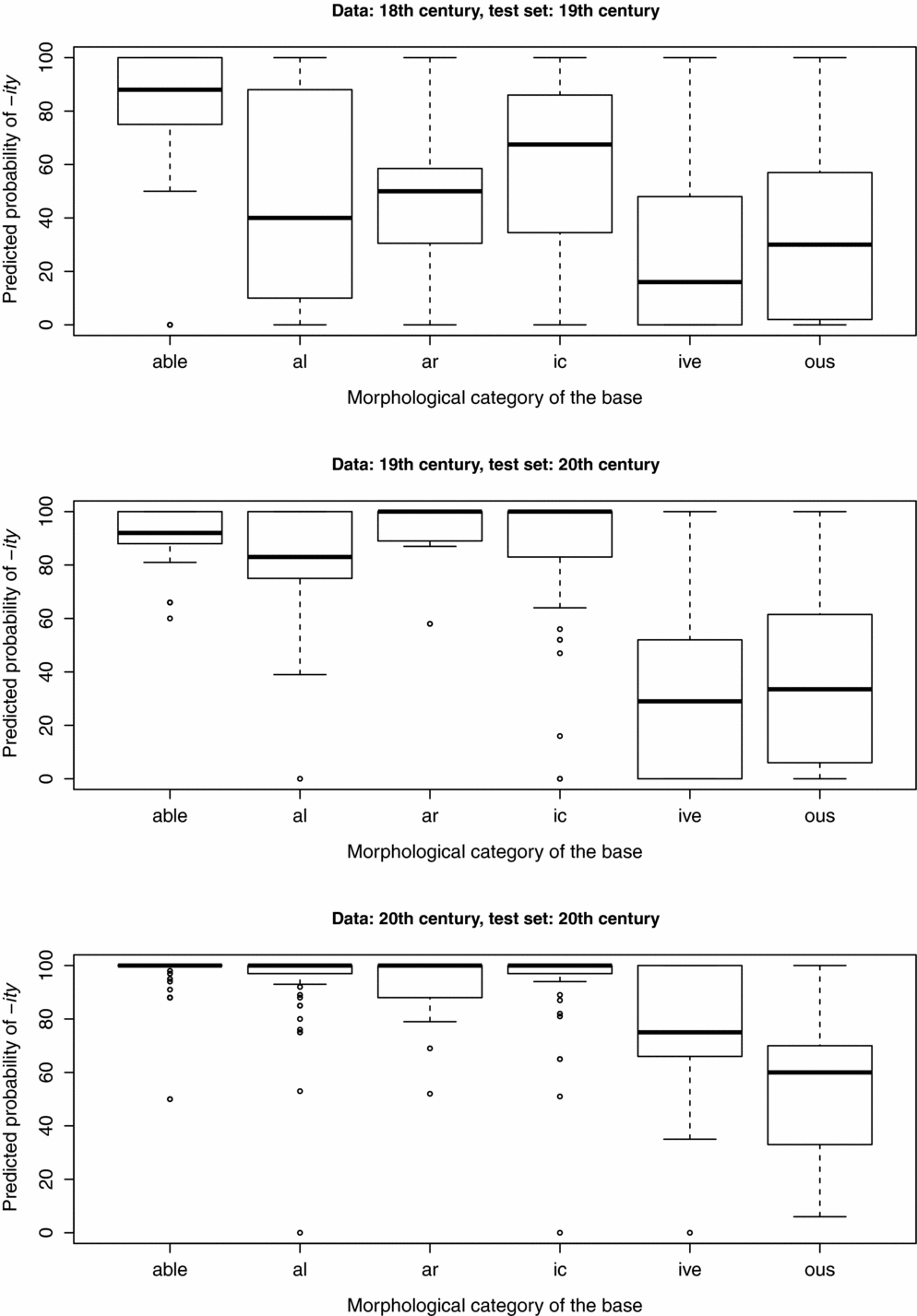
Two types of simulation were run. To model the synchronic productivity profiles of the two rival suffixes, the data set of twentieth-century neologisms was used both as a lexicon and as a set of test items. The parameters of the analogical program were set in such a way as to ensure that, for each new word to be classified, its copy in the lexicon was excluded from the classification procedure (termed ‘leave-one-out’ procedure in some of the literature; see e.g. Daelemans & van den Bosch Reference Daelemans and van denBosch2005). To model diachronic development, a data set from an earlier century was used as a lexicon to predict the set of neologisms for the later century. The eighteenth-century data set was used as a lexicon to predict the nineteenth-century data, and the nineteenth-century data were used as a lexicon to predict the twentieth-century data. The setup of the diachronic experiments was modelled on the setup used by Chapman & Skousen (Reference Chapman and Skousen2005) in their diachronic simulation study of rivalry between English negative prefixes.
The basic rationale that underlies the experiments in the present article contains two aspects that are potentially contentious. The first is that it is pretended that the new words to be predicted by the system are true neologisms, which precludes the possibility that (simulated) speakers may already know the word. This setup was chosen to avoid circularity of the argument. If the new word is identical to an entry in the lexicon, this identical entry will automatically be the most influential member of the analogical set. Even though, depending on lexical distributions, the identical item is unlikely to be the only member of the analogical set, AM's predictions will be heavily biased by that item. The second, more problematic aspect is that the lexicon in all simulations has been recruited from OED neologisms, with a high proportion of very low-frequency words and specialised terms. It is thus clear that this type of lexicon does not constitute a realistic approximation of speakers’ lexical knowledge. However, note that it is far from clear what exactly would constitute a realistic lexicon for analogy-based classification in word-formation. For example, as pointed out by a referee for this article, a conceivable alternative to the approach used in the present study would be to take the total of all -ity and -ness derivatives from all centuries as a lexicon for the twentieth-century simulation. The rationale that guided the choice of the lexica in the present simulation experiments was the idea that the neologisms from the same century (for the synchronic experiment) or the previous century (for the diachronic experiments) comprise a set of lexical items that can be assumed to be formally transparent members of the right morphological category (-ity or -ness derivatives, respectively) to speakers in the later century. This is not necessarily the case for items that were coined in more remote periods. Formal transparency or analysability, in turn, is a plausible key prerequisite for lexica used in analogical simulations (see e.g. Chapman & Skousen Reference Chapman and Skousen2005: 343f. for discussion). It was hoped, thus, that even if the lexicon is not an entirely realistic approximation of speakers’ lexical knowledge, it could serve as a plausible proxy for that knowledge.
5.2 Overall performance of the model
This section will provide an overview of the overall predictive power of the simulations. For the sake of clarity, the discussion will refer to categorical AM predictions which were derived from transforming AM's probabilistic predictions into categorical values reflecting the majority vote among exemplars in the analogical set. If the predicted probability of -ity was 50 per cent or higher, the predicted suffix was taken to be -ity. If the predicted probability of -ity was less than 50 per cent, the predicted suffix was taken to be -ness. In addition, goodness of fit of AM's probabilistic predictions is assessed by reporting the concordance statistic C for each simulation (see Austin & Steyerberg Reference Austin and Steyerberg2012 for discussion). Here, the C statistic can be understood by taking all possible pairs of words from the lexicon used in the simulation so that in each pair, one word contains the nominaliser -ity and the other word contains the nominaliser -ness. C is the proportion of pairs in which the word containing -ity also has a higher predicted probability of having -ity than the word containing -ness. A C value of 1.0 indicates a perfect fit, and a value of 0.5 indicates a random distribution of predictions (see Baayen Reference Baayen2008: 204 for details).
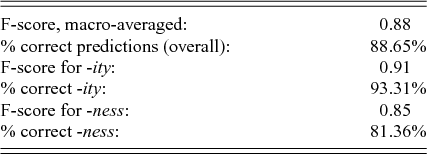
Table 5 provides an overview of the simulation in which the twentieth-century neologisms were used both as the lexicon and the test set (henceforth ‘synchronic simulation’ for short). Predictive power is measured in terms of the percentage of correct predictions and in terms of macro-averaged F-scores. F-scores are a measure of accuracy that is frequently used in information theory (see e.g. Daelemans & van den Bosch Reference Daelemans and van denBosch2005: 48ff.; 78–9 for discussion). They are computed separately for each target category, in our case for -ity and -ness, as the harmonic mean of two ratios. The first ratio, termed ‘recall’, gives us the number of items for which the model predicts the nominaliser correctly divided by the number of items which are indeed observed to take that nominaliser. This measure is often cited as a measure of predictive accuracy. The second ratio, termed ‘precision’, gives us the number of items for which the model predicts the nominaliser correctly divided by the number of items for which the model predicts that nominaliser. It thus tells us how well aimed the model is in its predictions. Possible F-score values range between 0 and 1, with an F-score of 1 indicating faultless performance. An overall F-score is computed as the harmonic mean of the two F-scores for -ity and -ness (termed ‘macro-averaged F-score’).
The predictive power of the synchronic simulation (lexicon: twentieth century, test set: twentieth century, N = 564). For the probabilistic AM predictions: C = 0.92
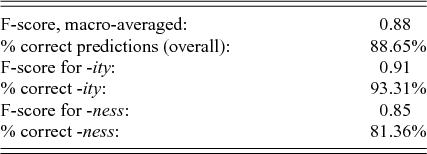
As table 5 shows, the distribution of -ity and -ness among twentieth-century neologisms in the OED is highly predictable, with both the overall F-score and the percentage of correct predictions clearly above 85 per cent, and a very high concordance statistic C of 0.92. Only 64 of all 564 derivatives in the set are mispredicted by the system.
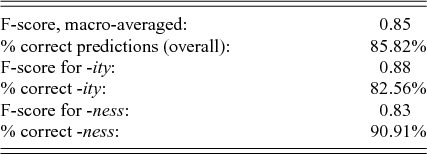
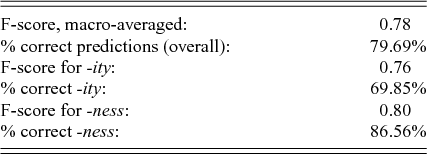
Tables 6 and 7 summarise the results of the diachronic experiments, i.e. those where the set of neologisms from the earlier century serves to predict the later century. The format of the tables is parallel to that of table 5.
The predictive power of the diachronic simulation (lexicon: nineteenth century, test set: twentieth century, Ntest set = 564). For the probabilistic AM predictions: C = 0.89
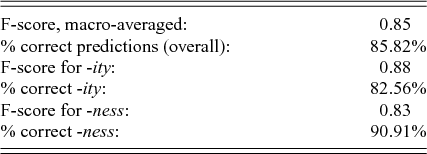
The predictive power of the diachronic simulation (lexicon: eighteenth century, test set: nineteenth century, Ntest set = 1,492). For the probabilistic AM predictions: C = 0.82
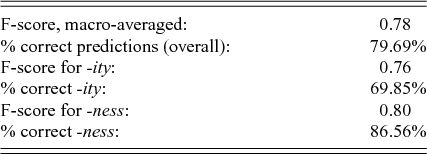
As can be seen especially from the averaged F-scores (0.85 for the later data, 0.78 for the earlier data) overall predictive power is very good in all diachronic experiments. Nevertheless, we see a consistent decrease in overall predictability if we go back in time (reflected also in the concordance statistic C, which decreases from 0.89 for the later data to 0.82 for the earlier data). This is in line with the findings presented in section 3.3, where we saw that variability between -ity and -ness decreases over time for certain types of bases.
In what follows the discussion will address in more detail the question of how exactly the system constructed the similarity relations that are relevant to this particular classification task. The focus will be on two issues: the first is how AM manages to predict the domain-specific productivity of -ity and the default status of -ness in the synchronic simulation. The second is how the increase in the domain-specificity of -ity that we have observed over time is reflected in the diachronic AM simulations.Footnote 13
5.3 Domain-specific productivity and default selection are epiphenomena
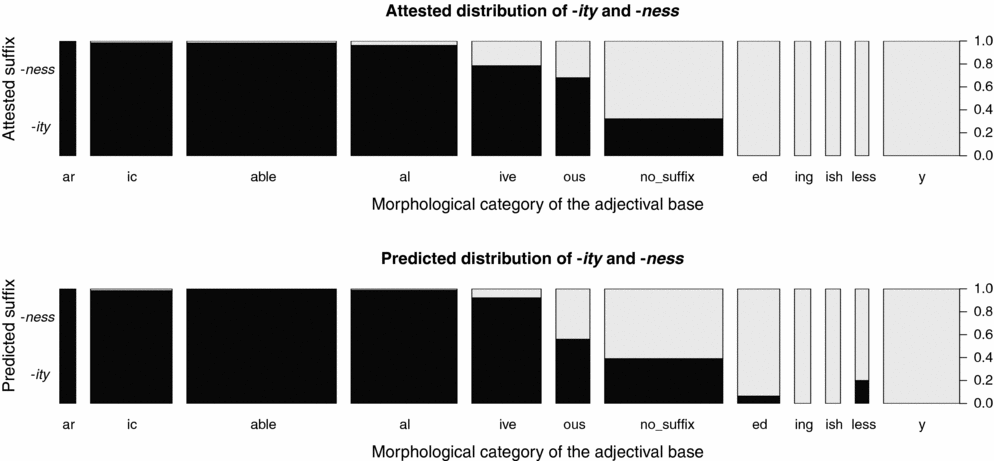
The present section will first address the question of how AM replicates the distributions that we found in section 3.2 for the different morphological categories, and then explore the details about how productivity differences emerge in AM. Figure 9 compares the attested distribution by morphological category (in the upper panel) with AM's predictions (in the lower panel) for those morphological categories with at least ten attestations in the data. Again, AM predictions are transformed into categorical predictions on the basis of majority votes in the analogical set. Note that, unlike in the discussion of distributions in section 3.2, figure 9 also incorporates adjectival bases that do not contain an adjectival suffix. In contrast to accounts that base their predictions on the combinatorics of particular suffixes, AM makes predictions for all types of bases; one particularly frequent type is unsuffixed bases.
Attested and predicted distributions of -ity and -ness, synchronic experiment (N = 545)
We see that categorical AM predictions yield a predicted distribution that is highly similar to the attested distribution.Footnote 14
As we have seen in section 3.2, two crucial phenomena characterise the productivity profiles of -ity and -ness. -ity's productivity is not only concentrated in particular domains, but it also dominates these domains in comparison to -ness. The productivity of -ness, by contrast, is characterised by -ness's default status. This means that -ness can, in principle, occur on almost any type of base. A close analysis of the AM model reveals that this situation is in fact predicted by the algorithm. The key to understanding how this works lies in the composition of analogical sets (see section 4 above for an introduction of the terminology). These are significantly more local for -ity than they are for -ness. ‘Locality’ refers to two properties of analogical sets: one is the number of exemplars in the set, the second is the degree of similarity of members of that set with the test word. In general, these two properties are often correlated because analogical sets that consist of exemplars that are highly similar to the test word tend to be smaller than analogical sets that also incorporate less similar exemplars. In what follows the analogical sets predicting -ity and -ness will be compared in terms of both aspects of locality.
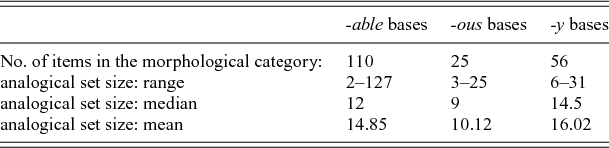
Table 8 provides analogical set sizes and measures to assess the variation in sizes for bases belonging to three morphological categories: those ending in -able (-ity leaning), -ous (exhibiting a relatively large degree of variation between -ity and -ness) and -y (-ness leaning). The choice of -able, -ous and -y bases is arbitrary, other bases show a similar behaviour.
Analogical set sizes for three types of bases
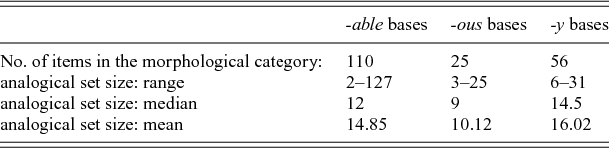
We see that for most test items, analogical sets are much smaller than the morphological category, with median or mean sizes being only a fraction of the number of pertinent items in the morphological class.Footnote 15 The second thing we see is that analogical set sizes are not uniform within morphological categories, exhibiting a vast range for all categories. In sum, the sizes of the analogical sets make it abundantly clear that classification in AM is not based only on the features in the phonological coding that are indicative of morphological categories, but is often much more local than that in the above-described sense.
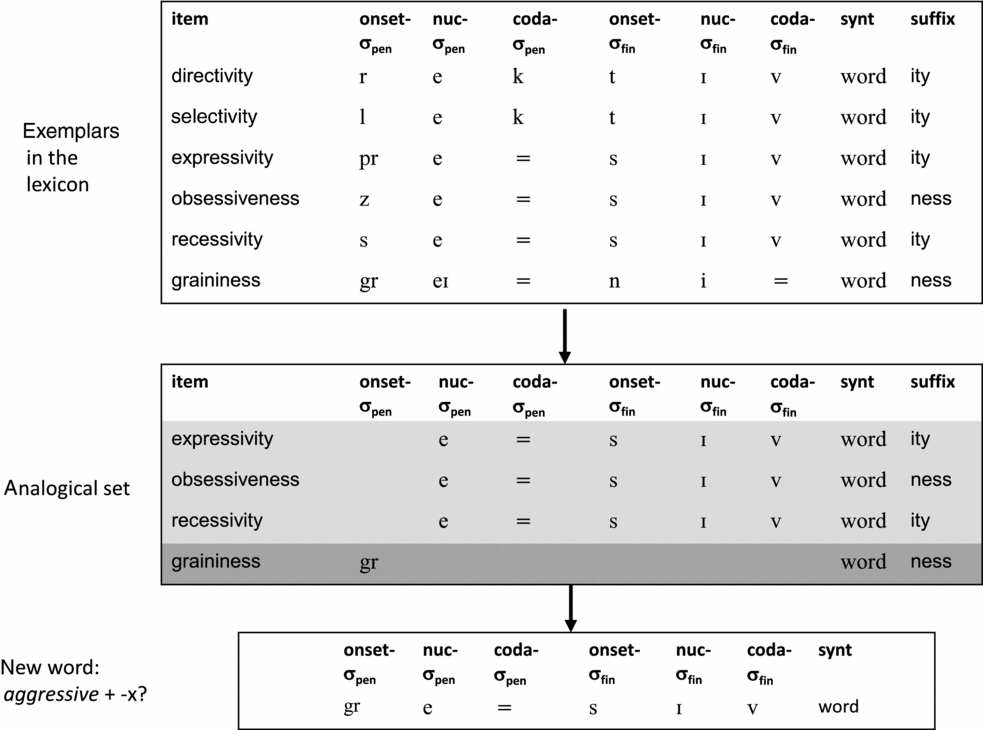
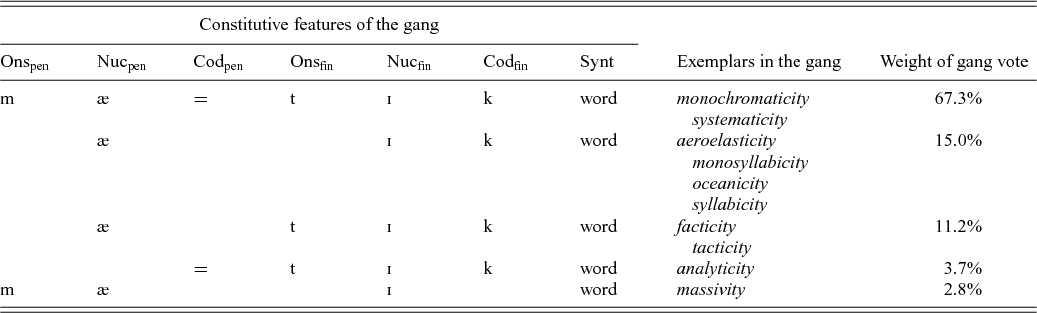
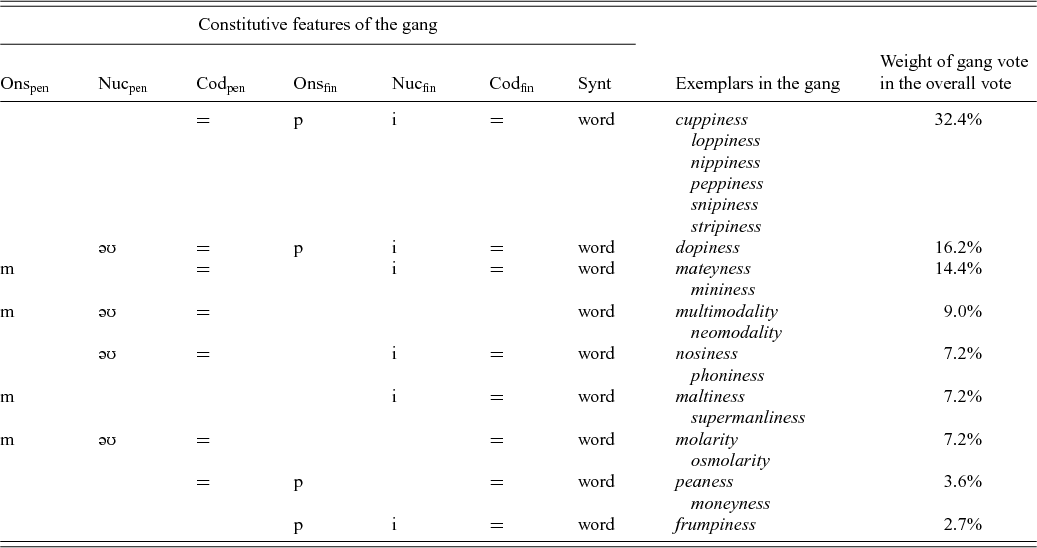
Against this background, it is now instructive to compare -ity and -ness derivatives in terms of the degree of similarity that is constitutive of analogical sets. This will be done on the basis of the feature combinations that define the most influential gang in each analogical set that occurred in the simulation. The term ‘gang’ refers to a group of exemplars within an analogical set which all have exactly the same features in common (see especially Skousen Reference Skousen1995, Reference Skousen, Skousen, Lonsdale and Parkinson2002a, Reference Skousen, Skousen, Lonsdale and Parkinson2002b, Reference Skousen, Köhler, Altmann and Piotrowski2005). These features, then, define the gang in the above-described sense, and I will henceforth refer to them as ‘constitutive features’ of the gang. The ‘most influential gang’ is the gang that has the strongest weight and, thus, the strongest influence on the classification of a new item. Figure 10 provides an illustration of the gang terminology for the new word aggressivity with its analogical set. The general format is identical to that of figure 8 above, the only difference is that gangs are shaded, and that gang members are represented only in terms of the constitutive features of the gang.
Gangs in the analogical set
The analogical set comprises four exemplars, expressivity, obsessiveness, recessivity and graininess, which are split into two gangs. The first gang consists of expressivity, obsessiveness and recessivity. The constitutive features of that gang are the phonological features nuc-σpen, coda-σpen, onset-σfin, nuc-σfin and coda-σfin, as well as the syntactic category. The second gang in figure 8 consists of only one exemplar, graininess. The base grainy is only vaguely similar to aggressive, the constitutive features of the gang being onset-σpen and the syntactic category. In terms of their influence on classification of aggressive, the algorithm gives much more weight to the first gang than to the second gang. This is due to two reasons: one is that the first gang is defined by more constitutive features, that is, exemplars in the gang are more similar to the new word than the exemplar in the second gang. The second is that the first gang has more members than the second gang.Footnote 16
The question now is whether there is a principled difference between -ity and -ness words in terms of the similarity structure in their analogical sets. Figure 11 provides an overview of the number of constitutive features that define the most influential gang for each -ity and -ness derivative in the test set.
Similarity between the most important gang and the test word, N = 564
The boxplot shows that there are clear differences between the similarity structure of analogical sets of -ity and -ness derivatives. The median number of features shared by the most influential gang with the test word is 7 for -ity derivatives and 5 for -ness derivatives (indicated by the black dots in the plot). The boxes indicate that for 75 per ent of all -ity derivatives, the range of the number of shared features is between 5 and 7, whereas for 75 per cent of all -ness derivatives it is between 4 and 5. As is clear from the location of the mean with respect to the interquartile range represented by the boxes, the pertinent means are somewhat lower than the medians for both groups of derivatives (for -ity derivatives: 6.17; for -ness derivatives: 4.70). A Wilcoxon test shows that the difference between the means is indeed highly significant (W = 61003, p < 2.2e−16).Footnote 17
Tables 9 and 10 provide representative examples of the similarity structure of analogical sets for -ity and -ness derivatives (for the new words aromaticity and mopiness, respectively). An important structural difference between the analogical sets for the bases aromatic and mopey is how similar the most influential exemplars in the analogical set are to the new word. The most influential gang for aromatic shares all seven coded features with the new word. As we saw in figure 11, the same is true for half of the -ity derivatives in the simulation. Even though the gang consists of only two exemplars, it accounts for 67.3 per cent of the overall vote on the predicted nominaliser for aromatic. The situation is different for mopey, for which -ness is predicted as a nominaliser. Here the most influential gang shares only four features with the new word.Footnote 18 Overall, we also see that the analogical set for mopey contains more gangs than the set for aromatic, where gangs differ more widely in terms of their constitutive features.
Gangs in the analogical set for aromatic (◆ aromaticity)
Gangs in the analogical set for mopey (◆ mopiness)
The findings of the analysis thus show that differences in productivity profiles between -ity and -ness emerge from differences in the similarity structure that is relevant for the classification in the lexicon. For -ity derivatives, classification is very local, i.e. dominated by highly similar exemplars. The effect is the niche behaviour that was observed for -ity in section 3 of this article as well as in related research (esp. in Lindsay Reference Lindsay2012). For -ness derivatives, by contrast, classification is relatively more general than for -ity, i.e. dominated by less similar exemplars. The effect is that relevant similarity relations tend to be more sparse, making the behaviour of -ness look like default selection, i.e. a kind of selection that is not primarily dependent on specific feature constellations.
These results are fully in line with recent work on productivity in computational analogical frameworks (esp. Albright & Hayes Reference Albright and Hayes2003; Keuleers et al. Reference Keuleers, Sandra, Daelemans, Gillis, Durieux and Marten2007; Keuleers Reference Keuleers2008). The classic phenomenon that has attracted most interest here is English past tense formation, specifically, the insight that, contrary to the expectations of many grammatical models, not only regular, but also allegedly irregular formation patterns are productive, albeit to different degrees (Bybee & Moder Reference Bybee and Moder1983; Prasada & Pinker Reference Prasada and Pinker1993). This has given rise to a vivid theoretical debate about the status of regular and irregular processes in morphology especially between dual-mechanism models (Pinker Reference Pinker1991; Marcus et al. Reference Marcus, Pinker, Ullman, Hollander, Rosen, Xu and Clahsen1992; Prasada & Pinker Reference Prasada and Pinker1993; Pinker & Prince Reference Pinker, Prince, Lima, Corrigan and Iverson1994), connectionist models (McClelland & Rumelhart Reference McClelland, Rumelhart, McClelland and Rumelhart1985; Matthews Reference Matthews2013), and analogical models (Derwing & Skousen Reference Derwing, Skousen, Lima, Corrigan and Iverson1994; Eddington Reference Eddington2000; Keuleers Reference Keuleers2008; Chandler Reference Chandler2010). What is interesting in the context of the present investigation is that the differences between irregular and regular past tense formation in terms of their productivity profiles are in principle similar to those between -ity and -ness. Like -ity, irregular past tense formation exhibits niche productivity in the sense that its productivity is mainly confined to bases that are highly similar to existing irregular bases. Like -ness, regular past tense formation has a status that looks like a default. For the past tense this situation, which has been a classic source of evidence for dual mechanism models, has been shown to also emerge in a single-mechanism analogical model (Derwing & Skousen Reference Derwing, Skousen, Lima, Corrigan and Iverson1994; Eddington Reference Eddington2000; Keuleers Reference Keuleers2008; Chandler Reference Chandler2010). The way in which it emerges is stunningly similar to what we saw for -ity and -ness: Domain-specific behaviour (‘niches’ in the terminology of Lindsay Reference Lindsay2012, Lindsay & Aronoff forthcoming) in an analogical model translates into strong gang behaviour exerted by lexical items that are highly similar to a test item. ‘Default’ translates into influence from (relatively) more distant items that are also usually more sparsely distributed over the similarity space. The metaphors ‘niche’ and ‘default’ constitute endpoints on a gradient scale.
5.4 Predicting change: the role of certainty and strong gangs
This section will compare the two diachronic simulation experiments with the synchronic model. The question to be addressed is how exactly the models represent the fact we observed in section 3.3 that for bases with frequent Latinate suffixes, -ity becomes the dominant nominaliser whereas -ness retreats from those domains. Again the morphological category of the base will be used as a convenient label for those domains, without much theoretical commitment. As we saw in section 5.3 for the synchronic study, analogical sets in the present simulations are only broadly correlated with morphological categories.
The situation that -ity comes to robustly dominate contexts where before there was variation between -ity and -ness can be seen in two properties of the AM models: One is that, as we progress in time, AM predicts a decreasing amount of variability between the two nominalisers for these contexts. The second is that in time we see the emergence of strong gangs favouring -ity. These gangs are strong in the sense that they reappear in several analogical sets. Both properties will be discussed in turn.
In order to look at the predicted variability in pertinent domains (i.e. bases with frequent Latinate suffixes), we need to consider AM's probabilistic predictions for nominalisers rather than the categorical predictions that have been the focus far. Recall from section 4 that AM predictions are inherently probabilistic. To avoid unnecessary complexities, these were in the discussion so far transformed into categorical predictions reflecting majority choices within analogical sets. The three boxplots in figure 12 plot the predicted probabilities of -ity for pertinent bases with Latinate suffixes. The upper panel represents the simulation in which the nineteenth-century data were predicted on the basis of the eighteenth-century lexicon. The mid panel represents the simulation in which the twentieth-century data were predicted on the basis of the nineteenth-century lexicon. The lower panel contains the synchronic experiment for comparison, in which the twentieth-century data were predicted on the basis of the twentieth-century lexicon.
Predicted probability of -ity for bases with frequent Latinate suffixes in the diachronic experiments and in the synchronic experiment
The boxplots show two things. First of all, for all morphological categories, the median predicted probability of -ity, which is represented as the line in each of the boxes, increases over time. This median closely corresponds to the proportion of -ity derivatives in the pertinent data set that is used as a lexicon in the simulation (see section 3.3 for the pertinent distributions). Secondly, the boxplots show that the range of predicted probabilities becomes smaller over time. This is reflected in the fact that the boxes, which represent 75 per cent of the data, become smaller. What this means is that -ity predictions become more and more robust, and -ness becomes less and less likely for those morphological categories.
In order to see how gang behaviour produces the observed patterns, we need to analyse the simulations in terms of which gangs are most active in classification. To this end, we take a look again at the most influential gangs in the analogical sets of -ity derivatives (see section 5.3 for an explanation of the terminology). The simulation that predicts the nineteenth-century data on the basis of the eighteenth-century data will be used as an illustrative example. Figure 13 is a so-called Fruchterman-Reingold diagram (Fruchterman & Reingold Reference Fruchterman and Reingold1991), as implemented in the R package igraph (Csardi & Nepusz Reference Csardi and Nepusz2006). Fruchterman-Reingold diagrams are commonly employed for social network analysis. The purpose of such a graph is to visualise relationships between members of a network in an undirected graph. The graph represents these relations by means of analogy with natural forces. Thus, related members are subject to attractive forces, whereas unrelated members are subject to repulsive forces. In our case, we will consider the -ity derivatives in the nineteenth-century test set to be the members of the network. Relationships between the members of the network are defined in terms of the set of features that are constitutive of the most influential gang in the simulation that predicts the nominaliser for those derivatives (in this case, on the basis of the eighteenth-century data). The effect is that derivatives which are classified on the basis of the same most influential gang will cluster together in the graph. Notice that the clustering visible in the graph is actually less strong than in reality, given that the graph can only take into account the most influential gang. If all gangs in the analogical set were taken into account, overlap between gangs would be even greater.
Derivatives and the constitutive features of their most influential gangs for -ity derivatives; data set: eighteenth century, test set: nineteenth century
Each dark grey node in figure 13 represents an -ity derivative in the nineteenth-century test set. Each light grey node represents a gang that acts as the most influential gang for some -ity derivative. There are two possible configurations: if the most influential gang for a derivative is only active in that derivative, there is a pair of one dark grey and one light grey node in the graph. If, however, a gang is active for more derivatives, there will be a cluster of dark grey nodes around the relevant light grey gang node. The most striking property of the graph is that most dark nodes are clustered, and there are several very large clusters. If we look at the largest clusters, which may be defined here as clusters comprising at least seven dark grey nodes, we see that 12 of the 15 clusters of that size comprise -able derivatives. The most influential gang of such derivatives typically consists of highly similar exemplars, which share all seven coded features. An example is the biggest cluster in the lower right part of the graph, which comprises 53 derivatives whose bases end in [təbl] and whose syntactic category is ‘word’. Examples of pertinent derivatives are affectability, adoptability, attemptability and reductibility. The three big clusters that are not related to -able comprise gangs
• where the base-final syllable ends in [ɪk] and the nucleus of the penultimate syllable is [e] (as in concentricity, geocentricity, hydroelectricity and photoelectricity),
• where the base is bound (as in biplicity, caducity and tenebrity), and
• where the base ends in [ɪəs] (as in vitreosity, prodigiosity, lugubriosity and ambagiosity).
The situation in which the same gang is active in many derivatives, i.e. the situation that is represented by the clusters in the graph, is the prerequisite both for patterns to emerge and for change to happen in nominaliser selection. For example, as we have seen in section 3.3, the nineteenth century saw a sharp rise in nominalisations based on -able derivatives. Within that set, for example, the number of bases ending in the sequence [nəb ] rose from four in the eighteenth-century data (alienability, inalienability, ponibility, interponibility) to 29 in the nineteenth century (e.g. retainability, unamenability, assignability, fashionability). Since all four eighteenth-century [nəb] bases take -ity as a nominaliser, these four exemplars, acting as a gang for 29 new words, exerted a disproportionately strong pressure towards -ity among -able bases. The 29 derivatives taking [nəb] as the most influential gang can be seen as a big cluster on the bottom left side of the circle of big clusters in figure 13.
As another example of the role of strong gangs in promoting change, we may consider the behaviour of adjectival bases ending in -al in the earliest simulation (data set: eighteenth century, test set: nineteenth century). For -al bases, we have seen in figure 12 above that there is large variation in terms of the probability of -ity predicted by AM. This is captured in the box-and-whiskers plot in figure 12 by the dimensions of the box for -al suffixed bases, which shows that for 75 per cent of -al suffixed bases, the predicted probabilities of -ity are between 9.25 and 87.5 per cent. The reason is that for AM -al derivatives do not form a homogeneous class apart from formal similarities in the base-final syllable. Given that analogies for the Latinate bases are very local, predictions vary with the exact phonemic makeup of the two base-final syllables. For example, AM makes radically different predictions for bases ending in /tjʊəl/ and /rɪəl/. The eighteenth-century lexicon contains only one base ending in /tjʊəl/: eventual (◆ eventuality). This base serves as a strong gang with only one member favouring -ity for all nineteenth-century test data ending in /tjʊəl/. The nineteenth-century test set contains six pertinent bases, which appear as a cluster in the upper right corner of figure 13: conceptuality, factuality, textuality, unpunctuality and accentuality. By contrast, analogical sets for bases ending in /rɪəl/ provide stronger support for -ness than for -ity. The eighteenth-century lexicon contains five pertinent words: corporealness, etherealness, imperialness, territoriality. For the ten test items from the nineteenth-century test set which end in /rɪəl/, then, the predicted probability of -ity is relatively small compared to -ness. The pertinent items are dictatorial (-ness), mercurial (-ness), ministerial (-ness), aerial (-ity), areal (-ity), ethereal (-ity), exterritorial (-ity), extraterritorial (-ity), irreal (-ity) and ministerial (-ity).
5.5 Section summary
This section reported on a series of simulation experiments that explores how AM predicts synchronic variation and diachronic change in -ity/-ness selection on the basis of merely the phonological makeup of the two base-final syllables and a rudimentary specification of word-class information. In terms of overall predictive power, it was shown that this model accounts accurately for between about 88 and 78 per cent of the data. Highest F-scores were reached for the twentieth-century data, and predictive power shows a consistent decline in the simulations that are concerned with the two earlier centuries. The success of the model suggests that formal factors like the ones coded indeed play a paramount role in the rivalry between the two nominalisers, and that their distribution is highly predictable on the basis of these factors already. Furthermore, the comparison of predictive power reached in the diachronic simulations shows that predictability of -ity and -ness selection is increasing over time. This is reflected both in the overall accuracy scores of the model based on majority choices in the analogical set and the ranges that can be seen in the probability distributions within analogical sets.
This finding lends strong support to the idea that choices between nominalisers are determined online on the basis of lexical distributions, and that probabilistic biases in those distributions can lead to a slow decrease in variability over time. On the surface, then, this situation looks like a type of regularisation of the system. However, ‘regularisation’ does crucially not mean here that there is an underlying rule, but is only used here to refer to the emergence of clear preference patterns.
A detailed analysis of the synchronic simulation experiment with the twentieth-century data revealed how differences in the productivity profiles of -ity and -ness emerge from the model. Crucially, it was shown that differences in the productivity behaviour of the two nominalisers are an effect of differences in the locality of classification in the model. Classification is more local in AM than in other approaches which are based on the morphological category of the base. Furthermore, -ity predictions are significantly more local than -ness predictions. This difference between the two nominalisers emerges automatically in the AM model because it can be read directly from the lexical distribution: exemplars taking -ity are, overall, more similar to each other than exemplars taking -ness.
Furthermore, two diachronic simulation studies were discussed which revealed how the change in preference patterns for -ity is represented in the analogical model. It was argued that the prediction of change rests on two crucial properties of the model: one is the probabilistic nature of predictions, the second one is the locality of prediction. The probabilistic nature of predictions makes sure that variability persists, but is slowly weakened in time. In the simulation studies this was reflected by the decrease in the range of predicted probabilities for the later data in comparison to the earlier data. The effect of locality is that change can come about if the distribution of pertinent properties in the lexicon changes, enhancing the activity of strong gangs while weakening others.
6 Conclusion
The present article has sought to make a contribution to our understanding of the competition between -ity and -ness on both an empirical and a theoretical level. The quantitative survey of the distribution of the two suffixes among OED neologisms from the three past centuries has helped to shed light on two issues that are at the centre of the debate in the current literature on the two suffixes. One is their productivity profiles, the other is the diachronic emergence of these profiles. With respect to the former, the analysis has shown that the distribution of the two suffixes is semi-complementary, in the sense that, as is well known, the two suffixes are subject to different selectional restrictions for some types of bases, but may select bases from the same category for other types of bases. Examples of complementary restrictions are those ruling out -ity for bases with Germanic adjectival suffixes or those ruling out -ness for bound bases. More interestingly, however, we saw that among bases which in principle allow both -ity and -ness, there are clear preference patterns, most of which clearly favour -ity over -ness. These are bases ending in the Latinate adjectival suffixes -able, -ar, -al, -ic and -ive. With the exception of -ive bases, -ity preference is near-categorical for such bases. The validity of the findings gathered from the OED data is substantiated by the fact that they are fully in line with observations found in earlier corpus-based work (esp. Baayen & Renouf Reference Baayen and Renouf1996; Lindsay Reference Lindsay2012).
This means, then, that differences between -ity and -ness selection cannot be accounted for in terms of appeals to global differences in productivity between the two suffixes, of the type often postulated especially in stratum-based theories (e.g. Kiparsky Reference Kiparsky, van der Hulst and Smith1982a, Reference Kiparsky and Yang1982b; Giegerich Reference Giegerich1999). The reason is that such models do not provide a straightforward way of accounting for the interdependence of the productivity profiles of the two suffixes. Instead, differences are more adequately captured in terms of the scope of domains in which the two suffixes are productive. Such scope is more particularised for -ity than for -ness, a situation which has been described as niche productivity in the case of -ity (Lindsay Reference Lindsay2012) and a default behaviour in the case of -ness (Bauer et al. Reference Bauer, Lieber and Plag2013). Crucially, domains are interdependent. A natural explanation for such interdependence is provided by the idea that speakers’ decisions about which of the two suffixes they choose are based on the distribution of similar items in the lexicon, i.e. on analogical inferencing.
In terms of the diachronic emergence of productivity patterns, the analysis in the present study was the first to investigate the recent past of the development in Late Modern English, a period that has not been in the focus of much work in historical word-formation in general (see Dietz in press). It was shown that the productivity profiles that we see in the contemporary data are the result of an ongoing and consistent development throughout that period, which is characterised by a constant increase of the productivity of -ity in the domains in which it occurs. This is accompanied by a corresponding decrease of the productivity of -ness in those domains. The diachronic facts therefore provide further evidence that competition between -ity and -ness in language use involves analogical reasoning. If the lexical distribution influences speakers’ online choices, such choices are necessarily probabilistic. Choices based on these probabilities are bound to develop towards what looks like a regularisation of the system. The effect is the apparent stabilisation of -ity in the domains in which it occurs. Lindsay has convincingly demonstrated how such a development can be triggered by lexical change accompanying language contact in Middle English (Lindsay Reference Lindsay2012). The present investigation has shown that the development is much more persistent than hitherto assumed, which implies that analogical mechanisms are not only relevant in situations of radical changes in the system (such as those in Middle English). The exact relation between the observed developments and lexical change in Late Modern English needs to be explored in future research.
The simulation studies with AM showed how an analogical model can predict preference patterns for -ity and -ness solely on the basis of the phonological makeup of the two base-final syllables and rudimentary information about the syntactic category of the base. We saw that AM successfully predicts the attested distribution in all experiments. A close analysis of the model has revealed how the key insights gained from the analysis of the OED data are accounted for by the analogical model. From this model, testable predictions emerge about the nature of productivity, variation and change.
With respect to productivity, we saw that differences in the degree of specificity of domains for -ity and -ness translate into differences between local and more general analogies. Whereas classification in AM is quite local in general, the default status of -ness as compared to -ity emerges as an epiphenomenon of the fact that analogies predicting -ness are based on a lesser degree of similarity than those predicting -ity. Crucially, this effect emerges because AM uses information about the distribution of -ity and -ness in the lexicon to determine analogical set composition (via ‘homogeneity’; see Skousen Reference Skousen, Skousen, Lonsdale and Parkinson2002a, Reference Skousen, Skousen, Lonsdale and Parkinson2002b, Reference Skousen, Köhler, Altmann and Piotrowski2005 for detailed explanation). With respect to change we saw that AM's prediction is that change is connected to the probabilistic and to the local nature of classification. Specifically, change can occur if the distribution of relevant properties in the new word stock is different from that in the older lexicon, leading to a strengthening of the activity of relevant gangs and a weakening of others. This was illustrated with examples from the simulation studies conducted in the present paper. However, it is a task for future research to test this prediction in detail. This was not possible within the limits of the present study. Such testing must crucially involve a more realistic representation of lexical distributions both in terms of the coding of features relevant to describe formal similarity between bases and in terms of the question of the composition of the lexicon in general.
In terms of the debate in the literature about the role of morphological vs purely phonological information for affix selection (discussed in section 2.1), the simulations in the present article not only show that very good predictive power can be achieved without including the morphological category of the base as a predictor. The analysis of the AM models has also demonstrated that AM's success crucially relies on the model having access to more specific and fine-grained information about the phonological form of the base than there is in the morphological category alone. The reason is that this more specific information allows AM to refer to more fine-grained differences in similarity between exemplars in the lexicon. As we have seen, it is these fine-grained differences that allow the key properties of an analogy-based model of productivity, variation and change to emerge: analogies of different degrees of locality (see section 5.3) and the emergence of strong gangs (see section 5.4). It is also clear, however, that this does not necessarily mean that morphological information is irrelevant. It may be that adding morphological information on top of the features already coded would enable AM to make even more fine-grained distinctions in computing similarity relations. The same holds for the inclusion of other types of information, such as semantic or pragmatic information. Future research may show how much can be gained from adding further information. Crucially, this must be done with a different data set as in the present model there is not much room for predictive improvement to make a convincing case here.
Appendix
Morphological classes of bases, eighteenth century
Morphological classes of bases, nineteenth century
-ity/-ness derivatives by syntactic category of the base, nineteenth century
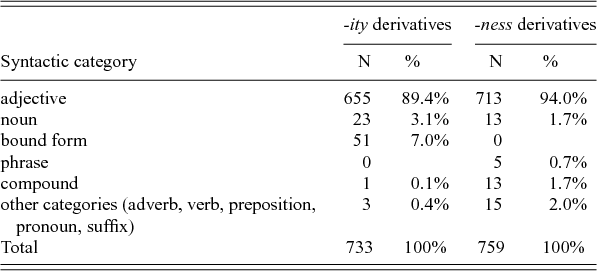
-ity/-ness derivatives by syntactic category of the base, eighteenth century