Introduction
After the Scopes Trial in 1925 and the subsequent establishment of evolutionary theory in state schools in the United States, there was a broad conviction among educated Westerners that the defeat of anti-evolutionist fundamentalism and probably all religion was a matter of time. But to the great surprise of many, religious activity including Creationism and Intelligent Design today enjoy a worldwide resurgence. The reason is simple: evolutionary theorists brought up far more scientific arguments – but committed believers in supernatural agents brought up far more children. (Blume, Reference Blume, Voland and Schiefenhovel2009)
In the past fifteen years there has been an increasing effort to explain the evolution of religiousness (for review see Kirkpatrick, Reference Kirkpatrick, Zigler-Hill, Welling and Shackelford2015). Although advances in this goal have been made, a crucial question has remained unanswered: is religiousness an evolutionary adaptation or a byproduct? Various authors believe that religiousness is a byproduct of evolution (Bourrat, Reference Bourrat, Heams, Huneman, Lecointre and Silberstein2015). Byproduct or spandrels do not have an adaptive function, which means that they did not enhance survival and reproduction in ancestral populations. Scholars think that religiousness can emerge as a byproduct of several psychological mechanisms: hyperactive cognitive heuristics for the detection of agency (Boyer, Reference Boyer2001; Atran & Norenzayan, Reference Atran and Norenzayan2004), as an extension of the attachment processes to supernatural beings (Kirkpatrick, Reference Kirkpatrick2005; Granqvist & Kirkpatrick, Reference Granqvist, Kirkpatrick and Pargament2013) or as a side-effect of evolved social cognition, which enables humans to infer the motives, emotions, goals and intentions of others (Bering, Reference Bering2011). On the other hand, a vast number of researchers think that religiousness is an adaptation: a characteristic that elevated human fitness. Several authors assume that religiousness promotes in-group co-operation based on honest signals of devotion to religious rituals and norms (Alcorta & Sosis, Reference Alcorta and Sosis2005; Bulbulia, Reference Bulbulia2012). The evolution of religiousness is certainly a problem of great complexity since social and cultural factors contribute to its potential biological adaptiveness (Rowthorn, Reference Rowthorn2011).
It is highly arguable whether the evolution of religion in ancestral populations is an empirical question at all; with the current methodology the answer to this question cannot be provided. This is why behavioural ecology focuses on examining the current adaptiveness of a behavioural trait. This is done by exploring the relations between a trait and evolutionary fitness, usually operationalized as reproductive success. Religiousness is a behavioural trait with substantial heritability; studies show that 27% to 65% of phenotypic religious expression can be explained by genetic contributions (reviewed in Kandler & Riemann, Reference Kandler and Riemann2013). Hence, if individuals with higher religiosity have elevated reproductive success, then natural selection could actively propagate alleles that contribute to the phenotypic expression of religious affiliation. In this case it could be reasonably assumed that religiousness does have an adaptive function in contemporary humans. And indeed, empirical data usually confirm the positive link between religiousness and number of children (Sanderson, Reference Sanderson2008; Blume, Reference Blume, Voland and Schiefenhovel2009; Fieder & Huber, Reference Fieder and Huber2016). It is important to note that religious affiliation may not be biologically adaptive by enhancing only individual fitness, but inclusive fitness as well. Inclusive fitness is a concept that emphasizes propagation of the shared genes between an individual and her/his kin; natural selection can positively act on a trait that contributes to kin survival and reproduction as well (Hamilton, Reference Hamilton1964). According to recent theoretical predictions, religiousness could boost inclusive fitness by emphasizing mutualism in family, kin altruism and social bonding (Crespi & Summers, Reference Crespi and Summers2014).
It is also important to reveal the specific ways the trait contributes to fitness, i.e. to explore the mediators in the religiousness–fitness link. Religions are generally pro-life orientated: major world religions often explicitly advocate a higher number of children and are often opposed to birth control (Sanderson, Reference Sanderson2008). This could be important in contemporary humans since they are characterized by conscious and intentional planning of reproduction. Hence, religious individuals could have a pronounced desire to have a larger number of offspring (Hayford & Morgan, Reference Hayford and Morgan2008). Attending religious services has been shown to be negatively associated with the time of first birth; religious individuals tend to reproduce earlier in their lifetime (Pearce & Davis, Reference Pearce and Davis2016). Having in mind that age at first birth is negatively related to completed fertility (Tropf et al., Reference Tropf, Stulp, Barban, Visscher, Yang, Snieder and Mills2015; Sanjak et al., Reference Sanjak, Sidorenko, Robinson, Thornton and Visscher2018), this could be another pathway religious individuals use to achieve higher fitness. Finally, religiousness may have a more indirect way to increase fitness – by enabling longer relationships between romantic partners. Previous studies have found that religiousness has a positive effect on commitment to marriage and marital satisfaction, and a negative effect on divorce rates (Mahoney et al., Reference Mahoney, Pargament and Tarakeshwar2002). Hence, it elevates the duration and quality of marital relationships, which may result in a higher number of offspring.
Life-history theory represents an evolutionary framework aimed at explaining the trade-offs in reproductive strategies (Del Giudice et al., Reference Del Giudice, Gangestad, Kaplan and Buss2016). The theory identifies two major reproductive trajectories with both costs and benefits regarding fitness. The fast life-history pathway is based on early reproduction, followed by a large number of offspring and low parental investment; the slow or K pathway is related to a later age of reproduction and smaller number of offspring with high parental effort. Religions tend to regulate many aspects of sexual, mating and partner behaviour (Baumard & Chevallier, Reference Baumard and Chevallier2015); these findings motivated some scholars to assume that religiousness was a life-history trait. Since religiousness is associated with lower sexual permissiveness, restricted sexuality and monogamy, several researchers have assumed that religiousness is a part of slow life-history trajectory (Gladden et al., Reference Gladden, Welch, Figueredo and Jacobs2009; Baumard & Chevallier, Reference Baumard and Chevallier2015; Schmitt & Fuller, Reference Schmitt and Fuller2015).
However, the role of religiousness in individual life-history strategies could be more complex. The dynamics of life histories are largely dependent upon the environment. Detrimental, scarce and unpredictable environments facilitate a fast life-history strategy, while rich, supportative and predictable enviroments enable the development of a slow life-history strategy (Del Giudice et al., Reference Del Giudice, Gangestad, Kaplan and Buss2016). Religiousness could also promote a fast life-history strategy, especially in unfavourable environmental conditions (Reynolds & Tanner, Reference Reynolds and Tanner1995). Furthermore, religious sentiment may be related to earlier reproduction, which is a key marker of a fast life-history pathway: religious affiliation is related to earlier age at first birth (Pearce & Davis, Reference Pearce and Davis2016) and higher rates of teenage pregnancies (Strayhorn & Strayhorn, Reference Strayhorn and Strayhorn2009). Hence, the assumption is that the life-history dynamics of religiousness are complex and involve both fast and slow life-history characteristics.
If religiousness contributes to fitness then its underlying gene alleles may be subject to positive directional selection. Consequently, this would mean that religiousness might be biologically adaptive in contemporary humans. Behavioural ecological research usually investigates behavioural dispositions shared by humans and other animals such as personality (Gurven et al., Reference Gurven, von Rueden, Stieglitz, Kaplan and Rodriguez2014) or cognitive traits (Međedović, Reference Međedović2017). However, it has been frequently argued that culturally shaped, complex social–psychological traits (values, lifestyles, attitudes, social norms), which are distinctive to humans, are important for their current fitness (Bouchard, Reference Bouchard, Voland and Schiefenhöven2009). The present study aimed to advance existing knowledge on religiousness’ role in fitness optimization. It leaned on previous research that analysed the relations between religiousness and fitness-related and life-history traits. However, it expanded on previous studies in several ways: 1) both reproductive success and parental investment as a more complete operationalization of fitness were measured (participants were selected to be at the end of the reproductive phase because fitness can be most validly estimated in this stage of the ontogeny); 2) several fitness-related outcomes (desired number of children, age at first reproduction and duration of partner relationship) were postulated as mediators in the link between religiousness and fitness; 3) the role of a harsh environment in these links were examined as well. Contingent on the research goals, the following hypotheses were developed. It was expected that: 1) religiousness would be positively related to harsh environment, fitness, desired number of children and relationship longevity (as an indicator of long-term mating); 2) religiousness would be negatively related to age at first birth; 3) the link between religiousness and fitness would be partially mediated by the desired number of children, age at first reproduction and the duration of partner relationship. Note that if religiousness is found to be positively associated to harsh environment and negatively to age at first birth, this would indicate that religiousness has some characteristics of the fast life-history pathway.
Methods
Sample
The study sample consisted of 461 individuals (54% females). The participants were the parents of psychology students at the Singidunum University of Belgrade, Serbia. Students asked their parents to fill in a questionnaire as part of a psychology course. Participation in the research was voluntary for both students and parents (students received additional ‘points’ if they volunteered to participate in the research). The questionnaires were put in envelopes and sealed by the study participants after they had been filled in, to ensure anonymity. The participants were not related; observations from only one parent per student (randomly assigned) were used. The mean age of participants was 51.75 years (SD = 6.56). Participants’ ages suggested that they were at the end of their reproductive lives at the time of data collection. If a limit for the end of the reproductive phase is set to 50 years in females and 55 years in males, it can be stated that 47% of females and 32.7% of males in the study sample were in the post-reproductive stage. Participants were more highly educated than average: 47.4% had completed faculty (4 or 5 years of college education), 30.4% had completed high school, while the rest had completed only elementary school.
Measures
Religiousness was measured using the abbreviated version of the Religiosity scale, which is part of the Arizona Life History Battery (Figueredo, Reference Figueredo2007). Five items on this scale that have been shown to have high reliability (α = 0.85) were administered.
Harsh environment was operationalized using two scales. Family dysfunction was measured using the Weak Socialization scale from the AMORAL inventory (Knežević, Reference Knežević2003). This scale measures various dysfunctional processes in the family during the participant’s childhood, operationalized by five items. Childhood Poverty was explored as well, using a four-item scale. Since these two measures correlated positively in the study sample (r = 0.33; p < 0.001), the total average score on all items was calculated and labelled as Harsh environment (α = 0.76 for the whole scale). These scales were self-report inventories with a standard Likert-type scale ranging from 1 to 5, where 1 stands for ‘I disagree completely’ and 5 stands for ‘I agree completely’. Higher scores represent a harsher environment.
Two measures were used to explore participants’ fitness. Reproduction Success was used as a major indicator of evolutionary fitness (participants were asked how many biological children they had). In addition, Parental Investment was measured using the Kin Care-Children scale (α = 0.64), which is part of the Fundamental Social Motives Inventory (Neel et al., Reference Neel, Kenrick, White and Neuberg2016). Furthermore, three additional indicators assumed to mediate the relation between religiousness and fitness were measured: 1) Age at first birth (participants were asked how old they were when they had their first child); 2) Planned number of children (participants were asked the following question: ‘When you started to think about having children, how many children in total did you want to have?’); 3) The duration of the relationship with their reproductive partner (participants were asked how long they were in a relationship with the partner they had children with; if participants had children with multiple partners they were asked to write the longest relationship with any of them). Items of the self-report inventories for assessing Religiousness, Harsh environment and Parental investment are shown in Table 1.
Items of the self-report scales for measuring Religiousness, Harsh environment and Parental investment

The last two scales were combined into the ‘Harsh environment’ measure.
Data analysis
First, the distributions of the reproductive success for the whole sample and separately for the two sexes were determined. Then, descriptive statistics for all measures, scale reliabilities and the two types of correlation on the whole sample were presented: zero-order correlations and partial correlations where participants’ sex and age were taken into account. Sex differences in analysed variables were determined, together with the correlations between all variables for males and females separately. Finally, path analysis was conducted to further examine the relations between the variables and to explore the postulated mediation role of age at first birth, desired number of children and relationship duration in the link between religiousness and fitness. Reproductive success and Parental investment as fitness components were set as criteria measures. Age at first birth, Relationship duration and Desired number of children were set as mediators, while Religiousness and Harsh environment were set as endogenous variables. All measures were modelled as the observable variables. It is important to highlight that age and sex were modelled in the path analysis as well, but these variables were not shown in the model in order to save space. All of the parameters were modelled except the correlation between sex and age and that between the two fitness components (since neither zero-order nor partial correlations suggested that there was a connection between these measures). Several goodness-of-fit indices were calculated in order to evaluate the ability of the model to adequately describe empirical data (Hu & Bentler, Reference Hu and Bentler1999): χ 2 as the most common parameter for evaluation of the discrepancy between the model and empirical data; Normed Fit Index (NFI); Comparative Fit Index (CFI); and the Root Mean Square Error of Approximation (RMSEA). The model with a high fit to the data should have a low χ 2 and RMSEA (below 0.060) and high CFI and GFI (above 0.90).
Results
The distribution of reproductive success by sex
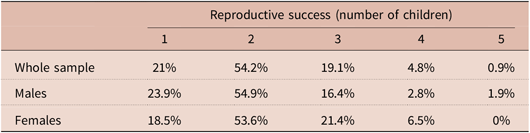
The study sample was somewhat specific due to a fact that all participants were parents. Hence, the distribution of Reproductive success for the whole sample and for males and females separately is shown first (Table 2). It can be seen that Reproductive success was very similar for the two sexes, with a median of 2 children for both males and females. It should be noted that the distribution of Reproductive success was significantly different for both the normal (Z = 6.50; p < 0.001) and Poisson distributions (Z = 3.62; p < 0.001) on the whole sample.
Distribution of reproductive success across the sexes

Descriptive statistics and bivariate relation with study variables
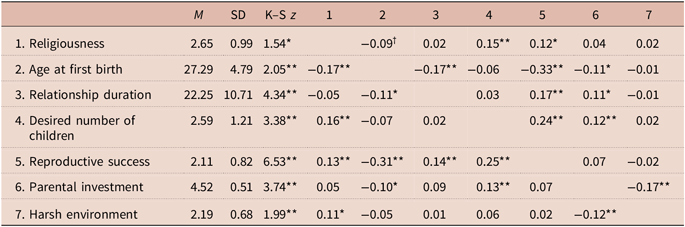
The descriptive statistics were described and normality tests for all analysed variables calculated. All of the Kolmogorov–Smirnov statistics were statistically significant, which suggests that variables deviated significantly from a normal distribution. Thus measures were normalized using Blom’s algorithm (Blom, Reference Blom1958) and the normalized variables were used in further analyses. Pearson’s coefficients of linear correlation between the analysed measures were calculated. Furthermore, partial correlations between the measures were obtained as well, with the variance of participants’ sex and age controlled for. These results are shown in Table 3 (zero-order correlations are shown below the diagonal, while the partial correlations are shown above the diagonal).
Descriptive statistics and correlations between the examined variables

K–S z: Kolmogorov–Smirnov statistic; Pearson’s bivariate correlations are shown below the diagonal; partial correlations (controlled for the variance of sex and age) are shown above the diagonal.
†p < 0.10; *p < 0.05; **p < 0.01.
Both zero-order and partial correlations produced similar results, which suggests that participant’s sex and age accounted only for a small amount of the covariance between the explored measures. Religiousness correlated negatively with Age at first birth and positively with Desired number of children and Reproductive success (although, this association was significant only in the subsample of male participants). Age at first birth was negatively associated with Relationship duration, Reproductive success and Parental investment. Individuals who had longer partner relationships had a higher number of children as well; desired number of children was positively related to both fertility and investment in children. Finally, individuals who grew up in a harsher environment showed less Parental investment. The only difference between the two types of obtained correlations emerged in the link between Religiousness and Harsh environment: the zero-order association turned out to be positive and significant while partial correlation was non-significant. All of the detected effect sizes were small to moderate.
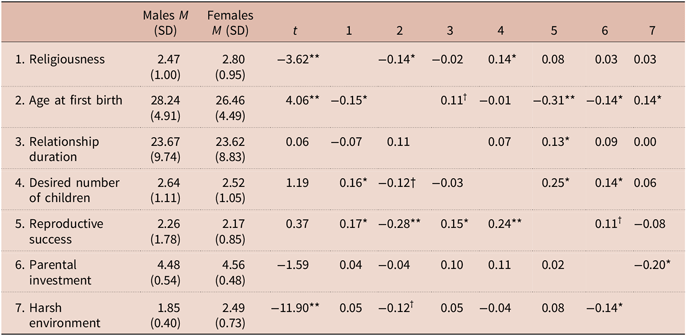
Mean levels of examined measures, together with the associations between them, may have been affected by sex differences. Thus a t-test was done to examine sex differences; furthermore, the correlations in the subsamples of males and females were obtained. These results are shown in Table 4. Three significant differences between the sexes were detected: females reported harsher environmental conditions in childhood and higher mean levels of religiousness; females also had earlier mean age when they had their first child compared with males. There was one important sex difference in regard to the associations between Religiousness and the other examined variables: the association between Religiousness and Reproductive success was positive and significant in males; the sign of the correlation was positive in females as well, but it did not reach statistical significance.
Sex differences and correlations between the examined variables by sex

M (SD): means and standard deviations. Correlations for males are shown below the diagonal; correlations for females are shown above the diagonal.
†p < 0.10; *p < 0.05; **p < 0.01.
Modelling the relations between the environment, religiousness and fitness-related outcomes
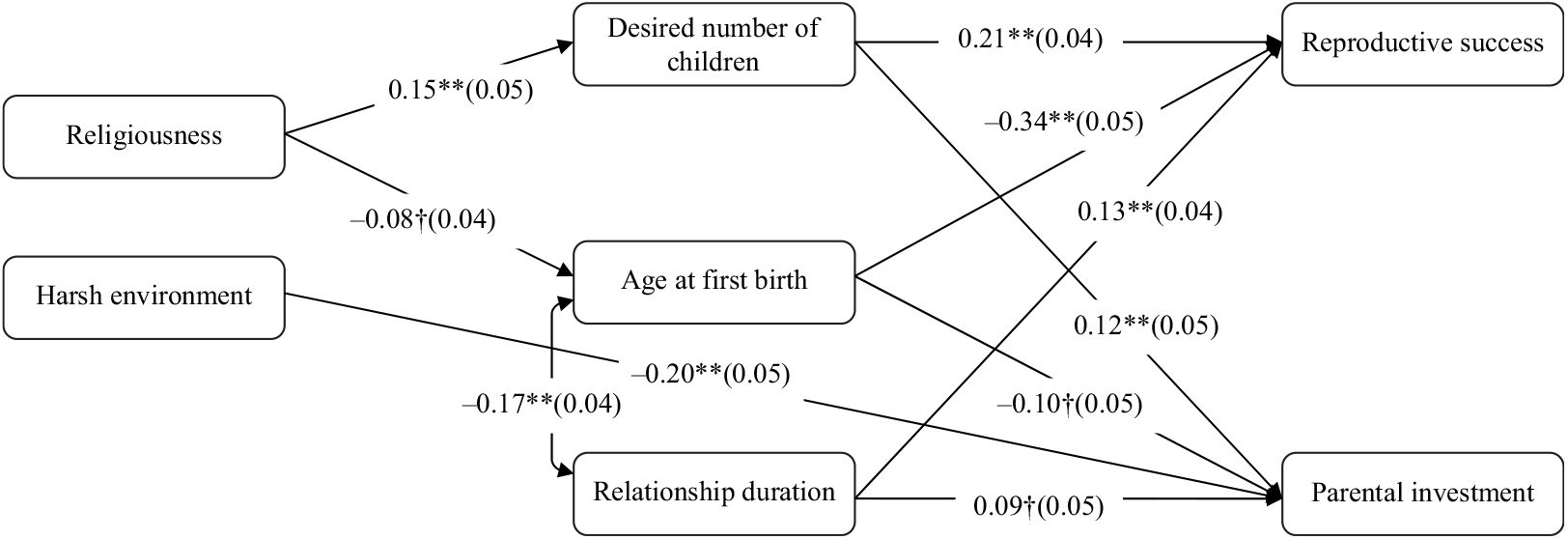
Finally, the path analysis that incorporated relations between Harsh environment, Religiousness and Reproductive fitness, including the role of potential mediators, was tested. Fit indices of this model were as follows:  $\chi^{2}_{(2)}=5.35$, p = 0.069; NFI = 0.990; CFI = 0.994; RMSEA = 0.060. It can be concluded that the model describes empirical data very well, which can be expected since the fit indices for the models comprised only of observed variables are usually high. The model was more successful in explaining the variance of Reproductive success (18% of explained variance) than Parental investment (7% of explained variance). The model is shown in Figure 1. In order to facilitate the analysis of the associations between the variables, only statistically significant parameters are shown (including marginally significant ones). It can be seen that the path coefficients mostly confirmed the partial correlations between the variables, which could be expected. However, there was an exception that is important for the goals of the present study: the path between Religiousness and Reproductive success was not significant in the model. This suggests that the link between religious affiliation and fertility was completely mediated by the planned number of children and (to a lower extent) Age at first birth.
Path analysis of the relations between environment, religiousness and fitness outcomes. Only statistically significant coefficients (including marginal significance) are shown; one-sided arrows represent hypothetical causal pathways; the two-sided arrow represents the correlation between the variables; standardized path coefficients are provided (except for one correlation); standard errors are shown in parentheses. †p < 0.10; *p < 0.05; **p < 0.01.

Discussion
The behavioural ecological framework enables the analysis of the evolution of any behavioural trait if the trait in question is genetically transmitted across generations. This can even be applied to complex, socially and culturally influenced traits such as religiousness. However, the trait can be targeted by natural selection only if it is related to evolutionary fitness. Furthermore, one of the fundamental assumptions of behavioural ecology is that individuals adapt to their local environments. The present research sought to explore the relations between religiousness and fitness, the potential mediators of this relation and the environmental conditions that could be involved in it. The study hypothesis was that religiousness is biologically adaptive (i.e. it is positively associated with fitness and other fitness-related outcomes, all except age of first reproduction where negative association was assumed) and that it emerges from harsh environmental conditions. These hypotheses were only partially confirmed. However, the study data provide a broader and more comprehensive view of religiousness in a behavioural ecological context, confirming its adaptiveness in a biological sense. Furthermore, it reveals some of the mechanisms that religious individuals use to achieve higher reproductive success. Finally, the results are implicative for the future life-history theory of religiousness.
The associations between fitness and fitness-related measures
From the viewpoint of behavioural ecology, it is very important to analyse the relations between measures connected with fitness. First of all, reproductive success and parental investment were found to be uncorrelated in the present research. This is not unusual – in fact, a negative correlation could be expected since number of children should be negatively related to parental investment in each of them; this is a major evolutionary trade-off called the ‘quantity–quality trade-off’ (Lawson & Mace, Reference Lawson and Mace2009). The absence of a negative correlation probably stems from the fact that the research was conducted in a low-fertility population, while the magnitude of this trade-off is higher in populations with elevated mean reproductive success (Ross et al., Reference Ross, Mulder, Winterhalder, Uehara, Headland and Headland2016).
Age at first birth was found to be negatively related to both fitness indicators. This finding confirms earlier findings of a negative directional selection on the timing of first reproduction: individuals who have their first child earlier in their lifetime have higher overall fitness (Tropf et al., Reference Tropf, Stulp, Barban, Visscher, Yang, Snieder and Mills2015; Sanjak et al., Reference Sanjak, Sidorenko, Robinson, Thornton and Visscher2018). The desired number of children was positively related to both fitness measures as well. At first glance, this may sound like a trivial finding, but actually it is very important since it shows unique features of contemporary human evolution: fertility in humans is based on, but far from completely determined by, intentional motivation and planning (Johnson-Hanks, Reference Johnson-Hanks2008). Furthermore, it is at least partially subject to conscious control via contraception and other birth control measures. Finally, the duration of the partner relationship is positively related to reproductive success and negatively related to age at first birth: the longer individuals are in a romantic relationship, the earlier they become parents and they have more children. It is important to note that these links were unchanged when participants’ age was controlled in the analysis. Thus, long-term mating is apparently evolutionarily adaptive. This is in line with the theories that assume that long-term mating is a dominant mating pattern in humans since human offspring need elevated care and investment from both parents (Stewart-Williams & Thomas, Reference Stewart-Williams and Thomas2013). In sum, the obtained data regarding the relations between fitness-related outcomes are quite congruent with previous findings and life-histories of contemporary humans.
Behavioural ecology of religiousness
Religious individuals have been shown to desire a higher number of children at the beginning of their reproductive phase, and they have their offspring earlier in their lifetime (although this link was rather weak in the present research) and have higher total fertility in general (this association was pronounced particularly in males, but it did not reach statistical significance in a subsample of females). However, they did not show elevated parental investment. A positive relation between religiousness and parental investment was assumed since religiousness is related to a closeness towards family members and family values in general (Jensen & Jensen, Reference Jensen and Jensen1993). The absence of this link may suggest that religious individuals are oriented towards offspring quantity but not necessarily offspring quality as a way of optimizing fitness.
A positive link between religiousness and reproductive success has been empirically obtained in previous research (Sanderson, Reference Sanderson2008; Blume, Reference Blume, Voland and Schiefenhovel2009; Fieder & Huber, Reference Fieder and Huber2016). The present study also found a positive link between religiousness and the desired number of children. These data are in line with a previous finding that shows positive attitudes of religious individuals towards childbearing (Hayford & Morgan, Reference Hayford and Morgan2008). Furthermore, major religions often advocate a higher family size (Sanderson, Reference Sanderson2008). Previous research has also obtained evidence that religious individuals tend to have their first child earlier in their lifetime (Pearce & Davis, Reference Pearce and Davis2016). This was confirmed in the present study, although the link was relatively weak (i.e. only marginally significant in multivariate analyses). Finally, religiousness may enable high fitness in a somewhat indirect way: by facilitating longer romantic relationships via commitment to marriage, marital satisfaction and lower risk of divorce (Mahoney et al., Reference Mahoney, Pargament and Tarakeshwar2002). However, this link was not detected in the present data and this was the only fitness-related outcome that was not associated with religiousness. It is important to note that desired number of children and age of first birth completely mediated the link between religiousness and reproductive success. This was not expected due to a fact that there could be other mediators of this link; however, this result only highlights the role these two variables have in elevating the fitness of religious individuals.
In sum, the data obtained in the present research are in line with previous results suggesting that religiousness is probably under positive directional selection on fertility. Thus, selection acts positively on the genetic basis of religious attitudes. Note that this does not necessarily mean that higher phenotypic levels of religiousness in the upcoming generations should be necessarily expected. Many complex cultural and environmental factors act on the phenotypic development of religious attitudes and some of them may be opposed to selection. This is why the frequency of religious commitment has in fact been found to fall in Western populations (Zuckerman, Reference Zuckerman2015). The complexity of the biological and environmental factors that shape religiousness prevents the prediction of its phenotypic levels in future populations.
Towards a future life-history theory of religiousness
Previous findings of negative associations between religiousness, sexual permissiveness and restricted sexuality together with positive associations with serial monogamy suggest that religiousness is part of a slow life-history trajectory (Gladden et al., Reference Gladden, Welch, Figueredo and Jacobs2009; Baumard & Chevallier, Reference Baumard and Chevallier2015; Schmitt & Fuller, Reference Schmitt and Fuller2015). However, this view may be oversimplified. If religiousness emerges from a harsh environment and enables earlier reproduction this would mean that it has the characteristics of the fast life-history trait as well. These associations were obtained in the present research although they were fragile. The positive link between harsh environment and religiousness was heavily dependent on the participants’ sex and age. The negative link between religiousness and age at first birth was low in magnitude and marginally significant. However, these associations have been found in previous studies as well, and with more convincing effect sizes (Delamontagne, Reference Delamontagne2010; Pearce, Reference Pearce, Hummer and Ellison2010; Solt et al., Reference Solt, Habel and Grant2011; Pearce & Davis, Reference Pearce and Davis2016). It should be noted that elevated offspring quantity, which is clearly associated with religiousness, is the most important indicator of a fast life-history pathway in the first place. All these data suggest that religiousness indeed has some attributes of a fast life-history trajectory.
The present study was cross-sectional by design, which prevented making conclusions about the causal relations between the measures. However, perhaps a hypothesis of religiousness’s involvement in life-history trajectories can be made. The existing data suggest that the life-history characteristics of religiousness are contingent on the stages of ontogeny. In earlier stages of development religiousness delays mating activity (expressed, for example, in negative associations between religiousness and the onset of sexual behaviour: Jones et al., Reference Jones, Darroch and Singh2005), which means that it has slow life-history attributes. However, in the reproductive stage itself, it is associated with earlier marriage and reproduction, thus acting as a fast life-history phenotype. When family is constituted, religiousness again turns to the slow life-history trait by decreasing sexual permissiveness and promoting monogamy. Hence, the life-history characteristics of religiousness are different during the ontogeny. This proposition may be labelled as an ‘ontogeny-dependent life-history theory of religiousness’. This hypothesis may be tested in future studies using a longitudinal approach.
Limitations and future directions
Some of limitations of the study have already been mentioned. The cross-sectional design of the study did not allow the causal influences between variables to be inferred. This was especially important for the present topic as it would be very important to know when the religious sentiment was developed in ontogeny. Only then can the hypothesis of the different life-history characteristics of religiousness throughout the ontogeny be tested. Another limitation was the sample structure. The study sample was not representative, and probably consisted of more educated individuals with a relatively higher socioeconomic status (this may be the reason why the link between harsh environment and religiousness was relatively weak; environmental harshness was relatively low in the present sample). The sample structure required caution when generalizing the study results to the whole population. Finally, some of the study variables could have been operationalized using a more objective measurement, particularly for harsh environment and parental investment measures. Using self-reported measures made data collection easier, but such measures have issues that may limit their validity (e.g. recollection of the environmental characteristics in childhood).
Suggestions for future research are numerous as the behavioural ecological research of religiousness is still in its infancy. Additional moderators of the religiousness–fitness link can be tested: for example, lack of motivation to use contraception and opposition to abortion, which could also lead to higher reproductive success (Bahr & Marcos, Reference Bahr and Marcos2003). Since previous research has shown that religiousness can elevate not only individual fitness, but inclusive fitness as well (Crespi & Summers, Reference Crespi and Summers2014), some form of inclusive fitness (e.g. kin altruism) should be set as a criterion variable in future research. Previous studies have also shown that there is relatively high assortative mating on religiousness (Watson et al., Reference Watson, Klohnen, Casillas, Nus Simms, Haig and Berry2004): this could lead to multiplicative fitness benefits in religious couples. The present findings suggest that future research, not only for religiousness but also for similar attitudinal dispositions (e.g. traditionalism, conservatism etc.), looks very promising. This would provide a new possibility for behavioural ecology to explore complex human behavioural dispositions and to establish new links between cultural characteristics and fitness-related outcomes in contemporary humans. Having in mind that cultural factors do have an important role in the biological evolution of humans, this could provide new insights into the patterns and consequences of natural selection in human populations.
Funding
The study was financed by the Serbian Ministry of Education, Science and Technological Development, Project 47011, realized by the Institute of Criminological and Sociological Research.
Conflicts of Interest
The author has no conflicts of interest to declare.
Ethical Approval
The author asserts that all procedures contributing to this work comply with the ethical standards of the relevant national and institutional committees on human experimentation and with the Helsinki Declaration of 1975, as revised in 2008.