Introduction
During the interwar years, British Malaya’s canned pineapples were known as the “poor man’s dish,” as they were the cheapest and most consumed preserved fruit among the working class of Britain and its Dominions.Footnote 1 Chinese entrepreneurs who resettled in British Malaya—colonies under the British Empire comprising Malaya and Singapore—were the key players of the canned pineapple industry, which was established in the late 19th century before the emergence of large-scale rubber plantations.Footnote 2 Nevertheless, given British Malaya’s position as the world’s largest rubber and tin producer in the early 20th century, the pineapple industry (hereafter known as the Malayan pineapple industry) was of marginal importance.Footnote 3 Current historiographies and colonial government reports have mainly portrayed the Malayan pineapple industry as problematic and relatively backward, mainly due to its lack of mechanization which caused the product to be inferior and cheap.Footnote 4
This study examines how Chinese entrepreneurs pursued cheapness as a distinct marketing strategy to counter constraints in mechanization that arose from the rubber plantation-export complex under British colonialism. Using previously unexamined newspaper reports, this study analyzes the roles of two representative pineapple entrepreneurs, Tan Kah KeeFootnote 5 (1874–1961) and Lee Kong ChianFootnote 6 (1893–1967), to understand the following: 1) why the Malayan pineapple industry did not adopt vertical integration like the rubber industry despite rising demand for canned pineapples; 2) how the industry stayed afloat despite the serious impairment it faced from the lack of mechanization and branding. This study investigates the contexts of their strategies against a broader and comparative political economy framework under British colonialism, which differed from the industrial logic that drove the Hawaiian industry to be capital-intensive.
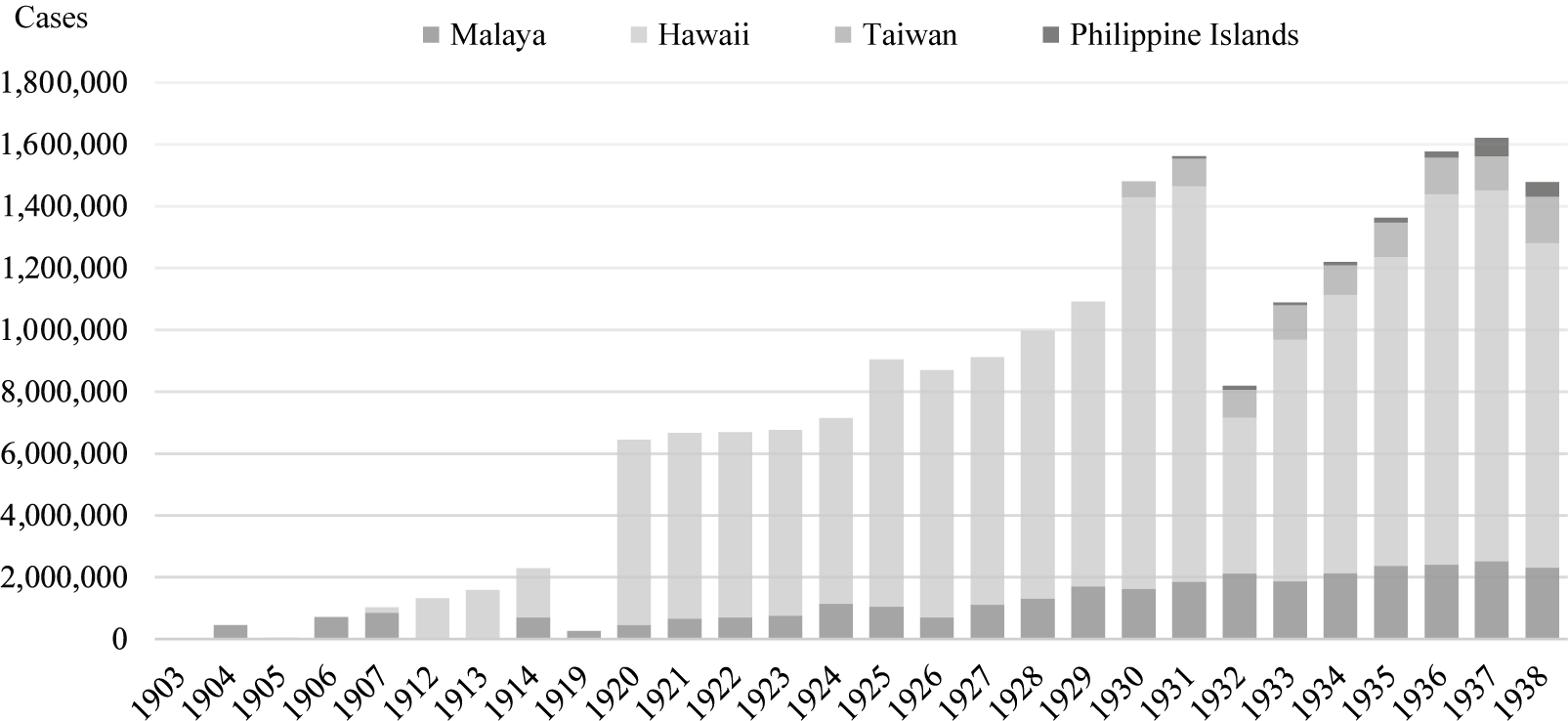
Histories of fruit canning in the early twentieth century have mainly elucidated the importance of technological innovations and sophisticated marketing in enabling Western enterprises to achieve scale and scope. The Hawaiian Pineapple Company, for instance, transformed Hawaii into the world’s largest and most renowned canned pineapple producer by implementing superior canning technologies, branding initiatives, and industrial organization.Footnote 7 Across the Pacific Ocean, British Malaya’s production stood in stark contrast to Hawaii’s; it was the world’s second-largest canned pineapple producer—a position it held until after the Second World War (see Figure 1)—but its growth trajectory was constrained by the rubber economy that disincentivized entrepreneurs from investing in mechanization, as well as limited their marketing and industrial organization capabilities.Footnote 8
Canned pineapples produced for export by territory, 1903–1938.
Sources: Author’s own. Clarence Birgfeld, Fruit Canners of the World (Washington, DC, 1939), 2–3; “The Pineapple Industry,” Malaya Tribune, April 28, 1917, 2; “Pineapple Industry,” Straits Times, September 2, 1908, 7; “Pineapple Growing,” Malaya Tribune, August 20, 1921, 7.

Figure 1. Long description
The vertical Y axis is labeled Cases and ranges from 0 to 1,800,000 in increments of 200,000. The horizontal X axis lists years from 1903 to 1938. The data is presented as stacked bars with four categories from bottom to top: Malaya (medium gray), Hawaii (light gray), Taiwan (lightest gray), and Philippine Islands (dark gray).
Key trends include:
* 1903 to 1919: Production is low, primarily dominated by Malaya and Hawaii. Malaya shows early peaks in 1904 and 1907, while Hawaii begins significant growth around 1912.
* 1920 to 1931: A period of rapid expansion. Hawaii becomes the dominant exporter, with its segment of the bar growing significantly. Total cases rise from approximately 650,000 in 1920 to a peak of nearly 1,600,000 in 1931.
* 1932: A sharp decline in total production to approximately 800,000 cases, with Hawaii's share shrinking significantly.
* 1933 to 1938: Recovery and diversification. Total production climbs back to over 1,600,000 cases by 1937. During this period, Taiwan and the Philippine Islands appear as visible segments at the top of the bars, while Malaya maintains a steady base of approximately 200,000 to 250,000 cases annually.
Departing from the dominant narratives of entrepreneurs’ lack of commitment in mechanization to upgrade the Malayan pineapple industry, this article focuses on their marketing strategies and argues that Tan and Lee actively leveraged colonial ties and production cheapness to capture imperial markets. The entrepreneurs lobbied for government policy intervention on the industry, reframed cheapness from a weakness to a competitive advantage in marketing and leveraged the “Buy Empire” policy to keep Malayan pineapples more attractively priced than Hawaiian pineapples. By tracing the historical processes in rebranding cheapness as a competitive advantage for Malayan pineapples, this study elucidates the diverse characteristics of entrepreneurial agency within the broad structures of colonialism’s political economy and colonial administrators’ ambivalence towards industrializing colonies.
This study expands the Malayan pineapple industry’s current historiography by situating the industry’s position within the broader debates on imperial marketing, commodity chains, and local entrepreneurship. It contributes to the literature of Chinese entrepreneurship and imperial economic studies of British Malaya on two levels. First, by elucidating the marketing strategies which Chinese entrepreneurs devised within a colonial framework to reach Western consumer markets, it adds nuance to the literature on local entrepreneurship and the trajectories of a secondary commodity sector in British colonies. Second, it challenges the predominantly ethnically essentialist readings of Chinese business strategies under colonialism of Southeast Asia. This study broadens research on Chinese entrepreneurship in colonies by demonstrating how intra-ethnic cooperation was not a given, as the entrepreneurs repeatedly failed to restructure the industry among themselves. Instead, Chinese entrepreneurs in colonies found it more useful to leverage colonial and imperial ties to navigate colonial logic in commodity trade and production, even though their success was transient.
This study mainly consulted newspaper articles from colonial Singapore that were previously unexamined. While these newspapers are also colonial sources and primarily in English, hitherto unexamined letters by Tan and Lee revealed their active lobbying for the industry. These primary sources are consulted alongside colonial archives on the pineapple production and trade, namely the Malayan Agricultural Journals issued by the Department of Agriculture, archives on the Empire Marketing Board’s meeting with pineapple entrepreneurs, and the colonial administrators’ views on the Malayan pineapple industry in the Report of the Pineapple Conference 1931.
This study’s arguments and findings are organized in three sections. First, pineapple’s relationship to rubber, which set the historical conditions and constraints on the pineapple industry. Second, Tan’s appeal for government intervention, and the implication of Malayan pineapples’ marketing positioning as empire produce by the Empire Marketing Board and Malayan Information Agency. Third, branding restrictions and the entrepreneurs’ rebranding of cheapness as a strategic advantage in the metropole and dominion markets.
The Intersections of Chinese Entrepreneurship, Imperial Marketing, and Canned Pineapples
Businesses in the emerging markets of Asia, Africa, and Latin America are profoundly shaped by colonial experiences, migrant entrepreneurs, and corporate strategies to manage political and economic volatility that differ from North American and Western European experiences.Footnote 9 In recent years, a growing body of business histories from emerging markets, especially from China and India, underscores the importance of integrating the diversity of contexts into “core” business history.Footnote 10 From this perspective, Southeast Asia—a region with histories of colonial domination from the seventeenth century to the twentieth century and plural societies—provides rich empirical investigations on the diverse conditions and contexts that shape emerging economies’ contemporary business environments.Footnote 11
The basis for Southeast Asia’s economic development is its geography. The region straddles the equator between south of China and east of India, making it a central location among the main maritime trading routes in Asia since the fifteenth century. Historian Anthony Reid described the sixteenth century as the “Age of Commerce” for Southeast Asia, whereby merchants from Asia, Europe, and the Middle East exchanged cosmopolitan worldviews through trade.Footnote 12 Nevertheless, Western colonialism disrupted inter-ethnic maritime trade and reorganized the region as cash crop production centers to fuel Western industrialization. The Chinese trading class reconfigured their economic roles by becoming tax farmers in colonies and utilized their local knowledge and networks to function as middlemen between local elites and colonial administrators, which enabled them to exploit opportunities in resource-based businesses.Footnote 13
In the Malay Peninsula (known as Malaya by British colonists) and Singapore, Chinese entrepreneurs were active in tin mining and opened new frontiers in export-oriented agribusinesses such as tapioca, gambir, pepper, and sugar alongside European planters.Footnote 14 Until the domination of Europeans in rubber in the early twentieth century, Chinese planters had exhibited successes in navigating the speculative nature of plantation businesses by securing finances and labor supply through kin-based clan associations, known as the kongsi system.Footnote 15 Management scholars have predominantly described Chinese economic dominance in British Malaya, and to a larger extent, Southeast Asia, as a culturally driven phenomenon, and argued that its exceptionalism was inherently tied to its ethnicity.Footnote 16 However, in recent years, historians and economists have called out the culturalist models as exaggerated and ahistorical, as they ignored the fluid political conditions that shaped Chinese entrepreneurs’ economic behavior.Footnote 17 As Xiao An Wu contended in his thesis on Chinese networks in nineteenth century Malay states, interdependency among Chinese entrepreneurs, colonial governments, and indigenous rulers was also crucial to their successes.Footnote 18
Recent historical research has suggested that Chinese entrepreneurship from the early twentieth century cannot be neatly categorized within a political-economic framework, given their multiple interests straddling nationalism, identity construction, and business modernization. For instance, in Kuo’s analysis of Chinese rubber entrepreneurs’ nationalist and anti-Japanese sentiments, she argued that Chinese entrepreneurs utilized dual identities as Chinese nationals and British colonial subjects to counter Japanese cheap imports into Singapore, which fueled tensions between local entrepreneurs and the colonial government.Footnote 19 Through analyzing how Lim Peng Siang diversified his interests from shipping to banking in twentieth-century Singapore using extra-familial networks of capital and technological expertise, Goh and Koh demonstrated a more complex interplay between tradition and modernization in business strategies than essentialist readings on Chinese entrepreneurs afforded.Footnote 20 As William Tai Yuen contended, Chinese capitalism in Southeast Asia evolved from the historical processes of combining “Chineseness” and “coloniality” within the colonial framework.Footnote 21 Nevertheless, the dominant framing of research on Chinese entrepreneurship remains predicated on narratives of success, which underplay their entrepreneurial strategies as coping mechanisms to navigate business and identity precarity under colonialism.
Being two of the most prolific entrepreneurs in the twentieth century, Tan Kah Kee and Lee Kong Chian have received much scholarly attention for their legendary successes in rubber businesses and philanthropic contributions toward British Malaya’s social institutions.Footnote 22 Their modernization of the Malayan pineapple industry in the early twentieth century, however, was generally evaluated as unsuccessful. For instance, Brown utilized the Malayan pineapple industry as a case study to illustrate the consequences of weak entrepreneurship in the long-term development of colonies, whereby local entrepreneurs’ unwillingness to vertically integrate hindered the expansion of large-scale manufacturing.Footnote 23 Her assessment was built on Hawkins’ earlier comparative study of the Hawaiian, Malayan, and Taiwanese pineapple industry during the interwar years, which argued that Malaya had “low standards of production, lack of investment and the total lack of coordination among the canners.”Footnote 24 As Tate contended in The RGA History of the Plantation Industry in the Malay Peninsula (commissioned by the Rubber Growers’ Association comprising British plantation owners in Ceylon and Malaya and published in 1996), the pineapple industry “operated within a vicious circle of poverty,” whereby temporary canners flooded the market with poorly produced canned pineapples and perpetuated its cheapness.Footnote 25 Three decades later, a most recent historical overview of the Singaporean canned pineapple industry published in The Pineapple from Domestication to Commodification concurred with the thesis that the fate of the industry was mainly shaped by Chinese entrepreneurs’ regard for canned pineapples as a transient commodity.Footnote 26 While this research has lent useful insights into understanding the shortcomings of the Malayan pineapple industry within a colonial economic framework, they have not sufficiently examined how product innovation and quality were driven by social constructs embedded within the broader structures of imperialism, and how the local entrepreneurs responded to Western consumer markets through marketing strategies.Footnote 27
Recent scholarship of global histories of pineapples has expanded the scope beyond nationally-bounded narratives by centering Hawaii’s experiences to critically examine how the crop’s ascent in global consumption overlapped with imperial histories, consumerism, and the rise of modern marketing and production technologies.Footnote 28 In A Pacific Industry: A History of Pineapple Canning in Hawaii, Hawkins argued that the Hawaiian industry’s success depended not only on technological innovations backed by a large capital base and government’s support for industrialization, but also on the transformation of market conditions that led to the development of a mass market in continental US.Footnote 29 By contrast, the Malayan pineapple industry had less supportive environment and access to infrastructure to thrive in the early twentieth century. Based on the prevailing logic of the colonies’ role as the world’s largest tin and rubber producers, Loh argued that the British Malayan government developed a policy environment that ranged from benignly unsupportive to outrightly apathetic of Chinese entrepreneurs’ attempts to develop a secondary industry.Footnote 30
Given the ultimate importance of rubber production to Western industrialization, European agency houses played a crucial role in connecting rubber production to global markets, and diversification into oil palm plantation from the 1920s, but showed little interest in entering the canned pineapple industry or manufacturing in general until the 1930s.Footnote 31 As Huff contended, under a colonial framework that was highly vulnerable to boom-bust commodity cycles, it was “the weight of incentives, not shortsightedness, irrationality, or a trading mentality” that largely explains why Malaya’s industrialization was unmeaningful during the colonial period.Footnote 32
While the colonial framework has provided deeper understanding of how the Malayan pineapple industry faced structural limitations under British rule, the historiography remains incomplete as it has not sufficiently included the Chinese entrepreneurs’ agency and adaptive strategies in navigating the colonial framework. As Roy and Gardner argued, a narrow focus on entrepreneurs’ limitations under colonialism skewed the entrepreneurial histories of the indigenous and local communities.Footnote 33 A way to move beyond the binary relationship between colonialism and local entrepreneurship is to study the metropole-colony relations from a shared spatial perspective.Footnote 34
The marketing campaigns of the Empire Marketing Board (EMB) hold potential as an empirical site to analyze colonial networks within a shared space. In 1926, Leo Amery, Secretary of State for the Colonies (1924–1929), established the EMB to increase British and British Empire food product consumption and reduce dependency on foreign imports as part of a wider ambition to develop colonies.Footnote 35 Historiographies of the Board’s campaigns have conventionally posited its limited success in constructing a political idea of “empire” through shaping consumer preference for empire products.Footnote 36 As a recent study by David Higgins and Aashish Velkar on blended teas—an essential empire product that was produced in India but blended and packaged in Britain—showed, tea retailers and producers were unable to transfer British patriotism into consumption patterns, as brands and prices were more decisive factors than the product of origin.Footnote 37 Studies on the EMB’s promotion of empire goods until its demise in 1933 have also mainly analyzed dominion products premised on selling Whiteness and Britishness to connect producers with consumers, especially in the metropole.Footnote 38
Departing from empire marketing in British Empire dominions, a recent study by Mokhtar, Samsudin, and Mansor on the Malayan pineapple industry shows how a joint effort by colonial administrators and the EMB was crucial in expanding the pineapple industry to imperial markets.Footnote 39 While the study has insightfully highlighted the importance of colonial government intervention in the industry in the early 1930s, a systematic analysis of the industry’s legacy weaknesses and the local entrepreneurs’ adaptations to shifting empire interests in colonies was underplayed. Further, in contemporary consumer culture, cheap manufactured products from developing economies resemble the characteristics of the Malayan pineapples, as they provide lower-class consumers with affordable access to modernity, while suffering from unshakeable reputational risks of being low quality and unreliable.Footnote 40 Historical scholarship on consumer culture, however, has not explicitly explored the discourse of cheapness and the ambivalent attitudes in marketing colonial products to consumers in imperial markets.
The availability of digitized newspaper archives as a research tool has made it possible to conduct a fuller inquiry into the dynamics of the Malayan pineapple industry and situate studies on Chinese entrepreneurship in Southeast Asia within broader colonial networks. Details on financing the pineapple trade and the industry’s growth and decline were most vividly described in a biography of Tan, titled Tan Kah-Kee: An Overseas Chinese Legend, by C. F. Yong, and was based on Tan’s original diaries in Chinese.Footnote 41 Even so, in his diaries, Tan left out details about his attempts to upgrade the industry in the 1920s and early 1930s. By including these sources in reevaluating the Malayan pineapple industry, this study positions the relationship between colonialism and ethnic entrepreneurship as highly flexible and dynamic.Footnote 42
A Rubber-Pineapple Complex: Structural Constraints on the Malayan Pineapple Industry
The Malayan pineapple’s cheapness was path-dependent upon the wider political-economic framework of industrial agriculture under British rule. The first condition that shaped the pineapple industry’s trajectory into a cheap product was a conducive climate that supported its cultivation practices. The pineapple, Ananas comosus, is a tropical fruit native to South America, which Spanish and Portuguese traders brought to Singapore in the sixteenth century.Footnote 43 From the mid-1800s, Chinese planters began small-scale pineapple cultivation, and sold the fresh fruit whole or in slices, to the extent that “the pineapples’ rich perfume pervades the streets.”Footnote 44
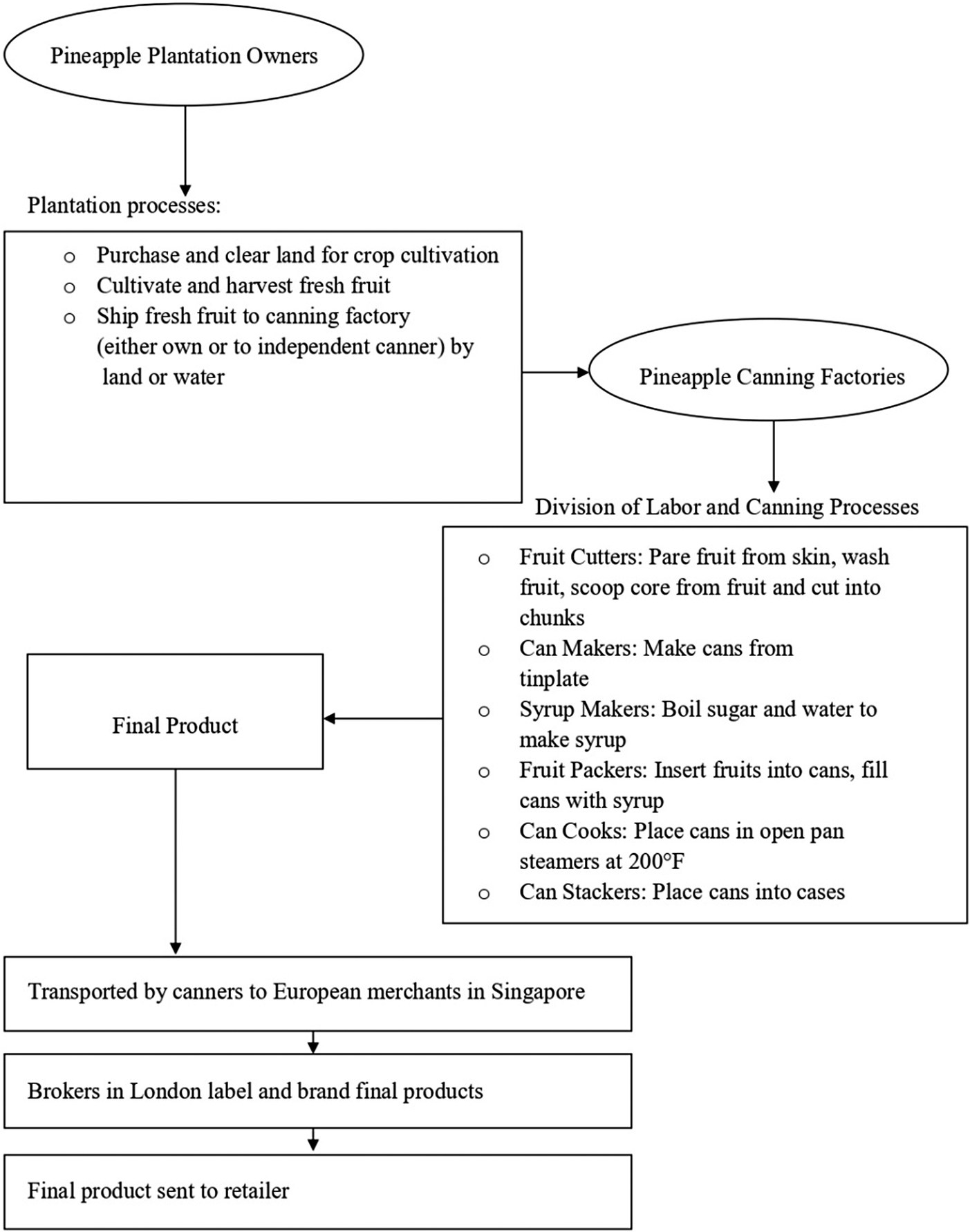
The invention of the tin can created export opportunities for the Singaporean pineapples, which French Corsican entrepreneur M. Joseph Bastiani had the greatest success in exploiting in the 1870s.Footnote 45 Nevertheless, he closed his pineapple canning business in Singapore and returned to Nice, France, where he continued his fruit preserving business.Footnote 46 Thereafter, Chinese planters began vertically integrating into canning businesses and producing canned pineapples for export (see production processes in Figure 2).Footnote 47 The key enterprises were Chin Giap Pineapple Company, Jit Sin, Seah Eng Kiong, Hin Choon & Co., and Tek Watt, which wealthy Chinese entrepreneurs owned.Footnote 48 Tan Kah Kee’s father operated Jit Sin, which was among the largest pineapple plantations and canning factories in Singapore, and produced 70 percent of the exports in 1900.Footnote 49
Pineapple canning processes in the early twentieth century.
Sources: Author’s own. Wright and Cartwright, Twentieth Century Impressions, 594; Tan, “The Colonial Port,” 9.

Figure 2. Long description
The flowchart begins at the top with an oval labeled Pineapple Plantation Owners. An arrow points down to a box titled Plantation processes which lists three bullet points: Purchase and clear land for crop cultivation; Cultivate and harvest fresh fruit; and Ship fresh fruit to canning factory (either own or to independent canner) by land or water.
An arrow from this box points right to an oval labeled Pineapple Canning Factories. Below this oval is a large box titled Division of Labor and Canning Processes containing six roles:
* Fruit Cutters: Pare fruit from skin, wash fruit, scoop core from fruit and cut into chunks.
* Can Makers: Make cans from tinplate.
* Syrup Makers: Boil sugar and water to make syrup.
* Fruit Packers: Insert fruits into cans, fill cans with syrup.
* Can Cooks: Place cans in open pan steamers at 200 degrees Fahrenheit.
* Can Stackers: Place cans into cases.
An arrow points left from this box to a central box labeled Final Product. From the Final Product box, a vertical sequence of three boxes follows:
1. Transported by canners to European merchants in Singapore.
2. Brokers in London label and brand final products.
3. Final product sent to retailer.
By 1901, Singapore supplied 75 percent of the canned pineapple exports, under various brands such as “Tiger,” “Defiance,” and “Sultan.”Footnote 50 Entrepreneurs sold canned pineapples to local exporters who, in turn, shipped the products to various territories in East Asia, Europe, and the US.Footnote 51 A newspaper article written in 1932 claimed that the Singaporean industry’s early success in 1900 apparently caught “so much attention that the Americans who had then just begun to can their Hawaiian pines, sent a deputation to Singapore to study the conditions of the trade here.”Footnote 52 The Hawaiian industry had begun in 1898 by several Californian entrepreneurs who migrated to Hawaii, following the US’s annexation of Hawaii and shortly before James D. Dole’s arrival in 1899.Footnote 53 In 1903, Dole set up the Hawaiian Pineapple Company and exported its first batch of canned pineapples containing 1,800 cases.Footnote 54 By 1908, the tables had turned, with the colonial newspapers reporting on the “serious competition” which the Dole-led Hawaiian industry posed to the Singapore canned pineapple trade.Footnote 55 When the Hawaiian industry introduced the Ginaca machines that automated the coring and peeling of pineapples in 1911, it decisively trumped the Singaporean production (refer to Figure 1). Alexis Shriver, a US Department of Commerce officer who observed Singapore’s pineapple industry in 1913, commented that the Singaporean canneries also had limited access to sophisticated machinery, as there were no demonstrations of actual machinery from representatives, unlike in the US.Footnote 56
In the early twentieth century, capitalists, entrepreneurs, and colonial administrators of British Malaya adapted to the modes of industrialized agriculture, namely in rubber-planting.Footnote 57 The development of large-scale rubber plantations played a decisive role in shaping the possibilities and constraints for entrepreneurial action in the pineapple industry, mainly because of rubber’s long investment period. Rubber trees take at least six years to mature, during which planters undertake high financial risks in planting, supervising labor, and maintaining the estate before the trees start producing latex.Footnote 58 Large-scale rubber plantations materialized mainly through European participation and London capital, as European bank branches operating locally were confined to trade financing and refused to provide long-term loans to Chinese entrepreneurs.Footnote 59
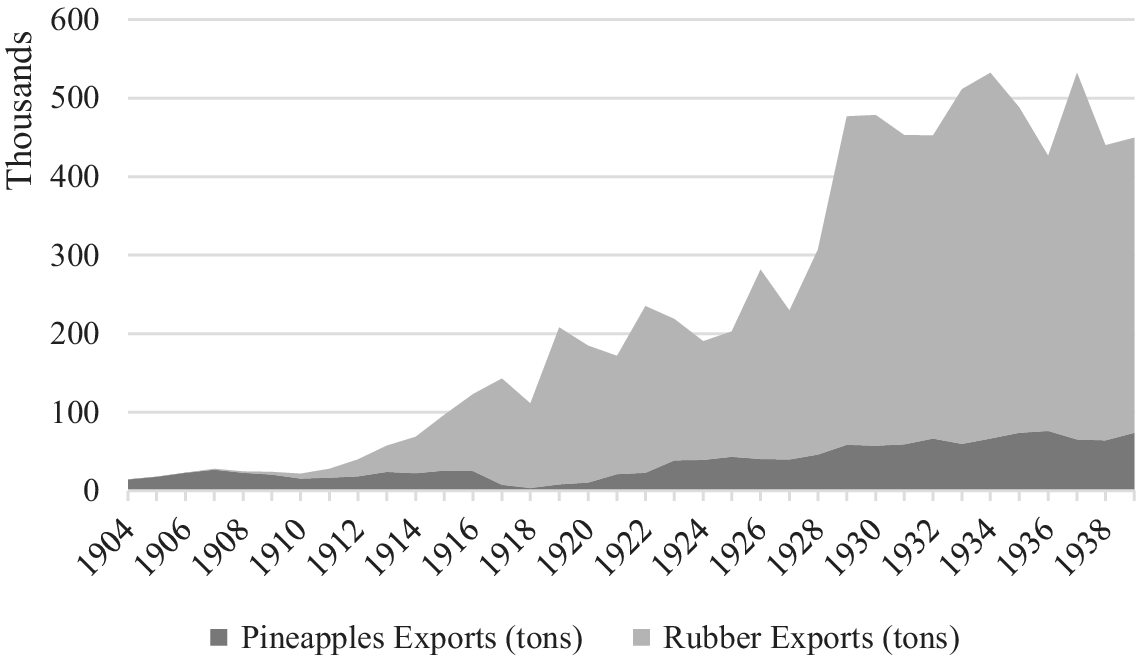
Excluded from Europeans’ access to capital, Chinese entrepreneurs in Singapore gained working capital to participate in rubber-planting by sharecropping pineapples with rubber, a practice initiated by Chinese entrepreneur Tan Chay Yan.Footnote 60 Pragmatism drove pineapple cultivation, as low pineapple shrubs would not interfere with rubber tree growth, yield fruit only after 18 months, and could be easily removed without harming rubber tree roots.Footnote 61 Sold pineapples helped pay wages for weeding and crop cultivation.Footnote 62 Local entrepreneurs innovated the workings of the rubber-pineapple financing model further by assigning workers a portion of the estate to tend to, and incentivizing them to clear the plantations for rubber cultivation after five years.Footnote 63 The utilization of pineapple cultivation and canning was an effective capital management strategy; hence, pineapple cultivation continued to expand despite the rise of rubber prices from 1910 and pineapple exports continued to surpass rubber exports until 1912 (see Figure 3).Footnote 64
British Malaya’s pineapple and rubber exports, 1903–1939.
Sources: Author’s own. Singapore High Commissioner’s Office, “Memorandum,” HCO 882/37; Huff, Capital Markets, 295; trade reports in various Singapore newspapers, 1904–1935; Department of Overseas Trade, Review of Trade, 1928, 23; Department of Overseas Trade, Economic Conditions, 1931, 18; Department of Overseas Trade, Economic Conditions, 1934, iv; Shah, “Historical GDP Accounts,” table 32, Economic History of Malaya; Drabble, Rubber in Malaya, 220, 230.

Figure 3. Long description
The X axis represents years from 1904 to 1938 in two-year increments. The Y axis represents volume in Thousands, ranging from 0 to 600.
Pineapple Exports (tons) are represented by a dark gray area at the base. From 1904 to 1917, exports remain relatively flat, staying below 25,000 tons. There is a sharp dip toward zero around 1918, followed by a steady, gradual increase that reaches approximately 75,000 tons by 1936, before slightly leveling off.
Rubber Exports (tons) are represented by a light gray area stacked on top of the pineapple data. Starting near zero in 1904, rubber exports show an exponential increase beginning around 1910. The trend is characterized by significant volatility with major peaks and troughs. Notable peaks occur around 1920 (200,000 tons), 1926 (280,000 tons), and 1934 (over 500,000 tons). A sharp decline is visible around 1932, followed by a rapid recovery to the series maximum in 1934, another dip in 1936, and a final peak near 530,000 tons in 1937.
The rubber-pineapple complex was also useful in facilitating Chinese entrepreneurs’ entry into manufacturing expansion in Singapore.Footnote 65 In 1906, Tan Kah Kee bought 180,000 rubber tree seedlings for Straits$1,800, and planted them in his pineapple plantations developed in 1904.Footnote 66 Tan, who owned the Jit Sin pineapple canning factory in Singapore, also took advantage of the rubber boom in 1910 to trade rubber plantations, and used the profits as working capital for his other businesses in rice and to expand pineapple canning in Siam and foodstuff canning in Amoy (present-day Xiamen, China).Footnote 67
The lucrative rubber economy, however, disincentivized Chinese entrepreneurs from investing in upgrading the pineapple industry. At the turn of the twentieth century, colonial writers described the largest pineapple factories as modern and specifically pointed out that Seah Eng Kiong’s pineapple factory demonstrated “the greatest cleanliness,” was steam-powered, and employed hundreds of workers with a division of labor.Footnote 68
Nevertheless, from 1906, sharecropping pineapple-rubber diverted entrepreneurs’ attention from deepening and upgrading the industry. As Huff contended, “The desire for diversification rather than gains from vertical integration appears to have been the reason why the same entrepreneurs both grew and packed pineapples.”Footnote 69 The pineapple industry’s market structure based on circulating capital, low technology, and transient labor movement, not only incapacitated the pineapple entrepreneurs from systematically controlling output but also disincentivized them from improving product quality.Footnote 70 Cheap production courted the entry of temporary and undercapitalized canners that had crude techniques, and lumped underripe and overripe pineapples together for canning.Footnote 71 The smallest canneries were makeshift ones, often operating out of temporary buildings made of wood and galvanized iron which were dismantled as soon as rubber trees matured, perpetuating the quality control problem.Footnote 72
A root cause of the vicious cycle was the local entrepreneurs’ inability to raise profit margins. Although Chinese entrepreneurs controlled the cultivation and canning of pineapples, they had little agency in setting prices, branding, and shipping as European merchant houses largely managed exports of canned pineapples.Footnote 73 Despite being finished products, European shippers treated these canned pineapples as raw materials and disallowed branding in Singapore.Footnote 74 They took commission from the canners and then pocketed the bulk of the profits from sales via auctions in London and Liverpool.Footnote 75 Hence, Chinese entrepreneurs gained little profits from canned pineapples which, in turn, forced them to disregard product quality to minimize costs.Footnote 76 When the value of canned pineapples fell from Straits$8–9 per case in 1904 to Straits$3.50 in 1907, 20 established canneries formed the first known packers’ association to reduce dependency on European distributors.Footnote 77 However, the organization failed as the entrepreneurs could not agree to only sell their products to one selected agent.Footnote 78
The pineapple industry also faced structural limitations in growth because the British administrators developed agricultural policies that favored large-scale rubber plantations that incorporated a longer-term use of land and labor, which undermined the early success model of Chinese planters based on transient capital and labor.Footnote 79 Rubber trees were not native to British Malaya, but were first planted in 1888 as an experiment by H. N. Ridley, the Singapore Botanic Gardens’ director.Footnote 80 Prior to the development of large-scale rubber plantations, Ridley promoted the diversity of economic resources in Singapore—ranging from forest products such as rattan for furniture, to coconuts for copra and oil, and pineapples—and asserted that the natural wealth of the colony was not yet properly explored.Footnote 81
In 1910, however, the Malayan Agricultural Bulletin explicitly prejudiced against planting other agricultural crops, and dismissed Chinese entrepreneurs’ practices of rubber-pineapple sharecropping by claiming that pineapple plants impoverished soil and eventually, the latex quality.Footnote 82 The optimization of land for rubber plantations disincentivized the development of other crops across the Straits Settlements (British colonies comprising Penang, Malacca, and Singapore) and Federated Malay States (FMS), with colonial newspapers reporting that sugar, coconuts, pepper, and gambier acreage fell significantly.Footnote 83 The colonial government even handed rebates to pineapple planters to plant rubber solely on their land.Footnote 84
The plantation colonialism framework not only created structural hierarchies in agriculture crops, but also in identities vis-à-vis their economic roles. Colonial policies on rubber supported the expansion of British agency houses’ strategic control of rubber companies in British Malaya, because of their integrated capabilities in pooling London capital, managing estates, and distribution.Footnote 85 While agency houses were flushed with capital, the relatively modest returns in manufacturing discouraged European participation, leaving the development of secondary industries to Chinese entrepreneurs.Footnote 86 The Straits Settlements and FMS colonial administrators’ general apathy toward industrialization further put manufacturing businesses at a disadvantage, and industrialization in British Malaya was grossly underdeveloped until the 1930s.
The Straits Settlements government’s explicit discouragement to advance pineapple cultivation, squeezed profits from the lack of industrial organization and the rubber boom appeared to indicate that the pineapple industry was no longer sustainable. Tan was the largest canned pineapple producer and exporter until the First World War grounded the industry to a halt.Footnote 87 During the war, the British government barred canned pineapples from entering the United Kingdom due to a lack of shipping capacity.Footnote 88 Given pineapple canning’s dimming prospects, Tan converted the pineapple canneries into rubber mills and redirected workers to his rubber processing businesses. From the early 1920s, he became the largest exporter of rubber goods in the colonies.Footnote 89
A Revival and Positioning of Malayan Pineapples as Empire Produce
In the 1920s, a revival and expansion of the Malayan pineapple industry took shape under the conditional support of colonial administrators premised on two political-economic frameworks: the colonial economy framework that prioritized the rubber economy of British Malaya, and a broader British Empire framework that sought higher imperial trade and food exports from tropical colonies. The publicity on British Malaya’s canned pineapples through empire marketing significantly increased its exports and consumption. However, the colonial framework constrained local entrepreneurs from improving price and quality, thus setting the Malayan pineapple’s cheapness as a key criterion to sustain its demand.
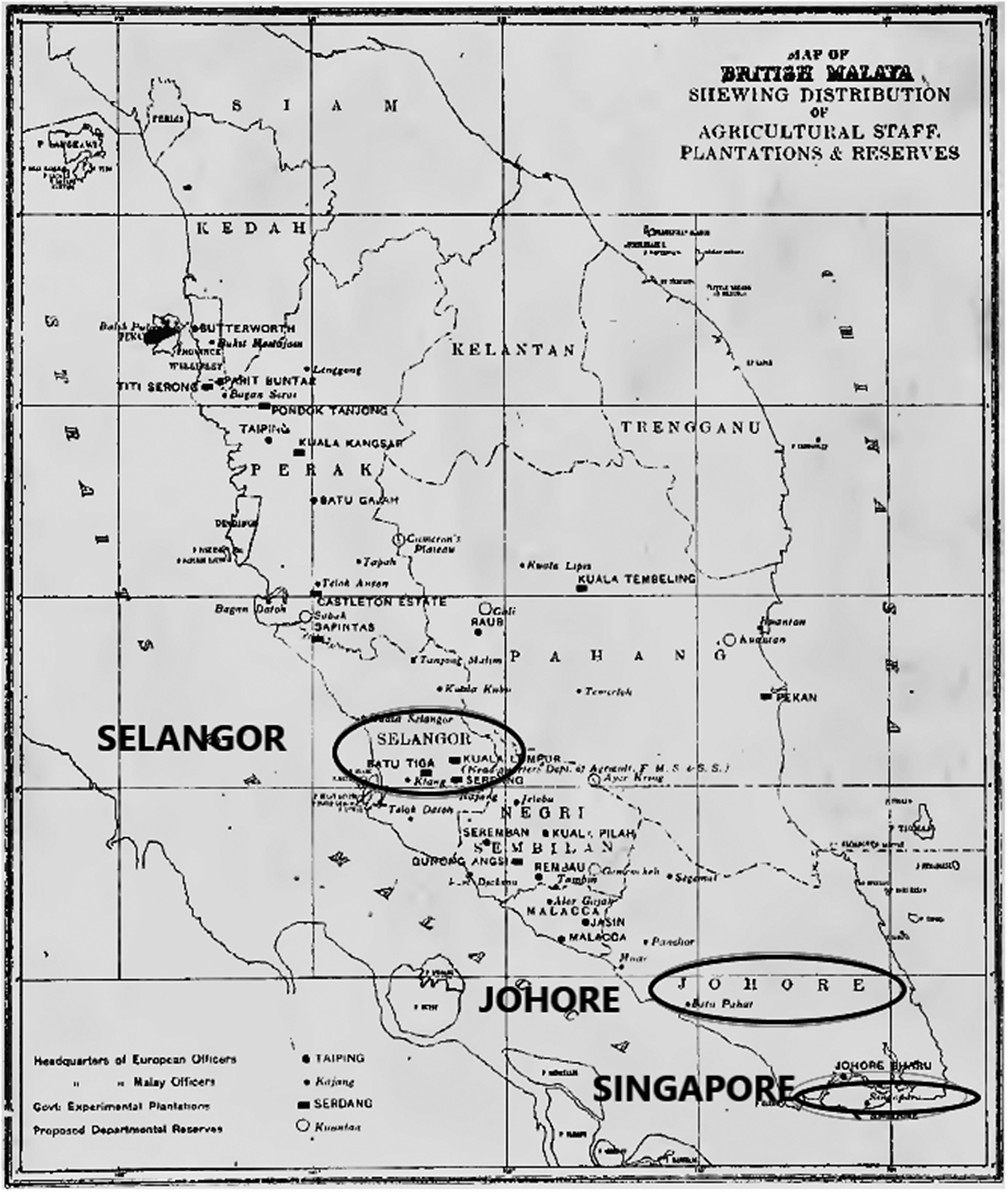
From 1920, British Malaya’s position as the world’s leading rubber producer exposed the economy to global price volatilities, following a reversal of the rubber boom from overproduction.Footnote 90 During the corresponding period, the United Kingdom became a growing importer of canned fruit, and demand for Malayan pineapples returned.Footnote 91 Given the rubber economy’s instability, Chinese entrepreneurs revived canning businesses in Singapore and expanded plantations in the FMS, specifically in Johore and Selangor (see map of pineapple plantation locations in Figure 4), where pineapples served as catch crops in rubber plantations.Footnote 92 The location choices were logistically sound as they were supported by infrastructure through railway networks and ports.Footnote 93 Since pineapple plantations shifted to the FMS from the 1920s, the industry became known as the Malayan pineapple industry.Footnote 94
Map of pineapple cultivation and canning clusters (circled) in British Malaya in the 1920s.
Source: Department of F.M.S. and S.S., The Malayan Agriculture Handbook (Kuala Lumpur, 1922), 257. Used with permission.

Figure 4. Long description
A black and white geographical map of the Malay Peninsula. The top of the map shows Siam, Kedah, and Kelantan. Moving South, the central region includes Perak, Pahang, and Trengganu. The primary data points are concentrated in the Southern half of the peninsula. Three distinct areas are highlighted with hand-drawn horizontal ovals. The first circle is in the West-Central region over Selangor, encompassing Kuala Selangor, Batu Tiga, and Klang. The second circle is further South in Johore, specifically around Batu Pahat. The third circle is at the Southernmost tip, encompassing Singapore. A legend in the bottom-left corner identifies symbols for Headquarters of European Officers, Malay Officers, Government Experimental Plantations, and Proposed Departmental Reserves. Text labels for Selangor, Johore, and Singapore are written in large bold capital letters near their respective circled clusters.
The Malayan pineapple industry gave employment to manual laborers who were affected by rubber production restriction schemes.Footnote 95 In 1922, Tan utilized capital derived from rubber manufacturing profits to set up a new pineapple factory in Klang, Selangor.Footnote 96 Newspaper articles reported that Tan ordered modern machinery from Cameron Can Machinery Co.—the world’s largest sanitary can maker based in North America—and other semi-automatic machines.Footnote 97 However, mechanization was confined to only can-making, whereas other processes remained labor-intensive. It was not known how many people were hired to work at the pineapple factory. However, through visits to his flagship factory in Sembawang, Singapore—where the production of canned pineapples, rubber footwear, biscuits, leather shoes, and even indigestion pills took place—journalists reported that he employed “thousands of hands,” including women and girls.Footnote 98 Having built Southeast Asia’s largest empire of rubber goods and factories, he was likened by journalists to Henry Ford and Tomáš Baťa.Footnote 99
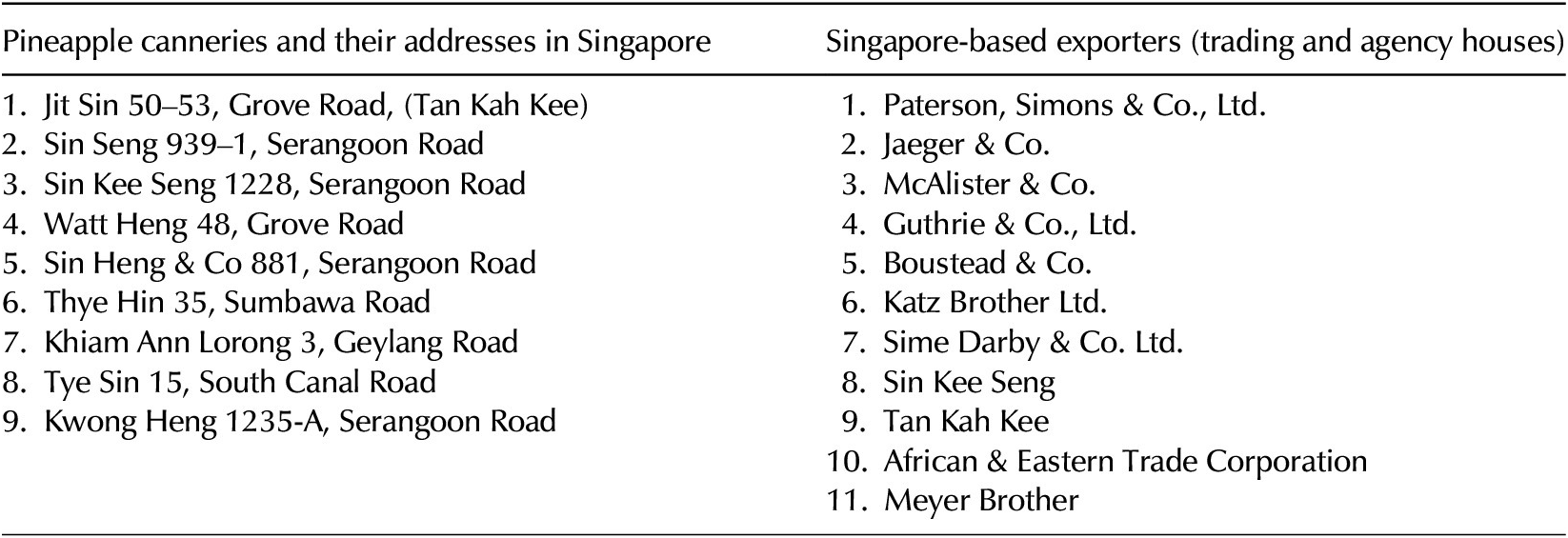
By 1925, there were nine established canneries in Singapore exporting to Britain, France, New Zealand, and the Netherlands, through a network of mainly large British agency houses based in Singapore (see Table 1).Footnote 100
List of pineapple canneries and exporters in Singapore, 1925

Table 1. Long description
The table is divided into two main columns.
Column 1: Pineapple canneries and their addresses in Singapore
1. Jit Sin 50–53, Grove Road, Tan Kah Kee
2. Sin Seng 939–1, Serangoon Road
3. Sin Kee Seng 1228, Serangoon Road
4. Watt Heng 48, Grove Road
5. Sin Heng & Co 881, Serangoon Road
6. Thye Hin 35, Sumbawa Road
7. Khiam Ann Lorong 3, Geylang Road
8. Tye Sin 15, South Canal Road
9. Kwong Heng 1235-A, Serangoon Road
Column 2: Singapore-based exporters (trading and agency houses)
1. Paterson, Simons & Co., Ltd.
2. Jaeger & Co.
3. McAlister & Co.
4. Guthrie & Co., Ltd.
5. Boustead & Co.
6. Katz Brother Ltd.
7. Sime Darby & Co. Ltd.
8. Sin Kee Seng
9. Tan Kah Kee
10. African & Eastern Trade Corporation
11. Meyer Brother
Source: “Xingzhou zi guantou fengli zhezhaoye” [Singapore’s Pineapple Industry], Nanyang Siang Pau, July 10, 1925, 17.
The Malayan industry largely monopolized the British market, given the established exporting networks between Chinese entrepreneurs and the agency houses as importers. Nevertheless, the industry faced new competition from the Formosan (present-day Taiwan) pineapple industry, which started exporting following an industry-wide restructuring by the Japanese colonial government.Footnote 101 The Nanyang Siang Pau—a Chinese-language trade newspaper which Tan owned—emphasized the importance of cooperation among entrepreneurs to reform the Malayan industry, or risk losing control of the European market to Formosa.Footnote 102
In 1926, Tan led ten Chinese pineapple canneries in Singapore, Johore, and Selangor to form the Singapore United Pineapple Packing Company, an industrial organization to address quality inconsistencies in the Malayan pineapples.Footnote 103 The industrial organization limited canning to two types: 60 percent of production to contain only sufficiently ripe fruit (known as “Golden” quality), 40 percent of production containing a mixture of golden and white fruit (known as “Good Average” quality), and required canners to use only white sugar syrup to improve the appearance of the canned pineapples.Footnote 104 Low-quality and unripe fruit would not be canned, thus significantly reducing product quality inconsistencies.Footnote 105 While they were still unable to brand the canned pineapples, the entrepreneurs attempted to differentiate their products from the rest using red markings on the crates containing the canned pineapples.Footnote 106
Tan argued that the improvements in quality justified an overall price increase, which was set to a minimum of Straits$6.50 per case.Footnote 107 The move angered European middlemen, who boycotted the trade for six weeks.Footnote 108 Through a lengthy letter to the editor of The Straits Times, Tan appealed for colonial government intervention for the first time. He wrote:
Although our pines have been improving in quality recently, still I hope buyers will co-operate with preservers in pushing this trade to their level best, and will not think that we are purposely boosting the prices. Government in the past used to look lightly on the pineapple industry, but I am glad to see that lately Government are making proper investigations which will, it is hoped, lead to a general amelioration in the pine industry.Footnote 109
In a follow-up letter a week later, Tan urged the colonial government to implement a legislation requiring labeling for all pre-exported Malayan canned pineapples. This, he argued, would clamp down on British speculators’ sales of canned pineapples ahead of the actual production and delivery. “If the local government is willing to help the Malayan pines, like Hawaiians, drastic measures must be legalized to safeguard the industry…,” he wrote.Footnote 110
The timing for Tan’s appeal to the colonial government was impeccable, given the British government’s realization of their dependence on foodstuff controlled by other imperial governments during the First World War.Footnote 111 In the 1920s, Britain sought to improve its trade balance by encouraging colonies to supply raw materials and food products to Britain and its dominions.Footnote 112 The plight of the Malayan pineapple industry caught the Empire Marketing Board’s (EMB) attention, following a correspondence with the Malayan Department of Agriculture seeking advice on compulsory pre-export grading.Footnote 113 In 1928, while accompanying William Ormsby-Gore, Parliamentary Under-Secretary of State (1924–1929) to Malaya, Java, and Ceylon, Amery’s assistant secretary Edward M. H. Lloyd met Chinese entrepreneurs, including Tan and his enterprising son-in-law Lee Kong Chian, and European shippers in Singapore—the first gathering among entrepreneurs, shippers, and colonial and imperial officers—to address product quality inconsistencies.Footnote 114 Prior to the meeting, Lloyd told his colleague and Secretary of the EMB, Stephen George Tallents, that the Singapore United Pineapple Packing Company was “more or less bogus.”Footnote 115 The suspicion each had for the other underscored the challenges of forming partnerships between Chinese entrepreneurs and colonial rulers in British Malaya in industrializing British Malaya.Footnote 116
Nevertheless, through Llyod’s appeal to the industry players, they agreed not to ship inferior quality pineapples, nor trade with unscrupulous firms in Liverpool.Footnote 117 The meeting, however, revealed the deadlocked issues on entrepreneurs’ agency in branding that handicapped the industry from raising canned pineapple prices. In May 1928, while Lloyd concluded in his diary entry that the meeting ended on positive note despite “a good deal of suspicion and rivalry,” the colonial government’s involvement in disciplining the industry remained shallow as “any complete system of government grading and inspection is ruled out for the time being.”Footnote 118 The Singapore United Pineapple Packing Company also failed to achieve its objectives, as some members sabotaged its attempt to regulate pineapple prices by selling them cheaply to shippers, leading to the organization’s demise.Footnote 119 As the local entrepreneurs were unable to make meaningful marketing efforts in pineapples through branding, the EMB played a crucial role in publicizing Malayan pineapples to British consumers, a departure from empire marketing efforts that generally focused on products from the dominions.Footnote 120
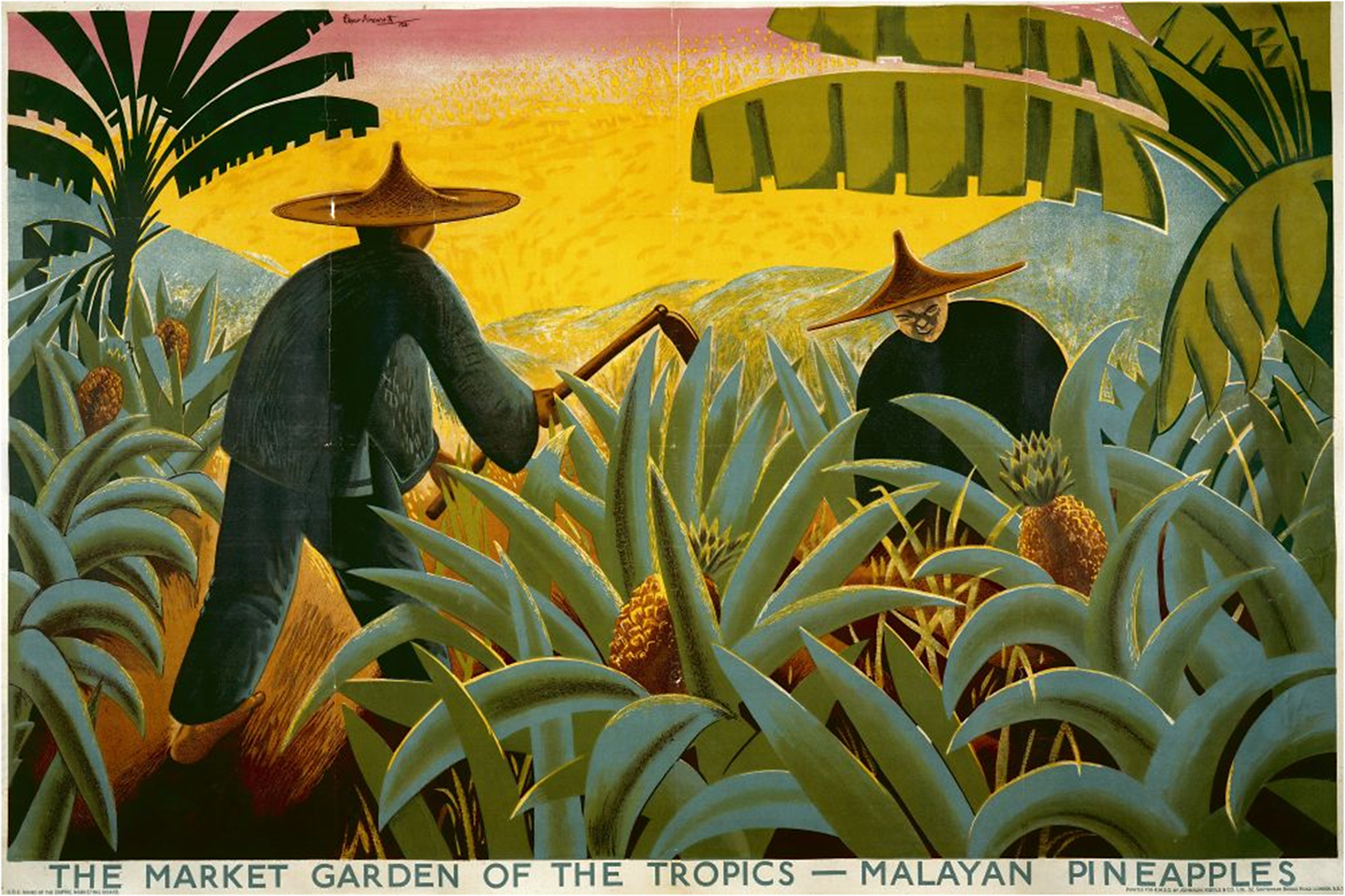
Marketing Malayan pineapples as a generic empire product, however, created a mismatch of narratives between production instability in colonies and marketing success in Britain. Together with the Malayan Information Agency—the FMS government’s public relations unit based in London—the EMB and Agency strategically invented appealing narratives of the Malayan pineapples as a versatile fruit with “unlimited table-potentialities to consumers in Britain,” and also portrayed pineapple plantations as idyllic “market garden of the tropics” in its poster series on colony commodities (see Figure 5).Footnote 121 At the Imperial Fruit Show exhibitions across Britain, cooking demonstrations, free tastings of the canned fruit and pineapples in sausage rolls, and recipe books made the Malayan pineapples highly popular among visitors and the press.Footnote 122 As part of an ongoing broader marketing strategy on Malayan pineapples across Britain, the Agency even claimed that “the grading and packing of the Malayan pineapple have now been improved to such a degree that it can compete on level terms with any product of any country in the world” at the International Grocers’ Exhibition in London.Footnote 123
Poster of pineapple market garden by the Empire Marketing Board, 1931.
Source: CO 956/269, The National Archives (UK). Used with permission.

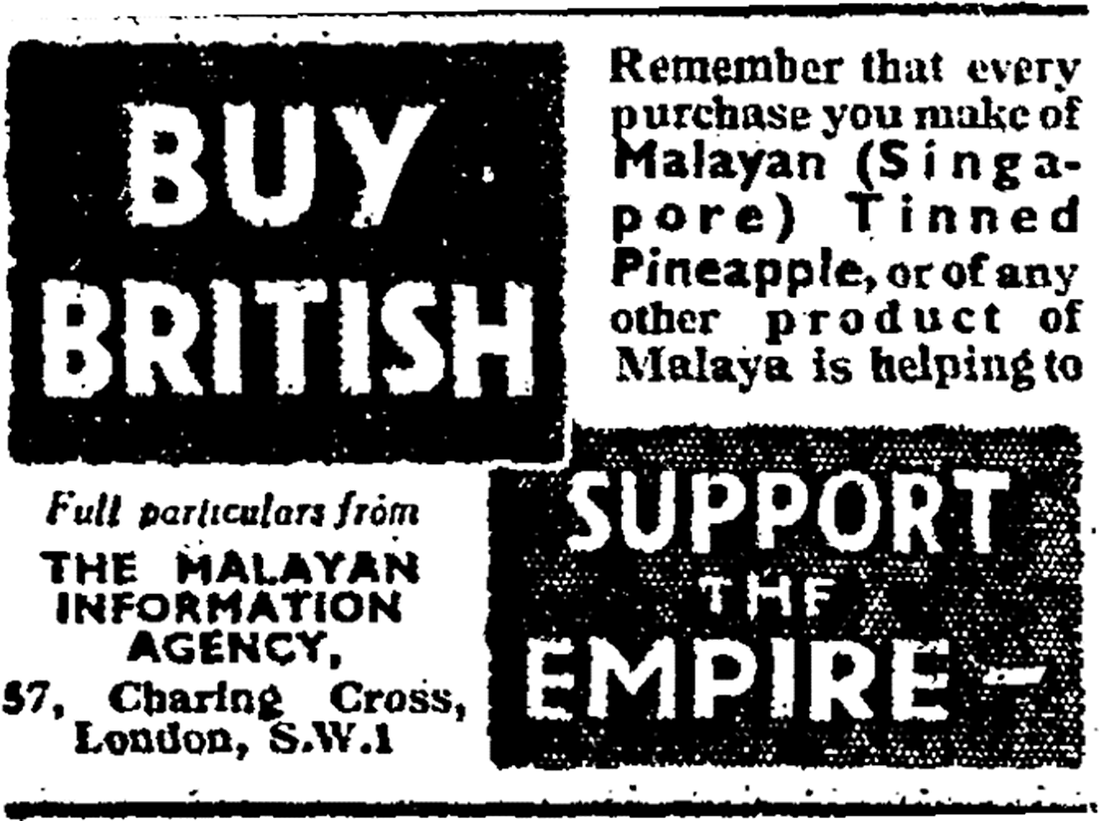
From 1931, the EMB incorporated the Malaya Stand under its watch, and prominently displayed “Support the Empire” posters, while the Agency placed advertisements in newspapers (see Figure 6).Footnote 124 To the colonial marketers, canned pineapple consumption represented a symbolic act of supporting the British Empire; hence, efforts were mainly directed to compel the “most practical and un-imperialist English working-class housewife” to choose Malayan pineapples over those made by non-British Empire territories.Footnote 125 The economic crisis in Britain in the post-Depression years further encouraged citizens to consume British Empire food products to reduce foreign imports.Footnote 126 The combined factors of Malayan pineapples’ versatility as a pantry food product, status as empire produce, and cheapness significantly contributed to a rise in demand during the Depression years. Nevertheless, Britain’s rising consumption of Malayan pineapples gave the impression that poor supply quality had little correlation with demand and became a key leverage for Chinese entrepreneurs operating in colonial frameworks.
An advertisement for Malayan pineapples in British newspapers, 1931.
Source: “Untitled” [advertisement], Times (London), November 16, 1931, 10. Used with permission.

Rebranding Malayan Pineapples’ Cheapness as Competitive Advantage in Imperial Markets
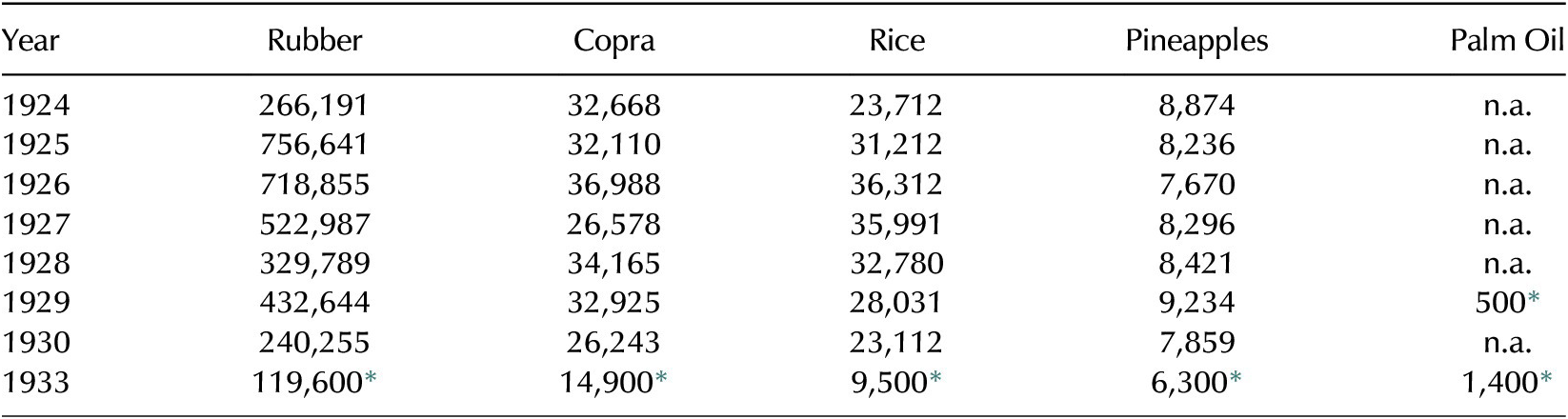
In the early 1930s, the Straits Settlements and FMS colonial governments increasingly recognized the pineapple industry’s strategic importance by calling it “an asset of great potential value,” given its position as the fourth most important agricultural export (see Table 2).Footnote 127
Malaya’s agricultural exports during the interwar years (Straits$’000).

Table 2. Long description
The table contains six columns: Year, Rubber, Copra, Rice, Pineapples, and Palm Oil. Values are in Straits dollars ‘000.
* 1924: Rubber 266,191; Copra 32,668; Rice 23,712; Pineapples 8,874; Palm Oil n.a.
* 1925: Rubber 756,641; Copra 32,110; Rice 31,212; Pineapples 8,236; Palm Oil n.a.
* 1926: Rubber 718,855; Copra 36,988; Rice 36,312; Pineapples 7,670; Palm Oil n.a.
* 1927: Rubber 522,987; Copra 26,578; Rice 35,991; Pineapples 8,296; Palm Oil n.a.
* 1928: Rubber 329,789; Copra 34,165; Rice 32,780; Pineapples 8,421; Palm Oil n.a.
* 1929: Rubber 432,644; Copra 32,925; Rice 28,031; Pineapples 9,234; Palm Oil 500.
* 1930: Rubber 240,255; Copra 26,243; Rice 23,112; Pineapples 7,859; Palm Oil n.a.
* 1933: Rubber 119,600; Copra 14,900; Rice 9,500; Pineapples 6,300; Palm Oil 1,400.
Rubber is the dominant export throughout the period, peaking in 1925 and significantly declining by 1933. Palm oil data is mostly unavailable until the late interwar years.
* Figures reported were rounded to the nearest whole number in the reports.
Sources: Author’s own. Department of Overseas Trade, Review of Trade, 1928, 23; Department of Overseas Trade, Economic Conditions, 1931, 18; Department of Overseas Trade, Economic Conditions, 1934, iv.
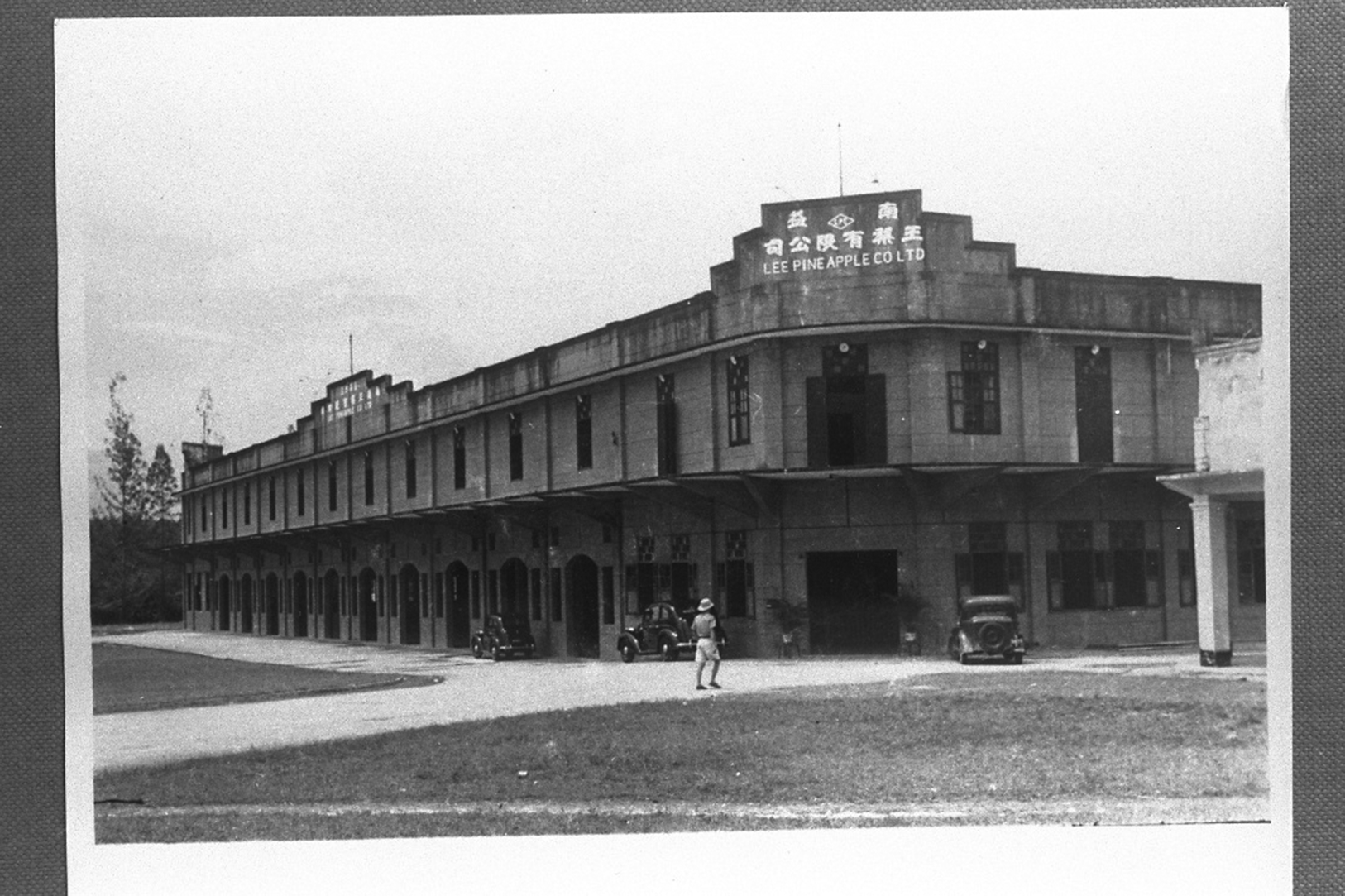
Between 1930 and 1931, the Malayan government organized a multi-day Malayan Pineapple Conference in Singapore, whereby colonial officers in Johore and Singapore met with Tan and Lee to discuss the legacy weaknesses in production and marketing, and the immediate improvements for the pineapple industry.Footnote 128 Colonial policy directed pineapple single-cropping in Singapore, Johore, and Selangor, after the colonial government allocated a 3,000-acre plot of land in Johore to Lee Pineapple Company (which Lee owned and which is shown in Figure 7), and established an experiment station to improve yields.Footnote 129
Lee Pineapple Co. Ltd. building, Singapore, ca. 1935–1950.
Source: National Archives of Singapore, image no. 19980005828-0098. Courtesy of National Archives of Singapore. Reproduced with permission.

However, during this period, local entrepreneurs leveraged colonial ties and strategically branded the pineapples’ cheapness as a competitive advantage in imperial markets instead of upgrading the industry through mechanization. While it had appeared as an act of self-sabotage, it was a coping mechanism to overcome repeated failures to raise the Malayan pineapple prices, underpinned by the lack of colonial government support to reform the industry’s marketing issues.
The production of low-quality canned pineapples was often linked to the Malayan industry’s lack of mechanization in processing and canning pineapples.Footnote 130 Unlike Hawaii and Taiwan, the Malayan pineapple industry was largely labor-intensive, which gave the perception that the Chinese entrepreneurs were backward and unwilling to mechanize to raise product quality. In 1930, Captain R.T. Nevill, director of the South Wales Tinplate Corporation, who met with local entrepreneurs in Singapore, suggested that they should at least centralize canning processes and install more modern machinery.Footnote 131 Nevill’s suggestion failed to take off, mainly because of two key reasons.
First, following the post-1929 collapse of world trade and disintegration of international agricultural commodity markets, British Malaya—whose economy was highly dependent on export earnings from tin and rubber—fell into recession between 1930 and 1933.Footnote 132 The challenging economic conditions had a severe impact on Chinese businesses and employment in the colonies, and wiped out the rubber wealth of Chinese entrepreneurs, including Tan’s. Tan faced a double whammy from the flooding of cheap Japanese-made rubber shoes into Singapore through its free port status and expansion restrictions into the UK market.Footnote 133 His company faced liquidation in 1934, after failing to restructure payments of more than $10 million to Chinese and British banks.Footnote 134 Tan’s business failure was especially detrimental to British Malaya’s employment crisis, as it left more than ten thousand workers jobless.Footnote 135 Lee took over pineapple plantations from Tan and other entrepreneurs in financial distress, as well as the banking assets of three Chinese banks, to prevent the lending sector for Chinese businesses from disappearing.Footnote 136 The surviving pineapple factories stepped in by providing manual jobs to migrant workers. It explains why the Malayan pineapple industry had remained largely labor-intensive throughout the 1930s.
Second, the Chinese entrepreneurs perceived that the more acute limitations the industry faced were in marketing, not production.Footnote 137 Colonial administrators insisted upon tighter inspection and grading to discipline the industry into improving product quality, but were unwilling to address its marketing issues arising from speculative activities and the canners’ inability to brand.Footnote 138 In 1930, out of the eighteen registered canneries in Singapore, Johore, and Selangor, Tan owned four of them with production capacity of 40 percent of output.Footnote 139 Despite being an established and permanent canner, Tan’s pineapples were lumped together with low-quality ones when sold to British retailers, with 70 percent of the colonies’ output sold under more than seventy different trade labels.Footnote 140 London importers also rejected Chinese entrepreneurs’ canned pineapples embossed with their factory names, out of prejudice against manufactured goods produced by non-Europeans.Footnote 141 These factors encouraged speculative activities by British brokers, which temporary canners co-opted by undercutting prices and perpetuated the pineapples’ cheapness in the market.
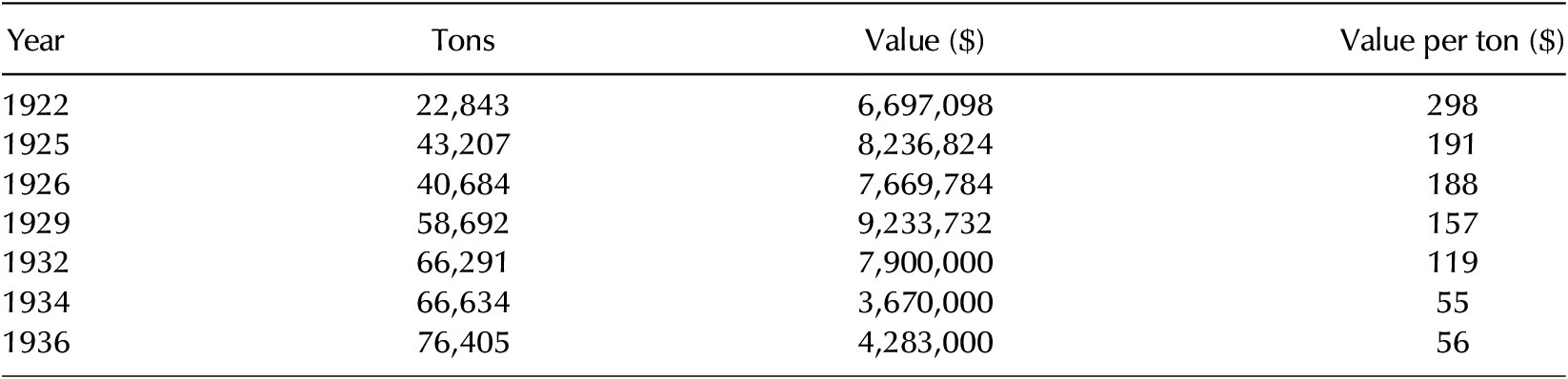
Despite exporting more, the decreasing export value per ton presented established pineapple entrepreneurs with a chicken-or-egg dilemma, as improvement in production methods required capital made through profits (see Table 3).Footnote 142 As Lee complained,
“The local price c.i.f. London today is about 2s. 9d. per dozen tins while the London retail price is 6d. a tin; that is to say, 39d. of the price per dozen tins which the public pays is going somewhere in London.”Footnote 143
Malayan pineapples exports, selected years.

Table 3. Long description
The table consists of four columns: Year, Tons, Value in dollars, and Value per ton in dollars.
* 1922: 22,843 tons; 6,697,098 dollars; 298 dollars per ton.
* 1925: 43,207 tons; 8,236,824 dollars; 191 dollars per ton.
* 1926: 40,684 tons; 7,669,784 dollars; 188 dollars per ton.
* 1929: 58,692 tons; 9,233,732 dollars; 157 dollars per ton.
* 1932: 66,291 tons; 7,900,000 dollars; 119 dollars per ton.
* 1934: 66,634 tons; 3,670,000 dollars; 55 dollars per ton.
* 1936: 76,405 tons; 4,283,000 dollars; 56 dollars per ton.
The data shows a general trend of increasing tonnage over time, while the value per ton significantly decreases from 298 dollars in 1922 to 56 dollars in 1936.
Sources: Author’s own. Grist, “Malayan Pineapple,” Agricultural Journal 18, no. 2 (February 1930): 188; Singapore High Commissioner’s Office, “Memorandum,” HCO 882/37.
At the Malayan Pineapple Conference, Tan and Lee advocated for enforced branding using their factory names to enable consumers to differentiate product quality and mitigate speculation.Footnote 144 However, the Pineapple Conference rejected Tan’s and Lee’s proposal on grounds that the colonial government expected strong resistance from British retailers and wholesalers that controlled branding activities, and doubted the established entrepreneurs’ ability to consistently provide quality canned pineapples to British retailers. Further, attaching Chinese-sounding names to the canned pineapples was an inconvenience to the EMB since pineapples were marketed as empire produce.Footnote 145 Ultimately, the colonial government was ambivalent in supporting the industry, by utilizing the pineapples’ cheapness to justify that it was implausible that “the industry can ever have any real permanent stability.”Footnote 146
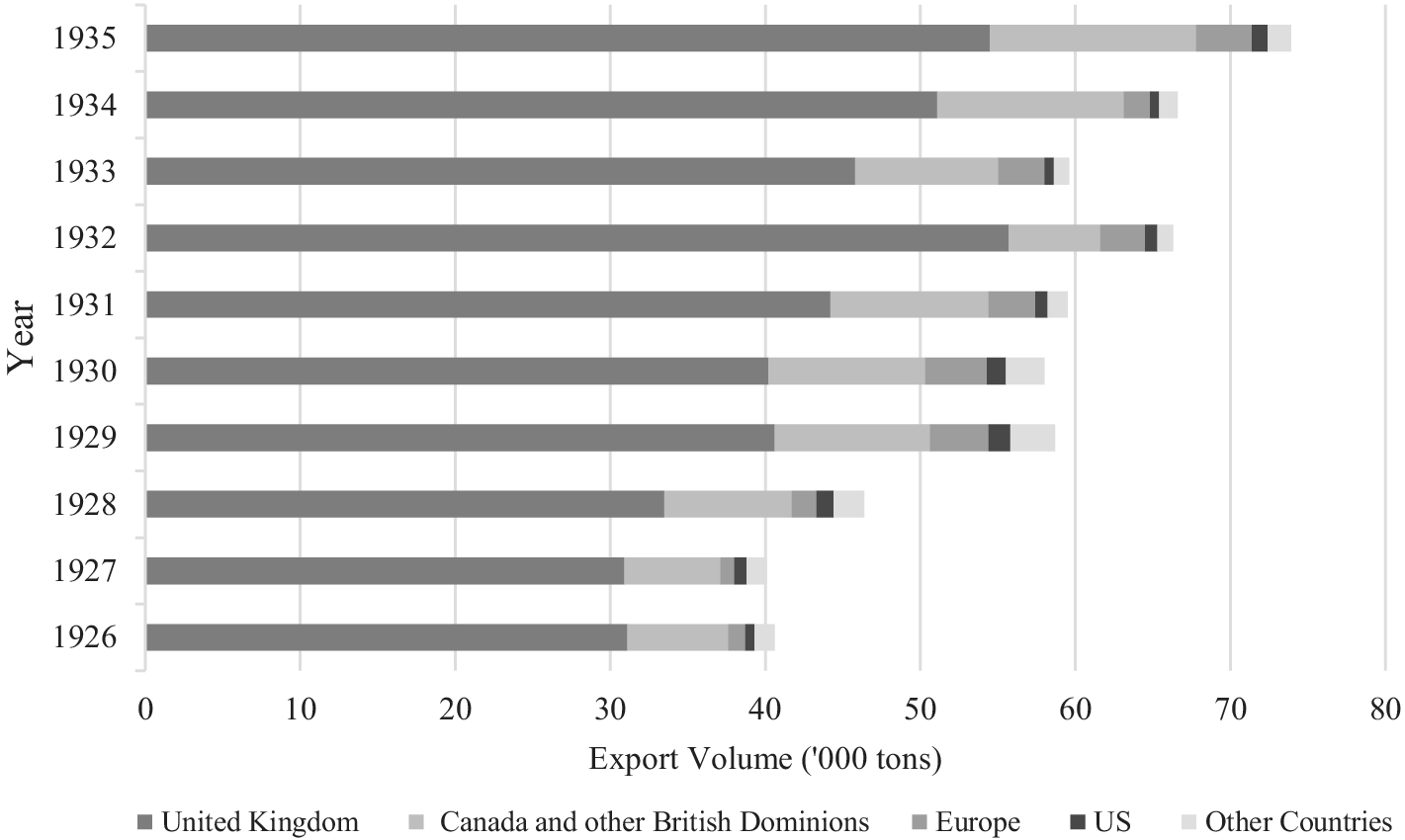
Under the policy environment based on a colonial framework that did not favor industrialization or capital-intensive operations, the local entrepreneurs did not necessarily think it was financially sound to invest in technological deepening. Rather, they reframed cheapness of production as a competitive resource, by leveraging manual labor abundance and driving up production volume to compensate for low profit margins. As agricultural economist D.H. Grist explained, the “Malayan method”—in which manual labor cost less than freight—was driven by pragmatism.Footnote 147 Because of its low production costs, Malayan pineapples were the cheapest canned fruits and their price was consistently 40 percent to 80 percent lower than other types of canned fruit such as pears, apricots, and peaches imported from non-colonies.Footnote 148 In 1932, a record amount of over 66,291 tons of Malayan canned pineapples valued over Straits$7.9 million were exported, demonstrating that the Malayan pineapples’ cheapness gave the pineapple industry some resilience across markets in the British Empire (see Figure 8).Footnote 149
Export destinations and volume of Malayan pineapples, 1926–1935.
Sources: Author’s own. “Empire Gains Larger Share of Canned Fruit Industry,” Straits Times, November 9, 1936, 7.

Figure 8. Long description
The horizontal axis represents Export Volume in thousands of tons, ranging from 0 to 80. The vertical axis lists years from 1926 at the bottom to 1935 at the top. Each year is represented by a stacked bar composed of five segments, from left to right: United Kingdom (dark gray), Canada and other British Dominions (light gray), Europe (medium gray), U S (black), and Other Countries (very light gray).
* 1926: Total volume is approximately 41,000 tons, with the United Kingdom accounting for about 31,000 tons.
* 1927: Total volume remains steady at approximately 41,000 tons.
* 1928: Total volume increases to approximately 47,000 tons.
* 1929: Total volume rises to approximately 59,000 tons.
* 1930: Total volume is approximately 58,000 tons.
* 1931: Total volume is approximately 59,000 tons.
* 1932: Total volume increases to approximately 67,000 tons.
* 1933: Total volume is approximately 60,000 tons.
* 1934: Total volume increases to approximately 67,000 tons.
* 1935: Total volume reaches its peak at approximately 74,000 tons.
The United Kingdom remains the dominant export destination throughout the period, showing a steady growth trend from 31,000 tons in 1926 to over 54,000 tons in 1935. The Canada and other British Dominions segment shows the most significant relative growth, expanding from a small sliver in 1926 to roughly 15,000 tons by 1935.
In the absence of differentiated branding, the entrepreneurs learned that positioning the Malayan pineapple’s cheapness was also an effective marketing tool to boost demand among the working class in Canada—its second-largest market after Britain. When colonial officer Cecil Rae complained that it was “surely not a very dignified attitude for any industry to admit that it caters for the poorest class of consumers,” Lee—the industry’s representative—defended the strategy and said: “Businessmen are accustomed to measure the desirability of their products by the number of people who can be persuaded to buy them.”Footnote 150
At the 1932 Ottawa Imperial Economic Conference (hereafter known as the Ottawa Conference), maintaining Malayan pineapples’ cheapness through preferential trade agreements became the pineapple industry’s key strategy to corner the British and Canadian markets. When Malayan pineapples’ market share in Canada was threatened by a rise in its import duty from half a cent to 3 cents per pound a year earlier, the Pineapple Packers’ Agency Ltd—which represented all Singaporean and Johore Chinese pineapple enterprises—appealed to the colonial government to send a representative to Ottawa to renegotiate Malaya’s trade terms with Canada.Footnote 151 Dissatisfied with the colonial government’s initial choice of a negotiator, the Chinese entrepreneurs hired William Graham, a well-known fruit broker from London to the Ottawa Conference, who convinced the governments of Canada and Australia that the empire trade would be at a net loss if the Malayan pineapple exports to Canada decreased.Footnote 152 Canada lowered import duties for Malayan pineapples to 1 cent per pound, eliminating competition from the Hawaiian pineapples, which had import duties of 5 cents.Footnote 153 The Canadian trade recovered from 1933, even as exports to Britain grew throughout the 1930s.
During this period, Chinese entrepreneurs continued to engage with colonial officers to resolve marketing issues. In 1933, through a meeting with H. A. Tempany, Director of Agriculture of Straits Settlements, and D.G.P. Olds, Agricultural Officer of Singapore, Lee conveyed the industry’s stance on enforced labeling to weed out speculative activities, which he said was the “cancer” to the industry.Footnote 154 The industry believed that once enforced labeling was implemented, it would require no further government assistance as the manufacturers would be more inclined to upgrade the industry rather than keeping an eye on the market.Footnote 155 After the colonial government passed the Pineapple Industry Ordinance 1934 that required all Malayan pineapple canning factories to register their operations and cannery marks from October 1, 1934, the local entrepreneurs formed the Central Board of Pineapple Packers, Malaya, Ltd, whereby eleven pineapple canners managing thirteen factories collectively decided on the daily selling price and reduced price fluctuations by 15–25 cents per case.Footnote 156
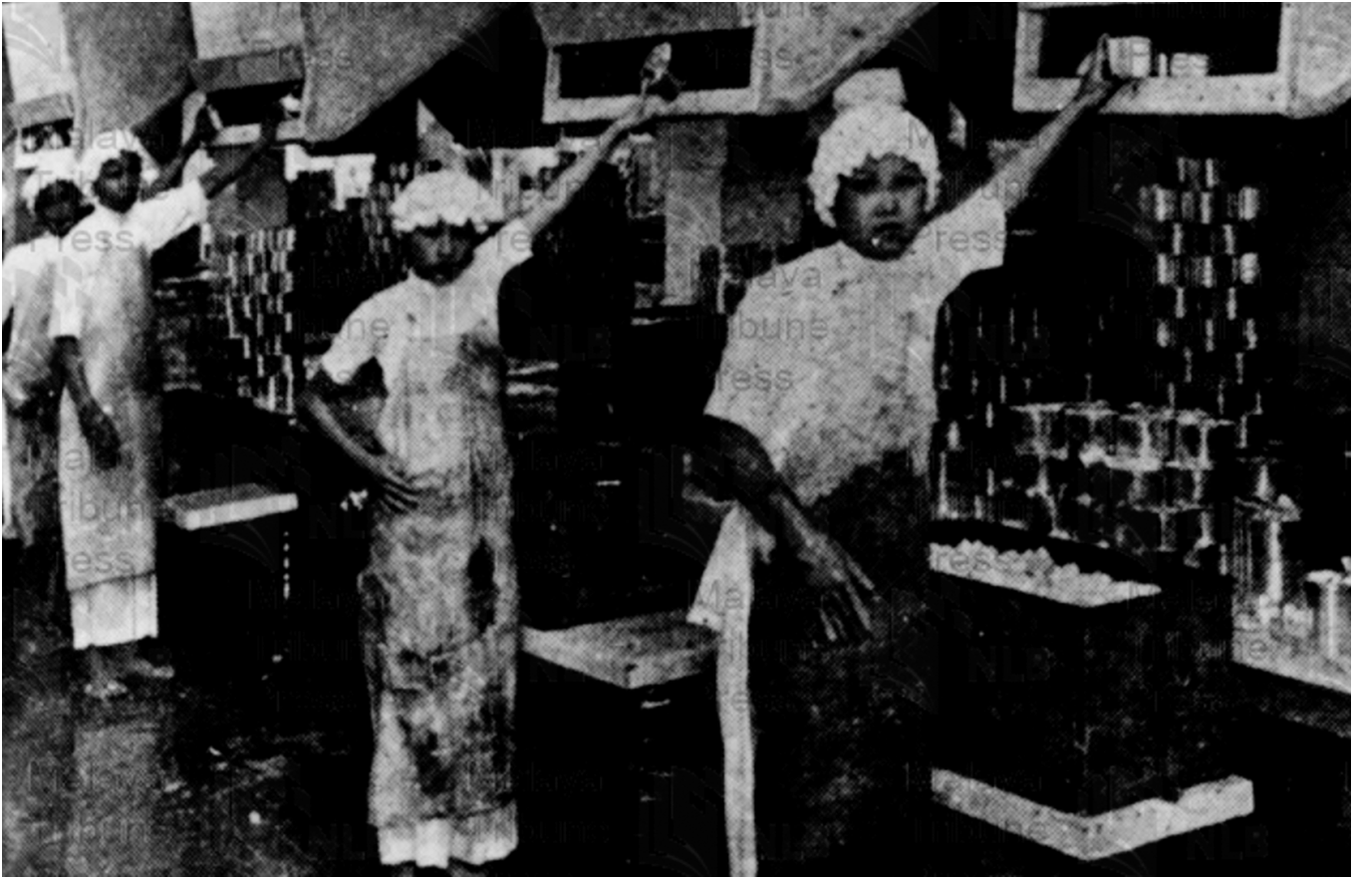
Despite the Malayan pineapple industry’s problematic state, its contribution towards fostering imperial trade helped cast a more sympathetic light toward the industry. The Empire Canning Council named the Malayan industry as a positive example for other colonies to emulate in setting up canning industries.Footnote 157 By 1935, doubts about the quality of canned pineapples had lessened. British canning expert G.S. Williamson—a Metal Box Company director—was even reportedly “surprised” to learn that cans in Singapore could be made cheaper without using automatic machines.Footnote 158 British consumers had also stated their preferences for “the Malayan brand” over other canned pineapples because it was “cheap and good” thus severing the perceived connection between manually made and low quality.Footnote 159 Hence, it explains why even in 1937, the largest and most modern pineapple canning factory in Malaya continued to rely mainly on manual labor, that “no part of the fruit at any period in the process of canning is touched by the bare hand—only by a sterilised rubber glove” (see Figure 9).Footnote 160
Workers in a pineapple canning factory in Johor, 1936.
Source: “New Pineapple Factory in Johore,” Morning Tribune, July 22, 1936, 21. Reproduced with permission.

Figure 9. Long description
The scene depicts an industrial interior with several workers engaged in the canning process.
* In the foreground on the right, a worker wearing a light-colored cap and a dark, stained apron stands next to a large rectangular bin filled with light-colored fruit pieces. Their right arm is raised toward a shelf or machinery above.
* To the left of this worker, another individual in similar attire stands facing forward with their left arm extended upward.
* In the background on the far left, two more workers are visible, one standing behind a table or conveyor system.
* The environment is filled with stacks of cylindrical metal cans arranged in neat rows on shelves and work surfaces.
* Overhead, dark industrial chutes or ventilation hoods are positioned above the workstations.
* The floor appears wet or reflective, and the overall lighting is high-contrast, typical of early 20th-century newspaper photography.
* A faint watermark from the Malaya Tribune Press is visible across the center of the frame.
Before the Second World War, the Malayan pineapple industry posted record shipments in 1939, with a value of nearly Straits$10 million.Footnote 161 Nevertheless, the factories were destroyed under Japanese occupation during the Second World War, and the industry was reconstructed post-war.Footnote 162 Two weeks before Singapore fell to Japanese Occupation forces in 1942, Tan fled Singapore and lived in hiding in Sumatra and Java, Netherlands East Indies (present-day Indonesia), to avoid execution by the Imperial Japanese Army that had placed a reward of one million guilders on his head for his anti-Japanese stance.Footnote 163 Lee lived in exile in the US during the occupation years.Footnote 164
Both entrepreneurs and British rule returned to Singapore after the war ended in 1945. Lee rebuilt his rubber empire by becoming the world’s largest rubber supplier during the rubber demand boom during the Korean War, and led the reconstruction of the pineapple industry through Lee Pineapple.Footnote 165 Meanwhile, in 1950, Tan renounced his British citizenship, left his Malayan and Singaporean business interests to his sons, and returned to mainland China, where he took on several high-profile positions with the People’s Republic of China government under the Chinese Communist Party (CCP).Footnote 166
Conclusion
This study has reassessed the Malayan pineapple industry and situated it more broadly within the debates of colonial consumption, commodity chains, and local entrepreneurship. Together with previously unexamined newspaper records, it has revealed two key findings. First, this study has elucidated the historical processes that led to the Chinese entrepreneurs’ decision to leverage Malayan pineapples’ cheapness to corner imperial markets during the interwar years. Second, it has clarified the commitment of Tan Kah Kee and Lee Kong Chian—who were representatives of the Chinese-led pineapple industry—toward upgrading the industry, which has not been documented until now.
The Malayan pineapple industry’s labor intensity and decision to position cheapness as a marketing strategy took shape under the conditional support of colonial government and British Empire. Tan and Lee persistently sought government intervention to curb speculation from British brokers that kept pineapple prices low. While colonial policy and marketing efforts by the Empire Marketing Board were helpful in raising pineapple consumption in imperial markets, the colonial government was reluctant to upend the power structures that British exporters, brokers, and retailers had over local entrepreneurs in branding. Hence, to keep the industry running, the entrepreneurs leveraged cheap production methods and colonial ties to rebrand cheapness from a weakness to a competitive advantage in imperial markets.
This study’s implications are two-fold. First, under colonial commodity production-export logic, the nascent industrialization faced serious limitations, but it did not necessarily mean that local entrepreneurs were passive agents in pursuing expansion opportunities in Western consumer markets. In fact, the contrary holds true, as external constraints forced local entrepreneurs to respond more creatively in seeking new markets and navigating colonial frameworks. Second, it adds to the empirical evidence that challenges the conventional essentialist readings on Chinese entrepreneurship in colonies. Intra-ethnic business networks were not always effective in business modernization, nor was Chinese exceptionalism always evident. In fact, Chinese entrepreneurs repeatedly failed to combine and effectively address the industry’s problems that they also co-created, resulting in the entrepreneurs’ lobby for colonial government intervention to save the industry.
These findings demonstrate that broadening the interpretations of innovation and capabilities that correspond to the specific conditions of a territory can sharpen the contextual depths of entrepreneurial histories of Southeast Asia. Ideally, technology adoption is a prerequisite for industrialization, but its boundaries are also shaped by distinctive social realities. Future research can consider expanding the conceptual understandings of innovation that are distinct under colonial frameworks to contribute to the literature intersecting Chinese entrepreneurship, imperial studies, branding and marketing, and commodity chains.
Acknowledgments
The author is very grateful to the three anonymous referees whose constructive reviews have greatly helped improve the article. I would like to also thank the archivists and librarians of the National Library of Singapore for their laborious tasks in digitizing newspaper sources that made this article possible. Personal thanks also to Andrea Lluch and Ai Hisano for their encouragement, and Andrew Popp for supporting the processes of bringing this article to publication.