Introduction
Adolescence is a time of sweeping changes across hormonal, physical, and social domains, and of increased risk for the development of psychopathology, especially in females. An examination of the National Survey on Drug Use and Health concluded that the 12-month prevalence of major depressive episodes among mid-adolescent females (ages 12–17 years) is 17.3%, or nearly one in every five teenage females (Mojtabai, Olfson, & Han, Reference Mojtabai, Olfson and Han2016). In addition, subclinical adolescent depressive symptoms are more stable over time in adolescent females (Mason, Chmelka, Trudeau, & Spoth, Reference Mason, Chmelka, Trudeau and Spoth2017), and have been shown to strongly predict the appearance of later clinical depression in adulthood (Pine, Cohen, Cohen, & Brook, Reference Pine, Cohen, Cohen and Brook1999). These findings suggest a need for models of risk for adolescent depressive symptoms. Such models may help to lay bare the mechanisms underlying the sudden surge in risk for depressive symptoms in adolescent females and, further, may allow us to identify individuals at risk who can benefit from behavioral and psychological interventions.
The endocrine system in adolescence
One of the biological hallmarks of the transition to adolescence is the peri-adolescent hormone surge, which consists of dramatic increases in hormones of the hypothalamic–pituitary–adrenal (HPA) and hypothalamic–pituitary–gonadal (HPG) axes. Hormones produced by both axes have been identified as drivers of the sweeping physical, emotional, and cognitive changes associated with the adolescent period. In adolescent females, it has been suggested that cortisol and estradiol are related to emerging internalizing psychopathology during this developmental stage (Angold, Costello, & Worthman, Reference Angold, Costello and Worthman1998; Angold, Costello, Erkanli, & Worthman, Reference Angold, Costello, Erkanli and Worthman1999). Strong evidence points to an association between cortisol and psychopathology. Specifically, the presence of high basal cortisol levels and both hyper and hypo cortisol reactivity have been linked to the emergence of depressive symptoms (Angold, Reference Angold2003; Colich, Kircanski, Foland-Ross, & Gotlib, Reference Colich, Kircanski, Foland-Ross and Gotlib2015; Goodyer, Park, & Herbert, Reference Goodyer, Park and Herbert2001; Hankin, Badanes, Abena, & Watamura, Reference Hankin, Badanes, Abela and Watamura2010; Herane-Vives et al., Reference Herane-Vives, de Angel, Papadopoulos, Wise, Chua, Strawbridge and Cleare2018), while evidence for an association between estradiol and psychopathology has been mixed (e.g., Angold et al., Reference Angold, Costello, Erkanli and Worthman1999; Balzer, Duke, Hawke, & Steinbeck, Reference Balzer, Duke, Hawke and Steinbeck2015; Slap, Khalid, Paikoff, Brooks-Gunn, & Warren, Reference Slap, Khalid, Paikoff, Brooks-Gunn and Warren1994; Susman, Dorn, & Chrousos, Reference Susman, Dorn and Chrousos1991), indicating the possible presence of one or more moderators.
Estradiol and adolescence
Estradiol acts on the neural circuitry in the limbic system and prefrontal cortices of the adolescent brain, driving many of the physical, cognitive, and emotional changes typical of the teenage years (Åslund, Leppert, Starrin, & Nilsson, Reference Åslund, Leppert, Starrin and Nilsson2009; Blakemore, Reference Blakemore2008; Brooks-Gunn & Warren, Reference Brooks-Gunn and Warren1988; Casey, Jones, & Hare, Reference Casey, Jones and Hare2008; Nelson, Leibenluft, McClure, & Pine, Reference Nelson, Leibenluft, McClure and Pine2005; Peper & Dahl, Reference Peper and Dahl2013; Somerville, Reference Somerville2013).
Evidence implicating estradiol in developmental changes during adolescence (Klapwijk et al., Reference Klapwijk, Goddings, Burnett Heyes, Bird, Viner and Blakemore2013; Rose, Kreuz, Holaday, Sulak, & Johnson, Reference Rose, Kreuz, Holaday, Sulak and Johnson1972; Sehested et al., Reference Sehested, Juul, Andersson, Petersen, Jensen, Müller and Skakkebaek2000; Shirtcliff, Dahl, & Pollak, Reference Shirtcliff, Dahl and Pollak2009; Varlinskaya, Vetter-O'Hagen, & Spear, Reference Varlinskaya, Vetter-O'Hagen and Spear2013) is consistent with claims regarding estradiol's role in activation of the so-called “affective node” of the social information processing network – a theoretical model that seeks to explain, from a neural perspective, the process by which adolescents respond to social stimuli in their environment (Nelson et al., Reference Nelson, Leibenluft, McClure and Pine2005). The affective node – which, appropriately, is related to emotional responding to social stimuli – comprises several brain regions that undergo sweeping organizational and activational changes during puberty (for more detail see Nelson et al., Reference Nelson, Leibenluft, McClure and Pine2005), all of which contain large numbers of gonadal hormone receptors (McEwen, Reference McEwen2001; Nelson et al., Reference Nelson, Leibenluft, McClure and Pine2005; Romeo, Reference Romeo2003). These changes are thought to increase adolescent motivation for social reward and sensitivity to social rejection, and to drive the development of strong emotionality in response to social stimuli – a response pattern that is unique to adolescents (Nelson et al., Reference Nelson, Leibenluft, McClure and Pine2005).
From driving physical development, to contributing to activation of specific areas of the brain, to increasing social sensitivity and awareness, it is clear that estradiol plays a number of different roles in the development of the adolescent female. These myriad changes are especially intriguing to consider in the context of increasing risk for mood disorders during this developmental period.
Estradiol and mood disorders
Estradiol has long been predicted to play a role in the development of female mood disorders during adolescence. However, as already noted, examinations of the association between estradiol and adolescent psychopathology, especially depressive symptoms (e.g., Angold et al., Reference Angold, Costello, Erkanli and Worthman1999; Balzer et al., Reference Balzer, Duke, Hawke and Steinbeck2015), have produced mixed results, ranging from significant positive associations between estradiol and mood, to partial associations, to no association (for a thorough review and meta-analysis of the findings in this literature, see Balzer et al., Reference Balzer, Duke, Hawke and Steinbeck2015). This mix of findings suggests the possible presence of one or more moderators that may influence the relationship between estradiol and mood in adolescence. Evidence in support of moderating influences on the estradiol–psychopathology relationship is provided by a small handful of studies of adolescent girls. In one such study, estradiol was associated with externalizing psychopathology, but only when cortisol levels were low and personality traits of disagreeableness and emotional instability were high (e.g., Tackett et al., Reference Tackett, Reardon, Herzhoff, Page-Gould, Harden and Josephs2015), suggesting possible dual-hormone regulation of the estradiol–psychopathology association (Mehta & Josephs, Reference Mehta and Josephs2010; Tackett et al., Reference Tackett, Reardon, Herzhoff, Page-Gould, Harden and Josephs2015). These dual-hormone associations stem from the theoretical framework proposed by the dual-hormone hypothesis (Mehta & Josephs, Reference Mehta and Josephs2010), which demonstrated that testosterone promotes status seeking, but only in the presence of low cortisol levels. When cortisol levels are high, the dual-hormone hypothesis predicts no promotion of status seeking by testosterone. Findings with the dual-hormone hypothesis have been mixed, and recent work has proposed that dual-hormone associations may be more stable if researchers look only at status-relevant situations (Dekkers et al., Reference Dekkers, van Rentergem, Meijer, Popma, Wagemaker and Huizenga2019). In addition to work with the dual-hormone hypothesis, a review of models examining relationships between adolescent hormones and negative affect suggests that the association between adolescent hormones and negative affect may be moderated by secondary sex characteristics that develop in response to pubertal maturation (Brooks-Gunn, Graber, & Paikoff, Reference Brooks-Gunn, Graber and Paikoff1994). Importantly, pubertal maturation can differ on many dimensions and have complex effects: the pace of development of secondary sex characteristics, the social environment surrounding these developmental changes, and the interaction between the two could shape the female adolescent's internal conceptualizations of her own development and overall self-worth (Brooks-Gunn et al., Reference Brooks-Gunn, Graber and Paikoff1994).
Building on these ideas, we propose that the association between estradiol and mental health among females during adolescence is, in part, moderated by the adolescent's perception of her pubertal timing, such that an adolescent who believes herself to be pubertally “out-of-step” with her peers will be at elevated risk for mood disorders when estradiol levels – which have been associated with increased social awareness – are high.
Pubertal development and mood disorders
Putting aside the discussion of estradiol levels for a moment, pubertal onset is a well-established risk factor for major depressive disorder in females (Angold et al., Reference Angold, Costello and Worthman1998). More specifically, much work exploring risk factors for depression conferred by the pubertal period, especially in females, has examined pubertal timing – a measure of the age of onset and rate of development of secondary sex characteristics (Marceau, Ram, Houts, Grimm, & Susman, Reference Marceau, Ram, Houts, Grimm and Susman2011). The secondary sex characteristics are sexually dimorphic physical features that develop as a result of exposure to increased levels of gonadal hormones during the pubertal period. Measures of pubertal timing in females generally include subjective and/or objective ratings of skin changes, pubic and underarm hair growth, breast development, and age of first menses. In addition, many measures often include subjective ratings of an individual's development relative to peers. These measures, and the ages at which they occur, have been related to the development of risk for adolescent psychopathology in both males and females (Hamlat, McCormick, Young, & Hankin, Reference Hamlat, McCormick, Young and Hankin2020). According to the deviance hypothesis (Petersen & Taylor, Reference Petersen, Taylor and Adelson1980), pubertal development that is out-of-step with peers increases the likelihood of poor mental health outcomes by diminishing peer support and acceptance, and increasing stress and negative peer influences (Mendle, Harden, Brooks-Gunn, & Graber, Reference Mendle, Harden, Brooks-Gunn and Graber2010; Petersen & Taylor, Reference Petersen, Taylor and Adelson1980; Thompson, Hammen, & Brennan, Reference Thompson, Hammen and Brennan2016). Most of the work examining the link between pubertal timing and mental health symptoms during adolescence has linked early pubertal onset in females (“early blooming”) to risk for major depressive disorder (Graber, Lewinsohn, Seeley, & Brooks-Gunn, Reference Graber, Lewinsohn, Seeley and Brooks-Gunn1997; Graber, Reference Graber2013; Marceau, Ram, & Susman, Reference Marceau, Ram and Susman2015; Mendle, Turkheimer, & Emery, Reference Mendle, Turkheimer and Emery2007; Stice, Presnell, & Bearman, Reference Stice, Presnell and Bearman2001), whereas relatively little research has focused on risk for depressive symptoms associated with later onset of puberty, although both early and late pubertal onset relative to peers appear to share the distinction of identifying an individual as being developmentally out-of-step with peers.
The small body of existing studies on late pubertal onset shows a modest elevation in depression risk compared to “on-time” pubertal onset (Galvao et al., Reference Galvao, Silva, Zimmermann, Souza, Martins and Pereira2014; Ge & Natsuaki, Reference Ge and Natsuaki2009; Hayward et al., Reference Hayward, Killen, Wilson, Hammer, Litt, Kraemer and Taylor1997; Mendle et al., Reference Mendle, Turkheimer and Emery2007; Natsuaki et al., Reference Natsuaki, Klimes-Dougan, Ge, Shirtcliff, Hastings and Zahn-Waxler2009). Associations have been reported between late menarcheal timing, which is sometimes used as a proxy for pubertal onset in biological females, and adult depression (Graber, Brooks-Gunn, & Archibald, Reference Graber, Brooks-Gunn, Archibald, Stoff and Susman2005; Herva et al., Reference Herva, Jokelainen, Pouta, Veijola, Timonen, Karvonen and Joukamaa2004; Somerville, Reference Somerville2013). It has been suggested that the weaker association between delayed pubertal onset and depressive symptoms may be due to the existence of one or more unmeasured moderators (Burt, McGue, DeMarte, Krueger, & Iacono, Reference Burt, McGue, DeMarte, Krueger and Iacono2006; Hamlat et al., Reference Hamlat, Shapero, Hamilton, Stange, Abramson and Alloy2015; Lee & Styne, Reference Lee and Styne2013; Oldehinkel, Verhulst, & Ormel, Reference Oldehinkel, Verhulst and Ormel2011; Reynolds & Juvonen, Reference Reynolds and Juvonen2012; Seaton & Carter, Reference Seaton and Carter2018; Thompson et al., Reference Thompson, Hammen and Brennan2016; Whittle et al., Reference Whittle, Yücel, Lorenzetti, Byrne, Simmons, Wood and Allen2012). In support of this possibility, whereas early development conferred risk for anxiety in females at the start of middle school, delayed development also conferred risk for anxiety, but not until the end of middle school (Reynolds & Juvonen, Reference Reynolds and Juvonen2012). This points to the possibility that the risk represented by out-of-step pubertal timing may depend, in part, on the average pubertal status of peers and on the extent to which one's own status as “out-of-step” is recognized and judged to be important to the individual. We propose that this second criterion is fulfilled after the pubertal estradiol surge occurs. In other words, because the pubertal surge in estradiol is delayed in females for whom pubertal development is delayed, the rise in risk for anxiety symptoms may be undetectable until puberty begins, which, for these individuals (Reynolds & Juvonen, Reference Reynolds and Juvonen2012), did not occur until the end of middle school.
Current study
In this study, we investigated the underpinnings of adolescent depression risk by proposing a hypothesis that incorporates estradiol into a pubertal timing framework (Angold et al., Reference Angold, Costello, Erkanli and Worthman1999; Boyce & Ellis, Reference Boyce and Ellis2005; Brooks-Gunn & Warren, Reference Brooks-Gunn and Warren1989; Goddings, Burnett Heyes, Bird, Viner, & Blakemore, Reference Goddings, Burnett Heyes, Bird, Viner and Blakemore2012; Klump, Keel, Sisk, & Burt, Reference Klump, Keel, Sisk and Burt2010; Nottelmann et al., Reference Nottelmann, Susman, Inoff-Germain, Cutler, Loriaux and Chrousos1987; Peper & Dahl, Reference Peper and Dahl2013; Rowe, Reference Rowe2002; Shulman & Scharf, Reference Shulman and Scharf2018; Udry, Reference Udry1979; Zahn et al., Reference Zahn, Moll, Krueger, Huey, Garrido and Grafman2007). If developing out-of-step with peers confers an increased risk of mood and/or anxiety disorders and estradiol (which surges at the start of puberty) sensitizes the adolescent brain so that females experience a heightened awareness of their goodness-of-fit with those around them, then estradiol and depressive symptoms may be positively correlated, but only in freshman high-school females who feel pubertally out-of-step. However, because our study incorporated only ninth-grade females who are, on average, past the earliest stages of pubertal development, we expected that we would only be able to detect this risk in late-blooming rather than early-blooming females. In addition, as previous work (Tackett et al., Reference Tackett, Reardon, Herzhoff, Page-Gould, Harden and Josephs2015) has indicated that estradiol–externalizing psychopathology relationships may be moderated by cortisol, we included cortisol as an exploratory interaction term to examine whether cortisol might moderate estradiol–internalizing psychopathology relationships under some conditions.
In summary, despite evidence illustrating the prominent role played by gonadal hormones in shaping the adolescent brain (Angold & Rutter, Reference Angold and Rutter1992; Balzer et al., Reference Balzer, Duke, Hawke and Steinbeck2015; Blakemore, Burnett, & Dahl, Reference Blakemore, Burnett and Dahl2010; Ducharme et al., Reference Ducharme, Forest, Peretti, Sempé, Collu and Bertrand1976; Shirtcliff et al., Reference Shirtcliff, Dahl and Pollak2009; Vermeersch, T'Sjoen, Kaufman, & Vincke, Reference Vermeersch, T'Sjoen, Kaufman and Vincke2008; Vogel, Klaiber, & Broverman, Reference Vogel, Klaiber and Broverman1978; Young & Altemus, Reference Young and Altemus2004), further clarification is needed to describe how the puberty-driven, hormonal milieu of adolescence interacts with physical pubertal development to confer risk for depressive symptoms. Furthermore, in light of suggestions that the link between pubertal maturation and mental health likely depends on one or more unmeasured moderators (Burt et al., Reference Burt, McGue, DeMarte, Krueger and Iacono2006; Hamlat et al., Reference Hamlat, Shapero, Hamilton, Stange, Abramson and Alloy2015; Lee & Styne, Reference Lee and Styne2013; Oldehinkel et al., Reference Oldehinkel, Verhulst and Ormel2011; Reynolds & Juvonen, Reference Reynolds and Juvonen2012; Seaton & Carter, Reference Seaton and Carter2018; Thompson et al., Reference Thompson, Hammen and Brennan2016; Whittle et al., Reference Whittle, Yücel, Lorenzetti, Byrne, Simmons, Wood and Allen2012), an exploratory study of gonadal hormones could represent a major step toward resolving what has, to date, been a puzzle in the literature. Our approach is novel in that it represents a simultaneous examination of pubertal development and hormone levels as risk factors for adolescent-onset depressive symptoms, using an approach in which pubertal state and endocrine activity were measured in participants during their first semester in high school (fall semester of ninth grade) and depressive symptomology was assessed in the fall of ninth grade, at the end (spring) of ninth grade, and at the end (spring) of tenth grade.
Method
In this study we investigated the possibility that an interaction between pubertal development and hormone levels was associated with changes in depression symptomatology in a longitudinal study of high-school females. Analyses were conducted with a subsample (N = 79) of the Texas Longitudinal Study of Adolescent Stress Resilience: Saturated Schools Sample (TLSASR: SSS), which will be a new public-use data set funded by the Eunice Kennedy Shriver National Institute of Child Health and Human Development (NICHD).Footnote 1
Participants
Data were collected during fall semester from 79 ninth-grade females (62% White, 28% Hispanic, 2.5% Asian, 1.3% Black or African American, 6.3% reporting “two or more races/ethnicities”) enrolled at an urban public high school in Austin, Texas.Footnote 2 Parental consent, child assent, and saliva samples were obtained for all individuals in the sample. N = 76 students provided longitudinal follow-up data on depressive symptoms in the spring semester of ninth grade and N = 67 provided tenth-grade spring semester follow-up assessments. The sample size was constrained by the number of students who provided saliva samples for hormone analysis. As our sample size was small (N = 79) and the primary outcomes described in the results section are interactional in nature, the results should be interpreted with caution (for a further description of errors that can occur with small sample sizes, see Button et al., Reference Button, Ioannidis, Mokrysz, Nosek, Flint, Robinson and Munafò2013). Degrees of freedom varied across analyses due to differential patterns of missing data at multiple waves. Research protocols were approved by the institutional research review board at the authors’ institution, by the research committee at the participating school district, and by the collaborating school principal.
Procedures
Participants were enrolled in a longitudinal program evaluation study at the beginning of their ninth-grade school year. Active parental consent and student assent forms were collected. On three school days, salivary hormone (cortisol and estradiol) concentrations were obtained from saliva samples collected at the same time each day in the fall of ninth grade. Samples were collected in the early afternoon (1:00–4:30 p.m.) to reduce variability due to diurnal changes in cortisol levels (Rose et al., Reference Rose, Kreuz, Holaday, Sulak and Johnson1972). The time of sample collection was automatically recorded in an electronic daily intake questionnaire and controlled for in the analyses as a proxy for time since waking. Students were asked to refrain from eating dairy products (e.g., yogurt), drinking caffeinated beverages (i.e., coffee, soda, tea, and energy drinks), taking nonprescribed medications, or engaging in strenuous physical exercise at least 2 hr prior to sample collection (Adam & Kumari, Reference Adam and Kumari2009). Passive drool saliva was collected using 2.5 ml or 4.0 ml Salicap tubes (IBL International, Hamburg, Germany). While sitting at their desks, students were given a Salicap tube, straw, and napkin, and instructed to provide 1.5 ml of saliva (for more detail on passive drool procedures, see Yeager, Lee, & Jamieson, Reference Yeager, Lee and Jamieson2016). As soon as salivary sample collection was complete, samples were transferred to a Yeti™ cooler (Austin, TX) at <0°C, before being moved to a −80°C laboratory freezer on the University of Texas at Austin (UTA) campus at the end of the same day. All samples were stored for 3–4 months in the same −90°C freezer on the UTA campus (between September 2016 and late December 2016) before being shipped to the biological health psychology laboratory at Brandeis University, Waltham, MA (PIs, N. Rohleder and J. Wolf) for analysis using a chemiluminescence immunoassay (IBL International, Hamburg, Germany). Samples were pipetted by a liquid handling robot (Hamilton Company, Franklin, MA) and measured in duplicate. Samples with a coefficient of variation (CoV) >10% underwent repeated analysis. Cortisol assay intra- and inter-assay CoVs were 9.07% and 5.59%, respectively. Estradiol assay intra- and inter-assay CoVs were 2.75% and 8.92%, respectively.
Measures
Depressive symptoms
Depression symptomatology was measured at three time points – fall semester of ninth grade, spring semester of ninth grade (approximately 8-month follow-up), and spring semester of tenth grade (20-month follow-up) – using the 27-item Children's Depression Inventory (CDI; Kovacs & Beck, Reference Kovacs, Beck, Schulterbrandt and Raskin1977); item 9 of the CDI, which assesses for suicidality, was removed due to concerns for student safety. A 2015 meta-analysis of the reliability of the English version of the CDI with item 9 removed resulted in a Cronbach's alpha of 0.841 (95% confidence interval (CI) of [0.839, 0.851] (Sun & Wang, Reference Sun and Wang2015). For comparison, our within-sample Cronbach's alpha was calculated to be 0.91 (95% CI [0.88, 0.94]). Each of the CDI items asks participants to identify which of three levels of a symptom best describes how they feel (e.g., 0 = I do most things OK; 1 = I do many things wrong; 2 = I do everything wrong). Scores from each item were summed together and divided by the total number of items answered to compute an average item score (ranging between 0 and 2). This method was employed to assess average ratings of depression symptomatology and to avoid issues with depression sum scores arising from omission of the suicidality item.
Three waves of analyses were conducted concerning depressive symptoms: symptomatology in the fall of ninth grade, symptomatology in the spring of ninth grade, and symptomatology in the spring of tenth grade.
Pubertal development
The Pubertal Developmental Scale (PDS; Petersen, Crockett, Richards, & Boxer, Reference Petersen, Crockett, Richards and Boxer1988) was administered in the fall semester of ninth grade to assess adolescents’ pubertal development stage. The PDS asks participants to rate progression of puberty-relevant physical changes, including breast development, the presence of pimples, growth spurt, body hair, and the presence or absence of menstruation. In addition, the PDS includes a question not calculated in the total score of the PDS, which is about perceived pubertal onset relative to peers. This item is scored on a 1–5 scale and asks individuals to evaluate their own development relative to peers on a Likert scale (answers range from 1 = I developed much earlier than my peers to 5 = I developed much later than my peers). For all other PDS items, a score of 1 meant that growth in the given area had not yet begun, a score of 2 indicated that some growth had started, a score of 3 indicated that growth was definitely underway, and a score of 4 indicated that the student perceived growth to be complete in that area. Scores from each item were added together and divided by the number of questionnaire items to create an average composite score of pubertal development (all items except the item related to menarche were scored 1, 2, 3, or 4, whereas menarche was dichotomously scored as 1 = I have not yet gotten my period or 4 = I have gotten my period). The average PDS score in our sample was 3.35 out of 4, with a range of 1.8 to 4 on a scale ranging from 1 to 4. We coded low PDS scores (less developed individuals or individuals at an earlier pubertal stage relative to peers) as PDS scores equal to or less than 1 SD below the mean (PDS = 2.84). High PDS scores (more developed individuals or individuals at a later pubertal stage relative to peers) were coded as PDS scores equal to or above 1 SD above the mean (PDS = 3.85). Seven participants had a PDS composite score of 4, indicating that they marked all measures of pubertal growth as complete. It should be noted that the PDS scores in our sample were restricted, ranging from 1.8 to 4 instead of from 1.0 to 4.0. Although this restricted range was expected given the relatively late age of our participants, it is worth noting that we were unable to examine a sample representing the full range of PDS scores for this analysis.
Data analysis plan
Hormone levels were averaged across the three consecutive days, z-scored, log-transformed to improve non-normal distributions, and winsorized. Depressive symptoms (CDI average scores) remained untransformed. As results associated with estradiol can be a marker for menstrual cycle phase, menstrual cycle stage was included as a covariate in all the presented analyses. Ethnicity was included as an additional covariate in order to control for any group differences in hormone levels (Boileau, Barbeau, Sharma, & Bielajew, Reference Boileau, Barbeau, Sharma and Bielajew2019). A correlation matrix of all relationships between variables is presented in the results section, as is a table of all regression analyses performed, including main effect and interaction models. Multiple regression models were used to analyze higher order interactive effects of z-scored, winsorized values of hormones and self-reported pubertal status (PDS). We tested whether our main model – the Estradiol × PDS interaction – was (a) able to predict changes in CDI from fall ninth grade to spring ninth grade, and from fall ninth grade to spring tenth grade, and (b) correlated with CDI scores at each time point without controlling for baseline CDI score. We conducted exploratory analyses to examine the moderating effect of perceived pubertal onset relative to peers, rather than pubertal stage, on the association between estradiol and CDI scores at all time points. In addition, in line with research examining interactions between the HPG and HPA endocrine axes (Mehta & Josephs, Reference Mehta and Josephs2010; Mehta & Prasad, Reference Mehta and Prasad2015; Tackett et al., Reference Tackett, Reardon, Herzhoff, Page-Gould, Harden and Josephs2015), we included cortisol as an interaction term. Because a portion of this exploratory analysis included two hormones and a measure of pubertal development, thus allowing for tests of three-way interactions, it was necessary to complement these higher order analyses with an examination of lower order effects. Lower order effects were assessed using procedures described by Aiken and West (Reference Aiken and West1991). A simple slopes analysis to test for lower order interactions involving continuous predictors was first described in 1991 (Aiken & West, Reference Aiken and West1991). In the exploratory model, this procedure allowed for a test of the association between estradiol and depression symptomatology at three discrete levels of cortisol (mean cortisol and ±1 SD from mean cortisol level). Non-parametric bootstrapping (with replacement, resampled 10,000 times) was completed due to the modest sample size. Bonferroni corrections were calculated in order to correct for multiple comparisons, setting our p-value criteria at .005. All analyses were completed in R and RStudio (RStudio, 2018). The packages “Interactions” and “Jtools” were used to create all figures (Long, Reference Long2019, Reference Long2020).
Results
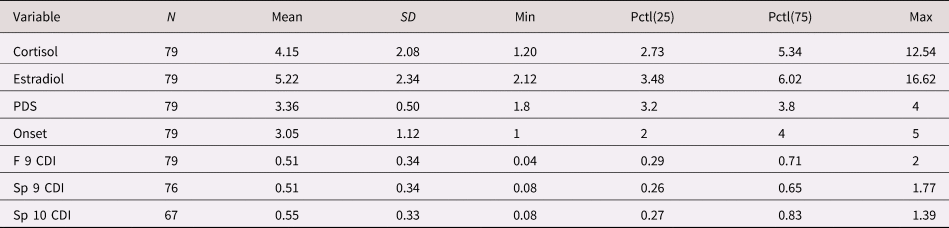
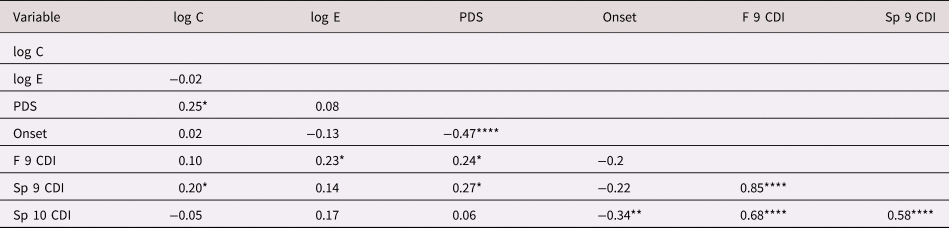
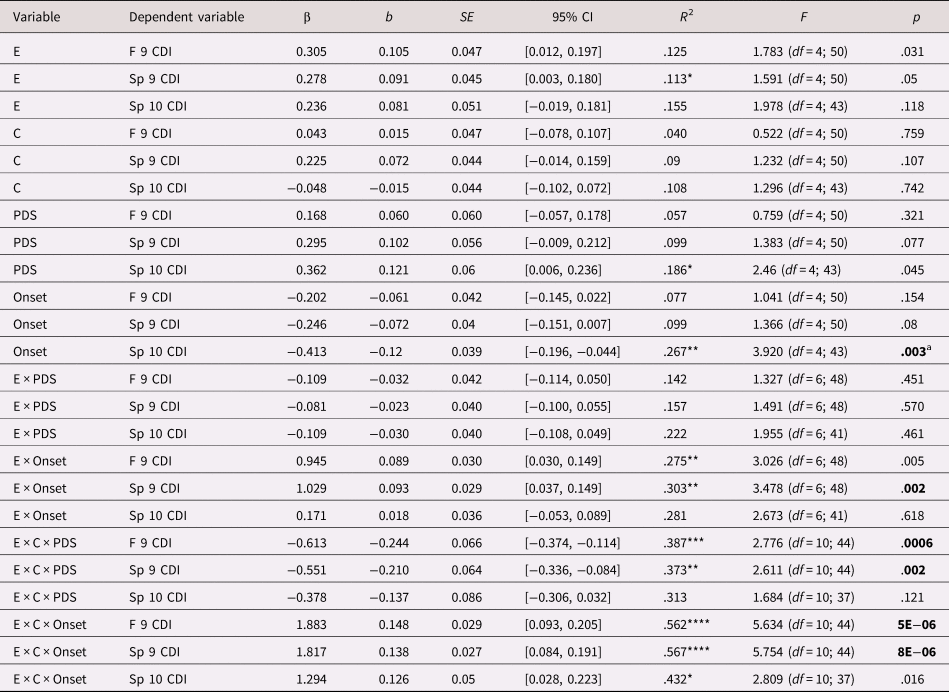
Descriptive statistics of the variables are presented in Table 1. All zero-order correlations between log-transformed hormone values, pubertal status, and CDI scores at all three time points are presented in Table 2. Contrary to our primary hypothesis, none of the regression models accounted for a change in CDI score over time. In addition, our original model (Estradiol × PDS stage) did not predict CDI at individual time points. However, the exploratory models were successful in predicting CDI scores at individual time points. The analyses presented below therefore include main effects and two- and three-way analyses predicting fall ninth-grade, spring ninth-grade, and spring tenth-grade CDI scores, all of which can be found in Table 3. Results of change score analyses can be found in the Supplementary Material.
Descriptive statistics of variables: sample size, mean, standard deviation (SD), and variable distribution

Note: Variables included cortisol, estradiol, pubertal stage (PDS), pubertal onset (Onset), fall ninth-grade Children's Depression Inventory (CDI) score (F 9 CDI), spring ninth-grade CDI score (Sp 9 CDI), and spring tenth-grade CDI score (Sp 10 CDI).
Zero-order correlation matrix of variables in models
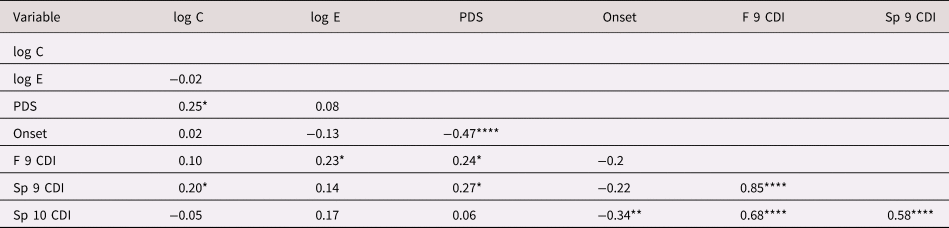
Note: Variables include cortisol (log C), estradiol (log E), pubertal stage (PDS), pubertal onset (Onset), fall ninth-grade Children's Depression Inventory (CDI) score (F 9 CDI), spring ninth-grade CDI score (Sp 9 CDI), and spring tenth-grade CDI score (Sp 10 CDI). *p < .05; **p < .01; ****p < .0001
Regression results for one, two-, and three-way interactions predicting Children's Depression Inventory (CDI) scores

Note: Regression table including main effects and two- and three-way interactions predicting fall ninth-grade depression Children's Depression Inventory (CDI) score (F 9 CDI), spring ninth-grade CDI score (Sp 9 CDI), and spring tenth-grade CDI score (Sp 10 CDI) with log-transformed cortisol (C) and estradiol (E), pubertal development stage (PDS), and perceived pubertal onset (Onset). All analyses included in the table control for menstrual cycle phase and ethnicity.
a Bold items indicate significance at Bonferroni-adjusted significance of p < .005. *p < 05; **p < .01; ***p < .001; ****p < .0001.
Main effects
In our sample of ninth-grade participants, estradiol and PDS measured in the fall of ninth grade were independently and positively associated with CDI scores in the fall of ninth grade, and cortisol and PDS were additionally positively associated with CDI scores in the spring of ninth grade, though the inclusion of covariates (described in the Method section) rendered all of these associations statistically insignificant. Main effects analysis of exploratory variables, which included the subscale “perceived pubertal onset relative to peers” from the PDS also revealed significant associations with CDI scores in the spring of tenth grade. Analyses revealed a negative association between perceived pubertal onset relative to peers and spring tenth-grade CDI scores, such that perceptions of earlier pubertal onset in the fall of ninth grade were associated with increased CDI scores in the spring of tenth grade – a result that remained significant after controlling for covariates.
Two-way interactions predicting CDI at three time points
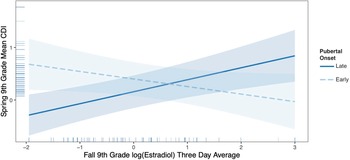
The results for all two-way interaction analyses, controlling for covariates, are presented in Table 3. In our sample of ninth-grade participants, the interaction between PDS and estradiol did not predict CDI scores at any time point (fall or spring of ninth grade or spring of tenth grade). However, an exploratory analysis revealed a significant association in which perceived pubertal onset relative to peers, rather than pubertal stage, interacted with estradiol to predict CDI scores in the fall and spring of ninth grade, but not in the spring of tenth grade. Because the Bonferroni correction reduced the p-value rejection threshold (p ≤ .005), only results with spring ninth-grade CDI are discussed here (figures for all findings significant at p ≤ .05 are provided in the Supplementary Material). An examination of lower order interactions indicated a statistically significant association between estradiol and spring ninth-grade CDI scores among participants reporting late perceived pubertal onset relative to peers (Figure 1: b = 0.228, SE = 0.062, p = .0006).
An Aiken and West plot (Aiken & West, Reference Aiken and West1991) was used to examine whether estradiol was correlated with spring ninth-grade Children's Depression Inventory (CDI) scores in females reporting early (dotted line) and late (solid line) pubertal onset relative to peers. Results are shaded with 95% confidence bands and bordered by rug plots indicating location of individual data points.

Three-way interactions predicting CDI at three time points
Results for all the exploratory three-way interactions, controlling for covariates, are presented in Table 3.
E × C × PDS
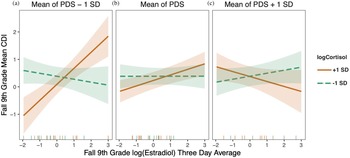
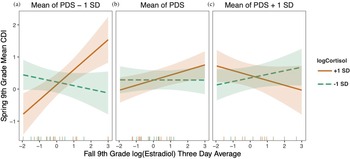
Among the ninth-grade participants, estradiol, cortisol, and pubertal stage interacted to predict CDI in the fall and spring of ninth grade. As can be seen in the leftmost panels of Figures 2a and 3a, fall ninth-grade estradiol was positively associated with fall (Figure 2a: b = 0.54, SE = 0.11, p = .00002) and spring ninth-grade (Figure 3a: b = 0.43, SE = 0.11, p = .0003) CDI scores in participants reporting early pubertal stage (−1 SD) and high cortisol levels (+1 SD). This lower order effect suggests a positive relationship between estradiol and CDI scores for late-blooming participants – but only among late-blooming participants with high cortisol levels. As visual inspection of this relationship revealed a possible high leverage data point, analyses were rerun without this point. As the relationships remained significant, the data point was included in the final figures. In participants reporting more advanced pubertal stage (+1 SD), we saw an opposite, though nonsignificant, trend toward a negative association between estradiol and CDI scores in the fall of ninth grade (Figure 2c: b = −0.22, SE = 0.11, p = .061) in participants with high cortisol levels (+1 SD). These results were not significant in the spring of ninth grade (Figure 3c: b = −0.18, SE = 0.11, p = .10). The results of nonparametric bootstrapping (resampled 10,000 times with replacement) indicated these results were highly unlikely to be due to random sampling error (99% CIs of the interaction terms for the fall ninth-grade and spring ninth-grade CDI analyses were [0.0991, 0.6936] and [0.1205, 0.6265], respectively).
Three-way Aiken and West plots (Aiken & West, Reference Aiken and West1991) were used to examine whether estradiol was correlated with fall ninth-grade Children's Depression Inventory (CDI) scores in females at low (−1 SD, dotted line) and high (+1 SD, solid line) cortisol levels reporting low (a), mean (b), and high (c) pubertal stage (variable PDS) relative to peers. Results of three-way interactions are shaded with 95% confidence bands and bordered by rug plots indicating location of individual data points. Due to the presence of a high value in the low PDS group (a), analyses were rerun without this data point, but the results remained significant. As such, the high data point was retained in the final figure.

Three-way Aiken and West plots (Aiken & West, Reference Aiken and West1991) were used to examine whether estradiol was correlated with spring ninth-grade Children's Depression Inventory (CDI) scores in females at low (−1 SD, dotted line) and high (+1 SD, solid line) cortisol levels reporting low (a), mean (b), and high (c) pubertal stage (variable PDS) relative to peers. Results of three-way interactions are shaded with 95% confidence bands and bordered by rug plots indicating location of individual data points. Due to the presence of a high value in the low PDS group (a), analyses were rerun without this data point, but the results remained significant. A such, the high data point was retained in the final figure.

PDS Onset
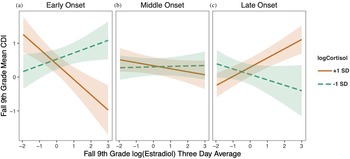
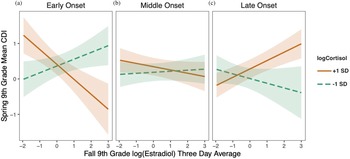
Among the ninth-grade participants, estradiol, cortisol, and perceived onset of pubertal development predicted CDI scores in the fall and spring of ninth grade and in the spring of tenth grade. Because the Bonferroni correction reduced the rejection threshold (p ≤ .005), results from the tenth-grade analysis (p = .02) are only included in Supplementary Material. As can be seen in the leftmost panels of Figures 4a and 5a, fall ninth-grade estradiol was positively associated with fall (Figure 4a: b = 0.34, SE = 0.06, p < .00001) and spring ninth-grade (Figure 5a: b = 0.31, SE = 0.06, p < .00001) CDI scores in participants who reported late perceived pubertal onset relative to peers and had high cortisol levels (+1 SD). This lower order effect revealed a positive association between estradiol and CDI scores for late-blooming participants who also had high cortisol levels. Among the participants who reported early perceived pubertal onset relative to peers who also had high cortisol levels, we saw the opposite pattern, such that estradiol was negatively associated with CDI scores in the fall of ninth grade (Figure 4c: b = −0.51, SE = 0.12, p = .00008) and spring of ninth grade (Figure 5c: b = −0.48, SE = 0.11, p = .0001). The results of nonparametric bootstrapping (resampled 10,000 times with replacement) indicated that these results were highly unlikely to be due to random sampling error (99% CIs of the interaction terms for the fall ninth-grade and spring ninth-grade CDI analyses were [0.2603, 0.8547] and [0.1789, 0.8252], respectively).
Three-way Aiken and West plots (Aiken & West, Reference Aiken and West1991) were used to examine whether estradiol was correlated with fall ninth-grade Children's Depression Inventory (CDI) scores in females at low (−1 SD, dotted line) and high (+1 SD, solid line) cortisol levels reporting early (a), middle (b), and late (c) pubertal onset relative to peers. Results of three-way interactions are shaded with 95% confidence bands.

Three-way Aiken and West plots (Aiken & West, Reference Aiken and West1991) were used to examine whether estradiol was correlated with spring ninth-grade Children's Depression Inventory (CDI) scores in females at low (−1 SD, dotted line) and high (+1 SD, solid line) cortisol levels reporting early (a), middle (b), and late (c) pubertal onset relative to peers. Results of three-way interactions are shaded with 95% confidence bands.

Discussion
The model described in the introduction proposed that estradiol and pubertal stage (both measured in the fall of ninth grade) would interact to predict changes in high-school females’ depressive symptomatology (CDI; Kovacs & Beck, Reference Kovacs, Beck, Schulterbrandt and Raskin1977). This turned out not to be the case (see the Supplementary Material for analyses, in which CDI change was the dependent variable – all non-significant (n.s.)). Furthermore, estradiol and pubertal stage did not interact to predict CDI scores at any of the three time points (fall of ninth grade, spring of ninth grade, or spring of tenth grade). In light of these null findings, we wondered whether pubertal stage might lack the requisite sensitivity needed to capture an adolescent's feeling of being out-of-step with peers. In pursuit of this possibility, we replaced pubertal stage with the more face valid measure of perceived pubertal onset relative to peers and found that perceived pubertal onset interacted with estradiol to predict spring ninth-grade CDI scores. Simple slopes analysis of this two-way interaction revealed that estradiol was positively correlated with CDI scores, but only in participants who reported late perceived pubertal onset relative to peers.
The inclusion of cortisol in our model (as an additional exploratory variable meant to capture stress) revealed an additional number of significant associations. We found that, among “late bloomers” (participants reporting either later perceived pubertal onset or earlier stage puberty relative to peers) with high cortisol, estradiol was positively associated with CDI scores in both the fall and spring of ninth grade. Finally, we found that among more developed participants (those who reported either early perceived pubertal onset or later stage puberty relative to peers) with high cortisol, estradiol was negatively associated with CDI scores in both the fall and spring of ninth grade.
This finding – that pubertal stage and perceived onset statistically moderate the association between hormones and CDI scores – suggests that hormones may be differentially associated with depressive symptoms, depending on perceived pubertal status: both stage and perceived onset. Further, the relationship between estradiol and CDI scores in both late and early bloomers with high cortisol was significant not only at the start of the freshman year of high school, but also 8 months later in the spring of ninth grade. This suggests that the relationship between hormones and pubertal development during critical periods, such as the start of high school, is durable and might be associated with long-lasting mental health risk.
Our exploratory inclusion of perceived pubertal onset relative to peers was based on literature suggesting the importance of this, in addition to current developmental stage, in explorations of risk for internalizing symptoms during puberty (Moore, Harden, & Mendle, Reference Moore, Harden and Mendle2014). In addition, as our hypothesis suggested that estradiol might increase social sensitivity and social drive, subjective reports of perceived pubertal onset relative to peers seemed to encapsulate a more socially aware measure of pubertal development than pubertal stage alone. Our understanding of our own development is significant in comparison with those around us. Analyses of pubertal development exploring the social comparison that occurs when individuals self-report pubertal development (Carter, Blazek, & Kwesele, Reference Carter, Blazek and Kwesele2020; Mendle, Beltz, Carter, & Dorn, Reference Mendle, Beltz, Carter and Dorn2019; Thompson et al., Reference Thompson, Hammen and Brennan2016) provide support for models that measure perceptions of pubertal onset in addition to stage.
The inclusion of cortisol as an exploratory variable in this study was suggested by the dual-hormone hypothesis, in which testosterone's role in status-relevant behavior is argued to depend on concentrations of cortisol, such that testosterone is associated with increases in status-seeking behavior when cortisol is low (Mehta & Josephs, Reference Mehta and Josephs2010; Mehta & Prasad, Reference Mehta and Prasad2015; but also see Dekkers et al., Reference Dekkers, van Rentergem, Meijer, Popma, Wagemaker and Huizenga2019). As mentioned in the introduction to this article, one study extended the dual-hormone hypothesis to include other gonadal hormones: Tackett et al. (Reference Tackett, Reardon, Herzhoff, Page-Gould, Harden and Josephs2015) reported that estradiol was positively associated with externalizing behaviors among adolescents with high levels of the personality traits of disagreeableness and emotional instability, but – in support of the dual-hormone hypothesis – only in adolescents with low levels of cortisol. Our finding – that estradiol is positively associated with CDI in late bloomers with high cortisol and negatively associated with CDI in early bloomers with high cortisol – extends the findings of Tackett et al. (Reference Tackett, Reardon, Herzhoff, Page-Gould, Harden and Josephs2015) to internalizing symptoms and highlights the importance of considering developmental status in models of adolescent mental health risk.
As mentioned at the start of this article, considerable research suggests that the importance of peer approval among adolescent females translates to an increased vulnerability to peer-induced social stress. Because adrenarche is associated with an increase in stress sensitivity and gonadarche is associated with an increase in sensitivity to peers, gonadal and adrenal hormones may together provide a clearer picture of risk for depressive symptomatology (Adam et al., Reference Adam, Doane, Zinbarg, Mineka, Craske and Griffith2010; Bockting et al., Reference Bockting, Lok, Visser, Assies, Koeter and Schene2012; Dahl et al., Reference Dahl, Ryan, Puig-Antich, Nguyen, Al-Shabbout, Meyer and Perel1991; Goodyer, Herbert, Tamplin, & Altham, Reference Goodyer, Herbert, Tamplin and Altham2000; Gore, Aseltine, & Colten, Reference Gore, Aseltine and Colten1993; Hankin, Mermelstein, & Roesch, Reference Hankin, Mermelstein and Roesch2007; Harkness, Stewart, & Wynne-Edwards, Reference Harkness, Stewart and Wynne-Edwards2011; Larson & Ham, Reference Larson and Ham1993; Rudolph et al., Reference Rudolph, Hammen, Burge, Lindberg, Herzberg and Daley2000; Rudolph, Reference Rudolph2002; Wagner & Compas, Reference Wagner and Compas1990). Though we were not able to examine the impact of individual negative peer-related events on emotions and mental health in our sample, a future examination of mental health risk that examines dual-hormone relationships in the context of peer-related stressors might further elucidate the mechanisms by which social stress increases risk for developing adolescent psychopathology.
The novel data from this work raise many questions and invite speculation as to the mechanisms that may underlie the development of depressive symptom risk in late-blooming ninth-grade females. Because gonadal hormones play an important role in establishing the development of a social lens through which adolescents view their interpersonal world, adolescents are selectively attuned to social events in the environment and are especially sensitive to peer-based approval and validation. Furthermore, incorporation of ideas suggested by the dual-hormone hypothesis suggests that our understanding of social status and status motivation would benefit from the incorporation of gonadal and adrenal hormones. The current data show that late bloomers – who are shouldering the burden of surging gonadal and adrenal hormones –may be at increased risk for emerging psychopathology due to a heightened awareness of and sensitivity to their developmental out-group status. In other words, the confluence of developmental deviance from peers with increased awareness of and sensitivity to social difference may be creating a hospitable environment for nascent depressive symptomatology.
Unexpectedly, we found a trend toward a protective effect (lower average CDI scores) of estradiol among ninth-grade participants who had high levels of cortisol and reported perceiving an earlier onset of development relative to peers (“early bloomers”) at the start of ninth grade (see Figures 4a and 5a). If estradiol serves to bring the social environment into sharp focus and the social environment is not risky, but is instead supportive (as may be the case for ninth-grade females who, although once unusual for their early pubertal timing, are, in ninth grade, in-step with many of their peers), then perhaps elevated hormone levels are best characterized as a differential susceptibility factor rather than a diathesis (Belsky & Pluess, Reference Belsky and Pluess2009). There is evidence showing a positive association between perceived social support (adolescents’ perception of how much support is available to them if needed) and wellbeing during the adolescent period (Chu, Saucier, & Hafner, Reference Chu, Saucier and Hafner2010), and a positive relationship between social standing among peers and wellbeing (Åslund et al., Reference Åslund, Leppert, Starrin and Nilsson2009). In addition, our findings are interesting to consider in light of the “biological sensitivity to context” framework (Boyce & Ellis, Reference Boyce and Ellis2005). Under conditions of adversity (in this context developing out-of-step with peers), high stress reactivity is argued to be associated with negative outcomes, whereas under conditions of support and protection (here developing in-step with peers), high stress reactivity is argued to be associated with positive, protective outcomes (Boyce & Ellis, Reference Boyce and Ellis2005; Ellis, Essex, & Boyce, Reference Ellis, Essex and Boyce2005; Ellis & Boyce, Reference Ellis and Boyce2008, Reference Ellis and Boyce2011; Ellis, Shirtcliff, Boyce, Deardorff, & Essex, Reference Ellis, Shirtcliff, Boyce, Deardorff and Essex2011). Keeping in mind that our study examined baseline cortisol levels rather than stress reactivity, we would like to consider the extent to which this framing may still be a useful lens through which to view our findings. Using the theory of biological sensitivity to context, females who perceive that they are in-step with the physical, emotional, and cognitive changes of their peers may benefit from the heightened social awareness that is associated with elevated cortisol and estradiol concentrations. It is also possible that a supportive environment per se is not necessary for females who are in-step with most of their peers, but rather it is the lack of a risky environment, in which current development is perceived as too far outside the perceived norm, that is the significant difference. Given this hypothesis, we would expect to see elevated risk for depressive symptoms not only in late bloomers but also in early bloomers. We propose that the protective (negative) relationship between estradiol and CDI in early bloomers with high cortisol observed in our sample may be an artifact of not having captured self-reports of pubertal development among early bloomers as they were in the midst of early development. Though we were unable to directly test these associations in our study, future research examining the effects of the subjective experience of feeling out-of-step with peers over the course of the pubertal period might be an illuminating area to consider.
In our sample of ninth-grade participants, estradiol was positively associated with CDI scores in late bloomers with high cortisol levels. The coincidence of high estradiol and relatively low pubertal maturation that we observed in a subset of our participants is worthy of further discussion. Because gonadal hormones drive pubertal development, one might assume a positive correlation between estradiol and PDS. In females between the ages of 9 and 12 (Ikegami et al., Reference Ikegami, Moriwake, Tanaka, Inoue, Kubo, Suzuki and Seino2001; Zhang et al., Reference Zhang, Pollack, Ghods, Dicken, Isaac, Adel and Santoro2008), estradiol does appear to increase in concert with physical pubertal development. Interestingly, however, as variability in estradiol levels in females increases, starting in mid-puberty and continuing into adulthood, the positive correlation between estradiol and pubertal development seen early in adolescence, when gonadal hormones are first surging, weakens and in some cases disappears altogether (Norjavaara, Ankarberg, & Albertsson-Wikland, Reference Norjavaara, Ankarberg and Albertsson-Wikland1996; Rapkin, Tsao, Turk, Anderson, & Zeltzer, Reference Rapkin, Tsao, Turk, Anderson and Zeltzer2006; Sehested et al., Reference Sehested, Juul, Andersson, Petersen, Jensen, Müller and Skakkebaek2000). Further, research examining associations between estradiol levels and pubertal development is characterized, by and large, by a wealth of small to medium effect sizes (Ducharme et al., Reference Ducharme, Forest, Peretti, Sempé, Collu and Bertrand1976; Shirtcliff et al., Reference Shirtcliff, Dahl and Pollak2009; Vermeersch et al., Reference Vermeersch, T'Sjoen, Kaufman and Vincke2008). One explanation for these underwhelming estradiol–puberty relationships, especially in later pubertal development, may be related to fluctuations in estradiol that occur throughout the menstrual cycle (Peper & Dahl, Reference Peper and Dahl2013; Vermeersch et al., Reference Vermeersch, T'Sjoen, Kaufman and Vincke2008). In completing our analyses for this article, we considered the possibility that our findings may have been due, in part, to hormonal fluctuations related to menstrual cycle changes. There is evidence suggesting that certain stages of the menstrual cycle are linked to the presence of heightened psychopathological symptoms (Bisaga et al., Reference Bisaga, Petkova, Cheng, Davies, Feldman and Whitaker2002; Lahmeyer, Miller, & DeLeon-Jones, Reference Lahmeyer, Miller and DeLeon-Jones1982; Nillni, Toufexis, & Rohan, Reference Nillni, Toufexis and Rohan2011; Wu, Zhou, & Huang, Reference Wu, Zhou and Huang2014). To address this, we conducted a preliminary analysis using menstrual cycle stage information collected from a subsample of participants included in our analysis who reported the date of the first day of their most recent period. Although no significant relationship was found, this may be due to the small number of participants in this sample who reported menstrual cycle data. We further included menstrual cycle stage as a covariate in all of our reported analyses. In addition to the influence of menstrual cycle stage on estradiol, estradiol levels have also been associated with adolescent behaviors that increase at the start of puberty but do not necessarily increase with pubertal stage, such as risk taking and reduced inhibition (Vermeersch et al., Reference Vermeersch, T'Sjoen, Kaufman and Vincke2008). Thus, although the modest developmental correlations between estradiol and PDS observed in some populations were not present in our sample, it is possible that the gonadal hormone levels in our sample are representative of something other than a marker of pubertal development.
The robustness of the relationship between CDI scores and estradiol in late bloomers with high cortisol – its persistent significance over the course of eight months – suggests that there may be something especially important about feeling out-of-step at a time when many of one's peers have achieved greater gains in pubertal maturation, or perhaps that there may be something significant about feeling out-of-step at the beginning of high school (Petersen & Taylor, Reference Petersen, Taylor and Adelson1980; Thompson et al., Reference Thompson, Hammen and Brennan2016). Evidence from studies on ninth-grade students suggests that the transition to high school is particularly stressful, with many previously healthy students experiencing rapid declines in mental health that persist well into the adult years (Chen, Haas, Gillmore, & Kopak, Reference Chen, Haas, Gillmore and Kopak2011; Copeland, Shanahan, Costello, & Angold, Reference Copeland, Shanahan, Costello and Angold2009; Lien, Haavet, & Dalgard, Reference Lien, Haavet and Dalgard2010). The combination of surging hormones that drive social attention and delayed development relative to peers is particularly daunting when framed within the high-school environment – new territory in which comparisons are made not just with same-age peers but also to more mature 17- and 18-year-old seniors.
Limitations and Future Directions
Our predictive model did not predict a change in depressive symptoms over time, nor was it associated with depressive symptoms at individual time points. Instead, only our exploratory models were significantly associated with CDI scores in the fall and spring of ninth grade. The failure to predict change in depressive symptoms may be related to a number of constraints, including, but not limited to, the demographic characteristics of our sample. In the current study, we did not oversample for depression symptoms and, as such, our study may not have been sufficiently powered to detect changes in participant depressive symptoms over time. In addition, although there is some evidence that hormone levels predict depressive symptoms (Hernández-Hernández, Martínez-Mota, Herrera-Pérez, & Jiménez-Rubio, Reference Hernández-Hernández, Martínez-Mota, Herrera-Pérez and Jiménez-Rubio2019), much research has yet to examine the specific depression symptoms that are most strongly associated with hormone levels (exceptions include the works of Graham, Denson, Barnett, Calderwood, & Grisham, Reference Graham, Denson, Barnett, Calderwood and Grisham2018 and Slavich & Sacher, Reference Slavich and Sacher2019). It might be the case that more hormonally relevant depressive symptoms, such as rumination, social isolation, or social stress, may be more strongly associated with changes in hormones over time. Future research might consider addressing these questions in larger samples with a higher percentage of individuals above the clinical cutoffs for depressive disorders in order to examine whether variation over time or in response to treatment may be linked to hormone levels.
Another limitation of our study was the small sample size (N = 79). Small sample sizes, especially when combined with interaction terms and an exploratory analytical approach, are characterized by low power and thus suffer from a variety of issues, including an increased risk of Type II error and inflated effect sizes (Button et al., Reference Button, Ioannidis, Mokrysz, Nosek, Flint, Robinson and Munafò2013). Furthermore, the inclusion of multiple, correlated, dependent variables, coupled with the addition of flexibility in the addition or omission of covariates, can increase the chance of “finding” a significant effect when such an effect does not actually exist (Simmons, Nelson, & Simonsohn, Reference Simmons, Nelson and Simonsohn2011). To address the last of these issues, we have included Supplementary Material that includes analyses both with and without covariates. To address the broader issue of the small sample size, we are planning a replication analysis of these data in a larger sample of participants (N ~ 300), which will be preregistered with the Open Science Framework (Foster & Deardorff, Reference Foster and Deardorff2017). We plan to report the results of this larger analysis regardless of the significance of the outcome. In this larger analysis, we also plan, if possible, to use liquid chromatography dual mass spectrometry to measure hormone levels, rather than using chemiluminescent enzyme immunoassay. This choice is in line with work suggesting that immunoassay is a less reliable measurement method than mass spectrometry for the measurement of steroid hormone levels (Schultheiss, Dlugash, & Mehta, Reference Schultheiss, Dlugash, Mehta, Schultheiss and Mehta2018; Prasad, Lassetter, Welker, & Mehta, Reference Prasad, Lassetter, Welker and Mehta2019). Issues related to the use of immunoassay techniques, which include heightened measurement error when steroid hormone levels are naturally low, are especially important to consider when examining our findings, as estradiol is naturally present at low levels (Amatoury, Lee, Maguire, Ambler, & Steinbeck, Reference Amatoury, Lee, Maguire, Ambler and Steinbeck2016). It is actually possible that the results of our study as a whole are due to measurement error related to the use of immunoassay to measure cortisol and estradiol. As such, these results should be considered in light of the recent shift toward the use of more sensitive and specific analytical tools for the measurement of steroid hormones in saliva.
Future research might also consider examining the contribution of adrenal and gonadal hormones in a wider range of adolescent females in order to disentangle pubertal stage from biological age in terms of hormonal risk for depression. Because our sample included a restricted range of age and PDS scores (1.8 to 4), we were unable to disentangle these factors. Furthermore, according to models of adolescent social sensitivity, attention to one's environment is, in part, a function of the maturation of these endocrine systems (Nelson et al., Reference Nelson, Leibenluft, McClure and Pine2005). It follows that it might be the case that adolescents with high levels of estradiol and cortisol are at greater risk of depression symptomatology when exposed to risky environments, such as those that exist for late bloomers (e.g., environments characterized by bullying, peer victimization, low socioeconomic status relative to peers, and low perceived academic standing relative to peers; Espelage, Bosworth, & Simon, Reference Espelage, Bosworth and Simon2000; Jackson & Goodman, Reference Jackson and Goodman2011; Murberg & Bru, Reference Murberg and Bru2004; Troop-Gordon, Reference Troop-Gordon2017). An examination incorporating a wider range of pubertal development might help to elucidate how relationships between hormones and pubertal development might look in adolescents at much earlier stages of pubertal development. We predict that in a sample with a broader distribution of pubertal development, our findings might replicate, such that in individuals at earlier stages of development with high cortisol levels, estradiol would still be positively correlated with CDI scores. It should also be noted that examinations of pubertal timing and perceived onset, and their relationship with mental health are complex, and models of these relationships are often difficult to interpret (Beltz, Corley, Bricker, Wadsworth, & Berenbaum, Reference Beltz, Corley, Bricker, Wadsworth and Berenbaum2014). As such, the implications of our findings should be considered conservatively.
In sum, the findings of this study contribute to the theory surrounding “deviant” developmental progress during puberty and contribute to the ever-growing dual-hormone literature. Whether developing “too early” or “too late”, these preliminary findings appear to suggest that, depending on the hormonal milieu, the perception that one is different from one's peers poses significant risk for burgeoning psychopathological symptoms. This analysis hopefully highlights the importance of promoting additional research that examines mental health in late bloomers. Their story may be more complex than what we see in early bloomers, but is no less troubling.
Supplementary Material
The supplementary material for this article can be found at https://doi.org/10.1017/S0954579420001935.
Acknowledgments
The authors would like to acknowledge the contributions of Ryan Bell, Mallory Dobias, Michael Mullarkey, Fortunato Medrano, Melanie Gonzalez, and the incredible team of lab coordinators and research assistants from the Adolescent Development Research Group for their hard work and commitment to data collection and management for this project. Without every member of our team, we would not have been able to complete this work.
Financial Statement
The research reported in this article was supported by the National Institutes of Health under award number R01HD084772. The research was also supported by grant P2CHD042849, awarded to the Population Research Center at The University of Texas at Austin by the Eunice Kennedy Shriver National Institute of Child Health and Human Development. The content of this article is solely the responsibility of the authors and does not necessarily represent the official views of the National Institutes of Health.
Conflicts of Interest
None.