

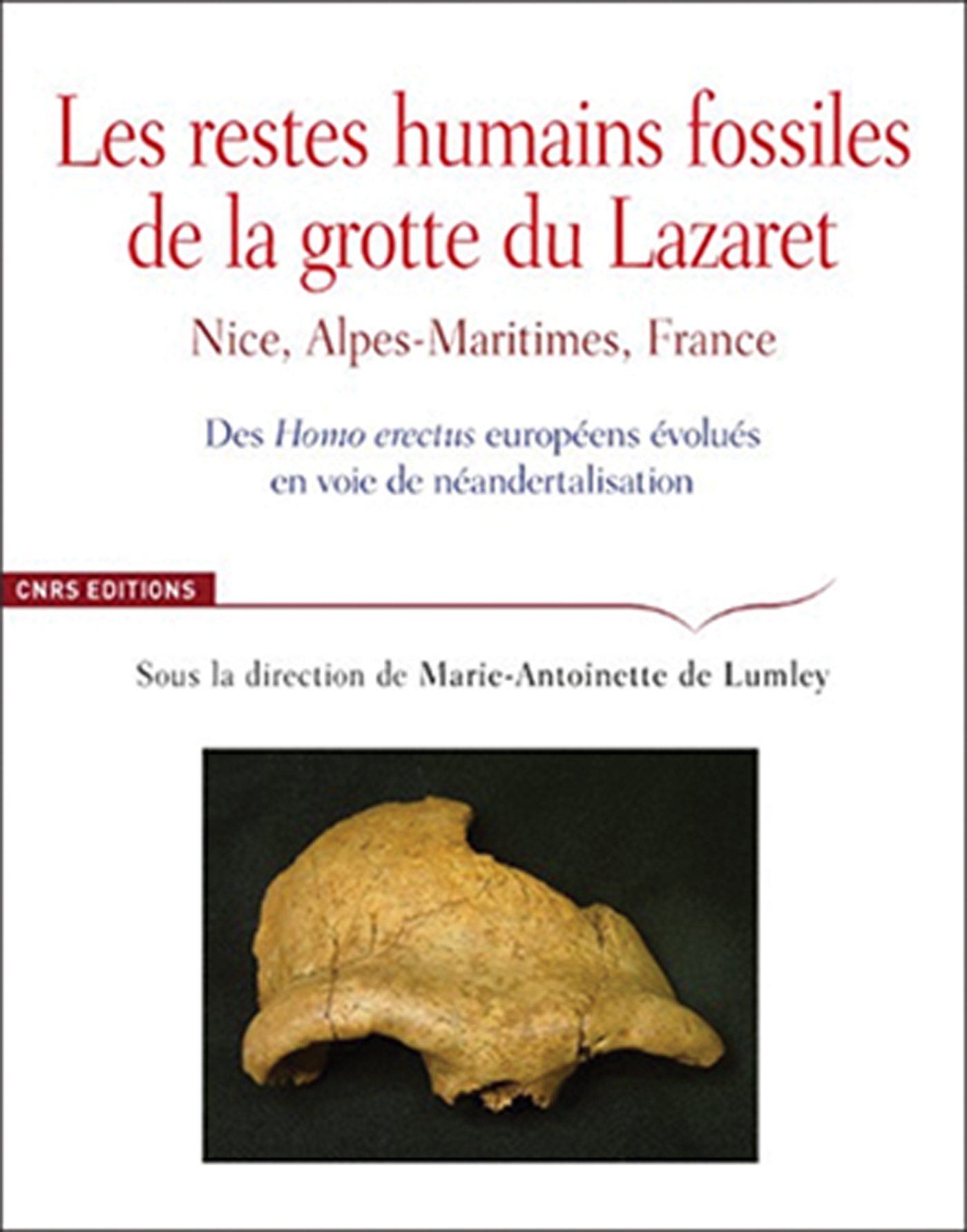
Lazaret Cave, near Nice in southern France, dating from 120 000–170 000 BP, ranks among the world's greatest prehistoric sites. This weighty tome is a key reference, summarising over 50 years of research at the site and presenting details of its human remains. The amount of material (including 640 000 pieces, 50 000 pollen grains and 374 hand axes) and detailed multidisciplinary analyses is staggering. The 19 chapters, 660 pages and 455 illustrations may seem exhaustive, but several more volumes of this scale would undoubtedly be required to present all the information on the 29 occupation levels at the site. I was happy to see the highlights from the site covered in the initial chapters of this publication, including its history, stratigraphy, palaeoenvironment, lithic industry, subsistence and life ways of occupants (Chapters 1–7, all multi-authored). The vast vision and analytic scope of this project (probably the longest-running excavation in Europe), and the ability to coordinate and bring to publication all of the highly specialised analyses is a remarkable feat that speaks volumes about the research and administrative skills of the de Lumleys. In addition to standard types of analyses, novel data were also analysed, from the smallest molluscs living on grasses and seaweed used in the cave, to detailed grain analysis of sediments, to degraded lipid residues in soils, to use-wear on teeth, to brain modelling.
The authors categorise the occupations as long-lasting (year-round) habitations, seasonal camps (several months) and brief hunting stops. On the basis of deciduous teeth, they argue that ten-year-old children were part of hunting groups, and given the presence of infant remains, women are assumed to have been part of seasonal or longer stays. A number of points of interest include: the presence of pine resin remains for hafting (p. 143); arguments for hand axes being used in butchering (p. 209); the inferred use of hearths for smoking and drying meat (on the basis of pyrolysed lipid residues and the use of smoky fuels like seaweed, pp. 159, 173); cut marks and phalanges consistent with the use of furs from carnivores (p. 170); the systematic breakage of bones to extract marrow and brains (p. 173) including human bones (pp. 194, 492–96, 505); and inferred long-term care of an injured child (pp. 188, 520). Most interpretations seem well argued, although the smoking of meat seems anomalous to me, and it certainly does not seem feasible on any large scale given the size of the hearth (0.5m), the nature of the fuel (seaweed and scrub), and the large amount of meat represented (34 large animals; pp. 209–10). Indeed, elsewhere, arguments are made for the consumption of raw meat and marrow at this same level (pp. 172, 209). The characterisation of this occupation as a smoking and butchering site stretches the available evidence, and the interpretation of these groups as collector societies, I think, is inappropriate.
In addition to these details, the authors make strong arguments for the existence of “a high cognitive level” (p. 525) and modern behaviour on the part of the pre-Neanderthal occupants of Lazaret. They exhibited mastery of fire, knowledge of a large territory (with a 25km radius), effective hunting, a lithic technology implying forethought and planning as well as language and cultural traditions, and care of injured individuals.
The following chapters of this volume (8–18) document the human remains from Lazaret in great depth, including detailed descriptions, endocast modelling, tooth use-striations, cut marks and breakage patterns, pathologies and animal gnaw marks. The remains consist of 28 bones: 18 isolated teeth (9 of which were deciduous); 4 femur fragments; 4 cranial fragments (including one massive frontal); 1 humerus fragment; and 1 mandibular fragment. While the authors see these remains as transitional from Homo heidelburgensis or Homo erectus to Neanderthals, there are varying opinions expressed about which species Lazaret individuals were closer to. Indeed, in Appendix 27 (p. 636), Eric Trinkaus describes “a complete absence of consensus on how to taxonomically sort the fossils from this [Mid-Pleistocene] period”.
Some of the more intriguing insights from the human remains involve evidence for scalping (on the frontal and the two parietals) and cannibalism. The authors argue that given the abundant faunal remains and evident success at hunting, there would have been little subsistence need to engage in cannibalism; therefore, it was more probably ritualistic in nature. This is an enduring element of European Palaeolithic life documented at Sima de los Huesos, Arago and Lazaret, as well as numerous Neanderthal and Upper Palaeolithic sites—an engaging topic worthy of future exploration.
The final part of this volume consists of 30 appendices, most of which are short commentaries reiterating various conclusions or expressing support for the project. For me, Marcel Otte's comments on the ritual manifestations at the cave are some of the more stimulating. He notes the presence of bouquetin (Capra ibex) bucrania (which have no meat value) being incorporated into the structures, and suggests that this was for symbolic reasons, as was—even more convincingly—the placing of a wolf's skull at the entry to the level 2 structure. These practices are echoed by the less well-documented Middle Palaeolithic remains excavated much earlier at the nearby Grotte du Prince where one of the hearths was associated with fossil bones “piled up as trophies […] This trophy included twenty-three remains of bouquetin crania, bucrania of bovids to the number of four, vestiges of bear, hyena, wolf and horse and several shed antler” (Villeneuve Reference Villeneuve1906: 55). An elephant skull and rhinoceros mandible were also placed, “probably as an ornament” (Villeneuve Reference Villeneuve1906: 55), on a natural platform. Furthermore, Otte notes that such use of animal crania (and perhaps the use of furs with claws) typically symbolised vitality or power. Such symbolic use of animals was probably accompanied by myths. To this one should probably add that scalping was used everywhere for symbolic displays. Otte also suggests that the stone circle (see p. 208) is similar to the ritual circle in the contemporaneous Bruniquel Cave.
All in all, this is a masterful report on a site of world-wide importance. Kudos are due to the de Lumleys and the small army of specialists that have persevered over the last 50 years. Anyone interested in the Palaeolithic of Europe should read this volume.


