Introduction
The use of donor sperm as a treatment for male infertility has been used for well over a century with the first documented case occurring in 1884.Reference Gregoire and Mayer 1 The introduction and increased use of intracytoplasmic sperm injectionReference Boulet, Mehta and Kissin 2 , Reference Jain and Gupta 3 has meant that donor sperm is not necessarily required as a treatment for male infertility in certain cases, and has therefore decreased demand for donated semen in this area. However, its use has been increasing due to reproductive choice by women in same sex relationships, or by single mothers without a male partner.Reference Moskovtsev, Dacanay and Baratz 4 – Reference Jadva, Badger, Morrissette and Golombok 6 Sperm donation and neonatal outcomes are therefore still relevant today.
Mechanistically, there is little reason to suggest that fertilization with donor sperm and subsequent outcomes would be different to naturally conceived outcomes. Whilst one introduces semen from a donor by means of a medical procedure, the latter involves intercourse between the woman and a male sexual partner. However, there are two factors which differentiate sperm donation from natural conception and that have the potential to introduce negative outcomes for the former. The first is that the incidence of preeclampsia is higher in donor conceived pregnancies and the second is that there is the use of cryopreservation procedures in storing donated sperm.
The incidence of preeclampsia is increased in donor sperm recipients when compared with spontaneously conceived pregnancies.Reference González-Comadran, Urresta Avila and Saavedra Tascón 7 – Reference Need, Bell, Meffin and Jones 11 As a leading cause of fetal and maternal morbidity and mortality, and one which is associated with increased incidences of intrauterine growth retardation (IUGR) and preterm delivery (PD),Reference Challis, Lockwood and Myatt 12 , Reference Zetterström, Lindeberg, Haglund and Hanson 13 preeclampsia represents a significant burden to the woman, her partner and the health care system. This burden is also further highlighted in the adult life of a person born where preeclampsia was present. This person has been shown to have an increased risk of hypertension,Reference Geelhoed, Fraser and Tilling 14 – Reference Himmelmann 16 endothelial dysfunction,Reference Davis, Newton and Lewandowski 17 higher body mass index (BMI),Reference Davis, Lazdam and Lewandowski 18 epilepsy,Reference Wu, Sun and Vestergaard 19 increased hospitalization due to disease,Reference Wu, Nohr and Bech 20 strokeReference Kajantie, Eriksson, Osmond, Thornburg and Barker 21 and autism spectrum disorder.Reference Mann, McDermott, Bao, Hardin and Gregg 22
Preeclampsia is considered a maternally mediated immune response.Reference Saito, Shiozaki, Nakashima, Sakai and Sasaki 23 , Reference Sargent, Borzychowski and Redman 24 This is supported, indirectly, by data from sperm donor recipients, where the incidence of preeclampsia reduced as the woman underwent subsequent inseminations with sperm from the same donor.Reference Kyrou, Kolibianakis, Devroey and Fatemi 25 As those couples that are trying to conceive naturally are likely to have had intercourse several times before conception occurs, the maternal immune system has adapted to the partner’s sperm and is less likely to induce preeclampsia in that population. Because the use of donor sperm is associated with preeclampsia, it is important to investigate whether there are increased risks for other poor neonatal outcomes when compared with spontaneous conceptions. In addition to the risk of preeclampsia described above, emerging evidence is suggestive of potential risks to health from sperm cryopreservation.
The technique of cryopreserving sperm was initially introduced for practical reasons of storage and shipment, and later became an important component of the donor conception practice to ensure appropriate screening of donors for genetic 26 – Reference Callum, Messiaen and Bower 28 and communicable diseases such as HIV.Reference Stewart, Tyler and Cunningham 29 This improvement is not without its own problems. As cryopreservation has been shown to cause DNA fragmentation,Reference Zribi, Feki Chakroun and El Euch 30 , Reference Dalzell, McVicar, McClure, Lutton and Lewis 31 and adversely affect morphology, motility and viabilityReference Di Santo, Tarozzi, Nadalini and Borini 32 in sperm. DNA fragmentation can also be induced through the mere handling of sperm in the laboratory.Reference Toro, Fernández and Colomar 33 For cryopreserved sperm, DNA fragmentation is typically mediated via oxidative stress,Reference Thomson, Fleming and Aitken 34 as a direct result of cryopreservation.Reference Tatone, Di Emidio, Vento, Ciriminna and Artini 35 With the potential to induce DNA changes through the manipulation of sperm, it is important to monitor how cryopreservation may impact on the health of donor conceived people.
As described above, the use of donor sperm has been in practice for a long time. A literature search of online databases in a non-systematic approach by the authors found few studies that investigated these outcomes in a case-controlled manner. It would appear from this investigation and the lack of published studies that the practices of donor insemination and intercourse have been assumed by some to be the same and therefore neonatal outcomes have also been presumed to mirror natural conception. Subsequently, offspring health outcomes have not been thoroughly investigated. Due to the modern practice of cryopreservation and subsequent knowledge of the incidence of preeclampsia in donor sperm pregnancies, we felt that these outcomes warranted a current systematic and structured review of the literature.
Furthermore, with evidence showing that neonates conceived with donated oocytes have significantly increased risks of being born of low birth weight (LBW) (<2500 g), very low birth weight (VLBW) (<1500 g), PD (<37 weeks), of lower gestational age (GA) and PD with LBW,Reference Adams, Clark, Davies and de Lacey 36 it is therefore important to consider whether neonates conceived with donated sperm are also at increased risk of these negative outcomes. This concern is not limited to the perinatal period, but also adulthood as poorer neonatal outcomes are associated with increased incidences of adult morbidity and mortality.Reference Class, Rickert, Lichtenstein and D’Onofrio 37 – Reference Barker 39
The purpose of this review was to summarize the published literature on neonatal outcomes such as birth weight (BW), PD and birth defects (BD), for conceptions after sperm donation. We aimed to elucidate whether the outcomes were altered when compared with a comparison cohort of spontaneously conceived neonates. Furthermore, the study would also include health outcomes reported from child and adult cohorts to determine any longitudinal effects. In addition, we aimed to investigate whether sperm cryopreservation influenced reported outcomes.
Methods
Literature search
A computerized literature search was conducted on articles published up to November 2012 in the online databases PubMed, EMBASE and Cochrane Reviews to identify studies containing data on neonatal health outcomes from donor sperm.
The literature search comprised a three-stage process. First, relevant articles known to the authors were used to identify keywords along with a search of the U.S. National Library of Medicine MeSH (medical subject headings) database to identify appropriate search headings. Second, MeSH terms and other identified keywords were used to search the online databases. Search results were then analyzed to determine specificity and to refine search terms, and filtered based on human not animal studies. Finally, the references of articles fitting the criteria were examined and online searches were implemented to find related articles.
Two main search categories were created and were termed ‘Techniques’, these were: artificial insemination and reproductive techniques. Artificial insemination was used in preference to sperm or semen donation as it had a long history of being used to describe the technique in the literature and other search terms and descriptors were designed to cover any of those publications not covered by the term artificial insemination. The term ‘reproductive techniques’ was chosen as a catch-all phrase. Two descriptors of human and donor were chosen to filter out animal studies and autologous treatments (own gametes). Three further qualifiers were implemented to each of the two techniques plus descriptor searches to refine the results. These qualifiers were: outcome*, morbidity and adverse effects. The * wildcard was implemented to cover studies whose keywords implemented outcomes v. outcome. Search terms are also presented in Supplementary Table 1 for reference.
Eligibility and selection
Article selection and eligibility was performed by D.H.A. and verified by S.d.L. according to the following PICOS criteria.
Participants
Cohorts of neonates that had neonatal health data presented in a study. Studies that incorporated offspring of older ages (children and adults) were also included.
Interventions
The treatment group must be comprised of a cohort of offspring conceived through fertility treatment of their parents with donated sperm. This could include both intrauterine insemination or in vitro fertilization (IVF) with donor sperm. The treatment group data must be appropriately segregated from comparison group data and not subsumed into larger combined data sets.
Comparators
Comparison cohorts could include offspring conceived through artificial insemination with their partner’s sperm or general population data of spontaneous conceptions.
Outcomes
Studies to be included must report neonatal health outcomes such as (but not restricted to), BWs, PD and BD (as determined by the publishing authors). Health outcomes of older offspring were also included if published. Studies that only focussed on live-birth rates or were case studies of single or few outcomes were excluded.
Study design
Only those observational case-controlled studies that used a treatment-cohort and comparison-cohort, or those studies involving a treatment-cohort that was compared with published, or public health data for that specific region and within 10 years of the study were included in the review. This was to remove any natural variation occurring between populations and between given time points.
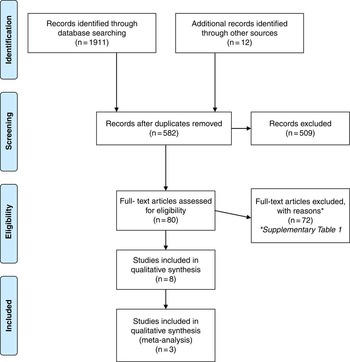
Published articles were restricted to the English language to allow for careful analysis of the study to ensure accurate data extraction as terminology and reporting methods varied considerably. There was no time restriction posed on publication dates, however, EMBASE would only allow a search from 1980. Database search results were downloaded into Endnote then analyzed by their titles and abstracts. Some articles were initially included as they could not be excluded based on their titles or abstracts, and were subsequently excluded following a full review of the text article (Fig. 1). Any disagreement was resolved via discussion.
Preferred reporting items for systematic reviews and meta-analyses (PRISMA) flowchart for identifying studies for inclusion in the review.

Data extraction
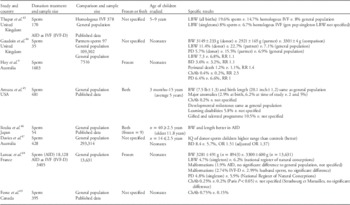
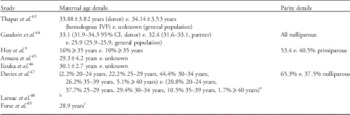
The following data were recorded by D.H.A. from the eligible studies: citation data, country, comparison type (partner’s sperm, spontaneous conception, published data), number of offspring in treatment/comparison group, if cryopreservation of sperm was used, specific neonatal health outcomes. Data were recorded onto a specially designed data extraction form. Specific health outcomes were included, but were not restricted to BWs, chromosomal or congenital malformations (BD), PD/GA, IUGR, and singletons v. multiple births (Table 1). Maternal age and parity were also extracted to assess confounding where applicable. Multiple birth is a known predictor of increased adverse outcomesReference Skora and Frankfurter 40 , Reference Barrington and Janvier 41 and was therefore a confounder to the analysis unless the data were stratified and extracted where presented.
Health outcomes for offspring conceived via sperm donation

AID, artificial insemination by donor; BW, birth weight, LBW, low birth weight <2500 g, ChAb, chromosomal abnormalities, BD, birth defects, IQ, intelligence quotient, IVF=in vitro fertilization; PD, preterm delivery (<37 weeks), RR, risk ratio, OR, odds ratio.
Sample sizes represented by statements such as ‘published data’ refers to the study citing data published elsewhere. Comparison data are presented as donor v. comparison group, P-value for significance is only provided where P<0.05. General population refers to data obtained from spontaneous conceptions that have either been presented in ‘published data’ by other authors, or were part of a comparison cohort with specific data presented in the study.
Data referring to previously published data or general population databases, but that did not record the actual outcome data, were not included in meta-analysis. No authors were contacted for missing or obscure data.
Meta-analysis
Meta-analyses of dichotomous outcomes data of LBW, PD and BD were performed according to Mantel–Haenszel methods, using a fixed effects model, risk ratios (RR), 95% confidence intervals (CI) and assessment of statistical heterogeneity using Cochrane’s Q-test and I 2 statistic. Heterogeneity of data were determined by the I 2 value and is considered significant when I 2>65%. All analyses were performed using Review Manager (RevMan) Version 5.2.8 (Copenhagen: The Nordic Cochrane Centre, Cochrane Collaboration, 2012). Publication bias was assessed by visual analysis of funnel plots constructed in RevMan for asymmetry.
Risk of bias in individual studies
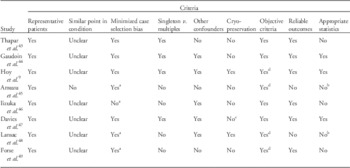
Included studies were assessed for methodological quality and the risk of bias using a modification of the Joanna Briggs Institute Meta Analysis Statistics Assessment and Review Instrument, with nine critical appraisal criteria for comparable cohort/case control studies. 42 Studies were assessed on the following criteria; are patients in cohorts representative of patients typically receiving fertility treatment (e.g. do they only include patients who may have been treated for ovarian cancer)? Are the patients at a similar point in the course of their condition/illness (do they describe how many times the patient had received treatment)? Has bias been minimized in relation to selection of cases and of comparators? Were singleton v. multiple births identified and strategies to deal with them stated? (If singleton v. multiples described but all of the outcome data relevant to the review was not stratified then=No); are other confounding factors identified and strategies to deal with them stated? Was cryopreservation of sperm or the use of fresh sperm adequately described, and were they appropriately stratified if both were included? Are outcomes assessed using objective criteria? Were outcomes measured in a reliable way? Was appropriate statistical analysis used?
Results
Searching of the three databases yielded 1911 articles with another 12 identified by hand-searching references lists. Duplicate removal reduced potential articles to 582. After screening the article titles and abstracts, 80 full-text publications were reviewed leaving a total of eight studies to be included in the review and, of these, three were included in a meta-analysis (Fig. 1).
A summary of the characteristics and outcomes of all studies included in this review is presented in Table 1.
There was a large amount of heterogeneity in the presentation of published outcomes. Subsequently, meta-analysis was only performed for outcomes that presented comparable statistical outcomes. The five studies not included in meta-analysis did not present comparable outcome data and have been summarized in the text.
Sperm donation
A total of eight studies investigating the health outcomes of people conceived via donated sperm met the criteria for inclusion.Reference Hoy, Venn, Halliday, Kovacs and Waalwyk 9 , Reference Thapar, Harold and Rice 43 – Reference Forse, Ackman and Fraser 49 From these studies a total of 24,699 health outcomes have been analyzed from sperm donation births and 423,763 from spontaneous conceptions. All donor sperm outcomes are from intrauterine inseminations unless otherwise stated.
Impacts of sperm donation on BWs
The most common parameter measured in all studies was BW with the exception of Forse et al.Reference Forse, Ackman and Fraser 49 Notably, BWs were reported in different formats and subsequently meta-analysis could not be conducted due to a lack of comparable data. Although Davies et al.47 reported BWs, these were not stratified as a separate outcome of donor insemination, but rather as a combined outcome for all Assisted Reproductive Technology (ART) procedures. Of the remaining six studies, none reported a statistically significant difference in BWs between donor sperm (treatment) and spontaneous conceptions in the general population (comparison) (see Table 1). Problematically, the study by Lansac et al. Reference Lansac, Thepot and Mayaux 48 compared the BWs of singleton donor sperm conceived neonates to all births including multiples of spontaneously conceived neonates. BW data from these studies were not controlled for GA.
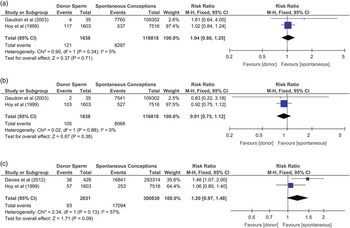
Thapar et al.43 showed a higher incidence of LBW of singleton donated sperm IVF neonates when compared to homologous IVF treatments but no difference to the spontaneous conceptions of the general population (general population data were not reported). The incidence of LBW were higher for donor sperm IVF neonates (19.6%), in comparison with homologous IVF (14.7%), and the spontaneous conceptions (8%) in the same cohorts. Gaudoin et al.44 also found a higher incidence of LBW in donor sperm neonates (11.4%), when compared with the general population (7.1%), but lower than that achieved when the partner’s sperm was used (22.7%). Hoy et al.Reference Hoy, Venn, Halliday, Kovacs and Waalwyk 9 reported no significantly increased risk of LBW (7.3 v. 6.8%, RR: 1.1), even though the actual frequency was greater. Conversely, a lower frequency of 4.7% LBW for donor sperm neonates when compared with 6.2% for spontaneous conceptions was reported by Lansac et al.Reference Lansac, Thepot and Mayaux 48 LBW data from these studies were not controlled for GA. Meta-analysis of comparable data showed that the RR for LBW was not statistically significant (RR: 1.04, CI: 0.86–1.25, P=0.71, I 2=0%) (Fig. 2a).
Forrest plots of sperm donation outcomes; (a) risk ratio for being born of low birth weight (<2500 g), (b) risk ratio for being born preterm delivery (<37 weeks), (c) risk ratio for incidences of birth defects, neonates from donor sperm offspring v. spontaneous conceptions.

Impacts of sperm donation on PD
Of the three studies reporting PD outcomes, all of them reported no increase in the rates of PD, rather the incidences were reduced (5.7 v. 6.9%;Reference Gaudoin, Dobbie and Finlayson 44 6.4 v. 6.6%;Reference Hoy, Venn, Halliday, Kovacs and Waalwyk 9 4.8v. 5.9%Reference Lansac, Thepot and Mayaux 48 ). Meta-analysis of the above studies (Lansac et al. was excluded due to lack of comparable cohort data), showed no significant change to PD outcomes (RR: 0.91, CI: 0.75–1.12, P=0.38, I 2=0%) (Fig. 2b).
Impacts of sperm donation on BDs
A significant increased incidence of BD between neonates conceived via sperm donation v. the comparison cohorts [8.4 v. 5.7%, odds ratio (OR) 1.5, 95% CI 1.08–2.11], was reported.Reference Davies, Moore and Willson 47 However, when this was adjusted for confounders such as maternal age, parity, fetal sex, year of birth, maternal race or ethnic group, maternal country of birth, maternal conditions in pregnancy, maternal smoking during pregnancy, socioeconomic status, and maternal and paternal occupation the association was attenuated and subsequently non-significant (OR: 1.37, 95% CI: 0.98–1.92). Amuzu et al.Reference Amuzu, Laxova and Shapiro 45 reported no significant difference in malformation rates in neonates to those found in the general population even though their incidence was 45% higher than the general population (2.9 v. 2%). Although not as large, this trend was also evident in the older children they studied (longitudinal), whereby the incidences of malformations were 24% higher (6.2 v. 5%). Hoy et al.Reference Hoy, Venn, Halliday, Kovacs and Waalwyk 9 reported no significant difference in BD rates (3.6 v. 3.2%, RR 1.1), and Lansac et al. also reported no significant differences in malformation rates between sperm donor neonates and the general population. However, the data for the general population was not reported by Lansac et al.Reference Lansac, Thepot and Mayaux 48 Meta-analysis showed a non-significant increased incidence of BD (RR: 1.20, CI: 0.97–1.48, P=0.09, I 2=57%) (Fig. 2c).
Of the four studies investigating chromosomal abnormalities, two found a higher incidence of occurrence which was restricted to aneuploidies.Reference Hoy, Venn, Halliday, Kovacs and Waalwyk 9 , Reference Forse, Ackman and Fraser 49 However, Thapar et al.Reference Thapar, Harold and Rice 43 found no increase in chromosomal abnormalities and that the chance of this occurring was correlated to both the maternal age as well as the donor age. Comparable chromosomal abnormality data were not available for meta-analysis.
Impacts of sperm donation on other outcomes
The only study to investigate the intelligence quotient (IQ) outcomes of these children found that those conceived via donor sperm had a higher IQReference Davies, Moore and Willson 47 than the general population.Reference Tanaka 50 A further study reported that 10.5% of donor sperm children were in gifted and talented programs while 5.8% had learning disabilities, however, no general population comparison data were provided by the authors.Reference Amuzu, Laxova and Shapiro 45
Effects of cryopreservation on outcomes
Cryopreservation was only recorded in two studies.Reference Hoy, Venn, Halliday, Kovacs and Waalwyk 9 , Reference Lansac, Thepot and Mayaux 48 Both of which only used cryopreserved sperm in their donor sperm cohorts. A further three studies used cryopreserved data due to the mandatory use of cryopreserved sperm in their respective jurisdictions but did not report it as such (see discussion for further information).Reference Thapar, Harold and Rice 43 , Reference Gaudoin, Dobbie and Finlayson 44 , Reference Davies, Moore and Willson 47 Subsequently, all three studies used in meta-analyses (two could not be included in meta-analyses due to lack of comparable data), involved the use of cryopreserved sperm; one from self-reporting and two from cryopreservation mandated jurisdictions. Of the studies using cryopreserved sperm, the outcomes that were statistically significant from comparison groups was an increased RR of 2.5 for aneuploidies,Reference Hoy, Venn, Halliday, Kovacs and Waalwyk 9 increased OR of 1.73 (CI: 0.26–11.69) for LBW,Reference Gaudoin, Dobbie and Finlayson 44 increased OR of 1.51 (CI: 1.08–2.11) for BD which was subsequently non-significant (1.37, CI: 0.98–1.92) when adjusting for confounders,Reference Davies, Moore and Willson 47 and an increased incidence of chromosomal anomalies (P<0.05).Reference Lansac, Thepot and Mayaux 48 A further study reported a higher percentage of LBW neonates in the cryopreserved sperm donation cohort when compared to the general population but did not conduct statistical analysis of the data.Reference Thapar, Harold and Rice 43 Contrastingly, BD were not affected in the study by Hoy et al., and the malformation rate was the same as comparison groups in the study by Lansac et al. As there was insufficient studies and data to conduct meta-analyses of outcomes from cryopreserved sperm v. fresh sperm, the effect of cryopreservation on neonatal outcomes requires elucidation through further studies.
Effects of multiplicity on outcomes
The incidences of multiple births were either poorly recorded in several of the studies or were not stratified from other data to allow for appropriate comparisons. Subsequently, meta-analysis of multiplicity could not be conducted on these studies. However, the three studies that provided the majority of data for neonatal health outcome meta-analysis had appropriate multiplicity data or were appropriately controlled.Reference Hoy, Venn, Halliday, Kovacs and Waalwyk 9 , Reference Gaudoin, Dobbie and Finlayson 44 , Reference Davies, Moore and Willson 47 Three further studies provided data on the incidences of multiplicity in the sperm donation cohorts,Reference Thapar, Harold and Rice 43 , Reference Amuzu, Laxova and Shapiro 45 , Reference Lansac, Thepot and Mayaux 48 but did not provide comparison cohort data from natural conceptions (general population). Rather, only multiplicity data were provided for homologous IVFReference Thapar, Harold and Rice 43 and IVF-D (IVF with frozen donated sperm).Reference Lansac, Thepot and Mayaux 48
As Hoy et al. did not control for multiplicity, no conclusion can be drawn on the confounding effects of multiplicity when interpreting sperm donor effects on LBW, PD or BD outcomes.
Risk of bias
There was variation in the methodological quality of the studies included (Table 2). In general, the length of time the woman had been receiving treatment (number of previous attempts) was not documented. Data of other confounders such as maternal age, BMI, reasons for infertility and other demographic data were poorly reported. Or in the instance where these confounders were reported well, they were not stratified into sperm donation v. spontaneous conception cohorts.Reference Davies, Moore and Willson 47 Multiplicity was reported in only half of the studies, but a lack of comparison data meant that meta-analysis of the rates of multiplicity could not be performed. Studies reporting outcomes such as BWs, LBW, and PD were deemed to be reporting objective criteria, although BWs and LBWs were not controlled for GA. However, those reporting BD (or what was classified as malformations) were more subjective in nature as BD is a general category that it is not typically well defined. Additionally, BDs can potentially be missed in the neonatal period with the reporting of BDs in reproductive technology cohorts historically being described as needing to be ‘more stringent’ by the American Fertility Society, Society for Assisted Reproductive Technology, and the American Society for Reproductive Medicine. 51 – 54 By contrast Davies et al.,Reference Davies, Moore and Willson 47 were more objective in reporting BD using the British Paediatric Association modification of the International Classification of Diseases (9th Revision), in addition to when chromosomal abnormalities and congenital cerebral palsy were reported.Reference Hoy, Venn, Halliday, Kovacs and Waalwyk 9 , Reference Amuzu, Laxova and Shapiro 45 , Reference Lansac, Thepot and Mayaux 48 , Reference Forse, Ackman and Fraser 49 Studies by Thapar et al., Amuzu et al., Iizuka et al., and Forse et al., used general population data as a comparison cohort but only referred to previously published information and did not provide data for comparison.Reference Thapar, Harold and Rice 43 , Reference Amuzu, Laxova and Shapiro 45 , Reference Iizuka, Sawada, Nishina and Ohi 46 , Reference Lansac, Thepot and Mayaux 48
Critical appraisal and risk of bias of included studies

a Comparison group was published data not a comparison cohort.
b Statistics used appropriately, but did not provide details of results in analysis to comparison group.
c Although cryopreservation was not recorded by, it is known through other means that cryopreservation was mandated during the period of those studies.
d Includes both objective and subjective data.
Funnel plot analysis showed publication bias in sperm donation health outcome meta-analysis for PD. Maternal age and parity data were not consistently reported or adjusted for in the studies included. Those studies that reported this data are presented in Table 3.
Maternal age and parity reporting of included studies

a Maternal age and parity data are from larger assisted conception cohort that also includes donor sperm outcomes.
b No maternal age data of sperm donor outcomes v. comparison, rather maternal age data were presented within sperm donation outcomes stratified as healthy infants v. malformed infants.
c Used comparison data for population with same maternal age distribution.
Limitations to this study
This review was limited by the restriction to three databases, limited hand-searching and the restriction to the English language. It was also limited due to the lack of studies meeting the inclusion criteria. There was a lack of consensus in the types of outcomes and how they were reported in these studies which prevented the inclusion of some studies in meta-analysis.
The reporting of multiple deliveries was inconsistent and data were rarely appropriately stratified for analysis of singleton v. multiple birth outcomes. While rates of multiples were reported in some studies, the outcome data were pooled rather than stratified and therefore meta-analysis could not be performed in a stratified manner for those studies. Only two studies restricted data to singleton outcomes,Reference Gaudoin, Dobbie and Finlayson 44 , Reference Davies, Moore and Willson 47 one of which appropriately adjusted for multiple confounders.Reference Davies, Moore and Willson 47
Consistency in reporting, with increased analysis of confounders such as multiple deliveries, maternal age, parity, and cryopreservation can be improved. There was a distinct lack of sperm donation outcomes in the reporting of other annual ART reports such as the ‘Assisted reproductive technology surveillance--United States’ reports that are produced by the Centers for Disease Control and Prevention (CDC), or early reports published by the Society for Assisted Reproductive Technology and the American Society for Reproductive Medicine, which includes comprehensive data (such as oocyte donation outcomes) for all other areas of reproductive technology treatments.
Discussion
This review has demonstrated that donor sperm neonates, when compared to spontaneously conceived neonates, are not at increased risk of being born of LBW (<2500 g), PD (<37 weeks), or with increased incidences of BD. There was also little to suggest any correlation with IQ or learning disabilities. In contrast to donor oocyte neonatal outcome data,Reference Adams, Clark, Davies and de Lacey 36 the limited amount of data on perinatal outcomes after donor insemination suggests that this group has been understudied.
While individual studies reported donor sperm neonates were not born of significantly lower mean BW, there was one report of increased BWs and body length in the sperm donation neonates,Reference Iizuka, Sawada, Nishina and Ohi 46 which requires consideration. While the authors postulated that this may be attributed to the environment of the Tokyo metropolitan and surrounding areas of the 1960s, it is plausible that the effect was confounded as the parents of the donor sperm conceived neonates were reported to have higher education levels than comparators, and therefore perhaps able to access a range of resources, including energy and protein dense diets, which can influence fetal development. Additionally in regard to mean BWs, another study compared singleton donor sperm conceived neonates to all births (including multiples) of spontaneously conceived neonates,Reference Lansac, Thepot and Mayaux 48 which may adversely affect the data as typically multiple births result in lower BWsReference Luke and Keith 55 , Reference Blondel, Kogan and Alexander 56 and therefore any effect may be missed.
A higher incidence of elective early caesarean section deliveries observed in cohorts of women that have used various forms of ART,Reference Poikkeus, Saisto and Punamaki 57 , Reference Gillet, Martens, Martens and Cammu 58 could also adversely affect outcome measures leading to reduced BWs reported for the donor sperm conceived neonates. These incidences would not be apparent from PD data analysis which is of delivery prior to 37 weeks, as elective caesarean is typically not performed before 37 weeks.
Meta-analysis of BD showed no significant increased incidences as a result of using donor sperm. However, there were some reports including chromosomal abnormalities that had conflicting outcomes. The increases in aneuploidy reported in two studies could potentially be explained by higher maternal and donor ages rather than as a function of the donor conception procedure itself.Reference Hoy, Venn, Halliday, Kovacs and Waalwyk 9 , Reference Forse, Ackman and Fraser 49 This was supported by another study which correlated malformation rates with maternal age but not with donor age.Reference Lansac, Thepot and Mayaux 48
The use of cryopreserved sperm raises the possibility of increased negative outcomes due to increased oxidative stress.Reference Tatone, Di Emidio, Vento, Ciriminna and Artini 35 Oxidative stress can lead to DNA changesReference Thomson, Fleming and Aitken 34 and is therefore of considerable interest in regard to offspring outcomes. While not specifying the use of cryopreserved sperm, three studies were conducted in jurisdictions which introduced mandatory cryopreservation following the transmission of HIV to recipient mothers,Reference Stewart, Tyler and Cunningham 29 prior to the start of those study’s inclusion periods. 59 , Reference Tyler, Dobler, Driscoll and Stewart 60 Mandatory use of cryopreserved sperm was not brought in to other jurisdictions 61 , 62 until after the inclusion periods of those respective studies.Reference Amuzu, Laxova and Shapiro 45 , Reference Forse, Ackman and Fraser 49 Subsequently there was only one study where the use of cryopreserved or fresh sperm was not reported and the use of which could not be elucidated through mandated protocols in the appropriate jurisdiction.Reference Forse, Ackman and Fraser 49
Reports in some studies of increased incidences of BD,Reference Davies, Moore and Willson 47 and chromosomal aneuploidies/anomalies,Reference Hoy, Venn, Halliday, Kovacs and Waalwyk 9 , Reference Lansac, Thepot and Mayaux 48 could potentially be attributed to the use of cryopreserved sperm. However, one study found no difference in BD in their cryopreserved cohort.Reference Hoy, Venn, Halliday, Kovacs and Waalwyk 9 While one of the studies that reported chromosomal aneuploidies/anomalies only found a difference in one comparison cohort and not two other comparison cohorts.Reference Lansac, Thepot and Mayaux 48 Additionally, in another study, after adjusting for multiple confounders, the OR for increased BDReference Davies, Moore and Willson 47 was attenuated and subsequently non-significant, however, the authors caution that the adjusted data for the sperm donation cohort was limited by a small sample size. The effect that cryopreservation induced DNA damage/fragmentation may have on offspring outcomes therefore remains somewhat unclear and requires additional studies as well as elucidation via longitudinal studies. Due to the fact that cryopreservation of donor sperm is mandated in several jurisdictions, the ability to be able to determine the influence of sperm cryopreservation on offspring outcomes would be difficult to ascertain in donor sperm offspring cohorts and therefore may be better achieved through the analysis of cryopreserved and fresh outcomes from artificial inseminations using partner sperm.
It was reported in the only study investigating IQ outcomes, that children conceived with donor sperm had higher IQs v. comparators.Reference Iizuka, Sawada, Nishina and Ohi 46 IQ is a function of both nature and nurture, genetics and environment.Reference Brant, Munakata and Boomsma 63 Given that it was reported by the authors that the recipient parents of the children with higher IQs had higher levels of education themselves (college education), and the fact that in the earlier period of artificial insemination by donor (AID) practice the majority of sperm donors were recruited from students at universities including medical students, 64 – Reference Cushing 66 which was also stated by the authors as the recruiting pool of donors for their study; this result is not surprising and may be due to confounding by either genetic or social factors related to IQ. Recruitment of donors by fertility clinics has changed over time with this earlier period of recruitment being before the advent of internet advertisement which some clinics currently employ.Reference Tomlinson, Pooley, Pierce and Hopkisson 67 , Reference Shukla, Deval and Jansa Perez 68 Earlier methods of recruitment often but not exclusively relied on advertisements in university student newspapers, 64 , Reference Paul, Harbottle and Stewart 65 , Reference Pacey 69 or even personal approaches by doctors to medical students.Reference Tyler, Dobler, Driscoll and Stewart 60 , Reference Paul, Harbottle and Stewart 65
Learning difficulties of 5.8% were reported in one of the donor sperm children cohorts.Reference Amuzu, Laxova and Shapiro 45 The American Academy of Pediatrics describe that ‘learning disabilities are complex’. 70 Subsequently, there can be considerable variability in reported prevalence between geographic locations due to inconsistencies in identification procedures,Reference Scruggs and Mastropieri 71 however, some estimate that the prevalence in children in the United States is in the vicinity of 5Reference Lyon 72 or 6.5%Reference Boyle, Decouflé and Yeargin-Allsopp 73 in a comparable time-period to the study in the review. Therefore, the figure of 5.8% reported could be considered as being within the reported frequency in the general population. Assessing gifted and talented students is additionally very complex with little consensus in how to define the group and with subsequent prevalence thereby ranging from 1 to 15–20%,Reference Pfeiffer 74 the figure reported in one study of 10.5%,Reference Amuzu, Laxova and Shapiro 45 , without corresponding comparison cohort data are therefore impossible to interpret. Subsequently, there is little evidence to suggest that the use of donor sperm has any effect on IQ or learning abilities of children outside of those effects that are attributable to genetic or environmental factors that are normally present in all families.
Although meta-analysis data showing increased incidences of negative outcomes in donor oocyte neonates of LBW, VLBW, PD, PD with LBW and lower GA have been reported recently,Reference Adams, Clark, Davies and de Lacey 36 there is little evidence to suggest that the outcomes for donor sperm neonates are equally affected. However, oocyte neonate outcomes have been more rigorously studied and reported in a systematic manner than donor sperm outcomes allowing for greater confidence in the data and subsequent analysis.
The lack of increased risks for negative outcomes compared with those observed in spontaneous conceptions is perceived as reassuring to both clinicians and their patients. Reports of increased incidences of preeclampsia that occur in donor conceived cohorts (not a focus of this review), are typically associated with poor neonatal outcomes such as IUGR and PD. Yet, these outcomes were not significantly elevated in the studies included in this review. Interestingly, each study reporting PD outcomes showed a non-significant decreased frequency. The dearth of multiple case-controlled studies to provide robust meta-analysis of outcomes however means that the results should be treated with caution. Considering the length of time that sperm donation has been used in a clinical setting for the treatment of male infertility, the lack of multiple case-controlled studies was surprising.
What is clear is that there is little evidence on the health outcomes not only in the neonatal period, but also in childhood; and a paucity of data on adult donor sperm offspring. There are some reports emerging of outcomes in the adult population, however the data are combined with other ART data,Reference Halliday, Wilson and Hammarberg 75 and as such more studies need to be conducted on health outcomes for donor sperm neonates, children and adults.
As poor neonatal outcomes are associated with increased incidences of morbidity and mortality in later life,Reference Class, Rickert, Lichtenstein and D’Onofrio 37 – Reference Barker 39 the types of outcomes represented in this review are significant for the long-term health of those conceived with donor sperm. Studies showed that there was not an increased risk of being born of lower mean BW or born of LBW (<2500 g). In addition, the lack of increased incidences of PD is also suggestive that long-term health outcomes for donor sperm offspring may not be as adversely impacted as those offspring conceived from donor oocytes. Although some reports suggest that there could be increased incidences of BD which may be associated with cryopreservation, this requires confirmation or rejection with further studies.
Acknowledgements
None.
Financial Support
The author(s) received no financial support for the research, authorship and/or publication of this article.
Conflicts of Interest
None.
Supplementary Material
To view supplementary material for this article, please visit http://dx.doi.org/10.1017/S2040174416000489