Introduction
The most important source of protein in livestock and poultry nutrition worldwide is soybean meal. However, because of the increasing demand for alternative protein feedstuffs in animal feed, there is a need to look for and use other sources. Cottonseed meal (CSM) is a by-product of the oil industry, i.e. oil extraction from cotton seeds. CSM is a relatively rich sources of protein (30 to 50%) and amino acids (He et al., Reference HE, ZHANG and OLK2015b). Traditionally, it is used as a protein source in the nutrition of ruminants as they tolerate well the presence of gossypol in the diet.
The restriction on the use of cottonseed by-products in poultry and other monogastric animals is due to the presence of such antinutritive substances as gossypol, gossypol-like pigments, phytin, and cyclopropene fatty acids, a high concentration of crude fibre, and low availability of some essential amino acids (Phelps, Reference PHELPS1966). Despite this fact, use of a CSM, as a cheaper substitute for soybean meal in the diets for poultry, can be economically justifiable. It is especially important in developing countries where growth of poultry production is limited by the high cost of such feed protein sources as soybean or fish meal (Kanyinji and Sichangwa, Reference KANYINJI and SICHANGWA2014). The aim of this paper is to present and discuss the results of recent experiments on the effects of dietary CSM on the performance, health, and metabolic parameters of poultry.
The nutrient composition of cottonseed materials
CSM can be a rich source of significant amounts of crude protein and amino acids, however the variability of nutrients concentration in different samples is often high. In recent years several experiments have been carried out to determine the chemical composition and variability in CSM. Cheng and Hardy (Reference CHENG and HARDY2002) analysed the nutritional properties of CSM from four different locations in the southern USA. They reported considerable variability in nutrient content among samples, whereby crude protein ranged from 34.9 to 41.3%, fat from 1.43 to 3.70%, phosphorus from 9.95 to 1.10%, Lys from 1.68 to 1.90%, Met from 0.57 to 0.63%, Thr from 1.17 to 1.30%, and Trp from 0.42 to 0.47%. The variation in chemical composition of CSM may be due to such factors as varieties and location differences, varied agronomic practices (fertiliser), and differences in degree of cortication, proportion of husk, and processing methods during oil extraction.
Protein and amino acid digestibility is one of the main concerns in the use of CSM as a feed material for poultry. Lysine (Lys) is the first limiting amino acid in cotton protein, and the digestibility of Lys in cotton is rather low because gossypol, during the oil extraction process, can bind with the epsilon amino group of Lys, reducing its availability (Nagalakshmi et al., Reference NAGALAKSHMI, RAO, PANDA and SASTRY2007). Huang et al. (Reference HUANG, RAVINDRAN, LI, RAVINDRAN and BRYDEN2007) reported that the ileal digestibility coefficient of crude protein of commercial cottonseed meal in broilers was 0.72, methionine 0.74, lysine 0.60, and threonine 0.59, and in general these values were lower for CSM than in cereal grains (sorghum, maize, wheat), soybean meal, canola meal, wheat middlings, and meat and bone meal. Similarly, relatively low values of coefficients of digestibility of crude protein and amino acids in CSM were found by Lemme et al. (Reference LEMME, RAVINDRAN and BRYDEN2004). Negative effects of gossypol content on amino acid digestibility in CSM was reported by Salas et al. (Reference SALAS, EKMAY, ENGLAND, CERRATE and COON2013), who found that true digestibility coefficients for essential amino acids in CSM containing 1.52% of total gossypol ranged from 73.9 to 91.8%, while in CSM containing 0.02% of gossypol these coefficients were all significantly higher.
The content of free gossypol differs between cotton varieties and ranges between 0.02 and 0.53% in different CSM samples; however, in glandless varieties it is much lower (Nagalakshmi et al., Reference NAGALAKSHMI, RAO, PANDA and SASTRY2007). The toxic effect of a high free gossypol dietary level in poultry can include decreased growth rate, feed intake, and poor feed efficiency, increased mortality, reduced egg weight, worsening internal egg quality and hatchability and the development of iron deficiency symptoms, including reduced blood haemoglobin.
Gossypol in cottonseed meal exists as a mixture of two identical structures with different optical properties, i.e. (+)- and (-)-enantiomers (Gamboa et al., Reference GAMBOA, CALHOUN, KUHLMANN, HAQ and BAILEY2001). Results of the study by Kakani et al. (Reference KAKANI, GAMBOA, CALHOUN, HAQ and BAILEY2010) showed that the toxic effects, among others impaired growth rate, of gossypol in broilers, are due mainly to the (-)-enantiomer. Data from others experiments proved that (-)-gossypol is more detrimental in regards to feed consumption and growth of broilers than (+)-gossypol (Bailey et al., Reference BAILEY, STIPANOVIC, ZIEHR, HAQ, SATTAR, KUBENA, KIM and VIEIRA2000; Lordelo et al., Reference LORDELO, DAVIS, CALHOUN, DOWD and DALE2005). Lordelo et al. (Reference LORDELO, CALHOUN, DALE, DOWD and DAVIS2007) found, however, that ingestion of both forms of gossypol could cause adverse effects in hens, but (+)-gossypol had a greater influence on yolk discolouration than (−)-gossypol. Crude fibre is another concern limiting the use of CSM in poultry diets, as its concentration is rather high and variable, i.e. ranging from 125 to 285 g/kg (Nagalakshmi et al., Reference NAGALAKSHMI, RAO, PANDA and SASTRY2007).
The effects of inclusion of cottonseed meal to poultry diets
broiler chickens
Several studies have been carried out to evaluate the optimum level of CSM that can be included in the diet without a negative influence on the performance indices and physiological status of broiler chickens. The results of these studies are summarised in Table 1 .
Results of selected studies on the effects of incorporation of cottonseed meal (CSM) or cake (CSC) into broiler diets.

El Boushy and Raterink (Reference EL BOUSHY and RATERINK1989) observed a negative linear effect of increasing dietary level of CSM (8 to 24%) on body weight gain (BWG) and feed conversion ratio (FCR). Since all diets were isonitrogenous and contained equal levels of essential amino acids as well as the growth performance of broilers fed with a high level of CSM (24%) was improved by the addition of 600 ppm Fe, the authors suggested that the negative effect of CSM was due to the high concentration of free gossypol (0.17%). The results of the study by Azman and Yilmaz (Reference AZMAN and YILMAZ2005) demonstrated that chickens (aged 7 to 21 d) can be fed up to 20% CSM in the formulation when the diet is supplemented to attain 1.5% or 3% Lys. Correspondingly, Gamboa et al. (Reference GAMBOA, CALHOUN, KUHLMANN, HAQ and BAILEY2001) demonstrated that CSM (with a free gossypol content ranging from 0.033 to 0.180%) could be successfully included in starter diets up to a level of 20% if the diets were isonitrogenous and formulated on a digestible amino acid basis. Henry et al. (Reference HENRY, PESTI, BAKALLI, LEE, TOLEDO, EITENMILLER and PHILLIPS2001) reported poor FCR in broilers fed diets containing 20% CSM containing 0.075% total gossypol, however after addition of 2% Lys, performance indices in isonitrogenous CSM and control corn-soybean diets were similar. Similarly, Hassanabadi et al. (Reference HASSANABADI, HEIDARINIYA and SHAHIR2009) showed that broiler diets containing CSM required an increased Lys supplementation to obtain growth performance comparable to soybean meal-based diets, due to the reduced availability of Lys bound to gossypol. The results of previous work by Fernandez et al. (Reference FERNANDEZ, ZHANG and PARSONS1995) showed that the performance of broilers fed diets formulated with 20% CSM containing 0.01% of free gossypol could be markedly improved if the diets are formulated on a true digestible, not total, amino acids basis.
Abdulrashid et al. (Reference ABDULRASHID, JOSEPH, MOHAMMED and ADAMU2013) did not find any significant effect of CSM when included up to levels of 30% in isoenergetic and isonitrogenous diets on BWG, however, FCR worsened. In a more recent experiment Mishra et al., Reference MISHRA, RAY, SARKAR and HALDAR2015 have shown that low-gossypol CSM (0.001% of free gossypol) can be safely incorporated at 5% (1-14 d of age) and 10% (15-35 d), as a partial replacement of soybean meal in diets containing the same level of crude protein and essential amino acids as control diet, without any negative effect on performance. However, higher inclusions levels of CSM decreased BWG and FCR, due to decreased content of available Lys. Similarly, the results of a study by Pieniazek et al. (Reference PIENIAZEK, STIPANOVIC, PUCKHABER, WEDEGAERTNER, FARNELL, BYRD and LEE2015) have shown that that pressed, dehulled CSM (0.373% of total gossypol) can be included at up to 10% in broiler diets without any adverse effect on growth performance. No negative influence was observed when the broilers were fed isoenergetic and isonitrogenous diets containing 0 or 10% genetically modified Bt cottonseed meal (0.07% of free gossypol) (Elangovan et al., Reference ELANGOVAN, TYAGI, SHRIVASTAV, TYAGI and MANAL2006). Adeyemo and Longe (Reference ADEYEMO and LONGE2007) reported that 25% of the soybean cake could be substituted by cottonseed cake (CSC) in isocaloric and isonitrogenous diets without any negative effects, while higher dietary levels of CSC negatively affected broilers’ performance.
The aim of the work by Ozdogan et al. (Reference OZDOGAN, WELLMANN and PAKSUZ2012) was to evaluate the influence of 0, 5, 10, and 15% CSM in isoenergetic and isonitrogenous diets as a gossypol source (0, 0.0062, 0.0124, and 0.0186% gossypol in the diet) on selected blood indices and intestinal physiology. They did not find any effect of CSM on blood haemoglobin, iron, and haematocrit, or intestinal morphometry, except for increased duodenal villus height, while jejunum and ileum digesta pH was enhanced in broilers fed with the highest CSM dietary level. The authors concluded that there were no adverse effects of high dietary gossypol on the metabolic indices of broilers. Mahmood et al. (Reference MAHMOOD, KHAN, KHAN, MUHAMMAD and JAVED2011) reported, however, that the inclusion of 20 or 30% CSM containing 0.075% free gossypol to isocaloric and isonitrogenous diets for broiler breeder males negatively affected BWG, serum testosterone, semen volume, sperm count, and testes volume and relative weight.
The aim of the study by Kanyinji and Sichangwa (Reference KANYINJI and SICHANGWA2014) was to compare the efficacy of unfermented and fermented CSM, used at dietary levels of 15 or 20% in replacement of soybean meal. Fermented CSM had no negative effects on broiler performance and yielded better economic returns at the 20% dietary level as compared with the control corn-soybean diet containing similar level of energy, crude protein and lysine, while the diet with 20% unfermented CSM decreased the growth rate of broilers during 21-42 d of age (Kanyinji and Sichangwa, Reference KANYINJI and SICHANGWA2014). Fermentation, by decreasing the content of crude fibre, inactivating the gossypol, and increasing the content of crude protein and ether extract, can therefore be a good way to enhance the feeding value of CSM. Similar results were obtained recently by Nie et al. (Reference NIE, ZHANG, GE, WANG, LIU and LIU2015a; Reference NIE, ZHANG, WANG, LIU, GE and LIU2015b) who found improved BWG, FCR, and digestibility of nutrients, as well as decreased levels of abdominal fat and hepatic triglycerides in chickens fed a diet containing 6% CSM fermented by Candida tropicalis and Saccharomyces cerevisae (0.0033% of free gossypol) than in those fed with the same dietary level of unfermented CSM (0.0127% of free gossypol). Tang et al. (Reference TANG, SUN, YAO, WU, WANG and FENG2012) reported that fermentation of CSM by Bacillus subtilis markedly decreased the content of free gossypol from 0.082 to 0.021%. Moreover, fermented CSM had a higher content of crude protein (50.5%) and amino acids, as well as a lower content of crude fibre and, included to the diet at an 8% level, beneficially affected BWG and immune functions of broilers (Tang et al., Reference TANG, SUN, YAO, WU, WANG and FENG2012). Similarly, a positive effect of Bacillus subtilis fermented CSM on growth performance, caecal microflora, intestinal morphology, and digestive enzyme activity in broilers was observed by Sun et al. (Reference SUN, TANG, YAO, WU, WANG and FENG2013).
The possibility of improving the nutritional efficacy of a diet with a high content of CSM (20 or 30%) was evaluated in broiler experiments by Mushtaq et al. (Reference MUSHTAQ, SARWAR, AHMAD, MIRZA, AHMAD, ATHAR, MUSHTAQ and NOREEN2009). The authors supplemented high-CSM diets with feed enzymes (xylanase and beta-glucanase) or increasing L-Lys to achieve 0.8, 0.9, and 1.0% digestible Lys in the diet. Supplementation had no positive effect on performance indices and carcass characteristics, however the enzymes increased the apparent metabolisable energy of the diet and digestibility coefficient of nitrogen, while increasing the Lys dietary level enhanced the antibody titres against Newcastle and infectious bursal disease.
laying hens
As the energy content in CSM is significantly lower than soybean meal, CSM can be an especially useful feed material for laying hens which have a lower requirement for energy than broilers (Davis et al., Reference DAVIS, LORDELO and DALE2002). On the other hand, several early studies showed that inclusion of CSM containing free gossypol and cyclopropenoid fatty acids to the layers’ diets may lead to pink discoloration of egg albumen or a brown colour of yolks (Heywang et al., Reference HEYWANG, BIRD and ALTSCHUL1955; Reid et al., Reference REID, GALAVIZ-MORENO and MAIORINO1984; Ryan et al., Reference RYAN, KRATZER, GRAU and VOHRA1986; Reid et al., Reference REID, GALAVIZ-MORENO and MAIORINO1987). More recently Davis et al. (Reference DAVIS, LORDELO and DALE2002) indicated that CSM (0.1% of free gossypol content) can be included in the layers’ diet up to a 10% dietary level without any adverse influence on egg colour.
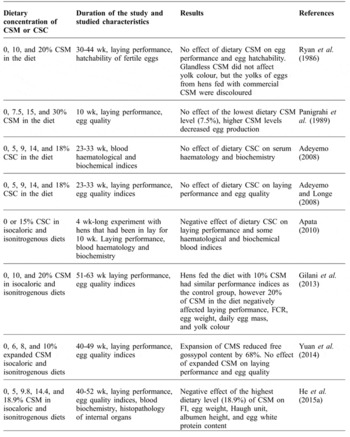
The results of the majority of recent studies with laying hens have indicated that CSM can be safely used in the nutrition of laying hens at a 10-15% dietary level ( Table 2 ).
Results of selected studies on the effects of incorporation of cottonseed meal (CSM) or cake (CSC) into laying hens’ diets.

For instance, Gilani et al. (Reference GILANI, KERMANSHAHI and TAHMASBI2013) reported no differences in egg performance or egg quality when layers were fed the control diet (without CSM) or the diet with 10% CSM (0.071% of free gossypol). However, a higher dietary level of CSM (20%) adversely affected the laying performance, FCR, egg weight, daily egg mass, yolk colour, and body weight of layers. Panigrahi et al. (Reference PANIGRAHI, PLUMB and MACHIN1989) reported that 7.5% CSM (0.085% of free gossypol) in the diet did not affect performance indices, but higher inclusion levels (15 and 30%) depressed egg production. Similarly, He et al. (Reference HE, ZHANG, WANG, WU, YUE and QI2015a) found that a high dietary level (18.9%) of CSM containing 0.015% of free gossypol negatively affected FI, egg weight, Haugh unit, albumen height, and egg white protein content but without any influence on egg performance, blood biochemical indices, and histopathology of internal organs. They speculated that this adverse effect was rather not related to free gossypol influence but to some others factors, i.e. the poor palatability of CSM diets, presence of malvalic and sterculic acid, high level of fibre, and over-abundance of arginine (disturbed Arg to Lys ratio in CSM). The authors recommended 9.8% as the optimum dietary level of CSM which can be fed without any effect on the performance, egg quality, and health of laying hens (He et al., Reference HE, ZHANG, WANG, WU, YUE and QI2015a).
The results of the experiments conducted by Saki et al. (Reference SAKI, POURNIA, TABATABAIE, ZAMANI, HAGHIGHAT and SALARY2012) showed that the FCR of a diet containing a high level of CSM (25%) can be improved by feed supplementation with Lys and NSP-hydrolising enzymes. Yuan et al. (Reference YUAN, SONG, ZHANG, JIANG, ZHANG, AZZAM and ZOU2014) reported that the nutritional value of CSM could be improved by an expansion process which highly decreased free gossypol content (from 0.124 to 0.040%). Expanded CSM was successfully fed to laying hens without any negative effects on egg production or quality (Yuan et al., Reference YUAN, SONG, ZHANG, JIANG, ZHANG, AZZAM and ZOU2014).
A study with ISA Brown laying hens showed that CSC (0.057% of free gossypol content) can be a valuable protein source and can be included to the diet at the level of 18% (replacing 60% of dietary soybean cake) without any negative effects on laying performance or egg quality (Adeyemo, Reference ADEYEMO2008; Adeyemo and Longe, Reference ADEYEMO and LONGE2008). However, Apata (Reference APATA2010) reported that CSC (15% in the diet) had an adverse influence on laying performance as well as some haematological and biochemical blood indices, and this negative effect was not alleviated by fermentation of CSC or vitamin and ferrous sulphate addition to the diet. The results of the study by Lordelo et al. (Reference LORDELO, DAVIS, WILSON and DALE2004) demonstrated that the diet containing CSM (0.15% of free gossypol content) as the main protein source (20% CSM in the diet) fed to broiler breeder pullets during the rearing period improved uniformity of body weight. However they stressed that CSM should be removed from the diet of pullets at least four weeks before the beginning of laying period to ensure that gossypol does not decrease egg fertility and hatchability.
other poultry species
Erturk et al. (Reference ERTURK, OZEN and CELIK2004) reported that 17.5% cottonseed meal containing 0.048% of free gossypol can be included in the diet for Japanese quail breeders as a replacement of 44% soybean meal protein without any adverse effect on egg production, egg weight, FI, and FCR. However, quail fed 17.5% CSM had significantly decreased blood haemoglobin concentrations. Ilyas et al. (Reference ILYAS, SALEEMI, MAHMOOD and KHAN2007) found a negative effect of high level of CSM (27 or 41% in the diet) included in isoenergetic and isonitrogenous diets on growth performance and testis weight, however Lys supplementation partially ameliorated this adverse influence. Corresponding results, i.e. depressed FI and altered blood indices in quail fed the diet with a high level of CSM, were reported by Jalees et al. (Reference JALEES, KHAN, SALEEMI and KHAN2011). Yannakopoulos and Tserveni-Gousi (Reference YANNAKOPOULOS and TSERVENI-GOUSI1989) did no observe any negative effects when replacing 50% soybean meal with CSM; however, a higher substitution level of soybean meal by CSM (75 or 100%) reduced growth performance and egg production in Japanese quail. In contrast, Yildirim and Ozturk (Reference YILDIRIM and OZTURK2013) found no differences in laying performance of quail fed diets containing an increasing level of CSM (0, 10, 20, and 30%).
An experiment with meat ducks studied the efficacy of increasing level of substitution (0, 25, 50, 75 and 100%) for soybean meal by CSM in the diet (Zeng et al., Reference ZENG, YANG, LIU, WANG, BAI, DING, LUO and ZHANG2014). The authors demonstrated that increasing dietary CSM and gossypol content (from 0% in control diet to 0.0153% free gossypol in the highest CSM diet) decreased growth performance during the first 14 days of age, and increased serum alanine aminotransferase and aspartate aminotransferase concentration. The results of histopathology analysis showed that the degree of damage to the liver increased with increasing dietary CSM and gossypol level (Zeng et al., Reference ZENG, YANG, LIU, WANG, BAI, DING, LUO and ZHANG2014). However, in older ducks, i.e. aged 35 days, no difference in growth and blood indices among the dietary treatments were found. As it was concluded by the authors that this indicated that dietary CSM affected the growth performance and liver function of young ducks, so the concentration of total and free gossypol for these animals (1-21 d of age) should be lower than 0.0923 and 0.0077%, respectively (Zeng et al., Reference ZENG, YANG, LIU, WANG, BAI, DING, LUO and ZHANG2014). Corresponding results were found in the subsequent study of the same researchers (Zeng et al., Reference ZENG, BAI, WANG, DING, LUO, BAI, XUAN, SU, LIN, ZHAO and ZHANG2015), where a low level of dietary CSM (5.8%) had no adverse in meat ducks, however birds fed 23% CSM diets (0.0153% free gossypol) presented decreased performance, hepatic lesions and a high concentration of gossypol residue in the liver.
In a study with ostriches, Dalle-Zotte et al. (Reference DALLE-ZOTTE, BRAND, HOFFMAN, SCHOON, CULLERE and SWART2013) evaluated the influence of replacing dietary soybean oilcake meal with increasing levels (3-12% in the diet) of cottonseed oilcake meal (0.0082% of free gossypol) on performance and meat quality. The authors demonstrated that cottonseed meal can be a valuable protein source in ostriches’ nutrition, as the birds fed the experimental diets had improved growth performance, without differences in proximate composition, cholesterol content, mineral and fatty acid profile of the meat.
Conclusions
Based upon results of the studies discussed in this article it can be concluded that CSM is an acceptable ingredient in poultry diets and can be used as a relatively rich source of protein and amino acids. Depending on its quality (free gossypol content) CSM can be safely fed at a 10-15% dietary level, i.e. below 0.01% of free gossypol in the diet, partially replacing soybean meal, with concurrent cost savings for the overall formulation. The main limitation on the use of CSM as a feed material in poultry nutrition is free gossypol and cyclopropenoid fatty acids presence, low available lysine and high variability in nutrient (gossypol) concentration, depending mainly upon the cottonseed variety and methods of oil extraction from the seeds. The results of some studies have shown that the fermentation process of CSM, as well as the dietary addition of iron sulphate or lysine, can increase the safety and nutritional value of CSM-containing diets for poultry.