Implications
The number of milking robots in dairy cattle farms has increased over the last few years. The introduction of an automatic milking system (AMS) implies important changes in farms routine and management. It also changes culling dynamics (both modifying causes for culling and increasing the percentage of animals culled), at least during the 1st years after installation. The modification of culling dynamics will have a great impact on dairies. Reduced longevity for cows increases the replacement cost of stock and avoid animals to achieve the highest lifetime production. Cow longevity is also important to reduce the environmental impact of milk production. In addition, this trait is an indirect indicator of animal welfare.
Introduction
The term AMS refers to a system that automates all the functions of the milking process and cow management undertaken in conventional milking by a mix of manual and machine systems (Koning and Rodenburg, Reference Koning and Rodenburg2004).The first commercial unit was installed in the Netherlands in 1992. In 2017, over 35 000 robotic milking systems units were operational on dairy farms around the world (Extensión, 2017).
Automatic milking system allows cows to decide their own milking time and interval, which implies that the farmer’s presence at regular milking times is no longer required. However, milking frequency is dependent on many factors, including the social structure of the herd, the farm layout design, the type of traffic imposed on cows, the type of flooring, the health status of the cows (especially hoof and udder health), the stage of lactation, the parity, and the type of ration fed at the feed bunk and the amount of concentrate offered in AMS (Bach and Cabrera, Reference Bach and Cabrera2017).
Automatic milking system entails changes in many aspects related to farm management and nutrition. Presumably, feeding at AMS is the primary motivation that attracts cows to the milking units and, therefore, a proper balance between feeding at the robot and feeding at the feed bunk is important in order to ensure nutritional requirements and milk production. Thereby, following the introduction of AMS in the market in the 1990s, research has been conducted examining AMS systems v. conventional parlors, focusing primarily on cow health, milk quality, reproductive performance or aspects such as the economic and social factors related to AMS adoption (Jacobs and Siegford, Reference Jacobs and Siegford2012).
One of the most frequently evaluated aspects was the influence of AMS on body condition scores (BCS). In general, the introduction of AMS did not have any significant effects on BCS, nor did it affect the levels of energy-related metabolites such as β-hydroxybutyrate acid (BHBA) or non-esterified fatty acids (Dearing et al., Reference Dearing, Hillerton, Poelarends, Neijenhuis, Sampimon and Fossing2004; Hillerton et al., Reference Hillerton, Dearing, Dale, Poelarends, Neijenhuis, Sampimon and Fossing2004; Abeni et al., Reference Abeni, Calamari, Calza, Speroni, Bertoni and Pirlo2005). However, a short-term increase in BCS following the installation of AMS was observed in some farms, after which no long-term changes succeeded (Dearing et al., Reference Dearing, Hillerton, Poelarends, Neijenhuis, Sampimon and Fossing2004).
In regard to udder health, Hovinen and Pyörälä (Reference Hovinen and Pyörälä2011) reviewed several studies comparing automatic and conventional milking. Most of them concluded that udder health deteriorated after the introduction of AMS. More frequent milking in AMS often means higher milk production, putting the energy balance in jeopardy, which in turn might have negative effects on fertility (Kruip et al., Reference Kruip, Stefanowska and Ouweltjes2000). Overall, there is little evidence of major changes in terms of fertility subsequent to the implementation of AMS, although some signs of deterioration in fertility were occasionally observed, which could potentially escalate into a more serious problem in the long term (Dearing et al., Reference Dearing, Hillerton, Poelarends, Neijenhuis, Sampimon and Fossing2004).
Despite the hypothetical influence that AMS might have on issues such as udder health or fertility, some previous studies assessing risk factors related to culling rate in dairy cattle indicated that this rate seems to be lower in herds with AMS compared to traditional milking systems (Burow et al., Reference Burow, Thomsen, Sørensen and Rousing2011; Alvåsen et al., Reference Alvåsen, Mörk, Sandgren, Thomsen and Emanuelson2012). In any case, no previous studies were designed to concretely assess the culling rate due to different causes prior or posterior to the installation of AMS.
Thereby, the aim of the present study was to analyze the effect of switching from a milking parlor to automatic milking on culling rates (due to different causes) of dairy cattle.
Material and methods
Studied area
The study was carried out in Galicia. Galicia is the major cattle-farming region of Spain; it is responsible for 37.2% of the milk produced in the country, constituting ~1.9% of the milk produced in the European Union (Ministerio de Agricultura, Alimentación y Medio Ambiente (MAGRAMA), 2016). The average number of dairy cattle farms in Galicia during the course of the study was 8425, although a steadily declining trend in number could be observed (Xunta de Galicia, 2018). In Galicia, 35% of the herds are enrolled in the Dairy Herd Improvement Program (DHIP), which represents 72% of the milk produced in this region (Asociación Provincial para el Control de Rendimientos (AFRICOR), 2017).
Herds surveyed
The data used in the study were obtained from 23 dairy farms, all of which were Holstein breed and enrolled in the DHIP at the time of the study. In every case AMS had been installed between February 2009 and October 2014. In order to be part of the convenience sample, the farms must have installed AMS before November 2014, considering the requirement of at least a 3-year interval between the installation of AMS and the beginning of the retrospective data collection in November 2017. In addition, only those farms whose facilities did not undergo substantial changes, other than the substitution of the milking system, were considered for the study. The mean herd size of the surveyed farms (when they entered the study) was 71 lactating cows.
Culling records from these 23 farms were provided by the monthly visits by the DHIP, during which the supervising technician inquired about the reason for animal losses since the previous visit. The reasons for losses were then coded according to the Royal Decree 368/2005 (Boletín Oficial del Estado, 2005), which regulates the program according to some specific rules:
1. Death/emergency slaughter: animals are discarded when they are found prostrate or dead on the farm/animals sent to emergency slaughter (in cases such as metabolic disorders, accident, toxemia, peritonitis, pericarditis or systemic infection).
2. Lack of productivity: animals are discarded because of low production.
3. Udder problems: animals are discarded mainly because of mastitis, loss of one or more single quarters or sagging udder).
4. Infertility: animals are discarded because of reproductive problems (such as infertility, sterility, abortions, metritis and mummified fetuses).
5. Loss in official disease eradication programs (zoonoses).
6. Others: animals are discarded either for some reasons which are not included in the classification above or for multiple causes.
7. Lameness: animals are discarded because of musculoskeletal problems (such as lameness, hoof infection).
In the event of on-farm euthanasia, it would be classified according to the specific causes.
In addition, when a cow was dried off, total milk traits per lactation were recorded and normalized to 305 days using the Fleischmann’s method (International Committee for Animal Recording, 2014).
Data of the animals from these 23 farms were collected over a 5-year time span, which was divided into three different stages: 2 years before switching from milking parlor to AMS (stage 1), the 1st year after the installation of AMS (stage 2) and the 2nd and 3rd years after the implementation of AMS (stage 3).
Finally, the study involved 3496 animals that calved at least once on these farms during the length of the study.
Statistical analysis
All data were processed in STATA (STATA11.1, Stata Corp LP, College Station, TX, USA). Analysis of variance tests were used to compare mean 305-day milk yield in different stages and Bonferroni tests were applied as posthoc test for multiple comparisons. For this purpose only those lactations in which at least 80% of its duration occurred in a single stage were used.
After that, the Cox model for survival analysis was used to estimate the time to culling during stage 1 with respect to stages 2 and 3. Seven models were fitted: one of them took into consideration all cullings overall, and another one for each of the reasons for culling mentioned before, with the exception of losses due to official disease eradication programs, as their low frequency and the fact that they took place in a single farm and in a short period of time made them irrelevant.
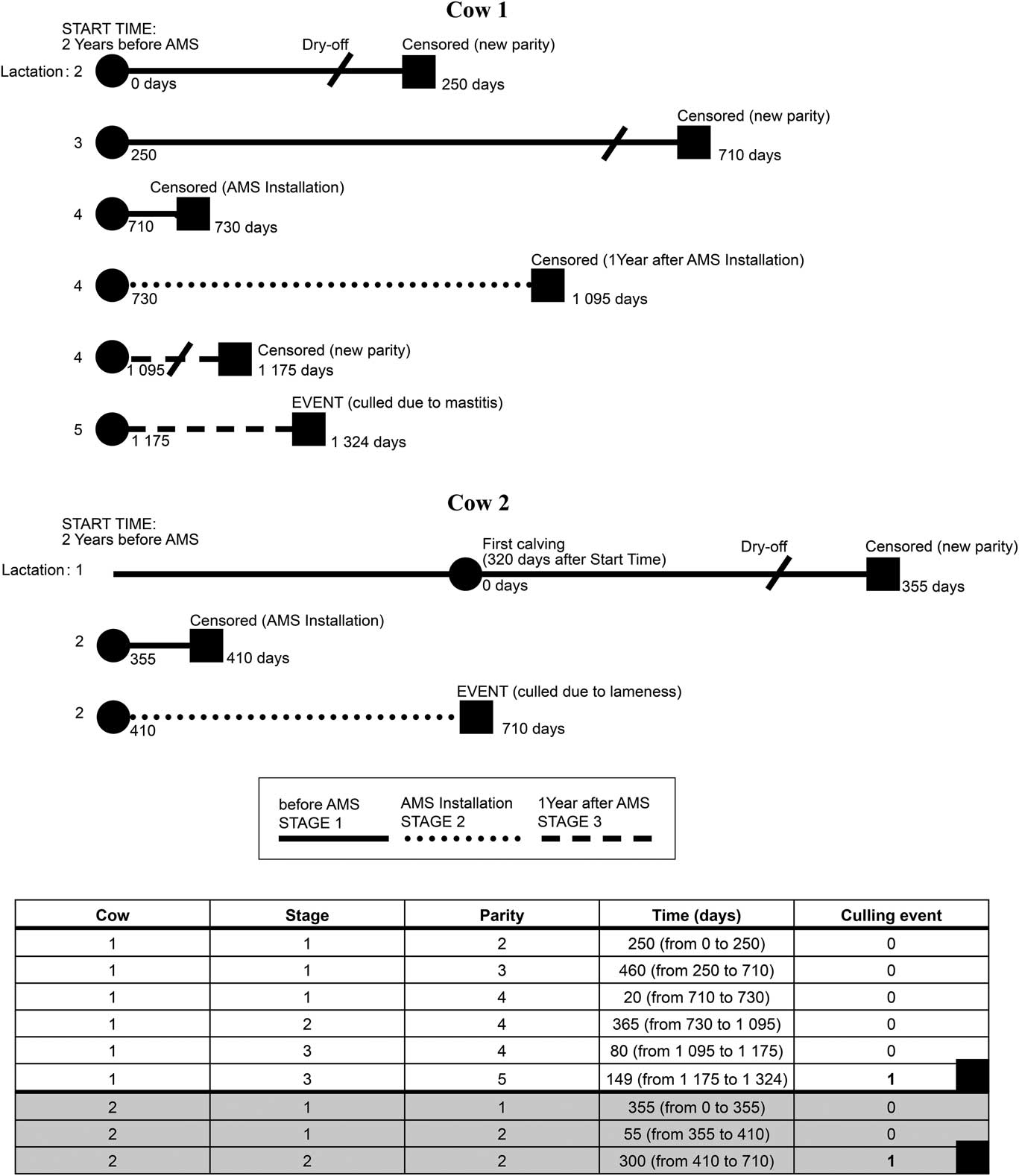
Animals entered the study 2 years before their farm of origin switched from milking parlor to AMS (which is the moment that marks the beginning of the 5-year follow-up period) or at their first calving (when a cow had its first calving during the 5-year time span). Therefore, for each animal, time to culling was calculated either as the number of days from 2 years before the change of the milking system until the time of culling or, between the first calving and the time of culling. That lapse of time was divided into separate records for each lactation and also for each stage. Thereby time-at-risk in each parity begins on the recorded calving date and ends with the censoring on the subsequent calving date. Likewise, each time a farm entered any of the three established stages, the records for each cow on that farm were censored and a new record was created for each animal (Smith et al., Reference Smith, Strawderman, Schukken, Welss, Pradhan, Espejo, Whitlock, van Kessel, Smith, Wolgang and Gröhn2010). Therefore, each time a cow calved, or whenever its farm of origin entered a new stage (with respect to the installation of AMS), the previous record was censored and a new one was created (Figure 1). Eventually, 10 996 records in total were obtained from the 3496 cows involved in the study.
Data set for the model of time to culling of two hypothetical animals. The follow-up in each farm begins 2 years before installation of an automatic milking system (AMS). The start of a new record (new lactation or new stage) is represented by solid circles. The end of the record is represented by squares, with the time below them. The table at the bottom shows the data as used in the study.

The lactation number and the days in milk (DIM) were also included as independent variables in the models. Three categories were established according to lactation number: (1) 1st parity cows, (2) 2nd parity and (3) 3rd or higher. According to DIM four categories were established: (1) early lactation, from 0 to 80 DIM, (2) mid lactation, from 81 to 200 DIM, (3) late lactation, >200 DIM and (4) dry cow.
A term for interaction between stage and parity was also incorporated (this variable had the value 1 when the cow was in stages 2 or 3 and it was in its 3rd or higher lactation; and 0 in any other case). In addition, year of installation of AMS was included as strata variable in the models. Robust standard errors were calculated using the robust variance estimator method to control within-herd cluster effects. To assess the adequacy of the survival models the Cox–Snell residual method was used (Lee and Wang, Reference Lee and Wang2003).
Results
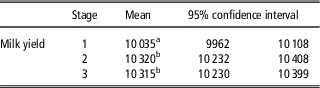
Data indicated that 305-day milk yield is significantly higher in stages 2 and 3 when comparing with stage 1 (Table 1). In total, 688 (33.5%) out of 2052 cullings that took place within the studied herds during the 5-year period were due to death/emergency slaughter, 456 (22.2%) to infertility, 320 (15.6%) to udder problems, 229 (11.2%) to other causes, 202 (9.8%) to lameness, 151 (7.4%) due to low production and 6 to disease eradication programs (0.3%). The average percentages of cows culled per year were 25.1, 29.7 and 28.2%, during stages 1, 2 and 3, respectively.
Adjusted 305-day milk yield recorded in dairy cattle 2 years before switching from milking parlor to automatic milking systems (stage 1), year 1 after the change (stage 2) and years 2 and 3 after the change (stage 3)

a,bValues within a row with different superscripts differ significantly at P<0.05.
Cox regression models indicated that the overall risk of culling was 1.34 (P=0.037) and 1.32 (P<0.001) times higher in stages 2 and 3, respectively, than in stage 1, after controlling for parity, DIM, installation date of AMS and herd cluster effects. However, the risk of death/emergency slaughter was significantly lower in stages 2 and 3 in comparison with stage 1 (Table 2). On the contrary, cows were significantly more likely to be culled due to low production, udder problems, infertility and lameness in stages 2 and 3, compared to stage 1 (Table 2). With respect to other causes of loss, no significant differences among stages were observed (Table 2). There was also a trend for increasing culling rate as the parity number increased except for the model which explained low production (Table 2). Losses due to death/emergency slaughter were more frequent in early lactation, whereas the risk of loss due to the remaining causes was higher as lactation progressed, with the dry period being the moment of highest risk (except for losses due to low production where no differences were observed when comparing late lactation v. dry cows) (Table 2). The interaction term was not significant in any of the models analyzed. The lines generated from the Cox–Snell residuals v. cumulative hazard estimates did not show large divergences from the reference line (zero intercept and unit slope) (Table 3).
Results of six Cox survival models for the effect of switching from milking parlor to automatic milking systems (AMS) on time to culling due to various reasons in dairy cattle

1 HR (SE)=Hazard ratio (robust standard error).
2 Stage 1: 2 years before switching from a milking parlor to AMS; stage 2: the 1st year after the change; stage 3: the 2nd and 3rd years after the change.
3 Early lactation: from 0 to 80 days in milk (DIM); mid lactation: from 81 to 200 DIM; late lactation: >200 DIM.
Intercept and slope of the trend lines generated from the scatterplot of Cox–Snell residuals v. cumulative hazard estimates obtained to assess the survivals models for the effect of switching from milking parlor to automatic milking systems on time to culling due to various reasons in dairy cattle (estimates should be close to 45° line – unit slope and zero intercept – if the fitted survival model was adequate)

Discussion
In the study population the number of milking robots, as in most regions with dairy cattle, has increased over the last few years. In October 2014 (deadline for inclusion in the study), 1.4% of the farms involved in the DHIP in Galicia have AMS. Nowadays, the percentage is 3.6% (AFRICOR, 2017). In some cases the farms that change the milking system also undergo significant remodeling of the farm facilities, but most of them were free stall barns in which the replacement of conventional milking parlor by AMS was the only alteration. The study was focused on the latter group in order to exclude the influence of other factors on culling as much as possible.
The herds involved in the study were not a particularly representative sample of the standard herd in Galicia, where the mean herd size is 42 cows (compared to 71 cows in the studied group) (MAGRAMA, 2016).
In terms of annual culling rates, the studied group (before the installation of AMS) showed similar figures to other farms in the area of Galicia, namely 26% for cows that have calved at least once (AFRICOR, 2017).
Since causes for loss were recorded monthly (each time the DHIP technician inquired about the reason for animal losses), recall bias could allegedly affect the accuracy of the information collected. However, this bias is expected to be unimportant considering that, due to the size of the farms and annual culling rates, on average, approximately two losses per month and farm could be expected.
In addition, year of installation of AMS was considered in the models, in order to minimize the impact of other factors that could affect the percentage of losses from year to year (such as differences in milk pricing).
Data indicated that the culling rate increased after the installation of AMS, a situation that persisted at least during the study coverage period. This finding was confirmed by the analysis of data from all the herds that take part in DHIP in Galicia, which indicated that the replacement rate was higher in farms with AMS: the proportion of 1st parity cows in farms with conventional milking systems was 32.6%, while in farms with AMS it increased to 35.1% (AFRICOR, 2017). A previous study based upon the producer’s perception after installing AMS indicated, however, that most of the producers did not report any variations in culling rates (Tse et al., Reference Tse, Barkema, de Vries, Rushen and Pajor2017). In the present study, in spite of the significant reduction in terms of culling due to death/emergency slaughter, a greater risk of loss caused by the combination of all the other causes of culling led to an overall rise in terms of culling rate.
In the case of death/emergency slaughter, such events are more frequent during early lactation and they are partly related to postpartum diseases such as abomasal displacement, acidosis or ketosis and others such as accidents or traumatisms (Pinedo et al., Reference Pinedo, De Vries and Webb2010, Fouz et al., Reference Fouz, Yus, Sanjuán and Diéguez2014, Sarjokari et al., Reference Sarjokari, Hovinen, Seppä-Lassila, Norring, Hurme, Peltoniemi and Rajala-Schultz2018). Alterations in schedule for the distribution of concentrate in automatic systems (normally several times a day) and in quantity (which becomes more adjusted to the production level of each cow) could contribute to a reduction of the risk of postpartum metabolic diseases. Automatic milking system could also imply a better control of the transition period; a common management practice is to allow the dry cows to walk through the robot so as to be gradually fed concentrate during the days leading up to calving, which would allow a better adaptation of the ruminal flora. A previous study, carried out in Galicia, indicated that cows from AMS had, on average, significantly lower postpartum BHBA concentrations than those from conventional milking parlors (AFRICOR, 2017), which could support this hypothesis.
For some farmers, the introduction of AMS brought about the daily monitoring of cows’ production levels, which meant a step forward from the previous conventional system, when such close monitoring was not possible in many cases. In addition, underproductive cows are still less profitable in AMS than in other systems, since the performance of the robot is given (among other traits) by the ratio milk flow/unit of time (Hogeveen et al., Reference Hogeveen, Ouweltjes, de Koning and Stelwagen2001; Castro et al., Reference Castro, Pereira, Amiama and Bueno2012). This could be related to the higher risk of culling due to low production.
Ineffective mastitis detection, dirty udders and incomplete teat cleaning are among the highest risk factors for poor udder health in AMS (Hovinen and Pyörälä; Reference Hovinen and Pyörälä2011; Jacobs and Siegford, Reference Jacobs and Siegford2012). A previous study, carried out also in Galicia, indicated suboptimal cleaning and disinfection of teat dipping cups, brushes and milk liners in dairy farms with AMS (Castro et al., Reference Castro, Pereira, Amiama and Bueno2015).
A reason for the higher risk of culling due to infertility in AMS may be that, despite having more time available for watching the cows, AMS producers may not actually be in the proximity of cows as often, as would be desirable, to detect changes (as cows in estrous) (Kruip et al., Reference Kruip, Stefanowska and Ouweltjes2000; Dearing et al., Reference Dearing, Hillerton, Poelarends, Neijenhuis, Sampimon and Fossing2004; Tse et al., Reference Tse, Barkema, de Vries, Rushen and Pajor2017)
In general, AMS is not flexible in terms of the number of milking cows in the herd, which makes the farmer choose the more profitable cows in AMS. This implies that less profitable cows (such as cows with fertility problems and many DIM or cows with udder problems) would be more likely to be culled. Some of these animals could have stayed longer had they been in conventional systems, which are more flexible in that sense.
The present study also reports an increased culling due to lameness in AMS. Hillerton et al. (Reference Hillerton, Dearing, Dale, Poelarends, Neijenhuis, Sampimon and Fossing2004) indicated that no significant changes in the lameness score occurred after AMS installation. However, although the prevalence of lameness remains stable, lame cows are more reluctant to visit the milking unit. In this case reductions in milk yield and possibly increased mastitis could be expected, as well as an increase in labor as the animals have to be brought into the milking unit by hand (Borderas et al., Reference Borderas, Fournier, Rushen and de Passille2008). In this sense, lame cows could extend their stay in herds with conventional milking systems.
In the studied population an increase in culling rates was found after the installation of AMS. This reflects the increased culling due to low production, udder problems, infertility and lameness, whereas losses due to death or emergency slaughter diminished. The work routine in farms with AMS does not facilitate individual management of animals. Low-production cows (e.g. because they have calved time ago) or sick cows (such as mastitic or lame cows) would affect the performance and, therefore the amortization of the cost of AMS, which would lead to a more probable removal than in conventional systems (which is more flexible with respect to the number of milking animals on the farm). The subsequent replacement of those animals would result in a greater overall efficiency.
Further studies based upon data obtained beyond the three year period after installing AMS could determine if culling rates return to previous levels or if they become even more favorable.
Acknowledgements
The authors thank AFRICOR Lugo for their invaluable help during the study.
Declaration of interest
The authors declare they have no competing interest.
Ethics statement
None.
Software and data repository resources
Data or models were not deposited in any official repository.