INTRODUCTION
Internationally-adopted (IA) children from China have a unique language learning experience. In contrast to typical second language (L2) learners who acquire two languages either simultaneously or successively, IA children from China discontinue acquisition of the birth language at a time when the neurocognitive substrates for language learning are becoming fine-tuned (Werker & Tees, Reference Werker and Tees2002). They also differ from native speakers because onset of exposure to the adopted language is delayed. Their unique pattern of language development is often referred to as second first language acquisition (DeGeer, Reference DeGeer1982). These unique experiences are often considered important risk factors for language development.
However, studies that have compared the performance of IA children from China to standardized test norms have generally found that they demonstrate age-appropriate language abilities soon after adoption (e.g. Snedeker, Geren & Shafto, Reference Snedeker, Geren and Shafto2007). These results are consistent with the fact that these children are usually adopted early, typically between ages 1;0 and 2;0, and thus well within the critical period for language acquisition (Gauthier & Genesee, Reference Gauthier and Genesee2011). They are also consistent with evidence suggesting that, in contrast to other populations of IA children (e.g. Croft et al., Reference Croft, Beckett, Rutter, Castle, Colvert, Groothues, Hawkins, Kreppner, Stevens and Sonuga-Barke2007, with IA children from Romania), IA children from China benefit from relatively good pre-adoption conditions. Indeed, studies have found that the cognitive abilities and the socio-emotional development of IA children from China, as a group, are age-appropriate and comparable to that of non-adopted children (e.g. Delcenserie, Genesee & Gauthier, Reference Delcenserie, Genesee and Gauthier2013; Gauthier & Genesee, Reference Gauthier and Genesee2011; Pomerleau et al., Reference Pomerleau, Malcuit, Chicoine, Séguin, Belhumeur, Germain, Amyot and Jéliu2005; Roberts, Pollock, Krakow, Price, Fulmer & Wang, Reference Roberts, Pollock, Krakow, Price, Fulmer and Wang2005). Our own research has also shown that IA children from China, on average, score in the typical range on most standardized language tests (Gauthier & Genesee, Reference Gauthier and Genesee2011), arguing that any pre-adoption deprivation or adversity is either short-lived or relatively minor in severity.
In contrast, studies that have made direct comparisons between the language test scores of IA children in comparison to control children who were matched for variables, such as socioeconomic status (SES), which have been found to influence language development, have obtained significant differences between the two groups (e.g. Cohen, Lojkasek, Zadeh, Pugliese & Kiefer, Reference Cohen, Lojkasek, Zadeh, Pugliese and Kiefer2008; Delcenserie & Genesee, Reference Delcenserie and Genesee2013; Delcenserie et al., Reference Delcenserie, Genesee and Gauthier2013). More specifically, Gauthier and Genesee (Reference Gauthier and Genesee2011) and Delcenserie et al. (Reference Delcenserie, Genesee and Gauthier2013) found that, at two to three, four to five, and seven to eight years of age, IA children from China performed significantly lower than non-adopted monolingual French-speaking children matched on age, gender, and SES on measures of expressive vocabulary, sentence recall, receptive grammar, and knowledge of word definitions (see also Cohen et al., Reference Cohen, Lojkasek, Zadeh, Pugliese and Kiefer2008, for similar results). It is particularly important to take SES into account when evaluating the language abilities of IA children since these children are adopted into relatively high SES families, and thus benefit from an enriched learning environment which, in turn, can impact their language development, and more specifically their vocabulary abilities (Hoff, Reference Hoff2006).
Studies that have examined the language abilities of IA children from China in detail, albeit few in number (e.g. Pierce, Genesee & Paradis, Reference Pierce, Genesee and Paradis2013; Snedeker et al., Reference Snedeker, Geren and Shafto2007), have similarly found that although they appear to demonstrate the same developmental pattern as native speakers of the adopted language (Snedeker et al., Reference Snedeker, Geren and Shafto2007), which is usually English, their mastery of grammatical morphemes, such as markers of verb tense, possessives, and plurals, does not attain native levels (Glennen & Masters, Reference Glennen and Masters2002). However, these studies examined IA children's mastery of grammatical morphemes after relatively little exposure to the adopted language – before the children were five years of age, and thus they might not have had sufficient exposure to the language to master these morphemes within age-appropriate levels. The question arises whether these lags would disappear with more extended exposure to the adopted language.
Of particular interest in the present study are findings from Gauthier, Genesee and Kasparian (Reference Gauthier, Genesee and Kasparian2012). Using spontaneous speech samples, they compared IA children from China and monolingual French-speaking children matched for age, gender, and SES on the use of complement clitics, tense morphology, and lexical diversity. They found that the IA children who were between ages 3;6 and 4;8 at the time of testing and who were adopted at age 1;1, on average, performed similarly to their non-adopted peers on lexical diversity and tense morphology but made significantly more errors using complement clitics, and accusative object clitics more specifically. French accusative object clitics are a specific category of personal pronouns in French that are strongly attached to the verb. They serve the same referential role as English object pronouns in that they are both used when the referent is salient in the discourse (Gauthier et al., Reference Gauthier, Genesee and Kasparian2012). Their use is restricted by several properties: they appear preverbally, except when they are used with verbs in the affirmative imperative form; they cannot be used in isolation; they cannot be conjoined with other pronouns; they cannot be modified; and they cannot be separated from the verb (Gauthier et al., Reference Gauthier, Genesee and Kasparian2012; Kayne, Reference Kayne1975). Examples of errors made by the IA children in Gauthier et al. (Reference Gauthier, Genesee and Kasparian2012) are noted below in bold:
(1) Incorrect choice of clitic:
Je s'en va au pique-nique.
‘I am going to the picnic.’
(child used 3rd person singular form se instead of 1st person singular form me required by the 1st person subject pronoun je)
[Target form:] Je m'en va au pique-nique.
(2) Clitics co-occurring with a postverbal lexical object:
Après je vais le mettre quelque chose dedans.
‘After I am going to put it something inside.’
(3) Use of an extra clitic:
On le l'ouvre.
‘We it it open.’
The acquisition of French accusative object clitics has been investigated by numerous researchers who have found that they are acquired late by native speakers of French (Hamann, Rizzi & Frauenfelder, Reference Hamann, Rizzi, Frauenfelder and Clahsen1996) – usually between 2;6 and 3;3, by simultaneous bilinguals (Hulk, Reference Hulk, Sorace, Heycock and Shillcock1997; Hulk & Müller, Reference Hulk and Müller2000), and by successive bilinguals as well (Grondin & White, Reference Grondin and White1996). L2 learners' difficulties with accusative object clitics have been characterized by high omission rates (e.g. Paradis, Reference Paradis2004), low production rates (Grüter, Reference Grüter2005), and late emergence (White, Reference White and Clahsen1996). Errors with accusative object clitics are often taken as a marker for specific language impairment (SLI) in children learning French as a first language. More specifically, children with SLI often omit accusative object clitics (e.g. Hamann, Reference Hamann, Prévost and Paradis2004), and they make significantly more agreement errors using accusative object clitics than typically developing children (Paradis, Reference Paradis2004). Of note, children with SLI have difficulty acquiring accusative object clitics, such as la, le, and les (‘it’-masculine; ‘it’-feminine, ‘them’), but do not exhibit difficulties acquiring definite articles of the same form (le, la, and les: ‘the’-masculine, ‘the’-feminine, ‘the’-plural), indicating that their difficulties are not likely due to perceptual processing, but rather reflect underlying difficulties.
Gauthier et al. (Reference Gauthier, Genesee and Kasparian2012) hypothesized that their findings could be attributed to IA children's unique language learning experiences and, in particular, to their delayed exposure to French; they also recognize that L1 attrition could be at play. In this regard, evidence indicates that although, at birth, infants have the capacity to discriminate between the phonetic units of any natural language, this ability decreases so that by the end of the first year of life they are progressively able to perceive only phonetic contrasts in the ambient language (Gauthier et al., Reference Gauthier, Genesee and Kasparian2012; Werker & Tees, Reference Werker and Tees2002). Considering that children's primary language drives the fine-tuning of the neurocognitive substrates for language learning and that IA children's exposure to their L1 is abruptly stopped at the time of adoption, it is possible that IA children are at a disadvantage for the acquisition of aspects of the adopted language that are expressed using small phonetic units, such as clitics, given that the substrates for language learning were not fully established in the L1. At the same time, there is evidence from studies on young immigrant children that early delayed onset of L2 learning, even during the preschool years, can result in incomplete acquisition of the L2 in the long term, a point we return to later (Abrahamsson & Hyltenstam, Reference Abrahamsson and Hyltenstam2009).
In any case, the question arises as to whether the difficulty with accusative object clitics exhibited by the IA children in Gauthier et al. (Reference Gauthier, Genesee and Kasparian2012) was due to their relatively short exposure to French at the time of testing. More specifically, these children were adopted between 1;0 and 2;0 and were tested at 4;1, on average, and thus had a maximum of two years exposure to acquire accusative object clitics which are usually mastered only after 2 years 6 months and 3 years 3 months of exposure (Hamann et al., Reference Hamann, Rizzi, Frauenfelder and Clahsen1996). While some of the youngest IA children at adoption may have had more than 2 years 6 months of exposure to French, and thus the same amount of exposure as native speakers of French, this may not have been sufficient given their delayed onset of acquisition of French. Thus, the present study was designed to examine if these IA children were able to close the gap with non-adopted monolingual French-speaking children (CTL children) after more exposure to French. The children who participated in the present study were, on average, aged 7;10 and had had 6 years 9 months of exposure to French, on average, at the time of testing. If no significant differences were found between the IA and CTL children, it would mean that previous results were due to a lack of exposure to French. If, however, the lags persisted, it would indicate that other factors are at play, such as delayed exposure to the adoptive language or attrition of the L1.
METHODS
Participants
The children who participated in the present study had participated in a larger investigation of IA children by Delcenserie et al. (Reference Delcenserie, Genesee and Gauthier2013), in which they were administered an extensive battery of tests assessing their non-verbal cognitive abilities, language abilities, socio-emotional development, and general development. The present study focuses on their performance on a Clitic Elicitation Task that was administered as part of that extended battery of tests.
There were twenty-seven IA children from China, all girls, who had been adopted by French-speaking parents between the ages of 0;7 and 1;9 (M = 1;1, SD = 3·8 months). At the time of testing, they were between 7;0 and 8;8 (M = 7;10, SD = 6·0 months) and had a mean length of exposure to French of 6;9, on average (SD = 7·4 months). None were exposed to Chinese post-adoption. The IA children were compared to twenty-seven non-adopted monolingual French-speaking children (CTL children). The CTL children were matched to the IA children on gender and age (range: 6;9 to 8;10, M = 7;11, SD = 6·9 months) as well as on family income and parental level of education, two indices of socioeconomic status. This information was collected from the parents using a Developmental Questionnaire. No significant differences were found between the groups in terms of age (F(1,52) = 0·81, p = ·37), parental level of education (Chi-squared tests: mother: χ 2 (2, N = 54) = 0·92, p = ·63; father: χ 2 (2, N = 54) = 1·06, p = ·59) or family income (χ 2(2, N = 54) = 1·39, p = ·85). Moreover, the IA and CTL children did not differ significantly on non-verbal cognitive ability (F(1,52) = 0·10, p = ·76) or on socio-emotional development, as measured by the Wechsler Non-Verbal IQ test (Wechsler & Naglieri, Reference Wechsler and Naglieri2006) and the Child Behavior Checklist (CBCL; Achenbach, Reference Achenbach1991), respectively. Both tests were administered and reported in Delcenserie et al. (Reference Delcenserie, Genesee and Gauthier2013).
Exclusion criteria for all participants included: (i) the presence of psychiatric or neurological antecedents, (ii) a history of intellectual deficiency, (iii) severe language impairments, (iv) premature birth, (v) serious health problems, (vi) motor or behavior problems, (vii) L1 other than French, and (viii) more than 25% of exposure to an L2 as reported by parents on a Language Environment Questionnaire.
Assessment measures
The Clitic Elicitation Task was designed to elicit the production of sentences containing a pronominalized direct object (Grüter & Crago, Reference Grüter and Crago2012). It consisted of a picture story depicting a girl, a boy, and a dog performing different actions, such as picking apples. During the task, the experimenter showed pictures to the child while reading a script. The script included questions that were designed to elicit the production of utterances containing a direct object. Because referents were made clear in the discourse, the task created contexts where the object was encoded easily using a pronoun. The task included twenty-one accusative clitic elicitation probes; for example, when shown a picture of a girl with a glass of milk:
EXPERIMENTER: Que fait Dora avec le lait?
‘What is Dora doing with the milk?’
EXPECTED ANSWER: Elle le boit.
‘She drinks it.’
(clitic pronoun in French appears in bold)
Children's responses during the Clitic Elicitation Task were recorded using a digital tape recorder (Sony IC-Recorder ICD-UX71). The recordings were transcribed by the experimenter and an independent second transcriber who were both native speakers of French. Inter-rater agreement was high (i.e. 98·8%) and any disagreements were resolved by discussion.
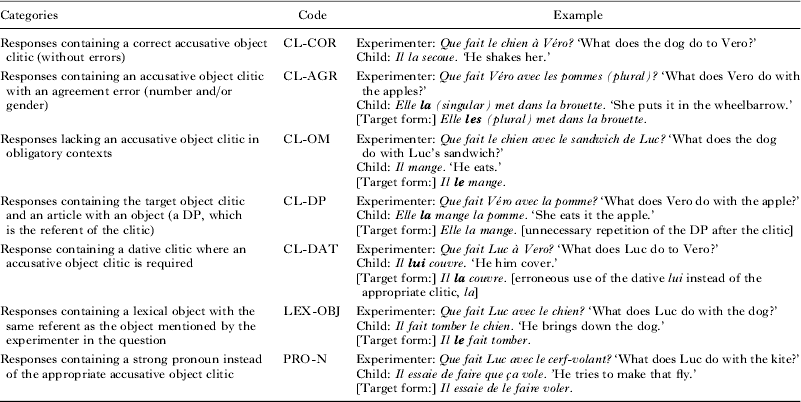
Children's responses were then coded by the experimenter and the transcriber as falling into one of seven categories (see Table 1 for more details and examples). The responses containing an accusative object clitic correctly elicited were coded as CL-COR. This category included only accusative object clitics that were elicited in the proper target form, without any error, and thus did not include productions from any of the other categories. The responses containing an accusative object clitic containing an agreement error were coded as CL-AGR. In this category, accusative object clitics were elicited but these did not appear in the target form since they included errors in gender and/or number. Responses containing a target object clitic as well as an article with an object, where the object is the referent of the clitic, were coded as CL-DP. Because proper use of accusative object clitics requires that these do not appear in conjunction with full DPs that refer to he object that they are supposed to replace, these were coded as errors. Responses containing a dative clitic where an accusative object clitic was required were coded as CL-DAT. Because these responses did not contain the target object clitic, although the sentence required one, these were also coded as errors. Responses lacking an accusative object clitic in obligatory contexts were coded as CL-OM, also coded as errors. Responses containing a lexical object with the same referent as the object mentioned by the experimenter in the question were coded as LEX-OBJ. Because these responses did not contain the target accusative object clitic, they were coded as errors. Although LEX-OBJ were coded as errors because they are inappropriate, we acknowledge that these are not strictly speaking grammatically incorrect. Finally, responses containing a strong pronoun instead of the appropriate accusative object clitic were coded as PRO-N. Again, because these responses did not contain the target accusative object clitic, they too were coded as errors. Aside from CL-COR, higher scores for the other categories mean a higher number of errors, and thus poorer performance.
Codes used to classify children's responses to the Clitic Elicitation Task

The children's scores for each category are expressed as a proportion of the total number of responses belonging to a given category over the total number of responses, including the omission of accusative object clitics in obligatory pronominalization contexts.
Procedure
Prior to testing, the objectives and the procedure of the study were explained to parents and their children, and parents were asked to sign the consent form; those who agreed to participate were then asked to complete the CBCL, a Language Environment Questionnaire, and a Development Questionnaire (see Delcenserie et al., Reference Delcenserie, Genesee and Gauthier2013, for details). The entire test battery was administered to each child individually during two 50-minute sessions on separate days. The Clitic Elicitation Task was administered during the second testing session. Testing took place in a quiet room at the university, in the child's school, or at home. When parents were present during testing, they were asked to remain quiet and not to help their child in any way.
Results
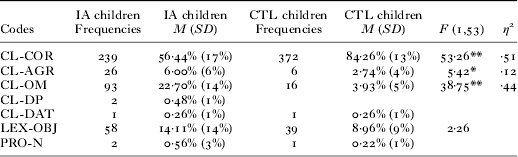
One-way independent groups analyses of variance (ANOVAs; α = ·05) were carried out to compare the IA and the CTL children's proportion scores on the Clitic Elicitation Task (see Table 2). Because there were very few responses in categories CL-DP, CL-DAT, and PRO-N, these results were not analyzed statistically and are not discussed further here. The results showed that, compared to the CTL children, the IA children produced significantly fewer correct accusative object clitics (CL-COR; IA = 56·44%; CTL = 84·26%) and they omitted significantly more accusative object clitics in obligatory contexts (CL-OM; IA = 22·70%; CTL = 3·93%). In terms of CL-AGR, the results show that the CTL children produced significantly more accusative object clitics containing errors of agreement in gender and/or number than the IA children (IA = 6·00%; CTL = 2·74%).
Performance on the clitic elicitation task by category (expressed as percentages)
notes: * p < ·05, ** p < ·001. IA = internationally adopted children; CTL = non-adopted monolingual French-speaking children; CL-COR = responses containing a correct accusative object clitic; CL-AGR = responses containing an accusative object clitic with agreement error(s); CL-OM = responses lacking an accusative object clitic in obligatory contexts; CL-DP = responses containing the target object clitic and an article with an object (DP); CL-DAT = response containing a dative clitic where an accusative object clitic is required; LEX-OBJ = responses containing a lexical object with the same referent as the object mentioned by the experimenter in the question; PRO-N = responses containing a strong pronoun. Note that, aside from CL-COR, scores represent number of errors, and thus poorer performance.
The groups were also compared in terms of the total number of clitics elicited, with or without errors. This category was calculated by adding the number of accusative object clitics correctly produced (CL-COR) and the number of accusative object clitics produced with agreement errors (CL-AGR). The results showed that the IA children produced significantly fewer clitics, with or without errors, than the CTL children (IA = 62·93%; CTL = 87·15%). No other significant differences were found between the groups.
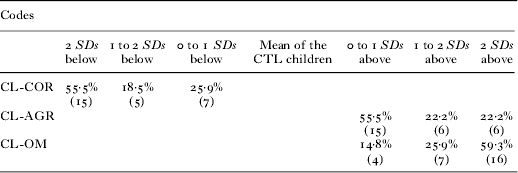
We then compared the results of the IA children to the results of the CTL children expressed in standard deviations; more specifically, we calculated the percentage of IA children who scored within ±1 standard deviation of the mean of the CTL children, between 0 and ±1 standard deviations, between ±1 and ±2 standard deviations of the CTL group, or more than ±2 standard deviations of the CTL group. This comparison was made for proportion of correct clitics (CL-COR), clitics containing agreement errors (CL-AGR), and clitics omitted in obligatory contexts (CL-OM). This revealed that all the IA children performed below the CTL children on number of correct accusative object clitics elicited (CL-COR; see Table 3 for the detailed distribution). Indeed, more than 55·5% (n = 15) of the IA children performed more than 2 SDs below the mean of the CTL children with respect to the use of correct accusative object clitics (CL-COR). In terms of accusative object clitics with agreement errors (CL-AGR), all of the IA children (n = 17) performed above the mean of the CTL children, consistent with the fact that they produced significantly more accusative object clitics with agreement errors than their non-adopted peers. Recall that the CL-AGR category includes responses with agreement errors, and thus higher scores represent poorer performance. More specifically, more than 44·4% (n = 12) of the IA children performed more than 1 SD below the mean of the CTL children on this measure. Moreover, all the IA children omitted more clitics in obligatory contexts than the CTLs (CL-OM). Indeed, 59·3% (n = 16) of the IA children scored more than 2 SD above the mean of their non-adopted peers; once again, note that higher scores on CL-OM represent poorer performance.
Percentage of IA children who scored above and below the mean of CTL children on the clitic elicitation task
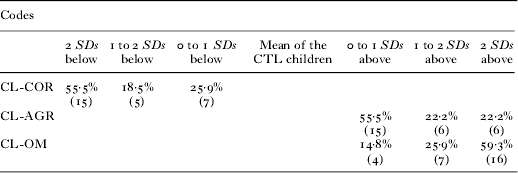
notes: The numbers in parentheses represent the number of children corresponding to each percentage. Note that, as CL-AGR and CL-OM represent agreement errors and omissions, respectively, scores above the mean of the CTL children represent poorer performance. In contrast, CL-COR represents the number of accusative object clitics correctly elicited. In this case, poor performance corresponds to scores below the mean of the CTL children.
DISCUSSION
The purpose of the present study was to determine if IA children from China have persistent difficulties with accusative object clitics. Indeed, the IA children omitted significantly more accusative object clitics (CL-OM), produced significantly more accusative object clitics with agreement errors (CL-AGR), and accordingly produced significantly fewer correct accusative object clitics (CL-COR) than the non-adopted monolingual French-speaking children. Thus, the performance of the IA children was considerably poorer than that of the CTL children overall – more specifically, all the IA children omitted more object clitics in obligatory contexts and, on average, produced more accusative object clitics with agreement errors (CL-AGR) than their non-adopted peers. In addition, all the IA children performed more than 1 SD below the mean of the CTL children in terms of number of correct accusative object clitics produced (CL-COR). The present results indicate that the IA children had persistent difficulties using accusative object clitics, difficulties that, although they differ in type, were reported by Gauthier et al. (Reference Gauthier, Genesee and Kasparian2012) in younger IA children, twelve of whom in fact were the same children.
Of particular interest is the similarity between the IA children's pattern of difficulties with accusative object clitics and those of children with SLI. Although we do not think that the IA children were experiencing language difficulties that were clinical in nature, because they performed within age-appropriate levels on other standardized measures of language abilities (Delcenserie et al., Reference Delcenserie, Genesee and Gauthier2013), agreement errors, high rates of omissions, and low rates of clitic production are all difficulties that have been reported for children with SLI learning French. As argued by Tuller, Delage, Monjauze, Piller, and Barthez (Reference Tuller, Delage, Monjauze, Piller and Barthez2011), it could be the case that certain structures, such as accusative object clitics, are inherently difficult to acquire in French, and thus create the same selective vulnerability across learner groups. In other words, this particular marker of SLI in French seems to be an area of difficulty for other at-risk populations, although the severity of the difficulties that these groups experience may vary. Future studies that compare IA children from China and children with SLI on other aspects of French which are difficult for other learners of French would be interesting.
The question then arises: What could be the cause of IA children's difficulties with object clitics? Given that the IA children performed within age-appropriate levels and similar to CTL children on tests of non-verbal cognitive abilities and socio-emotional adjustment, pre-adoptive deprivation seems an unlikely explanation. As noted previously, it has been shown that long-term impairment in language and other domains of development are exhibited by adopted children who experience severe deprivation and adversity pre-adoptively. In contrast, the adopted children who participated in this study scored within age-appropriate levels on other measures of general language abilities (see Delcenserie et al., Reference Delcenserie, Genesee and Gauthier2013), suggesting that they did not suffer from adverse pre-adoptive conditions. Indeed, IA children are highly resilient and, despite the fact that pre-adoption adversity cannot be ruled out completely because very little is known about IA children's conditions of institutionalization, this seems an unlikely explanation of the current findings.
It also seems unlikely that length of exposure to the adopted language is a viable explanation. Although it could be argued that the results reported by Gauthier et al. (Reference Gauthier, Genesee and Kasparian2012) were due to insufficient exposure to French, this seems unlikely in the present study since the adoptees benefited from more than 6 years 9 months of exclusive exposure to French, a level of exposure that is usually sufficient for non-adopted monolingual children to acquire clitics.
With respect to the IA children's unique language learning experiences, two other explanations are possible: L1 attrition and/or delayed onset of exposure to the adopted language. That the IA children were able to perform within age-appropriate levels on other measures of language ability, as reported in Delcenserie et al. (Reference Delcenserie, Genesee and Gauthier2013), suggests that disrupted L1 exposure did not impair their basic language learning abilities (Gauthier et al., Reference Gauthier, Genesee and Kasparian2012), but this remains a possibility.
Delayed onset of exposure to French could also be at play. In this regard, Abrahamsson and Hyltenstam (Reference Abrahamsson and Hyltenstam2009) found that even a short delay in onset of exposure in young L2 learners can result in long-term non-native levels of language ability. More specifically, they found that among a group of L2 learners of Swedish who were judged to be as proficient as adult native speakers of Swedish when tested in adulthood, very few were able to perform within the native-speaker range on a battery of tests of language and processing abilities, such as listening to language in noise, interpreting proverbs, voice onset time (VOT) tasks, and grammaticality judgment. This was true even of participants who started to acquire Swedish as an L2 before age five. More specifically, fewer than 10% (three of 31 participants) of the L2 learners who had begun to learn Swedish before five years of age performed like native speakers of Swedish more than twenty years later. Abrahamsson and Hyltenstam argued that very young L2 learners are not likely to perform as well as native speakers even after many years of exposure if examined using demanding language tests. Similar to these findings, results from the present study suggest that even the limited delay in onset of exposure (1 to 2 years) to the adopted language experienced by the IA children in the present study may account for their language difficulties, more specifically for their incomplete acquisition of accusative object clitics (see Delcenserie et al., Reference Delcenserie, Genesee and Gauthier2013, and Gauthier & Genesee, Reference Gauthier and Genesee2011, for more detailed discussions of this issue).
This raises a further question: Why does delayed onset of exposure compromise long-term native-like attainment in young learners? In this regard, Delcenserie et al. (Reference Delcenserie, Genesee and Gauthier2013) showed that IA children from China performed significantly lower than non-adopted children on expressive vocabulary, receptive grammar, and knowledge of word definitions, but that they performed more than 1 SD below the CTL children and below the norms on a test of sentence recall. Moreover, when the effect of sentence recall was partialled out, the groups were no longer significantly different on measures of language abilities. The authors hypothesized that delayed age of onset of acquisition of French may limit IA children's verbal short-term memory, which in turn might affect their language learning outcomes. Similarly, Grüter and Crago (Reference Grüter and Crago2012) suggest that limitations in working memory capacity could be a potential explanation of children's omissions of direct accusative object clitics in obligatory contexts. In their assessment of Chinese L2 learners of French who were aged 8;0, on average, and who had about 2 years 11 months of exposure to French at the time of testing, they observed a significant negative correlation between number of object clitic omissions and performance on a backward digit recall task, a test of verbal working memory abilities. Regression analyses also showed that this relationship remained significant when age at the time of testing and length of exposure to French were controlled for, and also that verbal working memory abilities explained 34% of the variance in frequency of object omission (Grüter & Crago, Reference Grüter and Crago2012). This is particularly interesting in light of recent findings by Delcenserie and Genesee (Reference Delcenserie and Genesee2013) that IA children from China performed significantly lower than CTL children on measures of verbal short-term memory, verbal working memory, and verbal long-term memory, but similarly to CTL children on measures of non-verbal short-term and working memory, suggesting that their memory difficulties are language-specific and not domain-general. Thus, it is possible that the IA children's difficulties in language acquisition in general, including the acquisition of accusative object clitics, are related to verbal memory limitations. In other words, the acquisition of object clitics might be affected along with other more general components of language because they are vulnerable structures, as evidenced by studies of French-L1 learners who master this structure relatively late (e.g. Hamann et al., Reference Hamann, Rizzi, Frauenfelder and Clahsen1996). Although this is an interesting possibility, more research is needed to determine if IA children's difficulties with accusative object clitics and their verbal memory lags are correlated.