


Introduction
A functionally univentricular heart includes a heterogeneous spectrum of complex congenital cardiac malformations where the ventricular chambers cannot sustain separate systemic and pulmonary circulations. The Fontan approach, more currently now undertaken as a total cavo-pulmonary connection, allows effective separation of the systemic and pulmonary circulations where a biventricular repair is not feasible. Reference Earing, Cetta and Driscoll1–Reference Kaulitz and Hofbeck3 Based on the assumption that a subpulmonary ventricular pump is not mandatory to facilitate venous return to the lungs via the pulmonary arteries, it can provide a stable circulation, usually with near-normal arterial oxygen saturations, although in the absence of a “subpulmonary pump,” there is no preload support for increased exertion. Since the systemic ventricle must perfuse both the systemic and pulmonary circulations in series, the circulation in general is under some abnormal strain, and systemic venous pressures are of necessity higher than in a biventricular circulation.
Since its introduction 6 decades ago, the Fontan procedure, or total cavo-pulmonary connection, has undergone various modifications in terms of surgical technique, and it is estimated that around 70,000 patients are now living with some form of Fontan palliation worldwide. Reference Schilling, Dalziel and Nunn4 The Fontan/total cavo-pulmonary connection is often complicated by a variable degree of long-term morbidity affecting multiple organ systems, Reference Rychik, Atz and Celermajer5 and there is considerable interest in ways to ameliorate this. No specific comparisons with healthy controls have been yet published regarding the blood pressure in adults who underwent a Fontan procedure or total cavo-pulmonary connection.
It could be hypothesised a higher blood pressure would be required to overcome the combined resistance of both the systemic and pulmonary circulations. Clinically, our own experience suggests that many adults with a functionally univentricular heart who underwent a Fontan procedure or total cavo-pulmonary connection variants (aortopulmonary type, lateral tunnel, and extracardiac) during childhood have systemic blood pressures in the lower range as part of the altered physiology of the single-ventricle circulation. However, there is remarkably little data regarding the long-term changes in blood pressure in the overall population of adults with congenital heart disease. Reference Sabatino, Avesani and Sirico6 There are no separately established values for optimal blood pressure in adults with congenital heart disease patients as opposed to, for example, patients with heart failure or diabetes, and the conditions which cause adults with congenital heart disease are themselves highly variable.
In some studies, both adults and children having undergone the Fontan procedure or total cavo-pulmonary connection have been shown to have increased arterial stiffness and an increased aortic augmentation index, which are also pathognomonic of essential hypertension. Reference Hacker, Reiner, Oberhoffer, Hager, Ewert and Muller7–Reference Schafer, Frank and Jacobsen9 In our own studies, we have found that Fontan/total cavo-pulmonary connection adults have significant alterations in their microcirculation, with skin capillary rarefaction and increased tortuosity compared to healthy controls. Reference Raghuraman, Ebeid, Debiec, Bolger, Squire and Bu’Lock10 The microcirculation is one of the important determinants of systemic vascular resistance. Capillary rarefaction is also one of the hallmarks of essential hypertension. Reference Antonios, Singer, Markandu, Mortimer and MacGregor11 Thus, it is imperative to establish whether arterial hypertension could therefore be involved in the microvascular differences seen in Fontan patients. Therefore, we undertook a systematic search of all research papers which have recorded the blood pressure in post-Fontan/total cavo-pulmonary connection adults (>=16 years of age) as a part of their vital signs assessment and compared them with healthy volunteers also >=16 years old.
Methodology
Search strategy
The trial strategy was registered in PROSPERO, CRD42022355781 (https://www.crd.york.ac.uk/prospero/display_record.php?ID=CRD42022355781). The databases searched were MEDLINE, Embase, and Cochrane (CENTRAL). The systematic search was first conducted in September 2022, and the second search was conducted in November 2023 to ensure all recent papers were included. Follow-up citation searches were conducted from the key articles identified through screening. The basic search structure was “Fontan/total cavo-pulmonary connection AND blood pressure,” which was further expanded using a variety of keywords and subject headings as appropriate for each database. Search terms included (“Fontan” OR “Lateral tunnel” OR Total “cavo-pulmonary” OR “cavopulmonary anastomosis” OR “shunt” OR “connection” OR “total cavo-pulmonary connection” OR “atriopulmonary connection” OR “stage 3” OR “stage III,” “Norwood” OR “Fontan procedure” OR “combination of all the surgical terms described above” OR “blood pressure” OR “systolic pressure” OR “diastolic pressure” OR “hypertens” OR “hypotens” OR “augmentation index or indices” OR “AIx” OR “pulse wave velocity” OR “sphygmomanometer” OR “Pulse Wave Analysis” OR “Blood pressure” OR “exp Sphygmomanometers” OR “Combination of blood pressure terminologies OR with the Fontan surgery terms”). The types of studies included were randomised controlled studies, observational studies, and retrospective audits which were written in English from the year 1978. The Preferred Reporting Items for Systematic Reviews and Meta-Analyses statement was followed for our systematic review and meta-analysis.
Study selection
We have included studies which recruited adults >=16 years of age with functionally univentricular hearts who underwent a Fontan procedure or total cavo-pulmonary connection during childhood and controls (healthy adults >=16 years of age within the same studies) in whom blood pressure was measured with recording of systolic, diastolic, or mean blood pressures.
Eligible studies were RCT’s, observational studies, case reports, or retrospective audits. All types of Fontan procedures, or total cavo-pulmonary connection, including atriopulmonary, lateral tunnel, and extracardiac types, were included. Studies that have measured aortic augmentation index and aortic stiffness in Fontan adults were also included. This is because systolic and diastolic blood pressure are usually measured by default using non-invasive devices that also measure the aortic augmentation index.
Studies recording 24-hour blood pressure monitoring in patients with functionally univentricular hearts who underwent either a Fontan procedure or total cavo-pulmonary connection in childhood were also included.
We excluded patients < 16 years old; patients operated for a bidirectional Glenn shunt only; blood pressure measured in emergency settings and post-operatively; diagnosis of essential hypertension and secondary hypertension.
Hence, the main aim of this systematic review is to provide insight regarding the blood pressure profile in adults with functionally univentricular hearts who have undergone either a Fontan procedure or total cavo-pulmonary connection in childhood, compared to healthy controls. The measure of effects includes differences in systolic, diastolic, and mean blood pressure in adults post-Fontan procedure or total cavo-pulmonary connection (>=16 years) compared to the healthy controls.
Data extraction and analysis
Two reviewers (RR and AE) independently screened the titles and abstracts of returned records against the inclusion/exclusion criteria. A third reviewer (RD) resolved any conflicts. Following title/abstract screening, the full texts were retrieved for the included studies, and two reviewers again independently screened these full texts. Reference management and screening was conducted in RefWorks. The extracted data include systolic blood pressure; diastolic blood pressure; mean blood pressure; type of Fontan procedure or total cavo-pulmonary connection; age at the time of study; cohort size; gender; and methods used to record the blood pressure (manual or digital). Central blood pressure, augmentation index, and pulse wave velocity were recorded in studies where the brachial blood pressure was measured by default. We also extracted citation details, cohort size, and bias rating. The extracted data were transferred to an Excel spreadsheet for further analysis.
Risk of bias (quality) assessment
The Newcastle–Ottawa scale was used to assess the characteristics and quality of included studies. Briefly, the scale was based on a star system and includes three broad perspectives: selection of the study groups, comparability of the groups, and ascertainment of the outcome of interest. The total score was calculated by summing the score for each answer. Studies were considered of good quality if the total score was at least 7/9. Two reviewers (RR and AE) independently conducted the quality assessments of the included studies. Disagreements were resolved by discussion and further review. Publication bias was assessed by visual inspection of funnel plots and by Egger’s statistical tests. A P-value less than 0.05 shows evidence of publication bias.
Statistical analysis
Statistical analysis was performed using Cochrane Review Manager (Rev Man 5.3) software (Cochrane). For continuous outcomes, the mean differences between Fontan/total cavo-pulmonary connection patients and healthy controls (mean differences) in systolic, diastolic, and mean blood pressure and 95% confidence intervals were calculated. P < 0.05 was considered statistically significant. Meta-analysis was performed due to the availability of blood pressure data in Fontan adults and control in 4 studies. Heterogeneity among studies was assessed using the Higgins I 2 test and P values based on Cochran’s Q test. If P < 0.05 and I 2 >50%, the random-effects model was selected to calculate the pooled effective size. In other cases, the fixed-effects model was employed.
Results
Study selection
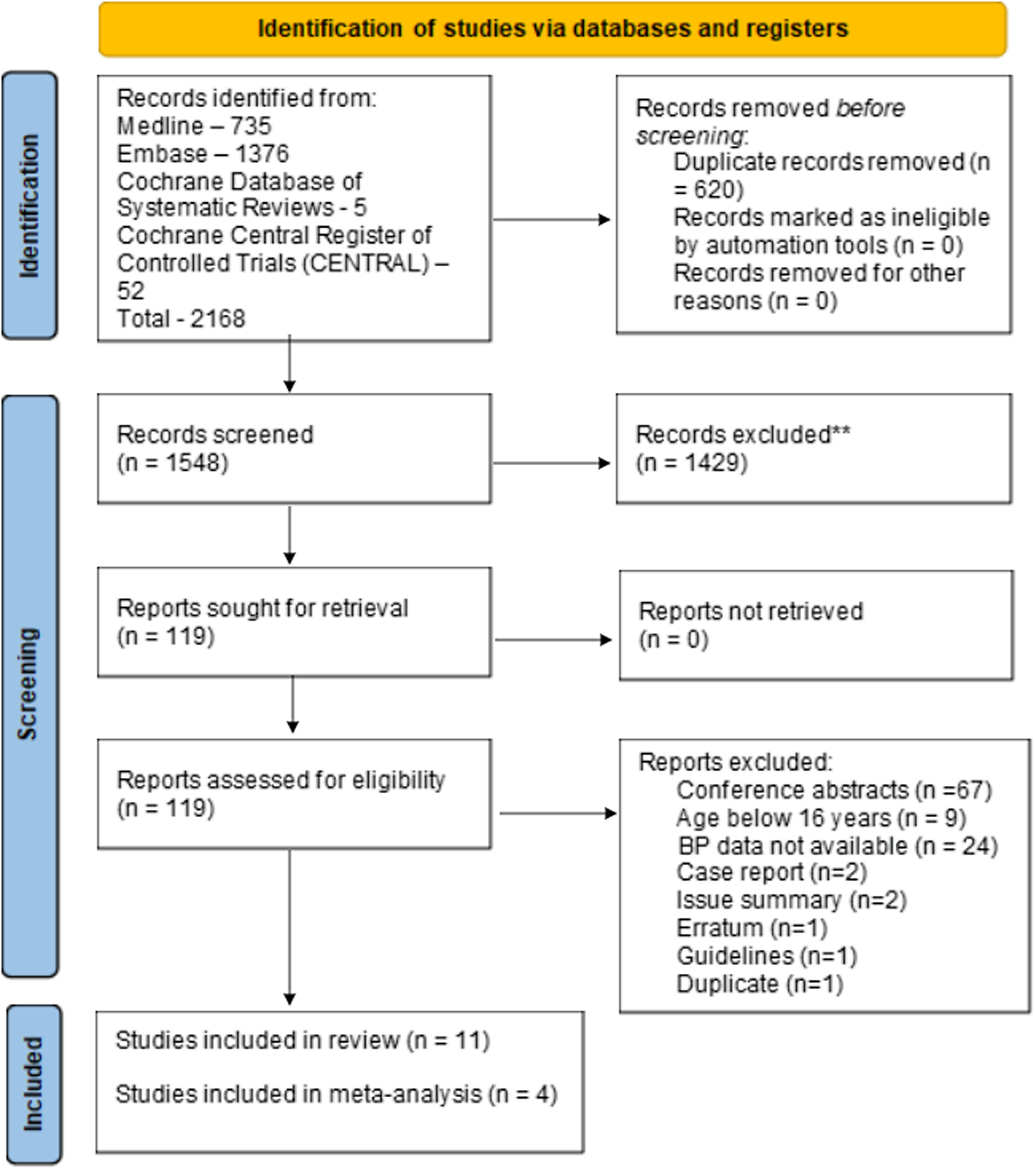
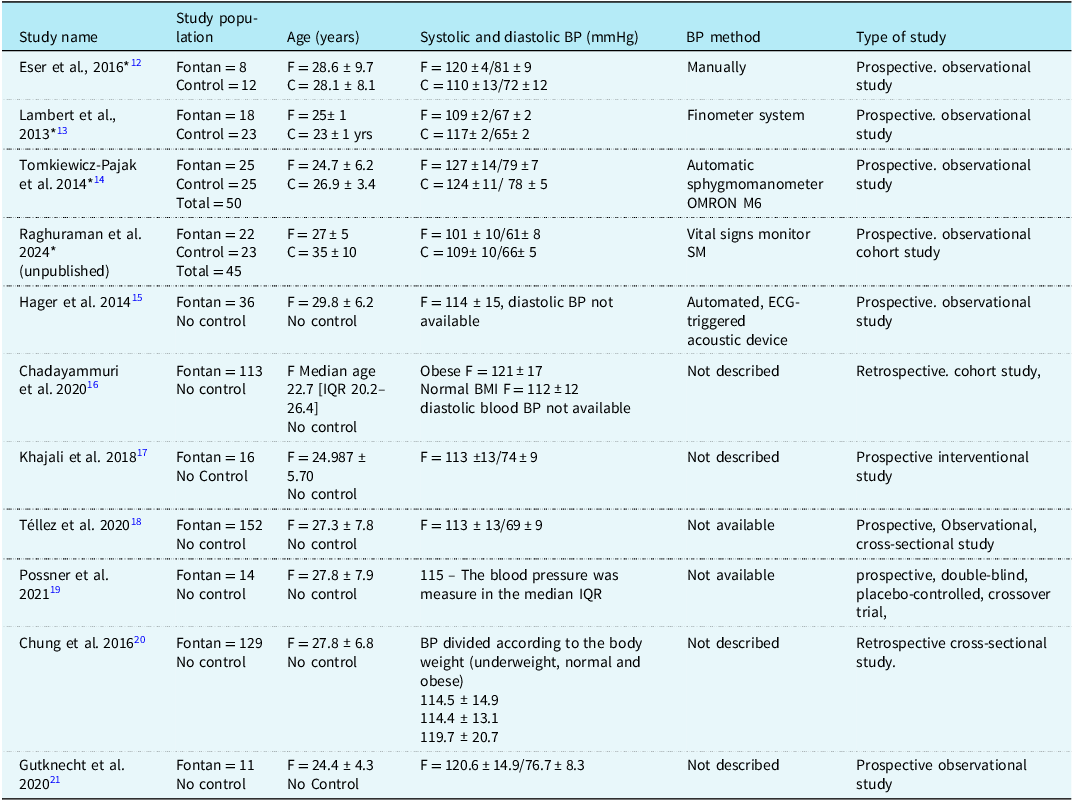
The searches done on two different timepoints yielded 2168 records in total. After removing duplicates and further screening, 119 potential records were identified and assessed for eligibility. Out of these 119 records, 11 studies had information related to systolic and diastolic blood pressure in Fontan/total cavo-pulmonary connection adults >=16 years of age. Four studies only were included in the final, quantitative analysis due to the presence of a control group (Figure 1). The list of studies included in the qualitative and quantitative synthesis is listed in Table 1. Reference Eser, Herzig and Vogt12–Reference Gutknecht, Kwiatkowska, Waldoch, Siebert and Siebert21
PRISMA diagram showing the studies that were included after the systematic search.

Figure 1. Long description
A flowchart illustrating the process of identifying studies via databases and registers for a systematic review. The process begins with the identification of records from various databases: Medline with 735 records, Embase with 1376 records, Cochrane Database of Systematic Reviews with 5 records, and Cochrane Central Register of Controlled Trials with 52 records, totaling 2168 records. Before screening, 620 duplicate records are removed. The remaining 1548 records are screened, and 1429 records are excluded. 119 reports are sought for retrieval, and all are retrieved. These 119 reports are assessed for eligibility. 67 conference abstracts, 9 records with age below 16 years, 24 records without BP data, 2 case reports, 2 issue summaries, 1 erratum, 1 guideline, and 1 duplicate are excluded. Finally, 11 studies are included in the review, and 4 studies are included in the meta-analysis.
List of studies included in the systematic review and meta-analysis. *Denotes the publications used for meta-analysis

Table 1. Long description
The table presents a comparison of studies on systolic and diastolic blood pressure in Fontan adults. It includes 11 studies, each detailing the study population, age, blood pressure measurements, method of blood pressure measurement, and type of study. The table has 11 rows and 6 columns. The columns are labeled as Study name, Study population, Age (years), Systolic and diastolic BP (mmHg), BP method, and Type of study. Each row provides specific details for each study. For example, the first row shows the study by Eser et al 2016 with a Fontan population of 8 and a control population of 12, ages 28.6 and 28.1 years respectively, systolic and diastolic BP measurements of 120 ± 4/81 ± 9 for Fontan and 110 ± 13/72 ± 12 for control, measured manually, and is a prospective observational study. The table continues with similar detailed information for each subsequent study.
Nine studies were of a prospective observational design; an additional 2 studies were retrospective. Most studies recruited small numbers of patients with a wide variety of underlying cardiac conditions (range 8–152) and healthy controls (12–25). The blood pressure readings were collected in these studies as a baseline for Fontan/total cavo-pulmonary connection and healthy adults in studies where medical products were used (i.e., phosphodiesterase inhibitors). Details of concomitant medications and comorbidities were not routinely available.
Blood pressure difference between Fontan/total cavo-pulmonary connection and controls and the blood pressure in Fontan/total cavo-pulmonary connection patients from all the studies included
Overall, blood pressure data were available for 544 Fontan patients from 11 studies. The average age of the Fontan/total cavo-pulmonary connection patients included was 26.1 ± 6.0 years. Methodology for blood pressure recording was digital in all but one study, where the blood pressure was measured manually. Some studies had data only for systolic blood pressure. Their weighted mean systolic blood pressure and diastolic blood pressure were 114 ± 14 mmHg and 69 ± 9 mmHg, respectively.
Meta-analysis
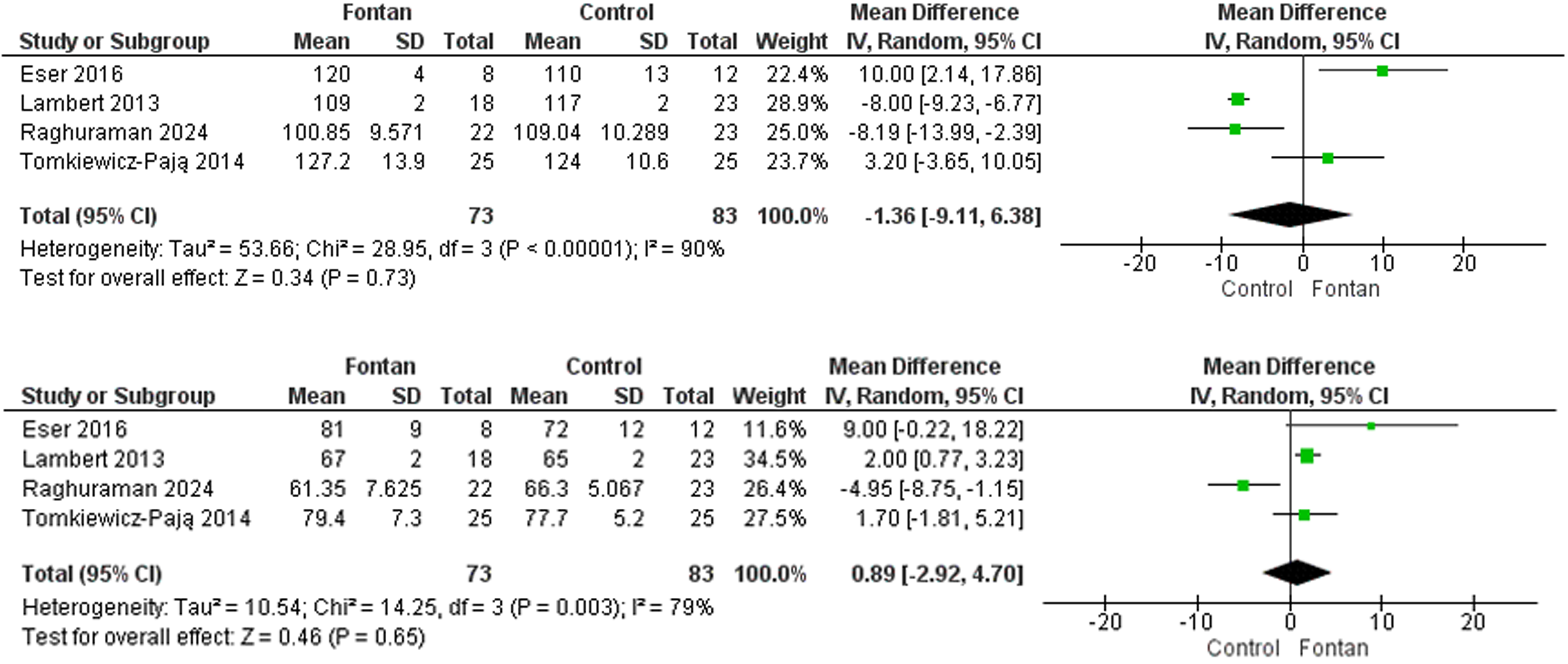
In the formal meta-analysis from the 4 studies with controls (n = 130 subjects), the weighted mean difference in systolic blood pressure was −1.36 mmHg (95% CI, −9 to 6.38) and in diastolic blood pressure was +0.89 mmHg (95% CI, −2.92 to 4.70) between the Fontan/total cavo-pulmonary connection and controls. A high level of heterogeneity in both the systolic blood pressure (P < 0.00001) and the diastolic blood pressure (P < 0.003) was noted (Figure 2).
Forest plot showing the difference in the systolic and diastolic BP between the Fontan group and control group.

Discussion
This is the first systematic review of the blood pressure of adult Fontan/total cavo-pulmonary connection patients compared to healthy controls. It demonstrates no statistically significant differences in blood pressure in the small number of studies suitable for meta-analysis, which does not align with our previous clinical “impression.” Furthermore, mean systolic and diastolic blood pressures of the 544 Fontan/total cavo-pulmonary connection patients included from the entire 11 studies were 114 ± 14 mmHg and 69 ± 9 mmHg, respectively. These are readily comparable to the blood pressure averages in the same age group described in normal population centiles. Reference Lin, Chen and Wu22–24
There is no currently defined optimum systolic or diastolic blood pressure known to best preserve the ventricular function of adults with a Fontan procedure or total cavo-pulmonary connection. Because of the uniqueness of the Fontan circulation, maintenance of optimum blood pressure may be important for complication-free survival and preservation of univentricular function and/or reduction of long-term end-organ complications, but as yet this is uncertain.
Given the increasing size of the emerging population of post-Fontan/total cavo-pulmonary connection adults and the paucity of data on the impact of systemic blood pressure on the preservation of ventricular function, we strongly recommend that blood pressure should not only routinely be recorded in clinic but also recorded according to established technical measurement guidelines (such as the British Hypertension Society guidelines Reference Williams, Por and Brown25) to ensure availability for future comparisons.
Arterial stiffness is found in conditions such as essential hypertension, diabetes, obesity, chronic kidney disease, hypercholesterolaemia, and, intriguingly, in children and adults operated on for some congenital heart conditions. Reference Cohen, Mitchell and Gill26–Reference Kaess, Rong and Larson29 Many studies have shown the presence of arterial stiffness in patients after the Fontan procedure or total cavo-pulmonary connection compared to healthy controls. Reference Schafer, Younoszai and Truong30–Reference Goldstein, Urbina and Khoury32 Most studies have shown stiffness in the aortic arch and ascending aorta in particular. However, the role of ventricular morphology and loading conditions in arterial stiffness is not yet studied, likely due to the morphological heterogeneity of the population and the small number of patients included in most studies. Some studies have reported the incidence of increased augmentation index without elevated pulse wave velocity. Elevated aortic augmentation index is a common feature post-aortic arch repair in hypoplastic left heart syndrome; however, some studies showed no difference in aortic stiffness in left or right ventricular morphology after aortic arch reconstruction with either systemic left or right ventricular morphology. Reference Schafer, Younoszai and Truong30,Reference Cardis, Fyfe and Mahle33 Furthermore, many single-ventricle patients have not had any intervention on the aortic arch at all. The preservation of systemic ventricular function is clearly very important in the long-term survival of patients after Fontan/total cavo-pulmonary connection. Loss of elasticity in the aorta and increased ventricular afterload might therefore have a significant impact on ventricular function and survival. Reference Schafer, Younoszai and Truong30 In many post-Fontan/total cavo-pulmonary connection studies, including our unpublished data, arterial stiffness is not necessarily associated with raised systolic and diastolic blood pressure or aortic surgery, so the reasons for this are yet to be elucidated. The impact of afterload reducing or anti-failure medications is also unexplored. Nevertheless, this systematic review provides a useful baseline for future research studies on our Fontan/total cavo-pulmonary connection patients by excluding one of the most usual causes of the abnormal microcirculatory changes we see in Fontan patients.
Conclusion
There was no statistically significant difference in systolic and diastolic blood pressure in patients post-Fontan/total cavo-pulmonary connection compared to controls, and overall weighted means of blood pressure were comparable for similar age groups. Arterial hypertension does not appear to explain the capillary rarefaction and aortic stiffness found in adults with post-Fontan procedure/total cavo-pulmonary connection. Further studies are required to explore other causes of this vascular remodelling.
Acknowledgements
None.
Financial support
This research received no specific grant from any funding agency, commercial, or not-for-profit sectors.
Competing interests
None.
Ethical standard
None.

 Open access

