1. Introduction.
This scholarly volume offers an in-depth analysis of the inventory of modal verbs in Norwegian. As noted by the author: “the literature on modals in Germanic languages is comprehensive […] it covers a vast array of topics associated with these verbs and the debate never seems to fade” (p. 3). The central purpose of this work is to enhance our understanding of Norwegian (and, more generally, Germanic) modal verbs and their structural (syntactic), semantic, and pragmatic properties, from both a functional and a generative perspective. The two main topics are the argument structure of Norwegian modals (chapter 4) and their interaction with aspect and tense (chapter 5).
Chapters 2 and 3 present preliminary background information necessary for the thorough treatment of the two main topics. Chapter 2 examines the morphological, semantic, and syntactic properties of Nor-wegian modals and offers a revised inventory of these verbs, including an overview of their main readings. In chapter 3, Eide reviews and renders a thorough critical analysis of thirteen recent generative analyses of modals (based on formal theories that have developed from the Principles and Parameters framework). All of the previous theoretical treatments of modals, except one (see Picallo 1990), focus on modality in Germanic languages. Eide's review of these earlier analyses of modals focuses on the two prime issues addressed: (i) the argument structure of modals, and (ii) their insertion or merger point in a syntactic structure. Chapter 6 offers a brief summary of the important empirical findings, generalizations, and theoretical innovations unique to this investigation of Norwegian modals.
2. Scope and Content of Individual Chapters.
In chapter 1, Eide lays out some key terminology that distinguishes her approach from other contemporary studies of modals. For example, rather than remaining consonant with the canonical epistemic/root distinction found in most earlier studies of modals, she introduces the dichotomy of root versus non-root modals. Her rationale for employing this distinction is the following: “although metaphysical modality (modality about the possible futures of a given situation) could easily be argued to be a variant of epistemic modality, one important reason to choose the cover term non-root for epistemic, metaphysical, and evidential readings is that many Germanic languages include at least one non-root modal with an evidential reading” (p. 6). Epistemic modality is concerned with reasoning based on the speaker's (present) knowledge, whereas evidential modality is concerned with the (speaker-external) evidence a speaker has for the truth of a given proposition.
Starting with Ross 1969, there is a long-held theoretical tradition in which the claim is made that the distinction between root versus epistemic (non-root) modals co-vary with specific structural traits. In this tradition, root modals are analyzed as control verbs (that is, main verbs) and epistemtic modals as raising verbs (for example, auxiliaries). Accordingly, these analyses are known as “control versus raising” analyses. As discussed and evaluated in more detail below, Eide rejects this type of approach, arguing that both root and non-root modals are modal auxiliaries due to their behavior with respect to do-replacement in tag questions and ellipsis.
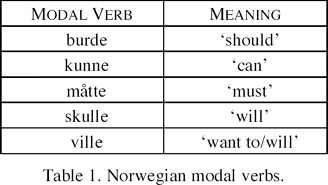
For the sake of clarity and to remain consistent with the traditional literature on modals in Germanic languages, Eide highlights the distinction between modals that can license a DP or a finite clausal complement (modal main verbs) and those that can only license bare infinitival complements (modal auxiliaries). With regard to both semantic and syntactic properties, Eide finds that modal main verbs differ significantly from modal auxiliaries. Unlike auxiliaries, which serve to be their lexical Doppelgänger, modal main verbs license DP arguments and finite clauses, and pattern with transitive lexical verbs with respect to do-replacement and passive formation. The only area in which overlap is observed between these two modal variants is lexical semantics. The focus of the analysis is on modal auxiliaries; modal main verbs are included in this discussion is to provide a general landscape of all verbs and their morphological, semantic, and syntactic properties that are designated to be “modals.” As mentioned in the introduction, chapters 2 and 3 function primarily as necessary background information for the unique claims and contributions of this particular analysis of Norwegian modals. In chapter 2, Eide discusses the various morphological, semantic, and syntactic properties of Norwegian modal verbs. As a point of departure, Eide recognizes five verbs in Norwegian as modals, as illustrated in table 1 (p. 16).

These modals have both root and epistemic (non-root) interpretations. Consider the sentence in 1 and its potential root and epistemic interpretations in 2 (p. 16).


For the modal måtte ‘must’—as with the rest of the inventory of modals discussed in this work—the modal has the potential of eliciting a root and/or epistemic reading of any given sentence. Speaking first of the morphological characteristics of Norwegian modals, Eide notes that perhaps the most salient characteristics connecting all Germanic modals, regardless of their synchronic language affiliation, is their status as preterite-present verbs. These verbs can be diachronically traced back to strong preterites in a past tense form, although their meaning now is present tense. In contrast to languages such as English, which exhibits an incomplete paradigm of its synchronic modals, Norwegian displays an almost full formal paradigm of finite and non-finite forms.1
A marked weakness in this assertion—as noted by Eide—is that all Norwegian modals lack present participles and almost all lack imperatives and passives (except for certain situations involving skulle ‘will’ and ville ‘want to/will’; see Lødrup 1996).

Norwegian modals can also occur in counterfactual statements. These constructions typically contain a preterite form of the modal. In addition, a pluperfect construction with a preterite auxiliary hadde ‘had’ preceding the modal is also possible, in which case the modal is a perfect participle.

The connection between past tense modals and a pluperfect can also (potentially) be seen in dialectal—both diachronic and synchronic—variants of British and American English. For example, the verb liketa functions as a quasi-modal verb in variants of American English. It appears in combination with a past participle to produce a counterfactual reading, as in 5. This structure is remarkably similar to the counterfactual construction in Norwegian in 4 above.

An analysis of counterfactual liketa in English would, of course, require the elevation of this verb/adverbial to the status of a (quasi-)modal. Alternatively, we could assume (along the lines of Julien 2000) that the verb have is syntactically present, although not phonologically realized.2
The possibility that an (unpronounced) aspectual have is deleted is also mentioned by Eide (p. 59).
The brief discussion of the semantic characteristics provides a succinct introduction to the interpretations (for example, epistemic, deontic, bouletic, doxastic, etc.) of modal expressions from the standpoint of philosophy and modal logic. Eide reaches the conclusion that regardless of how difficult the task may be to isolate “an area of meaning” (p. 33) encompassing all modals, the core inventory of modals in different languages is surprisingly similar from a semantic point of view.
As far as the syntactic properties of modals are concerned, Eide participates in the timeless debate of whether modals (more specifically, modal auxiliaries) contribute any lexical meaning to a sentence, or whether their contribution is exclusively grammatical. This discussion serves as the basis for the theoretically in-depth treatments of modals that examine the role theta-roles, and their connection to syntactic structures play in relation to Norwegian modals. Eide then discusses the contrastive roles that both modal and lexical verbs play in ellipsis and the construction of tag questions. Addressing ellipsis first, lexical verbs in Norwegian are replaced by the light verb gjøre ‘do’ in elliptical constructions, as in 6a, while modals are repeated, as in 6b (data, pp. 65–66).

Closely related to do/gjøre-support and the contrastive behavior exhibited by lexical and modal/auxiliary verbs are tag questions (data, p. 66):

Note again that modals pattern with aspectuals. Lexical verbs cannot be repeated in the tag; they must be replaced by gjøre ‘do’, as in 7a. In contrast, modals and aspectuals must be repeated in the tag; they cannot be replaced by gjøre ‘do’, as shown in 7b,c.
There are, however, two Norwegian modals—ville ‘want to’ and kunne ‘can/know’—that can be replaced by gjøre ‘do’ in tags. These two modals are special for a number of other reasons. For example, they can license a DP or non-finite CP arguments, and they can be passivized. Lastly, Eide notes that root modals can take directionals as complements and can license pseudoclefted complements on a subject-oriented reading. Much like her discussion of the semantic properties of Norwegian modals, Eide discusses these syntactic characteristics of modals outside of formal generative machinery or terminology—something that is addressed in chapter 3. This chapter concludes by examining three potential candidates for the status of modal verbs in Norwegian—få ‘get’, behøve ‘need’, and trenge ‘need’—and convincingly demonstrates that although there are semantic similarities between at least two of these verbs (behøve ‘need’ and trenge ‘need’) with true modals, there still remain structural differences that prevent their analysis as modals in Nor-wegian.3
At the same time, as mentioned by Eide (p. 80) and by Öhlschläger (1989:3), negated auxiliary-like verbs—such as trenger ikke/behøver ikke ‘need not’ in Norwegian and (nicht) brauchen ‘need not’ in German and other Indo-European languages—have similar negated modals.
Concerning the first issue (that is, whether or not modals potentially assign an external theta-role), there are two dominant camps in the literature. Originating with Ross’ (1969) seminal work comes the “control versus raising” view. Under such an approach, the non-root modal is analyzed as a raising verb (that is, an auxiliary verb) with no selectional require-ments, hence it assigns no external theta-role. Under an alternative approach, root modals are analyzed as control verbs that have the ability to assign an external (subject) theta-role. Accordingly, the subject con-trols the reference of the lower PRO subject, the subject of the infinitive. Yet another widespread view argues that all modals, both root and non-root, are raising verbs. In addition, there are hybrid theories of these analyses, where modals are analyzed as “raising verbs with an attitude,” that is, raising verbs that still impose certain selectional requirements on their subjects.
The other important issues in the thirteen proposals reviewed in this chapter concern a modal's possible position. Such issues have received additional attention since Cinque's (1999) work, which suggests a fixed, universal hierarchy of functional projections. Even prior to the appearance of Cinque's seminal work in this area, various authors have argued that root and non-root modals are merged into different positions. As demonstrated by the brief review of these earlier studies of Germanic (and Romance), it is difficult to see a clear-cut dominant trend in the treatment of modals, their potential conformity to a system of universal ordering, and their interaction with tense and aspect. Eide's interest in this topic is addressed in full in chapter 5, where she focuses on the interaction between modals, tense, and aspect, and between certain types of modality.
In chapters 4 and 5, Eide develops her analysis of Norwegian modals. In chapter 4, she provides a thorough review and criticism of the control versus raising analysis, where root modals are analyzed as control verbs and non-root as raising verbs. By means of a battery of tests (for example, expletive subjects, weather-det/það ‘it’, idiom-chunk subjects, quirky subjects, subject-modal scope ambiguity, ability to passivize, and acceptance of a pseudoclefted complement), Eide establishes that all non-root modals and most root modals (those that receive a deontic, monadic and/or dynamic semantic interpretation) exhibit traits that align them with raising verbs rather than control verbs. These results certainly do not support the control versus raising analysis; rather, a significant body of data (chapter 4, section 2) supports the view that nearly all modals are raising verbs. The only evidence from the data that seems to refute this view is the fact that some modals can accept pseudo-clefted complements. Raising verbs reject and control verbs accept pseudoclefted complements, as illustrated in 8a,b (from p. 417).

Although in most respects modals behave like raising verbs, they pattern with control verbs in their ability to license a pseudoclefted complement (data from p. 417).

However, Eide notes that upon closer inspection proposition-scope readings of root modals do not behave like control verbs. They reject a pseudoclefted complement just like raising verbs, as demonstrated by 10a,b (data from p. 417).

Accordingly, only subject-oriented (that is, dyadic) root modals pattern with control verbs in their ability to license pseudoclefted complements, as illustrated in 9 above. To account for the fact that root modals behave differently in pseudoclefts depending on whether their reading is dyadic (that is, subject-oriented) or monadic, Eide investigates whether or not some sort of semantic feature [subject-orientedness] is mirrored by, or possibly triggers, a syntactic difference. Such an analysis comes at the expense of accepting that root modals in fact assign something akin to an external theta-role on the subject-oriented reading. After investigating the possible analyses that exist for this behavior of root modals in Norwegian, Eide rejects the approach (contra Brennan 2004) in which each modal has two entries in the lexicon, one control-like and one raising-like in structure and function. She claims that the computational burden that multiple lexical homonyms would place on the faculty of human language.
However, Barbiers (2002) demonstrates that subject-oriented root modals behave like raising verbs in certain situations, namely when they take directional complements, as in 11. For example, en mann ‘a man’ in 11a has not only the wide-scope reading, but also the narrow-scope reading typical of raising structures.

To address these seemingly paradoxical data, Eide applies Hornstein's (1998, 1999, 2000) approach, which aims to subsume what the literature traditionally labels raising and control under raising. Such an approach, according to Eide, can account for the dual behavior of root modals. In the end, she sides with Hornstein in asserting that raising and control verbs are not structurally distinct, reducing control verbs to “raising verbs with an attitude.” Where control verbs are unique can be found in the selectional and thematic requirements towards their syntactic subjects. In contrast, since raising verbs do not have such requirements toward their subjects, they allow for a narrow-scope reading of the subject. This brings us back to Hornstein's approach, according to which an A-chain has only one visible link at LF. However, according to these assumptions, there appears to be no requirement that this link be the topmost link of the A-chain. Thus, raising verbs allow for the non-topmost A-link to be interpreted (that is, “reconstruction”), whereas for a control verb, the topmost A-link must be interpreted in order for the subject theta-role to be expressed at LF. In the end, Eide adopts Hornstein's approach to the control versus raising distinction to “avoid the massive ambiguity regarding the complement of a modal—whether it is an IP (for the modal-as-raising verb) or a CP (for the modal-as-control verb)” analysis (p. 420).
In chapter 5, Eide investigates how modals on their different readings interact with aspect and tense. The chapter begins with Eide noting certain default patterns and eventually concluding (contra Cinque 1999; Roberts & Roussou 2002, 2003) that a fixed ordering of modals and tense in a universal hierarchy of functional projections cannot be upheld. According to such an approach, each modal—as is assumed to be the case with any other verb in the lexicon—originates with its own tense marking. Eide concludes that a much more flexible account to accurately describe the interplay of modals, tense, and aspect in Germanic languages is sorely needed. Accordingly, she proposes a tense system for Norwegian, underspecified for present-future distinctions and “exploiting the aspectual properties of predicates and temporal adverbials for its specification” (p. 422). Within such a system, each and every verb form in Norwegian must host a tense element; there are no non-tensed verbs. The number of tense elements (T-projections, in Cinque's terminology) is determined by the number of verbs in a clause. As a result, each tense element specifies the relation between two events, where the speech event is the topmost event in the tense chain.
Eide concludes that these solutions “suggest important generalizations often assumed to be syntactic constraints on the behavior of modals are in fact semantic in nature” (p. 427). Consequently, semantic interpretation appears to play a more important role than syntactic properties in the evaluation of root versus non-root readings. Syntactic principles also take second-stage to semantic considerations in establishing the location and timing of the merger of modal verbs in the syntax, as well as determining how these modals interact with each other with regard to aspect and tense.
3. Critical Analysis.
Before addressing specific arguments, it should be mentioned that this work presents its empirical data and theoretical discussion in a very clear, succinct format that is easy both to understand and follow. This work constitutes an excellent point of departure for anyone seeking to gain a more enriched background on modality in Norwegian and Germanic. It also contributes to a better understanding of modality in Germanic through a laconic review of recent contemporary studies on modals. Eide's willingness to explore theoretical claims outside of the minimalist program (see Chomsky 1995 and later subsequent works) is simultaneously a strength and a weakness of her analysis.
For example, in her introduction to the discussion of theta-roles, Eide appeals to Construction Grammar (Goldberg 1995)—a non-Chomskyan approach to argument structure maintaining that the verb merely enriches the syntactic structure, which is primarily responsible for argument structure considerations. The primary reason for mentioning this framework is to present an alternative to Baker's (1988) Uniformity of Theta Assignment Hypothesis (UTAH), which proposes a one-to-one relationship between syntactic configurations and semantic roles. Eide achieves her goal of presenting a panoramic, comprehensive view of generative frameworks and their treatment of the syntactic structure-semantic interpretation interface with regard to theta-roles. However, in the end she resorts to a predominantly minimalist framework (see Hornstein 1998, 1999, 2000) to explain the behavior of Norwegian modals as “raising verbs with an attitude.” Concerning the theta-role structure of Norwegian modals, Eide adopts an analysis akin to Zubizarreta's (1982) notion of adjunct theta-roles to explain why only subject-oriented (that is, dyadic) root modals pattern with control verbs in their ability to license pseudoclefted complements. However, no clear demonstration of how this works in a derivational sense is provided to substantiate such an assertion.
Eide's adaptation of Hornstein's (see 1998, 1999, 2000) solution to the control versus raising debate on the status of modals comes at the cost of assuming that some sort of A-reconstruction may be possible. This claim is controversial in assuming that A-movement leaves interpretable traces/copies (see Lasnik 1999, Epstein & Seely 2006, among others). Eide is aware of the theoretical argument that A-movement does not leave interpretable traces, but she states that “there is no requirement that this interpretable link be the topmost link of the A-chain” (p. 419). In a level-free derivational syntax, as proposed by Epstein & Seely (2006, and earlier works), which claims that the external interfaces (LF and PF) have access to every iterative application of Merge, a more in depth explanation is required for such a stance. This is not so much a criticism of Eide's analysis of Norwegian modals, but is merely a result of some of the theoretical baggage that her analysis inherits. Although the discussion of previous theoretical literature and the treatment of modals in chapter 3 is quite robust, Eide settles on Hornstein's solution to the raising versus control debate without reviewing or considering alternatives. Perhaps the presentation of some other contemporary theoretical approaches (for example, Landau 1999) would have clarified Eide's rationale for adopting Hornstein's approach over other current treatments of modal verbs.
Aside from these issues, this work is a strong addition to the literature on Norwegian (Germanic) modal verbs. Since there is so much yet to say and learn about the properties of these verbs and their interaction with the syntax-semantic interface, Eide's contribution is a volume that should receive a healthy readership and be consulted by those engaged in the study of Germanic and Scandinavian linguistics, as well as syntactic and semantic theory proper.