1. Introduction
Most verbs can appear in multiple sentence structures, but they differ in how often they are used in each structure. In (1) below, there is a temporary ambiguity up through the word article about how it is related to the previous words in the sentence. This ambiguity arises in English because the complementizer that can be omitted. Thus, it is not obvious whether the student read the article itself or something about the article until either an adverbial phrase (1a) or the verb of a sentential complement (1b) is encountered.
(1) The student read the article. . .
a. . . .two months ago.
b. . . .was selected as the best one.
When there is a temporary structural ambiguity, one type of information that can lead readers to have a particular expectation about how the rest of a sentence will turn out is verb bias. The verb read tends to be followed by a direct object (DO) (Garnsey, Pearlmutter, Myers & Lotocky, Reference Garnsey, Pearlmutter, Myers and Lotocky1997), so read's bias leads readers to expect a direct object rather than other structural alternatives. In contrast, the verb worried is used more often with a sentential complement (SC) than with a direct object, leading readers to expect the verb to be followed by a sentential complement as in (2b) rather than by a direct object as in (2a). Verbs like read are referred to as DO-bias verbs and verbs like worried as SC-bias verbs.
(2) The bus driver worried the passengers. . .
a. . . .because he drove very fast.
b. . . .might complain to his manager.
It is well established for English that a verb's most likely use constrains the initial interpretation of the words that follow it (Garnsey et al., Reference Garnsey, Pearlmutter, Myers and Lotocky1997; Jennings, Randall & Tyler, Reference Jennings, Randall and Tyler1997; Osterhout, Holcomb & Swinney, Reference Osterhout, Holcomb and Swinney1994; Trueswell, Tanenhaus & Kello, Reference Trueswell, Tanenhaus and Kello1993; Wilson & Garnsey, Reference Wilson and Garnsey2009; see also Ferreira & Henderson, Reference Ferreira and Henderson1990; Kennison, Reference Kennison2001; Pickering, Traxler & Crocker, Reference Pickering, Traxler and Crocker2000). In (1), read's DO-bias leads to more difficulty at the words disambiguating toward a sentential complement reading (i.e., was selected) than at those disambiguating toward a direct object structure (i.e., two months). One reason for the comprehension system to rely heavily on verb bias is that verbs largely determine the structural relationships among the rest of the words in a sentence. Verbs provide useful information for predicting how a sentence will unfold, and readers rely on such information in real time during sentence processing. However, verb bias has the opportunity to play such a role only in languages whose word order places the verb early in the sentence, such as English. In verb-final languages like Korean or Japanese, verbs come too late to generate useful predictions. Thus, a parsing strategy in which verbs are used predictively is not possible in these languages. In this study, we examine whether speakers of English as a second language (L2-English) whose first language (L1) is verb-final learn to use verb bias predictively when understanding English sentences.
English speakers' use of verb bias information during sentence comprehension has typically been assessed in terms of ambiguity effects at the disambiguating region of temporarily ambiguous sentences (e.g., Garnsey et al., Reference Garnsey, Pearlmutter, Myers and Lotocky1997) such as those in (3).
- (3)
a. The club members understood (that) the bylaws would be applied to everyone.
b. The ticket agent admitted (that) the mistake might be hard to correct.
The verb understood is a DO-bias verb while admitted is a SC-bias verb. When the temporarily ambiguous noun phrase (the bylaws/the mistake) was followed by a sentential complement, readers had difficulty at the disambiguating region (would be/might be) only after DO-bias verbs. In a self-paced reading study, the effect of ambiguity was computed as the difference in reading time between the temporarily ambiguous sentence versions and the unambiguous versions, which included the complementizer that. The ambiguity effect was reliable only after DO-bias verbs, resulting in a reliable interaction between verb bias and ambiguity. The same pattern of results has been replicated across multiple studies using different types of measures, including eye-tracking (Garnsey et al., Reference Garnsey, Pearlmutter, Myers and Lotocky1997; Trueswell et al., Reference Trueswell, Tanenhaus and Kello1993; Wilson & Garnsey, Reference Wilson and Garnsey2009), event-related brain potentials (Osterhout et al., Reference Osterhout, Holcomb and Swinney1994) and functional magnetic resonance imaging (Novais-Santos, Gee, Shah, Toriani, Work & Grossman, Reference Novais-Santos, Gee, Shah, Troiani, Work and Grossman2007). In reading time studies, when that was absent, readers were garden-pathed toward a direct object structure after DO-bias verbs and slowed down when the sentence ending turned out not to match verb bias. In contrast, no ambiguity effect was observed in sentences with SC-bias verbs, indicating that for such verbs, bias alone was sufficient to guide readers to expect a sentential complement structure without needing a redundant complementizer cue. The partial redundancy of the two kinds of cues is reflected in patterns of that-inclusion. In the verb-norming study reported in Garnsey et al. (Reference Garnsey, Pearlmutter, Myers and Lotocky1997), the likelihood of including that in sentences with the sentential complement structure was negatively correlated (r = –.65, p < .01) with the strength of the verb's bias toward the sentential complement (for similar correlations, see also Juliano & Tanenhaus, Reference Juliano and Tanenhaus1993, and Trueswell et al., Reference Trueswell, Tanenhaus and Kello1993). Thus, when a verb is strongly biased toward the sentential complement structure, language producers are less likely to include the complementizer and comprehenders find it easier to understand sentences without the complementizer. Thus, the verb bias by ambiguity interaction found for native speakers reflects a highly efficient combination of two kinds of cues.
One of the debates in the L2 processing literature is whether L2 learners' syntactic processing is qualitatively different from native speakers'. Clahsen and Felser (Reference Clahsen and Felser2006a, Reference Clahsen and Felserb) have argued that there are qualitative differences between native speakers and adult L2 learners in the use of lexical and morphosyntactic information during online processing. Their Shallow Structure Hypothesis (SSH) proposes that for at least some kinds of sentences, the structures constructed online by L2 learners are shallower and less detailed than those constructed by native speakers, and that L2 learners partially compensate for shallow structures by relying on lexical-semantic information such as plausibility (Clahsen & Felser, Reference Clahsen and Felser2006a, Reference Clahsen and Felserb; Roberts & Felser, Reference Roberts and Felser2011). Evidence for this view comes primarily from the parsing of relative clause attachment ambiguities (e.g., Felser, Roberts & Marinis, Reference Felser, Roberts and Marinis2003; Papadopoulou, Reference Papadopoulou2005; Papadopoulou & Clahsen, Reference Papadopoulou and Clahsen2003) and long-distance wh-dependencies (filler–gap dependencies) (e.g., Felser & Roberts, Reference Felser and Roberts2007; Marinis, Roberts, Felser & Clahsen, Reference Marinis, Roberts, Felser and Clahsen2005). For example, Papadopoulou and Clahsen (Reference Papadopoulou2005) compared high proficiency L2 learners of Greek (L1-Spanish, L1-German, and L1-Russian) with native Greek speakers for the processing of relative clause attachment ambiguities. Native speakers showed disparate attachment preferences across different structures, preferring high attachment in the genitive-of construction (e.g., the secretary of the professor) and low attachment in the “with” construction (e.g., the professor with the secretary). In contrast, L2 learners were biased toward low attachment in the “with” construction, but showed no attachment preferences in the genitive-of construction. This discrepancy in parsing strategies between the native Greek speakers and the L2 learners of Greek was taken as supporting the view that while native speakers' online syntactic processing utilizes both syntactic and lexical information, L2 learners' syntactic decisions are guided primarily by lexical information. Another piece of evidence for L2 learners' underuse of syntactic information comes from work by Marinis et al. (Reference Marinis, Roberts, Felser and Clahsen2005) who examined L2 learners' processing of English long distance wh-dependencies (e.g., The manager who the secretary claimed that the new salesman had pleased will raise company salaries). Their reading time data provided evidence that native English speakers mentally reactivated the filler (i.e., who) at intermediate gaps, which consequently facilitated an integration of the displaced filler with its subcategorizer (e.g., pleased). In contrast, they found no evidence that L2 learners made use of intermediate gaps for the native-like reactivation of the filler.
However, the use of verb bias in the kinds of sentences investigated here is not something the Shallow Structure Hypothesis would make strong predictions about, for two reasons. One is that the sentences do not have the kinds of long-distance dependencies expected to be most problematic for L2 learners and the second is that verb bias might be considered to be the kind of lexical information L2 learners are argued to rely on. Frenck-Mestre and Pynte (Reference Frenck-Mestre and Pynte1997) have shown that there are no qualitative differences between L2 learners and native speakers in terms of the use of verb information when both L1 and L2 place verbs early in sentences. Both native French speakers and L1-English learners of L2-French used verbs predictively when processing French sentences with prepositional phrase attachment ambiguity, anticipating two arguments after ditransitive verbs (i.e., preferring to attach a prepositional phrase to the verb as an argument) and one argument after monotransitive verbs (i.e., preferring to attach a prepositional phrase to the preceding noun as a modifier). The results also showed that L2 learners were sensitive to L2-specific verb information even when the lexical constraints of the verb conflicted in their L1 and L2.
Verbs in all languages presumably have structural biases, regardless of whether they come early enough in sentences to be useful in generating predictions. Even in verb-final languages like Korean, particular verbs must be more likely to be used in some sentence structures than in others, and it is probably easier to process sentences that have the structure that is most common for the verb. In verb-final languages, such effects would presumably appear on the sentence-final verb itself. We know of no work so far investigating verb bias in a verb-final language, but there has been cross-linguistic work comparing verb argument structures and structural biases in different non-verb-final languages, as well as work finding verb effects in the comprehension of English sentences by non-native speakers of such languages (Dussias & Cramer Scaltz, Reference Dussias and Cramer Scaltz2008; Dussias, Marful, Gerfen & Bajo Molina, Reference Dussias, Marful, Gerfen and Bajo Molina2010; Frenck-Mestre & Pynte, Reference Frenck-Mestre and Pynte1997). Dussias and Cramer Scalz (Reference Dussias and Cramer Scaltz2008) tested L1-Spanish learners of L2-English, using English sentences taken from Wilson and Garnsey (Reference Wilson and Garnsey2009) and found that native Spanish speakers showed verb bias effects in English sentences that were quite similar to those found for monolingual English speakers. They also normed the 40 English verbs from their sentences with L1-Spanish learners of L2-English and the Spanish translation-equivalent verbs with monolingual Spanish speakers. (The verbs had previously been normed with native English speakers by Garnsey et al., Reference Garnsey, Pearlmutter, Myers and Lotocky1997.) For monolingual Spanish speakers, about half the Spanish verbs had the same bias in both languages, while the other half had either the opposite bias or no bias in Spanish. When the English verbs were tested in L1-Spanish learners of L2-English, the results were closer to those obtained from native English speakers, though four of the 20 verbs that had SC-bias for native English speakers had DO-bias for the bilinguals. This pattern of norming results suggests that verb meaning is probably the biggest but certainly not the only factor determining a verb's bias. (See also Hare, McRae & Elman, Reference Hare, McRae and Elman2003, Reference Hare, McRae and Elman2004.) The norming results further show that L1-Spanish learners of L2-English can have different structural biases for translation-equivalent verbs in their two languages. Verb bias effects in reading times were strongest when analyzed for just the items whose verbs' biases matched for native English speakers and L1-Spanish learners of L2-English.
However, no previous studies have investigated whether learners of L2-English whose L1 has a verb-final word order learn English verb biases and use them during comprehension in the way L1-Spanish learners have been found to do. L1-Spanish learners of L2-English may have been adept already at using verb bias to predict upcoming structure in parsing English sentences because such a strategy was also useful in their first language. The goal of the current study is to determine whether L1-Korean learners of L2-English, whose L1 places the verb late in the sentence, show similar verb bias effects in processing L2-English sentences.
In addition to being a verb-final language, Korean differs from English in another important way. Unlike the optionality of the complementizer in English, in Korean the complementizer, which is a particle attached to the clause-final verb, is obligatory. The obligatory complementizer (e.g., ko) is attached to the verb of the sentential complement as illustrated in (5) below, which are translations of the English sentences in (4).
- (4)
a. The passengers might complain to his manager.
b. The bus driver worried (that) the passengers might complain to his manager.
(5)

This cross-linguistic difference in the use of a complementizer may provide an additional challenge for L1-Korean learners of L2-English in learning to combine verb bias and complementizer cues on-line to efficiently predict upcoming sentence structure in the way that native speakers do.
Using multiple cues in combination may require accumulated language experience, so the native-like pattern of interaction between verb bias and complementizer cues may be achieved only after sufficient experience with the target language. The results of some studies by other researchers have shown that there is indeed variability in L2 processing, which is attributable to individual differences in factors such as proficiency in the target language (e.g., Frenck-Mestre, Reference Frenck-Mestre, Heredia and Altarriba2002; Hahne, Reference Hahne2001; Hopp, Reference Hopp2006, Reference Hopp2010; Jackson, Reference Jackson2008; Jackson & Bobb, Reference Jackson and Bobb2009; Jackson & Dussias, Reference Jackson and Dussias2009; Pliatsikas & Marinis, published online March 14, Reference Pliatsikas and Marinis2012; Rossi, Gugler, Friederici & Hahne, Reference Rossi, Gugler, Friederici and Hahne2006; Sagarra & Herschensohn, Reference Sagarra and Herschensohn2010, Reference Sagarra and Herschensohn2011). For example, an eye-tracking study by Frenck-Mestre (Reference Frenck-Mestre, Heredia and Altarriba2002) found opposite attachment preferences in resolving relative clause attachment in French between native French speakers (high attachment) and lower proficiency L1-English learners of L2-French (low attachment). However, high proficiency L1-English learners of L2-French showed attachment preferences that converged with those of native French speakers. Hopp (Reference Hopp2010) examined the processing of subject–object ambiguities in German. The canonical word order of German requires the subject to precede the object, but the object is optionally allowed to precede the subject in embedded clauses. Native German speakers have an initial preference for the canonical Subject–Object (SO) word order. Case morphology and subject–verb agreement are the information sources that native German speakers use for revising their initial interpretation to a dispreferred Object–Subject (OS) interpretation. Hopp found that native German speakers disambiguated the syntactic function of the noun phrase online on the basis of case information on the determiner: The initial noun phrase was read more slowly when it was marked as accusative (i.e., Object–Subject) than when it was marked as nominative (i.e., Subject–Object). When the determiner failed to disambiguate the syntactic function of the noun phrase due to case syncretism, native German speakers rapidly used subject–verb agreement: There was a greater slowdown at the verb disambiguating the sentence toward the Object–Subject order than toward the Subject–Object order. Crucially, although lower proficiency L2 learners (L1-English, L1-Dutch, and L2-Russian) failed to process subject–object ambiguities in German online in ways that native speakers do, there were no reliable differences in performance between native German speakers and near-native L2-German learners (L1-English, L1-Dutch, and L2-Russian). These data suggest that high proficiency L2 learners can achieve native-like processing even in sentences that may be initially problematic for them. The effects of proficiency in L2 morphosyntactic processing have also been reported in several ERP studies (e.g., Hahne, Reference Hahne2001; Rossi et al., Reference Rossi, Gugler, Friederici and Hahne2006). Among them, Rossi et al. (Reference Rossi, Gugler, Friederici and Hahne2006) found qualitative differences in the brain responses to morphosyntactic violations between native speakers and low proficiency L2 learners, but high proficiency L2 learners showed neural responses similar to those of native speakers.
If L2 learners are flexible enough to learn parsing strategies that are not made available by their L1, L1-Korean learners of L2-English should be able to learn to use verb bias and complementizer cues for making predictions about upcoming structure in the way that native English speakers do. Given that verb bias cannot be used predictively in Korean and also that optimal combination of verb bias and complementizer cues may require substantial experience, it is possible that L1-Korean learners of L2-English may achieve native-like use of verb bias statistics only after considerable exposure to English. If that is the case, L1-Korean learners' ability to combine and use verb bias and complementizer cues predictively during online comprehension should be modulated by their proficiency in English.
2. Method
2.1 Participants
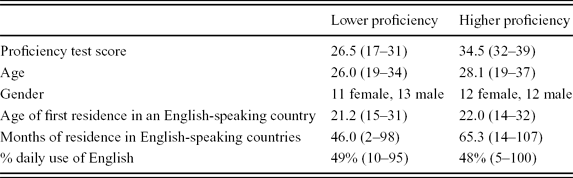
Forty-eight L1-Korean learners of L2-English (25 males, 23 females, mean age: 27 years) and a control group of 32 native speakers of English (22 males, 10 females, mean age: 20 years) participated in the study either for partial course credit or for payment. Participants had normal or corrected-to-normal vision. None of the L2 learners had stayed in English-speaking countries for more than six months before the age of 15. For all L2 participants, the total duration of residence in English-speaking countries did not exceed nine years. English proficiency was tested using an open-ended cloze test (40 questions adopted from P. Dussias, Pennsylvania State University, personal communication). In order to examine potential effects of proficiency, the L1-Korean learners of L2-English were divided into two proficiency groups based on a median split on the cloze test scores (lower proficiency group < 32, higher proficiency group ≥ 32).
Table 1 summarizes the L2 learner's proficiency scores and biographical information. The proficiency difference was closely tied to differences in the duration of residence in English-speaking countries, with longer duration of residence in the higher proficiency group (t = 2.4, p < .05). There were no other reliable biographical differences between the two L2 groups.
L2 learners' biographical information (ranges in parentheses).

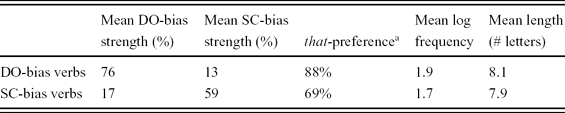
Verb properties.
athat-preference was calculated as the proportion of sentential complement structure sentences that included the complementizer that in the norming study reported in Garnsey et al. (Reference Garnsey, Pearlmutter, Myers and Lotocky1997).
2.2 Materials
Stimuli were constructed with 10 DO-bias verbs and 10 SC-bias verbs (based on the results of sentence completion norming described in Garnsey et al., Reference Garnsey, Pearlmutter, Myers and Lotocky1997). The 20 verbs chosen for this study all met the following criterion: Sentence fragments with proper noun subjects followed by DO-bias verbs were completed at least twice as often with a direct object as with a sentential complement, and the reverse for SC-bias verbs. For each verb, four different sentences were constructed such that only the verb and a few function words appeared in common across the four sentences, resulting in 80 critical sentences (see Appendix A and B below for a list of the critical sentences used in the experiment). Table 2 summarizes the properties of the 20 verbs, including their verb bias strengths from the norming study (Garnsey et al., Reference Garnsey, Pearlmutter, Myers and Lotocky1997), their mean frequencies (Francis & Kucera, Reference Francis and Kucera1982), and their mean lengths. There were no reliable differences in length (F(1,18) < 1) or log frequency (F(1,18) < 1) between verb types.
For each of the 80 critical items (20 verbs × 4 sentences/verb), two sentence versions were created that differed from each other only in the presence of the complementizer that. In one version, the role of the post-verbal noun was temporarily ambiguous between being the direct object of the verb or the subject of a sentential complement (see example stimuli (6a), (7a)), while in the other version, there was no ambiguity because the complementizer that was present (see example stimuli (6b), (7b)).
(6) DO-bias verb
a. The club members understood the bylaws would be applied to everyone
b. The club members understood that the bylaws would be applied to everyone.
(7) SC-bias verb
a. The ticket agent admitted the mistake might be hard to correct.
b. The ticket agent admitted that the mistake might be hard to correct.
As illustrated in (6) and (7), critical sentences were always disambiguated toward a sentential complement continuation at the word following the ambiguous noun (e.g., would, might).
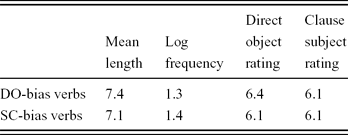
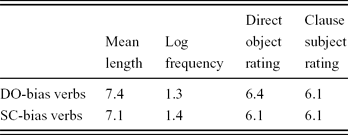
In order to ensure that any effect of verb bias was not confounded with differences in the properties of the ambiguous nouns across different types of verbs, we conducted two separate norming studies to assess the plausibility of the ambiguous noun phrase as a direct object of the preceding verb and also its plausibility as the subject of a sentential complement. In the direct-object norming study, sentences like (8) were rated on a seven-point scale (7: highly plausible) by 56 native English speakers who did not participate in the main experiment. The mean ratings as direct objects were slightly higher overall for DO-bias verbs than for SC-bias verbs (6.4 vs. 6.1, F(1,78) = 4.7, p < .05), which has also been found in previous studies using similar materials (Garnsey et al., Reference Garnsey, Pearlmutter, Myers and Lotocky1997; Wilson & Garnsey, Reference Wilson and Garnsey2009), suggesting that ratings of the plausibility of a noun as the direct object of a verb tend to be slightly higher when the verb is one that often takes direct objects.
- (8)
a. The club members understood the bylaws.
b. The ticket agent admitted the mistake.
A separate group of 12 participants rated sentence fragments like (9) as beginnings of sentences, again on a seven-point scale (7: highly plausible). The mean rating was 6.1 for both DO-bias and SC-bias verbs (F(1,78) < 1).
- (9)
a. The club members understood that the bylaws . . .
b. The ticket agent admitted that the mistake . . .
The length and frequency (Francis & Kucera, Reference Francis and Kucera1982) of the temporarily ambiguous noun phrases were also controlled across verb type (length: F(1,78) < 1, log frequency: F(1,78) < 1)). The properties of the temporarily ambiguous nouns are summarized in Table 3.
Properties of critical nouns.
In addition to 80 critical sentences, there were 80 distracter sentences with various syntactic structures, 20 of which had main verbs immediately followed by direct objects. Two lists were constructed by rotating critical items across two ambiguity conditions (i.e., the presence vs. absence of that). The order of the critical and distracter sentences was pseudo-randomized so that there were never two consecutive critical sentences from the same condition. The presentation order of the critical and distracter sentences was identical in both lists. Each participant saw only one list.
2.3 Procedure
One hundred and sixty sentences were displayed word-by-word in a non-cumulative self-paced moving-window paradigm, using the Presentation® software package. Each trial began with a trial number presented at the left side of the screen. Pressing a button-box button caused each subsequent word to be revealed while the previous word reverted back to a mask character. All sentences were presented on a single line. Each sentence was followed by a comprehension question and participants responded by pressing either a YES or NO button. They received feedback on the accuracy of their responses. If no response was made within four seconds after the question appeared, the feedback “TOO SLOW” was provided. The comprehension questions asked about the general content of the sentence (e.g., Did the ticket agent think that the mistake would be a problem?). None of the questions probed for the direct object interpretation (e.g., Did the ticket agent admit the mistake?).
There was one practice block of five trials followed by four test blocks. Each block consisted of 20 critical and 20 distracter sentences. The entire experiment lasted 30–45 minutes.
3. Results
Trials on which participants responded prematurely before the question appeared on the screen or failed to respond to the comprehension question by a four-second deadline (English: 2.3% of the data, Korean: 4.3%) were excluded from analyses of the accuracy and the reading time data.
3.1 Comprehension question accuracy
Accuracy was analyzed using a mixed logit model (Jaeger, Reference Jaeger2008) with verb bias, ambiguity, proficiency group (native English speakers, higher proficiency L1-Korean learners, and lower proficiency L1-Korean learners), and their interactions as fixed effects and random intercepts for participants and items. Fixed effects were coded using deviation coding. Proficiency group was coded so that the model would compare the native group with the non-native group, and the higher proficiency group with the lower proficiency group. Comprehension questions were answered reliably more accurately by native speakers (94%) than by L1-Korean speakers (88%, ß = 1.2, SE = 0.2, z = 6.9, p < .001). Within the L1-Korean speakers, question response accuracy was also better for the higher proficiency group (90%) than for lower proficiency group (86%, ß = 0.4, SE = 0.2, z = 2.9, p < .001). There was also a reliable interaction between proficiency group (native vs. non-native) and the bias of the verb in the sentence, such that native speakers were slightly more accurate at responding to questions after sentences containing SC-bias verbs (95%) than after sentences containing DO-bias verbs (93%), while L1-Korean speakers were slightly more accurate after sentences with DO-bias verbs (88%) than after those with SC-bias verbs (87%). However, the difference was not reliable in either group. There were no other reliable effects for accuracy.
3.2 Reading times
Trials on which the response to the comprehension question was inaccurate were excluded from analyses of the reading times during the sentence. Not surprisingly, the overall average reading time per word for L1-Korean learners was slower than for the native English group (498 ms vs. 362 ms).
In order to adjust for individual differences in reading rates as well as for differences in word length across conditions, residual reading times (Ferreira & Clifton, Reference Ferreira and Clifton1986) were analyzed. (Although the lengths of critical words were matched across conditions during stimulus construction, dropping trials with inaccurate question responses meant that small differences in the lengths of critical words could have arisen for the remaining trials whose reading times were analyzed.) Before residual reading times were computed, reading times were log transformed to correct skew and then multiplied by 100 to avoid very small parameter estimates. For each participant, a regression equation predicting log-transformed reading time from word length was computed based on all of the words in both critical and distracter sentences. Residual reading time for each word was then calculated by subtracting the predicted reading time from the obtained reading time.
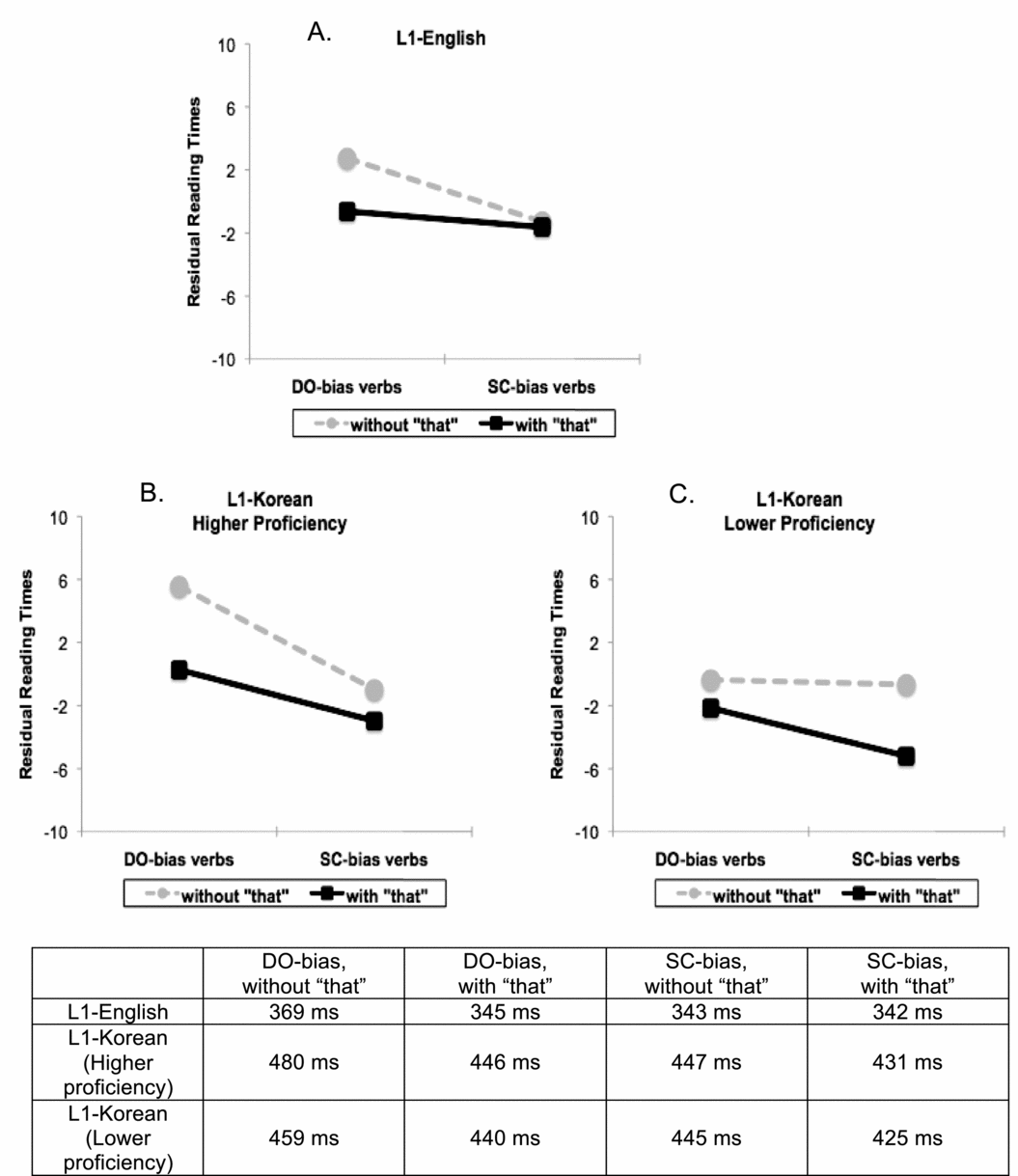
We focus on the two critical sentence regions that carried verb bias and ambiguity effects in previous work: the disambiguating verb region (Figure 1) and the temporarily ambiguous NP (Figure 2). As illustrated in (10) below, the disambiguating region consisted of the disambiguating word and the following word and the temporarily ambiguous noun phrase was composed of the determiner and the following head noun. Reading times for each region were calculated by averaging across the words in the region.
(10) The club members understood (that)
[Ambiguous NP the bylaws] [Disambiguating region would be] applied to everyone.
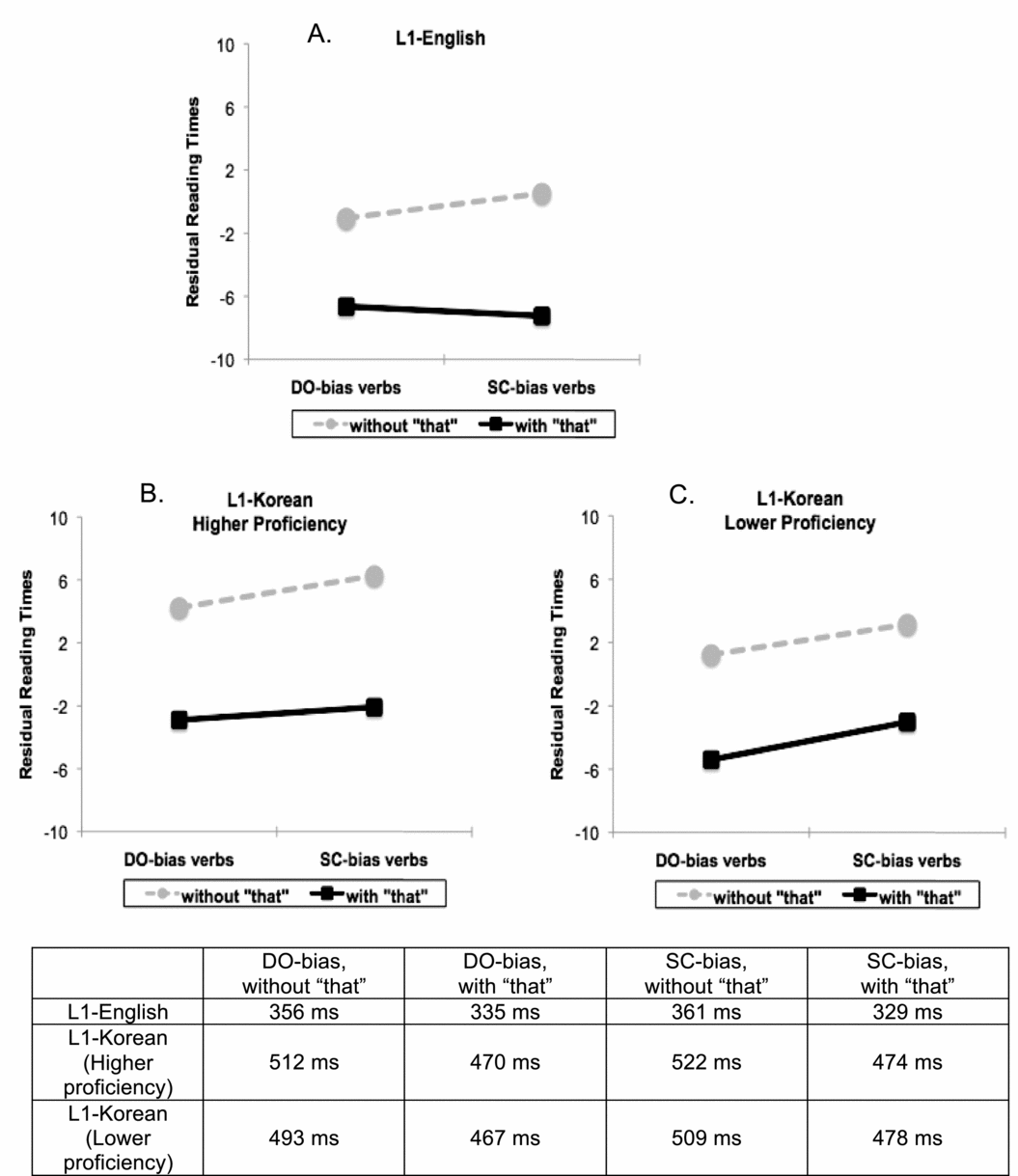
Reading times at the (temporarily ambiguous) NP for the native speaker group (panel A), the higher proficiency L2 learner group (panel B), and the lower proficiency L2 learner group (panel C). For illustration purposes, residual reading times are plotted separately for 10 DO-bias and 10 SC-bias verbs, although verb bias was treated as a continuous variable in the analysis. The y-axis represents length-corrected residual reading times computed from the log-transformed reading times multiplied by 100. The table below the graphs presents mean raw reading times.
Reading times at the disambiguation for the native speaker group (panel A), the higher proficiency L2 learner group (panel B), and the lower proficiency L2 learner group (panel C). For illustration purposes, residual reading times are plotted separately for 10 DO-bias and 10 SC-bias verbs, although verb bias was treated as a continuous variable in the analysis. The y-axis represents length-corrected residual reading times computed from the log-transformed reading times multiplied by 100. The table below the graphs presents mean raw reading times.
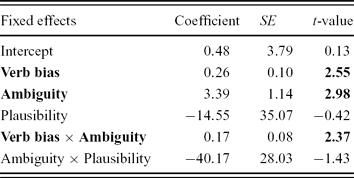
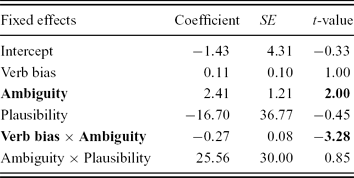
For each of the regions of interest, residual reading times were analyzed using multi-level models. The models included verb bias, ambiguity (presence vs. absence of the complementizer that), proficiency group (native English speakers, higher proficiency L1-Korean learners, and lower proficiency L1-Korean learners) and their interactions as fixed effects. In previous studies (e.g., Garnsey et al., Reference Garnsey, Pearlmutter, Myers and Lotocky1997; Trueswell et al., Reference Trueswell, Tanenhaus and Kello1993; Wilson & Garnsey, Reference Wilson and Garnsey2009), verb bias was analyzed as a categorical variable (DO-bias verbs vs. SC-bias verbs). For a stronger test of sensitivity to verb bias, we treated it as a continuous variable representing verb bias strength, which was calculated as a ratio of strength of DO-bias over that of SC-bias. Strength of DO-bias was an arcsine-transformed proportion of DO completion and strength of SC-bias was an arcsine-transformed proportion of SC completion in the norming study by Garnsey et al. (Reference Garnsey, Pearlmutter, Myers and Lotocky1997). In all models, categorical predictor variables were coded using deviation coding. Proficiency group was coded so that the model would compare the native group with the non-native group, and the higher proficiency group with the lower proficiency group. To avoid collinearity issues, continuous predictor variables were mean centered. T-values greater than 2 were treated as reliable. The random effects structure was justified through likelihood ratio tests (Baayen, Reference Baayen2008). Random effects parameters that significantly improved the model's goodness of fit were included in the model (all ps < .05).
As discussed above, the results from the plausibility norming study showed that the post-verbal noun was rated more plausible as a direct object of DO-bias verbs than that of SC-bias verbs. Thus, effects of verb bias were potentially confounded by small plausibility differences, so plausibility and its interaction with other factors (ambiguity, group, proficiency) were included as additional parameters in the model in order to isolate the effects of verb bias. In all models reported below, verb bias effects did not change with the inclusion of these control variables, suggesting that the verb bias effects reported below are not attributable to plausibility.
Figure 1 plots length-corrected residual reading times computed from the log-transformed reading times at the (temporarily ambiguous) NP for the native English speaker group (panel A), the higher proficiency L2 learner group (panel B) and the lower proficiency L2 learner group (panel C).
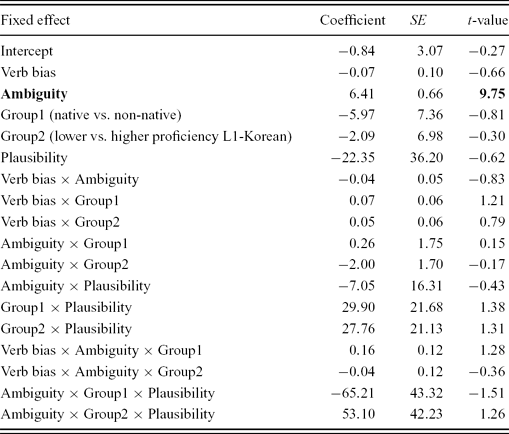
Table 4 displays parameter estimates for the models of residual reading times at the (temporarily ambiguous) NP. The NP was read more slowly for ambiguous sentences than for unambiguous sentences in all three groups, as revealed by the absence of any reliable interactions between ambiguity and group. There was no main effect of verb bias nor any interaction between verb bias, ambiguity, and proficiency group.
Fixed effect estimates for the mixed effects model of residual reading times at the NP (N = 5556, log-likelihood: −25810). The model also included by-participant and by-item random intercepts. Reliable effects are in bold.
Length-corrected residual reading times at the disambiguation are plotted separately for the native English speaker group (panel A), the higher proficiency L2 learner group (panel B), and the lower proficiency L2 learner group (panel C) in Figure 2.
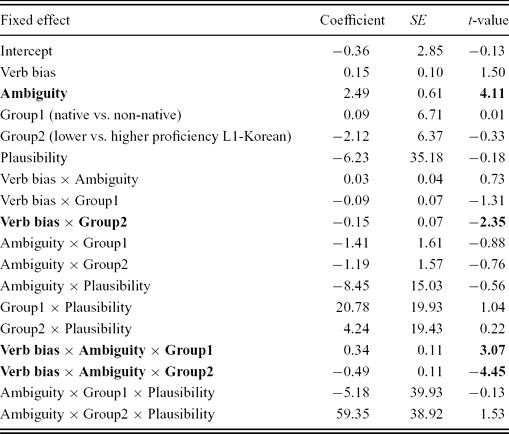
Parameter estimates for the model of residual reading times at the disambiguation are displayed in Table 5. Reading times at the disambiguating region were slower overall for ambiguous sentences than for unambiguous sentences. The overall effect of verb bias was not reliable, nor was the interaction between verb bias and ambiguity. Crucially, there was a reliable verb bias × ambiguity × proficiency group interaction, suggesting that there were reliable differences among the three proficiency groups in terms of their sensitivity to verb bias and ambiguity at the disambiguating region.
Fixed effect estimates for the mixed effects model of residual reading times at the disambiguation (N = 5556, log-likelihood: −25360). The model also included by-participant and by-item random intercepts, and by-participant random slopes for verb bias. Reliable effects are in bold.
In order to explore the interaction among verb bias, ambiguity, and proficiency group in residual reading times at the disambiguation, analyses were conducted separately for the native speaker group, the higher proficiency L2 learner group, and the lower proficiency L2 learner group.
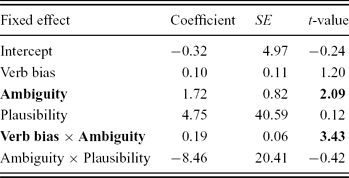
The model of residual reading times at the disambiguation for the native speaker group included verb bias, ambiguity, their interaction, and the interaction between ambiguity and plausibility as fixed effects (Table 6).
Fixed effect estimates for the mixed effects model of residual reading times at the disambiguation: native English speakers (N = 2346, log-likelihood: −10519). The model also included by-participant and by-item random intercepts. Reliable effects are in bold.
Residual reading times on the disambiguating region were slower overall in ambiguous sentences than in unambiguous ones for the native English group. There was no reliable main effect of verb bias, but, crucially, there was a reliable interaction between verb bias and ambiguity because the ambiguity effect was driven entirely by the sentences with stronger DO-bias. The mixed-effects model analyses conducted on the subsets of the data showed that the ambiguity effect was reliable in the sentences with DO-bias verbs (ß = 3.8, SE = 1.2, t = 3.1), but not in those with SC-bias verbs (ß = –0.2, SE = 1.1, t = –0.2). This pattern replicates that found in previous work (Trueswell et al., Reference Trueswell, Tanenhaus and Kello1993; Garnsey et al., Reference Garnsey, Pearlmutter, Myers and Lotocky1997; Wilson & Garnsey, Reference Wilson and Garnsey2009) with native speakers, confirming that readers had more difficulty when the disambiguation was inconsistent with the verb's more likely structural alternative.
Table 7 displays parameter estimates for the model for higher proficiency L1-Korean learners of L2-English. The higher proficiency group showed a main effect of verb bias, with longer reading times after DO-bias verbs than after SC-bias verbs. There was also an interaction between verb bias and ambiguity in the same direction as for native speakers, with the ambiguity effect increasing as a function of increased strength of DO-bias. The numeric pattern showed that, unlike native English speakers, higher proficiency L1-Korean learners of L2-English benefited from complementizer presence after both DO-bias and SC-bias verbs. However, the mixed-effects model analyses conducted on the subsets of the data showed that the effect of complementizer presence was reliable only after DO-bias verbs (DO-bias verbs: ß = 4.7, SE = 1.6, t = 2.9, SC-bias verbs: ß = 2.0, SE = 1.6, t = 1.2), replicating the pattern for the native speaker group. This suggests that the performance of higher proficiency L1-Korean learners of L2-English approached that of native speakers in optimally combining verb bias and complementizer cues to generate predictions about upcoming structure.
Fixed effect estimates for the mixed effects model of residual reading times at the disambiguation:higher proficiency L2 learners (N = 1666, log-likelihood: −7707). The model also included by-participant and by-item random intercepts. Reliable effects are in bold.
Table 8 presents parameter estimates for the model for lower proficiency L1-Korean learners of L2-English. Lower proficiency L1-Korean learners of L2-English showed no sensitivity to verb bias when the complementizer was absent: The disambiguating region was read equally slowly after DO- and SC-bias verbs. However, the lower proficiency group was sensitive to complementizer presence. They read the disambiguating region faster when the complementizer was present than when it was not. However, unlike native English speakers and higher proficiency L1-Korean learners of L2-English, this ambiguity effect was driven primarily by the sentences with stronger SC-bias (ß = 4.2, SE = 1.7, t = 2.5), with no reliable effect after DO-bias verbs (ß = 0.7, SE = 1.8, t = 0.4). Unlike native English speakers and higher proficiency L1-Korean learners of L2-English, who did not benefit from a redundant complementizer cue in the SC-bias sentences, lower proficiency L1-Korean learners of L2-English benefited from complementizer presence primarily when it was redundant with verb bias.
Fixed effect estimates for mixed effects model of residual reading times at the disambiguation: lower proficiency L2 learners (N = 1544, log-likelihood: −7173). The model also included by-participant and by-item random intercepts. Reliable effects are in bold.
4. Discussion
In this study, we investigated whether L2 learners of English with a verb-final L1 combine verb bias and complementizer cues in the efficient interactive way that native speakers do. Consistent with studies that have shown the impact of proficiency in L2 processing (e.g., Hopp, Reference Hopp2006, Reference Hopp2010; Frenck-Mestre, Reference Frenck-Mestre, Heredia and Altarriba2002; Rossi et al., Reference Rossi, Gugler, Friederici and Hahne2006; Sagarra & Herschensohn, Reference Sagarra and Herschensohn2010, Reference Sagarra and Herschensohn2011), we found that the L1-Korean group's ability to use verb bias and complementizer cues predictively during online comprehension was modulated by their proficiency in English, with the higher proficiency group's processing patterns converging with those of native speakers. Thus, our data suggest that despite Korean's verb-final word order, as proficiency increases in L1-Korean learners of L2-English, they attain the native-like parsing strategy of using verb bias predictively.
Consistent with previous findings (e.g., Garnsey et al., Reference Garnsey, Pearlmutter, Myers and Lotocky1997; Wilson & Garnsey, Reference Wilson and Garnsey2009), the native controls in the present study showed the usual reliable interaction between verb bias and ambiguity, which came from the absence of verb bias effects when the complementizer was present. When the complementizer was absent, native speakers used verb bias to predict whether the verb would be followed by a direct object or by a sentential complement. In contrast, when the complementizer that was present, native speakers interpreted it as signaling the presence of a sentential complement regardless of the bias of the verb. Thus, for native speakers, verb bias and the complementizer were each sufficient to eliminate difficulty at the disambiguation on their own, with no additional benefit from having two agreeing cues.
The lower proficiency L1-Korean learner group failed to show native-like processing patterns. While verb bias was a reliable cue for native speakers when the complementizer was absent, the same was not true for lower proficiency L1-Korean learners of L2-English. This discrepancy between native speakers and lower proficiency L1-Korean learners is not simply the result of lower proficiency L2 learners' incomplete learning of English verb biases, since they showed verb bias effects in the unambiguous conditions, where they slowed down more at the disambiguation when the sentence ending conflicted with verb bias (i.e., after DO-bias verbs). The finding that lower proficiency L1-Korean learners processed DO-bias and SC-bias verbs differently in the unambiguous conditions suggests that the absence of the verb bias effects in the ambiguous conditions was not due to their failure to acquire English verb biases.
A more likely explanation for the difference in processing patterns between native speakers and lower proficiency L1-Korean learners is that the lower proficiency group was not yet able to optimally combine the verb bias and complementizer cues in the way native speakers do. When the complementizer is present, it is a strong cue that a sentential complement will follow, but it was not a sufficient cue for lower proficiency L1-Korean learners, who needed verb bias to confirm the complementizer cue. They were successful in developing an expectation for a sentential complement only when there were two cues that both pointed in that direction. Similarly, when the complementizer is absent, verb bias is sufficient on its own for native English speakers to eliminate difficulty at the disambiguation, but the verb bias cue alone seems not to have been sufficient for lower proficiency L1-Korean learners. Lower proficiency L1-Korean learners read the disambiguating region equally slowly in the two verb bias conditions, suggesting that they did not benefit from the verb bias cue alone.
However, higher proficiency L1-Korean learners were able to use verb bias predictively in online comprehension despite the fact that their L1 did not provide the opportunity to do so. At low proficiency levels, it took the combination of two consistent cues (SC-bias plus complementizer) to alleviate comprehension difficulty. For the lower proficiency L1-Korean learner group, the complementizer helped only in sentences with SC-bias verbs, so the combination of two consistent cues seems to have been especially helpful. Unlike lower proficiency L1-Korean learners, higher proficiency learners optimally combined verb bias and complementizer cues online to efficiently predict upcoming syntactic structure in a native-like manner. They showed an interaction between verb bias and complementizer presence that was qualitatively identical to native speakers: both native speakers and higher proficiency L1-Korean learners benefited from the complementizer only when it counteracted a DO-bias verb.
The pattern of results found here is consistent with previous studies finding that L2 learners and native speakers are similar in their use of the structural biases of verbs during online comprehension (Dussias & Cramer Scaltz, Reference Dussias and Cramer Scaltz2008; Frenck-Mestre & Pynte, Reference Frenck-Mestre and Pynte1997), but goes beyond it to show that at high proficiency levels this is true even when the L1 is verb-final.
How do learners of a verb-early L2 with a verb-final L1 learn to predict upcoming sentence structure based on verbs in spite of the unavailability of such a processing strategy in their L1? One likely factor is the incremental nature of the language processing system. Presumably, native speakers of all languages learn to optimize comprehension by relying on the predictive cues that appear early in sentences (e.g., Altmann & Kamide, Reference Altmann and Kamide1999; Kamide, Reference Kamide2008; Kamide, Altmann & Haywood, Reference Kamide, Altmann and Haywood2003). Processing proceeds incrementally in verb-final languages just as it does in verb-initial ones (e.g., Inoue & Fodor, Reference Inoue, Fodor, Mazuka and Nagai1995; Kamide et al., Reference Kamide, Altmann and Haywood2003; Kamide & Mitchell, Reference Kamide and Mitchell1999; Mazuka & Itoh, Reference Mazuka, Itoh, Mazuka and Nagai1995; see Pritchett, Reference Pritchett1991, for a contrastive view). Perhaps people are generally flexible enough to learn to rely on whatever kinds of predictive cues appear early in sentences in a second language regardless of whether the same kinds of cues are similarly useful in their first language. Another possible factor underlying the ability of L2 learners with a verb-final L1 to learn to rely on verb-based cues in L2 processing is the informativeness of verbs about the structure of their sentences regardless of their position. We suggested earlier that native speakers of verb-final languages almost certainly develop structural biases linked to verbs because they so strongly constrain what sentence structures are possible, even though those biases cannot be used predictively. Presumably, verbs in all languages place constraints on the kinds of sentence structures they can appear in, so maybe verbs necessarily accumulate distributional information about the sentence structures they occur in regardless of whether it is predictively useful, and that makes it easy to learn to use such information in another language where it is predictively useful.
5. Conclusion
The present study examined whether L1-Korean learners of L2-English can learn to optimally combine verb bias and complementizer cues during the online processing of English sentences, and whether that changes with increasing proficiency. We found that in spite of Korean's SOV word order, L1-Korean learners of L2-English showed evidence of using verb-based information to predict upcoming sentence structure, but that they only attained the efficient interactive pattern of cue combination seen in native speakers once they reached a high level of proficiency. Such proficiency effects suggest that the kind of optimization that native speakers achieve by rapidly combining multiple cues requires the accumulation of substantial experience.
Appendix A. Experimental stimuli: SC-bias verbs
1. The unreliable butler admitted (that) the theft could have been prevented if he was not sleeping.
2. The ticket agent admitted (that) the mistake might be hard to correct.
3. The dedicated soldier admitted (that) the defeat might not have been completely inevitable.
4. The new receptionist admitted (that) her error should have been corrected sooner.
5. The defensive journalist argued (that) the view could have confused readers who were not experts.
6. The district attorney argued (that) the point would make a difference to everyone.
7. The divorce lawyer argued (that) the issue should be attended to very carefully.
8. The art professor argued (that) the interpretation might have been too controversial.
9. The captivated audience believed (that) the magician should be willing to explain his tricks.
10. The naive girl believed (that) the urban myth might not be a myth after all.
11. The shrewd officer believed (that) the criminal might have a concealed weapon on him.
12. The magazine editor believed (that) the article might be the best article he had ever written.
13. The murder suspect confessed (that) the crimes had gotten much worse over time.
14. The ashamed boy confessed (that) the lie might have deceived his whole family.
15. The government official confessed (that) the conspiracy could have damaged international relationships.
16. The fanatical terrorist confessed (that) the plot could be uncovered by the authorities.
17. The certified accountant figured (that) the budget should adjust to meet the increase in costs.
18. The insurance agent figured (that) the deductible should have decreased for the safe driver.
19. The delivery manager figured (that) the weight needed to decrease by several pounds.
20. The overwhelmed parents figured (that) the tuition might cost more than they could afford.
21. The gardener's assistant indicated (that) the temperature would be good for the flowers.
22. The office manager indicated (that) the problem could be worst for the new secretaries.
23. The roof inspector indicated (that) the leak would be expensive to fix.
24. The traffic officer indicated (that) the direction might be congested with many cars.
25. The sensitive boy inferred (that) the insult had been directed at him personally.
26. The church congregation inferred (that) the meaning was badly explained by the minister.
27. The rejected bachelor inferred (that) the reason could be his reluctance to make a commitment.
28. The hired investigator inferred (that) the evidence meant the suspect was not guilty.
29. The careful scientist proved (that) the theory might be difficult to explain.
30. The successful tests proved (that) the hypothesis could reveal the underlying mechanism.
31. The local detectives proved (that) the conspiracy had caused the government to crack down.
32. The birth certificate proved (that) the birthplace was not where we thought.
33. The plastic surgeon suggested (that) the operation would be too costly for the patient.
34. The swimming instructor suggested (that) the technique might be too difficult for the frightened novice.
35. The guidance counselor suggested (that) the job would help the student learn to be more responsible.
36. The writing instructor suggested (that) the book would need to be revised.
37. The ship's captain suspected (that) the mutiny would be damaging to his career.
38. The boxing referee suspected (that) the outcome had been staged right from the start.
39. The irate student suspected (that) the roommate stole the money while he was in class.
40. The wary teacher suspected (that) the cheating could cause bad feelings among the students.
Appendix B. Experimental stimuli: DO-bias verbs
41. The admissions office accepted (that) the application did not include some of the necessary documents.
42. The annoyed professor accepted (that) the excuse had been completely made up by the student.
43. The basketball star accepted (that) the contract requires him to play every game.
44. The department head accepted (that) the proposal would be resubmitted very late.
45. The brilliant doctor discovered (that) the cure would soon be shown to work for everyone.
46. The determined biologists discovered (that) the organism had not been seen before.
47. The famous archaeologist discovered (that) the artifacts might have been very clever fakes.
48. The FBI investigator discovered (that) the plot had been planned for three years.
49. The biology class established (that) the routine could have improved safety in the lab.
50. The enthusiastic students established (that) the club could be a meeting place for chess matches.
51. The head referee established (that) the rules were not to be strictly enforced.
52. The new lawyer established (that) the practice aims to serve the whole community.
53. The gossipy neighbor heard (that) the story could not be further from the truth.
54. The excited children heard (that) the fireworks were being planned to be the biggest ever.
55. The marine sergeant heard (that) the explosion might have been the result of an accident.
56. The orchestra conductor heard (that) the violins were not properly in tune.
57. The astronomy buff observed (that) the comet had been approaching very quickly.
58. The bird watcher observed (that) the sparrows had been taken from the nest.
59. The clever journalist observed (that) the scene could have been tampered with by police.
60. The construction worker observed (that) the house seemed to be in great condition.
61. The accused doctor protested (that) the lawsuit should have been settled out of court.
62. The activist group protested (that) the discrimination had been covered up by the governor.
63. The elementary students protested (that) the uniforms were too uncomfortable to play in.
64. The navy veterans protested (that) the war could become too expensive to continue.
65. The commanding general revealed (that) the strategy would help the army defeat the enemy.
66. The confessing criminal revealed (that) the hideout appeared to just be an abandoned warehouse.
67. The confident magician revealed (that) the rabbit had disappeared from his cage.
68. The gallery owner revealed (that) the painting is the most expensive one he's ever sold.
69. The club members understood (that) the bylaws would be applied to everyone.
70. The disciplined lieutenant understood (that) the orders were standard for all new recruits.
71. The foreign diplomat understood (that) the translation might take longer than they had anticipated.
72. The frustrated tourists understood (that) the message had never been sent.
73. The bank worker forgot (that) the policy would be implemented the very next day.
74. The college student forgot (that) the answer could be found at the back of the textbook.
75. The elderly woman forgot (that) the address had been changed since her last visit.
76. The hapless suitor forgot (that) the flowers reminded the woman of her ex- husband.
77. The angry farmer warned (that) the trespassers would not be allowed onto his fields.
78. The army general warned (that) the civilians might be in danger from the bombs.
79. The kind usher warned (that) the audience should not bring food or drink into the theater.
80. The new professor warned (that) the students should be on time for his class.