A. MONUMENTAL
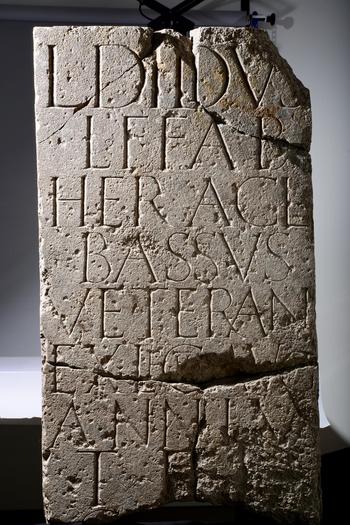
1. Dorchester (Durnovaria, SY 691 907), East Street, Dorset (fig. 1). Five conjoining pieces of an incomplete Purbeck marble slab, 0.64 by 1.15 m, 0.11 m thick, foundFootnote 2 in 2016. The width is original, but the lower portion is missing, and so is the top right-hand corner, with further loss at the joins. Inscribed with eight lines of lettering and trace of a ninth, the letters very well drawn and executed.Footnote 3 It reads: L Δ DID͡IVS | L ♠ F Δ FAB | HERACL Δ | BASSVS | VETERAN | EX Δ LEG͡II AVG | ANN ḶV | Δ T ♠ F ♠̣ ḷ [ ♠ ] | C̣Ḷ[…], L(ucius) Didius | L(uci) f(ilius) Fab(ia tribu) | Heracl(ea) | Bassus | veteran(us) | ex leg(ione) II Aug(usta) | ann(orum) LV | t(estamento) f(ieri) i(ussit) | CL[…].Footnote 4 ‘Lucius Didius Bassus, son of Lucius, of the Fabian voting-tribe, from Heraclea, veteran of the Second Legion Augusta, aged 55, in his will ordered (this) to be made …’Footnote 5
Dorchester, tombstone (No. 1). (Photo: R.S.O. Tomlin)

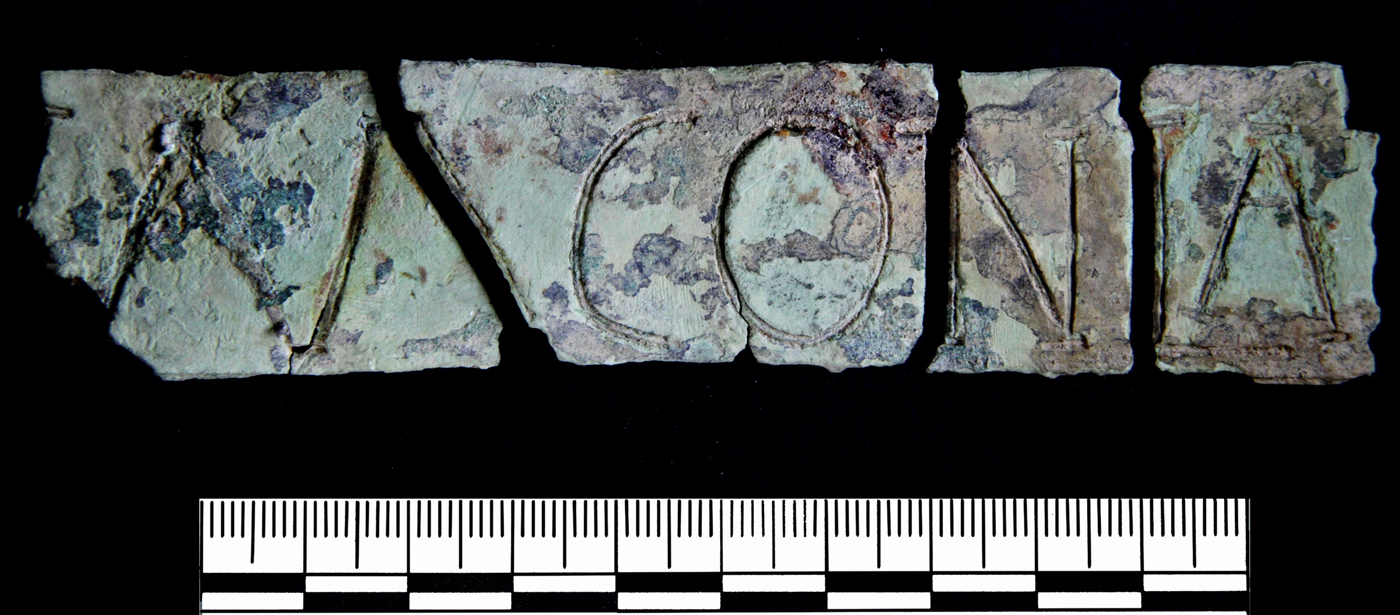
2. Near Gloucester (Glevum, SO 78 61), Gloucestershire (fig. 2). Five conjoining pieces of thin copper-alloy sheet, c. 130 by 30 mm, c. 1.25 mm thick, foundFootnote 6 in 2017. They are broken at top and bottom and on both sides, so are only part of a much larger inscription. Incised in capitals: […]ṾMCONLA[…], […]um conla[…] Footnote 7
Near Gloucester, inscribed copper-alloy fragment (No. 2). (Photo: PAS)

3. Carlisle (Luguvalium, NY 403 556), Botchergate, Cumbria. Fragment of a red sandstone slab, 0.22 by 0.28 m, 0.09 m thick, foundFootnote 8 in 2015. It is the upper left-hand corner of a gabled tombstone, and reads: D[…] | […], D(is) [M(anibus) …] | […]. ‘To the Shades of the Dead …’Footnote 9
4. Stanwix (Uxelodunum, NY 3956 9665), Roman bath-house, Cumbria. Fragment of a red sandstone altar, 0.165 by 0.25 m, 0.13 m thick, foundFootnote 10 in 2017. All the edges are broken, so it cannot be located exactly, but it preserves part of the capital with a moulding below, and part of the upper edge of the die. This carries the upper curve of one letter: […]Ọ[…] | […], probably [de]o | […]. ‘To the god …’Footnote 11
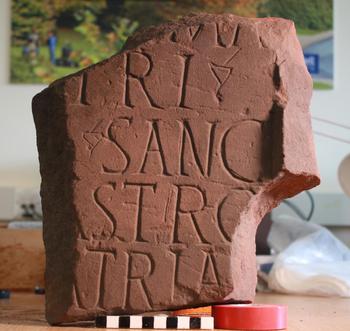
5. Ibid. (fig. 3). Fragment of a red sandstone slab, 0.25 by 0.27 m, 0.10 m thick. All four edges are broken, but there is part of an incised border-line to the right. Incised between setting-out lines: […]ṂẠ | […]ṬRI ♠ | […] ♠ SANC | […]ASTRO | […]ẠTRIA[.] | […], […]MA | [… ma]tri | […] sanc|[?tissimi … c]astro|[rum … senatus … p]atria[e] | […]. ‘… to … mother of our most holy Emperor … and of the army … senate … country …’Footnote 12
Stanwix, dedication slab (No. 5). (Photo: R.S.O. Tomlin)

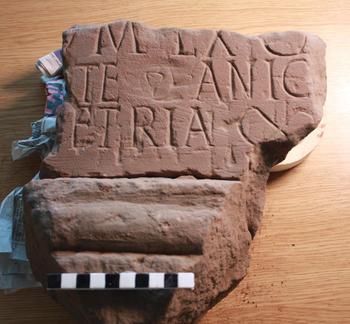
6. Ibid. (fig. 4). Two conjoining fragments of red sandstone, 0.22 by 0.28 m, and at least 0.14 m thick (but not original). It is the lower part of a recessed panel above a moulded base or border, which reads: […] | […]VM LX CẠ[…] | […]TE ♠ ANIC[…] | […]P̣ETRIA CXↃ, […] | [annor] um LX CA[…] | [?curam agen]te Anic[…] | [… alae] Petria(nae) (milliariae) […]. ‘… aged 60 … under the charge of Anic[…] … of the milliary ala Petriana …’Footnote 13
Stanwix, tombstone (No. 6). (Photo: R.S.O. Tomlin)

B. INSTRUMENTUM DOMESTICUM
BERKSHIRE
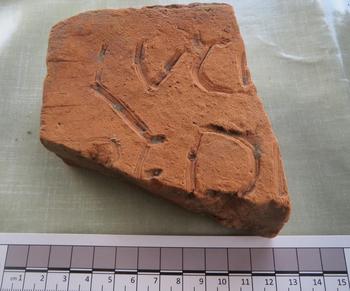
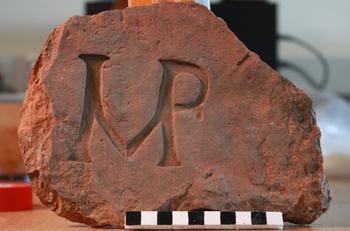
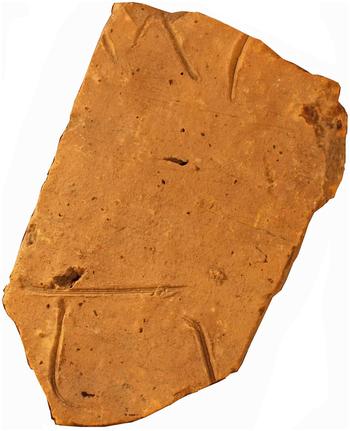
7. Boxford Roman villa (SU 428 716) (fig. 5). Corner fragment of a pedalis (‘foot-square’) brick, 89 by 108 mm, 35 mm thick, foundFootnote 14 in 2017. Inscribed before firing in crude capitals: LVCḷ[…] | P̣EDḷ[…] | […]Footnote 15
Boxford, inscribed brick (No. 7). (Photo: Lindsey Bedford)

CAMBRIDGESHIRE
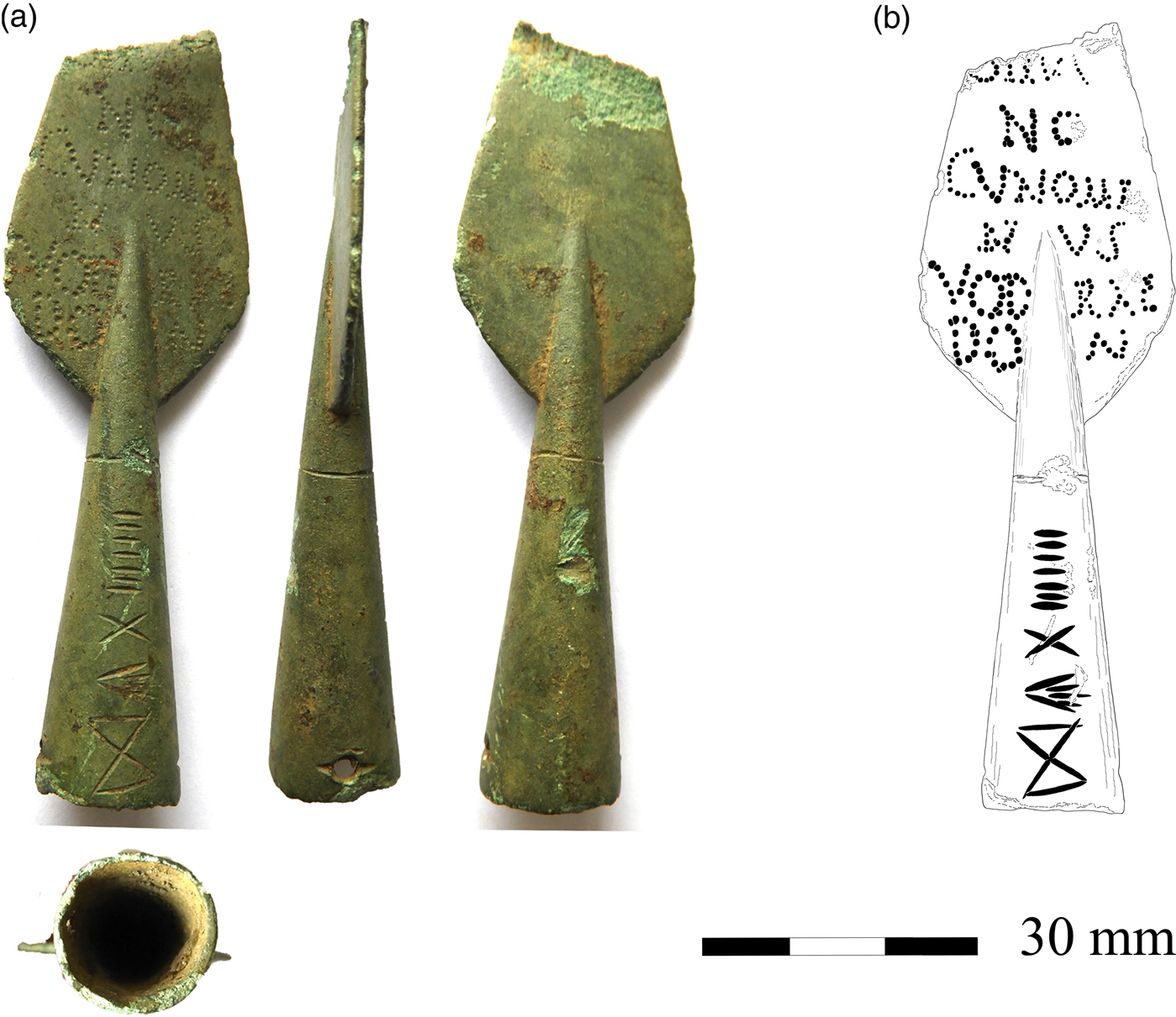
8. Knapwell (TL 33 60) (fig. 6). Copper-alloy spearhead, 26 by 82 mm (but originally c. 115 mm), weight 28 gm, foundFootnote 16 in 2017. The leaf-shaped blade, which is damaged and missing its tip, is 45 mm long and 2 mm thick, and set in a tapering hollow shaft of circular cross-section which widens to 12 mm at the base where it is pierced by two holes for attachment. There are two inscriptions. (i) Incised across the shaft: IIIIIII X V͡III $\mathop{{\hbox{VIII}}}\limits^\frown$ IXI, apparently the numerals ‘7’, ‘10’, ‘8’, ‘1000’.Footnote 17 (ii) On the blade, in dot-punched capitals: […] | SḷḶṾẠ|NO | CVNOMḷ|NVS | VODRẠ. | DON, probably [deo] | Silva|no |Cunomi|nus vo [tum] | don(avit). ‘To the god Silvanus, Cunominus gave (this as) a vow.’Footnote 18
Knapwell, inscribed spearhead (No. 8). (a. Photo: PAS; b. Drawn by R.S.O. Tomlin)

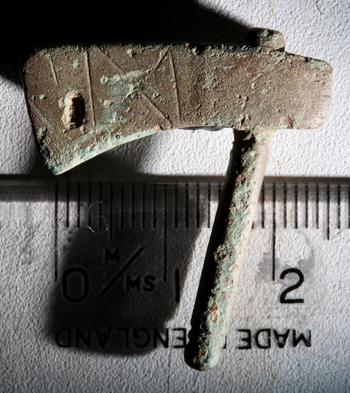
9. Ibid. (fig. 7). Copper-alloy miniature axehead and shaft, the curving head widening from 7 to 13 mm, and 30 mm long. Incised on one face: IXIFootnote 19
Knapwell, miniature axe (No. 9). (Photo: R.S.O. Tomlin)

CHESHIRE
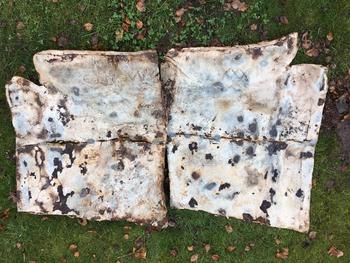
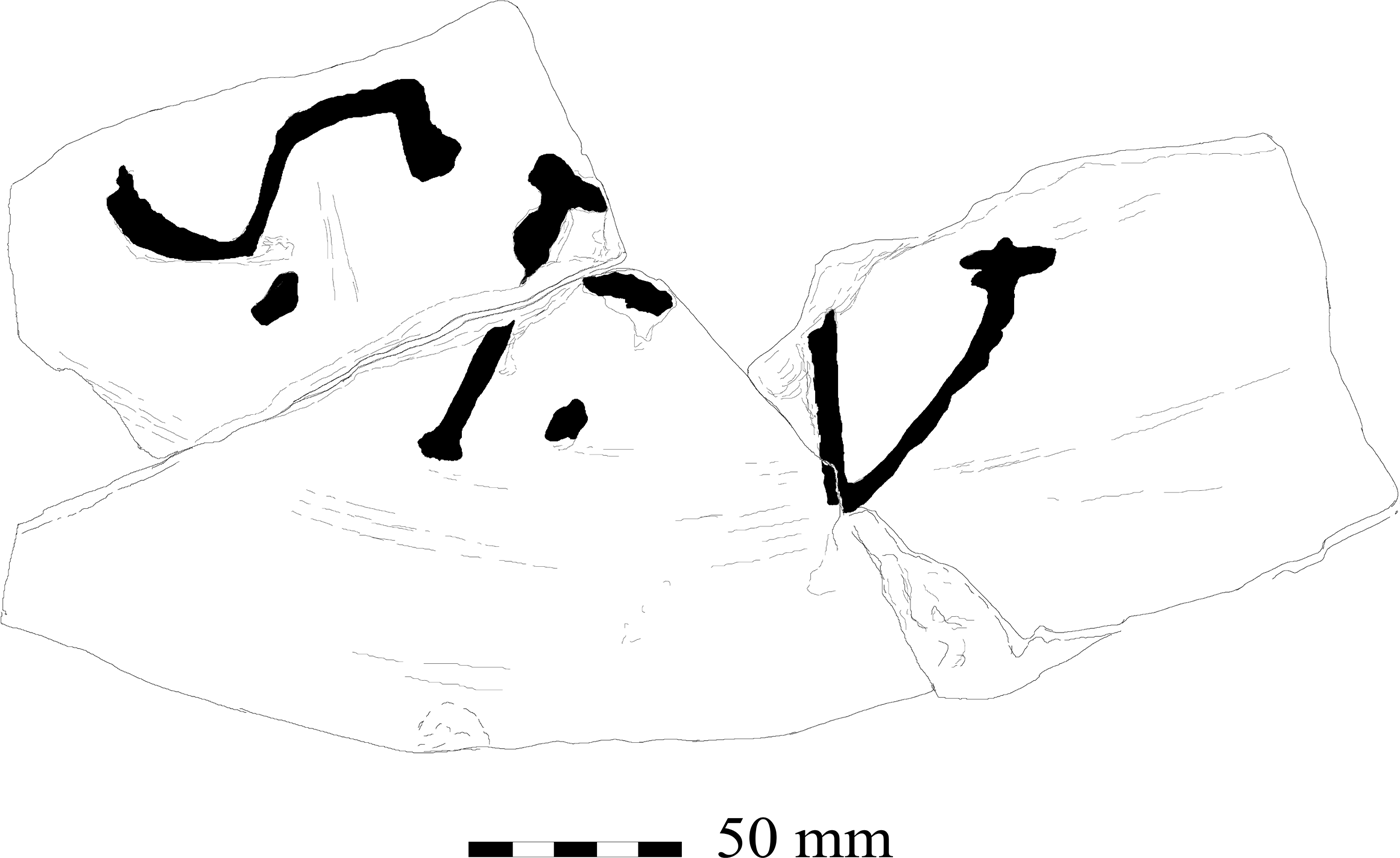
10. Brereton (SJ 77 63) (fig. 8). Two lead sheets, (i) 0.54 by 0.64 m and (ii) 0.56 by 0.71 m, c. 6 mm thick, foundFootnote 20 in 2017. They have been cut from a rectangular brine-pan which was being made into scrap.Footnote 21 They do not conjoin, but they each preserve one corner and between them almost all of one side of the pan, which is now folded flat. Midway would have been a lifting-hole reinforced above by an applied arc terminating in three pellets, but this is now incomplete because a strip has been lost between the two sheets. On either side of this break, below the folded rim, is a moulded inscription: (i) C̣CC and (inverted) OTHOM; (ii) XXX. Probably XXX Mo[tti]o CCC, ‘Mottio, 270’.Footnote 22
Brereton, inscribed brine-pan fragments (No. 10). (Photo: the finder, by courtesy of Teresa Gilmore)

CUMBRIA
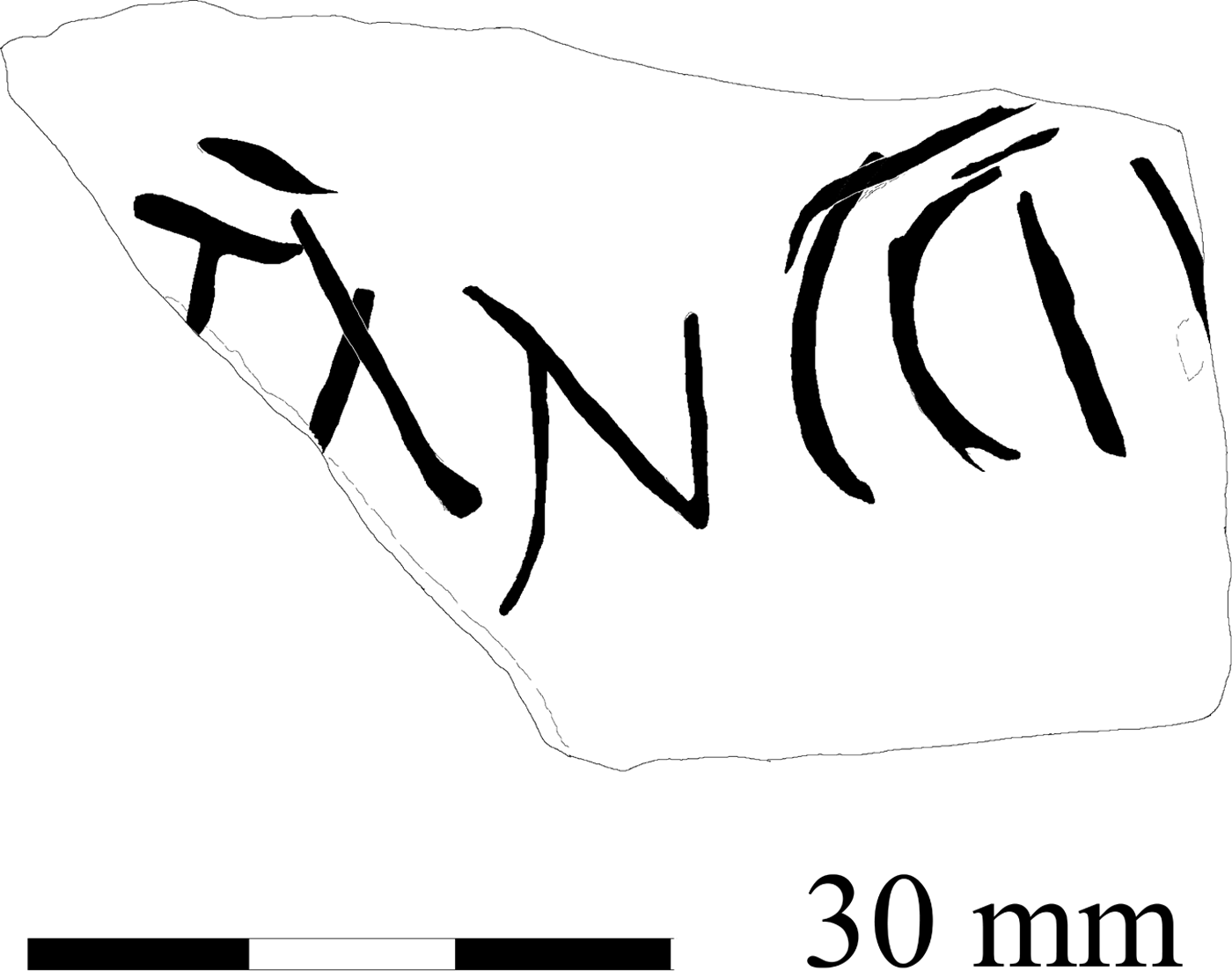
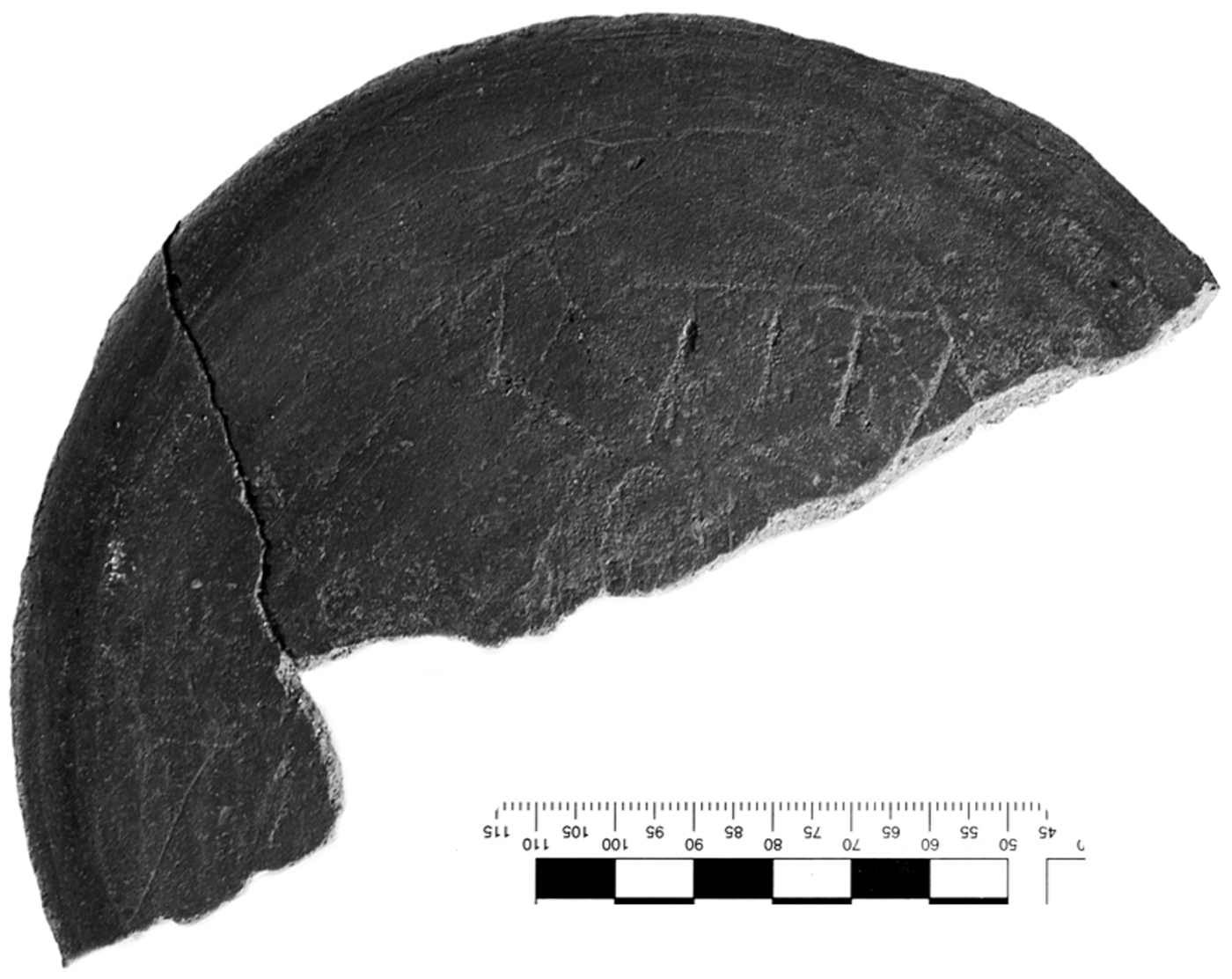
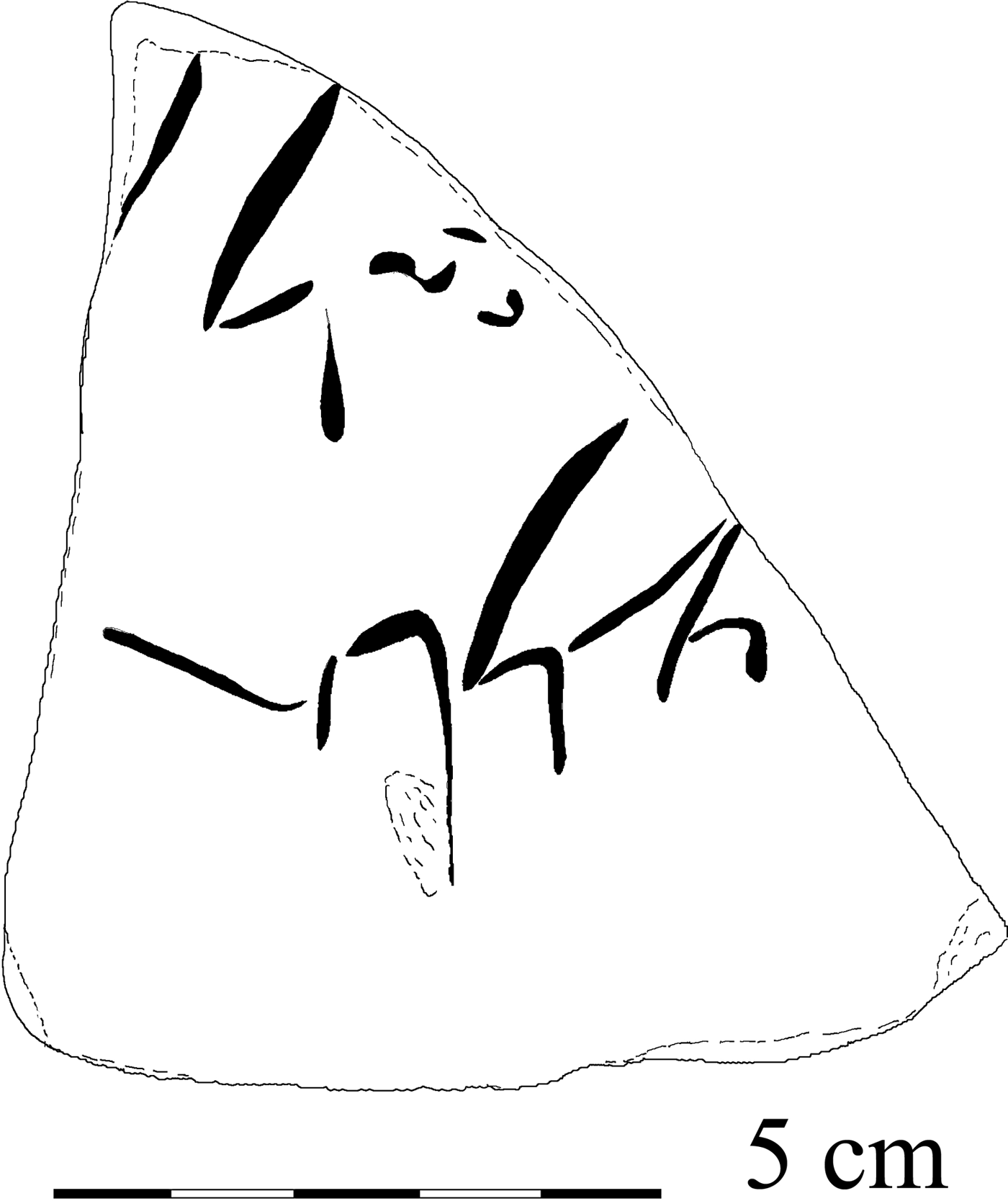
11. Maryport (?Alauna, NY 038 372), Roman fort vicus (fig. 9). Rim sherd of a samian bowl (Drag. 31) foundFootnote 23 before 2017. Inscribed after firing while the vessel was inverted: MS, probably M(…) S(…) Footnote 24
Maryport, samian graffito (No. 11). (Drawn by R.S.O. Tomlin)

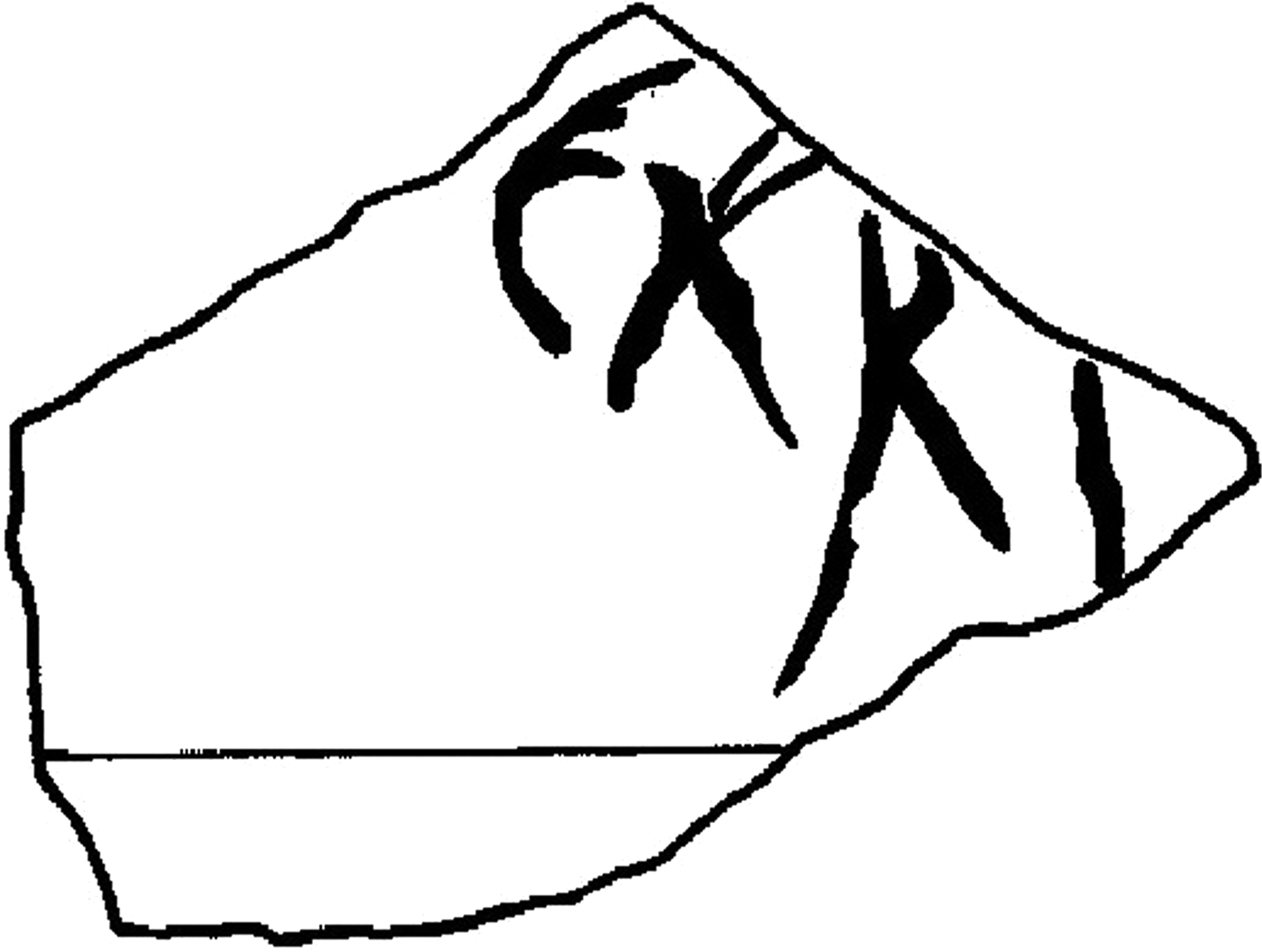
12. Papcastle (Derventio, NY 1105 3128), Roman fort (fig. 10). Wall sherd of a samian dish (Drag. 18/31, Central Gaulish), foundFootnote 25 in 2017. Scratched after firing in capitals: CΛRI, Cari. ‘(Property) of Carus.’
Papcastle, samian graffito (No. 12). (Drawn by Philip Cracknell)

13. Stanwix (Uxelodunum, NY 40 57), Roman bath-house (fig. 11). Hypocaust-pillar brick (bessalis), 0.20 by 0.19 m, 0.04 m thick, foundFootnote 26 in 2017. An impressed stamp 88 by 170 mm reads: ‘IMP’, probably imp(eratoris). ‘(Property) of the Emperor.’Footnote 27
Stanwix, stamped brick (No. 13). (Photo: R.S.O. Tomlin)

DERBYSHIRE
14. Derby, Little Chester Roman fort (Derventio, SK 353 375) (fig. 12). Rim sherd of a samian platter (La Graufesenque Ritterling 1, probably pre-Flavian), foundFootnote 28 in 2013 just north of the fort in the civil settlement. Scratched on the wall above the foot-ring in angular cursive letters: CVPITḷ[…], Cupiti or Cupiti[anus].Footnote 29
Derby, samian graffito (No. 14). (Drawn by R.S.O. Tomlin)

CO. DURHAM
15. Piercebridge (NZ 214 156). Three leaden sealings foundFootnote 30 in the river Tees at the site of the Roman bridge. An impressed rectangular die reads: D N, d(omini) n(ostri). ‘(Property) of Our Lord (the Emperor).’Footnote 31
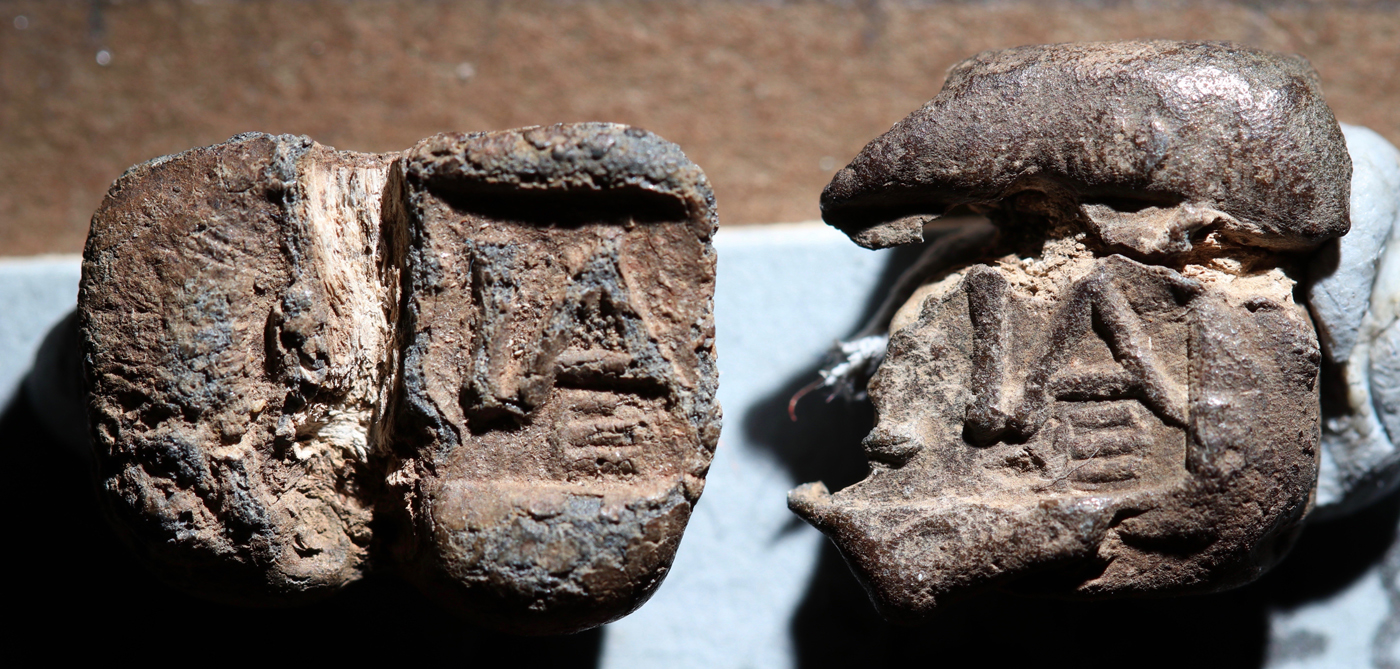
16. Ibid. (fig. 13). Two sealings with rectangular dies. Obverse: L o VI, l(egio) VI. Reverse: ḶIA|E, L(ucius) I(…) Ae(…) Footnote 32
Piercebridge, two sealings (No. 16, reverse). (Photo: R.S.O. Tomlin)

17. Ibid. Two sealings with rectangular dies. Obverse: LVI, l(egio) VI. Reverse: .VS 7, .(…) V(…) S(…) (centurio)
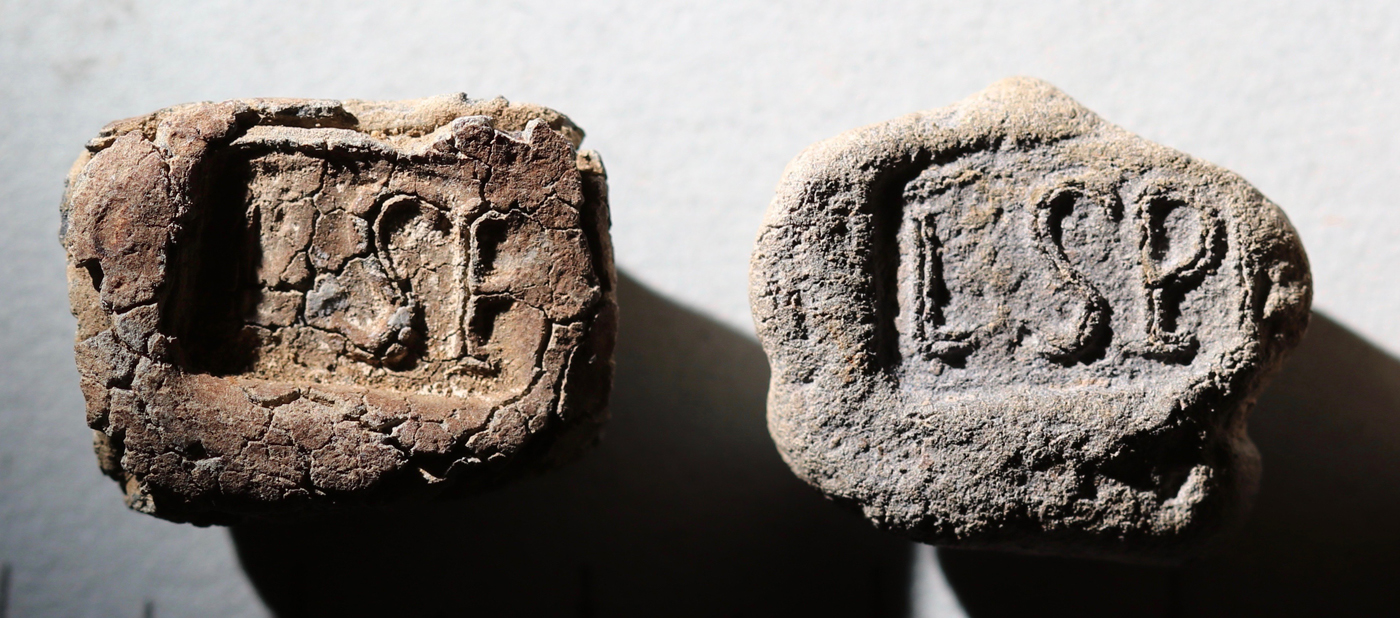
18. Ibid. (fig. 14). Five sealings with rectangular dies. Obverse: LVI, l(egio) VI. Reverse: LSP, L(ucius) S(…) P(…) Footnote 33
Piercebridge, two sealings (No. 18, reverse). (Photo: R.S.O. Tomlin)

19. Ibid. Four sealings with rectangular dies. Obverse: LVI, l(egio) VI. Reverse: OVA, probably AVO retrograde, A(ulus) V(…) O(…) Footnote 34
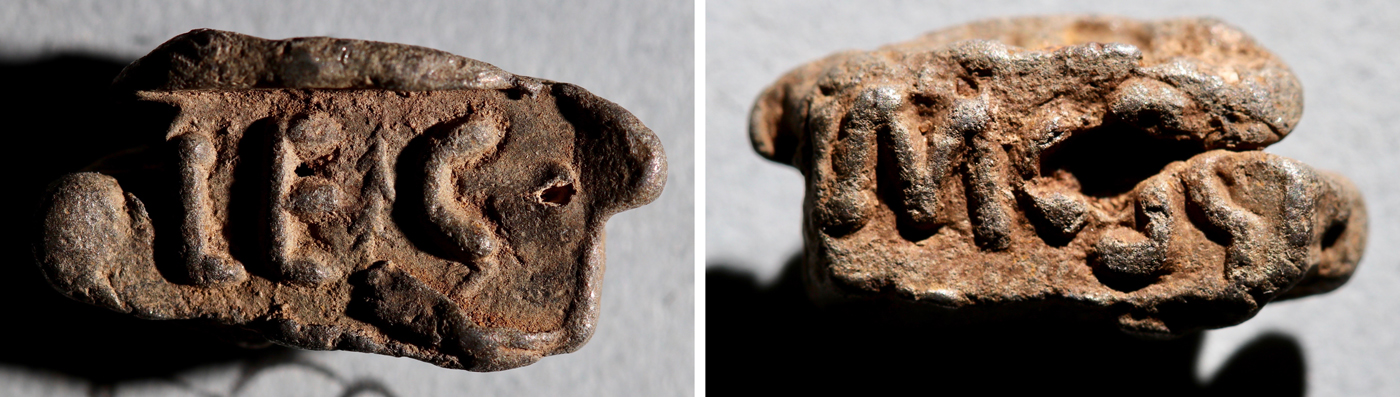
20. Ibid. (fig. 15). Sealing with rectangular dies. Obverse: LE palm G, leg(io …). Reverse: MCS 7, M(arcus) C(…) S(…) (centurio)
Piercebridge, sealing (No. 20); (a) obverse; (b) reverse. (Photos: R.S.O. Tomlin)

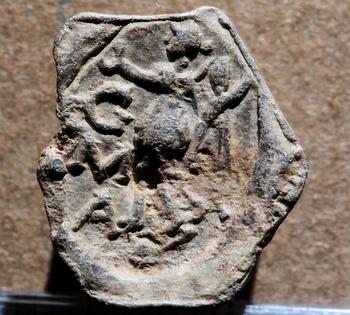
21. Ibid. (fig. 16). Sealing with oval die. Standing figure of winged Victory holding a wreath; to her left vertically: G | M | A, G(aius) M(…) A(…) Footnote 35
Piercebridge, sealing with Victory (No. 21). (Photo: R.S.O. Tomlin)

22. Ibid. Sealing with rectangular dies. Obverse: Λ o VE͡T, a(la) Vet(tonum). Reverse: o S o L o D retrograde, S(…) L(…) d(ecurio) Footnote 36
23. Ibid. Two sealings with an oval die: COH | IIII | G̣AḶ retrograde, coh(ors) IIII Gal(lorum) Footnote 37
24. Ibid. Sealing with rectangular dies. Obverse: B F̣ C, b(ene)f(iciarius) c(onsularis). Reverse: EX, probably ex(pedivit) Footnote 38
25. Ibid. Sealing with an oval die: GE͡PS, G(aius) Ep(…) S(…)
26. Ibid. Three sealings with a rectangular die: VNOV, perhaps V(i)nov(ia) Footnote 39
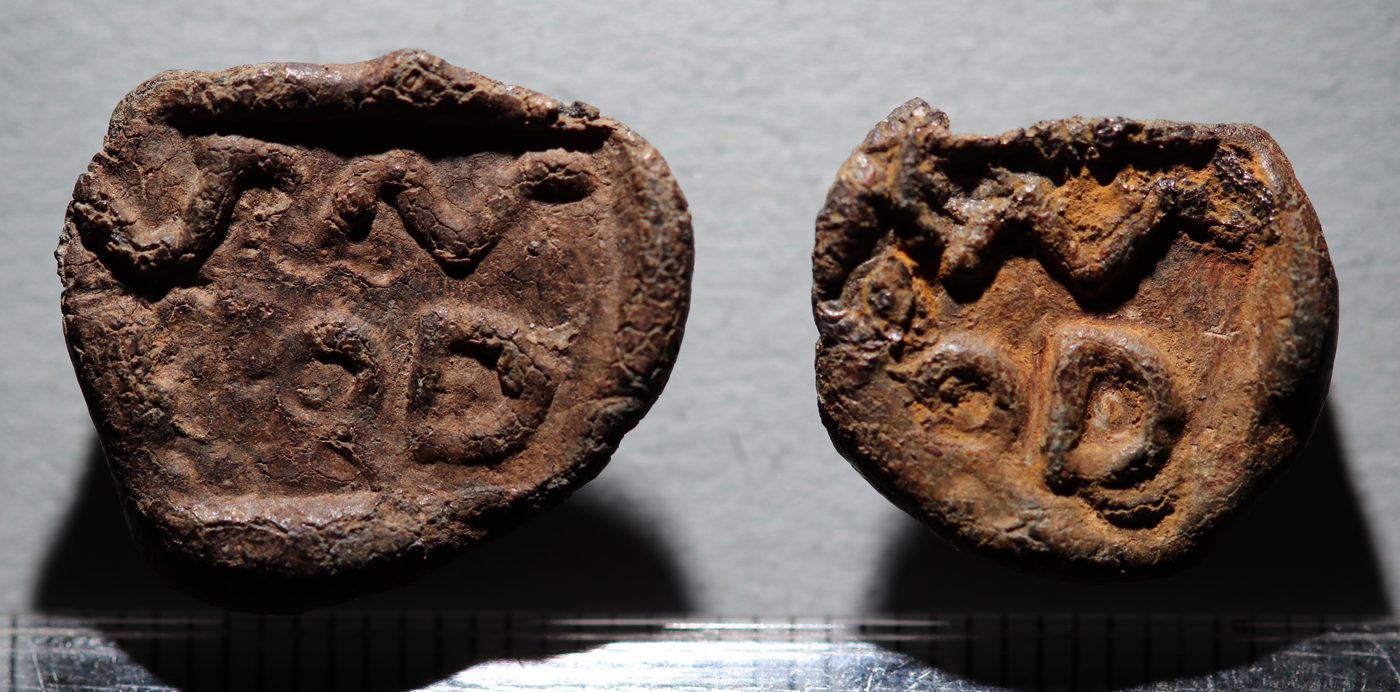
27. Ibid. (fig. 17). Sealing with a rectangular die: snake | C̣QD, G(aius) Q(…) D(…) Footnote 40
Piercebridge, sealings with a ‘snake’ (left, No. 27). (Photo: R.S.O. Tomlin)

28. Ibid. Sealing with rectangular dies. Obverse: OPH, Oph(…). Reverse: E o X retrograde, probably ex(pedivit). ‘Oph(…) has despatched (this).’Footnote 41
29. Ibid. Sealing with rectangular dies. Obverse: OPT, probably Opt(atus). Reverse: EX, probably ex(pedivit). ‘Optatus has despatched (this).’Footnote 42
30. Ibid. Long narrow sealing, 29 by 7 mm, 4 mm thick, with rectangular dies. Well-formed capital letters in high relief, with triangular medial points. Obverse: G Δ I Δ E͡T Δ C, G(…) I(…) et C(…). Reverse: M Δ LGF̣, perhaps m(anu) L(uci) G(…) F(…). ‘(Partnership of) G(…) I(…) and G(…) C(…), by the hand of L(ucius) G(…) F(…).’Footnote 43
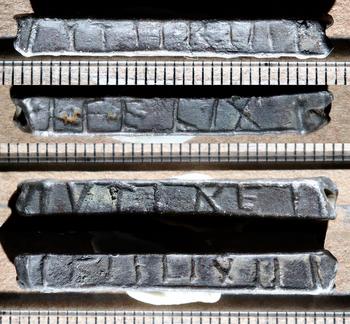
31. Ibid. (fig. 18). Small metal tube, 33 by 4 mm, square in cross-section but cylindrical within, as if it were cast around a suspension-cord or wire. The metal is apparently not lead, but high-tin alloy or even silver. It is not a sealing, but may have terminated a cord as a lace-end.Footnote 44 There is a moulded inscription on each of its four faces, defined by raised borders above and below, and to either side (transcribed as | or ||), with simply-formed letters in relief: (face 1) | VTIIRII || (2, inverted) || VTIRE || (3, inverted and retrograde) | FELIX | (4, retrograde) || FIILIX || |.Footnote 45 (1) utere (3) felix (2) ut(e)re (4) felix. ‘Use (this and be) happy’ (twice).
Piercebridge, terminal (No. 31). (Photo: R.S.O. Tomlin)

HAMPSHIRE
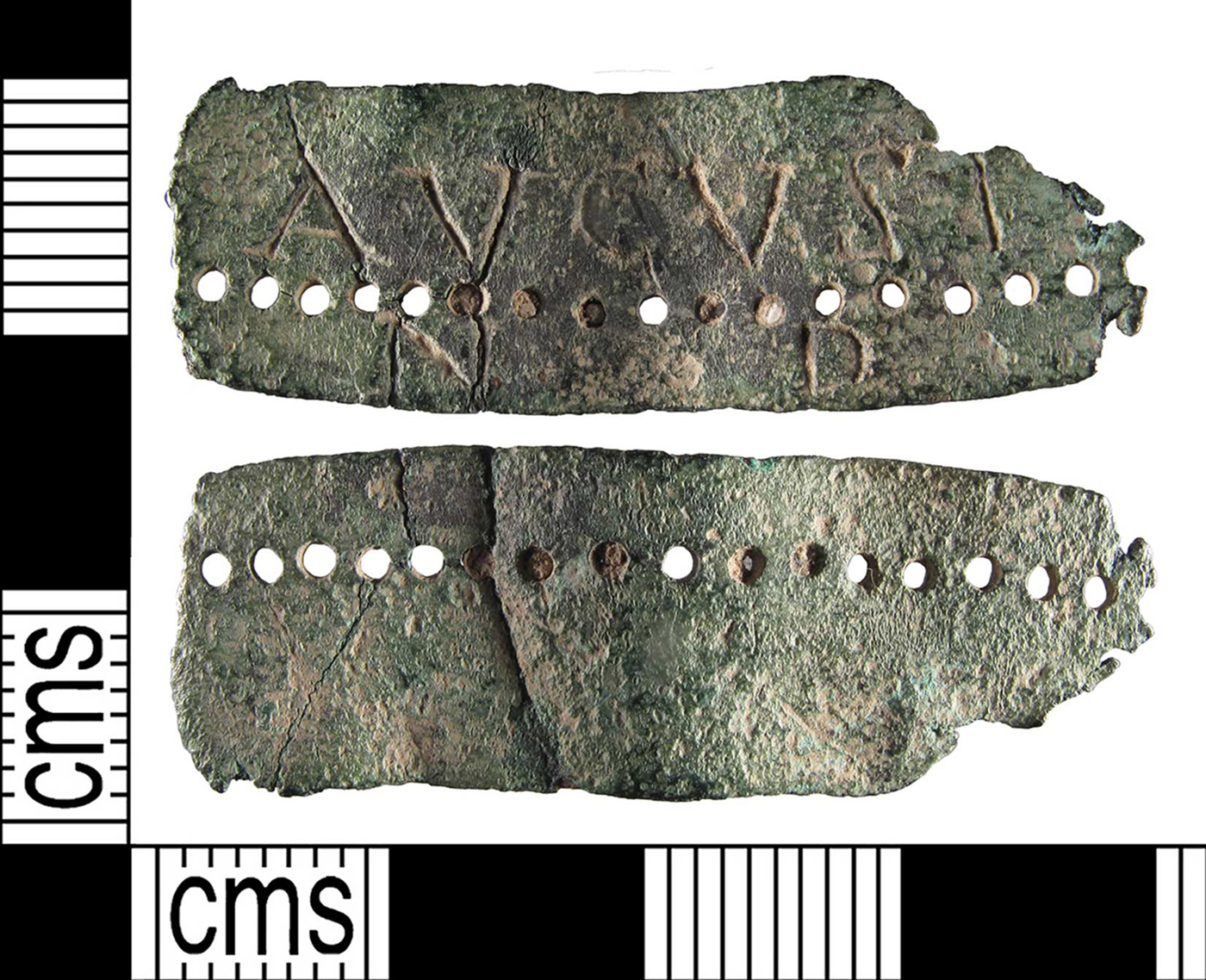
32. Hambledon (SU 65 15) (fig. 19). Fragment of a copper-alloy strip, 37 by 13 mm, foundFootnote 46 in 2017. It curves slightly as if part of a circumference c. 0.27 m in diameter, and is pierced medially with a series of seventeen holes (including one incomplete) c. 1 mm in diameter. Incised: AVGVSṬṾ[…] | N D, Augustu[s] | [K(alendae)] N(onae) (I)d(us). ‘August: Kalends, Nones, Ides.’Footnote 47
Hambledon, fragment of a water-clock (No. 32). (Photo: PAS)

KENT
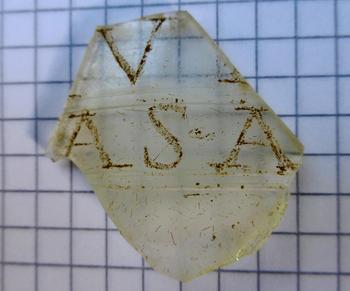
33. East Farleigh (TQ 728 536) (fig. 20). Fragment, 32 by 32 mm, of a glass bowl foundFootnote 48 in 2017. Incised in well-drawn capitals with extended horizontal serifs: […].V.[…] | […]AS o A[…], perhaps […].V.[…] | [… Marsy]as A[pollo …] Footnote 49
East Farleigh, engraved glass (No. 33). (Photo: MAAG)

LINCOLNSHIRE
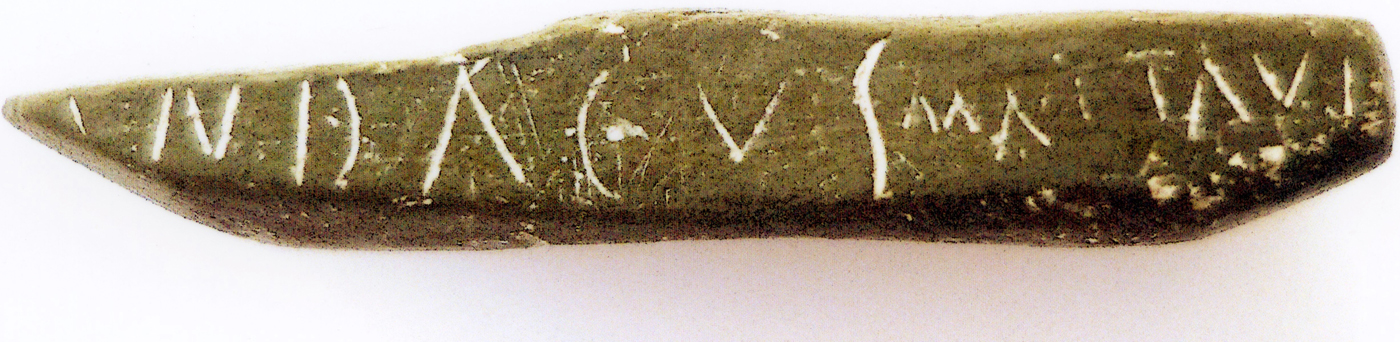
34. Gosberton (TF 17 31) (fig. 21). Whetstone of fine-grained green stone, probably slate, foundFootnote 50 in 2016. The upper face is grooved to take the point of a stylus for sharpening, and measures 46.7 by 21.7 mm, 8.2 mm deep. Inscribed on one side in irregular capitals: […]Λ̣NDΛCVS MA.TΛVI[…], perhaps [M]andacus Ma[t]taui, ‘Mandacus, son of Mattauus’.Footnote 51
Gosberton, inscribed whetstone (No. 34). (Photo: PAS)

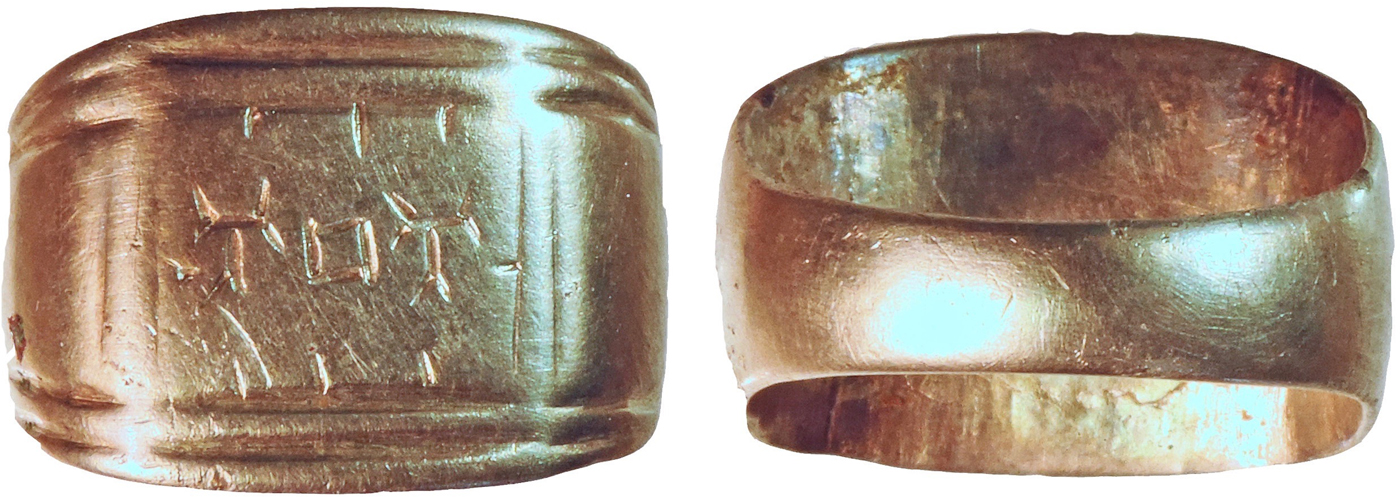
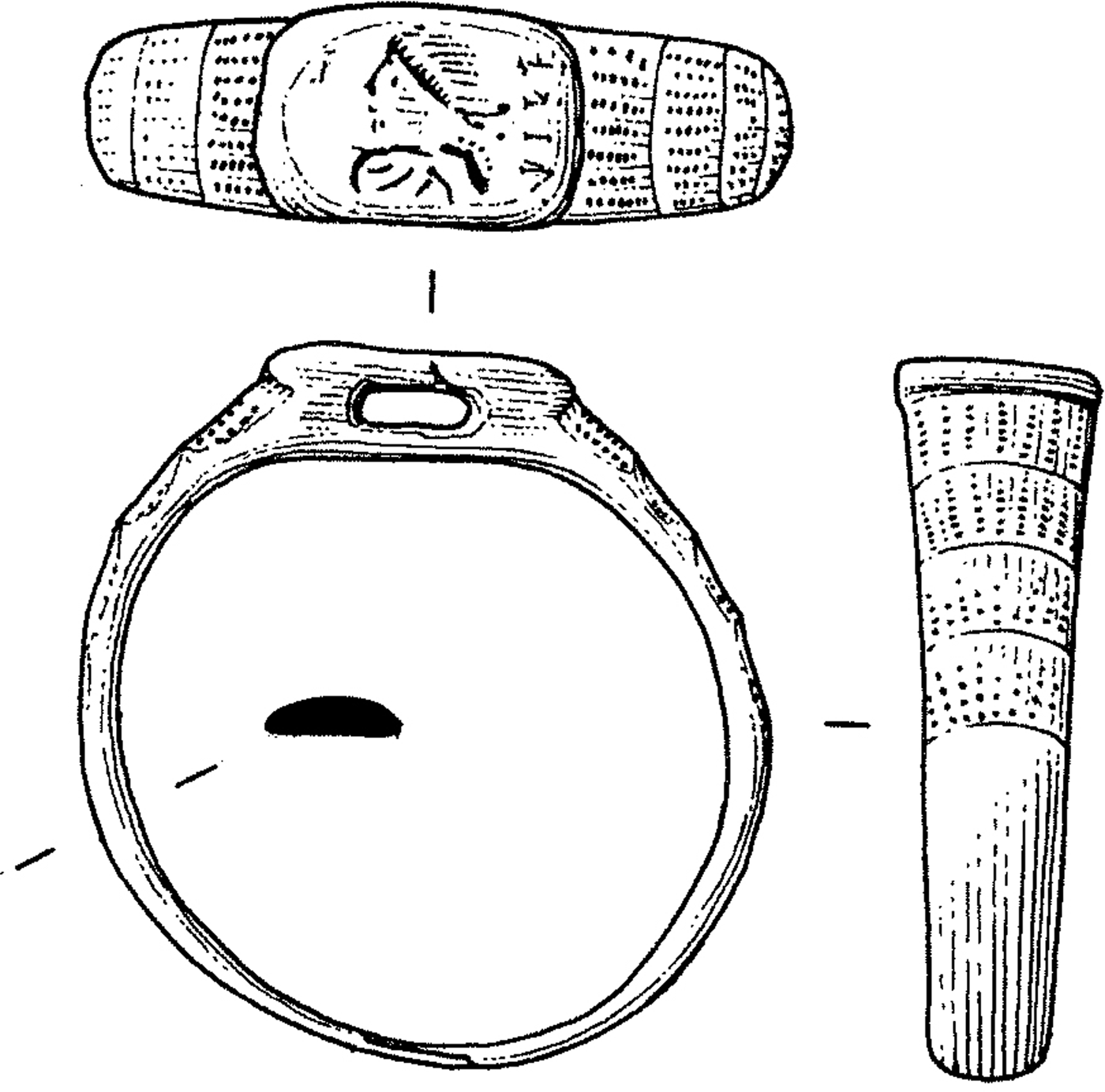
35. Melton Ross (TA 07 10) (fig. 22). Silver finger-ring (Henig type XI) foundFootnote 52 in 2017. The band expands into a rectangular bezel inscribed: TOTFootnote 53
Melton Ross, silver finger-ring (No. 35). (Photo: PAS)

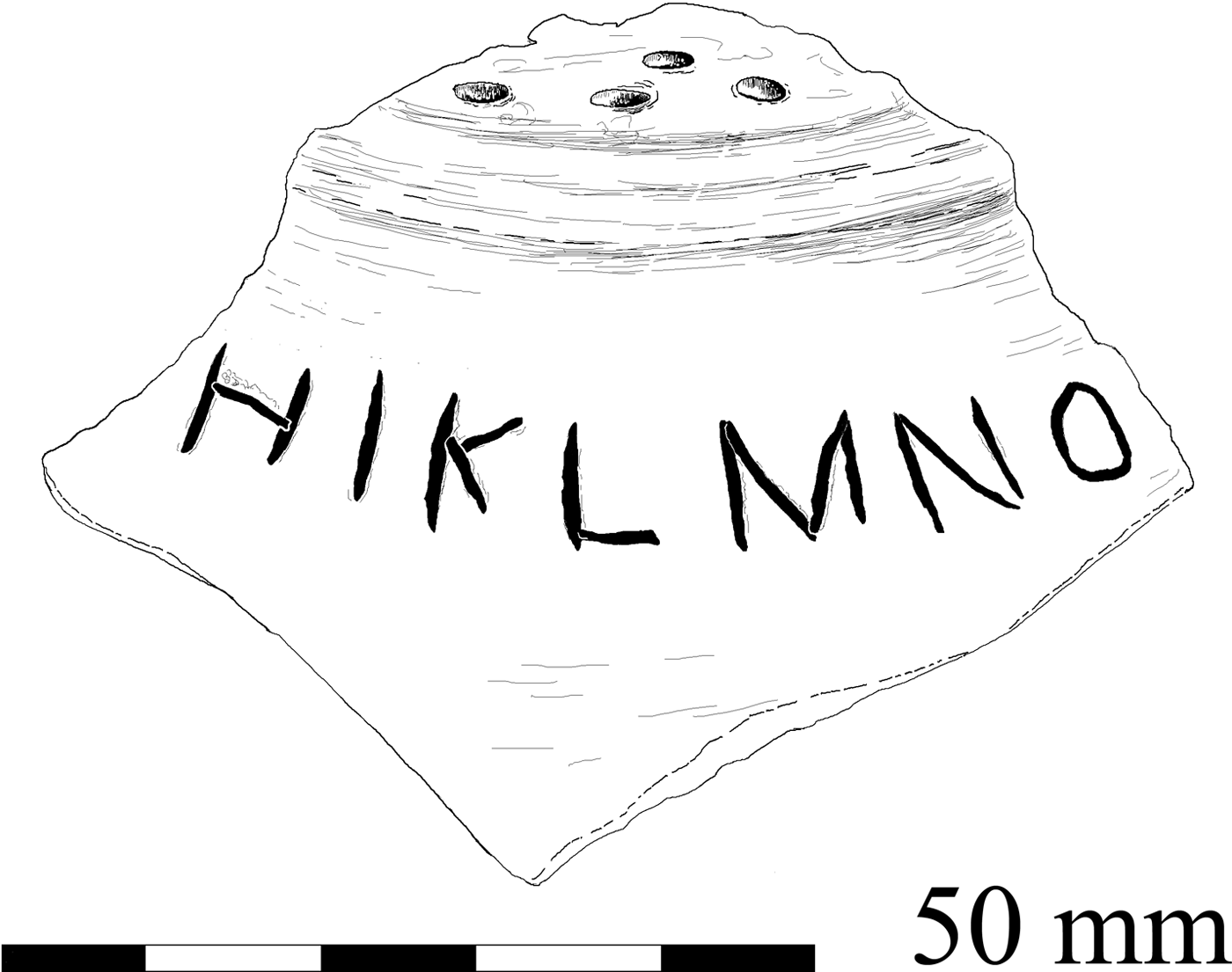
36. Old Sleaford (TF 0756 4584) (fig. 23). Base sherd of a greyware strainer or colander (colum), foundFootnote 54 in 2015. Inscribed on the wall before firing, in capital letters: […]HIKLMNO[…], part of an alphabet.Footnote 55
Old Sleaford, alphabet graffito (No. 36). (Drawn by R.S.O. Tomlin)

LONDON
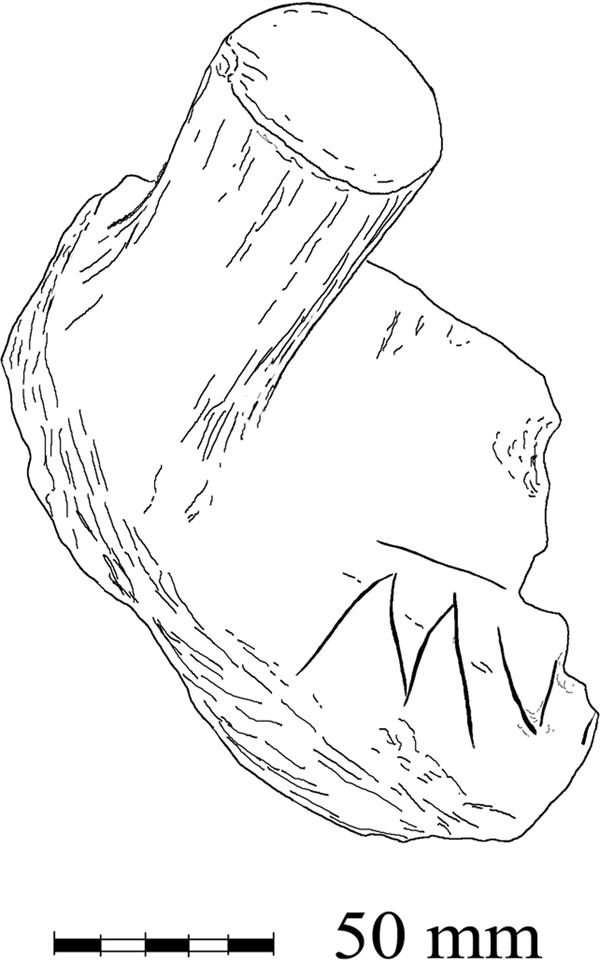
37. City of London (Londinium, TQ 3219 8151), Alderman's House, 117, 119 and 121 Bishopgate and 34–37 Liverpool Street (fig. 24). Shoulder sherd of a South Spanish oil amphora (Dressel 20), foundFootnote 56 in 2015. To the right of the handle, scratched after firing: MVI[…], m(odii) VI[…]. ‘Six (or more) modii …’Footnote 57
London, Alderman's House, amphora graffito (No. 37). (Drawn by R.S.O. Tomlin)

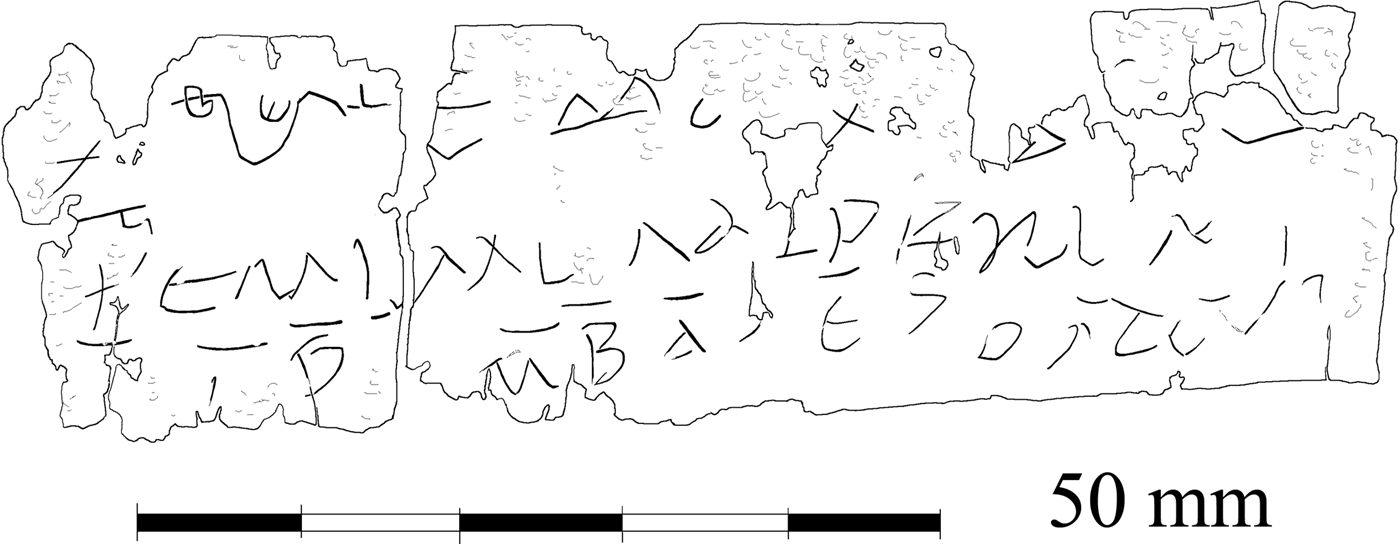
38. City of London (Londinium, TQ 3236 8080), Upper Thames Street (fig. 25). Thin pewter strip (approx. Sn 58% / Pb 42%), 84 by 24 mm, foundFootnote 58 in 1989 on the site of the Roman Thames foreshore. Now damaged and in two conjoining pieces.Footnote 59 It is apparently a protective text (‘phylactery’) which, before being rolled up for insertion into an amulet case, was inscribed on one face with three lines of writing. (1) magical signs (charaktēres).Footnote 60 (2) Roman cursive letters: […] nemiml[.]adlpke … Footnote 61 (3) Roman capital letters each with a suprascript bar: […] . . P [. .] M B . . E S O … . .Footnote 62
London, Upper Thames Street, pewter tablet (No. 38). (Drawn by R.S.O. Tomlin)

NORTHUMBERLAND
39. Corbridge (Coria, NY 982 648), Site 47 (fig. 26). Base sherd of a samian dish (Drag. 36) foundFootnote 63 before c. 1960. Incised after firing on the wall above the foot-ring: ΛVDΛX, Audax.Footnote 64
Corbridge, samian graffito (No. 39). (Drawn by Freya Lilof)

40. Vindolanda (NY 768 663) (fig. 27). Three conjoining sherds from the shoulder of a South Spanish oil amphora (Dressel 20, sf 21057) foundFootnote 65 in 2017. Coarsely incised in capitals: […]S o F o V, S(extus) F(…) V(…) Footnote 66
Vindolanda, amphora graffito (No. 40). (Drawn by R.S.O. Tomlin)

41. Ibid. Shoulder sherd with the stump of one handle of an amphora (probably Dressel 20, sf 21190), coarsely incised after firing midway between the handles: […] | VIIII[…], ‘9’.Footnote 67
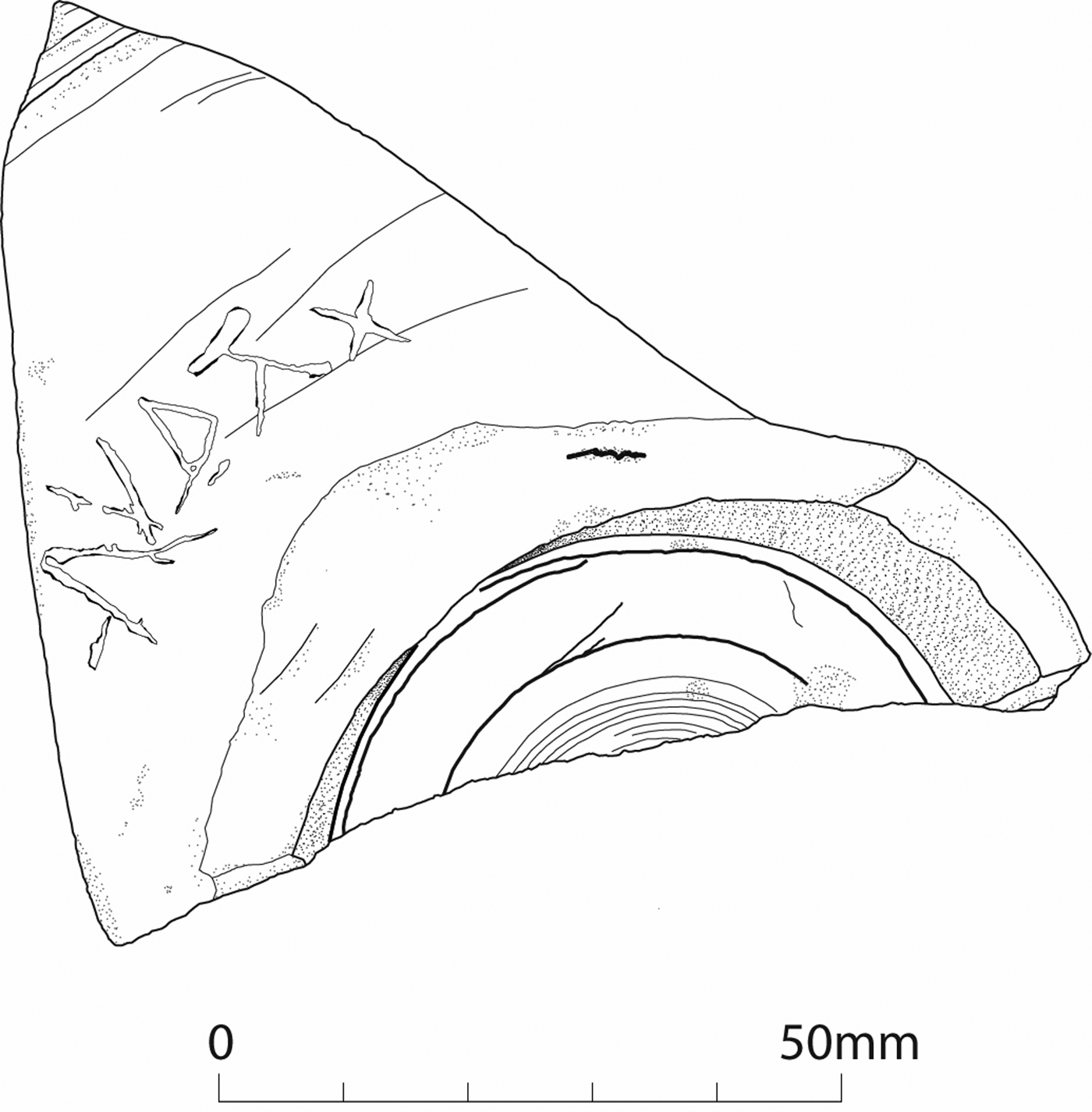
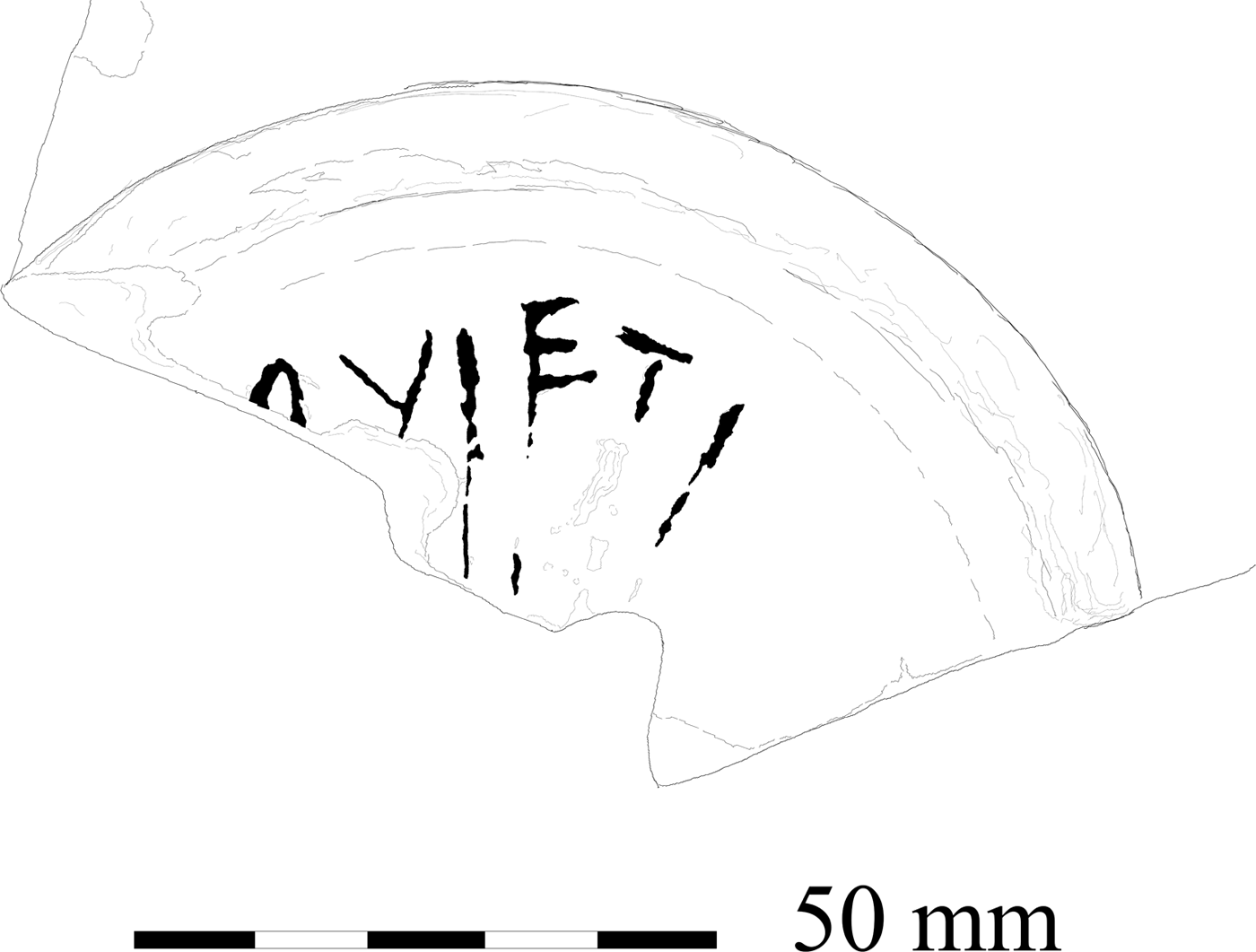
42. Ibid. (fig. 28). Base sherd of a samian dish (Drag. 18/31R, sf 20823) found in the vicus in an early third-century context. Scratched underneath within the foot-ring, in clumsy capitals: […]Q̣VIETI, Quieti. ‘(Property) of Quietus.’Footnote 68
Vindolanda, samian graffito (No. 42). (Drawn by R.S.O. Tomlin)

43. Ibid. Base sherd of a samian dish (probably Drag. 18/31, sf 21016), found in the courtyard of the Antonine praetorium. Incised on the wall just above the foot-ring, in neat capitals: […]ṬḷNV[…], […]tinu[s].Footnote 69
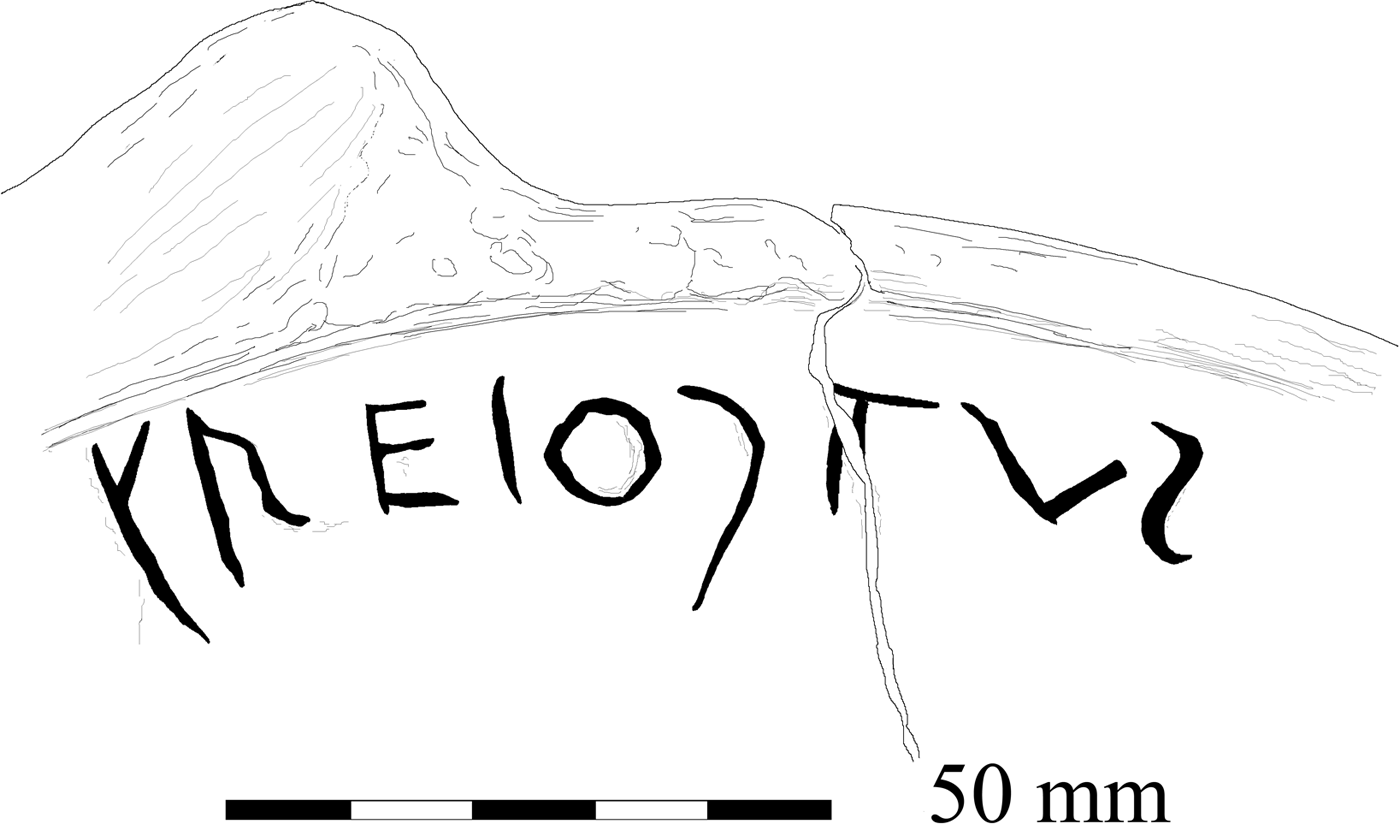
44. Ibid. (fig. 29). Four conjoining sherds of a buff mortarium 0.28 m in diameter, complete except for the base (sf 21323 and 21388). Neatly incised on the underside of the rim, from the mid-point of the pouring-lip: FREIO 7 TVL, Freio (centuria) Tul(lionis). ‘Freio, century of Tullio.’Footnote 70
Vindolanda, mortarium graffito (No. 44). (Drawn by R.S.O. Tomlin)

45. Ibid. (fig. 30). Wall sherd of a buff coarseware vessel (sf 20889). Neatly scored: […]ṬΛNCCIḷ[…]Footnote 71
Vindolanda, coarseware graffito (No. 45). (Drawn by R.S.O. Tomlin)

NOTTINGHAMSHIRE
46. Cotham (SK 80 47). Incomplete silver finger-ring (Henig type VIII) foundFootnote 72 in 2016. Inscribed on the disc bezel: TOTFootnote 73
OXFORDSHIRE
47. Northmoor (SP 4269 0235), Moreton Lane. Wall sherd of a greyware jar foundFootnote 74 in 2017 in a late Roman context. Incised after firing: CΛ, Ca(…) Footnote 75
48. Gill Mill (SP 379 068), Roman settlement (fig. 31). Base sherd of a black burnished dish, foundFootnote 76 in 1995. Scratched underneath after firing: LAḷḷTI, Laeti. ‘(Property) of Laetus.’Footnote 77
Gill Mill, coarseware graffito (No. 48). (Photo: Oxford Archaeology)

SUFFOLK
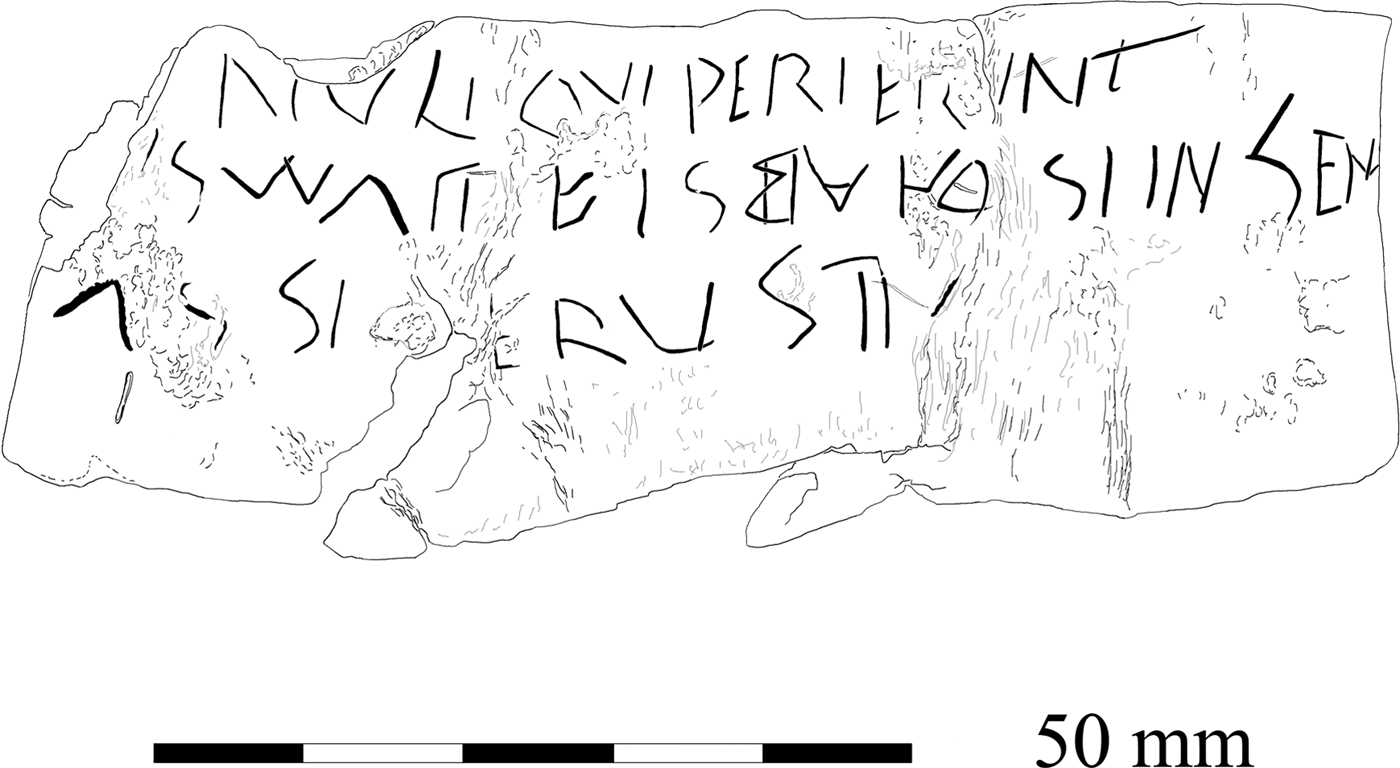
49. Lidgate (TL 73 56), Roman villa (fig. 32). Oblong strip of sheet lead, 90 by 33 mm, foundFootnote 78 in 2017. It is almost complete, but bumped in the top-left corner and split in three places along the bottom edge. After being inscribed, it was folded upon itself twice. The surface of the inscribed (inner) face survives best in the upper right-hand corner, where it was most protected, but elsewhere is quite badly corroded, and damaged at the folds. The text is three lines of irregular capitals inscribed from left to right, with the letters of the first two-thirds of the second line being inverted or reversed in various ways.Footnote 79 It reads: NVLI Q̣VI PERIEṚṾNT | ḷS MVLI[.]Ṛ IS BAṚO SI INGEN | VṢ SI [.]SẸRVS 2–3 more letters, then blank. [a]nuli qui perierunt|(si) muli[e]r (si) baro si ingen|u(u)s si [s]er(v)us … ‘The rings which have been lost, whether woman or man, whether free or slave …’Footnote 80
Lidgate, lead tablet (No. 49). (Drawn by R.S.O. Tomlin)

SURREY
50. Ashtead (TQ 177 601), Roman villa (fig. 33). Fragment of a flanged roof-tile (tegula), 80 by 140 mm, foundFootnote 81 in the late 1920s. Inscribed before firing: […]… | […]TV[…]Footnote 82
Ashtead, inscribed roof-tile (No. 50). (Photo: Alan Hall)

51. Ibid. (fig. 34). Conjoining sherds of a samian bowl (Drag. 31R, stamped by Sextus, Lezoux c. a.d. 155–200), scratched after firing below the rim: […]ṚMΛN, probably […]rman(us) Footnote 83
Ashstead, samian graffito (No. 51). (Drawn by R.S.O. Tomlin from a photo)

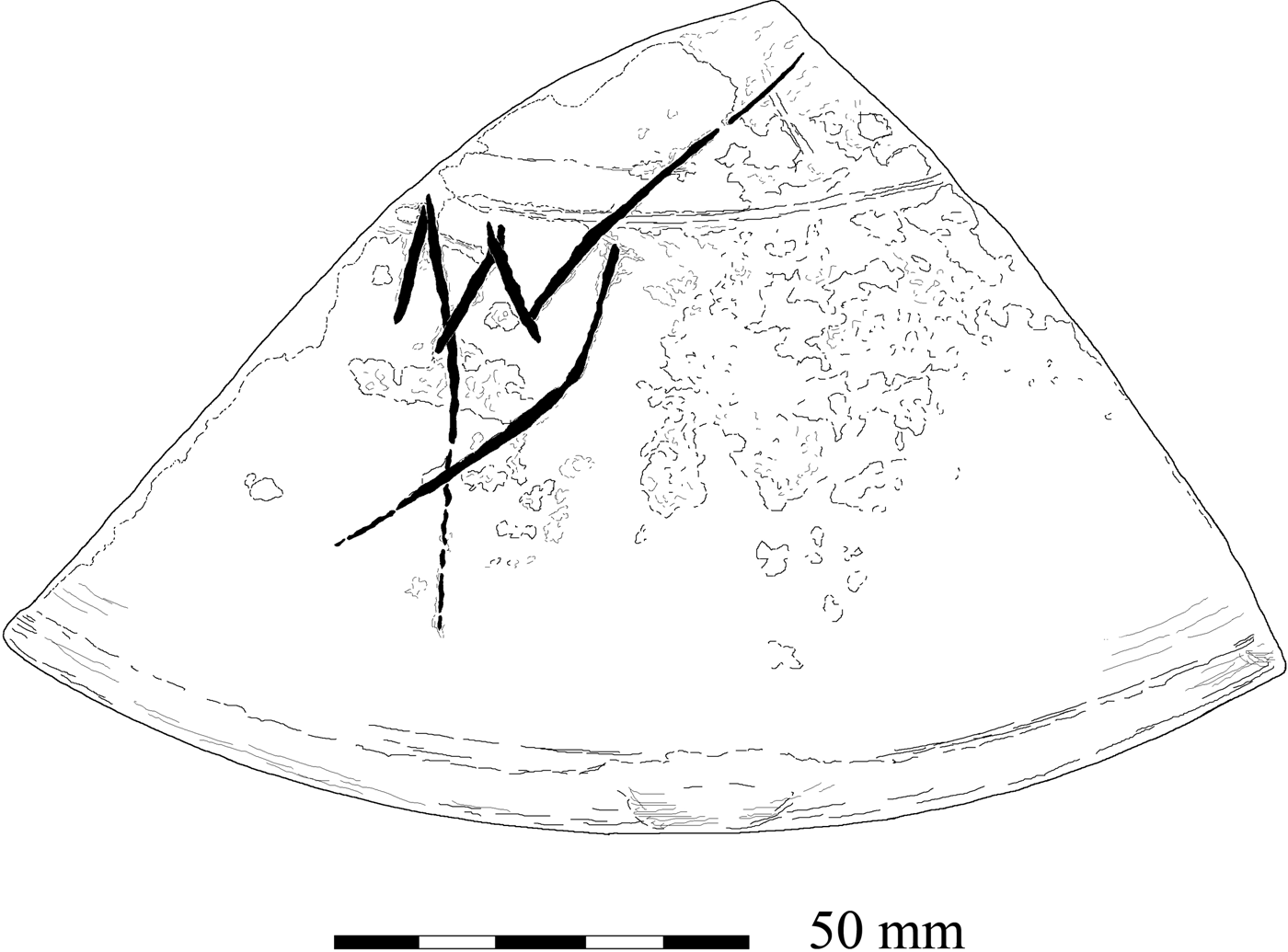
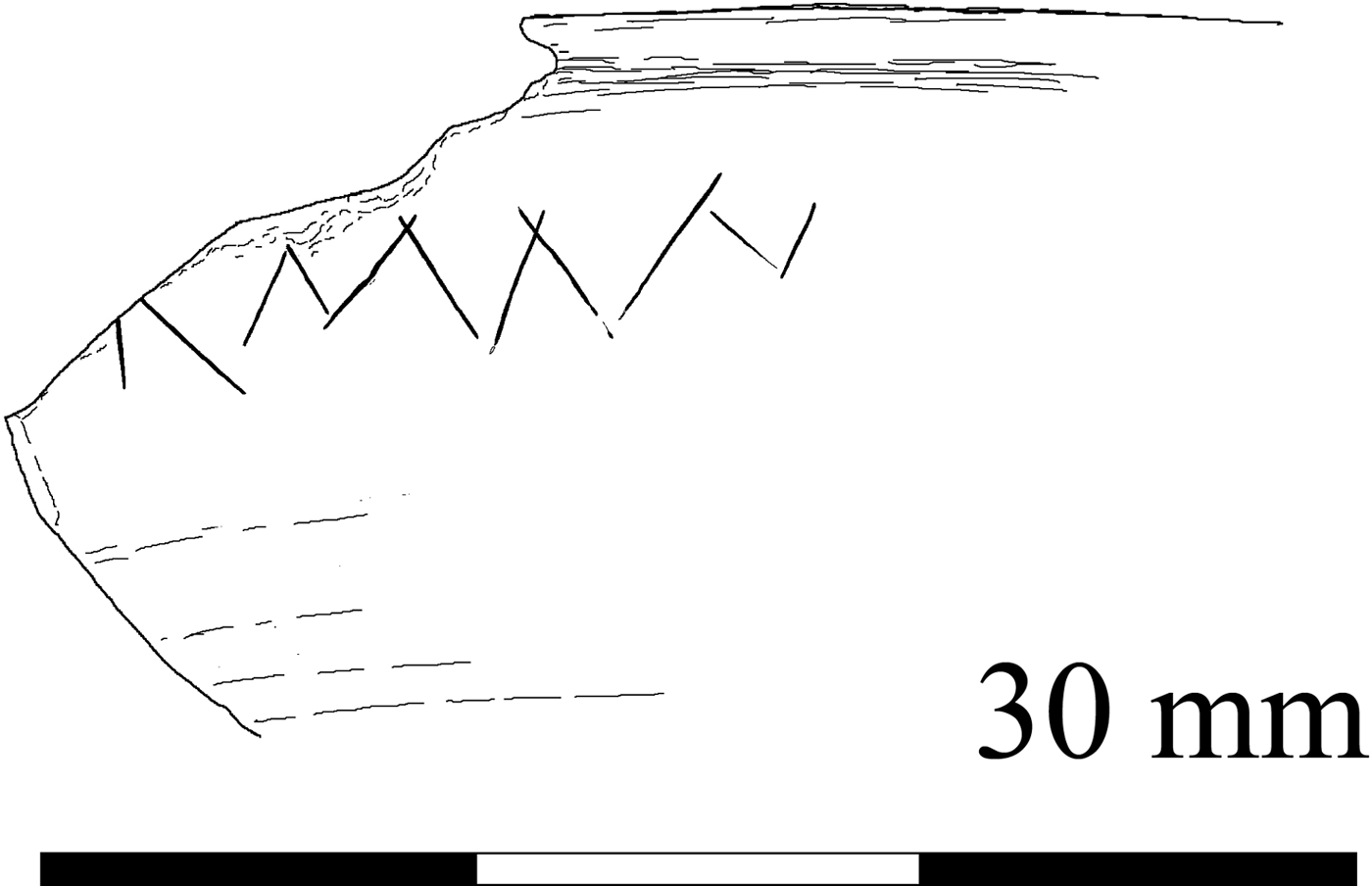
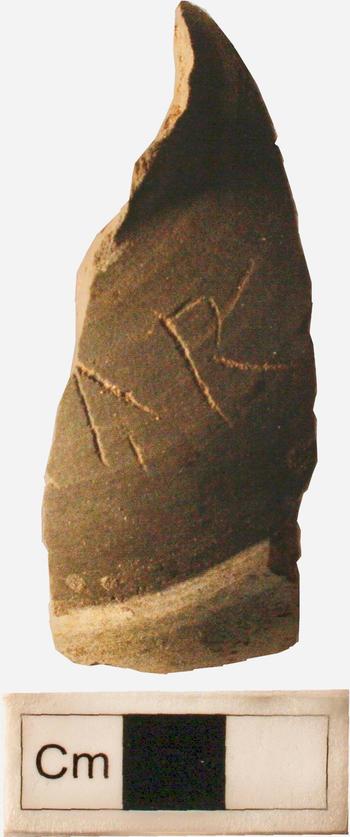
52. Ibid. (fig. 35). Coarseware rim sherd, foundFootnote 84 in 2007. Incised after firing on the wall, when the vessel was inverted: […].AR, probably MAR for Mar(…) Footnote 85
Ashtead, inscribed sherd (No. 52). (Photo: Alan Hall)

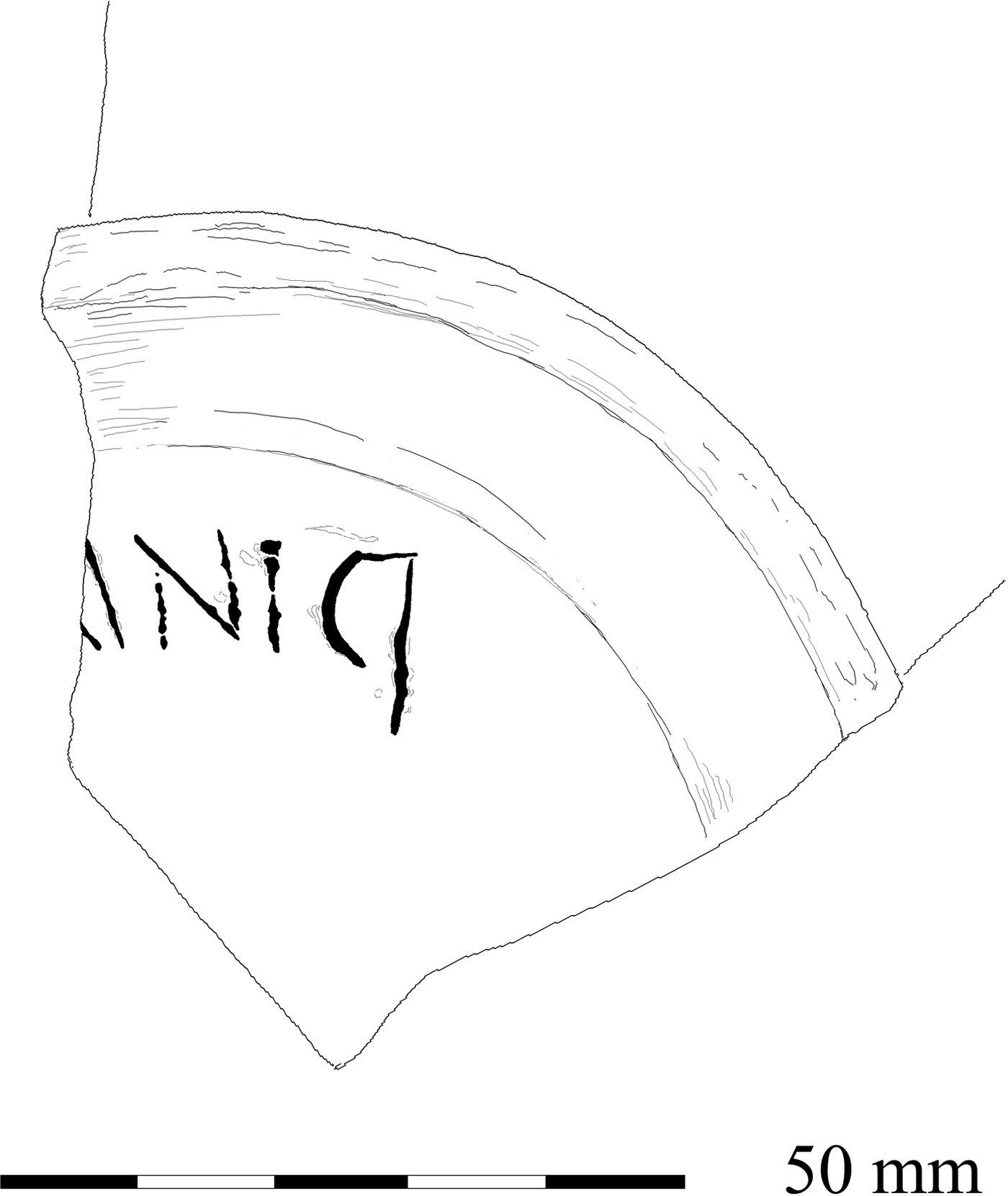
53. Ewell (TQ 222 623) (fig. 36). Base sherd of a samian platter (Drag. 18/31 stamped by Peculiaris, Lezoux c. a.d. 145–70), foundFootnote 86 in 1860. Scratched after firing underneath, within the foot-ring: […].INICI, probably [M]inici. ‘Property of Minicus.’Footnote 87
Ewell, samian graffito (No. 53). (Drawn by R.S.O. Tomlin from a photo)

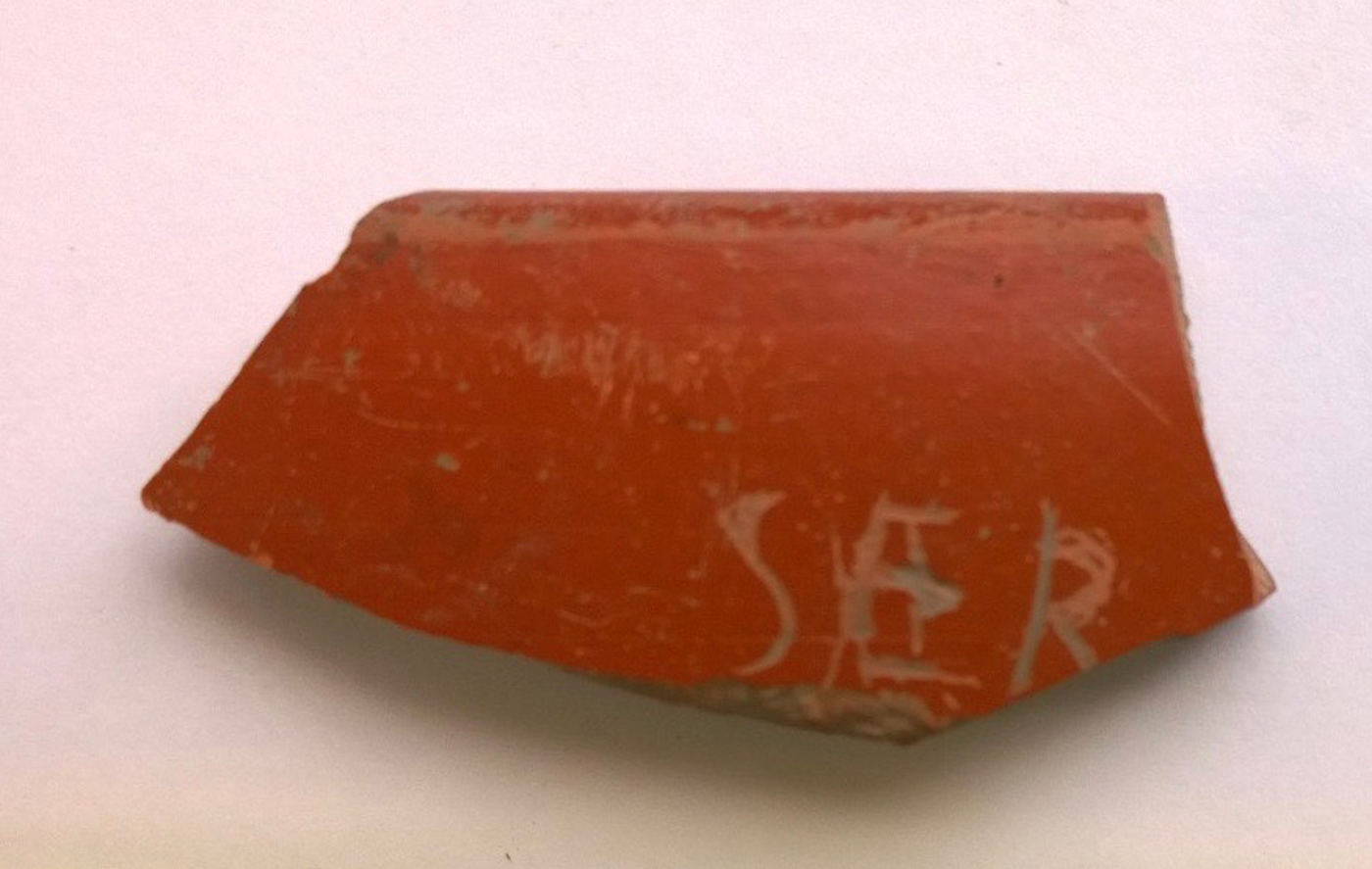
54. Ewell (TQ 222 626), King William IV site (fig. 37). Rim sherd of a samian mortarium (Drag. 45, East Gaulish, first half of the third century), foundFootnote 88 in 1976–77. Scratched on the wall after firing: SER, Ser(…) Footnote 89
Ewell, samian graffito (No. 54). (Photo: Nikki Coward)

WILTSHIRE
55. Roundway Down (SU 000 646) (fig. 38). Silver finger-ring of Brancaster type, probably late fourth-century, found before 2000. Incised in Greek capitals retrograde on the oblong bezel: NIKH with an imperial bust. ‘Victory.’Footnote 90
Roundway Down, inscribed finger-ring (No. 55). (Drawn by Cate Davies)

YORKSHIRE (NORTH)
56. Barlby (SE 63258 35142), Turnhead Farm (fig. 39). Wall sherd of a South Spanish oil amphora (Dressel 20), foundFootnote 91 in 2015–16. Inscribed before firing in cursive letters: […]ụero[…] | […]uksep̣[…], probably [Se]vero [et Sabiniano co(n)s(ulibus)] | V K(alendas) Sep[tembres …]. ‘In the consulship of Severus and Sabinianus, on the fifth day before the Kalends of September (27 August 155) [potter's name].’Footnote 92
Barlby, amphora graffito (No. 56). (Drawn by R.S.O. Tomlin)

SCOTLAND
PERTH AND KINROSS
57. Castle Craig (NN 97604 12714), broch. Copper-alloy handled pan (trulla) foundFootnote 93 in 2011, crushed but complete. A curved maker's stamp concentric to the perforation in the terminal, poorly impressed or worn, can still just be read: DIORATVS F, Dioratus f(ecit).Footnote 94
FALKIRK
58. Airth (NS 898 872) (fig. 40). Subconical lead weight, 31 mm in diameter tapering to 26 mm, 15 mm thick, weight 108 g, foundFootnote 95 in 2000. Punched into the upper surface: IIII | I, probably ‘4 (unciae)’.Footnote 96
Airth, lead weight (No. 58). (Photo: Falkirk Museum)

ADDENDA ET CORRIGENDA
(a) RIB 15 (London) and III, 3135 (Stanwick), both described as ‘Purbeck marble’. The stone is Alwalton marble, a Middle Jurassic limestone quarried near Peterborough.Footnote 97
(b) RIB 2276 + add. The discovery of this milestone in 1776 at Duel Cross (SE 4263 6342), 2.5 miles south of Aldborough, is also recorded by William Hargrove.Footnote 98
(c) RIB II.4, 2470.1. The captions of the two accompanying drawings have been confused. The first (Castleshaw, ‘2470.1’) should be 2470.1(i). The second (Castleford, ‘2470.1(i)’) should be 2470.1(lxviii).Footnote 99
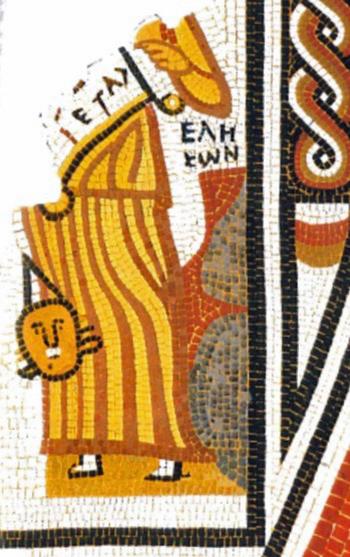
(d) RIB II.4, 2448.5 (Aldborough), ‘Helicon’ mosaic fragment (fig. 41). An early photograph enables the 1952 drawing to be improved slightly, and reveals a second inscription already lost in 1952. The standing Muse held a scroll, on which was inscribed: […].EIA. , perhaps [ΘΑΛ]ΕΙΑ. Thalia, the Muse of pantomime.Footnote 100
Aldborough ‘Helicon’ mosaic (Add. (d)). (Drawn by D.S. Neal)

(e) RIB II.8, 2504.16 (Wood Eaton). This bronze votive plaque entered as an addendum to RIB II.3, 2432 (Votive objects in Bronze) is RIB 236.
(f) Britannia 48 (2017), 460, no. 7 (Lanchester). This fragmented military diploma found in 2015 has now been fully published.Footnote 101 It is dated 19 November 150, and was issued to a British veteran of the German Fleet called Velvotigernus son of Magiotigernus. It also records a new prefect of the Fleet called Marcus Ulpius Ulpianus, and names the suffect consuls as Gaius Curtius Iustus and Gaius Iulius Iulianus.
CHANGES OF LOCATION
(a) RIB 461 (Chester), altar ‘found in 1851 under the Saracen's Head Hotel’. This inn was demolished soon after 1868, but its site is immediately south of the present Town Hall, just north of the Roman praetorium.Footnote 102
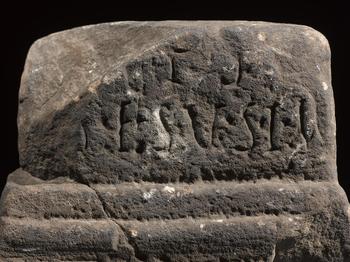
(b) RIB 2153 (Castlecary) (fig. 42). This lower part of an altar, ‘not available’ in 1965, has been rediscovered in an outlying store of the National Museum of Scotland, Edinburgh.Footnote 103
(c) RIB 1776 + add. and 1784 + add. (Carvoran). These altars have been returned from Kendal Museum to the Great North Museum, Newcastle.Footnote 104
RIB 2153, Castlecary altar (Change of Location (b)). (Photo: NMS)

(d) RIB III, 3014 (London, Southwark). This dedication slab is no longer in the Cuming Museum, Southwark, but is displayed at the Museum of London.Footnote 105
(e) RIB III, 3289 (Halton Chesters) and 3481 (Bewcastle). Inscribed stones stored at Corbridge in 1960 but ‘not located’ in 2009. Now stored in Newcastle by the Great North Museum.Footnote 106
ALIENUM
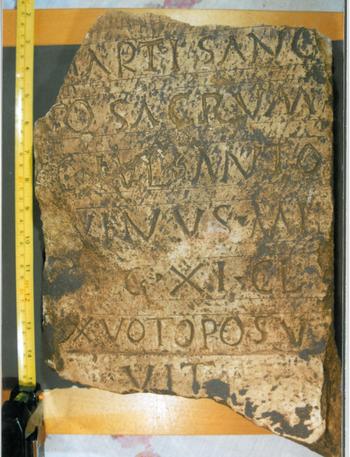
(a) Marton (SK 839 819), Lincs. (fig. 43). Major fragment of a stone altar, 0.27 by 0.36 m, comprising most of the die and part of the base, said to have been foundFootnote 107 in 2001 in the hedge beside a track leading to the river Trent. Inscribed between pairs of setting-out lines: […] | MΛRTI Δ SΛNC|TO SΛCRVM | C Δ IVL ♠ ΛNTO|ṆINVS Δ MIL | [..]G Δ XI Δ CL | [.]X VOTO POSV|VIT, […] | Marti sanc|to sacrum | G(aius) Iul(ius) Anto|ninus mil(es) | [le]g(ionis) XI Cl(audiae) | [e]x voto posu|
Marton, altar (Alienum (a)). (Photo by courtesy of Adam Daubney)

<u>it. ‘Sacred to […] holy Mars, Gaius Iulius Antoninus, soldier of the Eleventh Legion Claudia set (this) up in accordance with his vow.’Footnote 108