The Ross procedure, first described in 1967,1 is a procedure in which a diseased aortic valve is replaced with a pulmonary autograft, a pulmonary or aortic homograft is then placed between the right ventricle and the pulmonary trunk, and the coronary arteries are re-implanted into the neo-aortic root. Following the procedure, patients do not require anti-coagulation, and the autograft has been shown to be durable and capable of growth.2, 3 Due to these attributes, the pulmonary autograft is an attractive alternative to mechanical, porcine, and homograft valves in the treatment of aortic valvar disease in children and young adults.
The Ross procedure has been shown to be effective in children and adolescents with isolated aortic valvar disease,4–7 as well as those with complex obstruction of the left ventricular outflow tract.8–11 Comparison of early surgical outcome in children and adolescents with simple aortic valvar disease and those with complex left heart disease, revealed the procedure to carry a low risk of morbidity and mortality in both groups.12 The vast majority of patients who undergo the Ross procedure, whether they have isolated or complex disease, have absent or mild neo-aortic insufficiency and no significant neo-aortic stenosis in the early post-operative period.12 The significant change in the loading conditions of the left ventricle may result in myocardial remodeling and improved ventricular performance.13, 14 This remodeling may have an effect on exercise performance in the early period of follow-up.
Other factors may also impact exercise performance after the Ross procedure, including factors related to the underlying disease, as well as those related to the Ross procedure itself. Factors related to the underlying disease include pre-operative left ventricular pressure and/or volume overload, and associated anomalies within the left ventricular outflow tract. Factors related to the Ross procedure include the function of the right ventricle following placement of the pulmonary arterial homograft, coronary re-implantation, the function of the neo-aortic valve, and chronotropic impairment as a consequence of aortic root surgery.
Previous literature has focused on echocardiographic assessment of the autograft and homograft at rest, and with exercise, in adults and children.15–18 Data is lacking, however, regarding aerobic capacity and response of the cardiovascular system to exercise, and pre- and post-operative comparisons of exercise performance. The purpose of our study, therefore, was to compare the exercise state, including metabolic and haemodynamic parameters, prior to and after the Ross procedure in children and adolescents.
Methods
Study design
This study is a case series focusing on changes in exercise performance before and after the Ross procedure.
Patient population
We included patients followed at the Children's Hospital of Philadelphia who had undergone the Ross procedure between January of 1995 and December 2003, and who were able to perform pre- and post-operative exercise stress tests. Charts were reviewed for age at surgery, gender, original anatomic diagnoses, prior procedures, indication for Ross procedure, peri-operative and post-operative interventions. Peri-operative data was obtained at the time of the Ross procedure, and post-operative data from follow-up appointments in the outpatient clinic. Body composition data of the study subjects was analyzed by comparing the pre- and post-operative exercise stress test height, weight, body-mass index, and ratio of weight to height. Exercise stress test data was indexed to the measured weight of the patient, as well as their ideal weight.
Exercise testing
Resting spirometry. Prior to exercise testing, all subjects underwent measurement of resting lung mechanics consisting of inspiratory and expiratory flow volume loops. Maximal volume ventilation was calculated by multiplying the forced expiratory volume at 1 second by 40. This value was used to calculate the breathing reserve at peak exercise by the formula:

where VE equals the minute ventilation at peak exercise and MVV is the maximal volume ventilation. The results of the spirometry data were compared to data for healthy children at reported by Polgar et al.19
Exercise protocol. All subjects were exercised to maximal volition using an electronically braked cycle ergometer (Bosch 601). The protocol consisted of three minutes of pedalling in an unloaded state followed by a ramp increase in work rate to maximal exercise. The steepness of the ramp protocol was designed to achieve the subjects predicted work rate in 10 to 12 minutes of cycling time. A single cardiologist (SMP) interpreted the exercise stress tests.
Cardiac monitoring. A 12 lead electrocardiogram (Marquette Case-12 Milwaukee, Wisconsin) was obtained at rest in the supine, sitting, and standing position. A 12 lead electrocardiogram was obtained during each minute of exercise and the first 10 minutes of recovery. Cardiac rhythm was monitored continuously throughout the study.
Blood pressure was measured by auscultation at rest, and every three minutes during exercise and recovery. Systemic arterial saturation of oxygen was monitored continuously during exercise by ear oximetry.
Cardiac output was estimated from effective pulmonary blood flow using the acetylene–helium rebreathing technique. Gases were measured using a mass spectrometer (Perkin-Elmer, Pomona, California). Measurements were made at rest, peak exercise, and every three minutes of exercise. The maximal stroke volume index was calculated by dividing maximal cardiac index by peak heart rate. Data were compared to previously published values for healthy children from our laboratory.20
Metabolic measurements. Metabolic data were obtained throughout the exercise study and for the first two minutes of recovery on a breath-by-breath basis using a metabolic cart (Sensor Medics, Yorba Linda, California). Parameters measured included the consumption of oxygen per minute, the production of carbon dioxide per minute, the minute ventilation, and the ratio of respiratory exchange, calculated as the production of carbon dioxide divided by the consumption of oxygen in each minute. Ventilatory anaerobic threshold was measured by the V-slope method. Data were compared to healthy age and sex matched children using a similar exercise protocol as reported by Cooper et al.21
Echocardiographic data
Echocardiographic data was obtained at the time of exercise stress tests performed both before and after the surgical procedure. Data collected included the degree of pre-operative aortic stenosis and regurgitation, the degree of post-operative neo-aortic insufficiency, neo-aortic stenosis, neo-pulmonic insufficiency, and right ventricular homograft stenosis; and left ventricular dimensions and function for both time periods. Aortic and neo-aortic valvar regurgitation was graded utilizing the quantitative criterion for children delineated by Jenkins et al.22 The width of the colour jet of regurgitation was measured at the level of the valve, and graded as none, or trivial or mild when the jet was from 1 to 4 millimetres, moderate from 4 to 6 millimetres, and severe when broader than 6 millimetres. Moderate or greater aortic regurgitation was confirmed by holodiastolic reversal of flow in the descending aorta.
Statistical methods
Continuous variables are expressed as mean and standard deviation, or median and range, where appropriate. Statistical differences between the pre and post-operative exercise stress test data were assessed by the paired t-test. Significance was determined at a p-value of less than 0.05. All p-values were two-sided with a 95% confidence interval. Secondary analysis of maximum cardiac output was performed in those patients with a decrease in maximum consumption of oxygen. An increase or decrease in the maximal consumption was defined as an increase or decrease of greater than 10% in percent of predicted consumption, indexed to weight, in the post-operative exercise stress test, relative to the pre-operative exercise stress test. Body composition was analyzed by comparing the pre-operative and post-operative height, weight, body-mass index, and ratio of weight to height; and exercise stress test data were indexed to the measured weight and the ideal weight.
Results
Patient population
During the period of study, 119 patients underwent the Ross procedure at the Children's Hospital of Philadelphia. Of the 119 patients, 3 died, resulting in a mortality rate of 2.5%. Of the 116 survivors, 57 patients were unable to perform an exercise stress test, due to young age (less than 8 years), or neurological deficit. Of the remaining 59 patients, 26 were followed at our institution, and underwent both preoperative and post-operative exercise testing. The cohort studied included 19 males and 7 females.
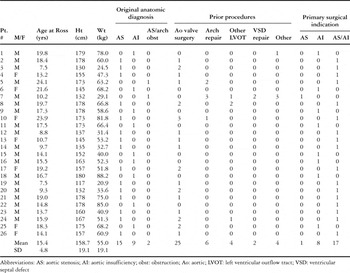
The median age at the time of the operation was 15.7 years, with a range from 7.5 to 24.1 years. Sex, age at the procedure, body composition, original anatomic diagnoses, prior procedures, and primary surgical indications of the population are displayed in Table 1. For 7 of the patients, the Ross procedure was their first surgical intervention. In the other 19 patients, there had been 40 previous operations. More than half of these were on the aortic valve.
Table 1. Subject data.

The primary indication for the Ross procedure was isolated aortic stenosis in 1, isolated aortic insufficiency in 8, and combined aortic stenosis and insufficiency in the remaining 17. Additional disease of the left heart was noted in 4 of the 26 patients at the time of surgery, specifically supravalvar aortic stenosis in 2, a subaortic shelf in 2, proximal and distal obstruction in an interposition graft in 1, mitral regurgitation in 1, and a residual ventricular septal defect in 1.
Pre-operative echocardiographic data
Pre-operative echocardiographic evaluation was performed at a median of 2.4 months, and a range from zero to 12.4 months, from the pre-operative exercise stress test, and within 6 months in 21 of the 26 patients. Of the 26 patients, 24 had aortic insufficiency, which was severe in 17, moderate in 4, and mild in 3. Of the 19 patients with pre-operative aortic stenosis, the mean gradient was 54 millimetres of mercury, with a standard deviation of 27 millimetres of mercury. Of the 19 patients with aortic stenosis, 9 had a gradient greater than 50 millimetres of mercury. Mean pre-operative shortening fraction was 38%, with a standard deviation of 8%. Only 1 patient had a shortening fraction of less than 28%. Pre-operative mean left ventricular end diastolic dimension was 5.8 centimetres, with a standard deviation of 1.4 centimetres, and the mean z-score was 1.5, with standard deviation of 1.8. Of the 26 patients, 11 had a left ventricular end diastolic dimension z-score greater than 2.
Surgical technique
The Ross procedure, as previously described,23 was performed without concurrent procedure on 22 patients with isolated aortic valvar disease, 1 of whom underwent an enlargement of the ventriculo-arterial junction to accommodate the size of the larger pulmonary autograft. In one other patient, aortic valvoplasty was initially attempted during surgery, prior to the Ross procedure. Four patients had 7 additional procedures to the left ventricular outflow tract at the time of the Ross procedure. These included resection of the subaortic shelf in 2, a Konno procedure in 2, augmentation of the aortic arch in 1, repair of a residual ventricular septal defect in 1, and mitral valvoplasty in 1. A valved pulmonary homograft was used in all patients to reconstruct the right ventricular outflow tract. The mean length of stay for the cohort in hospital was 4.7 days, with standard deviation of 1.3 days. There was 1 patient who developed severe neo-aortic insufficiency and underwent re-intervention, consisting of neo-aortic valvoplasty, prior to the post-operative exercise stress test.
Post-operative echocardiographic data
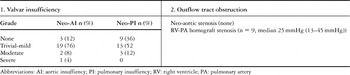
Echocardiographic data was available in 25 of the 26 patients. The median time between the post-operative echocardiogram and the post-operative exercise stress test was 2 months, with a range from zero to 16.4 months, and was 6 months or less in 17 of the 25 patients. The degree of neo-aortic insufficiency, neo-aortic stenosis, neo-pulmonary insufficiency, and stenosis of the right ventricular homograft noted at the post-operative echocardiographic assessment is shown in Table 2. More than 85% of patients had mild or less neo-aortic insufficiency and neo-pulmonary insufficiency at the time of the post-operative exercise stress test. In 2 patients, there was moderate neo-aortic insufficiency, and 1 patient had severe neo-aortic insufficiency. Moderate neo-pulmonary insufficiency was found in 3 patients. No patient had residual obstruction of the left ventricular outflow tract. Nine patients had a gradient across the right ventricular outflow tract that ranged from 13 to 45 millimetres of mercury as measured at the resting post-operative echocardiogram. The mean left ventricular end diastolic diameter was 5 centimetres, with standard deviation of 0.7 centimetres. The mean left ventricular end diastolic dimension z-score was 0.6, with standard deviation of 0.7, which was significantly less than the mean pre-operative measurement of 1.5, with standard deviation of 1.8. The p-value for this difference was 0.04 (Fig. 1). In 2 patients (8%), the z-score for the left ventricular end diastolic diameter was greater than 2. Mean shortening fraction was 36%, with standard deviation of 6%, with 3 patients (12%) having a shortening fraction less than 28%.
Table 2. Echocardiographic assessment at post-operative exercise stress test.


Figure 1. The z-scores for the left ventricular end-diastolic dimensions as measured before and after the Ross procedure.
Body composition data
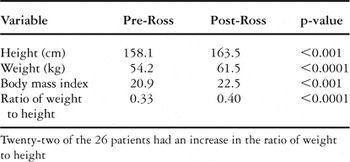
The pre-operative and post-operative data for weight, height, body mass index, and ratio of weight to height is shown in Table 3. Evaluation of the data before and after the Ross procedure revealed a significant increase in all parameters.
Table 3. Body composition before and after the Ross procedure.

Exercise stress test data
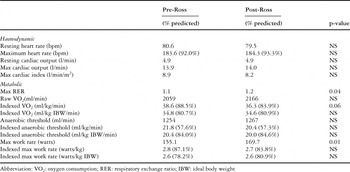
The median time from the pre-operative exercise stress test to the Ross procedure was 29 days, with a range form 1 day to 1.1 years, and was less than 6 months in 21 of the 26 patients. The median interval between surgery and the post-operative exercise stress test was 17.4 months, with a range from 6.7 to 30.2 months. At rest, there were no statistically significant differences found in the mean values of pre-operative and post-operative exercise stress test data (Table 4).
Table 4. Exercise stress test data before and after the Ross procedure.

Pre-operative exercise stress test metabolic and haemodynamic data were within normal limits, with mean maximum consumption of oxygen of 38.6 millilitres per kilogram per minute, representing 88.5% of the predicted value (Table 4). There was a trend toward decreased mean maximal consumption of oxygen post-operatively (36.3 millilitres per kilogram per minute, with a standard deviation of 7.6); p-value equal to 0.06. As noted above, measures of adiposity significantly increased following the Ross procedure. When maximal consumption of oxygen indexed to ideal body weight was compared pre- and post-operatively, there was no difference detected (Fig. 2). Pre- and post-operative maximal work rate and anaerobic threshold were also similar (Table 4).

Figure 2. The percent of predicted maximal consumption of oxygen as found before and after the Ross procedure, indexed to ideal body weight.
Figure 2 illustrates the percent of predicted maximal consumption of oxygen, indexed to ideal body weight, before and after the Ross procedure. Of the 26 patients, 7 had an increase in consumption, 13 patients showed no significant change, and 6 had a decrease. In the patients with decreased consumption, 2 of the 6 also had a decrease in their maximal cardiacoutput, and one subsequently underwent a neo-aortic valvoplasty for progressive and severe neo-aortic insufficiency.
There were no statistically significant differences between pre-operative and post-operative mean values for maximal haemodynamic data (Table 4). There was, however, considerable variability in the response (Figs 3 and 4). Mean maximal heart rate was 184 beats per minute, with standard deviation of 14, pre-operatively, and remained at 184 beats per minute with standard deviation of 15 post-operatively (Fig. 2).

Figure 3. The maximal heart rates as observed before and after the Ross procedure.

Figure 4. The maximal cardiac index as calculated before and after the Ross procedure.
Discussion
Our study demonstrates that, following the Ross procedure, exercise performance is within the range of healthy, age and sex matched controls, and unchanged compared to the pre-operative exercise stress test. Only 6 patients had a deterioration in aerobic capacity. This small number of patients with deterioration precluded analysis of risk factors. Following the Ross procedure, there was no post-operative chronotropic impairment, with similar peak heart rates pre- and post-operatively.
Pre-operative echocardiographic assessment showed significant aortic valvar disease prior to surgery. Pre-operative exercise performance, nonetheless, was within normal limits. This is expected, as the current standard of care for children with aortic valvar disease is to intervene before symptoms develop. Post-operatively, left ventricular remodeling was evident, with a significant decrease in left ventricular end diastolic dimension compared to pre-operative echocardiographic measurements. In our study, this did not result in any change in post-operative exercise performance. We speculate that any possible beneficial effects of left ventricular remodeling on exercise performance may have been offset by the increased adiposity and sedentary lifestyle of our patients. No subject was involved in regular physical activity, or had participated in any post-operative programme for physical conditioning. All but 4 subjects in this study had an increase in their ratio of weight to height over the course of the period of follow-up, and we found a trend toward lower post-operative maximal consumption of oxygen when indexed to measured weight. When indexed to ideal weight, however, pre-and post-operative maximal consumption was similar. These findings may indicate a potential problem with the long-term post-operative management of these children and adolescents. Our data would suggest that these subjects should generally well tolerate regular non-competitive physical activity. Oury et al. demonstrated very similar exercise haemodynamics in a small group of young adult well-conditioned athletes after the Ross procedure compared with 13 conditioned control athletes with normal aortic valves.15 These findings in the face of the increase adiposity seen in our patients suggest that a routine post-operative exercise regime may be useful in the adolescent population.
Reports on exercise performance following the Ross procedure are few. Our study adds to prior reports by comparing exercise performance before and after the procedure, and in assessing metabolic parameters and cardiac output with exercise in children.15–24 The results of our study confirm in children similar findings previously seen in the adult population. In the only other report measuring aerobic capacity following the Ross operation, Pibarot et al. measured maximal oxygen consumption and anaerobic threshold using a similar ramp cycle protocol.24 Maximal consumption was 37 millilitres per kilogram per minute, representing 117% of the predicted value for age and sex. There were no pre-operative exercise data. The subjects were tested at a somewhat later time from surgery compared to our study. It remains to be seen whether younger patients who have undergone the Ross procedure will continue to perform as well as they progress further from their surgery.
Deterioration over time in the autograft or the pulmonary homograft appears to raise the most concern for long-term exercise performance. In the study of Pibarot et al., as well as the studies by Phillips and Oury et al., the autografts were shown to have excellent long-term haemodynamic characteristics.15, 18, 24 Little difference was noted in their velocity patterns measured during exercise by Doppler echocardiography compared with the native aortic valve. Compared to the native right ventricular outflow tract, however, the gradient across the pulmonary homografts are higher at rest, and increased significantly with exercise. The peak gradients at post-operative echocardiogram in our study are within the range of 35 to 50 millimetres of mercury that have been demonstrated by others, and have not correlated negatively with exercise performance.15, 18, 24 There are some data in adults to suggest that these changes in the pulmonary homograft are relatively stable after approximately the first 6 months. It remains to be seen whether the children and adolescent populations will behave similarly.
Interestingly, there was no change in the chronotropic response to exercise of our cohort following surgery. Transection of the great arteries results in potential disruption of the sympathetic innervation of the heart. Resultant chronotropic impairment is well documented in populations that have undergone cardiac transplantation.25, 26 Similarly, other types of congenital heart defects, such as transposition and tetralogy of Fallot, that require transection of the great arteries or significant great arterial surgery as a part of their repair, frequently show evidence of post-operative chronotropic impairment with exercise.27, 28 The reason for this difference in chronotropic response in these populations compared to those undergoing the Ross procedure in our study is unclear.
Our study is limited by the small size of our cohort, and its descriptive nature. Furthermore, it focuses only on early and intermediate results. The sample population may not be representative of the large group of younger patients who underwent a Ross procedure at our institution, but who are currently too young to perform an exercise test. Due to the potential progression of obstruction at the homograft placed in the right ventricular outflow tract, aortic root dilation, and the unknown effects of coronary reimplantation, the long-term exercise performance of children after the Ross procedure remains unknown. Long-term follow-up is underway to determine if there is a significant difference in late exercise performance in children and adolescents after the Ross procedure.
Acknowledgements
We thank Scott Young, B.S., for his collaborative work with these patients in the exercise laboratory at the Children's Hospital of Philadelphia, and Colleen Houseman for her assistance in collection of the data from the exercise stress tests. We also thank the medical, surgical, nursing, respiratory, and support staff of the Cardiac Center at the Children's Hospital of Philadelphia for their help in the care of these patients and with collection of data.