Introduction
Schizophrenia is a major cause of disability. Schizophrenia is associated with significant functional impairment and cognitive deficits in most patients (Green et al. Reference Green, Kern, Braff and Mintz2000; Mesholam-Gately et al. Reference Mesholam-Gately, Giuliano, Goff, Faraone and Seidman2009; Bora et al. Reference Bora, Yücel and Pantelis2010a ). However, there is still a considerable amount of variability of functional impairment and cognitive deficits in schizophrenia. There might be subgroups of schizophrenia, which are associated with more severe neurocognitive impairment compared with others (Lewandowski et al. Reference Lewandowski, Sperry, Cohen and Ongür2014; Bora, Reference Bora2016; Bora et al. Reference Bora, Veznedaroğlu and Vahip2016). In many patients with schizophrenia, cognitive deficits might be less severe and comparable with neuropsychological findings in affective psychoses (Lewandowski et al. Reference Lewandowski, Sperry, Cohen and Ongür2014; Bora et al. Reference Bora, Veznedaroğlu and Vahip2016). Some evidence suggests that a subgroup of schizophrenia with severe cognitive deficits is characterized by pronounced negative symptoms (Lewandowski et al. Reference Lewandowski, Sperry, Cohen and Ongür2014; Bora et al. Reference Bora, Veznedaroğlu and Vahip2016). Negative symptoms and cognitive deficits in schizophrenia are partially related (Dibben et al. Reference Dibben, Rice, Laws and McKenna2009; Ventura et al. Reference Ventura, Wood and Hellemann2013). Understanding the nature of cognitive and symptomatic heterogeneity in schizophrenia can be helpful to identify subgroups of schizophrenia with different neurobiological and genetic underpinnings.
One potential candidate for a schizophrenia subtype characterized by severe negative symptoms and pronounced cognitive impairment is deficit schizophrenia. Carpenter and his colleagues proposed the delineation of deficit subtype of schizophrenia characterized by enduring and primary (i.e. not explainable by other factors such as medication effects, depression, positive symptoms and anxiety) negative symptoms (Buchanan et al. Reference Buchanan, Kirkpatrick, Heinrichs and Carpenter1990; Carpenter et al. Reference Carpenter, Heinrichs and Wagman1998; Kirkpatrick et al. Reference Kirkpatrick, Buchanan, Ross and Carpenter2001; Ahmed et al. Reference Ahmed, Strauss, Buchanan, Kirkpatrick and Carpenter2015). A number of studies suggested that deficit schizophrenia might have distinct pathophysiological correlates (Voineskos et al. Reference Voineskos, Foussias, Lerch, Felsky, Remington, Rajji, Lobaugh, Pollock and Mulsant2013; Peralta et al. Reference Peralta, Moreno-Izco, Sanchez-Torres, García de Jalón, Campos and Cuesta2014; Wheeler et al. Reference Wheeler, Wessa, Szeszko, Foussias, Chakravarty, Lerch, DeRosse, Remington, Mulsant, Linke, Malhotra and Voineskos2015). Buchanan et al. (Reference Buchanan, Strauss, Kirkpatrick, Holstein, Breier and Carpenter1994) proposed that patients with deficit schizophrenia might have greater performance impairment in neuropsychological tasks measuring frontal and parietal lobe functions. In 2007, Cohen et al. conducted the first and only meta-analysis of cognitive functions in deficit schizophrenia (Cohen et al. Reference Cohen, Saperstein, Gold, Kirkpatrick, Carpenter and Buchanan2007). The meta-analysis of Cohen et al. (Reference Cohen, Saperstein, Gold, Kirkpatrick, Carpenter and Buchanan2007) included a limited number of studies (n = 13) comparing deficit and non-deficit schizophrenia and was not able to investigate cognitive differences between healthy controls and two subtypes of schizophrenia (deficit and non-deficit). The preliminary findings of Cohen et al. (Reference Cohen, Saperstein, Gold, Kirkpatrick, Carpenter and Buchanan2007) have not supported the hypothesis of differential fronto-parietal impairment in deficit schizophrenia and authors argued that a more extensive and rigorous investigation of cognitive abilities were necessary to define a differential pattern of cognitive impairment associated with deficit schizophrenia (Cohen et al. Reference Cohen, Saperstein, Gold, Kirkpatrick, Carpenter and Buchanan2007). On the other hand, investigating the neurocognitive profile of non-deficit schizophrenia, which is associated with more pronounced affective symptoms compared with deficit schizophrenia, might be important to understand whether the cognitive profile of schizophrenia without enduring negative symptoms is more similar to the profile of affective psychoses.
Over the last decade, a number of new studies have investigated cognitive performances of patients with deficit and non-deficit schizophrenia. An updated meta-analysis can explore neurocognitive differences between deficit and non-deficit schizophrenia in more detail. Also, no meta-analysis has investigated neurocognition in deficit and non-deficit schizophrenia in comparison with healthy controls. Our aim was to systematically review, using meta-analytic methods, the available studies investigating cognitive differences between deficit and non-deficit patients with schizophrenia and healthy controls.
Methods
Study selection
PRISMA guidelines were used in conducting this meta-analysis (Moher et al. Reference Moher, Liberati, Tetzlaff and Altman2009). A literature search was conducted using the databases Pubmed, PsycINFO, and Scopus to identify the relevant studies (January 1980–October 2016) using the combination of keywords as follows: (‘deficit-schizophrenia’ OR ‘non-deficit schizophrenia’ OR ‘deficit syndrome’) AND (‘cogn*’ OR ‘neuropsychol*’). Reference lists of published reports and reviews were also reviewed for additional studies. Inclusion criteria for the qualitative part of the review were studies that: (1) Examined cognitive abilities in ‘deficit schizophrenia’ and ‘non-deficit schizophrenia’ and compared these groups with each other or with a healthy control group; (2) Deficit status was defined by Schedule for deficit syndrome (SDS) or a proxy measure based on other rating scales (PDS); (3) Reported sufficient data to calculate the effect size and standard error of the neuropsychological measure, including results of parametric statistics (i.e. t and F values).
Statistical analyses
When available, overall cognition measure was used as a measure of general cognition. In other studies, an effect size for general cognition was based on the average of effect sizes of individual cognitive domains. The same method was also used to calculate effect size of cognitive domains if more than one cognitive variable was available for a cognitive domain. Cognitive domains included in the current review were verbal memory, visual memory, processing speed, attention, executive functions, working memory, and verbal fluency (see eTable S1 in the supplement for cognitive tests under each domain). In addition to traditional neuropsychological domains, separate meta-analyses for social cognition and olfaction were also conducted. Social cognitive tasks included were measuring labeling or discriminating mental states from faces and eyes. It was also possible to conduct individual task meta-analyses for several measures, including semantic and letter fluency, trail making test A (TMT A), trail making B (Trail-making B), Stroop interference, Wisconsin card sorting test (WCST) perseverative errors and number of categories achieved, labeling of facial emotions, discrimination of facial emotions.
Meta-analyses were performed using packages in R environment (OpenMetaAnalyst, Metafor) (Viechtbauer, Reference Viechtbauer2010; Wallace et al. Reference Wallace, Dahabreh, Trikalinos, Lau, Trow and Schmid2012). Effect sizes were weighted using the inverse variance method and a random effects model (DerSimonian–Laird estimate) (p-value for significance <0.05). Homogeneity of the distribution of weighted effect sizes was tested with the Q-test. Tau-squared (τ 2), an estimate of between-study variance, was used as a measure of the magnitude of heterogeneity in the random effects model. The possibility of publication bias was assessed with funnel plots and Egger's test.
For the meta-analysis of deficit v. non-deficit schizophrenia, a number of subgroup analyses were conducted for gender (matched v. non-matched), age (matched v. non-matched), positive symptoms (matched v. non-matched), duration of illness [statistically matched (longer v. not longer in deficit schizophrenia)], assessment method for deficit syndrome status (SDS v. PDS), clinical stability (stability was assured v. not assured by clinicians for all patients). The Q bet test was used to compare subgroups. Meta-regression analyses were conducted for investigating the relationship between cognitive impairment in deficit and non-deficit schizophrenia compared with controls and gender (ratio of males in patients), the age of patients, duration and age of onset of illness, duration of education age (age of patient group). Meta-regression analyses were only conducted when a minimum of eight studies reported required information. Meta-regression analyses performed with a random-effects model using the restricted-information maximum-likelihood method with a significance level set at p < 0.05.
Results
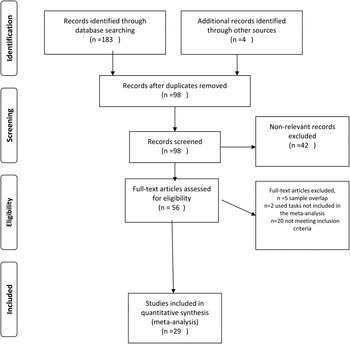
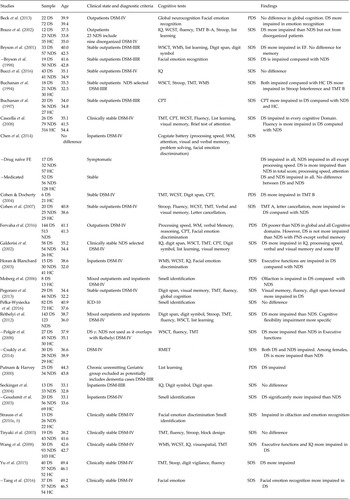
The selection process is summarized in Fig. 1. Seven studies were excluded as their samples were overlapping with other studies. Six other studies were excluded as they were using cognitive measures that are not included in the current meta-analysis. A total of 29 studies were included in the meta-analysis (Table 1).
PRISMA Flow Diagram for meta-analysis of studies investigating the cognitive performances of deficit and non-deficit schizophrenia.

Neurocognitive findings in deficit and non-deficit schizophrenia

DS, deficit schizophrenia; NDS, non-deficit schizophrenia; HC, healthy controls; WMS, Wechsler memory scale; WCST, Wisconsin card sorting test; TMT, trail making test; SDS, schedule for deficit syndrome; CPT, continuous performance test; WM, working memory; PDS, proxy for the deficit syndrome; RMET, reading the mind from the eyes test.
Deficit v. non-deficit schizophrenia
28 studies were included in the meta-analysis of deficit and non-deficit schizophrenia. Four of these reports were based on overlapping samples with other studies but reported social cognition and olfaction data not reported in other studies. Twenty-four main studies in this meta-analysis included 897 patients with deficit and 1636 patients with non-deficit schizophrenia. All but five of 28 studies used SDS to assess deficit syndrome status of the patients. There were significantly higher percentages of males in deficit compared with non-deficit schizophrenia (RR 1.13, CI 1.05–1.22, Z = 3.4, p < 0.001). There was no significant between-group difference for age (d = 0.09, CI −0.04 to 0.21, Z = 1.3, p = 0.18) and age of onset of illness (d = 0.03, CI −0.08 to 0.14, Z = 0.6, p = 0.57). The duration of education was significantly shorter in deficit compared with non-deficit schizophrenia (d = 0.27, CI 0.15–0.40, Z = 4.4, p < 0.001). Positive symptom severity was significantly more pronounced in non-deficit compared with deficit schizophrenia (d = 0.23, CI 0.08–0.38, Z = 2.9, p = 0.003). As expected, negative symptom severity was significantly more pronounced in deficit compared with non-deficit schizophrenia (d = 1.59, CI 1.15–2.03, Z = 7.1, p < 0.001).
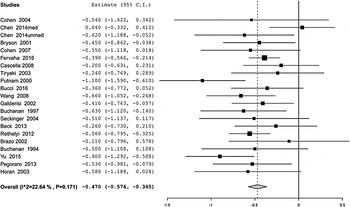
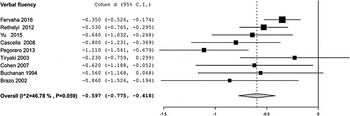
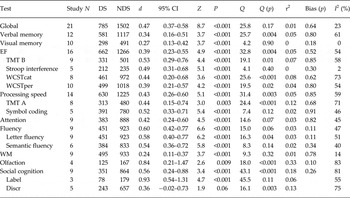
Global cognition was significantly impaired in patients with deficit schizophrenia in comparison with non-deficit patients with schizophrenia (d = 0.47, CI 0.36–0.58) (Table 2) (Fig. 2). In studies that used SDS, global cognition was also significantly more impaired (d = 0.49, CI 0.37–0.62, Z = 7.7, p < 0.001) in deficit in comparison with non-deficit schizophrenia. In meta-analyses of individual cognitive domains, patients with deficit schizophrenia performed significantly worse than patients with non-deficit schizophrenia in all cognitive domains (d = 0.24–0.60). The most significant differences were found for olfaction (d = 0.84, CI 0.21–1.47), verbal fluency (d = 0.60, CI 0.42–0.77) (Fig. 3), and social cognition (d = 0.56, CI 0.24–0.88). The distributions of effect sizes were significantly but modestly heterogeneous for verbal memory, executive functions, and processing speed (I 2 = 54–61%, τ 2 = 0.05–0.15). The heterogeneity of distribution of effect sizes was more significant for social cognition and olfaction [(I 2 = 81–83%, τ 2 = 0.18–0.33)]. Inspection of funnel plots and Egger's tests found no evidence of publication bias for any cognitive measure.
Forest plot of global cognitive differences between deficit and non-deficit schizophrenia.

Forest plot of verbal fluency differences between deficit and non-deficit schizophrenia.

Mean weighted effect sizes for differences between patients with DS and NDS on neurocognition

DS, deficit schizophrenia; NDS, non-deficit schizophrenia; d, Cohen's d; CI, confidence interval; TMT, trail making test; WM, working memory; WCST, Wisconsin card sorting test; EF, executive functions; Discr, discrimination, per, perseverative errors; cat, number of categories achieved.
In individual task analyses, patients with deficit schizophrenia were significantly impaired in all cognitive measures (d = 0.39–0.58). The most significant findings were between-group differences with medium effect sizes in labeling of facial emotions (d = 0.93, CI 0.54–1.31), letter fluency (d = 0.58, CI 0.40–0.77), semantic fluency (d = 0.54, CI 0.36–0.72), TMT B (d = 0.53, CI 0.29–0.76), and symbol coding (d = 0.52, CI 0.33–0.71).
The group differences between deficit and non-deficit schizophrenia were not significantly influenced by matching status (statistically matched v. non-matched) for age (d = 0.45 v. 0.53, Q bet = 0.68, p = 0.41), gender (d = 0.48 v. 0.42, Q bet = 0.55, p = 0.46), positive symptoms (d = 0.59 v. 0.40, Q bet = 1.44, p = 0.23), duration of illness (d = 0.46 v. 0.53, Q bet = 0.31, p = 0.58), and duration of education (d = 0.43 v. 0.55, Q bet = 0.72, p = 0.40). The effect sizes for the difference between deficit and non-deficit patients were not significantly different in studies that did or did not assure the clinical stability of included patients (Q bet = 1.02, p = 0.31).
Deficit schizophrenia v. healthy controls
Fifteen studies were included in the meta-analysis of deficit schizophrenia in comparison with healthy controls. Two of these reports were based on overlapping samples with other studies but reported social cognition data not reported in other studies. Thirteen main studies in this meta-analysis included 350 patients with deficit schizophrenia and 899 healthy controls. All studies used SDS to assess deficit syndrome status of the patients. There was a significantly a higher percentage of males in the deficit schizophrenia group compared with healthy controls (RR 1.23, CI 1.07–1.40, Z = 2.9, p = 0.004). Deficit schizophrenia and healthy control groups were very well matched for age (d = 0, CI −0.32 to 0.32, Z = 0.02, p = 0.99).
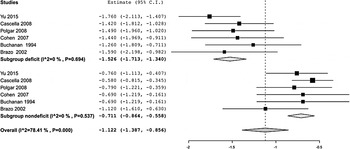
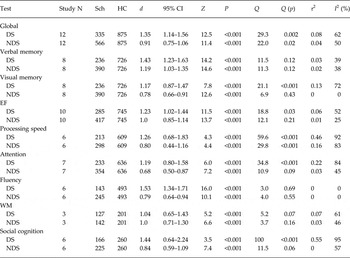
Global cognition was significantly impaired in patients with deficit schizophrenia in comparison with healthy controls (d = 1.35, CI 1.14–1.56) (Table 3). In meta-analyses of individual cognitive domains, patients with deficit schizophrenia performed significantly worse than healthy controls in all cognitive domains (d = 1.04–1.53). The largest effect size was found for verbal fluency (Fig. 4). The distribution of effect sizes was significantly heterogeneous for global cognition, social cognition, visual memory, executive functions, processing speed, and attention (I 2 = 52–95 %, τ 2 = 0.06–0.55). Inspection of funnel plots and Egger's tests found no evidence of publication bias for any cognitive measure.
Forest plot of verbal fluency impairments in deficit and non-deficit schizophrenia compared with healthy controls.

Mean weighted effect sizes for differences between patients with DS, NDS, and HC on neurocognitive domains

DS, deficit schizophrenia; NDS, non-deficit schizophrenia; d, Cohen's d; CI, confidence interval.
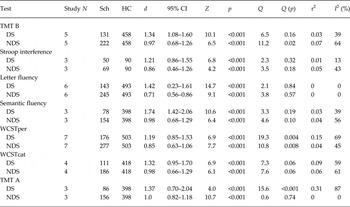
In individual task analyses, patients with deficit schizophrenia were significantly impaired in all cognitive tests, including WCST and verbal fluency measures, Stroop interference, TMT A and B (d = 1.19–1.74). The most significant findings were between-group differences in semantic fluency (d = 1.74, CI 1.42–2.06). The distributions of effect sizes were heterogeneous for WCST, and trail making A (Table 4).
Mean weighted effect sizes for differences between patients with DS, NDS and HC on individual cognitive tests

DS, deficit schizophrenia; NDS, non-deficit schizophrenia; Sch, schizophrenia; d, Cohen's d; CI, confidence interval.
In meta-regression analyses, global cognition and executive functions were not significantly related to gender (relative risk for male ratio), duration and age of onset of illness, and duration of education. Older age in non-deficit schizophrenia group was associated with more severe deficits in executive functions (Z = 2.6, p = 0.01) and global cognition (Z = 2.8, p = 0.005), but not with verbal and visual memory.
Non-deficit schizophrenia v. healthy controls
Fifteen studies were included in the meta-analysis of non-deficit schizophrenia in comparison with healthy controls. Two of these reports were based on overlapping samples with other studies but reported social cognition data not reported in other studies. Thirteen main studies in this meta-analysis included 592 patients with non-deficit schizophrenia and 899 healthy controls. All studies used SDS to assess non-deficit syndrome status of the patients. There was a significantly a higher percentage of males in the non-deficit schizophrenia group compared with healthy control group (RR 1.15, CI 1.05–1.25, Z = 3.1, p = 0.002). There was no significant difference for age between non-deficit schizophrenia and healthy controls (d = 0.21, CI −0.04 to 0.46, Z = 1.6, p = 0.11).
Global cognition was significantly impaired in patients with non-deficit schizophrenia in comparison with healthy controls (d = 0.91, CI 0.75–1.06) (Table 3). In meta-analyses of individual cognitive domains, patients with non-deficit schizophrenia performed significantly worse than healthy controls in all cognitive domains (d = 0.68–1.19). The distribution of effect sizes was significantly heterogeneous for global cognition and processing speed (I 2 = 50–83 %, τ 2 = 0.04–0.16). Inspection of funnel plots and Egger's tests found no evidence of publication bias for any cognitive measure.
In individual task analyses, patients with non-deficit schizophrenia were significantly impaired in all cognitive tests, including WCST and verbal fluency measures, Stroop interference, TMT A and B (d = 0.63–1.00). The distributions of effect sizes were heterogeneous for WCST and trail making B tests (I 2 = 45–64%, τ 2 = 0.04–0.07) (Table 4).
In meta-regression analyses, global cognition and executive functions were not significantly related to gender (relative risk for male ratio), duration and age of onset of illness, and duration of education. Older age in non-deficit schizophrenia group was associated with more severe deficits in executive functions (Z = 2.3, p = 0.02) but not in global cognition, verbal, and visual memory.
Discussion
The current quantitative systematic review was undertaken to appraise and synthesize the available evidence regarding differential neurocognitive profiles of deficit and non-deficit schizophrenia. The findings of the current meta-analysis suggest that both deficit and non-deficit schizophrenia are associated with widespread cognitive impairment. The cognitive performances of patients with non-deficit schizophrenia were intermediate between the performance of deficit schizophrenia and healthy controls in all cognitive domains.
Current meta-analysis is the first quantitative analysis of available studies comparing healthy controls with deficit and non-deficit schizophrenia. In studies that have not differentiated deficit syndrome, the cognitive impairment in schizophrenia is characterized by deficits with large effect sizes in executive functions, memory, processing speed, attention, working memory, and verbal fluency (Mesholam-Gately et al. Reference Mesholam-Gately, Giuliano, Goff, Faraone and Seidman2009; Bora et al. Reference Bora, Yücel and Pantelis2010a ; Bora, Reference Bora2015). Current findings suggest that severity of cognitive deficits are even larger for deficit schizophrenia. One of the cognitive domains, which was relatively more severely affected, was verbal fluency, including semantic fluency (d = 1.74) and letter fluency (d = 1.42). This is not surprising as alogia is a characteristic feature of patients presenting with persistent negative symptoms of schizophrenia. Social cognition was also relatively severely affected in deficit schizophrenia. This finding is compatible with the relatively strong relationship between negative symptoms and social cognition in schizophrenia (Brüne, Reference Brüne2005; Bora, Reference Bora2009). Our meta-analysis of cognitive performances of deficit in comparison with non-deficit schizophrenia patients extended findings of Cohen et al. (Reference Cohen, Saperstein, Gold, Kirkpatrick, Carpenter and Buchanan2007). The patients with deficit schizophrenia were more impaired in all cognitive domains compared with non-deficit schizophrenia. These findings supported the notion of global cognitive differences between deficit and non-deficit schizophrenia. However, it is important to note that there was some evidence of differential cognitive profile of deficit syndrome. The performances of deficit and non-deficit patients with schizophrenia were relatively similar in working memory, visual and verbal memory, and accuracy-based executive functions. On the other hand, effect sizes for differences between deficit and non-deficit schizophrenia in olfaction, labeling of facial emotions, verbal fluency, speed-based measures of executive functions, and processing speed were relatively larger (d = 0.43–93). More pronounced abnormalities in orbitofrontal and limbic cortices in deficit syndrome can explain relatively pronounced deficits in olfaction and social cognition in deficit schizophrenia in comparison with non-deficit schizophrenia (Kanahara et al. Reference Kanahara, Sekine, Haraguchi, Uchida, Hashimoto, Shimizu and Iyo2013; Good & Sullivan, Reference Good and Sullivan2015).
The patients with non-deficit schizophrenia also significantly underperformed healthy controls. However, effect sizes of observed deficits were relatively smaller compared with findings in deficit schizophrenia. For some cognitive domains (verbal fluency, processing speed, visual memory, visuospatial processing, and sustained attention), effect sizes found for non-deficit schizophrenia indicated medium (d = 0.5–0.8) rather than large deficits (d > 0.8). The magnitude of deficits in these domains was only slightly larger than findings in psychotic mood disorders and might be comparable with schizoaffective disorder (Bora et al. Reference Bora, Yucel and Pantelis2009, Reference Bora, Yücel and Pantelis2010b ). It is also interesting to note that affective symptoms are more common in patients with non-deficit compared with deficit schizophrenia (Kirkpatrick et al. Reference Kirkpatrick, Buchanan, Breier and Carpenter1994) and schizophrenia without persistent negative symptoms and affective psychoses might be associated with shared genetic risk factors (Craddock & Owen, Reference Craddock and Owen2010). In contrast, schizophrenia patients with persistent negative symptoms and severe cognitive impairment might be associated with separate genetic risk factors (Hallmayer et al. Reference Hallmayer, Kalaydjieva, Badcock, Dragovic, Howell, Michie, Rock, Vile, Williams, Corder, Hollingsworth and Jablensky2005; Bakker et al. Reference Bakker, Hoogendoorn, Hendriks, Verzijlbergen, Caron, Verduijn, Selten, Pearson, Kahn and Sinke2007; Holliday et al. Reference Holliday, McLean, Nyholt and Mowry2009). However, studies directly comparing cognitive profile of non-deficit schizophrenia with schizoaffective disorder and affective psychoses are lacking. Such studies are necessary to have a conclusive answer regarding similarity and potential differences between these syndromes. Also, it is important to note that non-deficit schizophrenia is a heterogeneous concept. Some patients with non-deficit schizophrenia have persistent negative symptoms, which were not considered as primary. Three studies have compared cognitive performances of deficit schizophrenia and other patients with persistent negative symptoms, and found less severe or no differences between groups (Brazo et al. Reference Brazo, Delamillieure, Morello, Halbecq, Marié and Dollfus2005; Dantas et al. Reference Dantas, Barros, Banzato, Fernandes and Li2011; Fervaha et al. Reference Fervaha, Agid, Foussias, Siddiqui, Takeuchi and Remington2016). Similarly, a single study which differentiated non-deficit patients with disorganization symptoms from other non-deficit patients found cognitive deficits comparable with deficit schizophrenia in the former group (Brazo et al. Reference Brazo, Delamillieure, Morello, Halbecq, Marié and Dollfus2005). These findings suggest that non-deficit schizophrenia patients without persistent negative and disorganization symptoms might have less severe cognitive deficits and can be better differentiated from deficit schizophrenia.
Current meta-analysis had the advantage of including neuropsychological data (i.e. including social cognition) in a large number of patients and originally included patient–control comparisons. The current meta-analysis suggests that neuropsychological studies support the validity of delineation of deficit v. non-deficit schizophrenia. However, it is important to consider the potential role of confounders, which can influence the differences between deficit and non-deficit patients with schizophrenia. Extrapyramidal symptoms and antipsychotics are among these factors and unfortunately, the vast majority of available studies have not reported between-group differences for extrapyramidal symptoms. Psychomotor side effects of antipsychotics might potentially affect speed-based deficits in schizophrenia. Some of the studies reported mean dose of antipsychotic and found no between-group differences. However, more detailed investigation of the effects of antipsychotics on differences between deficit and non-deficit schizophrenia are necessary. Stage of the illness is another consideration. Only a few available studies investigated cognitive functions in first-episode schizophrenia patients with persistent negative symptoms (Chen et al. Reference Chen, Jiang, Zhong, Jiang, Du, Li, Ma, Zhao, Hashimoto and Gao2014; Chang et al. Reference Chang, Lau, Chan, Hui, Chan, Lee, Lin and Chen2016). Also, the role of general intellectual abilities in group differences in social cognition, olfaction, and verbal fluency between deficit and non-deficit schizophrenia should be further investigated.
The current systematic review has a number of limitations. Some cognitive domains were investigated by a smaller number of studies. The heterogeneity of cognitive tasks used to assess cognitive domains is another consideration. Also, current review, like all meta-analyses, is limited with the quality of individual studies. For example, no relevant data to investigate the effect of potential confounders (i.e. medications, illicit substance and alcohol use, smoking) on cognitive deficits in deficit and non-deficit schizophrenia were reported in many studies. Also, meta-regression analyses of confounding variables might be underpowered as they use study-level rather the individual-level variables. Another consideration is the lack of sufficient studies that investigate the effect of clinical heterogeneity on cognitive deficits in non-deficit schizophrenia. The relationship between persistent negative and disorganized symptoms and neurocognition should be further investigated. Finally, no sufficient evidence is available regarding clinical implications of cognitive differences between deficit and non-deficit schizophrenia. For example, it is important to investigate the effect of deficit/non-deficit dichotomy on the outcome of cognitive remediation studies.
In conclusion, our findings suggest that there is consistent evidence for a significant relationship between deficit syndrome and more severe global cognitive impairment in schizophrenia. Severe deficits in social cognition, olfaction, verbal fluency, and other speed-based cognitive tasks might be relatively more strongly associated with deficit syndrome.
Supplementary material
For supplementary material accompanying this paper visit https://doi.org/10.1017/S0033291717000952.
Acknowledgement
Dr Bora is supported by The Scientific and Technological Research Council of Turkey (TÜBİTAK) BİDEB 2232 fellowship
Declaration of Interests
None.