Implications
Parasitism by gastrointestinal nematodes (GIN) is a major constraint of pasture-based small ruminant breeding systems. Bioactive forages that contain secondary compounds are one sustainable alternative strategy to the controversial use of chemical anthelmintics. In the present study, parasitized lambs and kids did not self-medicate with pelleted sainfoin (SF). This suggests that breeders should be cautious before relying on animals’ autonomy to select bioactive forages when parasitized, at least without animals having previously learned about the beneficial effects of forages.
Introduction
Gastrointestinal nematodes are one of the main issues affecting small ruminants raised at pasture, because of their consequences on both production losses and animal health and welfare. For more than 50 years, the conventional way to control parasites has been the use of chemical anthelmintics (AH). However, after a few decades, this quasi-exclusive use of chemical treatments has been challenged because of the constant development of resistance to the main, wide spectrum, AH families (Kaplan, Reference Kaplan2004). Moreover, the increasing societal demand to reduce the use of chemical compounds has prompted the use of natural plant products in agriculture and livestock husbandry. Therefore, research has focussed on finding new solutions to control GIN infections in sheep and goats, such as forages containing high concentrations of condensed tannins (CT), used as nutraceuticals (Hoste et al., Reference Hoste, Torres-Acosta, Sandoval-Castro, Mueller-Harvey, Sotiraki, Louvandini, Thamsborg and Terrill2015). In vitro and in vivo assays with tanniferous legumes such as sainfoin (SF) (Onobrychis viciifolia), sericea (Lespedeza cuneata) or sulla (Hedysarum coronarium) have shown promising AH effects (Hoste et al., Reference Hoste, Torres-Acosta, Sandoval-Castro, Mueller-Harvey, Sotiraki, Louvandini, Thamsborg and Terrill2015 and Reference Hoste, Torres-Acosta, Quijada, Chan-Perez, Dakheel, Kommuru, Mueller-Harvey and Terrill2016).
In sheep, and even more in goat grazing systems, CT-rich forages have sparked a great interest because of the far lower immune responses against parasites in goats than in sheep (Hoste et al., Reference Hoste, Sotiraki, Landau, Jackson and Beveridge2010). In addition, the browsing behaviour of goats, orientated towards the shrub layer often rich in plant secondary metabolites (PSM), has led to the assumption that they would be more willing to consume PSM-rich forages than sheep. These specific differences led to the consideration of two different strategies to control parasites, based on an immune response in sheep (‘fight strategy’) and on feeding behaviour in goats (‘flight strategy’) (Hoste et al., Reference Hoste, Sotiraki, Landau, Jackson and Beveridge2010).
Behaviourally speaking, small ruminants can modify their diet preferences to rectify nutrient imbalances or to avoid toxic compounds, via an associative learning process (Provenza, Reference Provenza1995). Diet selection then could be seen as the ‘constant quest for substances in the external environment that provide a homeostatic benefit to the internal environment’ (Villalba and Provenza, Reference Villalba and Provenza2007). In that way, herbivores may have the ability to select a feed rich in secondary metabolites to alleviate malaise. Some previous experiments have highlighted such abilities in sheep (Villalba et al., Reference Villalba, Provenza and Shaw2006), including scenarios when malaise was caused by the presence of GIN (Martínez-Ortíz-de-Montellano et al., Reference Martínez-Ortíz-de-Montellano, Vagars-Magaña, Canul-Ku, Miranda-Soberanis, Capetillo-Leal, Sandoval-Castro, Hoste and Torres-Acosta2010; Juhnke et al., Reference Juhnke, Miller, Hall, Provenza and Villalba2012; Amit et al., Reference Amit, Cohen, Marcovics, Muklada, Glasserd, Ungar and Landau2013). Conversely, others showed less conclusive results with only limited behavioural modifications or no evidence of self-medication (Lisonbee et al., Reference Lisonbee, Villalba, Provenza and Hall2009; Novelo-Chi et al., Reference Novelo-Chi, González-Pech, Ventura-Cordero, Torres-Acosta and Sandoval-Castro2014; Ventura-Cordero et al., Reference Ventura-Cordero, González-Pech, Jaimez-Rodriguez, Ortíz-Ocampo, Sandoval-Castro and Torres-Acosta2017 and Reference Ventura-Cordero, González-Pech, Jaimez-Rodriguez, Ortiz-Ocampo, Sandoval-Castro and Torres-Acosta2018). These experiments generally involved concentrate feeds enriched with quebracho tannins (e.g. 8% concentration in Juhnke et al., Reference Juhnke, Miller, Hall, Provenza and Villalba2012) or tropical or Mediterranean legumes and shrubs with naturally high CT concentrations (e.g. > 24% in Ventura-Cordero et al., Reference Ventura-Cordero, González-Pech, Jaimez-Rodriguez, Ortíz-Ocampo, Sandoval-Castro and Torres-Acosta2017 and Reference Ventura-Cordero, González-Pech, Jaimez-Rodriguez, Ortiz-Ocampo, Sandoval-Castro and Torres-Acosta2018). The question is whether a self-medicative behaviour can be observed when using a temperate fodder legume with natural but more moderate content in PSM. We focussed on SF, in a pelleted form, which showed AH activity against Haemonchus contortus (Gaudin et al., Reference Gaudin, Simon, Quijada, Schelcher, Sutra, Lespine and Hoste2016a).
Our objectives were to evaluate and compare the feeding behaviour of sheep and goats and their ability to self-select a tannin-rich feed because of its AH properties. The hypotheses are that the selection and motivation to get the tannin-rich feed would be greater in goats than in sheep, and greater in infected than in healthy individuals, especially for goats because of their reduced resistance against parasites and their greater willingness to consume PSM. Finally, we hypothesized that the intake of the tannin-rich feed would increase over time in infected animals as they progressively experienced the beneficial effects of tannin consumption.
Material and methods
The experiment was conducted indoors, in the facilities of the UE1414 Experimental Unit (Herbipôle) of INRA in central France.
General procedure
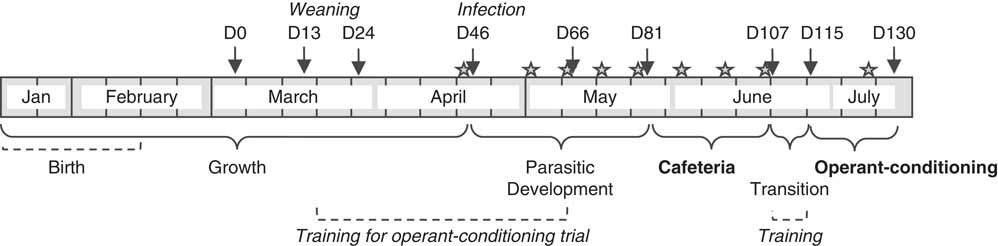
The experiment was conducted from March to July 2016, with young lambs and kids (born between mid-January and mid-February 2016). Due to differences in birth dates, we used 5 March as Day 0 (D0), when animals were weighed for the first time. The experiment consisted in five successive phases (Figure 1): (i) a ‘Growth’ phase from birth to experimental infection at about 2.5 months of age (D46), (ii) a ‘Parasitic development’ phase (35 days, D46 to D80) for the development of L3 larvae into adult nematodes with blood-sucking activity. Over these two phases (D24 to D65), animals were trained for the operant-conditioning trial (another short training occurred during the ‘Transition phase’), (iii) the cafeteria trial (first experimental phase, 24 days, D81 to D106) with daily free choice between SF and alfalfa, (iv) a ‘Transition’ phase (8 days, D107 to D114) and (v) the operant-conditioning trial (second experimental phase, 11 test days, D115 to D130) with short-term choice between SF (constrained) and alfalfa, to test animals’ motivation to get the tannin-rich feed.
Chronology of phases and events. Experimental phases (‘Cafeteria’ and ‘Operant-conditioning’ trials) appear in bold. Stars indicate times of lambs and kids weighing and of blood and faeces sampling.

Animals
Twenty female goat kids (Alpine breed) and 20 ewe lambs (Romane breed) were involved. From birth until weaning, all animals were fed artificial milk complemented with hay and concentrate for growth, to ensure they all had similar feeding experiences before the experiment. On D0, lambs weighed 14.3 kg (SD 2.83) and kids weighed 9.7 kg (SD 2.08). Due to differences in birth dates, weaning took place over 10 days, considering a minimum of 5 weeks of artificial milking, as commonly practiced in the field. Weaning was complete for all individuals on D13 (Figure 1). Until D65, animals were housed in a ventilated and artificially lighted (0700 to 1600 h) building, in the same room (designed as the ‘breeding room’), but in two adjacent pens (one per species). The pens were bedded with sawdust and animals had free access to fresh water and minerals.
On D39, we checked that there was no parasite egg excretion in faeces using the modified McMaster procedure (Raynaud, Reference Raynaud1970). On D46, within each species, animals were stratified by BW and blood packed cell volume (PCV), and assigned to two groups (n = 10) balanced for these factors. ‘Parasitized’ animals (P) received a single dose of third stage larvae of a susceptible strain of H. contortus, at the dose rate of 170 L3/kg BW (i.e. on average 3050 and 4620 L3 for kids and lambs, respectively); ‘non-parasitized’ (NP) animals remained uninfected and composed the control groups. Each pen was then divided in two equal smaller pens to host the four groups separately.
Experimental feeds and feeding management
We used SF (O. viciifolia – SFexp; 15.9% CP; 18.8 MJ/kg dry matter (DM) gross energy (GE); 361 g/kg DM NDF) and alfalfa (Medicago sativa – ALFexp; 15.7% CP; 18.0 MJ/kg GE; 460 g/kg NDF) as experimental feeds. These feeds were in a pelleted form, which allows standardizing the product with a better control and stability of conservation and quality over time. The SFexp pellets were chosen based on their CT concentration (3.82% v. 0% for ALFexp, HCl–Butanol method; Grabber et al., Reference Grabber, Zeller and Mueller-Harvey2013) and on their biological activity assessed in previous assays (Gaudin et al., Reference Gaudin, Quijada, El Korso, Ramsay, Gerfault, Ginane and Hoste2016b).
In addition, animals received other feeds, either as a basal diet during the non-experimental phases (‘Growth’, ‘Parasitic development’, ‘Transition’, Figure 1) or as a complement of the legume pellets during the trials. During the ‘Growth’ and ‘Parasitic development’ phases, animals received pasture hay (6.6% to 7.7% CP; 607 to 699 g/kg NDF; ad libitum) and a commercial concentrate for lamb growth (16% CP; 1 kg/lamb and 0.8 kg/kid). From the 4th week of the ‘Parasitic development’ phase (D66), animals were moved into the location used for the cafeteria trial for habituation, and were subjected to a feeding transition towards legume pellets. We used a different pelleted alfalfa (ALFhab; 15.3% CP; 340 g/kg NDF) and SF (SFhab; 16.7% CP; 441 g/kg NDF; 2.4% CT) to prevent animals being confronted with the experimental feeds at this stage, while they were housed by pair, which prevented any measurement of individual intakes (see below). SFhab had a lower CT content than SFexp, to prevent animals gaining too much experience with CT before the trial. We also provided small amounts of hay (200 g), including during the cafeteria trial, to provide fibre for digestion.
During the ‘Transition’ phase, animals progressively returned to a diet based on hay offered ad libitum and on commercial concentrate and barley (150 g/animal).
During the operant-conditioning trial, the basal diet was composed of hay (from 0.8 to 1.2 kg per lamb, from 0.5 to 0.9 kg per kid, according to refusals) complemented with a mixture of 50:50 SFexp and ALFexp (w/w basis) in amounts corresponding to 40% of daily intakes recorded during the cafeteria trial. This aimed at lowering the risk that animals would be motivated by the legume pellets in the test arena and would just eat the most accessible one without making a discriminative choice. The diet was offered after the tests, except for the provision of 100 g of hay (per animal) at 1200 h.
Sampling procedures and measurements
At infection (D46), then from D59, parasite eggs excretion and anaemia were monitored weekly, by collecting faecal samples (rectally) and blood samples (jugular venipuncture) for each individual. Faecal egg counts (FEC) were assessed using the modified McMaster procedure. Blood PCV was assessed using a micro-haematocrit centrifuge and reader. Packed cell volume can be used as an indicator of host resilience when infected with blood-sucking nematodes such as H. contortus (Hoste et al., Reference Hoste, Torres-Acosta, Sandoval-Castro, Mueller-Harvey, Sotiraki, Louvandini, Thamsborg and Terrill2015). At the same dates, animals were weighed using an electronic scale.
Experimental trials
Training of animals for the operant-conditioning trial
The training occurred over 20 days between D24 and D65, to familiarize animals with the test arena and with the principle of the test. Animals were introduced in the arena for 5 min daily, firstly, by small groups then by pairs, using a concentrate feed as the reward. After 3 (for kids) and 9 (for lambs) training days, animals were tested individually. After 15 days, ALFhab was added and then SFhab replaced the concentrate. All animals had learnt the principle of the test before the start of the cafeteria trial. On D107 to D114, another 4-day training session was performed to remind animals the principle of the test. All animals performed well.
Cafeteria trial (D81 to D106)
On D66, animals were transferred to the cafeteria trial device for habituation during 15 days. It was located in another room of the building and was composed of 20 individual pens (3 m2) equipped with two adjacent troughs allowing individual measurements of daily feed intakes. During habituation, animals were housed by pair in each pen. During the trial, because of the restricted number of pens, each group of 10 animals was split in two subgroups for the measurements. One subgroup stayed in the device for 4 consecutive days while the other subgroup returned to the breeding room. In the cafeteria device, animals were then penned individually and had access to two troughs, one filled with ALFexp and the other one with SFexp (sides changed every day), offered ad libitum from 0900 to 1600 h. During those days, the animals that returned to the breeding room were fed the same feeds in two separated racks. The two subgroups alternated in the cafeteria device every 4 days. This was repeated three times (three periods of 8 days (4 per subgroup)) over 24 days. The animals stayed in this device until D106.
Operant-conditioning trial (D115 to D130)
The trial aimed to test animals’ motivation to get a reward (SFexp) by imposing a moving constraint. The arena consisted in a U-shape corridor surrounded by 1.5-m high gird panels, with an entrance door at both ends. The schematic overview is presented in Supplementary Figure S1. The middle part was made of 2-m high wooden panels. Adjacent to the arena, a buffer zone allowed isolation of the test animal just before and just after the test. Two waiting pens completed the device, for the animals before and after being tested.
At each entrance of the arena, the animal had access to two bowls. One was filled with restricted amounts of SFexp (10 or 25 g) and the other one with 200 g of ALFexp (considered ad libitum for the 5 min-long tests). Once the SFexp reward consumed, the animal had the choice between consuming ALFexp or walking through the arena to get another reward. As soon as the animal started to consume one of the feeds on one side of the arena, the operator removed the eventual refusals of SFexp on the opposite side, and refilled the SFexp bowl with a new reward. Food was provided by either one of two familiar operators, through a trapdoor within the panel that made him invisible to the animals. Each animal was individually tested for 5 min from the moment it went through one entrance door (changed daily). The amount of 10 g for the SFexp reward was chosen to be within a shift zone defined in a previous study (Catanese et al., Reference Catanese, Distel, Fernández and Villalba2016) where there was an individual variability in the propensity to walk for the reward. In the same way, the amount of 25 g was chosen to be above this shift zone.
We performed three consecutive sessions. On the first two sessions, the animals had a choice between SFexp and ALFexp, with the two SFexp rewards (10 and 25 g) being tested in either sessions 1 or 2 using a crossover design. Sessions lasted for 4 days. On D1, only SFexp was offered to make animals aware of the reward proposed. On D2, D3 and D4, animals had choice between both feeds. In session 3, only SFexp was presented, both in the reward bowl (25 g) and in the bowl where alfalfa used to be. This aimed to assess lambs’ and kids’ propensity to move in the arena independently of the feed presented, in order to take it into account in behavioural analyses (used as covariate). Session 3 lasted for 3 days, 1 day with only the reward bowls filled and 2 days with both types of bowls filled.
The tests were performed from 0845 to 1215 h and from 1315 to 1645 h, 5 days a week, with two groups being tested on the morning and the other two on the afternoon. The passage order of each group changed daily according to a Latin square design. In return, animals passage order within a group was determined by individuals’ willingness to go to the test arena, to avoid stress due to sorting animals within the waiting pen. Two video cameras positioned over each entrance door recorded animals’ behaviour, which was encoded using ‘The ObserverTM software (XT12 version 12.5, Noldus, The Netherlands)’. The observed behaviours (feeding and sniffing at the bowls, walking, idling, exploring and number of laps executed) were used to calculate the times spent feeding and walking, the walking speed to get the reward and intake rates of each feed. We also recorded the number of SFexp rewards distributed and weighed all refusals to assess SFexp and ALFexp intakes for each individual test.
Statistical analyses
All data were analysed using the SAS software (SAS Enterprise Guide, v5.1) and the mixed procedure. The normality of residuals was checked and we proceeded to variable transformation when needed (square root transformation for FEC; arcsine transformation for SFexp preference ratio in the conditioning trial). We expressed intake data relative to metabolic weight (BW0.75) to account for differences in BW between animal species. The individual animal was the experimental unit.
Data relative to animals’ BW, FEC and PCV were analysed for the effects of animal species, parasitic status (except for FEC with only P animals considered), day and their interactions. We considered the animal as the random factor and used the repeated statement with the autoregressive covariance structure to account for the measurements being made on the same animals on different dates.
For the cafeteria trial, we averaged intakes of the last 2 days, considering the first ones as a period of re-habituation to the device. We analysed daily DM intakes of SFexp and ALFexp, total intake, and SFexp preference (intake ratio). The factors tested were the species, parasitic status, period and interactions. Random factors were the subgroups and the individuals, while period was the repeated factor. Lastly, we performed a Student t test to assess whether SFexp preference differed from the 0.5 value of no preference.
For the operant-conditioning trial, we analysed SFexp, ALFexp and total DM intakes, SFexp preference (intakes ratio), SFexp intake rate (without considering walking time), lap number, walking speed, and the time spent towards feeds (eating, sniffing the feeds, walking to get the feeds). We tested the effects of species, parasitic status, reward and their interactions, and session. Data obtained from session 3 were included as a covariate. We used the individual nested in the sequence of reward presentation (10 to 25 and 25 to 10) as the random factor.
Results
Animal performance and parasitic loads
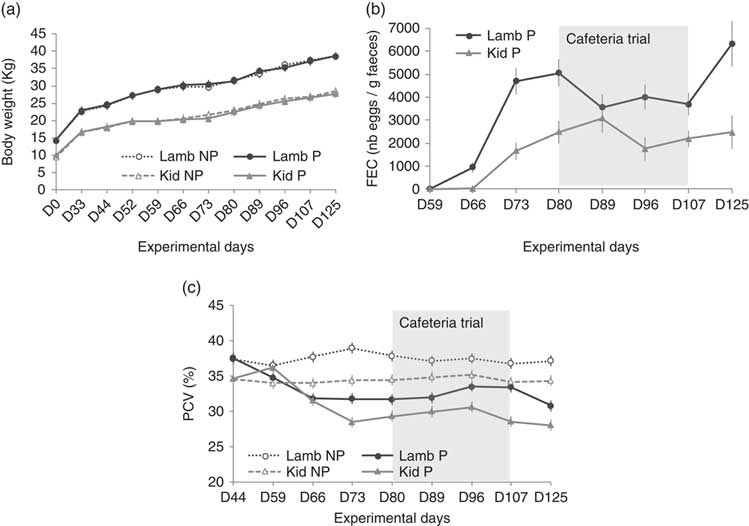
The infection with nematodes did not affect animals’ growth (P = 0.93) (Figure 2a). Lambs were always heavier than kids (P<0.0001), but growth patterns were similar with an average daily weight gain of 195 g (SD 25) in lambs and 148 g (SD 17) in kids.
Effect of species (lambs, kids) and parasitic status (P = parasitized; NP = non-parasitized) on (a) BW (kg), (b) faecal egg count (FEC, eggs/g faeces) and (c) blood packed cell volume (PCV, %). The grey square represents the time of the cafeteria trial. Data are lsmeans±SEM. For FEC, means are back transformed lsmeans (square root transformation), and errors are SEM of rough data.

All infected animals showed excretion of parasite eggs, while no excretion was recorded in NP animals (Figure 2b). Lambs had greater FEC values than kids and evolution patterns were different (Species × Day, P = 0.0001). In P lambs, egg excretion started from 3 weeks after infection and quickly reached a peak 2 weeks later. Excretion was quite stable during the cafeteria trial, despite a decline during its 1st week (P<0.01). Finally, FEC increased at the end of the experiment (P = 0.001). For kids, the kinetics of excretion seemed staggered by 1 week relative to lambs. Egg output decreased during the 2nd week of the cafeteria trial (P = 0.002), though being stable across the whole trial (difference D80 to D108, P = 0.59), and did not increase on the last part of the experiment.
Concerning PCV, data were affected by host species, parasitic status and day (three-way interaction, P = 0.018; Figure 2c). From the day of infection, lambs showed greater PCV than kids (P = 0.01). Packed cell volume was stable throughout the experiment in NP animals but dropped in P ones, with a significant difference between groups from D66 (3 weeks after infection, P<0.001). Packed cell volume stabilized after D66 in lambs, then slightly increased towards the end of the cafeteria trial (P<0.05) before dropping again (P<0.0001). For kids, PCV decreased until D73, then increased during the cafeteria trial (P = 0.003), and finally decreased again (P = 0.0002).
Cafeteria trial
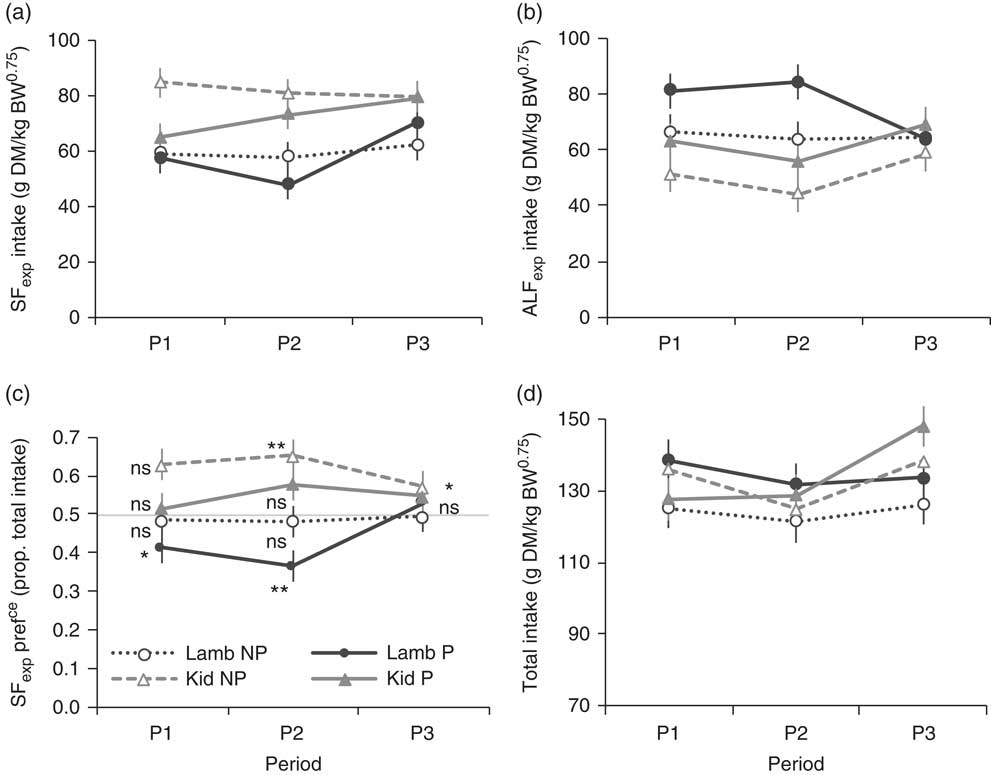
The P values associated with this trial are presented in Supplementary Table S1. Sainfoin intake (SFexp) was higher in kids than in lambs, independently of their parasitic status (+ 30% on average) (Figure 3a; Supplementary Table S1). Through periods, SFexp intake was stable in NP animals but increased in P ones (+22% between P1 and P3, P = 0.002). It was lower in P than in NP animals in P1 (P = 0.05) but similar between groups hereafter. ALFexp intake was greater in P than in NP animals, regardless of the species (Figure 3b; Supplementary Table S1). It was greater in lambs than in kids in P1 and P2 (P = 0.01) but no more in P3 (P = 0.99), because lambs slightly decreased ALFexp intake in P3 (P = 0.056) while kids increased it at the same time (+29%, P = 0.009). Total daily feed intake increased between P2 and P3 (P = 0.014) (Figure 3d; Supplementary Table S1).
Cafeteria trial – effect of species (lambs, kids) and parasitic status (P = parasitized; NP = non-parasitized) on (a) daily sainfoin (SFexp) intake, (b) alfalfa (ALFexp) intake, (c) sainfoin preference and (d) total intake, according to period (P1 to P3). Intakes are expressed per kilogram of metabolic weight. Sainfoin preference represents the ratio of SF intake over total intake. Data are lsmeans±SEM. For figure (c), ‘ns’, ‘*’ and ‘**’ mean no difference, difference at P<0.05 and P<0.01, respectively, relative to the value of no preference (0.5) (Student t-test). DM = dry matter.

Preference for SFexp was greater in kids than in lambs in P1 (P = 0.004) and P2 (P = 0.0001) (Figure 3c; Supplementary Table S1) but no more in P3 (P = 0.25) due to an increase in preference by lambs (P lambs mainly) between P2 and P3 (P = 0.005). SFexp preference was greater in NP than in P animals in P1 (P = 0.029) and P2 (P = 0.025), but no more in P3 (P = 0.9) because P animals (lambs mainly) increased their preference from P1 to P3 (P = 0.028), while NP ones did not (P = 0.47). Student t-tests showed that SFexp preference was not different from 0.5 in P kids and NP lambs. In NP kids, SFexp preference was greater than indifference in P2 (t = 3.82, P = 0.004) and P3 (t = 2.26, P = 0.05), and tended to be greater in P1 (t = 2.12, P = 0.063) due to the high individual variability across subgroups. In P lambs, SFexp preference was lower from indifference in P1 (t = 2.59, P = 0.029) and P2 (t = 3.99, P = 0.003).
Operant-conditioning trial
Regardless of species, parasitic status or SFexp rewards, the time animals spent on doing tests (sum of behaviours directed towards feed procurement) was above 285 s over the 300 s of test duration (Table 1).
Operant-conditioning trial – dry matter intakes (DMI), preferences, intake rates (IR), time on test, walking speed and laps number according to animal species (lambs, kids (Sp)), parasitic status (St), SFexp reward (Re) and associated P-values

SFexp = experimental sainfoin; ALFexp = experimental alfalfa; pref = preference; P = parasitized; NP = non parasitized; SEM = standard error of mean from mixed models output.
1 Values are back transformed lsmeans (arcsine transformation) and SEM are from rough data.
2 Time on test represents the sum of times spent in behaviours directed towards feed procurement (test duration: 300 s) Sp × St × Re interactions were never significant and are not presented in the Table; Cov represents data from session 3 used as covariate.
SFexp intake was not affected by species nor parasitic status, but – in contrast to ALFexp intake – increased with reward level. ALFexp intake was similar in P kids, P and NP lambs but twice lower than in NP kids (P = 0.0001). The same pattern was observed for total intake (P = 0.0001, Table 1).
Contrary to the cafeteria trial, SFexp preference was not greater in kids than in lambs (Table 1). Parasitized kids expressed a greater SFexp preference than NP kids (P = 0.05), but this was due to their lower ALFexp intake rather than to a greater SFexp intake. In lambs, both parasitic status expressed similar SFexp preferences (P = 0.10) though being numerically greater in NP individuals. SFexp preference increased with reward level regardless of the group.
Intake rate of SFexp at the bowls was similar between species and parasitic status, but increased with the reward. Finally, laps number and walking speed were similar between species, status and rewards (Table 1).
Discussion
We hypothesized that the selection and motivation to get a tannin-rich feed would be greater in goats than in sheep, greater in infected than in healthy individuals (particularly in goats), and that the intake of the tannin-rich feed would increase over time in infected animals as they progressively experienced the beneficial effects of tannins.
The effectiveness of experimental infection
We chose to administer parasite larvae relative to BW, to take account of weight differences between species. This may be consistent with differences in grass intakes at pasture, and so larvae ingestion, in animals of different BWs. We administered H. contortus larvae at the rate of 170 L3/kg BW, in order to obtain an effective infection perceived by the animal while lowering the risk of strong health impairments possibly implying chemical treatment and animals removal from the experiment. Infective dose rates ranging from 100 to 400 L3/kg BW were already used to induce sub-clinical parasitism (Martínez-Ortíz-de-Montellano et al., Reference Martínez-Ortíz-de-Montellano, Vagars-Magaña, Canul-Ku, Miranda-Soberanis, Capetillo-Leal, Sandoval-Castro, Hoste and Torres-Acosta2010; Khan et al., Reference Khan, Sahoo, Dhakad, Pareek and Karim2011). All our P animals were infected, with an average egg output ranging between 3000 and 5000 eggs/g at the peak of infection, which was comparable or even greater than those observed in studies reporting self-medication with sheep and H. contortus (Martínez-Ortíz-de-Montellano et al., Reference Martínez-Ortíz-de-Montellano, Vagars-Magaña, Canul-Ku, Miranda-Soberanis, Capetillo-Leal, Sandoval-Castro, Hoste and Torres-Acosta2010; Juhnke et al., Reference Juhnke, Miller, Hall, Provenza and Villalba2012; Méndez-Ortíz et al., Reference Méndez-Ortíz, Sandoval-Castro and Torres-Acosta2012). The clear drop in PCV 3 to 4 weeks after infection confirmed worms’ activity in P animals. Notwithstanding these moderate signs of infection, animals’ growth and daily feed intakes were similar in P and NP animals, while infection with H. contortus often leads to clinical signs such as anaemia, anorexia and delayed growth rate (Knox et al., Reference Knox, Torres-Acosta and Aguilar-Caballero2006; Besier et al., Reference Besier, Kahn, Sargison and Van Wyk2016). Hence, our experimental infection was effective but moderate, even when we cannot assess the levels of malaise that were experienced by the animals.
‘Fight and flight strategies’
As presented by Hoste et al. (Reference Hoste, Sotiraki, Landau, Jackson and Beveridge2010), strategies to control gastrointestinal parasites would be different in sheep (based on immunity: ‘fight’) and goats (based on behaviour: ‘flight’). The duration of the study (3 months between infection and experiment ending), was probably too short to allow an effective development of immunity in lambs, which generally develops at 6-months of age and consequently to repeated parasite exposures (Schallig, Reference Schallig2000). The FEC increase and PCV decrease in lambs after the cafeteria trial are consistent with the unlikely development of immunity.
In the cafeteria trial, SFexp preference was globally greater in kids than in lambs, due to greater SFexp and lower ALFexp intakes. This is consistent with the propensity of goats to consume PSM due to their browsing behaviour on the shrub layer, often rich in PSM and to their greater ability to detoxify these compounds than sheep (Silanikove, Reference Silanikove1997).
Furthermore, the SFexp preference in P individuals never exceeded that observed in their NP counterparts, regardless of species; actually, the reverse pattern occurred in periods 1 and 2 (cafeteria trial). Nevertheless, we observed an increased SFexp intake across periods only in P animals, which is consistent with a learning process. In lambs, this increase was associated with a slight decrease in ALFexp intake. In kids, as SFexp and ALFexp intakes increased concomitantly, SFexp preference remained stable. Increases in SFexp daily intakes were not negligible (+240 g DM and +260 g DM between P1 and P3 in kids and lambs, respectively). However, this result did not lead, after 24 days of free choice, neither to a clear preference for SFexp nor to greater SFexp intakes in P than in NP animals, regardless of species. The operant-conditioning trial did provide similar results. In lambs, SFexp intake and preference were similar in P and NP individuals. In kids, the greater SFexp preference in P than NP animals actually was due to a greater ALFexp intake in NP kids rather than to a greater SFexp intake in P subjects. In addition, none of the expected responses to the decrease in SFexp reward in P animals (greater SFexp intake rate, increased number of laps, increased walking speed) was observed.
In summary, we did not observe curative self-medication nor greater self-medication in kids than in lambs. Rather, lambs behaved more consistently with self-medicative behaviour (increase in SFexp intake and preference by P lambs through the cafeteria trial). Such absence of self-medication is in accordance with recent studies involving goats under tropical conditions (Novelo-Chi et al., Reference Novelo-Chi, González-Pech, Ventura-Cordero, Torres-Acosta and Sandoval-Castro2014; Ventura-Cordero et al., Reference Ventura-Cordero, González-Pech, Jaimez-Rodriguez, Ortíz-Ocampo, Sandoval-Castro and Torres-Acosta2017 and Reference Ventura-Cordero, González-Pech, Jaimez-Rodriguez, Ortiz-Ocampo, Sandoval-Castro and Torres-Acosta2018). Conversely, it contrasts with other ones showing greater intakes or preferences for the tannin-rich diet in P than in NP animals (sheep: Martínez-Ortíz-de-Montellano et al., Reference Martínez-Ortíz-de-Montellano, Vagars-Magaña, Canul-Ku, Miranda-Soberanis, Capetillo-Leal, Sandoval-Castro, Hoste and Torres-Acosta2010; Méndez-Ortíz et al., Reference Méndez-Ortíz, Sandoval-Castro and Torres-Acosta2012; goats: Amit et al., Reference Amit, Cohen, Marcovics, Muklada, Glasserd, Ungar and Landau2013), or changes in preference as a function of parasitic load evolution (sheep: Juhnke et al., Reference Juhnke, Miller, Hall, Provenza and Villalba2012), highlighting that the self-medication might not be a generalized phenomenon.
Sainfoin efficacy against parasites and perception by the host of sainfoin effects
Compared to the previously cited studies, the CT content of SFexp was quite low (3.8%). However, greater levels of CT do not necessarily imply greater efficacy against parasites nor evidence of self-medication. For example, Martínez-Ortíz-de-Montellano et al. (Reference Martínez-Ortíz-de-Montellano, Vagars-Magaña, Canul-Ku, Miranda-Soberanis, Capetillo-Leal, Sandoval-Castro, Hoste and Torres-Acosta2010) showed greater intakes of Lysiloma latisiliquum in P than NP sheep, while the CT content was 5.5%. Inversely, Ventura-Cordero et al. (Reference Ventura-Cordero, González-Pech, Jaimez-Rodriguez, Ortíz-Ocampo, Sandoval-Castro and Torres-Acosta2017), who proposed four plants with CT contents ranging from <1% to 40% showed an absence of self-medication in goats. Moreover, results confirming a role of the quality of CT (prodelphinidin/procyanidin ratio) in the AH activity have been accumulated recently (Li et al., Reference Li, Leverence, Trombley, Xu, Yang, Tian, Reed and Hagerman2010) and could be extended to a difference in perception by the host. Such CT quality appears to be different in quebracho (used by Juhnke et al., Reference Juhnke, Miller, Hall, Provenza and Villalba2012, mainly procyanidin) and in SF (mainly prodelphinidin). Nevertheless, some recent studies performed with SF pellets, report promising effects on H. contortus (Gaudin et al., Reference Gaudin, Simon, Quijada, Schelcher, Sutra, Lespine and Hoste2016a), confirming previous results on anthelminthic efficacy of SF hay or silage (Heckendorn et al., Reference Heckendorn, Häring, Maurer, Zinsstag, Langhans and Hertzberg2006).
Ruminants are able to perceive the post-ingestive effects of feeds and to modify their diet selection accordingly (Provenza, Reference Provenza1995), provided that the animal perceives the consequences promoted by the ingested feeds. When considering medicinal consequences of foods, such as AH consequences, some points can be highlighted, as detailed by Hart (Reference Hart2005).
First, the nature of the beneficial effects on the host. Condensed tannins can affect the biology of adult nematodes mainly by decreasing females’ fertility (Martínez-Ortíz-de-Montellano et al., Reference Martínez-Ortíz-de-Montellano, Vagars-Magaña, Canul-Ku, Miranda-Soberanis, Capetillo-Leal, Sandoval-Castro, Hoste and Torres-Acosta2010; Gaudin et al., Reference Gaudin, Simon, Quijada, Schelcher, Sutra, Lespine and Hoste2016a) and/or by decreasing worms’ lifetime (Heckendorn et al., Reference Heckendorn, Häring, Maurer, Zinsstag, Langhans and Hertzberg2006). For the infected herbivores, this can greatly influence its perception of the infection because if the number of active worms remains stable, the associated detrimental effects on the host would be maintained as well.
Second, the similarities between feeds. We used two pelleted legumes with similar protein concentrations, so that CT content was the main difference, but this may have impaired animals’ ability to discriminate between them. Sheep have already shown good abilities to discriminate feeds (Ginane and Dumont, Reference Ginane and Dumont2011), including two pelleted SF differing in their CT content (Costes-Thiré et al., Reference Costes-Thiré, Villalba, Hoste and Ginane2018). Failure to discriminate feeds is thus unlikely. In turn, SFexp and ALFexp were of good and comparable protein content. Infections with GIN induce damages along the digestive tract, associated with protein losses (Knox et al., Reference Knox, Torres-Acosta and Aguilar-Caballero2006). Thus, it is possible that ALFexp improved animals’ resistance towards H. contortus due to its nutritional value, thereby reducing their perception of a medicinal difference between feeds. Some studies have also shown the ability of sheep to increase their protein ingestion when infected (Kyriazakis et al., Reference Kyriazakis, Anderson, Oldham, Coop and Jackson1996). In fact, parasitized herbivores in some feeding contexts may prioritize the consumption of certain nutrients that also contribute to the maintenance of a low gastrointestinal infection, over selection of medicinal PSM. For instance, parasitized goats offered foliage of five plant species with decreasing concentrations of CT, balanced their nutrient intake without affecting their selection of CT-rich plants relative to their NP counterparts (Ventura-Cordero et al., Reference Ventura-Cordero, González-Pech, Jaimez-Rodriguez, Ortiz-Ocampo, Sandoval-Castro and Torres-Acosta2018). This balance may have helped infected individuals maintain low levels of parasitic burdens without the need to increase their preference for CT-rich plants (Ventura-Cordero et al., Reference Ventura-Cordero, González-Pech, Jaimez-Rodriguez, Ortiz-Ocampo, Sandoval-Castro and Torres-Acosta2018). Likewise, parasitized sheep offered choices among feeds differing in concentration of energy, protein and in the presence of CT, showed that an energy-dense feed was the main driver influencing diet preference regardless of CT, a choice that may have also contributed to control the parasitic infection (Costes-Thiré et al., unpublished results).
Third, the inertia of changes – or the delay between behaviour (ingestion) and reinforcement (consequence) (Hart, Reference Hart2005). Diet learning improves with the contiguity between the behaviour and its consequence (Burritt and Provenza, Reference Burritt and Provenza1991). With gastrointestinal parasitism, several days of substantial intakes of a tannin-rich feed are necessary for an AH effect to occur (Hoste et al., Reference Hoste, Torres-Acosta, Quijada, Chan-Perez, Dakheel, Kommuru, Mueller-Harvey and Terrill2016), and this may greatly impair the learning process.
Finally, the choice situation. The association between food intake and subsequent postingestive consequences is generally made difficult when the animal ingests more than one feed at a time (Favreau et al., Reference Favreau, Baumont, Duncan and Ginane2010). Consistently, in Juhnke et al. (Reference Juhnke, Miller, Hall, Provenza and Villalba2012) who reported self-medication, there was a conditioning period where the tannin-rich feed was offered as the sole feed for several days, while in Ventura-Cordero et al. (Reference Ventura-Cordero, González-Pech, Jaimez-Rodriguez, Ortíz-Ocampo, Sandoval-Castro and Torres-Acosta2017), four plants were simultaneously offered. Conditioning with single foods or plants allows animals to overcome neophobia, and increases the likelihood of animals associating a food with its specific consequences. We did not include a conditioning period in the present experiment because we wanted to test sheep and goats’ ability to disentangle the consequences of each feed by themselves. Thus, a conditioning period seems important for the animals to perceive the consequences of the ingested feeds (e.g. SF; Costes-Thiré et al., Reference Costes-Thiré, Villalba, Hoste and Ginane2018). Furthermore, such a period corresponds to the cures with bioactive forages (nutraceuticals) (Hoste et al., Reference Hoste, Torres-Acosta, Sandoval-Castro, Mueller-Harvey, Sotiraki, Louvandini, Thamsborg and Terrill2015) that can be recommended on-farm as an alternative to chemical AH for the control of GIN infections.
Conclusion
This study showed evidence of the absence of curative self-medication with SF pellets in infected lambs and kids. Kids were more willing than sheep to consume the tannin-rich feed but did not show a greater ability to self-medicate. Actually, sheep behaved more consistently with curative self-medicative behaviour by increasing SFexp intake and preference throughout the cafeteria trial. This could be seen in line with the study of Amit et al. (Reference Amit, Cohen, Marcovics, Muklada, Glasserd, Ungar and Landau2013), where goats that initially were the most reluctant to consume the PSM-rich feed developed the strongest preference for this feed once parasitized. This aspect may deserve more investigation in the future. In the literature, some studies reported behaviours in accordance with self-medication whereas others did not. The great majority used gastrointestinal parasitism as ailment and feeds rich in secondary compounds as medicine. Considering the issues raised about this model and discussed above, other models may deserve to be considered to assess livestock abilities to self-medicate.
Acknowledgements
The authors acknowledge the financial support of the STReP project from INRA metaprogram focused on the integrated management of animals’ health (GISA), the French Agency for Research (ANRt) for the CIFRE PhD thesis 2013/1480 of E. Gaudin, and the Phase INRA department and Auvergne region for the PhD thesis of M. Costes-Thiré. The authors also particularly acknowledge the help of Mickaël Bernard, Aline Cercy and Bruno Viallard for taking care of the animals, and MG2MIX for providing the SF pellets.
Declaration of interest
The authors disclose that there is not any conflicts of interest associated with this manuscript.
Ethics statement
The protocol was examined and validated by the regional ethical committee and approved by the French Research Ministry, under no. 2015121609019762.
Software and data repository resources
None of the data were deposited in an official repository.
Supplementary material
To view supplementary material for this article, please visit https://doi.org/10.1017/S175173111800304X