Introduction
From the first use of health technology assessment (HTA) in the 1970s, ethics has been a key element (Reference Banta1). There are many reasons for this (Reference Hofmann2): HTA is a type of policy evaluation and ethics is the “science of values.” Addressing ethical issues of a health technology (HT) involves “an understanding of the consequences of implementing or not implementing a healthcare technology in two respects: with regard to the prevailing societal values and with regard to the norms and values that the technology itself constructs when it is put into use” (3). The HTA process itself also raises normative issues. Value judgments are involved in making decisions on how to conduct an assessment, from prioritizing which HT needs an assessment, the selection of outcome measures, to deciding upon which information is reported to decision makers and the general public (Reference Hofmann4).
Ethical analysis recognizes that values play an integral role throughout a HTA (Reference Hofmann, Bond and Sandman5;Reference Legault6), and this seems to be the perspective of the new definition of HTA (Reference O'Rourke, Oortwijn and Schuller7). HTA is not just a matter of collecting the facts about a HT, but “a matter of collecting facts that are considered meaningful, given a particular value framework, plausible, given a particular body of knowledge, and that are amenable to empirical research, given particular methodological standards” (Reference Reuzel, van der Wilt, Grin and Grunwald8). Consequently, ethical analysis in HTA deals with a series of normative aspects related to a HT as well as the HTA process itself.
The need for an analysis of these normative aspects raises the question of who might be qualified to conduct such an analysis. Is there a specific expertise for doing this work? In this article, we argue that such expertise is available and we characterize such expertise. As you have experts in the synthesis of clinical evidence and conduct of economic evaluation, you have experts in ethical analysis.
Answering the question about the existence and nature of ethics expertise for HTA is not an easy task for several reasons: (i) the concept of “expertise” is unclear; (ii) defining what “ethics” means in the context of HTA is not easy; and (iii) defining the concept of “ethics expertise” in the context of HTA is even more challenging. In addition, the issue of what constitutes ethics expertise in HTA is not addressed systematically in current HTA educational programs (Reference Mueller9). Moreover, those working in agencies conducting HTA may not know how to scrutinize the qualifications of self-professed ethics experts. Although a majority of those who participate in ethical analysis in HTA may have considerable formal education, others with little to no formal education may (believe they can) conduct ethical analysis in HTA (Reference Bond and Oremus10).
To contribute to capacity building in HTA (Reference Pichler, Oortwijn, Ruether and Trowman11), and in particular the capacity needed for addressing the ethical domain of HTA, the authors aimed to address the following challenges: (i) to clarify the concept of ethics expertise and (ii) describe and specify characteristics of ethics expertise in HTA. Based on this, we propose a set of competencies for ethics experts in HTA and suggest how the relevant competencies might be acquired.
Methods
A group of members of the Health Technology Assessment International (HTAi) Interest Group (IG) on Ethical Issues in HTA (https://htai.org/interest-groups/ethics/) met twice during the course of 2018–19 for discussion on the competencies needed for ethical analysis in the context of HTA. The first workshop was held in Amsterdam, The Netherlands, on 6 and 7 December 2018. Two members (DS and PR) prepared and led the discussion that was based on a review of key documents on the nature of ethics expertise/competences. Notably, the American Society for Bioethics and the Humanities (ASBH) publication on the Core Competencies for Health Care Ethics Consultation (12) and Collins and Evans’ sociological theory of expertise (Reference Collins and Evans13), which elaborates a notion of expertise within the field of technology policy, were helpful in structuring the discussion. The workshop participants critically analyzed the collected material, and the results were used to propose working definitions of “ethics expertise” and “core competencies” of ethics experts in HTA. Following the Amsterdam workshop, a draft manuscript was prepared and this became the focus of discussion by participants during a second workshop held in Oslo, Norway, between 18 and 20 December 2019. The list of participants for both workshops is provided in Supplementary Table 1. This paper is the output of the workshop and subsequent revisions and discussions online among the authors. However, it does not necessarily reflect the opinion of HTAi and of the (HTAi) IG on Ethical Issues in HTA.
What is Expertise?
In broad and formal terms, expertise in some area (X) refers to knowing or being able to do X, whereas nonexperts cannot know or do X, or expertise refers to knowing or doing X better than nonexperts (Reference Iltis and Sheehan14). For example, an expert in astrophysics is someone who knows more about that subject than a nonexpert. Likewise, a marksman is someone who knows how to shoot in a way that the nonexpert does not. This relatively lay conception of expertise requires clarification (Reference Iltis and Sheehan14). First, an expert has expertise in a certain domain and the domain over which the expert possesses expertise should always be clarified. Second, the possibility of there being experts in any domain rests on there being an acknowledged standard according to which it is possible to distinguish experts from nonexperts. This makes the identification of experts not always easy, particularly in those cases where the body of knowledge is ubiquitous. For example, all people at least have the capacity to make moral judgments, that is, choices about the right thing to do in a moral dilemma (Reference Priaulx, Weinel and Wrigley15). But does this mean that they are experts in making these judgments? Does the expertise of making moral judgments require that you are “better” in making these judgments, or that you are especially entitled to derive moral conclusions? And, how can “better” judgments be distinguished from “worse”?
To help answer these questions, Priaulx et al. (Reference Priaulx, Weinel and Wrigley15) applied Collins and Evans’ theory of expertise (Reference Collins and Evans13;Reference Collins and Evans16) to the concept of ethics expertise. Collins and Evans’ concept of expertise can also be applied to illuminate the nature of expertise for other types of judgments, such as claims on causal associations or regarding cost-effectiveness. The cornerstone of this theory is the connection between the acquisition of expertise and the acquisition of “tacit knowledge,” which is knowledge related to particular domains. Therefore, a person who possesses tacit knowledge relevant to a domain can be considered an expert. But, what is “tacit knowledge”? Tacit knowledge (as opposed to formal, codified, or explicit knowledge) is a nonverbal form of knowledge derived from personal experience, and, as such, it is difficult to formalize. The difference between explicit and tacit knowledge finds a parallel in the distinction between “knowing that” and “knowing how.” Examples of tacit knowledge are the ability to ride a bike and the way a musician interprets a piece of music.
Collins and Evans argue that tacit knowledge is involved in every meaningful or intentional human practice. However, it can be divided into two distinct types:
(1) Ubiquitous tacit knowledge: the knowledge we all need to survive everyday life, such as the ability to speak a language, or to use a smartphone;
(2) Specialist tacit knowledge: the knowledge needed to be able to work within a specific field or discipline.
However, the boundary between these two types of knowledge is blurred and not definitive. For example, the ability to write can be considered a ubiquitous skill in many countries, whereas in some other countries, it is still not ubiquitous.
Moreover, as Priaulx et al. (Reference Priaulx, Weinel and Wrigley15) note, a crucial aspect of tacit knowledge is its social dimension. Tacit knowledge is a collective property, which means that bodies of tacit knowledge are developed and maintained within social groups. The collective nature grounds expertise not (only) in its special methodological features but in the tacit, social knowledge that individuals gain as members of specialized groups. In short, expertise is seen as acquired not only through explicit knowledge, but also—and above all—through a process of social learning. For example, to become a competent astrophysicist, “it is not sufficient to just live in a country where astrophysics is practiced by a subset of the population. What is needed to gain "fluency" is to immerse oneself into the community of astrophysicists, either by enrolling in a University course and then working in the field or by talking to astrophysicists on a regular basis about domain-relevant ‘stuff’” (Reference Priaulx, Weinel and Wrigley15).
Following this approach, we suggest that competency (or expertise) in a domain consists of both explicit and tacit knowledge, and that it is acquired by formal training and social learning. We also note that expertise is distributed across a population: people can have ubiquitous knowledge, but some people can acquire specialist knowledge. As a consequence, rather than viewing expertise in authoritarian and exclusivist terms, we argue that it should be seen as the result of an open process of acquiring new, and improving existing, knowledge; as well as a process of reciprocal recognition of the persons who have certain knowledge.
What is Ethics Expertise?
The expertise that ethicists are typically expected to provide concerns moral judgments, but everyone could be said to possess this kind of expertise. Why should an “ethics expert” be better suited than anyone else to develop moral judgments? What is ethics expertise, and how does someone earn the title of “ethics expert”?
A particular challenge related to defining ethics expertise is that it is often contrasted unfavorably with other standards of expertise, for example, clinical and scientific expertise. Unlike in the medical or engineering fields, where there may be a body of knowledge that professional organizations or others have articulated as fundamental for education and training of experts, it seems to many that ethics would admit of no such body of knowledge or required experience.
Another challenge is that ethicists cannot easily silence the opinions of nonexperts: a doctor can tell a student that the latter's judgement is erroneous, but this may not be so easy with ethicists. However, a doctor can show the validity of judgments by curing patients, whether moral judgments can be evaluated in terms of truthfulness or validity is still debated. This question about the nature of ethics expertise, particularly in the healthcare field, has been widely debated by philosophers and other theorists for many years (Reference Singer17–Reference Rasmussen26), and it continues to be debated. This debate (which we do not summarize here) is not only theoretical, but also practical, because it affects the legitimacy of some well-established expertise roles, such as clinical ethics consultants or ethics experts being members of ethics committees. Indeed, philosophers, and particularly moral philosophers, are increasingly involved in decision-making in areas that are seen to raise ethical issues. HTA is one of these. If ethicists are to be legitimate members of these decision-making bodies, then they should provide a form of expertise similar to that possessed by other members of the decision-making bodies.
This criticism of ethics expertise assumes that expertise consists of absolute authority (i.e., only experts have the authority to speak on matters within their domain) and is exclusionary (i.e., only experts show elite performance or are better in making judgments within their domain) (Reference Priaulx, Weinel and Wrigley15). But, as concluded above, the competency associated with expertise consists of both explicit and tacit knowledge, can be acquired by formal and social learning, and is distributed among a population and occurs in a continuum. In the light of this perspective, the specialist domain of ethics can be considered as populated by individuals who not only have acquired explicit knowledge about ethics (through texts, manuals, university courses, etc.), but have also “tapped into” the reservoir of tacit knowledge about how to develop moral judgments in this regard. Therefore, specialist expertise in an area involving “ethical activities” (e.g., clinical ethics consultation) can be obtained only by those who actively immerse themselves in that area. In other words, there is such a thing as ethical expertise, both in a “ubiquitous” and “specialist” sense of expertise. This view acknowledges that there is a ubiquitous ethical expertise shared by most people in society, which refers to making decisions on a wide range of normative matters in everyday life. In this sense, what ethics experts do is similar to what lay people do. Nevertheless, some people acquire specialist ethical expertise, which can be gained not only through receiving explicit knowledge, but also from experiencing the activities and practices that take place in a certain community.
As Priaulx et al. note (Reference Priaulx, Weinel and Wrigley15), the conclusion is that “it is neither necessary nor sufficient that one is a moral philosopher in order to make a claim of moral expertise.” Nevertheless, moral philosophers hold a particular status: in fact, “only the moral philosopher has tacit knowledge that allows them, for example, to know when to take a particular journal article or author seriously, how to convey an advancement in moral argument to a philosophy conference, or to recognize patterns in critical approaches to certain types of moral argument” (Reference Priaulx, Weinel and Wrigley15). In this sense, it is possible to argue that they have privileged but not exclusive access to this role. Although all persons living in social relations to others have morals, and normally have the ability to make moral judgments, experts are better at identifying, analyzing, and reasoning with moral norms and values. Although simple medical procedures are done at home, more complex ones require the expertise of medical professionals. This is perhaps similar to ethics expertise. One requires more than moral intuition for providing a complex moral analysis.
What is Ethics Expertise in the Context of HTA?
This discussion on the nature of ethics expertise has important consequences for the ethics expert in the context of HTA. To become an ethics expert in the field of HTA, one needs to acquire general knowledge about ethical issues and ethical judgments as well as specific knowledge of the ethical domain in HTA. On the other hand, it is also necessary to know about the subject matter of HTA and immerse oneself into the HTA community and to communicate with others in HTA to acquire tacit knowledge.
Having clarified the nature of ethics expertise in the field of HTA, another issue concerns how learning activities can be categorized. This issue is subject to such diverse use and interpretation that it is impossible to identify or impute a coherent theory or to arrive at a position capable of accommodating and reconciling all the different views (27). One of the most widely used ways of organizing levels of expertise is according to Bloom's Taxonomy of Educational Objectives (Reference Bloom, Engelhart, Furst, Hill and Krathwohl28). Bloom's Taxonomy consists of three domains:
(1) cognitive: mental skills (knowledge)
(2) psychomotor: manual or physical skills (skills)
(3) affective: growth in feelings or emotional areas (attitude).
This taxonomy is at the basis of some guidance for other areas of health care in which ethics expertise has been recognized. One is the ASBH publication on the Core Competencies for Health Care Ethics Consultation (12), which is intended for ethics consultants and educational programs that help prepare individuals, teams, or committees to do ethics consultations, and all healthcare organizations that offer ethics consultation services.
The ASBH guide provides a helpful starting point for elaborating ethics competencies in HTA as healthcare ethics consultation and ethical analysis in HTA have some important features in common.
Like clinical ethics consultation, doing ethics analysis in HTA well requires competencies of knowledge, skills, and attitudes. Therefore, we adopted the tripartite framework from the ASBH and adapted it for HTA.
The core competencies of ethics experts in HTA consist of three fundamental elements: knowledge, skills, and attitudes. The unavoidable value-laden nature (or normativity) of HTA requires that those tasked with addressing ethical issues have knowledge of normative theory and skills to identify (implicit) value judgments and provide guidance in evaluating and articulating normative statements. Our conception of ethics expertise in HTA also recognizes knowledge, skills, and attitudes that are developed by being part of a community sustaining the practice of HTA. And, finally, because ethics work involves discussion with and among researchers and frequently involves communicating with patients and other stakeholders, as well as participating in, expert committees, ethics expertise in HTA must also include interpersonal skills as well as particular attitudes. Many of these aspects were also identified by the workshop participants as being crucial to the success of their work. It is important to note that, although there are knowledge and skills unique to those doing ethics work, we are not claiming that the attitudes of ethics experts are unique to those doing ethics work. It is very likely that our list of expert attitudes, such as integrity and open-mindedness, is also important and desirable for those doing scientific or other work in HTA.
Knowledge
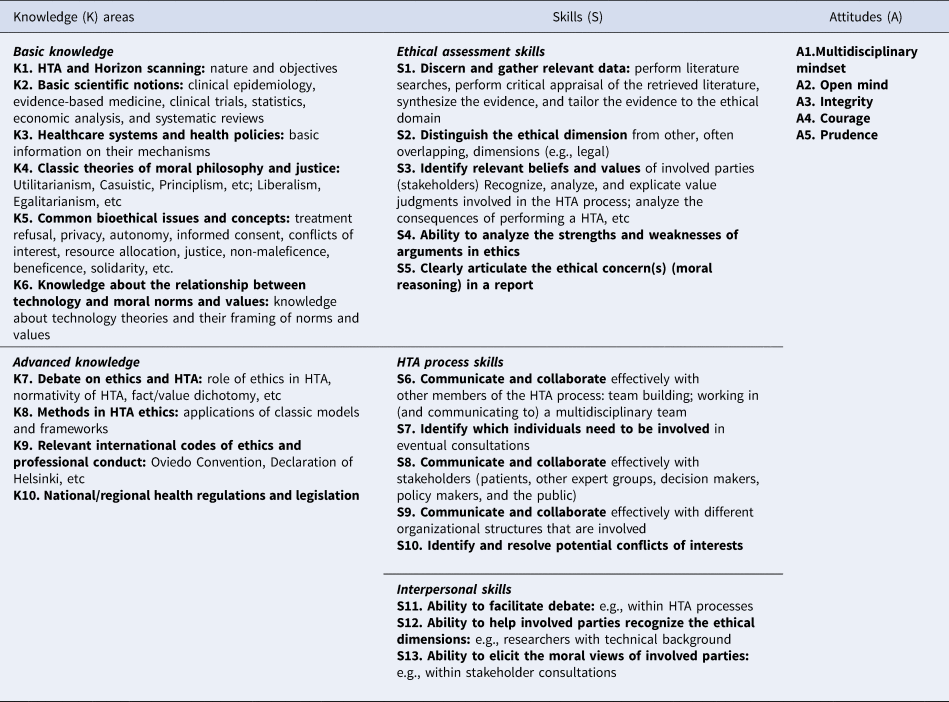
The ten knowledge areas indicated in Table 1 are required for someone to be considered an ethics expert for HTA. They reflect “explicit knowledge,” as expressed by Collins and Evans, about ethics in HTA. We distinguish between “basic” (K1–K6) and “advanced” knowledge (K7–K10). Basic knowledge is a general, or introductory, familiarity with the domain specified. It includes basic notions about HTA and horizon scanning, their nature and objectives (K1); basic scientific notions (K2) useful to understand the content of HTA, such as clinical epidemiology, evidence-based medicine, experimental design, statistics, economic analysis, and systematic reviews; basic information about how health systems are managed, and how health policies are formulated (K3); basic knowledge about both main classical ethical theories (e.g., Utilitarianism, Casuistic, and Principlism) and main classical theories of justice (e.g., Liberalism and Egalitarianism) (K4); knowledge of common and well-known bioethical issues and concepts, such as self-determination (autonomy), privacy, informed consent, conflicts of interest, resource allocation, justice, non-maleficence, beneficence, and solidarity (K5); and knowledge about technology theories and their framing of norms and values (K6).
Table 1.Core competencies of the ethics expert in HTA as identified by group
“Advanced knowledge” includes a knowledge of ethics in both HTA and other material crucial for supporting a robust ethical reflection. It includes: knowledge about both the debate on ethics and HTA (K6) and about the different methods for addressing ethical issues in HTA (K7); knowledge about relevant international codes of ethics and professional conduct (e.g., Oviedo Convention, Declaration of Helsinki, etc.) (K8), as well as national/regional health regulations and legislation (K9).
The ten areas identified can overlap and may need to be revised over time due to advances in technology or changes in healthcare practice. There are many different ways that one might come to have knowledge of the content listed. These include graduate and postgraduate education (master courses and educational programs), as well as intensive courses, participation in conferences, oral presentations, seminar sessions, accessing and reviewing relevant literature, self-education, etc.
Skills
We believe that ethics expertise in the context of HTA requires three categories of skills: ethical assessment skills (S1–S5), HTA process skills (S6–S10), and interpersonal skills (S11–S13). All these reflect “tacit knowledge” about ethics in HTA. Ethical assessment skills refer to the abilities to perform ethical analysis in the context of HTA. They include the following capabilities: to search information/literature, appraise the relevant literature, synthesize, articulate the ethical concern(s), and write a report (S1; S5); to distinguish the ethical dimension from other dimensions (e.g., legal dimension) that are often overlapping (S2); to identify relevant assumptions, beliefs, value judgments, and stakeholders’ values (S3); and to analyze the strengths and weaknesses of arguments in ethics (S4).
HTA process skills refer to the set of skills associated with the conduct of a HTA. They include the ability to communicate and collaborate effectively with other members of the HTA process (S6) as well as patients, other expert groups, decision makers, policy makers, and the public (S8), and any other organizational structure that is involved in the HTA process (S9); to identify which individuals need to be involved in eventual consultations (e.g., scoping) (S7); and to identify and resolve potential conflicts of interest (S10).
Interpersonal skills are related to the way ethics experts interact with others to facilitate the ethical reflection within a HTA process. They include the following abilities: to facilitate debate within the HTA process (S11), to help involved parties recognize the ethical dimensions (S12), and to elicit the moral views of stakeholders (S13).
The thirteen skills indicated can be acquired or improved by actively immersing oneself in the HTA community. There are many different ways that one might come to have contact with the HTA community including research projects, being a member of expert committees, conferences, congresses, symposia, seminar sessions, and workshops.
Attitudes
We believe that ethics experts in HTA should possess certain attitudes including a multidisciplinary mindset (A1), open-mindedness (A2), integrity (A3), courage (A4), and prudence (A5). Attitudes are internal states that influence an individual's choices or decisions in a certain way under particular circumstances. We do not believe that all ethics experts in HTA should possess all of these traits; rather, the more an expert possesses and exhibits these attitudes, the more effective the expert is likely to be. Finally, these attitudes, integrity in particular, are important not only for conducting the ethical analysis itself but also for the personal credibility of those who will be conducting it. These attitudes or traits are often the result of experience or upbringing, but can also be acquired and improved by finding role models and immersing oneself in situations where these attitudes are demanded or beneficial.
Discussion
Despite acknowledged challenges, we have argued for ethics expertise in HTA. To become an ethics expert in the field of HTA, one needs to acquire general knowledge about ethical issues as well as specific knowledge of the ethical domain in HTA. In addition, we have elaborated the core competencies of such expertise. Certainly, the suggested competencies are by no means final. However, we encourage institutions and agencies to discuss, apply, revise, and amend them.
We hope that our suggestions are a step toward both improving the rigor of HTA and strengthening ethics in HTA. For agencies including ethical issues in HTA, our proposed list of competencies provides a starting place for the identification of those who have the ethics expertise necessary for HTA. Our work can also be applied to the capacity building in HTA more generally (Reference Pichler, Oortwijn, Ruether and Trowman11), which currently lacks a clear definition of core competencies. A recent commentary on capacity building (Reference Gutiérrez-Ibarluzea, Mueller and Chiumente29) highlighted the fact that Master's degree courses and HTA manuals did not cover all of the dimensions of HTA analysis in an equal and standardized way. Particularly, the ethical, legal, social, and organizational aspects were lacking in some of the programs.
Although we have indicated how to acquire the relevant knowledge, skills, and attitudes, more could be said about what might serve as reliable indicators of achieving these competencies. This issue is closely connected to improving education in HTA and ethics analysis. We believe that these indicators might be further developed, for example, completing graduate degree courses on particular topics, as well as matching these competencies with existing training programs that have a similar aim, such as programs for clinical or health policy ethics.
Our proposal assumes that a well-defined community of ethicists who work in the field of HTA already exists. The Health Technology Assessment International (HTAi) IG on Ethical Issues in HTA is composed of a relatively small number of individuals (eighty-three formal members). Although some research indicates that there may be a potentially large number of experts available to do ethics work in HTA (Reference Bond and Oremus10), this contrasts with the difficulty HTA organizations report having in enlisting the resources required to conduct ethical analysis. An explanation for this observation may be that a clear idea on competencies for ethical analyses in HTA was missing, and our proposal aims to address this gap.
Our list of knowledge, skills, and attitudes is quite analytical, treating competencies in terms of singular elements and saying little about how they may interact and reinforce each other. We hope the interconnections and interactions among the different elements will be explored in future work. Relatedly, our proposal does not address the question of whether ethical analysis should be performed by individuals or teams. When a team handles a consultation and ethical analysis, the members of the team should collectively embody the full range of core competencies required.
Conclusion
Based on the general theory of expertise and work on ethics expertise, we have elaborated a view of core competencies for expertise in ethical analysis in HTA consisting of knowledge, skills, and attitudes. We have provided an initial outline of the required expertise for each of these domains. The competencies can be applied to call attention to and strengthen ethical analysis in HTA. They may also assist with capacity building within HTA and the development of educational programs for ethical analysis.







 You have
Access
Introduction
From the first use of health technology assessment (HTA) in the 1970s, ethics has been a key element (Reference Banta1). There are many reasons for this (Reference Hofmann2): HTA is a type of policy evaluation and ethics is the “science of values.” Addressing ethical issues of a health technology (HT) involves “an understanding of the consequences of implementing or not implementing a healthcare technology in two respects: with regard to the prevailing societal values and with regard to the norms and values that the technology itself constructs when it is put into use” (3). The HTA process itself also raises normative issues. Value judgments are involved in making decisions on how to conduct an assessment, from prioritizing which HT needs an assessment, the selection of outcome measures, to deciding upon which information is reported to decision makers and the general public (Reference Hofmann4).
Ethical analysis recognizes that values play an integral role throughout a HTA (Reference Hofmann, Bond and Sandman5;Reference Legault6), and this seems to be the perspective of the new definition of HTA (Reference O'Rourke, Oortwijn and Schuller7). HTA is not just a matter of collecting the facts about a HT, but “a matter of collecting facts that are considered meaningful, given a particular value framework, plausible, given a particular body of knowledge, and that are amenable to empirical research, given particular methodological standards” (Reference Reuzel, van der Wilt, Grin and Grunwald8). Consequently, ethical analysis in HTA deals with a series of normative aspects related to a HT as well as the HTA process itself.
The need for an analysis of these normative aspects raises the question of who might be qualified to conduct such an analysis. Is there a specific expertise for doing this work? In this article, we argue that such expertise is available and we characterize such expertise. As you have experts in the synthesis of clinical evidence and conduct of economic evaluation, you have experts in ethical analysis.
Answering the question about the existence and nature of ethics expertise for HTA is not an easy task for several reasons: (i) the concept of “expertise” is unclear; (ii) defining what “ethics” means in the context of HTA is not easy; and (iii) defining the concept of “ethics expertise” in the context of HTA is even more challenging. In addition, the issue of what constitutes ethics expertise in HTA is not addressed systematically in current HTA educational programs (Reference Mueller9). Moreover, those working in agencies conducting HTA may not know how to scrutinize the qualifications of self-professed ethics experts. Although a majority of those who participate in ethical analysis in HTA may have considerable formal education, others with little to no formal education may (believe they can) conduct ethical analysis in HTA (Reference Bond and Oremus10).
To contribute to capacity building in HTA (Reference Pichler, Oortwijn, Ruether and Trowman11), and in particular the capacity needed for addressing the ethical domain of HTA, the authors aimed to address the following challenges: (i) to clarify the concept of ethics expertise and (ii) describe and specify characteristics of ethics expertise in HTA. Based on this, we propose a set of competencies for ethics experts in HTA and suggest how the relevant competencies might be acquired.
Methods
A group of members of the Health Technology Assessment International (HTAi) Interest Group (IG) on Ethical Issues in HTA (https://htai.org/interest-groups/ethics/) met twice during the course of 2018–19 for discussion on the competencies needed for ethical analysis in the context of HTA. The first workshop was held in Amsterdam, The Netherlands, on 6 and 7 December 2018. Two members (DS and PR) prepared and led the discussion that was based on a review of key documents on the nature of ethics expertise/competences. Notably, the American Society for Bioethics and the Humanities (ASBH) publication on the Core Competencies for Health Care Ethics Consultation (12) and Collins and Evans’ sociological theory of expertise (Reference Collins and Evans13), which elaborates a notion of expertise within the field of technology policy, were helpful in structuring the discussion. The workshop participants critically analyzed the collected material, and the results were used to propose working definitions of “ethics expertise” and “core competencies” of ethics experts in HTA. Following the Amsterdam workshop, a draft manuscript was prepared and this became the focus of discussion by participants during a second workshop held in Oslo, Norway, between 18 and 20 December 2019. The list of participants for both workshops is provided in Supplementary Table 1. This paper is the output of the workshop and subsequent revisions and discussions online among the authors. However, it does not necessarily reflect the opinion of HTAi and of the (HTAi) IG on Ethical Issues in HTA.
What is Expertise?
In broad and formal terms, expertise in some area (X) refers to knowing or being able to do X, whereas nonexperts cannot know or do X, or expertise refers to knowing or doing X better than nonexperts (Reference Iltis and Sheehan14). For example, an expert in astrophysics is someone who knows more about that subject than a nonexpert. Likewise, a marksman is someone who knows how to shoot in a way that the nonexpert does not. This relatively lay conception of expertise requires clarification (Reference Iltis and Sheehan14). First, an expert has expertise in a certain domain and the domain over which the expert possesses expertise should always be clarified. Second, the possibility of there being experts in any domain rests on there being an acknowledged standard according to which it is possible to distinguish experts from nonexperts. This makes the identification of experts not always easy, particularly in those cases where the body of knowledge is ubiquitous. For example, all people at least have the capacity to make moral judgments, that is, choices about the right thing to do in a moral dilemma (Reference Priaulx, Weinel and Wrigley15). But does this mean that they are experts in making these judgments? Does the expertise of making moral judgments require that you are “better” in making these judgments, or that you are especially entitled to derive moral conclusions? And, how can “better” judgments be distinguished from “worse”?
To help answer these questions, Priaulx et al. (Reference Priaulx, Weinel and Wrigley15) applied Collins and Evans’ theory of expertise (Reference Collins and Evans13;Reference Collins and Evans16) to the concept of ethics expertise. Collins and Evans’ concept of expertise can also be applied to illuminate the nature of expertise for other types of judgments, such as claims on causal associations or regarding cost-effectiveness. The cornerstone of this theory is the connection between the acquisition of expertise and the acquisition of “tacit knowledge,” which is knowledge related to particular domains. Therefore, a person who possesses tacit knowledge relevant to a domain can be considered an expert. But, what is “tacit knowledge”? Tacit knowledge (as opposed to formal, codified, or explicit knowledge) is a nonverbal form of knowledge derived from personal experience, and, as such, it is difficult to formalize. The difference between explicit and tacit knowledge finds a parallel in the distinction between “knowing that” and “knowing how.” Examples of tacit knowledge are the ability to ride a bike and the way a musician interprets a piece of music.
Collins and Evans argue that tacit knowledge is involved in every meaningful or intentional human practice. However, it can be divided into two distinct types:
(1) Ubiquitous tacit knowledge: the knowledge we all need to survive everyday life, such as the ability to speak a language, or to use a smartphone;
(2) Specialist tacit knowledge: the knowledge needed to be able to work within a specific field or discipline.
However, the boundary between these two types of knowledge is blurred and not definitive. For example, the ability to write can be considered a ubiquitous skill in many countries, whereas in some other countries, it is still not ubiquitous.
Moreover, as Priaulx et al. (Reference Priaulx, Weinel and Wrigley15) note, a crucial aspect of tacit knowledge is its social dimension. Tacit knowledge is a collective property, which means that bodies of tacit knowledge are developed and maintained within social groups. The collective nature grounds expertise not (only) in its special methodological features but in the tacit, social knowledge that individuals gain as members of specialized groups. In short, expertise is seen as acquired not only through explicit knowledge, but also—and above all—through a process of social learning. For example, to become a competent astrophysicist, “it is not sufficient to just live in a country where astrophysics is practiced by a subset of the population. What is needed to gain "fluency" is to immerse oneself into the community of astrophysicists, either by enrolling in a University course and then working in the field or by talking to astrophysicists on a regular basis about domain-relevant ‘stuff’” (Reference Priaulx, Weinel and Wrigley15).
Following this approach, we suggest that competency (or expertise) in a domain consists of both explicit and tacit knowledge, and that it is acquired by formal training and social learning. We also note that expertise is distributed across a population: people can have ubiquitous knowledge, but some people can acquire specialist knowledge. As a consequence, rather than viewing expertise in authoritarian and exclusivist terms, we argue that it should be seen as the result of an open process of acquiring new, and improving existing, knowledge; as well as a process of reciprocal recognition of the persons who have certain knowledge.
What is Ethics Expertise?
The expertise that ethicists are typically expected to provide concerns moral judgments, but everyone could be said to possess this kind of expertise. Why should an “ethics expert” be better suited than anyone else to develop moral judgments? What is ethics expertise, and how does someone earn the title of “ethics expert”?
A particular challenge related to defining ethics expertise is that it is often contrasted unfavorably with other standards of expertise, for example, clinical and scientific expertise. Unlike in the medical or engineering fields, where there may be a body of knowledge that professional organizations or others have articulated as fundamental for education and training of experts, it seems to many that ethics would admit of no such body of knowledge or required experience.
Another challenge is that ethicists cannot easily silence the opinions of nonexperts: a doctor can tell a student that the latter's judgement is erroneous, but this may not be so easy with ethicists. However, a doctor can show the validity of judgments by curing patients, whether moral judgments can be evaluated in terms of truthfulness or validity is still debated. This question about the nature of ethics expertise, particularly in the healthcare field, has been widely debated by philosophers and other theorists for many years (Reference Singer17–Reference Rasmussen26), and it continues to be debated. This debate (which we do not summarize here) is not only theoretical, but also practical, because it affects the legitimacy of some well-established expertise roles, such as clinical ethics consultants or ethics experts being members of ethics committees. Indeed, philosophers, and particularly moral philosophers, are increasingly involved in decision-making in areas that are seen to raise ethical issues. HTA is one of these. If ethicists are to be legitimate members of these decision-making bodies, then they should provide a form of expertise similar to that possessed by other members of the decision-making bodies.
This criticism of ethics expertise assumes that expertise consists of absolute authority (i.e., only experts have the authority to speak on matters within their domain) and is exclusionary (i.e., only experts show elite performance or are better in making judgments within their domain) (Reference Priaulx, Weinel and Wrigley15). But, as concluded above, the competency associated with expertise consists of both explicit and tacit knowledge, can be acquired by formal and social learning, and is distributed among a population and occurs in a continuum. In the light of this perspective, the specialist domain of ethics can be considered as populated by individuals who not only have acquired explicit knowledge about ethics (through texts, manuals, university courses, etc.), but have also “tapped into” the reservoir of tacit knowledge about how to develop moral judgments in this regard. Therefore, specialist expertise in an area involving “ethical activities” (e.g., clinical ethics consultation) can be obtained only by those who actively immerse themselves in that area. In other words, there is such a thing as ethical expertise, both in a “ubiquitous” and “specialist” sense of expertise. This view acknowledges that there is a ubiquitous ethical expertise shared by most people in society, which refers to making decisions on a wide range of normative matters in everyday life. In this sense, what ethics experts do is similar to what lay people do. Nevertheless, some people acquire specialist ethical expertise, which can be gained not only through receiving explicit knowledge, but also from experiencing the activities and practices that take place in a certain community.
As Priaulx et al. note (Reference Priaulx, Weinel and Wrigley15), the conclusion is that “it is neither necessary nor sufficient that one is a moral philosopher in order to make a claim of moral expertise.” Nevertheless, moral philosophers hold a particular status: in fact, “only the moral philosopher has tacit knowledge that allows them, for example, to know when to take a particular journal article or author seriously, how to convey an advancement in moral argument to a philosophy conference, or to recognize patterns in critical approaches to certain types of moral argument” (Reference Priaulx, Weinel and Wrigley15). In this sense, it is possible to argue that they have privileged but not exclusive access to this role. Although all persons living in social relations to others have morals, and normally have the ability to make moral judgments, experts are better at identifying, analyzing, and reasoning with moral norms and values. Although simple medical procedures are done at home, more complex ones require the expertise of medical professionals. This is perhaps similar to ethics expertise. One requires more than moral intuition for providing a complex moral analysis.
What is Ethics Expertise in the Context of HTA?
This discussion on the nature of ethics expertise has important consequences for the ethics expert in the context of HTA. To become an ethics expert in the field of HTA, one needs to acquire general knowledge about ethical issues and ethical judgments as well as specific knowledge of the ethical domain in HTA. On the other hand, it is also necessary to know about the subject matter of HTA and immerse oneself into the HTA community and to communicate with others in HTA to acquire tacit knowledge.
Having clarified the nature of ethics expertise in the field of HTA, another issue concerns how learning activities can be categorized. This issue is subject to such diverse use and interpretation that it is impossible to identify or impute a coherent theory or to arrive at a position capable of accommodating and reconciling all the different views (27). One of the most widely used ways of organizing levels of expertise is according to Bloom's Taxonomy of Educational Objectives (Reference Bloom, Engelhart, Furst, Hill and Krathwohl28). Bloom's Taxonomy consists of three domains:
(1) cognitive: mental skills (knowledge)
(2) psychomotor: manual or physical skills (skills)
(3) affective: growth in feelings or emotional areas (attitude).
This taxonomy is at the basis of some guidance for other areas of health care in which ethics expertise has been recognized. One is the ASBH publication on the Core Competencies for Health Care Ethics Consultation (12), which is intended for ethics consultants and educational programs that help prepare individuals, teams, or committees to do ethics consultations, and all healthcare organizations that offer ethics consultation services.
The ASBH guide provides a helpful starting point for elaborating ethics competencies in HTA as healthcare ethics consultation and ethical analysis in HTA have some important features in common.
Like clinical ethics consultation, doing ethics analysis in HTA well requires competencies of knowledge, skills, and attitudes. Therefore, we adopted the tripartite framework from the ASBH and adapted it for HTA.
The core competencies of ethics experts in HTA consist of three fundamental elements: knowledge, skills, and attitudes. The unavoidable value-laden nature (or normativity) of HTA requires that those tasked with addressing ethical issues have knowledge of normative theory and skills to identify (implicit) value judgments and provide guidance in evaluating and articulating normative statements. Our conception of ethics expertise in HTA also recognizes knowledge, skills, and attitudes that are developed by being part of a community sustaining the practice of HTA. And, finally, because ethics work involves discussion with and among researchers and frequently involves communicating with patients and other stakeholders, as well as participating in, expert committees, ethics expertise in HTA must also include interpersonal skills as well as particular attitudes. Many of these aspects were also identified by the workshop participants as being crucial to the success of their work. It is important to note that, although there are knowledge and skills unique to those doing ethics work, we are not claiming that the attitudes of ethics experts are unique to those doing ethics work. It is very likely that our list of expert attitudes, such as integrity and open-mindedness, is also important and desirable for those doing scientific or other work in HTA.
Knowledge
The ten knowledge areas indicated in Table 1 are required for someone to be considered an ethics expert for HTA. They reflect “explicit knowledge,” as expressed by Collins and Evans, about ethics in HTA. We distinguish between “basic” (K1–K6) and “advanced” knowledge (K7–K10). Basic knowledge is a general, or introductory, familiarity with the domain specified. It includes basic notions about HTA and horizon scanning, their nature and objectives (K1); basic scientific notions (K2) useful to understand the content of HTA, such as clinical epidemiology, evidence-based medicine, experimental design, statistics, economic analysis, and systematic reviews; basic information about how health systems are managed, and how health policies are formulated (K3); basic knowledge about both main classical ethical theories (e.g., Utilitarianism, Casuistic, and Principlism) and main classical theories of justice (e.g., Liberalism and Egalitarianism) (K4); knowledge of common and well-known bioethical issues and concepts, such as self-determination (autonomy), privacy, informed consent, conflicts of interest, resource allocation, justice, non-maleficence, beneficence, and solidarity (K5); and knowledge about technology theories and their framing of norms and values (K6).
Core competencies of the ethics expert in HTA as identified by group
“Advanced knowledge” includes a knowledge of ethics in both HTA and other material crucial for supporting a robust ethical reflection. It includes: knowledge about both the debate on ethics and HTA (K6) and about the different methods for addressing ethical issues in HTA (K7); knowledge about relevant international codes of ethics and professional conduct (e.g., Oviedo Convention, Declaration of Helsinki, etc.) (K8), as well as national/regional health regulations and legislation (K9).
The ten areas identified can overlap and may need to be revised over time due to advances in technology or changes in healthcare practice. There are many different ways that one might come to have knowledge of the content listed. These include graduate and postgraduate education (master courses and educational programs), as well as intensive courses, participation in conferences, oral presentations, seminar sessions, accessing and reviewing relevant literature, self-education, etc.
Skills
We believe that ethics expertise in the context of HTA requires three categories of skills: ethical assessment skills (S1–S5), HTA process skills (S6–S10), and interpersonal skills (S11–S13). All these reflect “tacit knowledge” about ethics in HTA. Ethical assessment skills refer to the abilities to perform ethical analysis in the context of HTA. They include the following capabilities: to search information/literature, appraise the relevant literature, synthesize, articulate the ethical concern(s), and write a report (S1; S5); to distinguish the ethical dimension from other dimensions (e.g., legal dimension) that are often overlapping (S2); to identify relevant assumptions, beliefs, value judgments, and stakeholders’ values (S3); and to analyze the strengths and weaknesses of arguments in ethics (S4).
HTA process skills refer to the set of skills associated with the conduct of a HTA. They include the ability to communicate and collaborate effectively with other members of the HTA process (S6) as well as patients, other expert groups, decision makers, policy makers, and the public (S8), and any other organizational structure that is involved in the HTA process (S9); to identify which individuals need to be involved in eventual consultations (e.g., scoping) (S7); and to identify and resolve potential conflicts of interest (S10).
Interpersonal skills are related to the way ethics experts interact with others to facilitate the ethical reflection within a HTA process. They include the following abilities: to facilitate debate within the HTA process (S11), to help involved parties recognize the ethical dimensions (S12), and to elicit the moral views of stakeholders (S13).
The thirteen skills indicated can be acquired or improved by actively immersing oneself in the HTA community. There are many different ways that one might come to have contact with the HTA community including research projects, being a member of expert committees, conferences, congresses, symposia, seminar sessions, and workshops.
Attitudes
We believe that ethics experts in HTA should possess certain attitudes including a multidisciplinary mindset (A1), open-mindedness (A2), integrity (A3), courage (A4), and prudence (A5). Attitudes are internal states that influence an individual's choices or decisions in a certain way under particular circumstances. We do not believe that all ethics experts in HTA should possess all of these traits; rather, the more an expert possesses and exhibits these attitudes, the more effective the expert is likely to be. Finally, these attitudes, integrity in particular, are important not only for conducting the ethical analysis itself but also for the personal credibility of those who will be conducting it. These attitudes or traits are often the result of experience or upbringing, but can also be acquired and improved by finding role models and immersing oneself in situations where these attitudes are demanded or beneficial.
Discussion
Despite acknowledged challenges, we have argued for ethics expertise in HTA. To become an ethics expert in the field of HTA, one needs to acquire general knowledge about ethical issues as well as specific knowledge of the ethical domain in HTA. In addition, we have elaborated the core competencies of such expertise. Certainly, the suggested competencies are by no means final. However, we encourage institutions and agencies to discuss, apply, revise, and amend them.
We hope that our suggestions are a step toward both improving the rigor of HTA and strengthening ethics in HTA. For agencies including ethical issues in HTA, our proposed list of competencies provides a starting place for the identification of those who have the ethics expertise necessary for HTA. Our work can also be applied to the capacity building in HTA more generally (Reference Pichler, Oortwijn, Ruether and Trowman11), which currently lacks a clear definition of core competencies. A recent commentary on capacity building (Reference Gutiérrez-Ibarluzea, Mueller and Chiumente29) highlighted the fact that Master's degree courses and HTA manuals did not cover all of the dimensions of HTA analysis in an equal and standardized way. Particularly, the ethical, legal, social, and organizational aspects were lacking in some of the programs.
Although we have indicated how to acquire the relevant knowledge, skills, and attitudes, more could be said about what might serve as reliable indicators of achieving these competencies. This issue is closely connected to improving education in HTA and ethics analysis. We believe that these indicators might be further developed, for example, completing graduate degree courses on particular topics, as well as matching these competencies with existing training programs that have a similar aim, such as programs for clinical or health policy ethics.
Our proposal assumes that a well-defined community of ethicists who work in the field of HTA already exists. The Health Technology Assessment International (HTAi) IG on Ethical Issues in HTA is composed of a relatively small number of individuals (eighty-three formal members). Although some research indicates that there may be a potentially large number of experts available to do ethics work in HTA (Reference Bond and Oremus10), this contrasts with the difficulty HTA organizations report having in enlisting the resources required to conduct ethical analysis. An explanation for this observation may be that a clear idea on competencies for ethical analyses in HTA was missing, and our proposal aims to address this gap.
Our list of knowledge, skills, and attitudes is quite analytical, treating competencies in terms of singular elements and saying little about how they may interact and reinforce each other. We hope the interconnections and interactions among the different elements will be explored in future work. Relatedly, our proposal does not address the question of whether ethical analysis should be performed by individuals or teams. When a team handles a consultation and ethical analysis, the members of the team should collectively embody the full range of core competencies required.
Conclusion
Based on the general theory of expertise and work on ethics expertise, we have elaborated a view of core competencies for expertise in ethical analysis in HTA consisting of knowledge, skills, and attitudes. We have provided an initial outline of the required expertise for each of these domains. The competencies can be applied to call attention to and strengthen ethical analysis in HTA. They may also assist with capacity building within HTA and the development of educational programs for ethical analysis.
Supplementary material
The supplementary material for this article can be found at https://doi.org/10.1017/S0266462320001968.
Acknowledgments
We are grateful for the financial and administrative support that we received from the HTAi, for two face-to-face workshops of the HTAi Interest Group (IG) on Ethical Issues in HTA. The first workshop was held in Amsterdam, The Netherlands, on 6 and 7 December 2018; the second one was held in Oslo, Norway, between 18 and 20 December 2019.
Conflicts of Interest
The authors report they have no potential conflicts of interest.