INTRODUCTION
The Crustacea constitute a diverse group of arthropods, displaying considerable variability in terms of morphology, behaviour and reproductive systems. Several members of this group have developed a symbiotic relationship with other marine invertebrates [symbiosis here defined sensu de Bary (1865) quoted by Vermeij (Reference Vermeij, Futuyma and Slatkin1983) as dissimilar organisms living together]. These symbiotic crustaceans feature a wide array of host-use patterns, population distributions and social behaviours in/on their hosts (Thiel & Baeza, Reference Thiel and Baeza2001). Some symbiotic species dwell in/on hosts as solitary individuals (Diesel, Reference Diesel1986; Baeza et al., Reference Baeza, Thiel and Stotz2001; Baeza & Díaz-Valdés, Reference Baeza and Díaz-Valdés2011), some are found as heterosexual pairs (Knowlton, Reference Knowlton1980; Baeza, Reference Baeza2008, Reference Baeza2010; Baeza et al., Reference Baeza, Bolaños, Hernandez, Lira and López2011) and others as dense unstructured aggregations of conspecifics (Baeza & Thiel, Reference Baeza and Thiel2000; Baeza & Piantoni, Reference Baeza and Piantoni2010). The diversity of host-use patterns featured by symbiotic crustaceans and their wide variety of hosts (e.g. sponges, corals, sea anemones, sea urchins, sea squirts, etc.: see Thiel & Baeza, Reference Thiel and Baeza2001) represent an opportunity to understand those environmental conditions favouring or constraining particular mating behaviours in organisms that exploit small, discontinuous refuges (Baeza & Thiel, Reference Baeza, Thiel, Duffy and Thiel2007; Asakura, Reference Asakura, Martin, Crandall and Felder2009; Bruyn et al., Reference Bruyn, Rigaud, David and de Ridder2009).
Recently, a general framework for understanding the relationship between environment (e.g. host characteristics and ecology) and the mating system of symbiotic crustaceans was proposed by Baeza & Thiel (Reference Baeza, Thiel, Duffy and Thiel2007). Mating strategies of males and females were suggested to be influenced by host abundance, host body size (relative to symbiont body size) and host structural complexity. All these host traits were considered important in determining the relative costs of resource (host) monopolization by symbiotic individuals. Predation risk outside of the shelter provided by hosts was another important condition considered relevant in driving the mating system of symbiotic crustaceans given that predation off hosts is expected to affect the potential costs for symbionts of switching among host individuals (cf. Reeves & Brooks, Reference Reeves and Brooks2001).
Baeza & Thiel (Reference Baeza, Thiel, Duffy and Thiel2007) proposed the evolution of five mating systems in symbiotic crustaceans depending upon particular environmental conditions. For example, monogamy [monogamy here defined sensu Wickler & Seibt (Reference Wickler, Seibt and Bateson1983) as pairs of conspecifics spending extensive periods of time together] was predicted to be advantageous in symbiotic crustaceans using hosts that are large enough to support few (e.g. two) but not more conspecifics, when hosts are relatively rare, and when predation risk away from hosts is high (Baeza & Thiel, Reference Baeza, Thiel, Duffy and Thiel2007; Baeza, Reference Baeza2008; Baeza et al., Reference Baeza, Bolaños, Hernandez, Lira and López2011). In this scenario, movements among hosts by symbiotic crustaceans are constrained and host monopolization is favoured in male and female symbionts due to host scarcity and its value in offering protection against predators (Baeza & Thiel, Reference Baeza, Thiel, Duffy and Thiel2007). Because spatial constraints allow only a few adult symbiotic individuals to cohabit in/on the same host, both adult males and females maximize their reproductive success by sharing ‘their' dwelling with a member of the opposite sex (Baeza, Reference Baeza2008). These monogamous species should display low sexual dimorphism in body size and weaponry (e.g. chelipeds used for intra-sexual aggression). The low intensity of sexual selection characteristic of monogamous regimes is expected to relax selection for large body size and weapons in males (Shuster & Wade, Reference Shuster and Wade2003; Baeza & Thiel, Reference Baeza, Thiel, Duffy and Thiel2007; Baeza, Reference Baeza2008). There is empirical evidence supporting the model proposed by Baeza & Thiel (Reference Baeza, Thiel, Duffy and Thiel2007), including the conditions that might favour monogamy, although the available studies are scarce (Baeza, Reference Baeza1999, Reference Baeza2008, Reference Baeza2010; Baeza & Thiel, Reference Baeza and Thiel2003; Bruyn et al., Reference Bruyn, Rigaud, David and de Ridder2009, 2011; Baeza & Piantoni, Reference Baeza and Piantoni2010). Therefore, these authors argued for more descriptive and experimental studies to improve our understanding of mating strategies in symbiotic crustaceans.
Crabs from the family Pinnotheridae are ideal candidates to explore the conditions favouring or constraining particular mating strategies in symbiotic crustaceans. The Pinnotheridae, with 52 genera and more than 300 described species (Ng et al., Reference Ng, Guinot and Davie2008; De Grave et al., Reference De Grave, Pentcheff, Ahyong, Chan, Crandall, Dworschak, Felder, Feldmann, Fransen, Goulding, Lemaitre, Low, Martin, Ng, Schweitzer, Tan, Tshudy and Wetzer2009; Palacios-Theil et al., Reference Palacios-Theil, Cuesta, Campos, Felder, Martin, Crandall and Felder2009), are diverse and widely distributed in marine coastal habitats of almost all oceans. Members from this family are reported to inhabit the mantle cavity and/or burrows of bivalve and gastropod molluscs, segmented worms, echinoderms, brachiopods, and burrowing shrimps, among others (Schmitt et al., Reference Schmitt, McCain, Davidson, Gruner and Holthuis1973; Manning & Morton, Reference Manning and Morton1987; Alves & Pezzuto, Reference Alves and Pezzuto1998; Harrison & Hanley, Reference Harrison and Hanley2005; Ng et al., Reference Ng, Guinot and Davie2008). Symbiotic interactions between pinnotherid crabs and their hosts range from commensalism to parasitism and pinnotherid crabs can be host-specific or generalists (Schmitt et al., Reference Schmitt, McCain, Davidson, Gruner and Holthuis1973). The majority of these symbiotic relationships, however, have not been studied in detail (McDermott, Reference McDermott2006) and many aspects of these associations are poorly known.
For instance, little is known about the costs and benefits experienced by the associates, food dependency between symbiotic partners, and the moment in which the symbiotic relationship is established. Similarly, the mating strategies of the different species within this clade are poorly studied. Species of Pinnixa and allies (e.g. other genera in the subfamily Pinnothereliinae) are reported to be monogamous with males and females having no major morphological differences (e.g. Pinnixa chaetopterana—Grove & Woodin, Reference Grove and Woodin1996; Pinnixa transveralis—Baeza, Reference Baeza1999). On the other hand, species of Pinnotheres and their like (e.g. other genera in the Pinnotherinae, including Holotheres (as Pinnotheres) halingi—Hamel et al., Reference Hamel, Ng and Mercier1999) seem to be promiscuous and are characterized by giant sedentary females and dwarf males that roam around in search of females. Lastly, a few pinnotherine species, e.g. Fabia subquadrata infesting the mussel Modiolus modiolus, inhabit host individuals solitarily but both males and females leave their hosts momentarily to form copulatory swarms in the open water. After mating in the water column, only females return to their hosts, and thus, only mature females but not males are found within hosts (Christensen & McDermott, Reference Christensen and McDermott1958; Pearce, Reference Pearce1966). A somewhat similar mating system appears to occur in European species of Pinnotherinae. For instance, the north-eastern Atlantic and Mediterranean pea crabs Nepinnotheres pinnotheres, Pinnotheres pisum and Pinnotheres pectunculi feature considerable sexual dimorphism, in which the adult male is considerably smaller than the adult female (Orton, Reference Orton1920; Atkins, Reference Atkins1926; Becker & Türkay, Reference Becker and Türkay2010). The small male is partly free living, and is only occasionally found together with a putatively sedentary female within the same host individual (Becker & Türkay, Reference Becker and Türkay2010). It is also known that males and juvenile females of P. pisum are good pelagic swimmers, paddling with their setose second and third pairs of walking legs (Hartnoll, Reference Hartnoll1972).
Within the Pinnothereliinae, species of the Neotropical genus Austinixa are found on sandy beaches within the galleries of callianassid shrimps (ghost shrimps) from the genus Callichirus, or with a few other axiidean shrimps that are ecological equivalents (Manning & Felder, Reference Manning and Felder1989; Harrison, Reference Harrison2004). The mating system of pea crabs from this genus is poorly understood. Only the host-use pattern of Austinixa gorei inhabiting sandy beaches in Florida, USA is known (McDermott, Reference McDermott2006). On the Brazilian coast, Austinixa aidae has been reported as an associate of Callichirus major (Rodrigues & Shimizu, Reference Rodrigues, Shimizu, Absalão and Esteves1997; Peiró & Mantelatto, Reference Peiró and Mantelatto2011; Peiró et al., Reference Peiró, Pezzuto and Mantelatto2011). This species was proposed to be a synonym of A. hardyi by Harrison & Hanley (Reference Harrison and Hanley2005), although the authors recognized some morphological differences among specimens from the two taxonomic entities. Ng et al. (Reference Ng, Guinot and Davie2008) followed these authors in regarding A. aidae as a synonym of A. hardyi. Interestingly, Palacios-Theil et al. (Reference Palacios-Theil, Cuesta, Campos, Felder, Martin, Crandall and Felder2009) documented the existence of genetic differences among specimens of the two taxonomic entities and suggested that it was better to recognize them as separate taxa for the time being.
The aim of this study is to describe the host-use pattern of the symbiotic crab A. aidae, a common symbiont of the callianassid shrimp Callichirus major on the coast of Brazil. We explored the possibility of a monogamous mating system in A. aidae given the generality of this mating strategy in other crabs from the Pinnothereliinae (see Baeza, Reference Baeza1999, and references therein) to which A. aidae pertains. Herein, we report on the population distribution, male–female association pattern and sexual dimorphism of A. aidae to gain a better insight of its socioecology.
MATERIALS AND METHODS
Collection of crabs and ghost shrimps
The host-use pattern of the crab A. aidae, living within the burrows of the ghost shrimp Callichirus major, was studied from May 2005 to March 2006 at Perequê-açu beach, Ubatuba, State of São Paulo, Brazil (23°24′59.99″S 45°03′17.13″W). The studied locality is a semi-protected and dissipative beach composed of fine sand. Within this locality, we chose a single plot (~400 m long by ~30 m wide) parallel to the waterline that contained a relatively large number of burrows compared to other sections of the beach. The density of C. major at this site was 0.2 ± 0.5 burrows m2 (range: 0–4 burrows m2) (Peiró & Mantelatto, unpublished results). This burrow density within the plot permitted focusing our sampling effort within a small area of the beach so to avoid the effect of unknown environmental conditions that might vary along this long beach and, in turn, might affect the nature of the studied symbiotic relationship. Such considerable environmental variability along the beach might have affected the host-use pattern of A. aidae further complicating our inferences on the mating system of this crab.
Individuals of A. aidae were collected bimonthly, only during diurnal low tides, and only from intertidal burrows of C. major located within this plot. The burrows of C. major have only a single opening (~5 mm diameter) to the surface of the beach. Burrows resemble a narrow tube that runs for up to 20–40 cm depth perpendicular to the surface of the beach. Austinixa aidae inhabits this relatively shallower and tubular section of the burrow, from 0 to ~40 cm depth. Deeper than 40 cm, the diameter of the burrow increases and starts running diagonal to the surface of the beach but it does not divide into smaller deeper burrows or chambers. The length and diameter of this last diagonal section of the burrow is proportional to the body size of the ghost shrimp that construct it and might attain approximately 1.5 m depth and between 10 and 30 mm diameter (Rodrigues & Shimizu, Reference Rodrigues, Shimizu, Absalão and Esteves1997; Shimizu & Rosso, Reference Shimizu and Rosso2000).
Crabs were collected from C. major burrows with a commercial suction-pump (100-cm long and 5-cm diameter) developed by Rodrigues (Reference Rodrigues1966) that was used in a manner similar to that described by Manning (Reference Manning1975). Suction pumping of burrows with manual pumps like that developed by Rodrigues (Reference Rodrigues1966) represents an efficient method for sampling organisms living within intertidal burrows. Our experience shows that all organisms from within single burrows are retrieved by means of suction pumping. During sampling, each burrow opening was pumped only twice, because the sediment collapses during this process. Importantly, the collapsing of the burrow eliminates the risk of sampling the same burrow more than once (Alves & Pezzuto, Reference Alves and Pezzuto1998). Burrows are ≥35 cm apart each one to another and they do not connect underground. Thus, our sampling protocol diminished the probability of sampling crabs accidentally from burrows adjacent each one to another. In this study, density of A. aidae refers to number of crabs collected per burrow of C. major (see Alves & Pezzuto, Reference Alves and Pezzuto1998).
Crab individuals, once collected from burrows, were carefully rinsed with seawater, placed in plastic bags, labelled, frozen, and transported to the laboratory. All material was preserved in ethanol (80%) until further examination. In the laboratory, crabs were sexed using the pleopods. Male crabs have a pair of long and thin pleopods (gonopods) on the ventral surface of the first abdominal somite and a pair of short pleopods on the second abdominal somite. Female crabs have four pairs of long setose pleopods from the second to the fifth abdominal somites. Specimens with undifferentiated or undeveloped pleopods were considered juveniles (Peiró et al., Reference Peiró, Pezzuto and Mantelatto2011). The following measurements were taken from all collected crabs under a stereomicroscope (Zeiss® Stemi SV6) with the aid of a drawing tube (precision = 0.1 mm): carapace width (CW), length of the left claw (LC), and abdomen width (AW) (measured between the fourth and fifth abdominal segments). All the information above is relevant to understand the mating system of symbiotic crustaceans (Baeza & Thiel, Reference Baeza and Thiel2003, Reference Baeza, Thiel, Duffy and Thiel2007; Baeza, Reference Baeza2008, Reference Baeza2010).
Population distribution of A. aidae
We examined whether the distribution of A. aidae in burrows of its ghost shrimp host differed significantly from a random distribution by comparing the observed distribution with the Poisson distribution (Elliott, Reference Elliott1983). Significant differences between the distributions were examined using a Chi-square goodness of fit test (Sokal & Rohlf, Reference Sokal and Rohlf1981). If significant differences were observed, specific frequencies between the observed and expected distributions were compared by subdivision of the Chi-square test and using the sequential Bonferroni correction to control for false discovery rate (Rice, Reference Rice1989). A small percentage of the studied burrows were found to contain pairs of crabs (see Results). We determined whether the sexes were randomly distributed when comparing the observed distribution with the binomial distribution. A Chi-square goodness of fit test was used to inspect for significant differences between these distributions (Sokal & Rohlf, Reference Sokal and Rohlf1981). Lastly, we examined whether the presence of eggs and the developmental stage of the eggs brooded by females affected the presence or absence of males. A Chi-square test of independence was used to detect significant differences between the frequencies of occurrence of males with females carrying eggs in different stages (Sokal & Rohlf, Reference Sokal and Rohlf1981).
Sexual dimorphism of A. aidae
In brachyuran crabs, including species from the genus Austinixa, the first pair of pereiopods bears large claws which may serve as weapons during intra-sexual interactions (Hartnoll, Reference Hartnoll1978, Reference Hartnoll and Bliss1982). Abdomen is greatly enlarged in females and can help to protect the eggs carried by females from physical abrasion (Hartnoll, Reference Hartnoll1978, Reference Hartnoll and Bliss1982). We examined whether the size of the largest claw and the abdomen increased linearly with body size in males and females of A. aidae. The relationship between the length of the propodus of the claw or width of the fourth–fifth abdominal segment and body size of crabs (carapace width = CW mm) was examined. The slope (b) of the log-log least-squares linear regression represents the rate of exponential increase (b > 1) or decrease (b < 1) of the claw and abdominal segment with a unit of increase in body size of crab. To determine if the relationship deviated from linearity, a t-test was used to examine if the estimated slope b deviated from the expected slope of unity (Sokal & Rohlf, Reference Sokal and Rohlf1981). If the claw or abdomen grows more or less than proportionally with a unit increase in body size of crab, then the slope should be greater or smaller than unity, respectively (Hartnoll, Reference Hartnoll1978). Assumptions of normality and homogeneity of variances were evaluated using the Kolmogorov–Smirnov and Bartlett's tests, respectively, and found to be satisfactory for each independent t-test conducted during the present study.
RESULTS
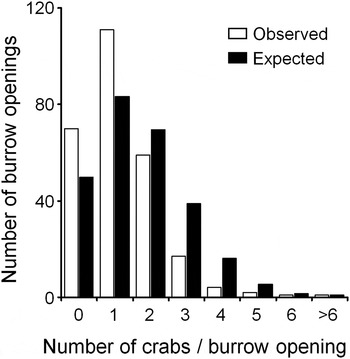
A total of 329 crabs of A. aidae were collected within 266 upper sections of burrows of the ghost shrimp C. major during this study (mean number of crabs per burrow: X = 1.23; standard deviation: SD ± 1.29; range 0–14 crabs per burrow). Of these burrows, a total of 73.7%, harboured at least one symbiotic crab. The population distribution of A. aidae within burrows of C. major differed significantly from the Poisson random distribution (χ2 5 = 43.56, df = 5, P < 0.0001; Figure 1). The number of burrows harbouring a single crab was greater than expected by chance alone (Chi-square of goodness of fit: χ2 1 = 14.49, P = 0.0001). Also, the number of burrows harbouring relatively large groups of symbiotic crabs (4 or more crabs per burrow) was lower than expected by chance alone (χ2 1 = 11, P = 0.0009).
Population distribution (number of crabs per burrow) of the pinnotherid crab Austinixa aidae, symbiotic with the ghost shrimp Callichirus major at Perequê-açu beach, Ubatuba, State of São Paulo, Brazil.

Of the 111 (41.7%) burrows in which only one crab was observed, the ratio of males to females did not differ significantly from 1:1 (48:62 versus 55:55: χ2 1 = 1.54, P < 0.2146). One solitary crab was considered a juvenile because its pleopods were not developed. Only 17 (27.4%) of the solitary females carried eggs (13 and 4 carried early and late eggs, respectively). The proportion of solitary females without eggs or carrying eggs at different stages of development did not differ significantly from the overall proportion of females without eggs or carrying eggs at different developmental stages in the whole population, respectively (observed = 0.73: 0.21 : 0.06 versus expected = 0.62 : 0.21 : 0.17; Chi-square of goodness of fit: χ2 = 5.26, df = 2, P = 0.0721).
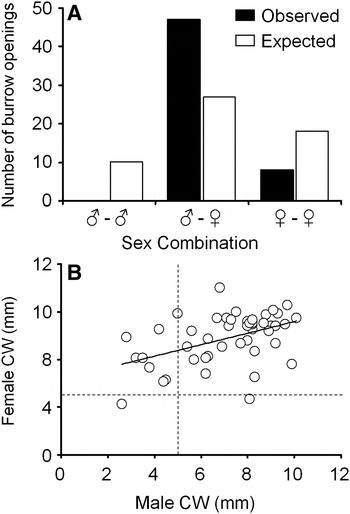
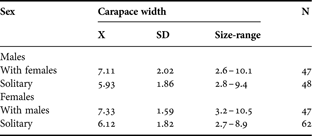
Of the 59 (22.2%) burrows containing pairs of crabs, the proportion of pairs composed of one male and one female was greater than expected by chance alone and the proportion of pairs composed of individuals from the same sex (i.e. female–female pairs) was lower than expected by chance alone (χ2 1 = 27.66, P < 0.001; Figure 2A). No male–male pairs were observed. There was a weak but positive correlation between the CW of males and females in a pair (r2 = 0.21, F1,45 = 12.22, P = 0.0011) (Figure 2B). In 24 of the male–female pairs, the females were larger than the male and in the remaining 20 male–female pairs, the male was larger than the female. Three male–female pairs were matched in size. In general, considerable variation in body size of males and females composing pairs was observed (Figure 2B). The observed proportion of paired females without eggs or with eggs at different stages of development differed significantly from the expected proportion of paired females without eggs or with eggs at different stages of development determined by chance alone (observed relative abundance = 0.74 : 0.22 : 0.04 versus expected relative abundance = 0.62 : 0.21 : 0.17; Chi-square of goodness of fit: χ2 2= 6.22, P = 0.0446). The differences between the observed and expected frequencies occurred because paired females carrying late eggs were less common than expected by chance alone (decomposition of Chi-square of goodness of fit: χ2 = 5.12, df = 1, P = 0.0237). Both males and females found in pairs were larger than crabs from the same sex occurring solitarily within burrows (t-test: males: t = –2.95, df = 93, P = 0.0039; females: t = 3.63, df = 107, P = 0.0004).
A male–female association pattern (A) and relationship between carapace length of females and males of Austinixa aidae found as heterosexual pairs (B) within burrows of the ghost shrimp Callichirus major at Perequê-açu beach, Ubatuba, State of São Paulo, Brazil. Horizontal and vertical dashed lines in (B) separate adult from juvenile crabs of Austinixa aidae.

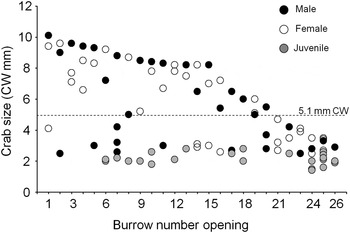
Of the 26 burrows (10.33%) in which three or more crabs cohabited, the intra-specific association pattern was similar to that found for burrows containing only single pairs of crabs. In 10 of these burrows, a heterosexual couple of crabs shared the burrow with smaller (usually) juveniles that were not possible to sex (Figure 3). In three burrows, one male cohabited with two mature females (burrows 3, 4 and 19 in Figure 3). In one burrow, two females cohabited. In the remaining burrows, one large male and/or females cohabited with a much smaller crab (a male, a female, or a juvenile) or several crabs from moderate or small size were found cohabiting in the same burrow. On the single occasion when 14 crabs were found in the same burrow, all of them were small males, small females and juveniles (burrow 25 in Figure 3).
Carapace width of males and females of Austinixa aidae within groups for crabs (N > 2) inhabiting different burrows of the ghost shrimp Callichirus major at Perequê-açu beach, Ubatuba, State of São Paulo, Brazil.

Sexual dimorphism
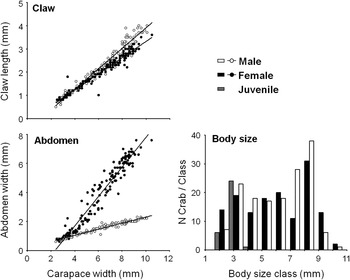
The carapace width of male and female crabs varied, respectively, between 2.4 and 10.1 mm (X ± SD; 6.13 ± 2.24) and between 2.5 and 10.5 mm (6.27 ± 2.03). No significant differences in CW between the sexes were detected (N = 141 males and 156 females; t-test: t = –0.56, P = 0.5791), indicating the absence of sexual dimorphism with respect to body size (Table 1). Positive correlations between body size of crabs and the length of the propodus of the claw and the width of abdomen were detected for crabs of both sexes (P < 0.001 in all cases: Figure 4). However, the different structures differed with respect to the status and degree of allometry depending on the sex of the crabs (Table 2). In males and females, the slope of the relationship between body size and claw length was significantly greater than one, i.e. the character was positively allometric. Moreover, the relative growth of the claw was greater in males than in females (P < 0.05: Table 1; Figure 4). In turn, the relationship between abdomen width and claw length was negatively allometric in males and positively allometric in females (Figure 4; Table 2).
Sexual dimorphism in body size of Austinixa aidae shown by the size–frequency distribution of males and females, and relative growth of the major claw and of the abdomen as a function of carapace width. Measurements are in millimetres. Linear regression equations obtained after log-log transformation of the data are shown for each sex in Table 2.

Size of paired and unpaired males and females of Austinixa aidae symbiotic with Callichirus major: mean (X), standard deviation (SD), size range expressed as carapace width, and number of crabs analysed (N). Measurements are in millimetres.

Relative growth of selected structures in males and females of Austinixa aidae. The regression equations, correlation coefficients, and standard errors of the slopes (SEs), of each studied variable are shown. AW, CW, and LC = abdomen width, carapace width, and length of left claw, respectively. Allometry was positive for all structures, but AW in males that exhibited negative allometry.

Lastly, males, females and juveniles had different general colour patterns. Adult females had dark body coloration with disruptive (not uniform) spots in the carapace. Adult males had a uniform translucent coloration, similar to that of the sand grains on the beach. Finally, juveniles of both sexes had a mixed coloration between that observed in adult males and females. Interestingly, adult males bear scattered tufts of plumose setae on the ventral side of the palm of the chelipeds and some individuals presented patches of setae on the dorsal surface of the carapace (cardiac region). Preliminary genetic studies (using the 16S mitochondrial gene) to assess the taxonomic status of A. aidae confirmed that these different morphs belong to the same species, and thus, they were treated as such in this study (F.L.M., unpublished data).
DISCUSSION
Is Austinixa aidae a monogamous species?
The available evidence suggests that A. aidae is not monogamous. First, A. aidae was found within burrows of the callianassid shrimp C. major as solitary individuals more often than expected by chance alone. This population distribution contrasts to that reported for socially monogamous crustaceans which are found as heterosexual pairs in/on their hosts more frequently than expected by chance alone (e.g. pinnothereliine crabs: Pinnixa transversalis (see Baeza, Reference Baeza1999), Pinnixa chaetopterana (see Grove & Woodin Reference Grove and Woodin1996); other crustaceans: palaemonid shrimps Pontonia domestica (see Courtney & Couch, Reference Courtney and Couch1981), Pontonia margarita (see Baeza, Reference Baeza2008) and Pontonia mexicana (see Baeza et al. Reference Baeza, Bolaños, Hernandez, Lira and López2011), porcelain crab Polyonyx gibessi (see Grove & Woodin Reference Grove and Woodin1996)). Within pinnotherine crabs, Nepinnotheres pinnotheres, Pinnotheres pisum and Pinnotheres pectunculi, males and females are occasionally found together inside their hosts (Becker & Türkay, Reference Becker and Türkay2010), and males and juvenile females are free living pelagic swimmers. Due to the limited information available on these species, we can only conjecture about the possibility of another promiscuous species, such as A. aidae, but more studies should be conducted to test this hypothesis.
Second, in symbiotic species featuring long-term monogamy, a close correlation between the body size of males and females sharing the same host individual is commonly reported. For instance, at least 63% of the variation in female body size is explained by male body size in the monogamous crab Pinnixa transversalis (see Baeza, Reference Baeza1999) and in the monogamous palaemonid shrimp Pontonia margarita (see Baeza, Reference Baeza2008). This tight correlation between the body size of paired males and females supports the idea of pair stability over long periods of time, as it should be expected for monogamous species (Baeza, Reference Baeza1999, Reference Baeza2008, Reference Baeza2010). If males and females of a symbiotic species were moving frequently among hosts, and thus exchanging potential sexual partners frequently, then a close correlation between paired crabs will be difficult to explain. Indeed, in symbiotic species in which individuals swap repeatedly among hosts, the body size of symbionts sharing a host individual is poorly or not correlated at all (e.g. in the porcellanid crab Liopetrolisthes mitra—Baeza & Thiel, Reference Baeza and Thiel2000; Baeza et al., Reference Baeza, Thiel and Stotz2001; Thiel et al., Reference Thiel, Zander and Baeza2003). In A. aidae, only 21% of the burrows harboured pairs of conspecifics and, most importantly, only 21% of the variation in female body size was explained by male body size. This weak relationship between the body size of males and females forming pairs found in A. aidae suggests pair instability and frequent shifts among hosts either by males or females in this species, as reported before for other symbiotic crustaceans that use hosts for short periods of time and shift among them rather frequently (e.g. in the porcellanid crab Liopetrolisthes mitra—Baeza et al., Reference Baeza, Thiel and Stotz2001; Thiel et al., Reference Thiel, Zander and Baeza2003).
Third, among paired males and females, males were found more often than expected by chance with females carrying no or early-stage eggs. This male–female association pattern contrasts to that reported for socially monogamous species in which males share hosts with females, independent of the reproductive condition of the female or regardless of the stage of development of their brooded eggs (Pinnixa transversalis—Baeza, Reference Baeza1999; Pontonia margarita—Baeza, Reference Baeza2008). In non-monogamous species, pairing usually is limited to short periods of time and males are most commonly found with receptive females either carrying no eggs or brooding early stage eggs. This is usually explained because males abandon these females shortly after insemination (Diesel, Reference Diesel1986, Reference Diesel1988; van der Meeren, Reference Van der Meeren1994). Males of A. aidae might be selecting non-ovigerous females if this female condition represents a signal of their receptivity to males. Whether or not males of this pinnotherid crab actively search for receptive females remains unknown. Nevertheless, the information on the host-use pattern of A. aidae so far suggests that males do not remain for long periods of time with the same female within a burrow.
Fourth, the sexual dimorphism in claw size (i.e. weaponry) herein observed for A. aidae represents another line of reasoning that is not consistent with the idea of monogamy in this species. In monogamous crustaceans, including pinnothereliine crabs, males are described as either having similar or slightly larger claws than females (Baeza, Reference Baeza1999, Reference Baeza2008). The reduced sexual dimorphism with respect to claw size is usually explained by the absence of competition among males for females under monogamous regimes; sexual selection is weak in these species (Baeza & Thiel, Reference Baeza, Thiel, Duffy and Thiel2007). In A. aidae, both males and females exhibited positive allometry of the claws (and other body dimensions: see Peiró et al., Reference Peiró, Pezzuto and Mantelatto2011 for details). Importantly, relative growth of the major claw was greater in males than in females. This positively allometric growth of the major claw suggests that sexual selection might be important in A. aidae. Furthermore, sexual dimorphism with respect to claw length argues in favour of more intense intra-sex competition and sexual selection among males than females of the studied species (Shuster & Wade, Reference Shuster and Wade2003). This pattern of claw relative growth agrees with that reported for polygamous crustaceans, where competition among males for receptive females is strong (Bauer, Reference Bauer2004; Baeza & Thiel, Reference Baeza, Thiel, Duffy and Thiel2007). Males with large claws are common in many crustacean species where males compete for females through agonistic interactions (Hazlett, Reference Hazlett1966; Grant & Ulmer, Reference Grant and Ulmer1974; Bauer, Reference Bauer2004; Biagi & Mantelatto, Reference Biagi and Mantelatto2006; Baeza & Thiel, Reference Baeza, Thiel, Duffy and Thiel2007). The large number of putatively receptive females accompanied by males in their hosts suggests that encounters and fighting among roaming males and others guarding females might be frequent in A. aidae. If resident and intruder males meet, claw size most probably determines the winner of the agonistic interaction and access to receptive females (Rahman et al., Reference Rahman, Dunham and Govind2002, Reference Rahman, Dunham and Govind2003). Again, this sexual dimorphism in terms of claw does not fit the idea of monogamy in A. aidae.
Fifth, sexual dimorphism with regards to body coloration argues in favour of roaming males (moving among hosts in search of receptive females) rather than sedentary males (that stay in the same hosts most of their lifetime) in A. aidae. The body coloration of males renders them inconspicuous when on the surface of the beach. If males and females were staying together or moving with the same frequency among host individuals, there would be no reason to expect sex-specific body colorations. That males have a colour more similar to the grains of the beach they inhabit suggests that these males might be moving between burrows of the host shrimp. Colour matching most probably was selected in males of A. aidae because it should pay (in terms of fitness) for roaming males to match the background, and thus, to be less conspicuous to potential predators when travelling between burrows. If both males and females were sharing the same burrow for long periods of time and if burrow switching by crabs was minimal, then the light colour of males (that match the sand) would have not been observed and body coloration of males and females would have been similar. Furthermore, males appear to position themselves near the entrance of the burrows and surface of the beach compared to females because males were most commonly retrieved first during collections (Peiró & Mantelatto, peronal observation). This last observation agrees with the idea of males being more prone to abandon burrows than conspecific females.
The mating system and life history of Austinixa aidae
Overall, the present observations strongly argue against social monogamy in the studied species. What is the mating system of the studied species? Our data allow us to infer the life cycle, suggest ontogenetic shifts in behaviours, and also hypothesize that A. aidae features a mating system other than monogamy in the studied species.
Austinixa aidae most probably recruits year round on Perequê-açu beach as indicated by the continuous presence of small individuals at the study site (Peiró & Mantelatto, Reference Peiró and Mantelatto2011). The cues that megalopae might be using during settlement remain to be addressed (e.g. sand, host, adult and/or juvenile conspecifics odours or visual stimuli). After settlement and early during their juvenile benthic life, crabs live solitarily within the burrows of their host, the callianassid shrimp Callichirus major, as indicated by the body size of solitary crabs (smaller than that of paired crabs in this study). This solitary habit of small juvenile crabs might be explained by a territorial behaviour, as demonstrated before for another symbiotic crab that lives solitarily on their host individuals (i.e. the porcellanid crab Allopetrolisthes spinifrons—Baeza et al., Reference Baeza, Thiel and Stotz2001). Host monopolization by juvenile males and females of A. aidae might be facilitated by their relatively large claws that grow quickly during the ontogeny as indicated by the positive allometric growth of this structure in the two sexes. Nevertheless, the possibility of territorial behaviour remains to be experimentally addressed in A. aidae. When crabs approach sexual maturity, both males and/or females seem to start roaming among burrows in search of their first sexual partner as indicated by the existence of males and/or females pairs with considerable differences in body size within the burrows of C. major. The sexual dimorphism in terms of coloration indicates that males are better ‘adapted' than females to roam around on the sandy beach surface for burrows; males most probably move more intensively than females in search of sexual partners. Once a sexual partner is found, male crabs might either mate immediately or fight for females in the case these females are already accompanied by a male. Male–male competition for receptive females might explain claw sexual dimorphism in this species. After their first mating, males might guard females for a restricted period of time as indicated by the frequent association of males both with putatively receptive females (carrying no eggs) and with brooding females usually carrying early and rarely late stage eggs. After mating and a putative period of mate guarding, males but not necessarily females might abandon the burrows in search of additional sexual partners. This behavioural sexual dimorphism is suggested by the differences in carapace and leg coloration between the sexes, lighter in males than in females. This colour might be adaptive for males when out of the burrows, reducing the probability of detection by potential predators (see above). This male roaming behaviour might continue for approximately one year as indicated by preliminary studies on the population dynamic of this species (Peiró & Mantelatto, Reference Peiró and Mantelatto2011) or until early death due to predation.
The scenario depicted above implies that A. aidae has a polygynandrous mating system (sensu Shuster & Wade (Reference Shuster and Wade2003) as the mating system in which the number of available mates is variable for both sexes, but the number of males is more variable than that of females) characterized by roaming males moving among burrows in search of receptive females. However, the inferred mating system must be considered a testable hypothesis. We argue in favour of experimental studies in this species addressing the following questions: how does mating proceeds in A. aidae?; do males and/or females roam around in the field (at night, maybe)?; do males of A. aidae engage in fights once a receptive female is found and is already paired?; do males exhibit pre- or post-mating guarding behaviour?; and do females reject or promote male fights and multiple mating? Future experimental and descriptive studies are needed to answer these relevant questions and to experimentally test for polygynandry herein inferred for A. aidae.
Lastly, the host-use pattern of A. aidae is similar to that reported before for the congeneric A. gorei, also inhabiting sandy beaches but in Florida, USA (McDermott, Reference McDermott2006). In contrast, the host-use pattern and mating system of other pinnotherid crabs, including representatives of the subfamily Pinnothereliinae (e.g. Pinnixa spp.—Grove & Wooding, Reference Grove and Woodin1996; Baeza, Reference Baeza1999) differs considerably from that here suggested for A. aidae (see Pearce, Reference Pearce1966; Hamel et al., Reference Hamel, Ng and Mercier1999). Crabs from this diverse family might prove most useful to improve our understanding of the evolution of host-use patterns and mating strategies in marine invertebrates that have adopted a symbiotic lifestyle.
ACKNOWLEDGEMENTS
This study formed part of a Master's degree thesis by D.F.P., and was supported by a fellowship from CAPES-Brazil (Coordenação de Aperfeiçoamento de Pessoal de Nível Superior). F.L.M. and D.F.P. are grateful to CNPq-Brazil (Conselho Nacional de Desenvolvimento Científico e Tecnológico) for an ongoing research grant (302748/2010-5) and PhD fellowships, respectively. Part of this study was supported under funding from the CNPq (471794/2006-6, 473050/2007-2) and FAPESP (2010/50188-8) to F.L.M. J.A.B. is most grateful to Maria Lucia Negreiros-Fransozo, Paula Araujo, Adilson Fransozo, Alexandre Oliveira de Almeida, Ricardo Cunha Lima and the Sociedade Brasileira de Carcinologia that made possible his visit to Brazil during 2010 and this collaboration. Special thanks to all members of the Laboratory of Bioecology and Crustacean Systematics of FFCLRP/USP for their help during field and laboratory work, and to Jennifer Rasch for English revision. The support of the Postgraduate Program in Comparative Biology of FFCLRP/USP and of the Centro de Biologia Marinha (CEBIMar/USP) during the collections is also acknowledged. All experiments conducted in this study complied with current applicable state and federal laws of Brazil. This is contribution number 862 of the Smithsonian Marine Station at Fort Pierce.