Implications
Using Norwegian Red bulls for crossbreeding with Israeli Holstein dams produced cows with a lower risk of postpartum diseases like metritis, ketosis and retained placenta. The crossbreds also had a decreased incidence of lameness, better body condition scores (BCS) and fewer days open compared with their Israeli Holstein counterparts. Although Norwegian Red crossbreds usually produce less milk than Holsteins, improving health and fertility by crossbreeding may result in better animal welfare and a higher income for the farmer because the cows require fewer treatments and less labor.
Introduction
In response to the effects of inbreeding and decades of effective selection for increased milk yield which has resulted in unfavorable correlated responses for health and fertility in the Holstein (HO) breed (Pryce et al., Reference Pryce, Woolaston, Berry, Wall, Winters, Butler and Shaffer2014), crossbreeding has grown in popularity over the last two decades. Crossbreeding can provide a fast solution to the decline in health and fertility through both heterosis and breed complementarity. While the NR breeding goal has focused on fertility and health along with milk production since the 1970s, breeding goals for HO have mainly focused on milk production (Miglior et al., Reference Miglior, Muir and Van Doormaal2005). Semen from Norwegian Red (NR) has been exported to over 20 countries and is used for crossbreeding with HO. Although they produce about 5% less milk per lactation, Norwegian Red–Holstein crossbreds (NRX) and NR have outperformed their HO herdmates in terms of fertility, lower incidence of mastitis, lower SCS and better survival (Heins et al., Reference Heins, Hansen and Seykora2006; Walsh et al., Reference Walsh, Buckley, Pierce, Byrne, Patton and Dillon2008; Begley et al., Reference Begley, Evans, Pierce and Buckley2009; Cartwright et al., Reference Cartwright, Begley, Schaeffer, Burnside and Mallard2011; Heins and Hansen, Reference Heins and Hansen2012).
Although many countries began shifting emphasis away from milk yield to more functional traits in the last 10 years, milk production was weighted at 80% of the breeding goal in Israel in 2005 and at 100% only a few years before that (Miglior et al., Reference Miglior, Muir and Van Doormaal2005). Dairy production in Israel has become of international interest because Israeli dairy cows, on average, produce the most milk per lactation of any country – first parity Holstein cows had an average 305-day yield of 438 kg fat and 388 kg protein in 2015 (Ezra et al., Reference Ezra, Van Straten and Weller2016). A veterinarian from the farmer-owned cooperative, Hachaklait, examines all cows weekly after calving and therefore extensive health records are available on dairy cows in Israel including unique postpartum traits (Flamenbaum and Galon, Reference Flamenbaum and Galon2010).
There are ~125 000 dairy cattle on two types of farms in Israel. ‘Kibbutz’ are large, communally owned farms with an average of 350 cows per herd and ‘moshav’ are smaller, cooperative family farms with an average of 60 cows per herd (personal communication, David Dror). Israel has a warm climate, subtropical on the coast and hot and dry in the desert, and is often affected by drought. Consequently, it is a challenging environment for dairy production as cows’ milk yield, health and fertility suffer when temperatures exceed 25°C (Klinedinst et al., Reference Klinedinst, Wilhite, Hahn and Hubbard1993). The Israeli HO originated from crossbreds between Damascus cows and European HO bulls, and the development of the breed continued using HO bulls from America and England until the mid-1960s (personal communication, David Dror). Since then, Israeli HO bulls have been exclusively used as sires. In 2005, the first NRX calf was born in Israel and crossbreeding has continued since, as both two-way crossbreds (NR×HO) and three-way crossbreds (NR×HO×Montbeliarde). The combination of intensive production and warm climate makes it interesting to investigate effects of crossbreeding in Israel, as many other countries have a similar production system and climate but do not have the thorough health records that are available in Israel.
Only one study has been published on NRX in Israel. Ezra et al. (Reference Ezra, Van Straten and Weller2016), which included fewer NRX cows and analyzed fewer postpartum diseases compared with the present study, reported that crossbreeding with NR was beneficial because it resulted in fewer cases of metritis. They found no differences between NRX and HO for incidence of ketosis, milk fever and displaced abomasum. Holsteins had ~5% higher fat and protein yields in parities 1 to 3 but NRX had higher fat and protein percentages (Ezra et al., Reference Ezra, Van Straten and Weller2016). While several studies in the USA, Ireland and Canada have compared NRX with HO for production and fertility, few have evaluated direct health traits. Many studies on NRX performance have analyzed SCS as an indication of health and immune response (Walsh et al., Reference Walsh, Buckley, Berry, Rath, Pierce, Byrne and Dillon2007; Heins and Hansen, Reference Heins and Hansen2012). Begley et al. (Reference Begley, Evans, Pierce and Buckley2009) and Cartwright et al. (Reference Cartwright, Begley, Schaeffer, Burnside and Mallard2011) found better immune responses in NRX calves compared with HO calves. Only one study has compared the incidence of clinical mastitis in HO, NR and NRX and reported a significantly lower incidence of mastitis in NR (6%) compared with NRX (10.4%) and HO (11.9%) (Begley et al., Reference Begley, Evans, Pierce and Buckley2009). Other indicators of health have not been examined in NRX cows, mostly due to lack of direct health records. Crossbreeding with NRX has also been found to improve fertility. Walsh et al. (Reference Walsh, Buckley, Pierce, Byrne, Patton and Dillon2008) reported that NR had 4.5 fewer days open compared with HO and Heins and Hansen (Reference Heins and Hansen2012) found that Scandinavian Red crosses had 12 fewer days open compared with HO.
In this study, we compared NRX and HO in order to evaluate the effect of crossbreeding on incidence of postpartum disease, lameness, fertility, BCS and changes in BCS. A greater number of direct health traits were analyzed than in any other study comparing NRX and HO. Although the data is from Israel, we expect the results to be relevant in many other countries that have similar intensive milk production systems and/or warm climates.
Materials and methods
The data was provided by David Dror (Qualified Gene, Tel Aviv, Israel) and consisted of records on health and fertility from 23 herds with an average of 2855 records per herd with calving events taking place from 2006 to 2016. Records from heifers for some traits (anestrus, lameness and abortion) and parity 1 to 6 for all traits were included. The farmers own the data and have given permission for its use in this study. Records are kept by farmers and veterinarians using the Israeli Dairy Herd Management Program (NOA), developed by the Israeli Cattle Breeder’s Association. Veterinarians recorded the BCS and all of the health traits. Cows were examined by a veterinarian at 6 to 12 days after calving. If they have any postpartum disorders at that time, they are treated and then checked weekly until they were considered ‘clean.’
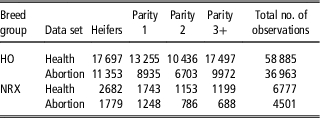
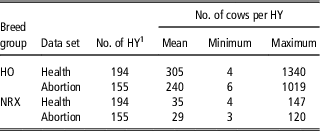
The breed group termed NRX was composed of F1 crossbreds, all with NR sires and HO dams. There were not enough crossbreds of other breed compositions to include additional groups in the analysis. The cows in the HO group were 100% HO. The data consisted of one data set with health records from routine weekly veterinarian examinations postpartum, BCS and days open, and the other file consisted of abortion records. The number of records per parity and breed group are given in Table 1. Herd-years having less than three NRX or HO observations each were removed from the data set (Table 2). Parities 3 to 6 were combined into one group called ‘parity 3+.’
Number of records (one record per cow per parity) in the health and abortion data sets for each breed group, Israeli Holstein (HO) and Norwegian Red×Israeli Holstein crossbreds (NRX) and parityFootnote 1 .

1 Parity 3+ included parities 3–6.
Number of Israeli Holstein (HO) and Norwegian Red×Israeli Holstein crossbreds (NRX) per herd-year (HY) in each data set.

1 Number of herd-year levels in each data set.
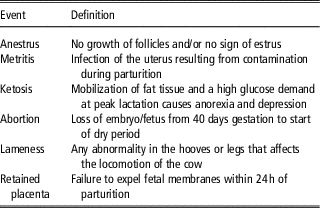
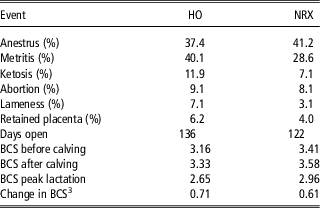
In the health records data set, each cow had one record per parity, where each of five diseases (defined in Table 3) were scored with either 1 or 0, 1 signifying that the disease or event was present or occurred at least once, and 0 signifying there was no sign of the disease. The diseases in the health data set included ketosis, metritis, retained placenta, lameness and anestrus. Records on milk fever, displaced abomasum, uterine prolapse and udder edema were also obtained, but frequencies were so low that they were not included in this study. For the postpartum diseases, the time period in which the scoring took place was between day 6 and 12 after calving. In the abortion data set, there were two records per lactation scored as 1 or 0. In the present study, abortion refers to the loss of pregnancy between 40 days of gestation and the beginning of the dry-off period. For the trait anestrus, two health events were combined: inactive ovaries and persistent corpus luteum (CL). Only 14% of positive anestrus cases were classified as persistent CL while 86% were due to inactive ovaries. There was only one fertility trait available in the dataset, days open, which was the number of days from calving to the start of the subsequent pregnancy. Body condition score was recorded three times per lactation by the veterinarian: two weeks after dry-off, within two weeks after calving and at peak milk production. In Israel, a scale of 1 to 5 with increments of 0.25 is used, 1 meaning thin and 5 meaning obese. The trait change in BCS was the difference between BCS after calving and BCS at peak lactation. The overall means for each trait are listed in Table 4.
Definitions of health traits.

Mean frequencyFootnote 1 of disease (% lactations with at least one case of disease) and mean days open and body condition score (BCS)Footnote 2 in Israeli Holstein (HO) and Norwegian Red×Israeli Holstein crossbreds (NRX).

1 Each disease was scored as 0 or 1 based on routine veterinary examinations. Postpartum diseases were recorded between days 6 and 12 after calving.
2 BCS scored in a scale from 1 to 5, in increments of 0.25, where 1=thin and 5=obese.
3 Difference between BCS after calving and BCS at peak lactation.
Model
Data edits and statistical analyses were performed in SAS (version 9.4, SAS Institute, 2013). Days open and BCS were analyzed with linear models using the GLM procedure. All other traits were binary and analyzed using a logistic model.
The following model was used for postpartum traits:
 $$Y_{{ijkl}} {\rm \,{\equals}}\,\mu {\plus}{\rm Breed}_{i} {\plus}{\rm HY}_{j} {\plus}{\rm Parity}_{k} {\plus}{\rm Birthyear}_{l} {\plus}e_{{ijkl}} $$
where Y ijkl is the observed value of the trait; μ the overall mean; Breed i the fixed effect of ith breed group (two classes, HO or NRX); HY j the fixed effect of herd-year (Table 2), which was made up of herd and year of calving except for the trait abortion, where HY included the year of conception instead of calving. Parity k was the fixed effect of the kth lactation (three classes; 1, 2 and 3+), Birthyear l was the fixed effect of the cow’s birth year, and e ijkl was the residual error.
The following model was used for traits relevant for heifers (anestrus and lameness):
 $$Y_{{ijkl}} \,{\equals}\,\mu {\plus}{\rm Breed}_{i} {\plus}{\rm }H_{j} {\plus}{\rm Parity}_{k} {\plus}{\rm Birthyear}_{l} {\plus}e_{{ijkl}} $$
where H j is the fixed effect of herd; Parity k the fixed effect of the kth lactation (four classes; 0, 1, 2 and 3+), and other effects were as defined above.
Effects were included in the models if they were significant at P<0.1. The final model for lameness did not include birth year as it was not significant. The effect of season (defined as winter, from November to January, spring, from February to April, summer, from May to July, and fall, August to October) was not significant for any of the traits, and therefore not included in the final models. For each trait, each parity was also analyzed separately, using the same model without the effect of parity.
Odds ratio
Odds ratio (OR) was calculated and used to evaluate differences in health traits between the two breed groups. The OR describes how much higher odds one breed group has of getting a disease compared with the other group. In the present study, an OR>1 means that HO has higher odds of getting the disease compared with NRX, while an OR <1 signifies the opposite. If the OR for HO v. NRX was 1, there was no significant difference between breed groups. The 95% confidence interval shows the range of OR that 95% of all observations in the true population fall into. The width of the confidence interval signifies how precise the estimate is. If this range includes one, there is not a significant difference between breed groups. The P-values also indicate the significance level of the difference between the breed groups.
Results
Postpartum diseases
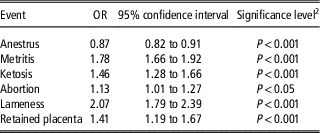
Odds ratios for HO v. NRX for the health traits ranged from 0.87 to 2.07 (Table 5). Here, OR>1 indicates a higher risk of the disease in the HO group, while OR <1 indicates a higher risk of the disease in the crossbred group. The highest OR (2.07) was found for lameness, that is the odds of lameness were higher in HO than NRX. Norwegian Red crossbreds had significantly fewer cases of ketosis, metritis, retained placenta, abortion and lameness than HO (Table 5).
Odds ratio (OR)Footnote 1 for Israeli Holstein (HO) v. Norwegian Red crossbreds (NRX) with 95% confidence intervals for each disease diagnosis.

1 Odds ratio (HO v. NRX), if OR>1 HO is more likely to have the disease; if OR<1 NRX is more likely to have the disease.
2 Significance level tested if odds ratio was different from one.
The mean frequency of anestrus decreased, while frequencies of ketosis and lameness increased with higher parities (Table 6). Odds ratios for each parity (Table 6) demonstrate that breed differences vary over parities for these traits. The incidence of ketosis increased in later lactations (Table 6), but difference between breeds decreased. The biggest difference between breed groups for ketosis was after the first calving, when odds for HO primiparous cows were 2.71 times as high compared with NRX (Table 6). Table 6 only includes the health traits that show a trend in OR from one parity to the next.
Mean frequency and odds ratio (OR)1 of the diseases with a trend in breed differences over parities2 for Holstein (HO) and Norwegian Red crossbreds (NRX).

1 Odds ratio (HO v. NRX): if OR>1, HO is more likely to have the disease; if OR<1, NRX is more likely to have the disease.
2 Table includes only diseases which vary from one parity to the next.
**Odds ratio is significantly different from 1 at P<0.01.
***Odds ratio is significantly different from 1 at P<0.001.
Israeli HO had two times higher odds of becoming lame compared with their NRX herdmates (Table 5). The biggest difference was observed in first-parity HO, which were 2.75 times higher odds of developing a case of lameness than first-parity NRX (Table 6). In later parities, the difference became slightly smaller between breed groups, but still significant at P<0.001.
Anestrus
The OR for HO v. NRX for anestrus was 0.87 indicating that NRX were at a slightly higher risk for anestrus compared with HO (Table 5). NRX heifers had a significantly higher risk of anestrus than HO heifers (Table 6). No significant breed difference for anestrus was found for cows during the first and second parities, but anestrus was more likely to be observed in NRX during parities 3 to 6 (Table 6).
Abortions
Abortion was the fourth most common health event in this study (Table 5). Norwegian Red crossbreds had a lower frequency of abortions than HO, significant at P<0.05 (Table 5). Israeli HO had 1.13 times higher odds of having an abortion compared with NRX. We did not observe any trend with increasing parity number in the differences between breed groups.
Days open and body condition score
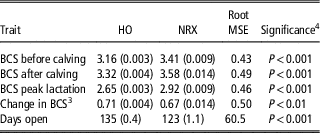
There were significantly more days open for HO compared with NRX (P<0.001). Least squares means (standard error) were 135 (0.4) and 123 (1.1), respectively (Table 7). There was no noticeable trend with increasing parity number and the difference between breeds was significant in each parity. Norwegian Red crossbreds had significantly higher BCS before calving, after calving and at peak lactation (P<0.001). The change in BCS from after calving to peak lactation was also lower for NRX (P<0.001). Least square means and standard errors are given in Table 7.
Least squares means with standard error (SE) for days openFootnote 1 and body condition score (BCS)Footnote 2 for Israeli Holstein (HO) and Norwegian Red×HO crossbreds (NRX).

1 Days open is the number of days from calving to the start of the next pregnancy.
2 BCS scored in a scale from 1 to 5, in increments of 0.25, where 1=thin and 5=obese.
3 Change in BCS from after calving to peak lactation.
4 Significance level of the difference in LS means different from 0 between the two breed groups.
Discussion
Disease frequencies
The frequency of some of the diseases and fertility problems were high in Israel compared with other countries. The frequent veterinary examinations in Israel allow for a high detection rate of postpartum diseases, and may explain the relatively high frequencies, especially for the traits metritis and ketosis. In the present study, 40.1% of HO and 28.6% of NRX had metritis, while the incidence of metritis in Norway was <1% (Haugaard and Heringstad, Reference Haugaard and Heringstad2015). In a review, Pryce et al. (Reference Pryce, Parker Gaddis, Koeck, Bastin, Abdelsayed, Gengler, Miglior, Heringstad, Egger-Danner, Stock, Bradley and Cole2016) reported a median incidence rate for ketosis of 3.3% over several countries in Europe and North America. This is much lower than the present study where means for NRX and HO were 7.1% and 11.9%, respectively (Table 4). The lower incidence rate in the other studies could be due to the recording system rather than a lower incidence of the disease.
The high incidence of anestrus (nearly 50% of cows had at least one case) found in both breed groups in the present study is probably reflective of the tradeoff between production and reproduction experienced by the modern dairy cow and could be due to different management practices. Incidence of reproductive problems was much lower in other countries: 6.3% in Canada (Koeck et al., Reference Koeck, Egger-Danner, Fuerst, Obritzhauser and Fuerst-Waltl2010) and 2.4% to 3.8% in Norway (Haugaard and Heringstad, Reference Haugaard and Heringstad2015) for anestrus and silent heat, respectively.
Differences in breeding goals
Differences between breed groups is due to a combination of additive genetic value of each of the parent breeds and heterosis effects. The latter could not be estimated in the present study because there are no purebred NR in Israel. Different genetic level for health and fertility in NR and HO is expected because of the differences in their breeding goals. Although HO in Israel have been a closed population for many decades, they have had a similar breeding goal to other Holstein populations, with the highest weight on milk production out of all the Interbull member countries. They have only recently included fertility in the breeding index, PD07 (Glick et al., Reference Glick, Shirak, Uliel, Zeron, Ezra, Seroussi, Ron and Weller2012) while Norwegian Red has been selected for a broad breeding goal with emphasis on health and fertility since the 1970s. Genetic improvement has been obtained for low-heritability traits like mastitis, ketosis (Heringstad et al., Reference Heringstad, Klemetsdal and Steine2007) and female fertility (A-Ranberg et al., Reference A-Ranberg, Heringstad, Klemetsdal, Svendsen and Steine2003). Some of the traits included in the present study have not been directly included in NR breeding goal (e.g. abortion, lameness) or have been added only recently (e.g. metritis, anestrus). However, positive genetic correlation to other health traits (Heringstad et al., Reference Heringstad, Chang, Gianola and Klemetsdal2005) and antagonistic genetic correlation between health traits and milk yield (Koeck et al., Reference Koeck, Egger-Danner, Fuerst, Obritzhauser and Fuerst-Waltl2010; Pryce et al., Reference Pryce, Parker Gaddis, Koeck, Bastin, Abdelsayed, Gengler, Miglior, Heringstad, Egger-Danner, Stock, Bradley and Cole2016) may have resulted in indirect selection responses and genetic differences between breeds.
Metabolic disorders
The inclusion of ketosis in each country’s breeding goal is reflected in the results. As ketosis is a metabolic disorder, the level of milk yield and, in turn, negative energy balance influences the prevalence. High milk production in the previous lactation can be a risk factor for ketosis (Fleischer et al., Reference Fleischer, Metzner, Beyerbach, Hoedemaker and Klee2001). Ketosis caused a decrease in milk yield from 126 to 534 kg depending on parity (Rajala-Schultz et al., Reference Rajala-Schultz, Gröhn and McCulloch1999) and can lead to a loss in body condition (Gillund et al., Reference Gillund, Reksen, Gröhn and Karlberg2001). The latter could be one of the causes of poor fertility identified in ketotic cows (Gillund et al., Reference Gillund, Reksen, Gröhn and Karlberg2001).
Lameness
The health event with the most substantial difference between breed groups in this study was lameness, as HO had double the odds of becoming lame compared with their NRX counterparts. The difference between breeds decreased in later lactations, which could be due to the culling of lame cows. Because the HO breeding index has put much more weight on milk production than NR’s breeding index, we expect that hoof problems would be more prevalent in HO. König et al. (Reference König, Wu, Gianola, Heringstad and Simianer2008) found positive but unfavorable genetic correlations ranging from 0.11 to 0.44 between milk yield and claw health. No previous studies on NRX and HO have compared incidence of lameness.
Reproductive disorders
Higher risk of metritis in HO compared with NRX was in agreement with Ezra et al. (Reference Ezra, Van Straten and Weller2016). Another study that compared Montbéliarde×HO crossbred cows with HO found a much lower incidence of uterine disorders in the crossbred cows (Mendonça et al., Reference Mendonça, Abade, da Silva, Litherland, Hansen, Hansen and Chebel2014). Metritis was added to the NR total merit index in 2015 (Geno Global, 2016) while genetically correlated traits such as mastitis and retained placenta have been included since 1978 and could have improved resistance to metritis. Two studies have shown that NRX have a better immune response than HO (Begley et al., Reference Begley, Evans, Pierce and Buckley2009; Cartwright et al., Reference Cartwright, Begley, Schaeffer, Burnside and Mallard2011). This could be an explanation of why NRX had a lower incidence of metritis and other disorders.
The genetic correlation between metritis and retained placenta is moderate-high and has been estimated from 0.55 to 0.74 (Heringstad, Reference Heringstad2010; Jamrozik et al., Reference Jamrozik, Koeck, Kistemaker and Miglior2016). The results of the present study were consistent with this study, as a higher incidence of retained placenta was observed in HO. Retained placenta can be a result of difficult calvings, which have been reported as more common in HO than in Scandinavian Red crosses (NRX and Swedish Red×Holstein crosses) and NR (Heins et al., Reference Heins, Hansen and Seykora2006; Ferris et al., Reference Ferris, Patterson, Gordon, Watson and Kilpatrick2014). Reducing the incidence of retained placenta and metritis by crossbreeding could also prevent fertility problems as there have been moderate genetic correlations (0.5) reported between retained placenta and anestrus/silent heat in HO (Koeck et al., Reference Koeck, Egger-Danner, Fuerst, Obritzhauser and Fuerst-Waltl2010). However, this disagrees with Heringstad (Reference Heringstad2010) who found no genetic correlation between the traits in NR.
The results for anestrus in the present study differ from our expectations based on previous studies comparing Holsteins with NRX. In all fertility-related traits, the NRX and NR have performed better than Holsteins in the same environment, including having a higher non-return rate and fewer services per conception (Schaeffer, unpublished data), a higher conception rate (Walsh et al., Reference Walsh, Buckley, Pierce, Byrne, Patton and Dillon2008; Ferris et al., Reference Ferris, Patterson, Gordon, Watson and Kilpatrick2014) and a higher first-service conception rate and pregnancy rate (Heins and Hansen, Reference Heins and Hansen2012). However, none of these studies looked into heifer fertility or fertility disorder traits like anestrus.
Anestrus has several different definitions, but in the present study, this health trait comprises two of the types of anestrus as defined by Peter et al. (Reference Peter, Vos and Ambrose2009). The first and most prevalent, inactive ovaries, is referred to as Type I. Type I anestrus occurs when there is no deviation of follicles or establishment of a dominant follicle (Peter et al., Reference Peter, Vos and Ambrose2009). The other type of anestrus included in the present study, type IV, was due to a persistent CL, which can be caused by dystocia, heat stress or postpartum diseases (Opsomer et al., Reference Opsomer, Gröhn, Hertl, Coryn, Deluyker and de Kruif2000).
Anestrus can be affected by many different events. Climate differs between regions in Israel; a warm Mediterranean climate dominates in the northern valley where most dairy farms in the present study are located. The winters are generally mild, 15°C to 20°C being the mean temperature, but summer temperatures typically reach 35°C. In the present study, there was not enough information on the time of anestrus diagnosis so we could not make a conclusion about the influence of summer or winter. There was no effect of season of calving, which could be due to the effective cooling systems in many barns in Israel involving the use of spraying and fans to prevent overheating (Flamenbaum and Galon, Reference Flamenbaum and Galon2010).
Abortions
The ability to maintain pregnancy is associated with the cow’s energy balance. A change in BCS of one unit from before calving to 30 days postpartum increased the likelihood of fetal loss by 2.4 (López-Gatius et al., Reference López-Gatius, Santolaria, Yániz, Rutllant and López-Béjar2002); likewise, Silke et al. (Reference Silke, Diskin, Kenny, Boland, Dillon, Mee and Sreenan2002) reported that a higher frequency of fetal loss was associated with a change in BCS during the second month of pregnancy. Frequency of abortion has been found to be higher in high-yielding than low-yielding cows (Grimard et al., Reference Grimard, Freret, Chevallier, Pinto, Ponsart and Humblot2006) so this could explain why we see a higher incidence in HO v. NRX. The results of the present study favored NRX over HO only marginally (P<0.05), however, each abortion results in an economic loss of US$ 550 (De Vries, Reference De Vries2006) so even a small decrease in abortions is noteworthy in terms of farm profit.
Days open
Days open is often used as a measure of fertility in dairy cattle. The results from the present study were consistent with previous studies on NRX v. HO, which found that there were significantly fewer days open among NRX cows compared with HO (Walsh et al., Reference Walsh, Buckley, Pierce, Byrne, Patton and Dillon2008; Heins and Hansen, Reference Heins and Hansen2012). One reason for the difference between breed groups in days open could be due to the NR’s history of including fertility in the total merit index. However, many factors can affect days open. If a cow requires many inseminations to become pregnant, or if she is not showing estrus, breeding will be delayed. Management decisions, like choosing to postpone breeding and have longer lactations, affect the number of days open. Metritis and other postpartum diseases can also affect days open. Toni et al. (Reference Toni, Vincenti, Ricci and Schukken2015) reported that metritis, retained placenta and lameness decreased first service conception rate and increased days open. It would have been preferred to use other measures of fertility in the present study as days open is biased because it only includes cows with a subsequent lactation. Unfortunately, days open was the only one available in the data we received.
Body condition score
Many of the metabolic diseases are associated with negative energy balance in early lactation. BCS is a subjective measure of an animal’s body reserves, and changes in BCS can be used to quantify mobilization of body reserves. The results of the present study were similar with two previous studies on Norwegian Red crossbreds in which NRX also had higher BCS than HO. In both the Republic of Ireland and Northern Ireland, purebred NR had a higher lactation average BCS than HO (Walsh et al., Reference Walsh, Buckley, Pierce, Byrne, Patton and Dillon2008; Ferris et al., Reference Ferris, Patterson, Gordon, Watson and Kilpatrick2014). Body condition scores are especially of interest because of the genetic correlation (r g =−0.27 to −0.62) with reproductive performance (De Haas et al., Reference De Haas, Janss and Kadarmideen2007). Poor body condition can make it more difficult for cows to become pregnant, leading to more days open and requiring several inseminations. A lack in body condition can also increase the risk of postpartum diseases such as lameness, metritis, ketosis and retained placenta (Hoedemaker et al., Reference Hoedemaker, Prange and Gundelach2009; Jamrozik et al., Reference Jamrozik, Koeck, Kistemaker and Miglior2016). Hoedemaker et al. (Reference Hoedemaker, Prange and Gundelach2009) also observed that cows with a change in BCS>0.25 from calving to 4 weeks after calving had a higher risk of developing lameness. In the present study, both breeds had a change in BCS>0.25 with the change in HO significantly higher than NRX, so that could partially explain the increase in lame cows. However, it is more logical that lameness results in a low BCS due to a decrease in feed intake rather than vice versa.
Implications
The relatively high incidence of some of the diseases in the present study can be attributed to the high milk yield, challenging environment, as well as the high detection rate in Israeli dairy herds. Most of these diseases are favorably genetically correlated with one another, so selection for resistance against one disease can result in a correlated selection response and a decrease in other diseases (Heringstad, Reference Heringstad2010; Jamrozik et al., Reference Jamrozik, Koeck, Kistemaker and Miglior2016). Although the present study used data only from Israel, the aforementioned genetic correlations are present in many different populations (Pryce et al., Reference Pryce, Parker Gaddis, Koeck, Bastin, Abdelsayed, Gengler, Miglior, Heringstad, Egger-Danner, Stock, Bradley and Cole2016). Therefore, we surmise that the effect of crossbreeding with NR would be similar in other countries with production systems that are also intensive and/or face the challenges of warm climates. It would be interesting to look at genotype by environment interactions between NRX in Israel and NRX in different production systems, but there is minimal data available on similar postpartum disease traits outside of Israel.
Heins and Hansen (Reference Heins and Hansen2012) has shown that crossing Holstein with Scandinavian Red breeds can result in 44% higher lifetime profit per cow due to a longer herd-life and 5% to 8% higher profit per day than pure Holstein. Their study did not consider veterinary expenses in the profit calculations. Therefore, it would be interesting to acquire and analyze veterinary treatments and the costs associated with them in order to determine the economic benefits of crossbreeding due to improved health. Lameness, for example, results in a substantial cost to the farmer due to a loss in milk production, increase of fertility problems and treatment of the disease, which has been estimated at US$ 120 to US$ 216 per case depending on the type of lameness (Cha et al., Reference Cha, Hertl, Bar and Gröhn2010).
Despite the small loss in milk production observed in NRX (Heins and Hansen, Reference Heins and Hansen2012), crossbreeding could be economically beneficial due to less money spent on treatments and fewer days open. The higher BCS and less change over time in the crossbreds could help prevent diseases and reproductive problems. According to Koeck et al. (Reference Koeck, Egger-Danner, Fuerst, Obritzhauser and Fuerst-Waltl2010), selecting cows for disease resistance could increase longevity. Improving health and fertility, and in turn, creating more robust animals, is the main purpose of crossbreeding, but in order to quantify this improvement and to do further studies we will need more records on direct health traits.
Conclusions
Crossbreeding HO and NR can result in cows that are less susceptible to postpartum diseases; NRX were less likely to be diagnosed with metritis, ketosis and lameness than their HO herdmates. They also had lower risk of having a retained placenta and abortions. NRX heifers and older cows had a higher risk of anestrus, but NRX cows had significantly less days open in all parities. They also had a higher BCS than HO and maintained more body condition from calving to peak lactation. The results from Israel show the same trend as previous studies on Norwegian Red crossbreds which indicates that the crossbreds are durable enough to thrive in warm climates while maintaining a high level of production. The challenge of intensive production in warm climates is not unique to Israel, and these results provide insight on how NRX would perform in other countries with similar environments. However, more crossbred animals are needed for future studies in order to demonstrate a significant difference between the breed groups for less frequent diseases and to be able to divide the crossbreds into groups to compare varying breed compositions.
Acknowledgments
The authors would like to thank David Dror for assistance with the data collection, the dairy farmers in Israel for their willingness to share their data, the Norwegian University of Life Sciences and Department of Animal and Aquacultural Sciences for funding the PhD project and the Mina and Samson Berges Research Grant for funding needed to acquire the data.
Declaration of Interest
The authors declare no conflict of interest.
Ethics statement
This study does not require ethical approval as data were collected for herd management purposes only.
Software and data repository resources
Data are not deposited in an official repository.