Introduction
Microstrip patch antennas (MPA) play an important role in modern wireless communication system. The main limitations of MPAs are narrow bandwidth, low gain, and spurious radiations. A major challenge in the design of MPA is to enhance bandwidth and gain using available techniques [Reference Chen, Wang and Zhang1]. Today's wireless communication system needs low profile, low cost, wideband, and compact antennas. Therefore, MPAs are designed to provide high gain, wider bandwidth, and support for multiband in any communication applications. Fractal antennas are exposed to the greatest extent in order to achieve these requirements. The word “Fractal” is a derivative of the Latin word “fractus”, which means broken or fractured. The term fractal was coined by B. Mandelbrot about 20 years ago, in the year 1975 [Reference Musselman and James2]. For most wireless communication systems, the size of antenna is an important factor. There are many methods, such as use of dielectric substrate material with high permittivity, applying resistive or reactive loading, increasing the electric length of the antenna by optimizing its shape, for achieving size reduction in MPAs. The fractal structures have two important geometric properties, such as self-similarity and space filling. The self-similarity of such fractal structures results in the multi-band behavior and frequency-selective surface fractal antennas. Fractal structures are used in antenna miniaturization [Reference Thankachan, Mohan, Anil, Alisha and Nair3] because of their space-filling properties. There are different types of fractal geometries that are used for various purposes such as miniaturization, enhancement of gain, bandwidth, and efficiency of an antenna. The fractals are used as arrays for beam forming in directional antennas. In the literature review, it is found that, there are few fractal geometries that are popular such as Koch, Sierpinski, Minkowski, Cantor set, and Hilbert [Reference Shrestha and Park4].
This paper is structured as follows: an overview of the related work is given in “Literature review” section, “Problem definitions” section explains about problem definition, “Antenna design” section describes antenna design, and “Results and discussion” section provides the results and discussion and finally conclusion of the paper in “Conclusion” section.
Literature review
In the literature, many different works on fractal antenna geometries are reported and few related works with respect to this communication are highlighted here. Chen et al. [Reference Chen, Wang and Zhang1] explained a novel technique to miniaturizing of MPAs by using two fractal geometries in a single antenna, that is, by etching the patch edges according to Koch curves as inductive loading, and inserting the Sierpinski [Reference Musselman and James2–Reference Shrestha and Park4] carpets into the patch as slot loading. The resonance frequency of the patch is shifted at lower frequency as the higher iteration order of the fractal shapes is considered. This property can be utilized to reduce the size of the MPAs. It is also found that, the radiation patterns of the proposed fractal-shaped antennas are maintained because of the self-similarity and Centro symmetry of the fractal shapes. In [Reference Kordzadeh and Hojat Kashani5] Kordzadeh and Hojat Kashani achieved the compact microstrip antenna with Koch-shaped fractal defects on the patch surface as presented. Using this method, the overall electric length of the antenna is increased largely and hence the size of antenna is reduced to 85%, compared to an ordinary microstrip antenna with the same resonance frequency. In [Reference Shandal, Mezaal, Mosleh and Kadim6] Shandal et al. proposed a pentagon slot [Reference Dalmiya and Sharma7] inside fractal circular patch microstrip resonator to design compact antenna over partial ground plane that is introduced using the third iteration of adopted fractal geometry. Similar works are proposed in the papers such as in [Reference Ali, Subhash and Biradar8] a miniaturized ultra-wideband (UWB) antenna based on Sierpinski square slots is reported [Reference Jayapal and Varadarajan9]. Antenna miniaturization is achieved by etching Sierpinski square slots in the radiating decagonal-shaped monopole, and UWB operations are accomplished by utilizing double truncations in the ground plane. Motevasselian and Whittow [Reference Motevasselian and Whittow10] introduced an effective approach to reduce the patch size in rectangular patch microstrip antennas by inductive loading of the patch using a cuboid ridge. The authors used the defected ground structure (DGS) and defected microstrip antenna structure [Reference Kushwah and Tomarn11, Reference Raval, Kosta, Makwana and Patel12] concept to design a compact MPA in [Reference Mirzapour and Hassani13, Reference Roman14]. In [Reference Saraswat, Prakash and Dahiya15–Reference Jiang and Liu17] size reduction of square patch antenna is proposed using meta-fractal technique. This technique implies adding fractal shape (Peano shape here) to the classical square antenna to reduce its size and then a complementary split-ring resonator is slotted on the patch as a defect. The defect enforces the antenna to behave as meta-material in a specific frequency range. In [Reference Chakravarty and Sarkar18] the authors explained the three issues such as (1) ambiguities in setting up a proper box cover of the object of interest, (2) problems of limited data points for box sizes, and (3) difficulty in determining the scaling range. The authors propose corresponding improved techniques with modified measurement design to address these issues: (1) rectangular grids and boxes setting up a proper box cover of the object; (2) pseudo-geometric sequence of box sizes providing adequate data points to study the properties of the dimension profile; (3) generalized sliding window method helping to determine the scaling range. Similar work related to this communication has been reported in [Reference Shareef and Shaalan19], a new compact fractal antenna in the shape of a snowflake is proposed. Various iterations of this fractal antenna with probe feed and capacitive coupled feed are compared and optimized. Size reduction is proposed using slots [Reference Gola and Agarwal20]. The author used meander line slot to improve the bandwidth and size reduced in microstrip antenna [Reference Mukti, Schreiber, Paulitsch, Gruber and Bösch21,Reference Chourasia, Sharma and Goswami22]. A dumbbell-shaped DGS in the common ground plane of a back-to-back microstrip structure was found to give a size reduction of about 64% and shifts the resonance frequency from 5 to 1.8 GHz, with 20 MHz bandwidth facilitating the antenna, to be used for global system for mobile communications [Reference Arya, Kartikeyan and Patnaik24].
Problem definitions
In the recent communication device scenario, the miniaturization of antennas has become so important. There are various types of fractals such as Koch, Cantor, Sierpinski, etc. In this paper, we are using Vicsek snowflake-box fractal to reduce the size of the micostrip patch antenna for modern wireless communication. The compact microsrtrip patch antenna is implemented using conventional Vicsek snowflake-box fractal antenna of third iteration and applying the DGS shapes like U-shaped slot etched in the ground plane is considered because of its better performance. The basic conventional MPA of Vicsek snowflake-box fractal first order is designed and its second and third iterations are also studied. The enhancement of its compactness is achieved by the fractal geometry. The rectangular and U-shaped slots as DGS have given better performance in both input and output parameters of MPA as well as enhancement of bandwidth.
Antenna design
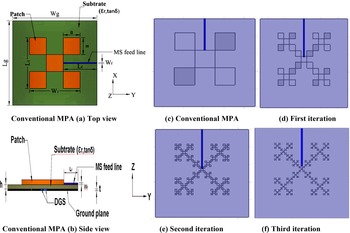
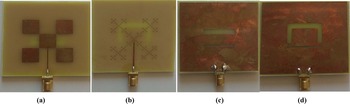
The dimensions of conventional antenna are designed using the well-known formulae given in antenna design hand book [Reference Chen, Wang and Zhang1]. The antenna is resonating at 3.95 GHz with a dimension of square patch of Lp = Wp = 30 mm with a substrate thickness of h = 1.6 mm and dielectric constant εr = 4.4 (FR-4) substrate and copper square ground plane with dimension of Wg = Lg = 50 mm. The antenna is fed with 50 ῼ microstrip line of length 18 mm and width 0.7 mm. Schematic diagram of conventional fractal antennas is shown in Fig. 1. The Vicsek snowflake-box fractal is used on the MPA; each box has equal sides, i.e. a = 10 mm in square shape. All the dimensions of the MPA, such as ground plane, the length and width of the slot, the location of the slot on the ground plane, the position of the patch above the ground plane, and the position of the feed point, are optimized using HFSS V.15. The conventional MPA and proposed Vicsek fractal iterations are shown in Fig. 1 [Reference Jiang and Liu17]. In this paper, Fig. 1(c) shows the conventional (basic) antenna; here the four squares are removed on each side for every five retained along length and width. The same procedure continues till third iteration. The wideband response is obtained by using DGS concept; here we etched two slots, one is rectangular slot and other one is U-shaped slot, and also observed the response of both by simulation study and found that the U-shaped DGS slot helps to improve the bandwidth of the antenna. The same arrangement is replicated at all the corners of the central base antenna in the initial step of the first iteration. For the second and third iterations, the same procedure is repeated and such fractal is known as Vicsek snowflake-box fractal. For the purpose of impedance matching, a microstrip line feeding of 50 Ω impedance is used. The experiment is done in the microwave laboratory for the measurement of return loss and radiation characteristics; for this set of conventional and proposed Vicsek snowflake-box fractal, MPAs are fabricated using the FR4 dielectric material as shown in Fig. 2.
The geometric view of conventional MPA top view (a) and side view (b) of Vicsek snowflake-box fractal MPA. (c) Conventional MPA. (d) First iteration of MPA. (e) Second iteration of MPA. (f) Third iteration of MPA. The dimensions of ground plane are Wg = 50, Lg = 50, L 1 = 30, W 1 = 30, t = 0.03, h = 1.6, ɛr = 4.4, L f = 18, W f = 0.7, and a = 10 (all dimensions are in mm).

The fabricated prototypes of conventional and proposed Vicsek snowflake-box fractal microstrip patch antenna. (a) Top view of conventional (basic) MPA. (b) Top view of proposed (third) iteration of MPA. (c) Bottom view of proposed (third) iteration of MPA with rectangular DGS slot. (d) Bottom view of proposed (third) iteration of MPA with U-shaped DGS slot. All parameters are shown in Fig. 1.

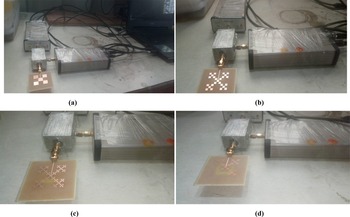
The fabricated prototypes and the experimental setup for the measurement of input parameters such as S 11 and VSWR and output parameters such as radiation characteristics are shown in Figs 3(a)–3(d).
Experimental setup of different prototypes for measurement of return loss and radiation pattern.

Results and discussion
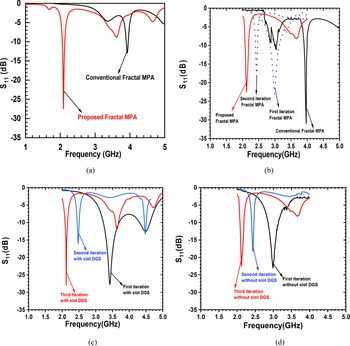
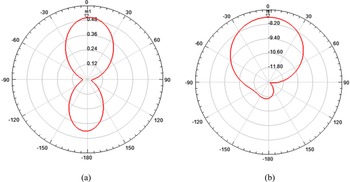
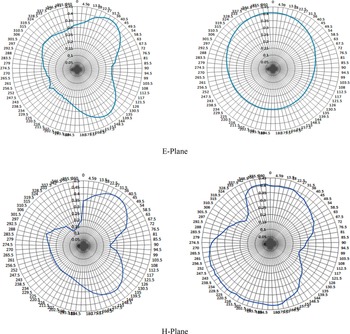
The proposed and the conventional Vicsek snowflake-box fractal MPA are simulated using HFSS V-15 Electro Magnetic (EM) simulator and verified using all input and output parameters of the antenna. Figure 4(a) shows the S 11 comparison of conventional and proposed Vicsek snowflake-box fractal MPA. Figure 4(b) shows the measured S 11 graph of conventional antenna and first, second, and third iterations fractal MPA. Figures 4(c)–4(d) show different iterations with and without DGS slots. Here the miniaturization is achieved by considering the third iteration of the Vicsek snowflake-box fractal MPA with U-shaped DGS slot. In the plot, it shows that the conventional MPA is resonating at 3.95 GHz with a −14 dB of S 11, whereas the proposed MPA is resonating at 2.12 GHz with a return loss of −28 dB. These data clearly show the achievement of compactness of 87.26% when compared to conventional MPA. In the proposed configuration, we have considered the third iteration along U-shaped defected ground slot as the final configuration. The third iteration gives compactness only by using fractal but bandwidth is improved because of U-shaped DGS slot. The proposed antenna is fabricated and measured using vector network analyzer. The results are shown in Table 1. The radiation characteristics are shown in Fig 5. The radiation characteristics for the proposed antenna are measured at frequencies of 3.95, 2.99, 2.42, and 2.12 GHz in the principal planes “X-Z and X-Y. Radiation characteristics that are almost dumbbell shape occur at 3.95 GHz. It is observed that the resonance frequency is shifted from 3.95 to 2.12 GHz. By making the defective ground structure in antenna design we observed increase in bandwidth and simulateously size of the antenna is going to reduces using fractal concept (as shown in Table 1), that as resonance frequency becomes lower it narrowing the bandwidth for the proposed antenna compared to the reference one. The simulated and measured radiation patterns for both the proposed and base antenna are shown in Figs 5 and 7. When compared with an antenna of the same resonance frequency, a reduction of about 87.26% is achieved in antenna size, by adding a Vicsek snowflake-box fractal to the proposed antenna. In the proposed antenna, we observed the bandwidth of 70 MHz at 2.12 GHz and gain is achieved to an acceptable value. The E- and H-plane radiation patterns of the conventional and proposed fractal-based antenna is as shown in Fig. 7.
Return loss characteristics (S 11) comparison of conventional and proposed fractal MPA, (a) simulated, (b) measured, (c) different iterations with slot DGS, (d) different iterations without slot DGS.

The simulated radiation pattern of (a) conventional and (b) proposed antenna.

Summary of the measurement results

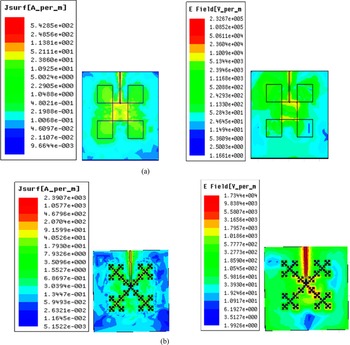
There are two parameters which affect antenna radiation properties. The first one is the surface current that affects resonance frequency of antenna, and the second one is surface resistivity Rs that affects input impedance, bandwidth, and gain of the antenna [Reference Patil, Vani and Hunagund23]. In our work, surface current has more effect on resonance frequency, and therefore a significant change in resonance frequency from 3.95 to 2.12 GHz as shown in Fig. 4. At the lowest resonance frequency, current distribution is more at the center of the MPA. That current is distributed over the entire area of the MPA and is maximum at the upper side and feed as shown in Fig. 6. The gain is minimized which is considered as acceptable due to the effect of more surface current (lesser surface resistivity). The surface resistivity plays a vital role in decreasing the gain and increasing the bandwidth (Fig. 6).
The simulated current distribution of (a) conventional and (b) proposed antenna.

Measured radiation patterns E- and H-plane of conventional and proposed antenna.

Conclusion
The compactness of MSA is achieved using Vicsek snowflake-box fractal in this work. The same has been used in third iteration along with etched U-shaped slot as DGS to improve the bandwidth. This proposed MPA is resonating at 2.12 GHz with acceptable gain and broadside radiation. The miniaturization of about 87.26% when compared to conventional fractal MPA is achieved. A series of simulations are carried out to get optimized compact design using HFSS V-15 EM simulator. The conventional and proposed compact MSA with DGS slot are fabricated for experimental verification. In this paper, the iterative approach is made up to the third iteration with microstrip feed. The measured results are well matched with the simulated predictions as shown in the S 11 and radiation plots. The S 11 plot shows the antenna size is reduced up to 87.26% relative to the operating frequency of the conventional MSA. A vector network analyzer is used to measure the S 11 parameters of both conventional and proposed MSAs. The proposed fractal microstrip antenna is highly compact and suitable for applications such as weather radar and satellite communication.
Acknowledgment
I would like to sincerely thank my guide Dr. Rajendra R Patil for his constant support to write this research paper. This research was supported in part by GSSS Institute of Engineering and Technology for Women, Mysore, India.
 Bharamappa I. Kattimani obtained BE and MTech from VTU Belagavi. He worked as lecturer in REC Hulkoti from 2008 to 2012 and currently working as assistant professor in VSM's Somashekar R. Kothiwale Institute of Technology Nipani since 2012 till date.
 Dr. Rajendra R. Patil obtained BE from PDAEC, Gulbarga in 1991 and MTech Specialization Power Electronics in 2006. He earned a PhD from the Department of Applied Electronics Gulbarga University, Gulbarga. He has more than 22 years of teaching experience. Currently he is a Professor & Head of the Department of E&C in GSSIETW, Mysuru since 2017 till date. He is a professor and research supervisor for several research scholars in VTU Belagavi. He also has presided as chairman and co-chairman of several national and international symposia. He has had pioneering research contributions in diverse areas of electromagnetic, antennas, measurement and diagnostics techniques, numerical and asymptotic methods, satellite and personal communications, human/antenna interactions, frequency selective surfaces, electromagnetic band-gap structures and their applications.