Introduction
The development of ageing research in the United Kingdom (UK) over the last 15 years has been largely through a series of the research council special programmes. The three largest programmes have encouraged multi-disciplinary research, collaboration with users and the close involvement of older people. This paper identifies some of the key factors which have sustained good progress and suggests that recently, support for these factors has been equivocal. Two distinct approaches to organising multi-disciplinary ageing research are highlighted particularly through reference to the New Dynamics of Ageing (NDA) Programme and the Engineering and Physical Sciences Research Council (EPSRC) EQUAL (Extending Quality Life) Programme, both of which are substantially completed. However this paper does not seek to evaluate the overall achievements of these programmes, but rather the manner in which they have stimulated multi-disciplinary user-focused research. First, it considers key events in the development of ageing research in the UK since 1996. This is followed by a comparison of levels of funding and participation over time, the issues faced by the programmes and, finally, a discussion of the implications for the future development of multi-disciplinary ageing research.
The genesis of the programmes was a determined request in November 1996 by the government Chief Scientist, Sir John Cadogan, and the Minister for Science and Technology, Mr Ian Taylor, that the UK research councils should take more notice of the ageing population and the needs of older people and should respond positively to the Office of Science and Technology EQUAL (Extend QUAlity Life) Initiative (Department of Trade and Industry 1995a).Footnote 1 Despite a decade of evidence about the challenges for UK society arising from the ‘age shift’ in the population (e.g. Department of Trade and Industry 1995b; Secretaries of State 1989), EQUAL had made little progress since it was announced in 1995 because the research councils had failed to play a major role. Although there was a tradition of research in geriatric medicine and old age psychiatry, supported by the Medical Research Council (MRC), the Department of Health and charitable foundations, and social gerontology was developing strongly, Sir John considered that a wider disciplinary base was needed. As well as extending the scope of bio-medical and social research there was concern about ‘the everyday living environments of older people and new technologies to support independence, particularly of frail older people’. In particular, Mr Taylor was ‘looking for the research community to show a stronger interest and demonstrate skills to a wider public of the importance of scientific research, especially multidisciplinary working’. He emphasised the need for ‘creating confidence in research amongst potential users and beneficiaries’. This set the scene for a series of research councilFootnote 2 special programmes of ageing research which since 1997 through funding of over £80 millionFootnote 3 have supported over 200 distinct research ventures and over 550 investigators.
Ten years later, ageing was the top priority for research council spending in the UK Government Science Budget for 2008/9 to 2010/11 with £485 million allocated to ageing (Department for Innovation, Universities and Skills 2007). However, as the bulk of this budget was for work not solely focused on ageing (e.g. stroke, neurodegenerative conditions, cardiovascular disease, basic biological research and technology development) which was already well funded, as well as work which, because of the ubiquity and ambiguity of the term ageing, can be allocated easily to other areas, this did not necessarily suggest that support had greatly improved. Between 2008/9 and 2010/11 the amount spent on the awards made by the special programmes which are the subject of this paper accounted for about 6 per cent of the budget attributed to ageing and the cost of similar work supported through other research council mechanisms was about 4 per cent. Indeed, over the period not a great deal of the ageing budget was invested strategically. For example, in 2010, all research council strategic investments (including the special programmes) accounted for no more than 15 per cent of the spending on ageing research (see MRC 2010a: Table 1).
For many researchers the special programmes have been the only source of funding for ageing research. Research council support for single-discipline ageing-related research is inadequate and despite the strong tradition of funding in the UK from charitable bodies (e.g. Alzheimer's Society, Dunhill Medical Trust, Joseph Rowntree Foundation and Wellcome Trust) their support has been limited, as has that from Government departments with the occasional exception of the Department of Health.
This paper draws heavily on programme-specific literature, press notices and databases of grant awards of the Biotechnology and Biological Sciences Research Council (BBSRC), EPSRC, Economic and Social Research Council (ESRC) and MRC (BBSRC 2010; EPSRC 2009; ESRC 2010; MRC 2009), government publications, and discussions with key figures involved with the development of ageing research, including research council staff.
Programmes
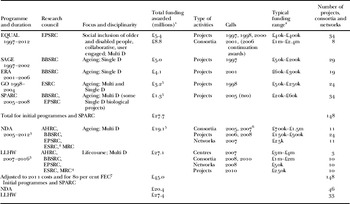
Between 1997 and 2008 ten research council initiatives specifically concerned with ageing processes and the needs of older people were launched with a total value of over £80 million. Each aimed to establish viable research communities which contribute both academic knowledge and improvements to the quality of life of older people and the functioning of society. They varied in scope and organisation. Of the research programmes (Table 2), EPSRC's EQUAL pioneered a broad multi-disciplinary approach, collaboration with users, including policy makers, practitioners and organisations which work with or provide products or services to older people, and the direct involvement of older people. Science of Ageing (SAGE) and Experimental Research into Ageing (ERA) supported largely single-discipline projects but Growing Older (GO) had a degree of multi-disciplinarity although limited to the disciplines which ESRC had traditionally supported. Strategic Promotion of Ageing Research Capacity (SPARC) focused on building capacity by supporting research newcomers, and working with the many organisations and individuals interested in the needs of older people. NDA drew together five research councils (BBSRC, EPSRC, ESRC, MRC, and Arts and Humanities Research Council (AHRC)) in a single programme, as does Life Long Health and Wellbeing (LLHW). Each of these programmes encouraged networking to varying degrees. This was integral to achieving the multi-disciplinarity and user engagement necessary to meet Sir John's challenge.
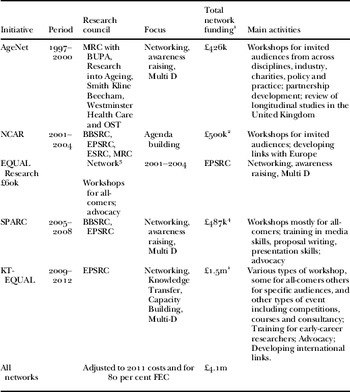
AgeNet and the National Collaboration on Ageing Research (NCAR) were significant early networking and agenda-building activities, and, later, KT-EQUAL (Knowledge Transfer for Extending Quality Life) used networking to exploit the existing knowledge and skills base; however, they did not directly fund research. These, as well as GO, NDA and SPARC, were directed by experienced researchers whilst EQUAL, SAGE, ERA and LLHW were managed by research council personnel.
UK research council ageing research programmes 1997–2011

Notes: AHRC: Arts and Humanities Research Council. BBSRC: Biotechnology and Biological Sciences Research Council. EPSRC: Engineering and Physical Sciences Research Council. EQUAL: Extending Quality Life. ERA: Experimental Research into Ageing. ESRC: Economic and Social Research Council. GO: Growing Older. LLHW: Lifelong Health and Wellbeing. MRC: Medical Research Council. Multi D: multi-discipline. NDA: New Dynamics of Ageing. SAGE: Science of Ageing. Single D: single discipline. SPARC: Strategic Promotion of Ageing Research Capacity. XCAR: Cross-Research Council Coordination Committee for Ageing.
1. Only the value of awards for projects, consortia and networks are included, the cost of other programme-level activities such as programme management and public workshops have been excluded as have research council direct costs. SAGE, ERA, GO projects and those from the first four EQUAL Calls were funded prior to the introduction of the system of Full Economic Costing (FEC). Those funded as a result of the final EQUAL Call, NDA and LLHW were funded according to FEC. SPARC followed a hybrid system.
2. k: thousands, m: millions.
3. Expected end date. Programme may be extended to accommodate delays in completing projects within the programme and end-of-programme activities.
4. Lead research council, responsible for management of the programme. For GO, SPARC and NDA academic directors were appointed. They were supported by advisory committees. Other programmes were managed directly by the lead research councils, taking advice where necessary, for example from XCAR.
5. Excludes cost of director(s), administration, and some training and dissemination activities.
6. In 2007 there was a conventional call and a further call for participation in a Sand Pit.
7. All costs have then been adjusted for inflation and rebased to 2011 levels and where necessary recalculated on an FEC basis. Note that the research councils award 80 per cent of FEC.
UK research council ageing networking initiatives 1997–2011

Notes: For abbreviations, see Table 1. OST: Office of Science and Technology. KT-EQUAL: Knowledge Transfer for Extending Quality Life. All initiatives had independent directors and administrations supported by advisory committees.
1. All values are pre Full Economic Costing (FEC) except for KT-EQUAL. k: thousands, m: millions.
2. An estimate, actual value not available.
3. The EQUAL Research Network was part of the EQUAL Programme.
4. Includes cost of administering SPARC awards scheme.
Objectives
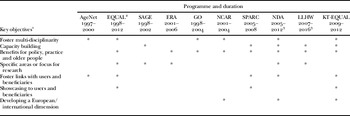
The objectives of each initiative differed but overlapped. Headline statements in programme announcements are summarised in Table 3. All but one initiative had the objective of building the research community, through either fostering multi-disciplinarity or capacity building. Most emphasised benefits for policy, practice and older people. Half highlighted specific questions, areas or the focus for research. A similar proportion emphasised fostering links with users and beneficiaries, with some networking initiatives specifically mentioning showcasing to users and beneficiaries, and three highlighted a European/international dimension. In summary, whilst there were common themes relating to developing the research base and contributing to policy and practice, the place of users varied, an objective which is considered in more detail later.
Comparison of key objectives of programmes and networks

Notes: For abbreviations, see Table 1.
1. Based on the principal objectives emphasised in descriptions of the programmes, for example in proposals and press notices. The detailed descriptions of most of the programmes included further objectives.
2. Includes EQUAL Research Network.
3. Expected end date. The programme may be extended to accommodate delays in completing projects within the programme.
The defining features of the largest programmes, EQUAL, NDA and LLHW, have been their promotion of working across disciplinary boundaries and involvement with users. However, whilst descriptions of the research areas which they sought to support were essentially similar, they were described variously as multi-disciplinary, inter-disciplinary and cross-disciplinary. For example, the promotional literature for EQUAL emphasised cross-discipline partnerships (EPSRC 2000). The first NDA call for proposals required inter-disciplinary research but the final call highlighted multi-disciplinary research (ESRC InfoCentre 2005, 2008). The term used for LLHW was multi-disciplinary (MRC 2010b). Differences between these terms are important to some disciplines and their meanings differ across disciplines, although possibly these distinctions were too subtle for those for whom, regardless of the term used, the requirement was new.
The terms ‘user’, and at times, ‘beneficiary’ and ‘stakeholder’, were also presented ambiguously and viewed differently by the disciplines. Some researchers, especially in some earlier programmes, took a narrow view of users, predominately those who inhabit the world of research, although this was not acceptable for the later programmes. Others considered users to include all of the individuals and organisations which could use research findings to benefit older people, their families and carers, and society.
Although the emphasis on multi-disciplinary research reflects the influence of the initial impetus for the programmes – that many issues faced by older people cannot be addressed by a single-discipline approach – other mechanisms, namely research council responsive mode funding, remained available to support single-discipline work. More importantly, the progress of the programmes was dependent on encouraging the involvement of single-discipline experts, able to draw on and contribute to scholarship within their own disciplines on the basis of their experience of multi-disciplinary projects.
Research council discussions about ways of achieving multi-disciplinary working has generally centred on facilitating scientists operating in different environments, often strongly delineated by the boundaries between research councils, to work together. Therefore, understanding the extent to which each programme has fostered working across these boundaries could provide useful insights into the progress towards desirable levels of multi-disciplinary working. Certainly analysis of the extent of working across these boundaries for all programmes is feasible, unlike analysis focused on individual disciplines which is very problematic.
So, this paper is informed by an analysis of the backgrounds of those individuals who have received awards from special programmes in terms of their ‘home’ research council – that is, their ‘domain’. An individual's domain is that to which they are likely to be most closely aligned, based on consideration of their research record. For example, the home research council of most social gerontologists was judged to be ESRC.
Despite some potential ambiguities, classification has been mostly straightforwardFootnote 4 and whilst certain disciplines are present in several domains, most are strongly associated with one domain. Rather than reflecting disciplines through, for example, the organisation of intellectual activity, theory and literature, the domains reflect the practical aspects of the organisation of academic life, the structure of research funding and of universities, and the characteristics of a researcher's career.
This approach enables assessment of the extent to which researchers from different environments worked together and provides the basis for considering the programmes in terms of their level of multi-disciplinarity albeit defined broadly, in terms of domains. Taking into account their aims and organisation it should then be possible to identify the reasons why some programmes have achieved higher levels of multi-disciplinarity than others. These considerations are important to justify the investment in cross-council programmes.
Key analyses have focused on those who secured funding as Principal Investigators or co-investigators, or equivalent roles. Each of the investigators named for each project or other activity has been classified to one of six domains representing five research council environments (BBSRC, EPSRC, ESRC, MRC and AHRC) and one other domain, Health (often those in the allied health professions who, to a large extent, have been funded by the Department of Health and associated organisations). Different types of activity have been supported: projects (EQUAL, SAGE, ERA and GO Projects, NDA Programme Grants, LLHW Pilot Projects); consortia (EQUAL Consortia, NDA Collaborative Research Projects, LLHW Collaborative Grants, LLHW Research Grants); and networks (NDA Preparatory Networks, LLHW Collaborative Development Networks). SPARC Projects, which were very small, and LLHW Research Centres represent other forms of activity.
First steps
This section and the following provide a historical review of the development of research council-funded ageing research since 1997, through highlighting the main features of the programmes and networks introduced earlier. Some of these are described in more detail in House of Commons (2000a, 2000b), Evans (Reference Evans2002), Walker (Reference Walker2004), House of Lords (2005) and Hennessy and Walker (Reference Hennessy and Walker2011).
By 1998 the four relevant research councils had responded to the call for more activity. According to Evans (Reference Evans2002), in 1997 a tentative proposal to establish a National Institute of Ageing led the MRC and five other organisations to fund AgeNet. Amongst its varied activities, AgeNet raised the profile of ageing research through expert workshops on distinctive themes aimed at encouraging new ideas for researchers and users to take forward. These spawned several partnerships which have since made a major contribution to the development of ageing research, for example, the i ∼ design consortium (Royal College of Art 2010).
In 1997 BBSRC launched SAGE to develop a stronger focus on the biology of ageing, followed by ERA in 2001, at a total cost of £9.2 million (BBSRC 2008). In 1998 ESRC established GO, to stimulate ageing research in the social sciences, at a cost of £3.5 million (GO 2005). SAGE and ERA supported 48 projects and GO 24 projects, involving 94 and 63 investigators, respectively. These were standard programmes organised along predominately single-domain lines.
Following extensive consultations with experts and users in the fields of ageing and disability, in 1997 EPSRC established its multi-disciplinary design and technology-focused EQUAL programme. This required researchers to engage closely with organisations which worked with and represented older people and to involve older people as experts in ageing (Lansley Reference Lansley2001, Reference Lansley2006). Researchers from different disciplines, older people and the organisations which worked with them, were encouraged to join together to establish proposals for addressing key issues faced by older people. This was a novel ‘bottom-up’ approach to programme development, quite different to the standard approach at that time especially when compared with that for SAGE, ERA and GO. The time frame for EQUAL was also novel, determined by learning from initial activities, leading to a programme which ends in 2012. The strong response to the first call for proposals in 1997 encouraged further calls, in 1998 and 2000. Subsequently, in 2002, EPRSC funded five consortia to focus on independence in old age with further funding for three of these in 2006. Whilst 27 of the 42 EQUAL projects and consortia were led by scientists from the EPSRC domain, almost half of the 146 investigators were aligned with other domains, notably ESRC, MRC and Health.
The need for and desirability of extensive engagement with users (including, policy makers, professionals who work with older people, older people, their carers and the public in general), was a significant aspect of EQUAL. There was a strong belief in the value of opening up the research process by engaging users in projects and involving others by communicating work in progress, enabling them to comment on and to influence the course of projects. This user engagement strategy emphasised co-production of knowledge, dialogue, participation and democracy to ensure that the opinions of specialists were balanced by those of non-specialists. This was facilitated by the programme specification and the close involvement of EPSRC staff and members of the research community who had been involved with developing the programme.
In summary, between 1997 and 2001 the initial programmes supported over 100 projects and nearly 300 investigators, largely from the EPSRC, BBSRC and ESRC domains. EQUAL achieved a high level of cross-domain activity. The other programmes were predominately single domain. Thus by 2002, across the programmes, there was major unevenness in participation from scientists from across the domains, in their experience of undertaking cross-domain research, in understanding different methodological approaches and in expectations about what ageing research could achieve for older people and other users as well as for careers in research.
Progressing ageing research
By 2000, outputs from EQUAL had already made an impact on, for example, the policies of the Housing Corporation, Department of Health and Department of Trade and Industry support for smart home technologies, and Building Regulations (Lansley Reference Lansley2001, Reference Lansley2006). By 2002, appraisals of the other programmes were strongly positive, as revealed in later commentaries by Walker (Reference Walker2004, Reference Walker2006) and BBSRC (2008).
However, before such evaluations could be made, the House of Commons Select Committee on Science and Technology had reviewed the state of ageing research in the UK (House of Commons 2000a, 2000b). It was critical of the low priority given by government departments to the needs of older people, the lack of investment in research and the poor co-ordination between funding agencies.
In response, in 2000, two committees were established: Cross-Research Council Coordination Committee for Ageing Research (XCAR) and Funders’ Forum for Research on Ageing and Older People (FFAOP) involving the major organisations which funded ageing research. Their intended role was to ensure a better understanding of where research was needed, articulated through a coherent national strategy for ageing research, and the co-ordination of funding decisions between organisations. In 2001, XCAR agreed to establish NCAR to produce the national strategy for research funding, and develop a European dimension for UK ageing research. Subsequently, a senior academic was appointed as director. Whilst NCAR replaced AgeNet as the vehicle for promoting ageing research it never developed the same level of credibility with researchers or users.Footnote 5 Contrary to the positive description of NCAR's achievements by Hennessy and Walker (Reference Hennessy and Walker2011), independent evaluations of NCAR were highly critical (House of Lords 2005). However, in 2004 the resulting NCAR national strategy was adopted for the subsequent cross-research council programme, NDA.
By 2000 there was much interest in EQUAL amongst researchers and users, stimulated by the design of a programme which valued relationships with intermediate organisations and older people. As some projects were ending there was a need to retain the interest of the research teams and to keep younger members ‘on board’. Their skills and experience represented a major investment in the future of ageing research. In late 2001, EPSRC provided £60k for a network: to promote the EQUAL projects and research supported by other funders to all relevant users; to advocate to policy makers the importance of the needs of older and disabled people and the contribution to be made by research; and, to support the cohesion of the research community. By 2001 there was an increased urgency for such a network. Because of the time-scale for NCAR, a long-term funding-famine was looming, as shown later in Table 5.
The EQUAL Research Network ran 12 public workshops between 2002 and 2005, had good media coverage and enjoyed a lively rapport with policy makers. It had considerable support from researchers and users, especially government, industry and professional bodies as well as older people, because of its ability to organise events which discussed both state-of-the-art developments and the challenges of old age in a wholly accessible and pragmatic way, yet neither compromised the scientific content nor the reality of growing older (Lansley Reference Lansley2006). One result was much encouragement for support to be given to researchers funded by the other research councils (Lansley Reference Lansley2010), especially for social gerontologists. They too had enjoyed positive dissemination experiences, at both local and national events, facilitated by the British Society of Gerontology and voluntary bodies, but were limited by the resources available.
By 2004 there were other pressing issues. Because of the slow pace of development the funding famine was set to continue and because so many senior scientists were keen for funding, a declared emphasis on funding consortia and a lack of interest in developing early-career researchers,Footnote 6 NDA was expected to offer few opportunities for newcomers to the area. Concerns about continuity and building capacity were found across the different research communities. So, a proposal was developed to extend the EQUAL Network's workshop and advocacy activities to support the other research communities and to introduce a ‘pump-priming’ awards scheme for newcomers to ageing research. Although encouraged by research communities, users and EPSRC, XCAR rejected this proposal because of its implied challenge to the NDA strategy developed by NCAR.
Almost immediately, Lord Sainsbury, Minister for Science and Innovation, who had heard about the success of the EQUAL Network gave his support. A revised proposal was requested by XCAR. However, this was also seen as inappropriate and support came only from EPSRC. Nevertheless, within two months BBSRC had joined with EPSRC to fund what became known as SPARC. This involved pump-priming newcomers to the field, workshops for all-comers and advocacy activities.
SPARC operated between 2005 and 2008. It funded 34 from nearly 200 applications for support. Award holders received between £17k and £60k, along with mentoring, access to prestigious dissemination platforms, support for working with the media and producing publications aimed at non-specialist audiences, and help in accessing further funding (Lansley Reference Lansley2010). The total cost of the awards was £1.25 million with a further £0.5 million for administration of the awards scheme, organising workshops and advocacy on behalf of older people and the research community. SPARC ran 48 workshops, occasioned two questions in Parliament (Hansard 2005, 2006), had an extensive mailing list comprising all types of user and developed an extremely popular website (at times exceeding 4,000 hits a day). The majority of the award holders and their teams were fast-tracked into the world of ageing research (Lansley Reference Lansley2010). Of the 34 projects, 17 of the Principal Investigators were from the BBSRC domain, ten from EPSRC and seven from other domains. In total there were 45 investigators, about 60 research assistants, and 100 mentors and collaborators, who were important for creating multi-disciplinary and user perspectives. This illustrates the important potential of very small projects for engaging a wide range of interested users.
SPARC's dissemination activities prompted an even greater emphasis on knowledge transfer to policy makers and practitioners such that in 2008 EPSRC constructed KT-EQUAL, a consortium of seven universities, with investigators drawn from all five domains. Between 2008 and 2011 it was the only research council activity to promote the collective success of UK ageing research.
Current programmes
In 2005 the Science and Technology Select Committee of the House of Lords reported on the health of ageing research in the UK (House of Lords 2005). Its report echoed the disquiet of the House of Commons five years earlier. Little had happened. Leadership from government was lacking. XCAR and FFAOP were ineffective. Research communities were poorly represented. The report was particularly critical of NCAR and, given the poor progress being made, of the likely value of NDA. However, XCAR continued to implement NDA, although progress remained slow. FFAOP transformed into United Kingdom Age Research Forum (UKARF) with the hope of improving its effectiveness and British Council of Ageing was reformed (British Council of Ageing 2011), representing the main scientific societies engaged with ageing.
NDA brought together four research councils, and eventually a fifth, AHRC, in a cross-council programme. The value of such programmes, which are a familiar feature of the UK research environment, comes from being able to support cross-domain multi-disciplinary work which a single research council would not fund. So, NDA was to take a further step than the multi-disciplinary EPSRC EQUAL Programme by involving several research councils, ‘building on their existing successful collaboration and previous initiatives on ageing’ (ESRC Infocentre 2005).
NDA, directed by a leading academic and managed by ESRC, was announced in 2004, began in 2005 and officially launched in 2006. It was structured around two main themes (‘ageing well across the life course’; ‘ageing and its environments’), initially two funding mechanisms, Collaborative Research Projects (consortia), and Programme Grants (projects), and a series of planned calls for proposals to be issued during its lifetime. Its funding grew from £12 million (initially mostly from ESRC and EPSRC) to £22 million of which about £20 million was for research activities (with more balanced contributions from five research councils).
The first call for proposals was for consortia of about £1 million each; 269 expressions of interest were received, highlighting the considerable interest in the research community, resulting in 71 outline applications (ESRC InfoCentre 2005). About a dozen were shortlisted for full proposals. That only two of these were funded created significant consternation within the research community.Footnote 7 Whilst some applicants had not appreciated what was required in terms of the design of multi-disciplinary projects, many issues were raised about poor and ambiguous briefing. It was an inauspicious start, but not a surprise (House of Lords 2005).
To help recover the situation, two well-established EPSRC devices were introduced: Preparatory Networks in 2006 and a Sand Pit in 2007. Networks of researchers and users are funded, typically for a year, to facilitate the development of research proposals. So, in addition to the planned call for conventional projects of around £250k, the second call invited proposals for Networks, of up to £25k. Twelve project proposals and 11 networks, five of which subsequently secured further funding, were supported. A Sand Pit (EPSRC 2010; Maldé Reference Maldé2011) is typically a week-long residential think-tank focused on a challenge which requires a multi-disciplinary perspective. Each is attended by about 25 researchers supported by a director, mentors, facilitators, relevant users and beneficiaries. The aim is to explore the challenge in great depth, develop potential solutions and generate research proposals. Prior to a Sand Pit, the funding available to support the most competitive proposals is announced. It took some time for NDA to agree to support a Sand Pit, and, despite the focus being nutrition, surprisingly BBSRC was not involved. The result was three consortia with funding of £2.4 million.
By mid-2007 NDA had a large portfolio of consortia, projects and networks, but except for the networks nearly all of the Principal Investigators and two-thirds of all investigators were from the ESRC domain. There was then a shift in the spirit of NDA; principally courting communities in specific domains and a relaxation of the requirement for multi-disciplinary proposals (ESRC InfoCentre 2008). It was at this time that the Older People's Reference Group was established to enhance awareness of issues of concern to older people. In due course two further calls for proposals resulted in six more consortia and 12 more projects, of which half were to be led by scientists from the BBSRC domain which had figured so little previously.
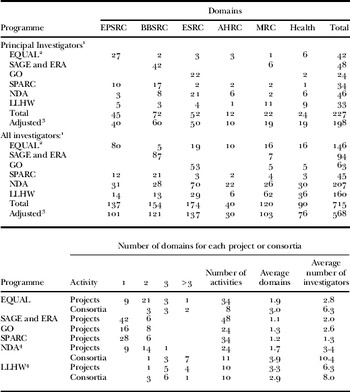
After all the funding had been allocated, cross-domain activity was uneven and multi-disciplinarity was potentially limited (Table 4). For example, for the 24 projects, 13 had Principal Investigators from the ESRC domain, and seven from BBSRC and nine involved investigators drawn from just one domain.
Number of Principal Investigators and all investigators by domain within programmes and number of domains

Notes: For abbreviations, see Table 1.
1. Principal Investigator or co-investigator or equivalent for each project or activity. This information is available from the relevant research council websites. For Networks the Principal Investigators have been included but co-investigators have not.
2. A few EQUAL projects had several Principal Investigators, the result of issuing of individual contracts to participating institutions. In these cases the lead investigator for a project has been identified as the Principal Investigator and the others have been classified as co-investigators.
3. Adjusted total is the number of distinct individuals after eliminating double counting of those involved with more than one project, consortia or network.
4. NDA Networks, LLHW Networks and LLHW Centres have been excluded from the analysis of the number of domains.
The 2005 House of Lords report created a broader debate on the nature of ageing and emphasised the need for a stronger focus on the processes of ageing and the impact of earlier life experiences. Although the MRC initially intended to establish a series of Centres which would reflect this perspective, it invited the other research councils and the Departments of Health of England, Wales, Scotland and Northern Ireland to participate in what became the LLHW programme. As well as funding major Centres some features of NDA were adopted, namely supporting consortia and networks. Importantly, there was a welcome boost when the Government Science Budget (Department for Innovation, Universities and Skills 2007) indicated that the research councils would give ageing significant priority.
The first LLHW call in 2007 resulted in three Research Centres, which together received £10 million for a range of pilot projects, the development of postgraduate courses and public engagement activities. The second call supported 12 networks and three consortia (£5 million). A further call in 2010 significantly increased the level of activity by £11.5 million, through funding further consortia and medium-sized projects. However, only one of the previously supported networks secured funding through this call. Although it is too early to provide a full analysis of the performance of LLHW it should be noted that whilst the MRC and Health domains are prominent, a broad level of multi-disciplinarity has been achieved (Table 4).
In 2009, those involved with managing LLHW were charged by government with developing a strategy for ageing research for the research councils and government health departments. Published in September 2010 (MRC 2010a), it contained no formal plans, milestones, timescales or commitments, but rather offered advice, especially on the need for collaborative programmes between those organisations which fund ageing research. However, it may not have appreciated the reasons for the poor performance of NCAR, FFAOP and UKARF (which by this time had reduced its aspirations) in pursuing the same ends. The successful bottom-up approach to collaboration with organisations which would never be in a position to support programmes, achieved by many EQUAL and some GO and NDA projects, may have been ignored. So too might have been the pleas of the Academy of Medical Sciences (2009) which had called for a major overhaul in the scale of funding and organisation of ageing research in the UK. With the role of the LLHW team, in essence XCAR, having been highlighted, it is likely that it will initiate further joint funding initiatives as LLHW activities, although these may be very different in spirit to that of the existing LLHW programme.
In October 2010, in its response to the major economic crisis, the UK Government announced a 10 per cent reduction in real terms in the Science Budget available to the research councils but with level funding for the MRC (HM Treasury 2010). Even though this may have reduced the level of support, ageing remained a priority across the research councils (Research Councils UK 2010).
Alongside the developments discussed in this paper, since 2008 there have been other research council investments with an ageing element, sometimes jointly with health departments and charities (MRC 2010a: Table 1). Examples are the EPSRC Healthcare Partnerships and the BBSRC-NIA Partnering Awards to Support Collaborative Research on the Biology of Ageing, both of which commenced in 2010, and the joint initiative of MRC and Arthritis Research UK to establish a Centre for Musculoskeletal Ageing Research announced in 2010.
Contrasts, developments and trends in ageing research
The funding committed by each programme to ageing research projects, consortia and networks is given in Table 1 in terms of the monetary value declared by the research councils as well as adjusted for inflation and where necessary revalued to the Full Economic Costing basis introduced by the research councils in 2006.Footnote 8 Whilst the funding from NDA was greater than each of the initial programmes, it was less than the total funding for the programmes which it replaced, by about half when differences in funding method are eliminated, and that for LLHW was about 40 per cent less.
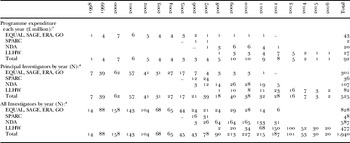
An indication of research activity over time is given by estimates of the total expenditure by the research councils on projects supported by the programmes and the involvement of investigators (Table 5). There was a peak of activity in 2000, a major decline during the life of NCAR and then a rise when NDA was eventually established. In the main, activity in the mid-2000s was due to the renewal of funding for EQUAL consortia and SPARC, for which support was available only to newcomers. The height of activity for NDA was in 2010 and for LLHW is predicted in 2012.
Estimated expenditure and number of investigators over time by programme

Notes: For abbreviations, see Table 1. All figures rounded to nearest whole number. Expenditure of less than £0.5 million but more than £0.2 million and investigator years of less than 0.5 but more than 0.2 indicated by ‘..’.
1. Programme expenditure is based on the expected costs of individual projects, consortia and networks, distributed evenly between the start and finish dates published on the relevant research council websites. Actual start and finish dates for some projects may have been later due to delays and extensions, but research council regulations usually limit these to no more than six months. Costs have been adjusted for inflation to 2011 levels and 80 per cent Full Economic Costing (FEC).
2. Investigators have been assumed to be engaged throughout the life of their projects. All investigators have been included except network co-investigators. Involvement for a full year has been counted as unity but when a project has started or ended part way through a year the investigator involvement has been counted as a fraction. The number of co-investigators involved with projects increased significantly and declared levels of time involvement of co-investigators declined significantly with the introduction of FEC, so comparison of the figures for early years with those for later years is problematic. The total is the estimated total number of ‘investigator years’.
Whilst the peak number of all investigators engaged with each of NDA and LLHW is similar to that achieved by the initial programmes, the number of Principal Investigators is much lower. This indicates an absence of growth in research capacity and a decline in the number of positions of research leadership in programmes which are a significant part of the research councils’ strategic investment in ageing research. Separate analyses suggest that few positions as Principal Investigator were taken by those in mid-career, with implications for the future leadership of large and complex projects. A further illustration of changes is given by the number of investigators from different domains involved with each programme (Table 4). There have been significant shifts, especially a decline in the number of Principal Investigators from the EPSRC and BBSRC domains. Caution is required when considering some trends, as a result of the move to Full Economic Costing many more co-investigators are now declared in proposals but many have a minimal time commitment.Footnote 9
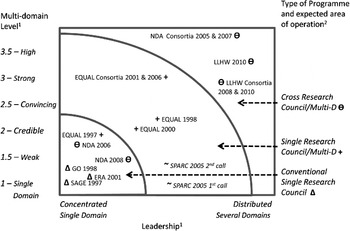
Further comparison of the programmes can be made in terms of, firstly, the distribution of the domains of the Principal Investigators, and, secondly, the typical number of domains represented in each project or consortia, as in Figure 1. A multi-disciplinary cross-council programme might be expected to have many highly multi-disciplinary projects with leadership distributed amongst the domains. This was achieved by the NDA consortia, LLHW projects and LLHW consortia. Strong multi-domain activity can be found in the EQUAL consortia and the EQUAL projects, where domain leadership was distributed at the level which would be expected of a single-council multi-disciplinary programme. However, the performance of NDA projects was similar to those of SAGE, ERA and GO, at the level to be expected of a conventional single-council single-domain programme.
Comparison of programmes by concentration of leadership domain and level of multi-domain activity. Notes: 1. Figure is based on: horizontal axis – a measure of concentration/diversity of domains of Principal Investigators in a programme; vertical axis – average number of domains/project or consortia for each programme. 2. Three concentric zones indicate the level of concentration and multi-domain level which would be expected of: (a) a conventional single research council programme; (b) a single research council multi-disciplinary (Multi-D) programme; (c) a cross-research council multi-disciplinary programme. The position of each collection of projects (or consortia where indicated) identified by date of the call for proposals within a programme is indicated with either ∆, + or Θ depending on the type of programme. From this it is possible to identify those programmes which achieved what might have been expected in terms of their mission and those which did not. SPARC (Strategic Promotion of Ageing Research Capacity), a hybrid programme, indicated ∼, is shown for completeness. EQUAL: Extend Quality Life and Extending Quality Life. ERA: Experimental Research into Ageing. GO: Growing Older. LLHW: Lifelong Health and Wellbeing. NDA: New Dynamics of Ageing. SAGE: Science of Ageing.

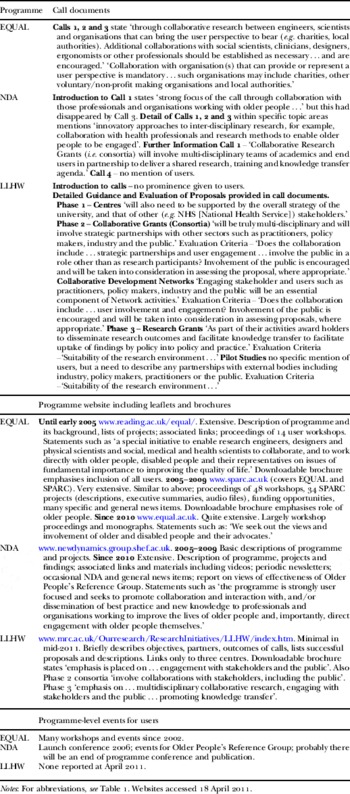
EQUAL, NDA and LLHW encouraged collaboration with intermediate agencies and the involvement of older people – users. The way this was embodied in the programmes through call documents, programme websites and programme events is given in Table 6. For EQUAL, the demonstration of a genuine commitment from proposed collaborators or advisors in, say, health and social services, the voluntary sector or industry, was mandatory. This project-level commitment was further supported by extensive programme-level activities, for example workshops and websites operated by the EQUAL Network, SPARC and KT-EQUAL. For NDA and LLHW expectations about collaboration were more open-ended. So, the partnership with older people varied, with a significant number of projects having limited engagement. Judgements about appropriateness of relationships with users rested with those submitting applications and those who assessed proposals. Often collaborators were scientists rather than agencies which worked with or for older people. For the successful proposals the onus was on individual project leaders managing relationships with users and beneficiaries. Initially there was little programme-level support in this area for NDA consortia and projects and to date little for those activities supported by LLHW. Eventually, in 2008, NDA established an Older People's Reference Group to comment on the progress of projects and the programme as a whole, but for a long period there was negligible activity and by mid-2011 there had been few programme-level user-relevant activities. In 2010, after several projects had been completed, an informative website was developed and, in 2011, after much advice from AgeUK,Footnote 10 it was populated with material likely to be of value to non-academic visitors. For LLHW, programme-level facilitation has been sparse. A Public Perspective Group, occasionally used to comment on its priorities and on research proposals, had no prominence. In mid-2011 there was a minimal programme website and by mid-way through the programme there had been no programme-wide activities for users. Even more than NDA, LLHW was dependent on activities at the project level for establishing credible relationships with users.
Indicators of user engagement at programme level

Notes: For abbreviations, see Table 1. Websites accessed 18 April 2011.
To summarise, after a dramatic lull, current programmes have recovered the activity levels of the initial programmes. Involvement from investigators from the ESRC domain has been maintained from the initial programmes, has fallen for those in the EPSRC and BBSRC domains, and increased for those in the MRC and Health domains. These changes are especially marked when considering the domains of the Principal Investigators, suggesting that later programmes have not built on the momentum created by initial programmes. LLHW appears more successful than NDA in establishing a convincing degree of multi-disciplinary, although, so far the degree of involvement of users and older people has been less than achieved by NDA which in turn has been much less than for EQUAL.
Discussion
Many issues are raised by the uneven progress in the UK towards establishing an effective cross-council multi-disciplinary user-involved ageing research programme. From the outset NDA was beset with difficulties. The performance of its predecessor, NCAR, was disappointing. NDA's start was delayed. Implementation was soon in difficulty with few successful proposals in response to the first call. Although the introduction of bottom-up approaches of Networks and Sand Pits made a difference, further corrective actions were needed, with specific research communities targeted so as to achieve a more balanced representation of domains. There were fewer difficulties for LLHW. The research councils did not appoint an academic director, kept closer control, and held academic and user communities at arm's length. By starting with a call for Centres, an activity closely associated with MRC, the intention to manage the programme in a conventional fashion was clear, as were its disciplinary points of reference.
Progress over the last ten years would have been swifter had NCAR taken a different approach and built on the work of AgeNet and EQUAL. These had revealed that much interest and informed advice about needs and priorities were readily available. What were then recent enquiries, for example the Millennium Debate of the Age (Midwinter Reference Midwinter2000), were providing valuable informed insights about the needs and expectations of older people and an ageing society and ways of meeting these. This existing knowledge base and associated networks should have been attractive, given the political view that the research councils attributed too low a priority to ageing research. Drawing on these sources, a viable strategy could have been rapidly developed, especially as the research councils needed a visible response to the criticisms made by the House of Commons (2000a, 2000b). In 2000, a strategy could have been produced easily in six months. The three years given to NCAR was grossly excessive. Surprisingly, AgeNet was brought to an end, despite it being well-established, lively, visible, politically aware and successful in encouraging researchers, professionals, older people's organisations and research funders to think about issues related to ageing in new ways and how new styles of research could contribute to improved quality of life.Footnote 11
Demonstrating some activity without making a major commitment may have been preferred by the research councils. This would reflect their ambivalence to ageing research noted by Sir John Cadogan in 1996, confirmed later in conversations between the author and heads of several research councils, and implied by initial funding commitments to NDA. It may also reflect a poor appreciation of the value and relevance of the advice and knowledge which was available, or a concern about how to handle that information and those who had compiled it, coupled with a preference for familiar academic perspectives. Yet, there would have been awareness that because of the preceding programmes, the research communities were ready to help and move forward and keen to do so. Keeping these communities at a distance may have also affected the relevance and progress of LLHW.
The strong bias of NDA towards the ESRC domain was reflected in the style of presentation of the programme, naivety in understanding how scientists from different backgrounds would interpret the calls and confusion about its cross-research council identity. Similar issues have arisen with LLHW which, although building on NDA, at the outset sought proposals for the development of centres, thus giving a focus on an activity especially associated with MRC. Misunderstandings have prevailed. For example, in 2010 the author attended 15 presentations about NDA and LLHW projects, consortia and centres. For 12 the lead council was credited as the sponsor rather than a cross-council programme!
Timeliness and clarity of purpose are crucial to successful programme delivery. Leaving aside SAGE and ERA which supported predominately single-discipline projects, the special programmes have followed two different approaches to the development of multi-disciplinary ageing research. One approach moved from single-domain multi-disciplinary working (GO), to cross-council multi-disciplinary working (NDA), to multi-agency multi-disciplinary working (LLHW), with each programme building on preceding programmes and with agendas and priorities being shaped by the lead councils, albeit with some consultation with users; a top-down approach. The other, taken by EQUAL and SPARC, was multi-disciplinary with a large measure of multi-agency working from the outset, achieved principally by devolving responsibility for determining priorities and agenda building to users and through research council-led interventions at the commissioning stage. Although elements of this bottom-up strategy were applied when the progress of NDA faltered, it has had little influence on the development of NDA or LLHW. Rather, user input has been treated with a strong degree of caution.
For example, a lengthy period was devoted to agenda building by NCAR, enabling a series of consultations with researchers and users. Key organisations were briefed, their interest secured, and a specification developed for NDA. However, this reflected assumptions, expectations and paradigms of research based on the historical development of social science-based ageing research, rather than those of the broad range of disciplines involved with ageing research. In turn this may have proscribed the most exciting developments which could have been pursued by, for example, biologists and medical scientists in linking cell biology, nutrition, physical activity and general health. Given its weak presentation and the lack of endorsement by senior figures from key fields, it is hardly surprising that NDA was not a serious contender for attention by many researchers. Later, the interest of specific communities had to be especially courted. Further, for those who did come forward, the outcome of the first call highlighted a significant mismatch either between the quality of the proposals and what was required by the programme or between the appetite and enthusiasm of the research community and the way the call had been presented and managed. Yet, these problems need not have arisen. EQUAL had shown that attracting large numbers of high-quality multi-disciplinary, collaborative, user-engaged proposals in the field of ageing was quite feasible but that this required sound, enthusiastic and extensive briefing as well as facilitation of partnerships, for example with housing, health and social services professionals. NDA's approach to briefing and commitment to multi-disciplinarity and collaboration was less full-blooded. For those who had been involved with EQUAL, this equated to a step backwards.
It may be surprising that given well-known commentaries on the difficulties of crossing disciplinary boundaries in gerontology, often rooted in conflicts of methodology, for example, as described by Achenbaum (Reference Achenbaum1995), and the detrimental effects caused by the ‘disciplining’ of gerontology discussed by Katz (Reference Katz1996), that more effort was not made to manage these issues, especially as EQUAL, with a strong involvement of social gerontologists, had not experienced these problems. They appear to have been caused by a combination of an unwillingness to embrace the perspectives and methods which can avoid these problems, a desire for absolute control of commissioning processes rather than devolving this to specific scientific or user communities, and an almost inevitable descent to the lowest common denominator, say, in terms of methodologies acceptable across the research councils supporting the programme. This would have led to traditional, low-risk proposals rather than the highly creative and challenging proposals which were needed. Despite an appeal for the development of new methodologies, the status quo of social gerontology, possibly conditioned by the success of GO, was taken as a starting point for NDA rather than a family of reference points relevant to different disciplinary and methodological perspectives in ageing research. This led to what many researchers viewed as an unappetising presentation. For example, there is a strong tradition of multi-disciplinary multi-agency socio-technical systems research in the UK (Trist Reference Trist, Pasmore and Sherwood1978) which is appropriate to many areas of gerontology, such as where designers, engineers and social gerontologists operate together. The need for such approaches had been clear ever since the exhortations of Sir John Cadogan (and, for example, most recently implied in the commentary by Phillips Reference Phillips2009) and their value demonstrated by extensive methodological developments within some EQUAL projects.
There were other mismatches between the strategy for NDA and the needs of the research community and its non-academic supporters. Because of the time spent on NCAR and delays to NDA there should have been great urgency for the first call to be announced and processed quickly so that new research projects could commence. Strangely, the first call was for proposals for consortia rather than projects. Consortia are necessarily complex especially in terms of the organisation of multi-disciplinary working. They require a great deal of time, effort and experience to establish. By starting with these, uncertainties increased and time scales lengthened. The need to make rapid progress after the long gap in new funding opportunities and to engage as many people as possible in the programme was ignored. A further consequence was the bias towards the ESRC domain, due in part to researchers from this domain more readily understanding the programme call and the procedures of ESRC which was managing the programme. This prompted later corrective measures aimed at the imbalance of domain representation but at the expense of the multi-disciplinary aims of the programme.
The comparatively timid programme-level approach of NDA and LLHW to working with users can also be found in their reliance on user representatives rather than a more public and ongoing exposure to wider scrutiny and comment. That the NDA Older Peoples Reference Group should be set up four years after the announcement of the programme reinforces the impression that this was not a high priority, and that user interests can be served later rather than sooner in the research process. Feedback from the Group, whilst positive, in some respects highlights the failure to be involved from the outset of projects (NDA 2011). LLHW appears even more distant from users and researchers in some domains. It is almost wholly reliant on project, consortia and centre-level user activities.
These approaches reflect differences in beliefs about the value of involving users in the research process and the apprehensiveness which accompanies recognition that involving older people would take many research teams into unfamiliar territory and require the development of new skills, not least in communication and coming to terms with quite different frameworks of reasoning and understanding. For example, there is the challenge of the complexity of science, particularly in biology. Another is reconciling the value judgements of older people formed from personal experiences and received wisdom about, say, the role of health and social services and the nature of intergenerational relationships, with theoretical constructs of, say, wellbeing and care. As a result, the call documents and many proposals have not fully reflected the often significant resources required for working effectively with older people and associated timescales.
The argument that research has to be completed before it can be developed further, users involved and dissemination can take place – the Research, Development, Diffusion Model (Havelock Reference Havelock1971) – misses the point, especially in an era when researchers have to be ever-more accountable, when credibility is at a premium and when there is much user interest. What is more, such close rapport with users can greatly enrich the questions posed by researchers and the ensuing research process (Staley Reference Staley2009). However, resistance can be considerable. Caswill and Shove (Reference Caswill and Shove2000) catalogue the incentives and challenges of engaging in interactive social science, which may be made more difficult by the fragility of research council support for user engagement (KT-EQUAL 2010). If this is such a contested approach, then probably current programmes would have been better co-ordinated from a research council supporting a more robust tradition of user involvement.
Elements of this largely linear model of research can also be found in SAGE, ERA and GO, but for these, with their aim to establish ageing research within particular domains, this was not inappropriate. Clearly, EQUAL relied on the understanding gained through consultation with users, such as professionals working with older people and older people themselves, as well as with leading researchers. This quickly led to a broad specification which defined the territory of the EQUAL programme. The dangers of an over-elaborate specification were clear: ageing was a new area for research, calling for new methodological approaches and a devolved responsibility for defining the research landscape. Such a landscape was especially appropriate for an area where most policy makers were remote from both the realities of growing older and from the leading edge of science. It made both researchers and other users responsible for determining the issues to be investigated within broad parameters set by EPSRC and the appropriate degree of multi-disciplinarity, as well as for articulating the need for the work, rather than providing a framework of priorities for the purpose of encouraging proposals for multi-disciplinary projects.
Hennessy and Walker (Reference Hennessy and Walker2011) provide a justification for some of those actions and decisions made by NCAR and NDA which have been criticised in this paper. In essence they argue that NCAR and NDA were pioneering developments; that given that multi-disciplinary ageing research was new to the UK research councils, there were many novel approaches and philosophies to be established and hurdles to be overcome. They give much weight to the difficulties inherent in undertaking multi-disciplinary research, the ambiguous stance of the research councils, and the sheer enormity of activities to be undertaken to establish a multi-disciplinary cross-council programme. Their account, however, is presented largely as if these were surprising challenges discovered as the programmes progressed rather than planned for at the outset; of the learning which took place; and possibly the realisation that these activities are the essence of multi-disciplinary applied research. Hennessy and Walker's account may reflect the state of development of social gerontology in the UK and its coming to terms with working with other disciplines but it does not reflect the overall state of multi-disciplinary ageing research in the UK at that time. Whilst the ESRC model for programme management may have been constraining, to imply that the failure of the first NDA call was due to the innovative nature of NDA and that this was part of a necessary learning curve (Hennessy and Walker Reference Hennessy and Walker2011) is unconvincing. The cost of learning about how to run a cross-council programme, hardly a new activity for the research councils and many researchers, was very much at the expense of the research community.
Because an essential feature of most research programmes is the pursuit of pioneering developments, there is a great deal of experience and advice available for organising such activities, not least those which are multi-disciplinary and involve several research councils. This advice reflects well-established principles of innovation and project management, emphasising amongst other factors: the need for visible champions, good communication, involving all users and building a relationship of trust with them, timely problem-solving and a concern to manage the ambiguities and uncertainties which arise during the course of a programme. In the case of ageing, much ground work had already been carried out in the five years before NCAR was established. For example, EPSRC had established EQUAL, a successful multi-disciplinary programme in which social gerontologists were playing a major part. A further example is that whilst tools and techniques, such as Preparatory Networks and Sand Pits, may have been new to some researchers in ageing, these have been familiar features for many others for some years. Networks of researchers and users have been supported by EPSRC since its formation in 1994 and Sand Pits since 2003.
Clearly it is not possible to reconcile the valedictory account of Hennessy and Walker with much of that presented in this paper which considers the development of ageing research as having been unnecessarily constrained by the approaches which they describe.
Conclusions
This paper has catalogued many issues raised by the rationale and operation of the special programmes of ageing research over the last decade. No programme is perfect, and a share of difficulties and mishaps might be expected even of the most well-crafted and managed programme. To some extent multi-disciplinary cross-council ageing research has been a victim of the circumstances of the time, for example, the weak enthusiasm of some research councils forced to work together because of political pressure and more recently their ambivalence towards the engagement of non-academic users. Yet there has been considerable support from researchers and from many organisations supporting older people, which could have been engaged early on to help build highly attractive programmes. The result is a current portfolio which, whilst comprising arguably excellent and worthwhile projects, has not exploited the potential for multi-disciplinary research which existed a decade ago, and has overseen a decline in the future capacity for ageing research, as shown, for example, in the fall in the number of investigators, particularly Principal Investigators in several domains (Tables 4 and 5). Significantly, because it has failed to engage a sufficient range of researchers with a proven track record in user-involvement or build on relevant knowledge of the management of multi-disciplinary programmes, multi-disciplinary cross-council ageing research has not exploited the full potential of the UK science base to address key contemporary issues faced by society and older people.
The current preference of research councils for consortia and relatively long-term projects and the lack of active facilitation of partnerships will continue to be unhelpful because they limit opportunities to develop research capacity and multi-disciplinary leadership skills. In 2010, the number of Principal Investigators involved with cross-council programmes was 40 per cent less than those involved with single research council programmes ten years earlier, with markedly fewer positions taken by those in mid-career. However, as lines of investigation within the field mature, so smaller projects can build on earlier projects. Projects which can start and be completed quickly are needed. The initial ageing research programmes, especially EQUAL, GO and, later, SPARC, showed that worthwhile multi-disciplinary research can be achieved with very modest funding and through these the pool of competent researchers and future research leaders increased rapidly. The success of programmes will be more assured if they build a reputation for performance and delivery and generate demonstrable benefits for society. By encouraging smaller projects a richer portfolio of ageing research can be developed which will ensure the development of a self-sustaining flexible research community.
Through such developments more champions will emerge who will take ageing into the mainstream of research activity and away from the need for special programmes, imbalances in the research portfolio will be avoided, and the need for ageing research justified in a publicly open way. Future programmes will need more creative organisation than has been the case. Quite simply, ageing research in the UK needs bolder leadership, more dynamic organisation, more confidence in working with users, and a stronger public face.
This paper challenges some beliefs about the extent to which the recent special programmes have contributed to the favourable development of ageing research in the UK. The spirit of the recent journey and destination for ageing research has been less rewarding for older people and society than that envisaged by Sir John Cadogan and Mr Ian Taylor in 1996 and achieved by the early programmes, especially GO and EQUAL. This is not necessarily because of the disciplinary landscapes chosen for organising recent programmes, but because of what has been built on these landscapes.
Acknowledgements
Sincere thanks are due to many colleagues, from all domains, and to anonymous referees for their considerable encouragement and advice in the preparation of this paper.