Introduction
22q11 deletion (The gene mutation associated with DiGeorge Syndrome) is seen in 1 in 4–6000 live births with 60–80% of patients having associated CHD. Reference Goldmuntz1 The three most significant cardiac lesions associated with this are Tetralogy of Fallot, truncus arteriosus, and interrupted aortic arch. Reference Hasten, McDonald-McGinn and Crowley2 Previous studies in mice have indicated that the TBX1 gene is associated with the formation of the cardiac outflow tracts Reference Hasten, McDonald-McGinn and Crowley2,Reference Merscher, Funke and Epstein3 and mutations in this region are seen in over 90% of patients with 22q11 deletion. Reference Merscher, Funke and Epstein3,Reference Zhong, Yang and Zhu4 This is thought to be the genetic basis for the complex CHD seen in patients with 22q11 deletion.
A single study from 2019 by Mastromoro et al has also shown that TBX1 haploinsufficiency is associated with smaller left pulmonary artery in mice compared with wild-type mice. This corresponded to a study of 58 patients with 22q11 deletion syndrome with no other cardiac lesions who had a decreased left pulmonary artery to right pulmonary artery ratio of 0.80 (standard deviation 0.09) in affected patents compared with 0.95 (standard deviation 0.11) in controls. Reference Mastromoro, Calcagni and Versacci5 Whilst recent studies on pulmonary arteries in patients with 22q11 deletion have shown that crossed pulmonary arteries appear to be an isolated finding associated with 22q11 deletion, Reference Mastromoro, Calcagni and Vignaroli6,Reference Cairello, Gagliardi, Magrassi, Secco, Strozzi and Felici7 there are no further studies attempting to reproduce the findings of hypoplastic left pulmonary artery in patients with 22q11 or determining if this phenomenon is present in the most common cardiac lesions in the 22q11 deletion population.
The purpose of this study was to determine whether we could demonstrate a reduced left pulmonary artery/right pulmonary artery ratio in patients with 22q11 deletion syndrome and CHD, thereby supporting previous findings that left pulmonary artery hypoplasia is associated with 22q11 deletion syndrome. We further wish to determine whether patients with 22q11 deletion syndrome and CHD are more likely to require intervention on their left pulmonary artery during their initial surgical repair and whether this discrepancy persists beyond the initial neonatal period, resulting in any need for subsequent intervention.
Methods and materials
Study population
This is a single-centre, retrospective analysis of all patients who underwent their initial surgical repair of Tetralogy of Fallot, truncus arteriosus, or interrupted aortic arch between January 1, 2007 and December 31, 2022 at The Queensland Children’s Hospital (Brisbane, QLD, Australia). These three lesions were selected as they have a strong association with 22q11 deletion syndrome. Our cardiac surgical database identified 211 patients for inclusion in this study.
Exclusion criteria
Patients were excluded from the study if they did not have their initial diagnostic scan and surgery at the Queensland Children’s Hospital, were deceased, did not have ongoing follow up at our centre, or if they had any additional genetic diagnosis or suspected syndromic association.
Data collection
Data were obtained from medical records, including operation and catheter reports and clinic letters. This included primary cardiac diagnosis, 22q11 deletion status, diagnostic imaging results, whether they had intervention on their left pulmonary artery at the initial surgery, or if they had subsequent re-intervention upon their left pulmonary artery. Individual echocardiograms were reviewed, and the left pulmonary artery and right pulmonary artery were measured on the initial diagnostic echocardiogram and the most recent echocardiogram by a single individual to exclude inter-reader variability. A waiver of consent was applied for and granted by the Queensland Children’s Hospital Human Research Ethics Committee.
Patients were subsequently divided into two groups based upon their 22q11 deletion status as either 22q11 positive (has the gene mutation) or 22q11 negative (does not have the gene mutation). The left pulmonary artery/right pulmonary artery ratios on initial and most recent echocardiograms and rates of intervention and reintervention on the left pulmonary artery were compared between each group.
Statistical analysis
Data were analysed using IBM SPSS Statistics Version 29.0.2.0. Categorical variables are reported as absolute number and percentages, whilst continuous variables are reported as median and interquartile ranges (interquartile range 25, 75) as appropriate. Continuous variables were compared using Mann–Whitney U nonparametric test. Categorical variables were compared using Fisher’s Exact Test for two variables or Pearson Chi Square test for more than two variables. Significance is determined as p < 0.05.
Results
Population description
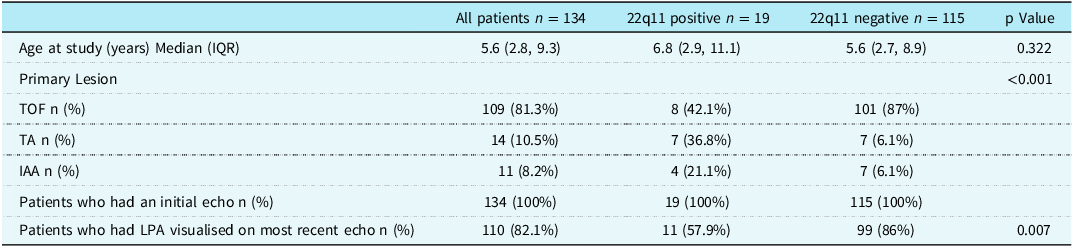
There were 211 patients who underwent cardiac surgical repair of Tetralogy of Fallot, truncus arteriosus, or interrupted aortic arch between January 2007 and December 2022, of which 134 were included in this study. Of the 77 patients who were excluded, 21 had an additional genetic diagnosis or syndromic association, 49 had their initial assessments performed at another site, and seven either died within the admission following their first surgery or had ongoing follow up at another centre. For the 134 included patients, the median age at follow up was 5.6 years (interquartile range 2.8, 9.3), the most common diagnosis was Tetralogy of Fallot (81%), and 19/134 patients (14.2%) were 22q11 positive.
Whilst Tetralogy of Fallot remained the most common diagnosis in both the 22q11 positive and 22q11 negative groups (Table 1), the proportions of patients with Tetralogy of Fallot were significantly higher in the 22q11 negative group compared to the 22q11 positive group (87% versus 42.1%, p = 0.001), implying an increased preponderance of truncus arteriosus and interrupted aortic arch in patients with 22q11 deletion. All patients had an initial diagnostic echocardiogram; however, patients in the 22q11 negative group were much less likely to have an echocardiogram with adequate imaging of the left pulmonary artery on the most recent scan (57.9% versus 86%, p = 0.007). There was no difference between the median time to follow up across the two groups (Table 1).
Baseline clinical and demographic variables

IAA = Interrupted Aortic Arch; IQR = Interquartile range; LPA = Left Pulmonary Artery; TA = Truncus Arteriosus; TOF = Tetralogy of Fallot.
Echocardiographic findings
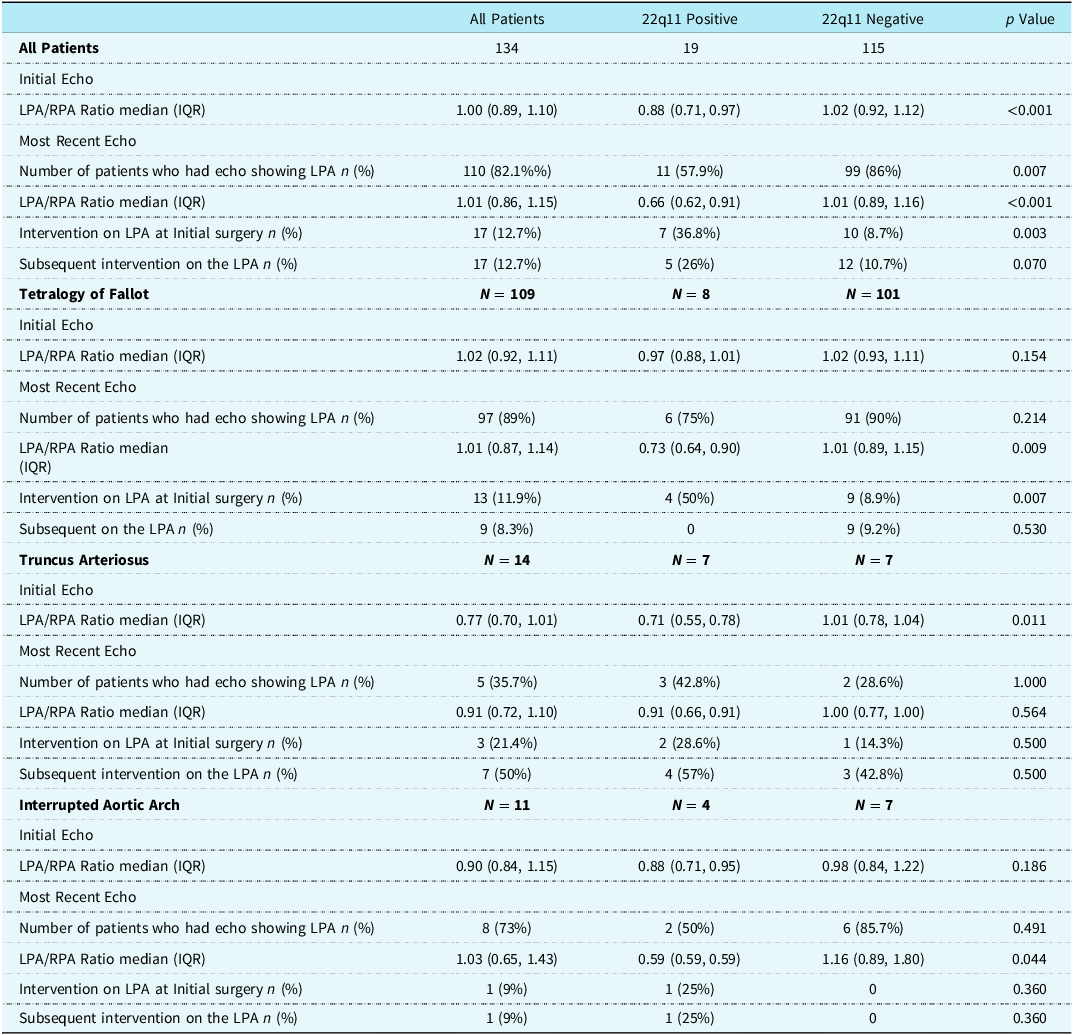
The left pulmonary artery/right pulmonary artery ratios on both the initial echocardiogram and most recent echocardiogram are outlined in Table 2. The median left pulmonary artery/right pulmonary artery ratio was reduced in the 22q11 positive group compared with the 22q11 negative group on both the initial and most recent echo [0.88 (interquartile range 0.71, 0.97) versus 1.02 (interquartile range 0.92, 1.12); p < 0.001] and [0.66 (interquartile range 0.62, 0.91) versus 1.01 (interquartile range 0.89, 1.16); p < 0.001], respectively. Patients with truncus arteriosus who were 22q11 positive had reduced left pulmonary artery/right pulmonary artery ratio compared to those who were 22q11 negative [0.71 (interquartile range 0.55, 0.77) versus 1.01 (interquartile range 0.78, 1.04) p = 0.011] on the initial echocardiogram; however, there was no statistically significant difference between the 22q11 positive and 22q11 negative groups on the most recent echocardiogram [0.91 (interquartile range 0.86, 0.91) versus 1.00 (interquartile range 0.77, 1.00); p = 0.564]. There was no statistical difference between the left pulmonary artery/right pulmonary artery ratios for the 22q11 positive and negative patients with Tetralogy of Fallot or interrupted aortic arch on the initial echocardiogram [0.97 (interquartile range 0.88, 1.01) versus 1.02 (interquartile range 0.93, 1.11); p = 0.154] and [0.88 (interquartile range 0.71, 0.95) versus 0.98 (interquartile range 0.84, 0.122); p = 0.186], respectively. However, in both these subgroups, there was a statistically significant difference between the 22q11 positive and 22q11 negative groups on the most recent echo [0.73 (interquartile range 0.64, 0.90) versus 1.01 (interquartile range 0.89, 1.15), p = 0.009] and [0.59 (interquartile range 0.59, 0.59) versus 1.16 (interquartile range 0.89, 1.80), p = 0.044], respectively.
Median LPA to RPA ratio at the initial and most recent echocardiogram and rates of surgical intervention in the 22q11 positive (N = 190) and 22q11 negative (N = 115) patients as a total group and by diagnosis

Echo = echocardiogram; IQR = Interquartile Range; LPA = Left Pulmonary Artery; RPA = Right Pulmonary Artery; SD = Standard Deviation.
Rates of surgical intervention
Surgical interventions across the two population groups were compared in Table 2. Patients who were 22q11 positive were more likely to require intervention on the left pulmonary artery at the initial surgery compared with those who are 22q11 negative (36.8% versus 8.7%, p < 0.05) but there was no difference between the rate of reintervention on the left pulmonary artery between the 22q11 deletion positive and 22q11 deletion negative groups (26% versus 10.7%, p > 0.070). Amongst the subgroups, the Tetralogy of Fallot group was the only lesion to show a statistically significant rate of initial intervention when the 22q11 positive group was compared with the 22q11 negative group (50% versus 8.9%, p = 0.007).
Discussion
In 2019, Mastromoro et al reported that the left pulmonary artery/right pulmonary artery ratio is reduced in patients who are 22q11 positive compared with patients who are 22q11 negative with structurally normal hearts. Reference Mastromoro, Calcagni and Versacci5 In this study, we attempted to see if we could replicate these findings across the different subsets of common forms of CHD seen in the 22q11 deletion population. We further sought to determine if there were practical implications of this finding, with regard to the need for intervention on the left pulmonary artery in the initial surgery and need for subsequent reinterventions.
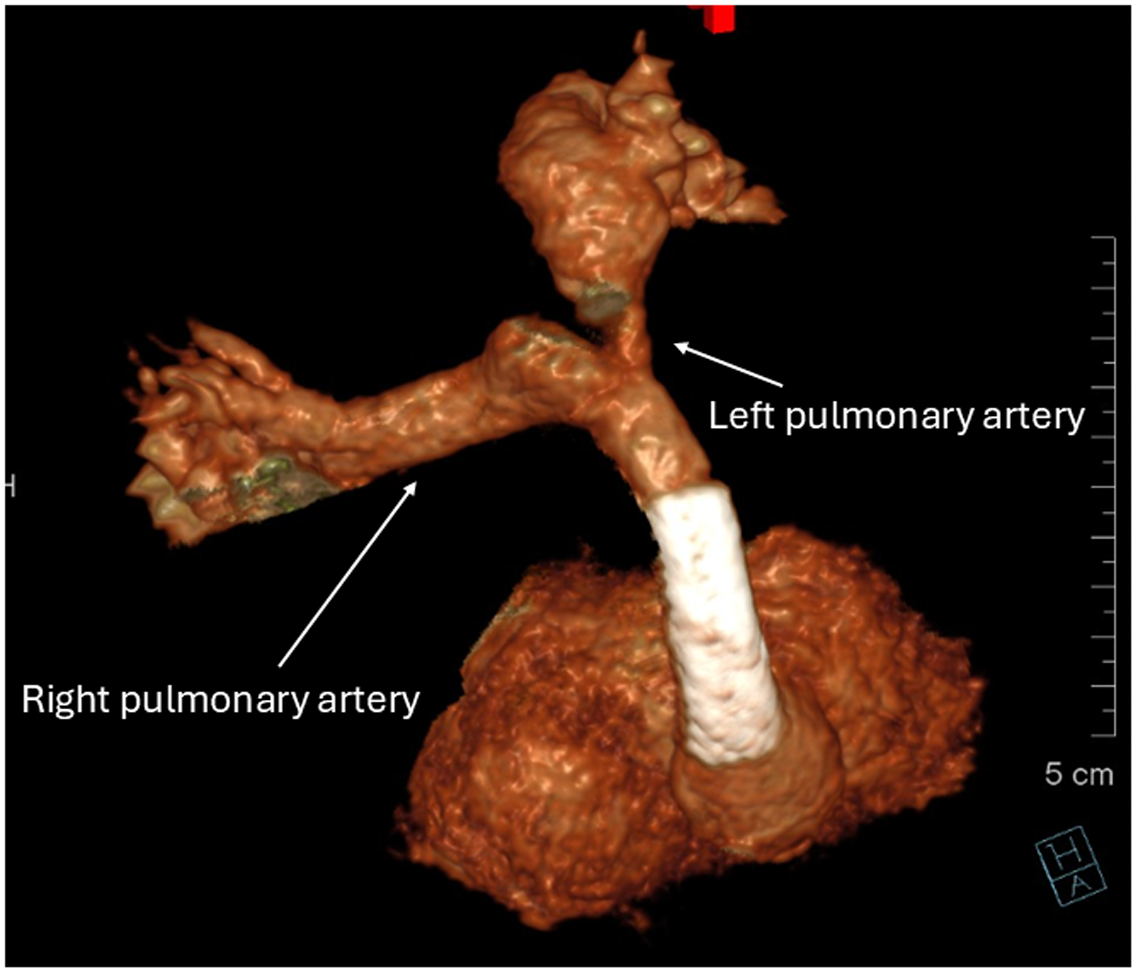
Our study supports the findings of Mastromoro et al, whereby we reported that the left pulmonary artery/right pulmonary artery ratio was reduced in our patients who were 22q11 positive, with Figure 1 demonstrating the smaller left pulmonary artery compared with right pulmonary artery in a patient who is 22q11 positive. Interestingly, our numbers were also comparable to Mastromoro et al, where we reported a median left pulmonary artery/right pulmonary artery ratio of 0.88 (interquartile range 0.71, 0.91) in our 22q11 positive group compared to 1.02 (interquartile range 0.92, 1.12) in the 22q11 negative group, with Mastromoro’s study reporting mean values of 0.80 (standard deviation 0.09) and 0.95 (standard deviation 0.11) in the 22q11 positive population and the 22q11 negative population, respectively. Reference Mastromoro, Calcagni and Versacci5
Is a 3D reconstruction from a cardiac CT of a patient who is 22q11 positive. This reconstruction demonstrates the hypoplastic left pulmonary artery compared to the right pulmonary artery.

Following on from this, our study shows that 22q11 positive patients are more likely to require intervention on their left pulmonary artery during the initial surgical repair than 22q11 negative patients, which has not been previously reported. We did not demonstrate a statistically significant difference between rates of subsequent need for intervention of the left pulmonary artery between the 22q11 positive and 22q11 negative groups. However, when we reviewed the most recent echocardiography images, patients who were 22q11 positive had reduced median left pulmonary artery/right pulmonary artery ratio compared to 22q11 negative patients. Given the relatively short duration of follow up for the patients, we postulate that if we followed these patients to an older age, we may have seen a difference between the two groups with regard to subsequent intervention.
When examining the individual lesions, patients with Tetralogy of Fallot demonstrated no statistically significant difference between the median left pulmonary artery/right pulmonary artery ratio when comparing the 22q11 positive group to the 22q11 negative group. However, patients who were 22q11 positive were more likely to undergo intervention on their left pulmonary artery at the initial surgery, suggesting that even in infant life, the left pulmonary artery in patients who are 22q11 positive are smaller than that of their counterparts who are 22q11 negative, despite the initial scan failing to demonstrate a significant difference. A potential explanation for this discrepancy is that the first scan was typically performed in first 24 to 48 hours of life, where ductal flow may have made the left pulmonary artery appear larger. Similarly, the proximal left pulmonary artery may have been affected by ductal closure. The suspicion that the left pulmonary artery was artefactually larger on the initial echocardiogram would also be supported by the fact that the most recent echocardiogram demonstrated the median left pulmonary artery/right pulmonary artery ratio was reduced in the 22q11 positive group compared with the 22q11 negative group.
Left pulmonary artery stenosis has been well described in patients with Tetralogy of Fallot, with pulmonary artery abnormalities reported in up to 18.92% of patients post repair, with left pulmonary artery stenosis occurring in up to 10.4% of patients. Reference Sheikh, Kazmi and Syed8,Reference Saeed, Hyder and Sadiq9 Most studies looking at left pulmonary artery abnormalities in Tetralogy of Fallot, however, have not taken into consideration the potential impacts of 22q11 deletion syndrome, and to date, there has only been one study comparing left pulmonary artery sizes between patients with Tetralogy of Fallot in patients who are 22q11 deletion positive and those who are negative. This study did not demonstrate any statistical difference; however, it only considered patients in the early neonatal period, which is in keeping with what we demonstrated. Reference Chessa, Butera and Bonhoeffer10 However, as mentioned above, we demonstrated that on follow up echocardiograms, the left pulmonary artery/right pulmonary artery ratio is reduced in the 22q11 deletion positive population, which could suggest the high reported incidence of left pulmonary artery stenosis in Tetralogy of Fallot post repair may be influenced by the presence of patients with a comorbid diagnosis of 22q11 deletion.
When we considered our interrupted aortic arch population, there was no statistically significant difference in the median left pulmonary artery/right pulmonary artery ratio between the 22q11 positive and the 22q11 deletion negative population on the initial echocardiogram. Whilst this finding may be explained by the small sample size, a possible explanation for why patients with interrupted aortic arch do not have left pulmonary artery stenosis would be the foetal flow pattern theory. Reference Shinebourne and Elseed11,Reference Mittal, Rissam, Garg and Puri12 Foetal flow pattern theory refers to the concept that if there is a left-sided obstructive lesion, there is increased flow through the right-sided outflow tract, causing the right-sided structures to dilate (or vice versa). Reference Shinebourne and Elseed11 As such, if a patient has a lesion such as an interrupted aortic arch, the resulting increased flow through the right side may be protective for the development of left pulmonary artery stenosis or hypoplasia.
Despite the absence of an initial difference in the interrupted aortic arch subgroup between the 22q11 deletion positive and 22q11 deletion negative patients, there was a statistical difference in left pulmonary artery/right pulmonary artery ratio between the 22q11 on the most recent echocardiogram. It is possible that once the arch is repaired, the left pulmonary artery growth is suboptimal compared to that of the right pulmonary artery in patients with 22q11 deletion. However, given the small sample size, this finding should be interpreted with caution.
Finally, with regards to our truncus arteriosus subgroup, the initial echocardiogram demonstrated that the median left pulmonary artery/right pulmonary artery ratio was reduced in the 22q11 positive population compared with the 22q11 negative population. Whilst the left pulmonary artery/right pulmonary artery ratio remained reduced in the 22q11 positive population compared to the 22q11 negative population on the most recent echocardiogram, this did not reach statistical significance. As there is currently no data on rates of left pulmonary artery stenosis or hypoplasia in truncus arteriosus, it would be useful to expand this study to allow for a bigger patient population group, to determine if there is truly a risk for left pulmonary artery hypoplasia in the 22q11 deletion positive population as one would expect biologically. Reference Mastromoro, Calcagni and Versacci5 Following from this, a larger study would be beneficial to determine if there was statistically significant difference in rates of intervention and reintervention, which we were not able to elicit in our study.
Study limitations
This study has several limitations. The first and most significant limitation is that only a single individual measured the pulmonary arteries, and that individual was not blinded to the 22q11 status of the patients. This could have led to a bias in measuring the left pulmonary artery, with the potential to under measure in patients with 22q11. Ideally, future studies should be prospective, and there should be multiple observers performing the same measurements to confirm accuracy of measurements, and they should be blinded to the 22q11 status. The second limitation is the duration of time for which the patients were followed. Due to the relatively short duration of follow up, we could be underestimating the left pulmonary artery growth and the need for subsequent intervention on the left pulmonary artery. The third limitation is that this was a retrospective analysis and thus relied on adequate imaging having been performed, and as such, not all patients were able to have left pulmonary artery measurements made on their most recent echocardiograms. There is the potential that this was because the left pulmonary artery was hypoplastic and therefore difficult to image, resulting in us underestimating the number of patients with left pulmonary artery hypoplasia on the most recent scan. Clearly, cross-sectional imaging would be very useful to define the anatomy of the more distal vessel and determine the incidence of left pulmonary artery hypoplasia as opposed to focal proximal stenosis. The final limitation of this study relates to the small sample sizes secondary to this being a single-centre study undertaken on rare conditions. Despite these limitations, this remains the first study to look at the potential links between 22q11 deletion syndrome and left pulmonary artery hypoplasia, and the first study to suggest that this genetic mutation may place patients at risk of needing surgical intervention on their left pulmonary artery.
Study conclusion
The results of our study support the association of left pulmonary artery stenosis/hypoplasia and being gene positive for 22q11 deletion. It further supports the hypothesis that patients with 22q11 and CHD are more likely to require intervention on the left pulmonary artery during their initial surgery. This is also relevant antenatally. A reduced left pulmonary artery/right pulmonary artery ratio noted antenatally may suggest that screening for 22q11 deletion could be warranted. Left pulmonary artery stenosis needs to be carefully considered in patients with 22q11 deletion. Larger studies with longer follow up would be beneficial for determining specific risks of left pulmonary artery stenosis with each lesion, and for assessing risks of reintervention.
Acknowledgements
Mr Sinh Le for providing the 3D reconstruction of the pulmonary arteries.
Financial support
None.
Competing interests
None.
Ethical standards
The authors assert that all procedures contributing to this work comply with the ethical standards of the relevant national guidelines on human experimentation (National Health and Medical Research Council) and with the Helsinki Declaration of 1975, as revised in 2008, and has been approved by the institutional committees (Queensland Children’s Hospital Human Research Ethics Committee).