Introduction
The septum pellucidum is a thin plate of two laminae that forms the medial walls of the lateral ventricles. When these laminae fail to fuse they form a cavity known as the cavum septum pellucidum (CSP) (Shaw & Alvord, Reference Shaw and Alvord1969). Although a CSP is present in all infants, the leaves normally fuse by the age 4 months. The presence of a large CSP (⩾6 mm in the sagittal axis) later in life might reflect neurodevelopmental abnormalities of structures related to the CSP, such as the corpus callosum and the hippocampus. The complete non-fusion of the two leaflets of the septum pellucidum, an anomaly termed a combined CSP and cavum vergae, is considered the most extreme form of CSP. Previous studies have reported different prevalence rates of CSP in association with psychosis, and such variability of findings may relate to differences in either the method used for detection of the CSP or the criteria for CSP definition, or to the heterogeneity of the populations investigated (Trzesniak et al. Reference Trzesniak, Oliveira, Kempton, Galvão-de Almeida, Chagas, Ferrari, Filho, Zuardi, Prado, Busatto, McGuire, Hallak and Crippa2011a).
The adhesio interthalamica (AI) is a grey matter junction that connects both thalami and generally fuses by the 13th week of gestation (Rosales et al. Reference Rosales, Lemay and Yakovley1968). Post-mortem studies have shown that the AI is absent in 15–25% of humans (Samra & Cooper, Reference Samra and Cooper1968), which suggests possible developmental problems during early gestation, a time when risk factors for schizophrenia reportedly have their effect for the disorder (Wright et al. Reference Wright, Takei, Rifkin and Murray1995). Magnetic resonance imaging (MRI) studies that evaluated the absence of AI in psychosis have presented conflicting findings (Trzesniak et al. Reference Trzesniak, Kempton, Busatto, Oliveira, Galvão-de Almeida, Kambeitz, Ferrari, Filho, Chagas, Zuardi, Hallak, McGuire and Crippa2011b).
This paper reports the results of the first longitudinal and population-based MRI study in which the presence and length of CSP and AI were evaluated in a large sample of first-episode psychosis (FEP) subjects. We applied an epidemiological approach to recruit controls, randomly selecting a group without psychosis from the same geographical area as the patients. A systematic assessment of both CSP and absent AI was carried out to determine whether the prevalence of these alterations would be different in psychosis patients relative to controls. In addition, we estimated the CSP/AI lengths to determine whether these measures were quantitatively altered in psychosis patients. After 13 months, a substantial proportion of these subjects underwent a second MRI evaluation that enables us to investigate whether these continuous CSP/AI measures changed over time. We also studied the inter-relationship between large CSP and absent AI, and also the relationship between these two abnormalities and sociodemographic, psychosis-related clinical variables and the volume of the lateral ventricle (LV). Finally, we examined regional grey matter volume (GMV) differences between subjects with and without large CSP or AI using voxel-based morphometry (VBM), a whole-brain semi-automated technique for characterizing between-group structural brain differences in vivo (Ashburner & Friston, Reference Ashburner and Friston2000).
Method
Subjects and clinical assessments
The sample originated from an epidemiological study of the incidence of psychotic disorders in São Paulo, Brazil (Menezes et al. Reference Menezes, Scazufca, Busatto, Coutinho, McGuire and Murray2007). Inclusion criteria for FEP subjects were: (a) age between 18 and 50 years at the baseline scan and (b) first contact with mental health services for a psychotic episode and a confirmed diagnosis of a functional psychosis according to DSM-IV criteria (APA, 1994). People with psychotic disorders due to a general medical condition or those with substance-induced psychosis were excluded from this study. To obtain a population-based sample of controls, next-door neighbours were contacted and screened to exclude the presence of psychotic symptoms using the Psychosis Screening Questionnaire (Bebbington & Nayani, Reference Bebbington and Nayani1995). Additional exclusion criteria for both groups were: (a) history of head injury; (b) the presence of neurological/organic disorders that could affect the central nervous system; and (c) contraindications for MRI scanning. Exclusion criteria specific for the control group were a personal history of psychosis or other Axis I disorders, except for substance misuse or mild anxiety disorders. We decided to include controls with the latter conditions to avoid ending up with a ‘super-normal’ control group, given the high prevalence of these diagnoses in the general population (Tominaga et al. Reference Tominaga, Kawakami, Ono, Nakane, Nakamura, Tachimori, Iwata, Uda, Nakane, Watanabe, Naganuma, Furukawa, Hata, Kobayashi, Miyake, Takeshima and Kikkawa2009; McEvoy et al. Reference McEvoy, Grove and Slade2011). The aim of this strategy was to increase the likelihood that any difference between the two groups would be attributable to the presence of psychosis.
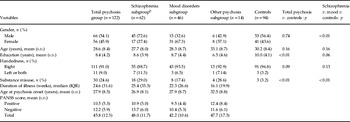
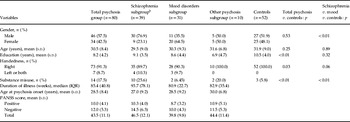
This resulted in a baseline sample of 122 FEP patients, subdivided into a schizophrenia subgroup (n = 62), a mood disorders subgroup (n = 46) and an other psychosis subgroup (schizo-affective disorder, brief psychosis and psychotic disorder not otherwise specified; n = 14); and 94 controls (Table 1). Eighty-four patients had been on antipsychotic treatment within 3 weeks prior to MRI scanning (chlorpromazine equivalent dose = 234.83 mg/day, s.d.= 147.40; based on the criteria described by Woods, Reference Woods2003). After a median period of 13.38 months (IQR = 3.55, range 8–39), 80 patients from the original FEP sample and 52 controls underwent a second MRI scan (Table 2). Among the patients that participated in the follow-up assessment, 39 had schizophrenia, 31 were diagnosed with mood disorders and 10 had other psychosis. Thirty-seven had been on regular antipsychotic treatment by the time of the follow-up MRI examination (chlorpromazine equivalent dose = 224.71 mg/day, s.d. = 154.13). Imaging data obtained from these groups have been reported previously as part of baseline (Schaufelberger et al. Reference Schaufelberger, Duran, Lappin, Scazufca, Amaro, Leite, de Castro, Murray, McGuire, Menezes and Busatto2007) and longitudinal VBM investigations of psychosis-related GMV abnormalities (Schaufelberger et al. Reference Schaufelberger, Lappin, Duran, Rosa, Uchida, Santos, Murray, McGuire, Scazufca, Menezes and Busatto2010).
Sociodemographic and clinical characteristics of the sample at baselinea

PANSS, Positive and Negative Syndrome Scale; s.d., standard deviation; IQR, interquartile range.
a The analysis of continuous variables was carried out using the t test for independent samples and an ANOVA; the analysis of categorical variables was carried out with the χ2 test.
b Subgroup of participants with diagnosis of schizophrenia or schizophreniform disorder.
Sociodemographic and clinical characteristics of the sample at follow-upa

PANSS, Positive and Negative Syndrome Scale; s.d., standard deviation; IQR, interquartile range.
a The analysis of continuous variables was carried out using the t test for independent samples and an ANOVA; the analysis of categorical variables was carried out with the χ2 test.
b Subgroup of participants with diagnosis of schizophrenia or schizophreniform disorder.
All subjects were interviewed at the baseline and at the follow-up evaluation using the SCID (First et al. Reference First, Spitzer, Gibbon and Williams1995). Current symptom severity in the psychosis group at the two time-points was assessed with the Positive and Negative Syndrome Scale (PANSS; Kay et al. Reference Kay, Fiszbein and Opler1987), and information about antipsychotic drug treatment was obtained from case-notes and participant/family interviews. Diagnostic criteria for substance abuse or dependence were assessed using the SCID. Handedness was assessed with Annett's Hand Preference Questionnaire (Annett, Reference Annett1970). In the final sample of the longitudinal evaluation, there were no differences between patients and controls regarding their median interscanning interval [schizophrenia subgroup: median 13.7 (IQR = 2.3) months; mood disorder: median 13.9 (IQR = 0.7) months; other psychoses: median 13.1 (IQR = 3.4) months; controls: median 13.7 (IQR = 5.8) months; Kruskal–Wallis test, p = 0.79]. Both baseline and follow-up MRI investigations were approved by the local ethics committee and informed consent forms were signed by all subjects.
MRI data acquisition and image analysis
Imaging data were acquired using either of two identical MRI scanners (1.5 T GE Signa scanners, General Electric, USA). The same acquisition protocols were used for both instruments and in the two assessments: a T1-spoiled gradient recalled (SPGR) sequence providing 124 contiguous slices, voxel size 0.86 × 0.86 × 1.5 mm, echo time 5.2 ms, resolution time 21.7 ms, flip angle 20°, field of vision 22 cm, matrix 256 × 192 mm.
The reliability of the volume measurements using the two MRI scanners has been reported elsewhere (Schaufelberger et al. Reference Schaufelberger, Duran, Lappin, Scazufca, Amaro, Leite, de Castro, Murray, McGuire, Menezes and Busatto2007). In brief, six controls were (re)scanned on the same day on the two instruments. We obtained interclass correlation coefficient (ICC) values >0.90 for neocortical and medial temporal regions, 0.79 and 0.83 for the left and right thalamus respectively, and 0.90 for the total brain volume. These ICC values for our main regions of interest (ROIs) assured us that we had sufficient interscanning reliability to go ahead with the analyses for the current study. There was no significant difference with regard to the number of participants examined in each scanner and their diagnosis at both baseline and follow-up evaluation (p > 0.05).
Prevalence and length of the CSP
All images were realigned into the anterior commissure–posterior commissure (AC–PC) plane. The CSP was rated blindly by an experienced researcher (C.T.). The CSP length was calculated by multiplying the number of coronal slices in which the cavity was seen by the coronal slice thickness (i.e. 1.5 mm). Clefts measuring at least 1.5 mm (in AP length) were considered as CSP. CSPs spanning four or more slices were defined as large (Kwon et al. Reference Kwon, Shenton, Hirayasu, Salisbury, Fischer, Dickey, Yurgelun-Todd, Tohen, Kikinis, Jolesz and McCarley1998). Subjects without CSP and with persistence of the cavum vergae were excluded from the calculation of the CSP length mean. Inter- (C.T. and J.A.S.C.) and intra-rater ICCs in 30 randomly selected brains were >0.95 for the CSP length and 100% for the presence of CSP.
Determination of the AI
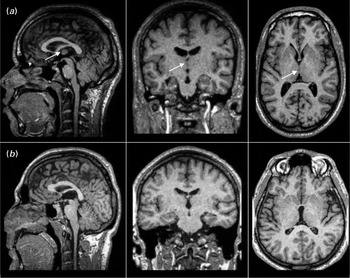
The number of slices in which an AI was seen were counted on consecutive coronal slices. The AI length was calculated by multiplying the number of these slices by 1.5 mm. The presence of the AI was determined by viewing both coronal and axial planes. The AI was considered as present when seen in two or more contiguous coronal slices, and simultaneously in three or more 0.86 mm axial slices (Takahashi et al. Reference Takahashi, Suzuki, Zhou, Nakamura, Tanino, Kawasaki, Seal, Seto and Kurachi2008a; Fig. 1). Subjects without AI were excluded from the calculation of the AI mean length. Inter- (C.T. and J.A.S.C.) and intra-rate ICCs for the AI length in a subgroup of 30 brains were >0.96. Inter- and intra-rater reliabilities for the presence of the AI were 100%.
Sagittal (left), coronal (middle) and axial (right) magnetic resonance (MR) images showing the brain (a; arrow) with and (b) without the adhesio interthalamica (AI).

LV volume
The LV volumes of the participants of this study have been quantified previously (Schaufelberger et al. Reference Schaufelberger, Lappin, Duran, Rosa, Uchida, Santos, Murray, McGuire, Scazufca, Menezes and Busatto2010). In brief, we used a manual ROI method applied with MRIcro software (www.mccauslandcenter.sc.edu/mricro/mricro/). The anterior and posterior horns and the body of the ventricle were combined as one ROI drawn sequentially on coronal slices along the entire extension of the LV. Measurements were taken separately for each hemisphere, starting on the slice in which the AC could be best visualized and continuing anteriorly and then back posteriorly. Only one rater (P.G.P.R.) was responsible for all measurements, which were performed blind to subjects' diagnoses. Inter- (F.L.S.D.) and intra-rater ICCs in a subset of 10 randomly selected brains were >0.90.
VBM
The VBM analysis was carried out with SPM8 software (www.fil.ion.ucl.ac.uk/spm/software/spm8/) running under Matlab 7.8 (www.mathworks.com/products/matlab/). The MRI dataset was oriented manually to place the AC at the origin of the three-dimensional Montreal Neurological Institute (MNI) coordinate system. The images were segmented into grey and white matter partitions using the unified segmentation procedure. The diffeomorphic anatomical registration using exponentiated lie algebra (DARTEL) algorithm was used to spatially normalize the segmented images (Ashburner, Reference Ashburner2007). An additional ‘modulation’ step consisted of multiplying each spatially normalized grey matter image by its relative volume before and after normalization; this ensured that the total amount of grey matter in each voxel was preserved. The resulting images were smoothed using a 12-mm full-width at half-maximum (FWHM) isotropic Gaussian kernel to ensure normal distribution of the data as required by statistical parametric tests.
Statistical analysis
There were two types of investigations of between-group CSP/AI differences: (a) comparisons of the overall psychosis sample versus controls; and (b) comparisons of diagnostic subgroups: schizophrenia subgroup versus mood disorders subgroup versus controls. Clinical and demographic differences were examined with a one-way analysis of variance (ANOVA), the χ2 test or Fisher's exact test. A post-hoc Turkey test was used to follow up the significant main effects yielded by the ANOVAs. The prevalence ratio (PR) was used to assess the frequency of variables, and correlations between them were tested with Pearson or Spearman tests. Differences over time related to the length of the CSP/AI were evaluated by a mixed-effects linear model, considering group, time and gender as independent variables, and age and intracranial volume as covariates of no interest. We decided to consider gender as an independent variable given the sexual dimorphic aspects that CSP and AI are known to display. The CSP/AI lengths were log transformed because of their skewed distribution. The model adjustment was performed using SAS® version 9 (Littell et al. Reference Littell, Miliken, Stroup, Wolfinger and Schabenberger1996). Post-hoc analyses were performed with multiple comparisons through orthogonal contrast. Statistical significance was defined as p < 0.05 (two-tailed).
In the VBM analyses, regional GMV differences were investigated on a voxel × voxel basis using the general linear model. We carried out two sets of analyses, investigating the relationship between GMV measures respectively with the presence of large CSP and the absence of AI. In each of these analyses, four subgroups were included: (1) controls without the anomaly (i.e. without large CSP or with AI); (2) controls with the anomaly; (3) patients without the anomaly; and (4) patients with the anomaly. A multiple regression analysis was performed to examine the extent to which GMV was associated with: (i) group (all patients versus controls); (ii) presence of large CSP/AI; and (iii) interaction between diagnosis and presence of large CSP/AI. Age, gender and intracranial volume were modelled as covariates of no interest. Inferences were made at p < 0.05 after family-wise error (FWE) correction for multiple comparisons across the whole brain. When significant effects were not detected, we report trends significant at p < 0.001 (uncorrected) for the sake of completeness.
Results
Prevalence of the CSP
There were no significant between-group differences in the prevalence of either a CSP of any size (seen in at least one coronal slice) or a large CSP (⩾6 mm) in the comparison between the overall psychosis sample versus controls or in the comparison of diagnostic subgroups (all p > 0.05; Table 3). When all subjects (patients and controls) were pooled, males showed a 67% higher prevalence of a large CSP than females (PR = 1.67, p = 0.02). This observation was stronger in the schizophrenia subgroup (PR = 2.01, p = 0.02).
Prevalence of the cavum septum pellucidum (CSP) and absent adhesio interthalamica (AI) in first-episode psychosis (FEP) patients (n = 122) and healthy controls (n = 94)a

a The analysis of categorical variables was carried out with prevalence ratio (PR) calculus (95% confidence interval). To calculate the PR, the highest value was divided by the lowest one.
b Subgroup of participants with diagnosis of schizophrenia or schizophreniform disorder.
c All CSPs that could be seen in at least one coronal slice (1.5 mm thickness).
Length of the CSP
Regarding the comparison of diagnostic subgroups, analyses of the CSP length (log transformed) revealed a main effect of time (F 1,116 = 280.50, p < 0.0001). However, there were no main effects of diagnosis (F 2,116 = 1.04, p = 0.356) or gender (F 1,116 = 0.75, p = 0.389) or interactions of diagnosis × time (F 2,116 = 2.08, p = 0.130), diagnosis × gender (F 2,116 = 1.48, p = 0.231), time × gender (F 1,116 = 1.37, p = 0.245) or time × diagnosis × gender (F 2,116 = 0.53, p = 0.593).
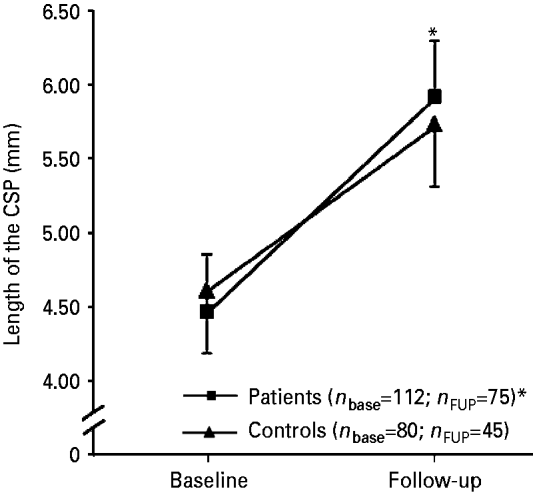
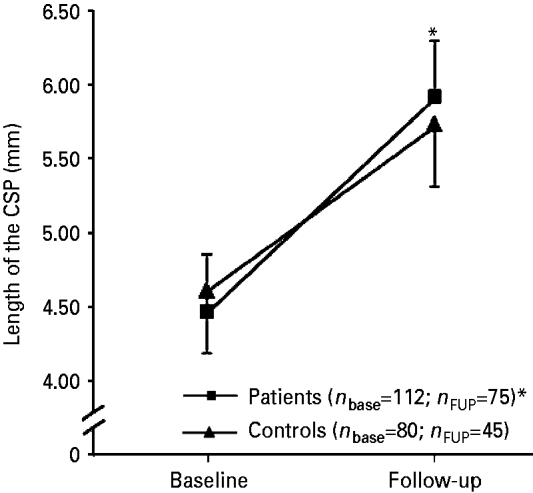
When the overall psychosis sample was compared to the controls, there were no main effects of group (F 1,128 = 0.00, p = 0.974) or gender (F 1,128 = 1.45, p = 0.231), but the main effect of time (F 1,128 = 346.81, p < 0.0001) and the group × time interaction (F 1,128 = 5.41, p = 0.02) reached statistical significance. Post-hoc tests indicated that the CSP increased over time for all subjects [mean (ln) at baseline = 1.51 mm, s.d. = 0.67; mean at follow-up = 1.76, s.d. = 0.60, p < 0.0001], but this increase was more prominent for patients (mean at baseline = 1.49 mm, s.d. = 0.66; mean at follow-up = 1.78 mm, s.d. = 0.53) than controls (mean at baseline = 1.53 mm, s.d. = 0.67; mean at follow-up = 1.74 mm, s.d. = 0.70, p < 0.0001; Fig. 2). There were no significant case × gender (F 1,128 = 0.11, p = 0.740), time × gender (F 1,128 = 0.56, p = 0.456) or case × time × gender (F 1,128 = 0.21, p = 0.651) interactions.
Case × time interaction for the length of the cavum septum pellucidum (CSP) when patients with psychosis are compared with controls. The difference between the baseline and the follow-up was median 13.38 months (IQR = 3.55). n base is the number of subjects at the baseline assessment and n FUP is the number of subjects at the follow-up assessment. The number of patients and controls is smaller than that of the original sample because of the subjects who needed to be excluded from the calculation of the CSP length (i.e. those with CSP = 0 or with the presence of cavum vergae). * A significantly greater increase for patients at follow-up (p < 0.001).
GMV and CSP
When subjects with a large CSP were pooled and compared with those without a large CSP, a focus of GMV reduction was detected in the right superior temporal gyrus (x = 42, y = 5, z = − 18, Z score = 4.46, cluster size = 953, p = 0.049, FWE corrected). After lowering the statistical threshold (p < 0.001, uncorrected), we identified a diagnosis × prevalence of large CSP interaction with trend significance in the left middle frontal gyrus (x = − 39, y = 45, z = 15, Z score = 4.34, cluster size = 249, p = 0.076, FWE corrected). One-way ANOVA showed differences between groups (F 3,215 = 7.00, p < 0.001). Patients with a large CSP had the lowest amount of GMV in this middle frontal focus (mean = 0.615, s.d. = 0.022) and post-hoc tests indicated that this difference was evident against controls with a large CSP (mean = 0.644, s.d. = 0.031, p < 0.001) and against patients without a large CSP (mean = 0.632, s.d. = 0.026, p = 0.008).
Relationship between CSP and clinical and demographical variables
The CSP length correlated positively with pre-MRI scanning duration of illness in patients (r = 0.19, p = 0.04). There was no correlation between CSP length and LV volumes on the right (p = 0.267) or left (p = 0.087) hemispheres when all subjects were pooled or when psychosis patients were analysed separately (p = 0.423 for the right LV and p = 0.140 for the left LV).
Prevalence of the AI
There was no difference in the prevalence of the AI for both diagnosis and case comparisons (all p > 0.05; Table 3). When subjects were pooled, there was a trend for males presenting a higher prevalence of non-AI than females (PR = 1.11, p = 0.056).
Length of the AI
Regarding the comparison of diagnostic subgroups, analyses of the AI length (log transformed) revealed main effects for diagnosis (F 2,100 = 9.23, p = 0.0002), gender (F 1,100 = 8.46, p = 0.004) and time (F 1,100 = 17.02, p < 0.0001) but there were no significant diagnosis × time (F 2,100 = 1.41, p = 0.248), diagnosis × gender (F 2,100 = 2.24, p = 0.112), gender × time (F 1,100 = 0.05, p = 0.819) or diagnosis × gender × time (F 2,100 = 0.99, p = 0.376) interactions. Post-hoc tests indicated that the AI was shorter at the baseline for the schizophrenia group [mean (ln) = 2.88 mm, s.d. = 0.28] compared to both mood disorders (mean = 3.02 mm, s.d. = 0.32, p = 0.03) and controls (mean = 3.10 mm, s.d. = 0.31, p < 0.0001) subgroups. The mood disorders subgroup did not display differences when compared to controls (p = 0.12). The AI was shorter in males (mean = 2.94 mm, s.d. = 0.34) than in females (mean = 3.06 mm, s.d. = 0.27). For all groups, the AI decreased at the follow-up (p < 0.0001).
Regarding the comparisons involving the overall psychosis sample, the AI was found to be shorter when patients were compared to controls (F 1,109 = 8.47, p = 0.004). There were main effects for time (F 1,109 = 15.41, p < 0.0001) and gender (F 1,109 = 8.46, p = 0.004) but no case × time (F 1,109 = 0.25, p = 0.618), case × gender (F 1,109 = 0.56, p = 0.456), time × gender (F 1,109 = 2.07, p = 0.153) or case × time × gender (F 1,109 = 0.04, p = 0.844) interactions.
GMV and AI
When all subjects with AI were compared with those without AI, the latter group presented a focus of GMV reduction in the midline brain area surrounding the AI (x = 0, y = 10, z = 0, Z score = 7.47, cluster size = 1944, FWE corrected p < 0.001).
Relationship between AI and clinical and demographical variables
The AI length correlated negatively with age in patients (r = − 0.24, p = 0.01), with a trend in the same direction as in the controls (r = − 0.19, p = 0.07). The correlation between AI and pre-MRI scanning duration of illness in FEP was not significant, and there was no difference between patients with and without AI regarding PANSS scores. The AI length correlated negatively with LV volume in patients (right: r = − 0.281, p = 0.005; left: r = − 0.291, p = 0.003) and controls (right: r = − 0.409, p < 0.001; left: r = − 0.470, p < 0.001) and also when all subjects were pooled (right: r = − 0.359, p < 0.001; left: r = − 0.394, p < 0.001).
Relationship between CSP and AI
Fourteen subjects presented both large CSP and absent AI (nine patients and five controls). There was no difference between these two groups regarding the frequency of coincidence between these anomalies. The quantitative measures of these two abnormalities were not correlated to each other (all p > 0.05).
Discussion
To our knowledge, this is the first longitudinal study to investigate the presence of CSP/AI and their lengths in FEP. In the baseline assessment, our results demonstrate reductions only in the AI length in schizophrenia compared to both mood disorders and controls subgroups, and dimorphic sexual aspects for the CSP/AI (with greater alterations in males). Furthermore, we detected a longitudinal increase in both CSP/AI lengths for all subjects, more prominently in patients than in controls over time.
Baseline assessment
Consistent with Takahashi et al. (Reference Takahashi, Yung, Yücel, Wood, Phillips, Harding, Soulsby, McGorry, Suzuki, Velakoulis and Pantelis2008b) we did not identify differences in the prevalence of the CSP between patients and controls, reinforcing the hypothesis that a large CSP does not play an essential role in the vulnerability to psychosis (Takahashi et al. Reference Takahashi, Yung, Yücel, Wood, Phillips, Harding, Soulsby, McGorry, Suzuki, Velakoulis and Pantelis2008b). However, our findings are discordant from another investigation that found a higher incidence of large CSP in FEP (Kasai et al. Reference Kasai, McCarley, Salisbury, Onitsuka, Demeo, Yurgelun-Todd, Kikinis, Jolesz and Shenton2004). One explanation for this discrepancy could be the differences in the composition of the samples. Our selection was derived from an epidemiological, population-based case–control study of FEP, with almost all participants recruited from a defined geographical area, minimizing the chance of selection bias (Schaufelberger et al. Reference Schaufelberger, Duran, Lappin, Scazufca, Amaro, Leite, de Castro, Murray, McGuire, Menezes and Busatto2007). It is known that the choice of the control group is crucial to any study, especially regarding psychosis in which the environment may play an important role in its onset (Broome et al. Reference Broome, Woolley, Tabraham, Johns, Bramon, Murray, Pariante, McGuire and Murray2005).
The prevalence of no-AI was equally common among all groups, which is in line with another study with FEP (Takahashi et al. Reference Takahashi, Yücel, Yung, Wood, Phillips, Berger, Ang, Soulsby, McGorry, Suzuki, Velakoulis and Pantelis2008c). However, the AI was shorter in patients with schizophrenia compared to the two other subgroups. Of note, although the AI of mood disorder subjects was not significantly shorter than of controls, it had an value intermediate between the schizophrenia and controls subgroups. It has been suggested that psychosis associated with schizophrenia and bipolar disorder may share neurodevelopmental abnormalities involving midline structures (Kasai et al. Reference Kasai, McCarley, Salisbury, Onitsuka, Demeo, Yurgelun-Todd, Kikinis, Jolesz and Shenton2004). Our results suggest that there may be a continuum of psychosis with regard to the manifestation of the AI length. Finally, no significant association was found between an absent AI and a large CSP. This may be because the development of the AI and the fusion of the septum pellucidum occur at different stages of life (de Souza Crippa et al. Reference de Souza Crippa, Zuardi, Busatto, Sanches, Santos, Araújo, Amaro, Hallak, Ng and McGuire2006). In addition, the brain structures responsible for each phenomenon are unlikely to be the same.
Follow-up evaluation
Our findings demonstrated that CSP length increases over time for all subjects but at a higher rate for patients. Moreover, there was a positive correlation between duration of illness and CSP length (with absence of correlations between the latter measure and current age). These results suggest that, although alterations in CSP may not be present at the onset of psychosis, such abnormalities may be found in individuals with chronic disease and may be related to progression of the disease. This helps to explain some previous studies on this topic that have reported a higher prevalence of large CSP in chronic schizophrenia (Nopoulos et al. Reference Nopoulos, Swayze, Flaum, Ehrhardt, Yuh and Andreasen1997; Kwon et al. Reference Kwon, Shenton, Hirayasu, Salisbury, Fischer, Dickey, Yurgelun-Todd, Tohen, Kikinis, Jolesz and McCarley1998; de Souza Crippa et al. Reference de Souza Crippa, Zuardi, Busatto, Sanches, Santos, Araújo, Amaro, Hallak, Ng and McGuire2006). The increase in the CSP length may be a consequence of the displacement of regions bordering the CSP (i.e. the corpus callosum and fornix) or of those known to be related to the cavity, such as the hippocampus (Rakic & Yakovlev, Reference Rakic and Yakovlev1968). Alternatively, this CSP expansion over time could simply reflect enlargement of the LV. However, this possibility is unlikely to have occurred in our sample as we did not observe longitudinal differences in the LV or any correlation between CSP length and LV volume. The reason why the CSP enhancement is more significant in patients may be an effect of the use of antipsychotics, of the duration of illness, or both, given that these factors may affect neuroanatomical structures in psychosis (Ho et al. Reference Ho, Andreasen, Ziebell, Pierson and Magnotta2011). However, because most of our patients had been exposed to antipsychotic medication or were under drug treatment during the second scan, it is difficult to specify what was responsible for this result.
This first longitudinal assessment of the AI confirmed the involution process of the junction with age previously proposed by Rosales et al. (Reference Rosales, Lemay and Yakovley1968). The lack of a diagnosis × time interaction of the AI length suggests that this area may be more affected by age than by duration of illness or the effects of drug treatment. Nevertheless, the higher incidence of an absent AI in chronic psychosis reported in the literature (Trzesniak et al. Reference Trzesniak, Kempton, Busatto, Oliveira, Galvão-de Almeida, Kambeitz, Ferrari, Filho, Chagas, Zuardi, Hallak, McGuire and Crippa2011b) might be explained by the fact that the AI was shown to be already shorter at the onset of psychosis. Several studies have shown associations between measurements of AI and LV in samples of controls and psychosis patients (Snyder et al. Reference Snyder, Bogerts, Wu, Bilder, Deoras and Lieberman1998; Meisenzahl et al. Reference Meisenzahl, Frodl, Zetzsche, Leinsinger, Maag, Hegerl, Hahn and Moller2002; Takahashi et al. Reference Takahashi, Yücel, Yung, Wood, Phillips, Berger, Ang, Soulsby, McGorry, Suzuki, Velakoulis and Pantelis2008c), which is in line with the suggestion that the AI develops jointly with important components of the ventricular system during early gestation (Rosales et al. Reference Rosales, Lemay and Yakovley1968).
Although the functional relevance of the AI to the pathophysiology of psychosis remains obscure, some possibilities should be considered. Several lines of evidence indicate that the thalamus plays a crucial role in schizophrenia (Andreasen et al. Reference Andreasen, Arndt, Swayze, Cizadlo, Flaum, O'Leary, Ehrhardt and Yuh1994). Dopamine dysfunction is thought to be a key feature of schizophrenia, and animal studies suggest that the AI might be involved in regulation of dopamine release in the basal ganglia (Romo et al. Reference Romo, Chéramy, Godeheu and Glowinski1984), and in the transfer of information implicated in the reciprocal regulation of the two nigrostriatal dopaminergic pathways (Leviel et al. Reference Leviel, Chesselet, Glowinski and Chéramy1981). Striking increases in neuronal activity are evident in the thalamic midline nuclei of rats in response to antipsychotic drugs (Cohen et al. Reference Cohen, Wan, Froimowitz, Ennulat, Cherkerzian and Konieczna1998). In addition, intra-AI injections of N-methyl-d-aspartic acid produced electroencephalographic (EEG) seizure in cats, supporting the existence of these receptors in the AI (Hirayasu & Wada, Reference Hirayasu and Wada1992).
Relationship between CSP, non-AI and GMV
We verified that subjects with a large CSP have GMV reductions in the right temporal regions, which is in line with the assumption that a large CSP would be related to the neurodevelopment of temporal structures (Rakic & Yakovlev, Reference Rakic and Yakovlev1968; Takahashi et al. Reference Takahashi, Suzuki, Hagino, Niu, Zhou, Nakamura, Tanino, Kawasaki, Seto and Kurachi2007). It is more challenging to interpret the trend towards an interaction between diagnosis and prevalence of a large CSP in FEP, indicating that patients with a large CSP have less GMV in the left middle frontal gyrus. The unexpected relationship between a frontal area and CSP raises the hypothesis that these regions are somehow linked to each other. One possibility is that temporal structures could influence both CSP and prefrontal areas, a possibility supported by findings of correlations between hippocampal and left middle frontal gyral volumes in psychosis patients (Suzuki et al. Reference Suzuki, Zhou, Takahashi, Hagino, Kawasaki, Niu, Matsui, Seto and Kurachi2005). Regarding the AI, significant losses of GMV were found in this region when subjects with AI were compared to those without AI, which corroborates our visual results observed with the semi-quantitative assessment. However, further studies with larger samples are advisable to replicate these GMV findings.
Gender effects
We found a pattern of sexual dimorphism in both CSP and AI. Previous schizophrenia studies indicated that the incidence of CSP is higher in males (Nopoulos et al. Reference Nopoulos, Swayze, Flaum, Ehrhardt, Yuh and Andreasen1997). However, it is possible that the gender effects found in our study for CSP, especially in schizophrenia, may have been due to the unequal balance between males and females in this group. As in previous studies (Allen & Gorski, Reference Allen and Gorski1991; Takahashi et al. Reference Takahashi, Suzuki, Zhou, Nakamura, Tanino, Kawasaki, Seal, Seto and Kurachi2008a, Reference Takahashi, Yücel, Yung, Wood, Phillips, Berger, Ang, Soulsby, McGorry, Suzuki, Velakoulis and Pantelisc), we found an overall trend for the AI to be absent and shorter in males. Unlike a recent meta-analysis (Trzesniak et al. Reference Trzesniak, Kempton, Busatto, Oliveira, Galvão-de Almeida, Kambeitz, Ferrari, Filho, Chagas, Zuardi, Hallak, McGuire and Crippa2011b) that found a gender × diagnosis effect, our AI gender differences were only detectable when all subjects from both groups were considered together. Some authors have hypothesized that the female brain is more functionally symmetrical than the male brain (McGlone, Reference McGlone1980). Moreover, it has been proposed that brain commissures, which are sexually dimorphic in normal brains, may be more developmentally vulnerable in schizophrenia (Nopoulos et al. Reference Nopoulos, Rideout, Crespo-Facorro and Andreasen2001).
Methodological issues
Some limitations of our study should be noted. The samples were not ideally matched for substance misuse, with controls showing lower prevalence rates (Tables 1 and 2). To investigate whether this variable could be a confounding factor to the main results, we carried out analyses with substance misuse as an additional exclusion criterion for patients and controls. The results of these repeated analyses were not different from our main findings. However, we cannot reject the possibility that this factor influences the CSP/AI measures. Another limitation is that we combined the imaging data acquired using two different MRI scanners, which could potentially influence the VBM findings. Nonetheless, the two equipment and acquisition protocols were identical, and we obtained very high interscanner reliability indices for the brain regions that were the main focus of this investigation. The thickness of the MRI contiguous slices of our acquisition protocol was 1.5 mm. Although this is a smaller value than that used in previous studies (Keshavan et al. Reference Keshavan, Jayakumar, Diwadkar and Singh2002), thinner slices allow more accurate estimates of the prevalence of the non-AI/CSP.
In summary, we found no increased prevalence of abnormal CSP in FEP individuals. However, the CSP length increased at a higher rate for patients over time. These findings suggest that the CSP may not be linked to the neurobiology of emerging psychotic disorders, although it may be related to the progression of the disease. However, the AI was already shorter at the onset of the disorder, supporting the neurodevelopmental model of schizophrenia (Murray & Lewis, Reference Murray and Lewis1987) and suggesting that an alteration in this grey matter junction may be a risk factor for developing psychosis.
Acknowledgements
We thank Professor R. Molina Souza, who performed the statistical analysis, S. Benetti for advice on VBM, and three anonymous referees for their review of an earlier version of this article. This study was funded by the Wellcome Trust, UK and a ‘Fundação de Amparo à Pesquisa do Estado de São Paulo’ Brazil fellowship (grant no. 2003/13627-0). C.T. is funded by ‘Coordenação de Aperfeiçoamento de Pessoal de Nível Superior’ (CAPES-Brazil, grant number 5797/09-8) and a FAPESP-Brazil fellowship (grant no. 08/57847-7). M.S.S. is funded by CAPES-Brazil (PRODOC Post-Doctorate Fellowship). J.A.S.C., G.F.B., P.R.M. and M.S.S. are recipients of a CNPq (Brazil) fellowship award.
Declaration of Interest
None.