




No CrossRef data available.
Article contents
Executive function asymmetry in older adults genetically at-risk for Alzheimer's disease: Verbal versus design fluency
Published online by Cambridge University Press: 16 December 2005
Abstract
Recent studies have reported cognitive asymmetries in patients with Alzheimer's disease (AD) and in individuals with apolipoprotein E ε4 (APOE ε4) genotype who are in the preclinical phase of AD. This increased frequency of cognitive asymmetry, typically defined as a significant discrepancy (in either direction) between verbal and spatial abilities, often occurs despite an absence of differences on traditional measures of central tendency (i.e., mean test scores). We prospectively studied the relationship between APOE genotype and two modality-specific executive-function tasks: The Verbal Fluency and Design Fluency tests of the Delis-Kaplan Executive Function System (D-KEFS) in 52 normal functioning older adult participants who were grouped according to the presence (n = 24) or absence (n = 28) of the APOE ε4 allele. Nondemented older adults with the APOE ε4 allele demonstrated a greater frequency of cognitive asymmetric profile on the new switching conditions of the Verbal and Design Fluency measures than the APOE non-ε4 individuals. This study further supports the utility of assessing cognitive asymmetry for the detection of subtle cognitive differences in individuals at-risk for AD, and suggests that dual-task executive function tests (i.e., fluency plus switching) may serve as a useful preclinical marker of AD. (JINS, 2005, 11, 863–870.)
Information
- Type
- Research Article
- Information
- Journal of the International Neuropsychological Society , Volume 11 , Issue 7 , November 2005 , pp. 863 - 870
- Copyright
- © 2005 The International Neuropsychological Society
INTRODUCTION
Recent research has made important advances in identifying a prodromal or preclinical phase of Alzheimer's disease (AD). This research has benefited considerably from the discovery of a genetic risk factor for AD, the apolipoprotein E ε4 allele (APOE ε4; Corder et al., 1993; Saunders et al., 1993; Strittmatter et al., 1993). The APOE ε4 allele appears to promote the early appearance of beta-amyloid and neurofibrillary tangles associated with AD in older individuals (Warzok et al., 1998). Despite the clinical importance of this research, APOE ε4 genotype, when considered alone, has generally shown fair to poor predictive value for the disease. For example, estimates of the probability of development of AD in individuals with the APOE ε4 allele range from only 10 to 50 percent (Henderson et al., 1995; Myers et al., 1996). In addition, it has been found that nearly half of the individuals diagnosed with AD do not have the APOE ε4 genotype, and that the presence of an ε4 allele accounts for a relatively small (but significant) portion of the incidence of AD (Evans et al., 1997; Myers et al., 1996). Most important, APOE genotyping has not proven to be helpful in determining when an individual will develop AD (Roses, 1997). There is growing importance to identifying the initial onset of AD, because early administration of cholinesterase inhibitors may maximize therapeutic effects (Giacobini, 2000). In addition, the development of a potential vaccine against amyloid deposition has created the clinical need to identify AD at the earliest possible phase in order for neuroprotective therapies to be most effective (Schenk et al., 1999).
In the light of the above limitations, it has been suggested that APOE genotyping combined with neuropsychological testing may prove to be a more effective method for early detection of preclinical AD than genotyping alone. Accordingly, neuropsychologists have used knowledge of APOE genotype to explore cognitive measures that might predict development of AD in older individuals (Albert et al., 2001; Bondi et al., 1995, 1999; Caselli et al., 2001; Jacobson et al., 2002; Lange et al., 2002). These studies presume that groups of normal-functioning elderly with the APOE ε4 allele have a higher proportion of individuals with preclinical AD pathology than groups without the ε4 allele. This assumption was borne out in a retrospective study by Bondi and colleagues (1999), who found (a) significantly worse learning and memory in a group of nondemented older adults with the APOE ε4 allele than in a group without the ε4 allele; and (b) that these differences disappeared when those who subsequently developed AD were removed from the analyses. In their study, roughly 20% (6/29) of the individuals in the APOE ε4 group went on to develop probable or questionable AD, whereas only about 2% (1/64) of the non-ε4 individuals developed dementia during longitudinal follow-up. Thus, a higher percentage of individuals in the APOE ε4 group than in the non-ε4 group appeared to be in the preclinical stages of AD, and it was these individuals who drove the APOE group differences in learning and memory.
Several additional studies have reported subtle cognitive differences between asymptomatic older adults with and without the APOE ε4 genotype. For example, a number of retrospective investigations found that older individuals with at least one APOE ε4 allele had lower scores on measures of verbal memory and executive functions than those who did not have an ε4 allele, or lower verbal memory and executive function scores in older adults who later developed AD compared with those who did not subsequently develop the disease (Albert et al., 2001; Bondi et al., 1995; Caselli et al., 2001; Chey et al., 2000; Craft et al., 1998; Elias et al., 2000; Jacobs et al., 1995; Linn et al., 1995; Mayeux et al., 2001). These reports have not been consistent, however, as other investigations have failed to replicate these findings (Reiman et al., 2001; Small et al., 1998; Smith et al., 1998).
Recently, Jacobson et al. (2002), suggested several possible reasons for the inconsistent findings in past neuropsychological investigations of preclinical AD. First, a genetic model would predict that only a subgroup of individuals with the APOE ε4 allele would develop AD (Martin, 1990), and this subgroup's early subtle cognitive deficits may be masked in analyses of central tendencies that included the entire APOE ε4 group. Second, APOE ε4 individuals who are in a preclinical phase of AD might exhibit only subtle cognitive declines that remain within the average range and have not reached a level of “impairment,” as traditionally defined by neuropsychologists. And third, since patients diagnosed with AD often initially exhibit asymmetrical neuropathology and corresponding lateralized cognitive deficits, it follows that APOE ε4 subjects who are in a preclinical phase of AD also may display subtle asymmetric cognitive deficits. These lateralized differences may cancel each other out when test scores are analyzed in terms of central tendency (e.g., test means) for the entire group of APOE ε4 individuals, thereby failing to identify subgroups of preclinical AD subjects with relative deficits in verbal or visuospatial abilities.
In line with this latter possibility, Jacobson et al. (2002) found that nondemented older adults with preclinical AD (who later developed AD) did not differ significantly from matched older control subjects on measures of naming (Boston Naming Test, BNT; Kaplan et al., 1983) or visuospatial construction (WISC-R Block Design, BD; Wechsler, 1974) when the groups' mean test scores were compared. However, an analysis of the difference in performance on the two tests did reveal a subtle cognitive decline in the preclinical AD group compared with the normal comparison group. Specifically, the magnitude of verbal-visuospatial discrepancy, defined as each subject's absolute z-score difference between the two tasks, was significantly greater in the preclinical AD group than in the normal comparison group. Furthermore, the preclinical AD group demonstrated a significantly higher frequency of asymmetric cognitive profile (i.e., greater than one standard deviation discrepancy between BNT and BD) than the comparison group. These findings suggest that an analysis of cognitive asymmetry may be a more useful method than group mean analyses of individual tests for detecting subtle cognitive declines in individuals who are at risk for AD.
The present study attempts to extend past investigations in this area through a prospective investigation of subtle cognitive asymmetry in normal-functioning older adults with or without the APOE ε4 allele. Previous studies of cognitive decline in normal-functioning individuals with the ε4 allele have been retrospective investigations that analyzed neuropsychological test results from several years before dementia developed. Such analyses are subject to methodological problems such as limited availability of results from sensitive neuropsychological tests and subject selection biases. In addition, whereas most studies have reported primarily memory deficits in this population, there is some evidence for subtle executive-function deficits in normal functioning individuals with the ε4 allele (Albert et al., 2001; Chey et al., 2000; Elias et al., 2000; Jacobs et al., 1995; Linn et al., 1995). The possibility of early executive-function deficits in those genetically at risk for AD is also supported by neuroimaging evidence of prefrontal changes (Bookheimer et al., 2000; Reiman et al., 1996, 2001). Thus, the present study also extends previous investigations by focusing on potential asymmetries in performance on verbal and visuospatial tests of executive functions. Our study used two new executive-function tasks from the Delis-Kaplan Executive Function System (D-KEFS; Delis et al., 2001a): the Verbal Fluency Test and the Design Fluency Test. These tasks were selected because (a) they allow an analysis of asymmetric performance between primarily verbal and nonverbal executive-function tasks; and (b) they incorporate a new switching condition that requires both fluent generation of responses and cognitive flexibility, thereby increasing cognitive demands and possibly the sensitivity of these tasks to subtle dysfunction. We hypothesized that normal-functioning older individuals with one copy of the APOE ε4 allele would exhibit a higher frequency of asymmetric performance on the two fluency tasks than matched control subjects without the ε4 allele, particularly when comparing performances on the new dual-task fluency tests that also require cognitive flexibility.
METHOD
Participants
Fifty-two healthy older adults participated in this study. Nineteen were recruited from the local community, and 33 were selected from a larger pool of control subjects from the Alzheimer's Disease Research Center (ADRC) at the University of California, San Diego (UCSD). Both cohorts of participants were recruited in a similar manner through newspaper advertisements and community lectures (i.e., not through clinic-based or medical referral sources) for participation in a longitudinal study of normal aging. All individuals were in good health and living independently at the time of participation in this study, and all were selected without regard to ethnicity or race. Informed consent was obtained from all individuals included in this study. All participants completed medical history questionnaires, were evaluated by a senior neurologist, and had blood drawn for APOE genotyping and additional laboratory analyses. They were considered to be normal based on medical, neurologic, laboratory, and cognitive screening measures described in detail previously (Galasko et al., 1990; Salmon & Butters, 1992). Individuals with a history of head trauma, stroke/TIA, other neurological disorder, major psychiatric disorder (including depression), learning disability, or alcoholism and/or other substance abuse were excluded. Participants from the ADRC were chosen based on demographic characteristics so that the two genotype groups were well matched. There were no significant differences between the two cohorts with regard to age [t(50) = .10, p = .92], education [t(50) = .41, p = .68], gender [χ2(1, N = 52) = 2.45; p = .12], DRS Total Score [t(49) = .76, p = .45], or APOE status [χ2(1, N = 52) = 2.56; p = .11].
Participants were grouped on the basis of their APOE genotype, with 24 individuals having inherited one copy of the APOE ε4 allele and 28 individuals without the APOE ε4 allele. The APOE allele distribution in the present sample consisted of six ε2/3, one ε2/4, 22 ε3/3, and 23 ε3/4. Study participants were genotyped for the APOE allele using a polymerase chain reaction based method discussed in Saunders et al. (1993).
Materials and Procedures
The neuropsychological measures included in this study were administered to participants at the baseline (first year) testing of a prospective, longitudinal study of preclinical AD. All tests were administered by a trained psychometrist.
The primary measures administered for this study were the Verbal Fluency Test and the Design Fluency Test of the D-KEFS (Delis et al., 2001a). The Verbal Fluency Test includes three trials or conditions: The traditional letter and category fluency trials and a new Verbal Fluency/Switching condition (see the D-KEFS Examiner's Manual for details). The D-KEFS Verbal Fluency/Switching task requires subjects to generate words while switching back and forth between two semantic categories (i.e., fruits and furniture). The D-KEFS Design Fluency Test also consists of three trials: Filled Dots, Empty Dots Only, and Switching. For the Filled Dots condition, participants are instructed to connect dots using only four straight lines to make as many unique designs as possible. The Empty Dots Only condition is similar to the Filled Dots condition except that examinees are instructed to connect only empty dots in the presence of filled-dot distracters. For the new Design Fluency/Switching condition, subjects are asked to draw different four-lined designs while switching between connecting filled and unfilled dots. Each of the Verbal and Design Fluency conditions is timed for 60 seconds and the number of correct verbal responses or designs drawn is recorded.
Statistical Analyses
Cognitive asymmetry scores were calculated by first converting subjects' raw scores on the D-KEFS Verbal Fluency and Design Fluency tests into Z-scores based on the D-KEFS national normative study (Delis et al., 2001b). Each subject's Design Fluency Z-score was then subtracted from his/her corresponding Verbal Fluency Z-score, yielding a standardized discrepancy score for the two measures. Participants whose absolute discrepancy Z-score was 1.5 standard deviations or greater were classified as “asymmetric,” and participants whose absolute discrepancy Z-score was less than 1.5 SD were classified as “symmetric” (see Matarazzo & Herman, 1985). This use of a calculated asymmetry score was based on similar methodology used in previous studies of cognitive asymmetry (see Demadura et al., 2001; Finton et al., 2003; Jacobson et al., 2002). Differences in the frequency of asymmetric standardized scores on the fluency measures between the two subject groups were evaluated using chi-square analysis. In addition, group differences between mean raw scores on the various fluency tasks were examined with independent samples t-tests.
RESULTS
Demographic Characteristics and Global Cognitive Functioning
The APOE ε4 group and the non-ε4 group were not statistically different with regard to demographic characteristics of age, level of education, or gender distribution (see Table 1). Also shown in Table 1, the groups did not differ on the Total Score or any of the subtest scores of the Dementia Rating Scale, a measure of global cognitive functioning (DRS; Mattis, 1973). All participants scored well within the normal range and above an established cutoff for impairment of 130 points on the Total Score (Monsch et al., 1995).
Demographic and cognitive characteristics of the APOE ε4 and non-ε4 groups

Group mean analyses
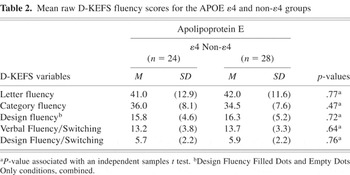
Table 2 shows the mean raw scores on the various D-KEFS fluency subtests for the APOE ε4 and non-ε4 groups. When overall mean scores were compared, no statistical differences were observed between the groups on any of the traditional fluency measures or on the new fluency/switching measures.
Mean raw D-KEFS fluency scores for the APOE ε4 and non-ε4 groups

Discrepancy analyses
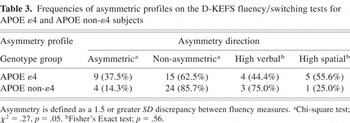
As predicted, the APOE ε4 group displayed a significantly greater frequency of asymmetric pattern than the non-ε4 group when performances on the verbal and design fluency/switching tasks were compared. As shown in Table 3, approximately 38% of the APOE ε4 individuals demonstrated an asymmetric fluency/switching profile, whereas only 14% of the APOE non-ε4 participants showed such cognitive discrepancy (χ2 = .27; p = .05). Table 3 also illustrates that among those individuals who showed an asymmetric profile, neither genotype group was more likely to show either a “high verbal” or “high spatial” asymmetry pattern (Fisher's Exact Test; p = .56). That is, the frequency of the direction of the asymmetry tended to be similar for both genotype groups. However, when the frequency of asymmetric pattern relative to the entire sample was compared between genotype groups, there was a slight trend, though not significant, for the APOE ε4 group to have a higher rate of high spatial asymmetry (5/24 = 21%) than the APOE non-ε4 group (1/28 = 4%) [Fisher's Exact Test; p = .08], while the high verbal asymmetry profile occurred at about the same frequency in both APOE genotype groups (ε4: 4/24 = 17%; Non-ε4: 3/28 = 11%) [Fisher's Exact Test; p = .69].
Frequencies of asymmetric profiles on the D-KEFS fluency/switching tests for APOE ε4 and APOE non-ε4 subjects

In contrast, the groups did not differ significantly in the frequency of asymmetric profiles when the traditional fluency measures were compared (Letter Fluency versus the combined Filled Dots and Empty Dots Only conditions of Design Fluency: χ2 = .05, p = .72; Category Fluency versus the combined Filled Dots and Empty Dots Only conditions of Design Fluency: χ2 = .14, p = .31).
Post hoc analyses
Table 4 shows the associations between the APOE genotype and presence of an asymmetric cognitive profile for the different fluency measures. For the fluency/switching measures, the relative risk of an APOE ε4 genotype was more than three times greater for individuals with an asymmetric profile (odds ratio = 2.625) than for participants without significant asymmetry (odds ratio = .729). The relative risk of an APOE ε4 genotype was substantially lower when predicted by asymmetry in performance on the more traditional fluency tasks.
Odds ratios for the D-KEFS fluency tests

DISCUSSION
This study represents one of the first prospective investigations of cognitive asymmetry in normal-functioning older adults with or without the APOE ε4 allele. In addition, whereas most studies of cognitive deficits in nondemented elderly with the APOE ε4 allele have focused primarily on memory functioning, in the present investigation, we explored the possibility of subtle asymmetric executive-function deficits in this population. The rationale for investigating executive-functioning as a possible preclinical marker of AD derives from recent neuroimaging studies (e.g., fMRI and PET) that have demonstrated increased prefrontal brain response and hypometabolism in this at-risk group (Bookheimer et al., 2000; Reiman et al., 2001). In the present study, we used two new executive-function tests: (a) a verbal fluency task that has a new condition that simultaneously assesses category fluency and cognitive switching; and (b) a nonverbal fluency task that also has a new condition that concurrently evaluates design fluency and cognitive switching. These tasks were selected because (a) the dual nature of these executive-function switching tasks likely increases processing demands, thereby enhancing their sensitivity to subtle frontal dysfunction; and (b) the tests allow an analysis of cognitive asymmetry in the performance of primarily verbal versus spatial executive-function tasks. It was hypothesized that a higher frequency of asymmetric cognitive performances between verbal and design fluency tasks would be found in the ε4 group compared to the non-ε4 group, especially for the dual-task tests that also require cognitive switching.
The two genotype groups were comparable with regard to age, education level, gender distribution, and global cognitive functioning, with both groups' DRS scores falling well within normal limits. As expected, we did not find significant mean differences between the two genotype groups when we analyzed performances on the Verbal Fluency and Design Fluency conditions individually. In fact, mean scores for the groups were nearly identical with no evidence of a trend toward differences in performance. In contrast, and as predicted, there was a significant group difference in the frequency of asymmetric pattern for the two fluency/switching tasks. That is, individuals possessing an APOE ε4 allele demonstrated a significantly higher frequency of asymmetric performance between the verbal versus spatial fluency/switching tasks compared to the non-ε4 group. We did not observe this asymmetric performance for the more traditional fluency tests that did not require cognitive flexibility. Furthermore, we found that among those who showed an asymmetric profile, both genotype groups were equally likely to demonstrate “high verbal” versus “high spatial” asymmetric profiles. However, when the frequency of type of asymmetric profile relative to the entire group was compared between genotypes, there was a trend for the APOE ε4 group to have a higher rate of “high spatial” asymmetry, but not “high verbal” asymmetry, than the APOE non-ε4 group. Thus, while there appears to be an increased likelihood of cognitive asymmetry in normal functioning older adults with the APOE ε4 allele, the direction of the asymmetry is less clear, but perhaps the occurrence of “high spatial” pattern may be influenced by APOE genotype.
Our findings are consistent with Jacobson et al. (2002) who also found that normal-functioning individuals with the APOE ε4 genotype demonstrated a significantly higher frequency of asymmetric performance than those without the ε4 genotype on tasks of more fundamental cognitive skills (i.e., naming vs. visuoconstructional ability). These findings are consonant with those from several studies that identified subgroups of AD patients with asymmetric verbal versus nonverbal profiles (see Delis et al., 1992; Demadura et al., 2001; Finton et al., 2003; Fisher et al., 1999; Haxby et al., 1985). Because the early occurrence of lateralized cognitive deficits is common in AD patients, it follows that asymmetric cognitive profiles may serve as a useful preclinical marker of AD in at-risk people. Furthermore, these findings are consistent with neuroimaging investigations that have documented asymmetric metabolic dysfunction in both normal older adults who are at-risk for AD and nondemented individuals who have subsequently developed AD (Hogh et al., 2001; Small et al., 1995).
Several limitations of the present study should be noted. First, the sample of APOE ε4 individuals does not include APOE ε4 homozygotes who have the greatest risk of developing AD, or APOE ε2 homozygotes who have a decreased risk of developing the disease. Inclusion of such individuals in future studies may actually amplify the APOE genotype-driven differences in asymmetry observed in the present study, and would better allow the results to be generalized to the entire population of older adults. Second, we do not know with certainty which participants will go on to develop AD dementia and which will not, making it impossible to predict future cognitive decline or conversion to AD on the basis of cognitive asymmetry. Longitudinal studies in our laboratory and others are currently underway to investigate whether or not the asymmetric cognitive profiles that we have identified in older adults with the APOE ε4 genotype enhance the ability to predict which normal older adults are likely to suffer an AD diagnosis in the future.
ACKNOWLEDGMENTS
Preparation of this article was supported in part by a Veterans Administration Merit Review Grant and by National Institute on Aging Grants AG 12674 (M.B.) and AG P50 05131 (D.S.). Dr. Delis is a co-author of the D-KEFS and receives royalties from the instrument.
References
REFERENCES
Albert, M.S.,
Moss, M.B.,
Tanzi, R., &
Jones, K.
(2001).
Preclinical prediction of AD using neuropsychological tests.
Journal of the International Neuropsychological Society,
7,
631–639.Google Scholar
Bondi, M.W.,
Salmon, D.P.,
Galasko, D.,
Thomas, R.G., &
Thal, L.J.
(1999).
Neuropsychological function and apolipoprotein E genotype in the
preclinical detection of Alzheimer's disease.
Psychology and Aging,
14,
295–303.Google Scholar
Bondi, M.W.,
Salmon, D.P.,
Monsch, A.U.,
Galasko, D.,
Butters, N.,
Klauber, M.R.,
Thal, L.J., &
Saitoh., T.
(1995).
Episodic memory changes are associated with the APOE-ε allele
in nondemented older adults.
Neurology,
45,
2203–2206.Google Scholar
Bookheimer, S.Y.,
Strojwas, M.H.,
Cohen, M.S.,
Saunders, A.M.,
Pericak-Vance, M.A., &
Mazziotta, J.C.
(2000).
Patterns of brain activation in people at risk for Alzheimer's
disease.
New England Journal of Medicine,
343,
450–456.Google Scholar
Caselli, R.J.,
Osborne, D.,
Reiman, E.M.,
Hentz, J.G.,
Barbieri, C.J.,
Saunders, A.M.,
Hardy, J.,
Graff-Radford, G.,
Hall, G.R., &
Alexander, G.E.
(2001).
Preclinical cognitive decline in late middle-aged asymptomatic
apolipoprotein E-e4/4 homozygotes: A replication study.
Journal of the Neurological Sciences,
189,
93–98.Google Scholar
Chey, J.,
Kim, J.W., &
Cho, H.Y.
(2000).
Effects of apolipoprotein E phenotypes on the neuropsychological
functions of community-dwelling elderly individuals without
dementia.
Neuroscience Letters,
289,
230–234.Google Scholar
Corder, E.H.,
Saunders, A.M.,
Strittmatter, W.J.,
Schmechel, D.E.,
Gaskell, P.C.,
Small, G.W.,
Roses, A.D.,
Haines, J.L., &
Pericak-Vance, M.A.
(1993).
Gene dose of apolipoprotein E type 4 allele and the risk of
Alzheimer's disease in late onset families.
Science,
261,
921–923.Google Scholar
Craft, S.,
Teri, L.,
Edland, S.D.,
Kukull, W.A.,
Schellenberg, G.,
McCormick, W.C.,
Bowen, J.D., &
Larsen, E.B.
(1998).
Accelerated decline in apolipoprotein E-ε4 homozygotes with
Alzheimer's disease.
Neurology,
51,
149–151.CrossRefGoogle Scholar
Delis, D.C.,
Kaplan, E., &
Kramer, J.H.
(2001a).
The Delis-Kaplan executive function system–examiner's
manual.
New York:
The Psychological Corporation.
Delis, D.C.,
Kaplan, E., &
Kramer, J.H.
(2001b).
The Delis-Kaplan executive function system–technical
manual.
New York:
The Psychological Corporation.
Delis, D.C.,
Massman, P.J.,
Butters, N.,
Salmon, D.P.,
Shear, P.K.,
Demadura, T., &
Filoteo, J.V.
(1992).
Spatial cognition in Alzheimer's disease: Subtypes of
global-local impairment.
Journal of Clinical and Experimental Neuropsychology,
14,
463–77.Google Scholar
Demadura, T.,
Delis, D.C.,
Jacobson, M., &
Salmon, D.
(2001).
Do subgroups of patients with Alzheimer's disease exhibit
asymmetric deficits on memory tests?
Journal of Clinical and Experimental Neuropsychology,
23,
164–171.Google Scholar
Elias, M.F.,
Beiser, A.,
Wolf, P.A.,
Au, R.,
White, R.F., &
D'Agostino, R.B.
(2000).
The preclinical phase of Alzheimer disease.
Archives of Neurology,
57,
808–813.Google Scholar
Evans, D.A.,
Beckett, L.A.,
Field, T.S.,
Feng, L.,
Albert, M.S.,
Bennett, D.A.,
Tycko, B., &
Mayeux, R.
(1997).
Apolipoprotein E epsilon4 and incidence of Alzheimer disease in a
community population of older persons.
Journal of the American Medical Association,
277,
822–824.Google Scholar
Finton, M.J.,
Lucas, J.A.,
Rippeth, J.D.,
Bohac, D.L.,
Smith, G.E.,
Ivnik, R.J.,
Petersen, R.C., &
Graff-Radford, N.R.
(2003).
Cognitive asymmetries associated with apolipoprotein E genotype in
patients with Alzheimer's disease.
Journal of the International Neuropsychological Society,
9,
751–759.Google Scholar
Fisher, N.J.,
Rourke, B.P., &
Bieliauskas, L.A.
(1999).
Neuropsychological subgroups of patients with Alzheimer's
disease: An examination of the first 10 years of CERAD data.
Journal of Clinical and Experimental Neuropsychology,
21,
488–518.Google Scholar
Galasko, D.,
Kwo-on-Yuen, P.F.,
Klauber, M.R., &
Thal, L.J.
(1990).
Neurological findings in Alzheimer's disease and normal
aging.
Archives of Neurology,
47,
625–627.Google Scholar
Giacobini, E.
(2000).
Cholinesterase inhibitors stabilize Alzheimer disease.
Neurochemical Research,
25,
1185–1190.Google Scholar
Haxby, J.V.,
Duara, R.,
Grady, C.L.,
Cutler, N.R., &
Rapoport, S.I.
(1985).
Relations between neuropsychological and cerebral metabolic
asymmetries in early Alzheimer's disease.
Journal of Cerebral Blood Flow and Metabolism,
5,
193–200.Google Scholar
Henderson, A.S.,
Easteal, S.,
Jorm, A.F.,
Mackinnon, A.J.,
Korten, A.E.,
Christensen, H.,
Croft, L., &
Jacomb, P.A.
(1995).
Apolipoprotein E allele epsilon 4, dementia, and cognitive decline
in a population sample.
Lancet,
347,
542.Google Scholar
Hogh, P.,
Knudsen, G.M.,
Kjaer, K.H.,
Jorgensen, O.S.,
Paulson, O.B., &
Waldemar, G.
(2001).
Single photon emission computed tomography and apolipoprotein E in
Alzheimer's disease: impact of the epsilon4 allele on regional
cerebral blood flow.
Journal of Geriatric Psychiatry and Neurology,
14,
42–51.Google Scholar
Jacobs, D.M.,
Sano, M.,
Dooneief, G.,
Marder, K.,
Bell, K.L., &
Stern, Y.
(1995).
Neuropsychological detection and characterization of preclinical
Alzheimer's disease.
Neurology,
45,
957–962.Google Scholar
Jacobson, M.W.,
Delis, D.C.,
Bondi, M.W., &
Salmon, D.P.
(2002).
Do neuropsychological tests detect preclinical Alzheimer's
disease: Individual-test versus cognitive-discrepancy score
analyses.
Neuropsychology,
16,
132–139.Google Scholar
Kaplan, E.,
Goodglass, H., &
Weintraub, S.
(1983).
The Boston Naming Test
(2nd ed.).
Philadelphia:
Lea & Febiger.
Lange, K.L.,
Bondi, M.W.,
Salmon, D.P.,
Galasko, D.,
Delis, D.C.,
Thomas, R.G., &
Thal, L.J.
(2002).
Decline in verbal memory during preclinical Alzheimer's
disease: Examination of the effect of APOE genotype.
Journal of the International Neuropsychological Society,
8,
943–955.Google Scholar
Linn, R.T.,
Wolf, P.A.,
Bachman, D.L.,
Knoefel, J.E.,
Cobb, J.L., &
Belanger, A.J.
(1995).
The “preclinical phase” of probable Alzheimer's
disease: A 13-year prospective study of the Framingham cohort.
Archives of Neurology,
52,
485–490.Google Scholar
Martin, A.
(1990).
Neuropsychology of Alzheimer's disease: The case for
subgroups. In
M.F. Schwartz (Ed.).
Modular deficits in Alzheimer-type dementia (pp.
143–175).
Cambridge, MA:
The MIT Press.
Matarazzo, J.D. &
Herman, D.O.
(1985).
Clinical uses of the WAIS-R: Base rates of differences between VIQ
and PIQ in the WAIS-R standardization sample. In
B.B. Wolman (Ed.),
Handbook of intelligence: Theories, measurements, and
applications (pp.
899–932).
New York:
John Wiley.
Mattis, S.
(1973).
Dementia Rating Scale.
Odessa, FL:
Psychological Assessment Resources.
Mayeux, R.,
Small, S.A.,
Tang, M.X.,
Tycko, B., &
Stern, Y.
(2001).
Memory performance in healthy elderly without Alzheimer's
disease: Effects of time and apolipoprotein-E.
Neurobiology of Aging,
22,
683–689.Google Scholar
Monsch, A.U.,
Bondi, M.W.,
Salmon, D.P.,
Butters, N.,
Thal, L.J.,
Hansen, L.A.,
Wiederholt, W.C.,
Cahn, D.A., &
Klauber, M.R.
(1995).
Clinical validity of the Mattis dementia rating scale in detecting
dementia of the Alzheimer type. A double cross-validation and application
to a community-dwelling sample.
Archives of Neurology,
52,
899–904.Google Scholar
Myers, R.H.,
Schaefer, E.J.,
Wilson, P.W.F.,
D'Agostino, R.,
Ordovas, J.M.,
Espino, A.,
Au, R.,
White, R.F.,
Knoefel, J.E.,
Cobb, J.L.,
McNulty, K.A.,
Beiser, A., &
Wolf, P.A.
(1996).
Apoliprotein E element 4 association with dementia in a
population-based study: The Framingham study.
Neurology,
46,
673–677.Google Scholar
Reiman, E.M.,
Caselli, R.J.,
Chen, K.,
Alexander, G.E.,
Bandy, D., &
Frost, J.
(2001).
Declining brain activity in cognitively normal apolipoprotein E 4
heterozygotes: A foundation for using positron emission tomography to
efficiently test treatments to prevent Alzheimer's disease.
Proceedings of the National Academy of Sciences,
98,
3334–3339.Google Scholar
Reiman, E.M.,
Caselli, R.J.,
Yun, L.S.,
Chen, K.,
Bandy, D.,
Minoshima, S.,
Tibodeau, S.N., &
Osborne, D.
(1996).
Preclinical evidence of Alzheimer's disease in persons
homozygous for the ε4 allele for Apolipoprotein E.
The New England Journal of Medicine,
334,
752–758.Google Scholar
Roses, A.D.
(1997).
A model for susceptibility polymorphisms for complex diseases:
Apolipoprotein E and Alzheimer disease.
Neurogenetics,
1,
3–11.Google Scholar
Salmon, D.P. &
Butters, N.M.
(1992).
Neuropsychological assessment of dementia in the elderly.
In
R. Katzman &
J.W. Row (Eds.),
Principals of geriatric neurology (pp.
144–163).
New York:
F.A. Davis.
Saunders, A.M.,
Strittmatter, W.J.,
Schmechel, D.,
St. George-Hyslop, P.H.,
Perick-Vance, M.A.,
Joo, S.H.,
Rosi, B.L.,
Gusella, J.F.,
Crapper-MacLachlan, D.R.,
Alberts, M.J.,
Hulette, C.,
Crain, B.,
Goldgaber, D., &
Roses, A.D.
(1993).
Association of apolipoprotein E allele ε4 with late-onset
familial and sporadic Alzheimer's disease.
Neurology,
43,
1467–1472.Google Scholar
Schenk, D.,
Barbour, R.,
Dunn, W.,
Gordon, G.,
Grajeda, H.,
Guido, T.,
Hu, K.,
Huang, J.,
Johnson-Wood, K.,
Khan, K.,
Kholodenko, D.,
Lee, M.,
Liao, Z.,
Lieberburg, I.,
Motter, R.,
Mutter, L.,
Soriano, F.,
Shopp, G.,
Vasquez, N.,
Vandevert, C.,
Walker, S.,
Wogulis, M.,
Yednock, T.,
Games, D., &
Seubert, P.
(1999, July 8).
Immunization with amyloid-beta attenuates Alzheimer-disease-like
pathology in the PDAPP mouse.
Nature,
400,
173–177.Google Scholar
Small, B.J.,
Basun, H., &
Bäckman, L.
(1998).
Three-year changes in cognitive performance as a function of
apolipoprotein E genotype: Evidence from very old adults without
dementia.
Psychology and Aging,
13,
80–87.Google Scholar
Small, G.W.,
Mazziotta, M.D.,
Collins, M.T.,
Baxter, L.R.,
Phelps, M.E.,
Mandelkern, M.A.,
Kaplan, A.,
La Rue, A.,
Adamson, C.F.,
Chang, L.,
Guze, B.H.,
Corder, E.H.,
Saunders, A.M.,
Haines, J.L.,
Pericak-Vance, M.A., &
Roses, A.D.
(1995).
Apolipoprotein E type 4 allele and cerebral glucose metabolism in
relatives at risk for familial Alzheimer disease.
Journal of the American Medical Association,
273,
942–947.Google Scholar
Smith, G.E.,
Bohac, D.L.,
Waring, S.C.,
Kokmen, E.,
Tangalos, E.G.,
Ivnik, R.J., &
Petersen, R.C.
(1998).
Apolipoprotein E genotype influences cognitive
“phenotype” in patients with Alzheimer's disease but not
in healthy control subjects.
Neurology,
50,
355–362.Google Scholar
Strittmatter, W.J.,
Saunders, A.M.,
Schmechel, D.,
Pericak-Vance, M.,
Enghild, J.,
Salvesen, G.S., &
Roses, A.D.
(1993).
Apolipoprotein E: High-avidity binding to β-amyloid and
increased frequency of type 4 allele in late-onset familial Alzheimer
disease.
Proceedings of the National Academy of Sciences (USA),
90,
1977–1981.Google Scholar
Warzok, R.W.,
Kessler, C.,
Apel, G.,
Schwarz, A.,
Egensperger, R.,
Schreiber, D.,
Herbst, E.W.,
Wolf, E.,
Walther, R., &
Walker, L.C.
(1998).
Apolipoprotein E4 promotes incipient Alzheimer pathology in the
elderly.
Alzheimer Disease and Associated Disorders,
121,
33–39.Google Scholar
Wechsler, D.
(1974).
Wechsler Intelligence Scale for Children–Revised.
San Antonio, TX:
The Psychological Corporation.

Demographic and cognitive characteristics of the APOE ε4 and non-ε4 groups
Mean raw D-KEFS fluency scores for the APOE ε4 and non-ε4 groups
Frequencies of asymmetric profiles on the D-KEFS fluency/switching tests for APOE ε4 and APOE non-ε4 subjects

Odds ratios for the D-KEFS fluency tests
 You have
Access
- 32
- Cited by