Nearly unique amongst the world's monetary bodies, the Federal Reserve defies description as a central bank. A century after its creation, the Fed retains a hybrid structure of a president-appointed, Senate-confirmed Washington board and twelve largely privately directed regional reserve banks. The decisions of the three-man committee that designed the Federal Reserve System have remained unchanged, despite significant changes in the economy, demographics, and technology since the reserve system was designed in 1914. Since that time, the organizational framework has influenced American monetary policy and allowed regional variation in bank supervision.
Anticipating the importance of the reserve banks to local economies, three dozen cities in 1914 competed to host one of the newly authorized reserve banks. In this article we explore the competition over the location of the reserve banks, challenging accounts that absolve the Reserve Bank Organization Committee (RBOC) of playing politics with the design of the system. We test our account with archival materials from the RBOC, showing the limits of a purely nonpolitical account of the selection of the reserve bank cities. Ironically, although Democrats on the RBOC purposively diversified the design of the reserve system, their handiwork created a decentralized institution that failed miserably less than two decades later, contributing to the onset of the Great Depression.
WHY STUDY THE FEDERAL RESERVE BANKS?
The Federal Reserve Act of 1913 created a hybrid institution. One part consisted of the Federal Reserve Board in Washington, D.C., whose five members (plus the secretary of treasury and the comptroller of the currency) would be selected by the president and confirmed by the Senate for ten-year terms. The other part consisted of a set of quasi-private regional reserve banks, in which national banks were required to purchase stock. Bankers were guaranteed influence over management of the reserve banks by the opportunity to select two-thirds of their reserve bank's directors (with the Federal Reserve Board choosing the remaining third). As we explore below, legislators disagreed intensely about the size and scope of the reserve bank system. Ultimately, to reach agreement on the Federal Reserve Act, Congress created a Reserve Bank Organization Committee (RBOC), a panel consisting of three Democratic political appointees: the comptroller of the currency and the secretaries of treasury and agriculture. Congress charged the RBOC with designing the Fed's regional structure—directing it to select the number of reserve districts, to choose the cities in which the reserve banks would be located, and to draw the geographic boundaries of the districts. The powers and structure of the Federal Reserve Board were revised in the Banking Act of 1935 (creating today's more familiar Board of Governors). The RBOC's 1914 regional design remains unchanged.
The regional banks today play a collateral role in the making of monetary policy. In addition to the Washington, D.C.-based governors, only the president of the Federal Reserve Bank of New York has a permanent seat on the Federal Open Market Committee (FOMC), the monetary policy committee of the Fed; the remaining eleven Federal Reserve Bank presidents rotate across four voting seats. Moreover, the regional bank presidents can be outvoted when six or seven governors sit on the Board of Governors. The district banks have supervisory powers over national banks in their districts, but most of the nation's largest financial institutions are in the Second District under the purview of the Federal Reserve Bank of New York.
We study the origins of the reserve system for five reasons. First, we lack a theoretical foundation for explaining the construction of the Fed. Scholarship on the creation of monetary institutions tends to focus on the origins of their independence. Lawmakers often try to insulate central banks from political authority to signal credible commitment to controlling inflation or to please dominant financial interests.Footnote 1 Alternatively, independence may be the unintended consequence of political compromise: Independence emerges when competing interests seek to prevent their adversaries from gaining control of monetary policy.Footnote 2 Still, theories that focus on the goal of creating an independent central bank provide little leverage for explaining the design of the Federal Reserve. Many legislators at the time preferred political control to independence, and others preferred a decentralized system rather than a “central” bank—which helps to explain the system's federal structure, the limited power originally granted to the Board in Washington, and the inclusion of the treasury secretary and comptroller on the Board. Explaining the creation of the reserve system and the selection of the district banks requires a different approach to thinking about the origins of monetary institutions.
Second, a robust account of the origins of the Fed requires a better understanding of the politics that gave rise to the reserve system. Disagreements about the degrees of centralization and political control meant that the Sixty-third Congress (1913–1915) would have struggled to create the Federal Reserve without a system of regional banks. Democrats and Populists rejected a central bank controlled by Wall Street, Republicans rejected a central bank controlled by Washington, and Progressives favored a purely independent bank. In short, a decentralized system of reserve banks was the price of enactment.
Third, although the reserve banks have a limited role in setting monetary policy today, that was not the case in the early years of the Federal Reserve, when the Federal Reserve Board struggled to coordinate monetary policy across the twelve reserve banks.Footnote 3 Reserve banks, David Wheelock argues, “held the balance of power.”Footnote 4 The district banks were central to the extension of credit from their creation in 1914 into the Great Depression. As J. William Barber observes, the regional banks in this period had “wide latitude to carry on their business as they saw fit, with little regard for whether or not their actions were consistent with recommendations from the center.”Footnote 5 Unlike today's discount rate—a uniform rate set by the Board of Governors—the pre-Depression-era Federal Reserve district banks could affect the lending activities of their member banks and their regional economies by varying the required reserve ratios and their locally set discount rates, even conducting their own open-market operations.Footnote 6 Indeed, Milton Friedman and Anna Schwartz's authoritative history of monetary policy in the United States singles out the autonomy of the reserve banks as a contributor to the severity of the Great Depression.Footnote 7
Gary Richardson and William Troost demonstrate why the reserve banks were economically consequential in the early years of the Fed's history.Footnote 8 Observing that Mississippi was divided into two different reserve bank districts (one serviced by the Federal Reserve Bank of Atlanta and the other by the Federal Reserve Bank of St. Louis), the authors exploit this regulatory quirk to test for the impact of the two banks' contrasting monetary policies on the survival rates of Mississippi banks in 1930. Mississippi banks in the Atlanta district (whose bank offered a lower discount rate and emergency lending) failed at a much lower rate than similar banks in the St. Louis district (whose bank followed the “real bills” doctrine and tightened access to credit during recessionary times). Given the semi-autonomous nature of the district banks and the economic impact of their policies, the selection of the reserve cities (and the drawing of the district boundaries) mattered.
Fourth, policymakers periodically question the fit of the reserve system to today's financial system. The Federal Reserve was a solution to the Panic of 1907. Yet, the regional banks have not been moved after a century of transformation in the economy, demographics, and technology. Finally, some puzzling elements of the Federal Reserve System merit attention. At least three western and Great Plains cities—Denver, Omaha, and Lincoln—made claims on a regional reserve bank. But the only reserve banks created west of Kansas City were placed in Dallas and San Francisco, with no regional banks placed in the Great Plains or Mountain West. Most curiously, the RBOC placed two reserve banks in Missouri, one in Kansas City and one in St. Louis. In short, the politics of creating the Federal Reserve continued after Wilson signed the Federal Reserve Act into law.
THE MANDATE OF THE RBOC
We start by mapping the disagreements that led Congress to create the RBOC. Two key disputes emerged as the House and Senate worked on currency bills in 1913.Footnote 9 First, how should Congress balance the demands by eastern, primarily Republican, bankers for centralized authority against the demands by Populists and Democratic farmers for decentralized control of the flow of credit? And second, how should Republican demands for private control of a central bank be balanced against Democratic, Populist, and Progressive demands for significant public control? These two dimensions—the degree of centralization and public control—gave shape to competing proposals in the wake of the Panic of 1907. Republicans wanted a single, central bank controlled by bankers, while Democrats and Progressives envisioned a set of regional banks under government control. By all accounts, President Woodrow Wilson played a critical role in devising a compromise around which a winning coalition would eventually agree.Footnote 10
Disputes over the Regional Reserve Banks
Disagreements over centralization and the balance of public and private control played out in debates over the number of regional reserve banks and the process for selecting them. At one extreme, rural Populists, farmers, and small-city bankers (largely Democrats) lobbied for a system of forty-eight regional banks—one per state.Footnote 11 A reserve bank “at every major crossroad,” Williams Jennings Bryan supposedly urged.Footnote 12 Such a system would maximize local control over the seasonal flow of credit and, coupled with a president-appointed board in Washington, would check Wall Street's influence during financial crises. The bill originally proposed by the chair of the House Banking and Currency Committee, Carter Glass (D-VA), came closest to advancing Populist interests by mandating twenty regional reserve banks. Under pressure from Wilson, the version of the bill passed by the House reduced the number of reserve banks to a minimum of twelve and a maximum of twenty.Footnote 13 Out of concern that a Federal Reserve Board in Washington could be dominated by banking interests, the House bill delegated the choice of reserve cities to an organizing committee that would be composed of Wilson's top Democratic appointees.
In contrast, large-city bankers—typically Republicans from the Northeast—preferred a single, central bank dominated by bankers. But with Democrats in control of both the White House and Congress and Progressives favoring public control, prominent New York bankers acquiesced to three or four regional reserve banks. Under lobbying from the banking community, the Senate Banking Committee approved two competing versions of the currency bill.Footnote 14 Gilbert Hitchcock (D-NE)—attracting the support of Republicans on the Senate Banking Committee—proposed four regional banks, with the Federal Reserve Board appointing a majority of each bank's directors; Robert Owen (D-OK), chair of the Senate Banking Committee, proposed a minimum of eight and a maximum of twelve regional banks, each of which would be owned by the subscribing banks. Both versions dropped the organizing committee, instead instructing the Federal Reserve Board (which bankers expected to dominate) to design the reserve system. Owen prevailed on the Senate floor after the Senate Democratic Conference voted to bind its members to his proposal.Footnote 15
We offer two observations about the final compromise that emerged from conference negotiations over the weekend before Christmas in 1913. First, despite the disagreements reflected in the House and Senate proposals for the reserve system, final decisions largely amounted to horse trading. That was perhaps inevitable given the approaching holiday. In short, negotiators split the difference: They adopted the Senate provision on the number of banks (at least eight, no more than twelve), and they adopted the House provision that created the RBOC to design the districts, rather than entrusting the job to the soon-to-be-established Federal Reserve Board.
Second, the votes in both chambers had a partisan cast. Nearly every House Democrat and every Senate Democrat voted in favor; a majority of House Republicans and 90 percent of Senate Republicans were opposed. This is not surprising, given Republican senators' objections after Democrats moved to bind its members on the currency bill. “A tightening of party lines,” one reporter observed, “would drive them [the Republicans] into concerted opposition to the bill.”Footnote 16 Still, House Republicans did not uniformly reject the compromise, as their more moderate members voted in favor. Just over half of the GOP who hailed from states won by Teddy Roosevelt in 1912 voted in favor of the House compromise, as did thirteen of fifteen House Progressives.Footnote 17 But even with Progressive support, a majority of Democrats favored the bill and a majority of the GOP was opposed. The partisan edge belies the received wisdom that the Federal Reserve System was a political compromise that was acceptable to all parties.Footnote 18
Preparations of the RBOC
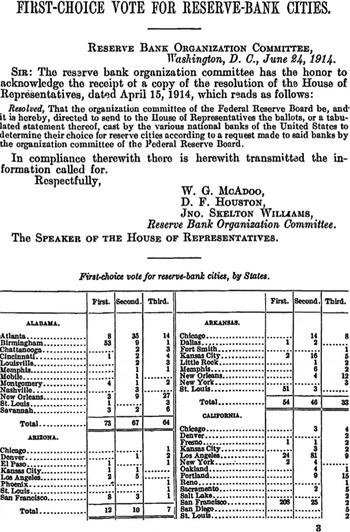
Funded by a $100,000 congressional appropriation, the RBOC (comprised of Treasury Secretary William McAdoo, Agriculture Secretary David Houston, and the yet-to-be-confirmed Comptroller of the Currency John Williams) took two preparatory steps in the winter of 1914. First, it conducted a poll of bankers in the more than seven thousand national banks that were required to join the new reserve system. The balloting sought to determine where the bankers preferred to have the reserve banks located (as excerpted in Figure 1). Second, McAdoo and Houston embarked on a ten-thousand-mile “listening tour” of eighteen cities to allow cities to press their case for a reserve bank. Houston claimed in his memoirs that the poll results “aided us immensely, helping to confirm opinions which we had developed during our trip.”Footnote 19
Excerpt from Poll of National Banks on Location of Reserve Banks, 1914. Source: Reserve Bank Organization Committee, “Location of Reserve Districts in the United States,” Letter from the Reserve Bank Organization Committee Transmitting the Briefs and Arguments to the Organization Committee of the Federal Reserve Board Relative to the Location of the Federal Reserve Districts (1914), 350–57 http://fraser.stlouisfed.org/publication/?pid=606 (accessed January 15, 2013).

The documents cataloged by the committee were diverse, ranging from letters by Chicago bankers to a statement on the mail facilities of El Paso, Texas.Footnote 20 Most cities marshaled evidence to show their city's centrality to commerce in the region, including maps showing rail travel times between each city and surrounding locales. Cities also explicitly compared themselves to their competitors. Summing up the city's claim, for example, one Kansas City banker argued that “Kansas City, ranking sixth in bank clearings, seventh in postal receipts, second as a live stock market and tenth in manufacturing, proves her supremacy in this great Southwestern territory.”Footnote 21 Chattanooga, with just three national banks compared to Kansas City's twelve (or New York's thirty-five), was promoted for its “40 miles of paved streets, 80 miles of sewers, a most efficient and well-equipped police and fire department, a low rate of insurance, 64 miles of street railway, an excellent school system, a very complete public library, and a very fine system of public parks and recreation center . . . . all the safeguards, comforts, and conveniences which would have to be considered in locating a reserve bank.”Footnote 22
The records of the RBOC reveal that thirty-seven cities submitted formal applications for a reserve bank: Each city provided data on national banking activity in their city, including the volume of capital, loans, discounts, deposits, bonds, and reserves.Footnote 23 The RBOC's statutory assignment was to apportion the country into eight to twelve reserve districts and then choose the cities that would host the new reserve banks. We now offer alternative explanations to account for the RBOC's selections, and then use the RBOC archival records to test the competing accounts.
SELECTING THE CITIES: COMPETING EXPLANATIONS
Very few scholars have examined the RBOC's selection of the reserve bank cities. The consensus view of this small set of studies holds that the RBOC sought to place the banks in the most active financial and commercial communities among the applicant cities.Footnote 24 That was precisely the rationale offered by McAdoo at the time, describing the committee's challenge as “an economic and not a political problem.” McAdoo opened up each meeting on the RBOC's cross-country tour with a simple, apolitical statement of the RBOC's mission: “What the committee is after is facts . . . that will enable us to determine as intelligently as possible the customary courses of business and what will best conserve the convenience of business throughout the country in the organization of this system.”Footnote 25
Still, some doubted that the RBOC considered solely economic facts in selecting the cities. When Wilson signed the Federal Reserve Act into law, one Republican senator warned that “These men would have the right to designate regional districts to suit themselves and to leave on the new system a deep partisan mark.”Footnote 26 Even the RBOC's staff director maintained some years later that the committee might not have hewed that closely to its professed guidelines. As Henry Parker Willis noted in his retrospective account of the RBOC's work, the reader was left to “draw his own conclusions concerning the degree to which the principles . . . had been put into application in any given place.”Footnote 27 The implication is clear: The RBOC might have considered more than the contending cities' financial activity in choosing where to locate the reserve banks.
We now explore the alternative strategies that the RBOC might have followed. These accounts—one financial, one political—are not mutually exclusive: The RBOC might have sought a system that was both financially rational and that would have advanced Democrats' interests. We articulate the logic underpinning each strategy and then turn to archival evidence to establish the fit of the competing models to the RBOC's decisions.
Financial Model
The RBOC claimed to follow the apolitical strategy of placing the banks in the most financially important cities. Such a strategy would have been consistent with the limited statutory guidance written into the Federal Reserve Act, which specified that the “districts shall be apportioned with due regard to the convenience and customary course of business.”Footnote 28 Given the concentration of capital in a select number of cities, it would have been hard for the RBOC to avoid placing banks in the most prominent financial capitals. New York, Chicago, and St. Louis, for example, had long been designated as “central reserve cities” under nineteenth-century banking acts.Footnote 29 As staff for the RBOC noted early in the process, placing federal district banks in those cities “must be regarded as practically predetermined.”Footnote 30
The RBOC claimed to have considered a number of variables in mapping districts to best serve the “convenience and customary course of business.” Financial activity was paramount, as was the strength of the national banks in the area. The RBOC also claimed to have taken transportation networks and general business activity into consideration. Indeed, the applicant cities went to great lengths to demonstrate the centrality of their cities to regional commerce: Chattanooga, Tennessee, for example, reproduced regional train schedules in its application to the RBOC to demonstrate its accessibility to banking centers in the region.Footnote 31 The RBOC's use of a banker survey regarding the location of reserve banks also suggests that the RBOC cared about the preferences of the banking industry in selecting the cities. Thus, if the RBOC located the reserve banks in the most financially active of the applicant cities, we can credit the committee with having adopted the financial model to guide its design of the reserve system.
Political Model
The alternative account recognizes the advantage afforded Democrats by the makeup of the RBOC. Putting three of Wilson's political intimates (including his son-in-law, McAdoo) on the committee would allow Democrats to incorporate other interests in designing the reserve system. Such a move would not be surprising given that institutions typically provide opportunities for distributive politics: Winners seek to bend institutions to their advantage.Footnote 32
How might Democrats have exploited their map-making power? One possibility is that Democrats used their monopoly of the RBOC to create a regionally diversified reserve system, regardless of the financial activity of the selected cities. Given the historic concentration of financial capital in the Northeast, locating some of the reserve banks beyond the eastern seaboard would have helped to address credit deficits in the agrarian South and West. That, after all, was one of the Democrats' key goals in creating the Federal Reserve: Coupling an elastic currency with decentralized authority over monetary policy was deemed essential for spreading access to credit beyond the Northeast, lowering interest rates and limiting the recurrence of financial panics.Footnote 33
According to documents provided to the RBOC during its cross-country tour, civic leaders across the South made precisely that argument in lobbying for a reserve bank in their region. Dallas business leaders noted that “The unassailable fact is—St. Louis and Kansas City will not dispute it—that when Texas needs money to move its crops its banks can not borrow money in any considerable quantities in either St. Louis or Kansas City, and must go to Chicago or the Atlantic seaboard.”Footnote 34 Moreover, Dallas leaders tied southern support for Wilson's Federal Reserve directly to the assumption that the administration would place reserve banks in their region: “The currency bill when under consideration attracted to its support those who believed that the present administration would locate the banks regionally . . . . those who thought that the old order was passing.”Footnote 35
Because the South was solidly Democratic at the time, placing reserve banks in southern cities would have provided an economic shot in the arm for Democratic constituencies in the region. And if the RBOC pursued Democrats' political interests in locating the reserve banks, we might see them disproportionately place banks in credit-starved areas in the South—rather than in the similarly credit-poor Republican West. To be sure, regional diversification of the reserve system would have served both the Democrats' political interest in broadening the regional footprint of the reserve system and their partisan interest in bolstering the economies of the underdeveloped South. It is impossible to distinguish between Democrats' potential motives since the two accounts are confounded: Party and region are co-terminus in this period. There were no Republican cities in the South and few Democratic cities in the West for the RBOC to consider. In short, the regional division of the parties complicates analysis of the allocation of the reserve banks. Still, evidence that the RBOC looked beyond cities' financial activity would suggest that the conventional wisdom overestimates the exclusive importance of local commerce and finance in shaping the location of the reserve banks.
In a more partisan vein, it is possible that the RBOC located the reserve banks with an eye toward Wilson's electoral needs in 1916. As Scott James argues, Wilson's policy agenda in his first term was partially aimed at drawing Progressive Republicans into the Democratic fold for the 1916 elections.Footnote 36 Unlikely to run again in a three-way race with two Republicans splintering the opposition vote, Wilson had a strong incentive to find ways to attract the support of Progressive Republican voters in the West and Midwest. If so, it is possible that applicant cities from Progressive-leaning states (particularly those whose Republican legislators voted in favor of the bill) would be especially likely to secure a bank. That said, Progressives' antipathy toward the Federal Reserve Act was well known, shaped in part by their preference for greater public control of the reserve system. That might have diminished the RBOC's interest in locating a reserve bank in Progressive strongholds.Footnote 37
Studies of the origins of the Fed typically stop at the moment of enactment—leading scholars to adopt a view of the Federal Reserve as a broadly accepted compromise by competing political coalitions. But the postpassage politics of the Federal Reserve Act suggest a different framework for understanding the geographic structure of the Fed: In crafting the final agreement, Democrats granted their party complete discretion over the design of the regional bank system.Footnote 38 We now explore whether and how the Democrats might have exploited that power.
DATA AND METHODS
We take two approaches to decipher the RBOC's decision making. First, we use Richard Bensel's “trade area” data to construct a counterfactual financial map.Footnote 39 If the RBOC had selected the reserve bank locations exclusively with “due regard to the convenience and customary course of business,” the selected cities should closely fit a mapping of the nation's financial hubs at the turn of the century. Second, we use the archival records of the RBOC to model the choices of the RBOC, pitting competing financial and political accounts against each other.
Constructing the Financial Map
Building on “central place theory,” Bensel in Sectionalism and American Political Development identifies two component parts of trade areas: an urban center and the surrounding hinterlands (rural areas and lesser cities). An urban center provides for the financial needs of the region, making it the dominant transportation, banking, and insurance hub in the area. Bensel uses two criteria to identify the trade areas and their urban centers at the turn of the century and to draw their territorial borders: a minimum of three railroad trunk lines connecting the city to other urban centers and a population greater than 50,000.Footnote 40 Cities within seventy-five miles of a larger urban center (say, New Haven with respect to New York City) were disqualified as urban centers. Ranking the urban centers by population generates a list of the top fifty commercial hubs at the time the RBOC sat down to draw the reserve system map. Given a strong correlation between each urban center's rank by population and its number of national banks, we can use the urban center ranking to determine the nation's top financial hubs. Thus, we use the ranked urban centers to create a counterfactual financial map and compare it to the RBOC's map: How closely did the RBOC follow the ranking of trade area urban centers in selecting reserve bank cities?
Modeling the RBOC's Choices
We use the RBOC archival materials to construct two models of the RBOC's decision making.
Model 1: Selecting the Cities
In the first model, we estimate a logit model to estimate the likelihood that each of the thirty-seven applicant cities would be selected to host a reserve bank. The dependent variable is thus whether or not the applicant city was selected by the RBOC (1 = yes; 0 = otherwise). The independent variables tap a range of financial and political factors, including:
Financial hub: We use Bensel's trade center data to create a “trade center” dummy variable (1 representing cities that were designated trade area urban centers, 0 otherwise). According to the financial model, trade centers should be more likely to secure a bank than non-trade-area centers.
Banker preferences: We measure the intensity of banker preferences by recording (and logging) the aggregate number of bankers' first-choice votes for each applicant city (as shown in Figure 1). If the RBOC placed the banks with “due regard to the convenience and customary course of business,” cities that are more popular with bankers should be more likely to secure a reserve bank.
South, Midwest, West: We create three dummy variables to tap the regional location of each applicant city, treating northeastern cities as the excluded category. If the RBOC sought to break up the historic concentration of capital along the eastern seaboard, cities in one or more regions outside of the East should be more likely to receive a reserve bank. If the parameter estimate for the South variable is statistically significant, that would suggest the RBOC sought to regionally diversify the reserve system paying special attention to cities in the solid Democratic South.
Progressive strength: We tap the strength of the Progressive movement in each state by measuring the percentage of Republican members from the state's congressional House delegation who voted for the conference report on the Federal Reserve Act in December 1913. If the RBOC sought to reward Wilson's Progressive supporters with a reserve bank to expand the Democratic coalition for 1916, Progressive areas should have a greater chance of securing a bank, even in light of their financial activity.
Model 2: Evaluating the Banker Survey
The second model explores how the RBOC responded to the preferences of the surveyed bankers. If the financial model provides the best fit for the RBOC map and if the RBOC was responsive to the bankers, we would expect that bankers recommending prominent financial centers would be more likely to see their preferred cities selected to host a reserve bank. If the RBOC considered political factors in selecting the cities, we would expect nonfinancial features of the recommended cities to correlate with their likelihood of being selected for a reserve bank.
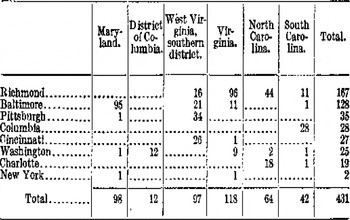
To build the dependent variable, we exploit the RBOC's aggregation of the survey results by each state's (or subregion of each state's) bankers. For example, as shown in Figure 2, Maryland's bankers cast ninety-five first-choice votes for Baltimore, one for Pittsburgh, one for Washington, and one for New York. We treat each state banker–city dyad as a different observation, so that the Maryland bankers contribute four observations (Maryland–Baltimore, Maryland–Pittsburgh, Maryland–Washington, and Maryland–New York); the data include a total of 229 state-city dyad observations. We code the dependent variable “1” if the bankers' recommended city in the dyad secured a reserve bank, “0” if otherwise.Footnote 41 The RBOC reported state banker preferences by the Federal Reserve district to which they were ultimately assigned. Thus, we use conditional logit to model the RBOC's choice of a reserve bank city from among the bankers' preferred cities within each reserve district, estimating the impact of state and city characteristics on the RBOC's calculus.Footnote 42 We include the following independent variables:
Excerpt from Poll of National Banks, Aggregated by Federal Reserve District (1914). Source: Reserve Bank Organization Committee, “Location of Reserve Districts in the United States,” Letter from the Reserve Bank Organization Committee Transmitting the Briefs and Arguments to the Organization Committee of the Federal Reserve Board Relative to the Location of the Federal Reserve Districts (1914), 349–50 http://fraser.stlouisfed.org/publication/?pid=606 (accessed January 15, 2013).

Financial strength: We include the number of national banks in each preferred city (as reported in the 1913 Annual Report of the Comptroller of the Currency) as a measure of the financial strength of the city.Footnote 43 The number of banks correlates highly with both city population and the volume of check clearings in each city.Footnote 44 Given the distribution of the data, we take the log of each city's number of banks.
South, Midwest, West: We create three dummy variables to tap the regional location of the bankers' preferred city, with the Northeast region as the excluded category. If the RBOC sought to break up the historic concentration of capital along the eastern seaboard and if the committee used the bankers' views to guide their decisions, bankers' preferred cities in one or more regions should be more likely to receive a bank.
Progressive strength: To test whether the RBOC was more responsive to bankers who hailed from Progressive states especially supportive of the Federal Reserve Act, we include the Progressive strength measure described above.
Banker disagreement: As a control for the extent of banker consensus, we include a variable that captures divisions within each banking delegation over preferred cities. The measure divides the number of cities that received votes from each banker delegation by the proportion of delegation votes received by the most popular city. For example, Maryland's bankers split their votes across four cities, but gave 97 percent of their votes to Baltimore (scoring just over 4 on the metric of disagreement). In contrast, bankers from the southern portion of West Virginia also split their votes across four cities, but the most popular city garnered only 35 percent of the bankers' votes (scoring just over 11 on the metric). Across the twelve reserve districts, the measure of disagreement ranges from 1 (with Washington, D.C., giving all of its votes to itself) to over 32 (with eastern Tennessee bankers splitting their votes over ten cities, with the most preferred city garnering just over 30 percent of the votes). We expect that the more fractured the state banking community, the less likely one of its preferred cities will be selected.
RESULTS AND DISCUSSION
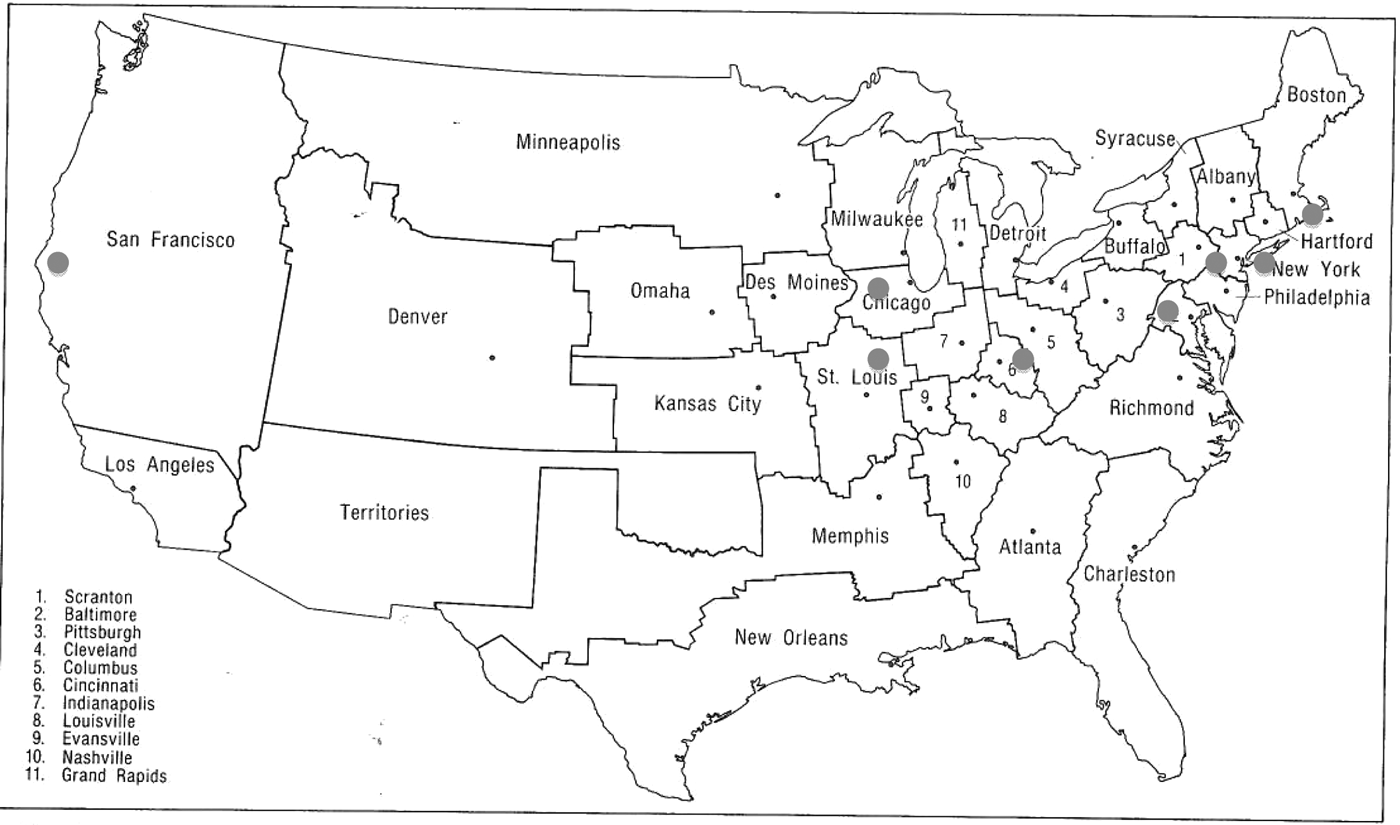
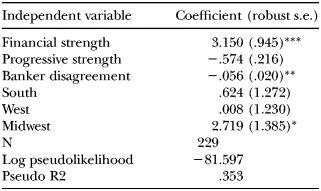
The counterfactual financial map appears in Figure 3. Given that the financial community preferred the least number of reserve banks possible, we assume that the counterfactual system should include eight reserve banks in the country's most active financial hubs (marked in gray). The actual Federal Reserve System map and the counterfactual map have six cities in common: New York (ranked first), Chicago (second), Philadelphia (third), St. Louis (fourth), Boston (fifth), and San Francisco (seventh). In placing the next five reserve banks in Cleveland (ninth), Minneapolis (fifteenth), Kansas City (eighteenth), Richmond (twenty-fourth), and Atlanta (twenty-seventh), the RBOC skipped over sixteen higher ranked cities—including Baltimore (sixth) and Cincinnati (eighth). The twelfth and final reserve bank was given to Dallas, which was too sleepy to qualify as one of the top fifty trade area urban centers in 1900. Taken at face value, it seems that the RBOC placed the reserve banks in only some of the top financial cities, exploiting its discretion to spread the reserve system beyond the major commercial areas of the period.
Counterfactual Financial Map.
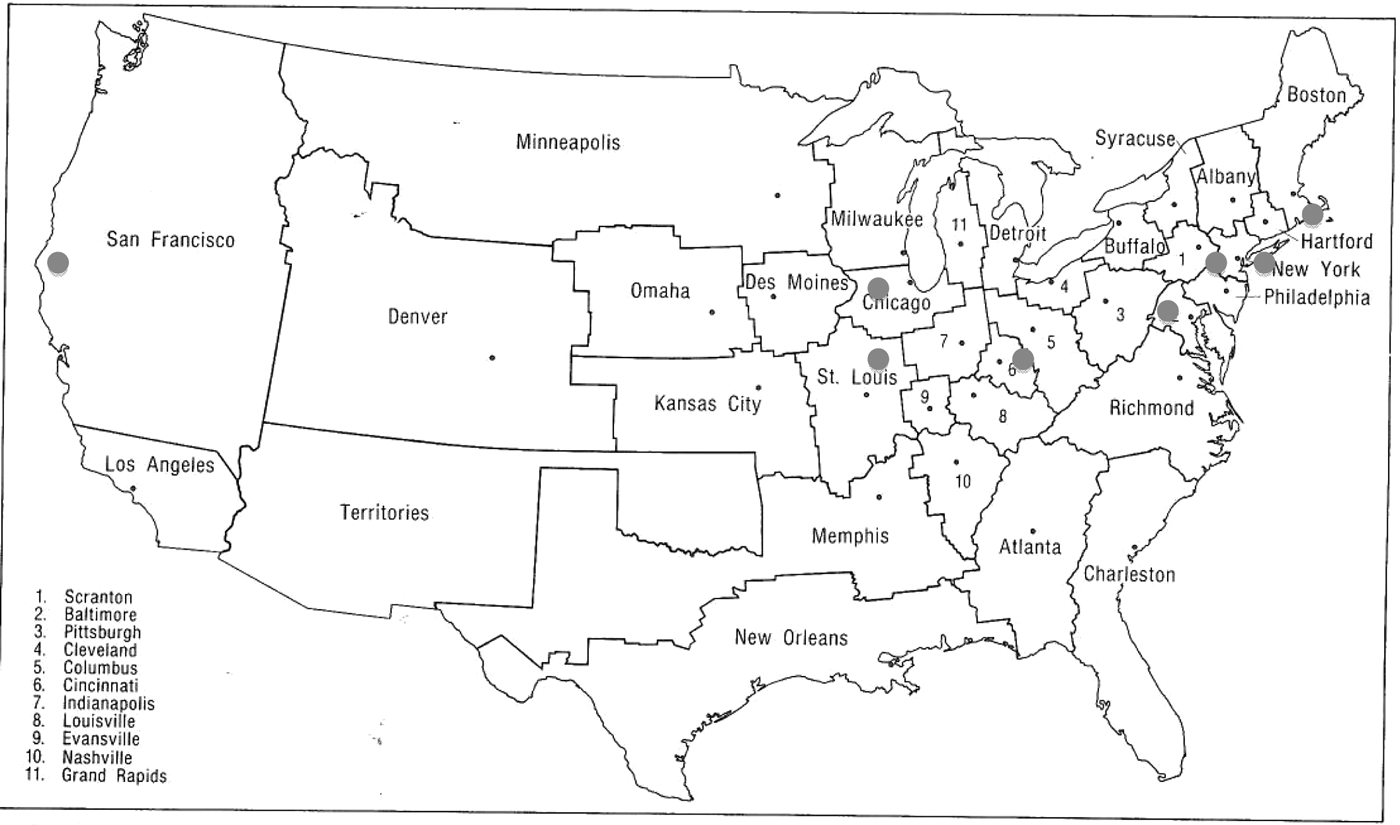
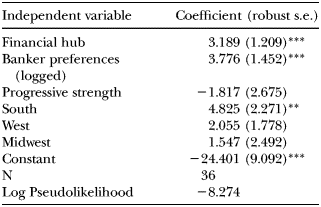
Given thirty-seven applicant cities, what broader set of factors shaped the RBOC's map? Table 1 reports the results for our first model of the RBOC's decision making. The overall fit of the model is good; we can reject the hypothesis that the coefficients jointly equal 0. First, we confirm that trade area centers were more likely to receive reserve banks than noncenter cities. Second, the greater the appeal of a city to the nation's bankers, the greater the probability that the RBOC would place a reserve bank in that city. Collectively, these two variables capture the overlap between the financial counterfactual map and the final reserve system map. The RBOC approached its job by locating reserve banks in the most prominent financial hubs at the time.
Cities' Likelihood of Securing a Reserve Bank
Notes: The dependent variable measures whether or not the RBOC placed a reserve bank in an applicant city (1 = yes, 0 = otherwise). Independent variable coefficients are logit estimates (robust standard errors in parentheses) calculated in Stata 11.2.
***p < .01, **p < .05 (1-tailed). N = 36. Because Washington, D.C., is unrepresented in Congress, we cannot calculate the level of Progressive support for the Federal Reserve in the District.
The results also support the political model. After controlling for a city's popularity with bankers and its financial status, cities in the South had a greater chance of being selected to host a reserve bank than cities in the Northeast. Applicant cities in the Midwest and West, however, were no more likely to be selected than a northeastern city. (Nor were cities in supportive Progressive states more likely to receive a reserve bank than other cities; if anything they were especially unlikely to receive a bank.) Taken at face value, these findings suggest that the RBOC sought to make up for the deficit of credit in the South, and thus sought out southern locations when looking to extend the reserve system beyond the nation's financial centers in the East. In doing so, of course, the RBOC also placed a coveted financial resource in the heart of the Democratic South. Given the correlation between region and party, we cannot distinguish between these two potential RBOC motives. Still, the results suggest that the RBOC looked beyond financial facts and banker preferences in locating the banks in the new reserve system.
Archival evidence supports the notion that the RBOC sought to dilute the importance of the New York district. For example, Paul Warburg, the Republican banker behind Senator Nelson Aldrich's (R-RI) proposal for a centralized and privately controlled reserve system, certainly understood the RBOC's intentions. Writing in his memoirs in 1930, Warburg recalled that “no plan should be considered which . . . might increase the power of New York.”Footnote 45 Or, as the New York Times noted, the challenge facing the RBOC after the RBOC's first day of hearings in New York City was that “it quickly developed that the committee had a difficult task on its hands and that it probably would be impossible to satisfy both New York and the rest of the country.”Footnote 46 Creation of the Richmond district is also suggestive that the RBOC sought to push the weight of the reserve system away from the Northeast and Mid-Atlantic. Addressing complaints about the Richmond reserve bank after the map was finalized, the RBOC noted that the Carolinas had objected to being assigned to either a southern or western reserve bank: “They said that their course of trade was northeast.” But the RBOC reasoned that “It seemed undesirable to place a bank in the extreme northeastern corner or at Baltimore, not only because of its proximity to Philadelphia, but also because the industrial and banking relations of the greater part of the district were more intimate with Richmond than with either Washington or Baltimore.”Footnote 47 Pushing reserve banks off and beyond the eastern seaboard seems to have been a paramount goal of the RBOC.
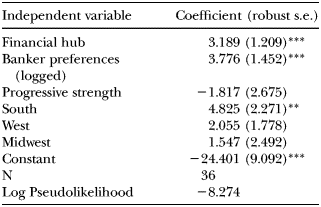
We build on these results in Table 2, exploring how the RBOC responded to the reserve bank city choices revealed in the banker survey. Again, the overall fit of the model is good, and we safely reject the hypothesis that the coefficients are jointly equal to 0. Our findings lend additional support for the impact of financial forces on the RBOC's choices. First, the financial strength of a banking community's most favored city mattered within each district, significantly increasing the odds that the city would be selected from among the cities proffered in the banker survey. Consensus within each state also mattered, as the greater the disagreement within each state banking community about the best site for a reserve bank, the less likely the RBOC was to locate a reserve bank in one of the preferred cities.
RBOC Response to the Banker Survey
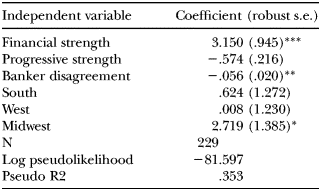
Notes: The dependent variable captures whether or not the RBOC placed a reserve bank in a city recommended by state-based groups of bankers. Coefficients are conditional logit estimates (robust standard errors in parentheses) grouped by reserve district and calculated in Stata 11.2. Details in text.
***p < .001, **p < .01, *p < .05.
The results also provide some support for the political model. Even after controlling for the financial strength of the bankers' preferred cities, recommended cities in every region were not equally likely to secure a reserve bank. We find some limited evidence that the RBOC looked more favorably on bankers preferring midwestern cities over locations in the Northeast. The data however reveal that outside of the three northeastern districts, only the Cleveland district had sizeable numbers of bankers preferring East Coast locations for their reserve bank. Indeed, when we drop the banker delegations located in the Cleveland district from the model, the parameter estimate for the Midwest dummy variable is no longer significant. In contrast, when reviewing banker preferences from the Cleveland district, the RBOC disproportionately heeded the views of bankers who designated a midwestern city for their preferred reserve bank location (producing the significant coefficient for the midwestern dummy); midwestern bankers desiring to venture east were unlikely to see a reserve bank in their preferred city.
The results in Tables 1 and 2 are noteworthy because they suggest the RBOC looked beyond financial activity in locating the reserve banks. They did so in two ways. First, we know from Table 1 that southern cities were disproportionately likely to secure a reserve bank compared to cities in the Northeast—even after controlling for economic activity in the cities. Second, we know from Table 2 that the RBOC kept the regional shape of the reserve map in mind when considering the preferences of the bankers who lived on the eastern edge of the Cleveland district. The RBOC deliberately moved beyond financial resources in designing the regional reach of the reserve system.
The RBOC could have ignored the banker survey and located the reserve banks solely on the basis of cities' financial activity. In fact, they designed the reserve system map with an eye to placing the reserve banks in the cities where bankers wanted them. Just as the RBOC might have wanted to secure Southern Democrats' support for the new reserve system, they might also have sought to build support for the newborn Fed amongst the nation's bankers far from Wall Street. Creating a reserve system that followed the outlines largely—though not entirely—recommended by banking communities would have been an efficient way to do so.
The results also help us to explain the decision to place two reserve banks in Missouri. Willis argued that St. Louis was bound to receive a bank, given its long-time status as a central reserve city. How to serve the region to the west of St. Louis was a thorny problem. Willis suggests that the choice came down to Omaha, Lincoln, Denver, or Kansas City. None of these cities were especially Democratic, but Kansas City stood out on a key dimension: Financial activity and popularity with the bankers. It far outstripped its rivals in terms of financial business, and bankers preferred it overwhelmingly—even compared to St. Louis. As RBOC member Houston noted in his memoirs, “I got a good many surprises. There was little enthusiasm for St. Louis anywhere.”Footnote 48 If we count votes only from those bankers in the states and regions ultimately assigned to the Kansas City district, Kansas City's popularity is even more pronounced. Just under half of these bankers named Kansas City as their first choice; its closest competitor was Omaha, garnering a quarter of the bankers' votes.
Although some charged at the time that Missouri received two banks because the Democratic Speaker of the House, Champ Clark, hailed from Missouri and because Houston had served as president of Washington University in St. Louis, we suspect that partisan connections at best smoothed the way for selecting two Missouri cities. In this case, the choice more likely reflected the region's political economy (with Kansas City looking westward and St. Louis to the east) and the desire to curry support of the most active banking communities (given St. Louis's status as a major financial center).
The results also provide some perspective on the RBOC's decision to place a bank in Richmond, passing over Baltimore. Financial business in Baltimore was nearly twice that in Richmond. And bankers barely preferred Richmond over Baltimore. So why did the RBOC place a reserve bank in Richmond? If the RBOC wanted to dilute the historic concentration of capital in the Northeast, selecting Richmond over Baltimore would have been a reasonable choice. Drawing a single reserve district to encompass Baltimore, Washington, and Richmond and placing the reserve bank in Richmond would have allowed the RBOC to push the center of financial activity beyond the northeastern seaboard and into the South. Of course, it is also possible that Richmond won out over Baltimore because Virginia was a more reliably Democratic state than Maryland: Wilson ran nearly twenty points better in Virginia in 1912 than in Maryland. Factor in the Virginia roots of Treasury Secretary McAdoo, Representative Glass, and Wilson himself, and it seems plausible that the RBOC also selected Richmond to reward a loyal Democratic city and state. McAvoy concludes that the RBOC “likely maximized social welfare rather than its own.”Footnote 49 Even if we cannot know for sure whether regional diversity or partisan advantage motivated the RBOC, both accounts suggest that the selection of Richmond furthered the RBOC's agenda of looking beyond financial and economic factors in locating the reserve banks.Footnote 50
With twelve banks to dispense, the RBOC managed both to place reserve banks in financially active cities and to create new financial centers in places historically deprived of reliable access to credit. In that light, we should not be surprised that the RBOC refused to entertain any changes in their decisions, despite strong protest from Baltimore, New Orleans, Denver, Pittsburgh, and other cities. Re-opening the RBOC's decision would have unraveled the committee's carefully knit plan. To be sure, the RBOC was aided by partisan geography. If the RBOC sought regional balance in locating the reserve banks, southern reserve banks would be placed in Democratic hands. Still, concerns about regional balance were insufficient to secure a reserve bank in the vast and typically Republican expanse between Kansas City and San Francisco. Finally, given Democrats' interests in constraining the size of the New York district, the RBOC inevitably had to reward cities in the predominately Republican Northeast (but not it seems in Progressive strongholds in the West or Midwest). Political geography helped to facilitate the RBOC's twin focus on financial and political priorities.
CONCLUSION
The matter of locating regional banks is not primarily, nor even principally, a political question. Every governmental faculty, however, has a political element and every governmental agency a political phase. No system of banking will long succeed that does violence to a great fraction of the wishes of the people of this country. Such political considerations as affect this feature of the problem are therefore of an entirely proper character for consideration by this committee.Footnote 51
These observations by the Dallas contingent seeking a reserve bank capture the political nature of the RBOC's charge. The Federal Reserve Act was at its heart a Democrats' law, passed over the objections of many Progressive and Republican colleagues. As such, the three Democratic politicians on the RBOC had the capacity and incentive to build a reserve bank system that was both financially viable and politically sustainable. The archival record supports such an interpretation of the RBOC's handiwork: The RBOC prioritized economic rationality tempered by a concern for regional dispersion. By looking beyond the financial claims of the cities desiring to host the new reserve banks, the RBOC exploited its unchallenged power to ensure that the reserve system would secure Democrats' goal of breaking up the Northeast's monopoly on the levers of credit. Top financial hubs, but not all of them, received a reserve bank. So too did some underdeveloped cities located in traditionally Democratic areas. Moreover, in considering the views of surveyed bankers, we find some evidence that the RBOC considered both the financial strength of the cities recommended by bankers as well as the cities' regional location.
The outcome of the RBOC's deliberations was a decentralized and regionally diverse reserve system. Ironically, it was the Fed's decentralized authority and structure that was partially to blame for the duration and severity of the Great Depression less than two decades later. As Friedman and Schwartz characterized the early years of the Federal Reserve, there was “so much confusion about purpose and power, and so erratic an exercise of power.”Footnote 52 And when disagreements in 1929 surfaced between the reserve banks and the Federal Reserve Board in Washington over how to rein in excessive market speculation, the dispute “paralyzed” monetary policy.Footnote 53 A decentralized Fed, Friedman and Schwartz concluded, “left a heritage of divided counsel and internal conflict for the years of trial that followed.”Footnote 54 Remarkably, the signature achievement of the RBOC proved incapable of generating effective monetary policy in the run up to the economic havoc of the 1930s.