The 2016 U.S. presidential election pitted the first-ever major-party female nominee against the first-ever male nominee to have been caught on tape admitting to sexual assault. Given the salience of gender in this matchup, one might expect most accounts of the election to focus considerable attention on how citizens’ beliefs and attitudes about gender influenced their candidate preferences. Yet this expectation has not been borne out. Most popular accounts of the 2016 election focused their analyses on other themes, such as authoritarianism (Taub Reference Taub2016), immigration preferences (Stevenson Reference Stevenson2016), and economic considerations (Kolko Reference Kolko2016), to explain support for the presidential candidates. Some election commentators even alleged that gender was irrelevant to the presidential race (Thompson Reference Thompson2016). Scholarly examinations of the 2016 presidential election have also tended to emphasize themes other than gender, such as class and racial attitudes (Bobo Reference Bobo2017; Carnes and Lupu Reference Carnes and Lupu2021; Sides, Tesler, and Vavreck Reference Sides, Tesler and Vavreck2018; Tolbert, Redlawsk, and Gracey Reference Tolbert, Redlawsk and Gracey2018). Some survey evidence suggests there is something to the idea that gender was not a decisive factor in 2016. For years, the vast majority of Americans have said they would be willing to vote for a female for president (McCarthy Reference McCarthy2019; Neidig Reference Neidig2016), and, on average, when women run for political office, they are as likely to win as men (Anastasopoulos Reference Anastasopoulos2016; Lawless Reference Lawless, Scott and Kosslyn2015).
That said, other evidence points toward gender playing a more significant role in elections, especially in 2016. Anecdotal evidence suggests that Hillary Clinton faced an unusual degree of hostility—often explicitly gendered—throughout her presidential runs. At events in 2008, citizens opposed to Clinton held signs with sexist statements, such as “Iron My Shirt” (McThomas and Tesler Reference McThomas and Tesler2016). In the 2016 primaries, there were accounts of antagonistic Twitter activity by so-called Bernie Bros (Heldman, Conroy, and Ackerman Reference Heldman, Conroy and Ackerman2018). At Donald Trump's campaign rallies, many wore offensive T-shirts (e.g., “Trump that bitch!”), and reporters described a “palpable hatred of Clinton in the air” (Johnson Reference Johnson2016). A growing number of high-quality studies conducted in recent years suggest that these anecdotes may symbolize consequential patterns in public opinion. For example, Krupnikov, Piston, and Bauer (Reference Krupnikov, Piston and Bauer2016) find that self-reported measures of support for female presidential candidates are inflated because of the inclination to provide socially acceptable answers. A number of researchers examining the 2016 general election have found that gender attitudes, particularly hostile sexism, affected electoral preferences in the way one would expect—with sexist attitudes correlating with support for the male candidate (Trump) over the female one (Clinton) (Cassese and Barnes Reference Cassese and Barnes2019; Ratliff et al. Reference Ratliff, Redford, Conway and Smith2017; Schaffner and Clark Reference Schaffner and Clark2017; Sides, Tesler, and Vavreck Reference Sides, Tesler, Vavreck, Patashnik and Schiller2020; Valentino, Wayne, and Oceno Reference Valentino, Wayne and Oceno2018). Several of these studies also present evidence that gender attitudes mattered more in 2016 than in prior elections, likely because of Clinton's presence in the race.
We join these authors in arguing that gender attitudes mattered a great deal in 2016. However, we also argue that prior accounts overlook some important complexities in the relationship between gender attitudes and candidate support. Whether those with more sexist or traditional gender attitudes support or oppose a candidate depends not only on the candidate's sex but also on the candidate's attitudes toward women and gender roles and perception of sexism as a problem in society. Thus, male candidates who champion women's rights may win the support of gender egalitarians (even over female political rivals), and female candidates who celebrate traditional women's roles may win the support of gender traditionalists. Furthermore, not all gender attitudes press in the same direction—a candidate with nuanced views on women's issues may draw some feminists’ support but turn off others.
To help make this argument, we employ a unique research design. One of the reasons it has been difficult to understand the real-world electoral effects of candidate sex and candidates’ gender-linked attitudes and behaviors is that general elections feature only two (main) candidates, limiting the ability to pinpoint which candidate attributes drove voters’ reactions. Most obviously, many races will have no variation across sex, with two men—or, occasionally, two women—competing. Where there is variation across sex, any analysis of the impact of citizens’ relative feminism or sexism on their candidate preferences cannot disentangle the import of candidate sex from correlated candidate characteristics. To take a common example, imagine a feminist woman running against a more traditional man. If we find that citizens with old-fashioned views about women's roles tend to prefer the male candidate, is it because of his (and his opponent's) sex, or because he voiced old-fashioned views about women (and his opponent did not)? To gain leverage on this type of question, scholars often employ an experiment (for a helpful example, see Ono and Burden Reference Ono and Burden2019), randomly varying the attributes of male and female candidates. While useful, true experiments—which tend to present study participants with fictional candidates—lack a degree of external validity.
Our study utilizes survey data to uncover the links between citizens’ attitudes about gender and their candidate preferences; however, we draw inspiration from experiments by not only focusing on real-world electoral matchups but also exploring several electoral counterfactuals: what if Clinton and Trump had faced a different set of candidates in the primary or general election? Would patterns of support in the public have been different? During the final stretch of the 2016 primary, we asked a sample of U.S. citizens how they felt about the leading candidates: Clinton and Bernie Sanders in the Democratic Party, and Trump, Ted Cruz, and John Kasich in the Republican Party. To increase our analytical leverage on the Democratic side, we also asked participants for their feelings about President Barack Obama. In our analyses, we probe the sources of citizens’ preferences in real election matchups (e.g., Clinton versus Sanders, Clinton versus Trump), contrasting those with hypothetical matchups (e.g., Clinton versus Obama, Sanders versus Trump).
Our study design expands beyond prior studies of gender attitudes in one additional way. While the number of investigations into gender attitudes and political preferences has increased substantially in recent years, most scholars measure just one or two types of gender attitudes—the most common types being hostile sexism and modern sexism (e.g., Cassese and Barnes Reference Cassese and Barnes2019; Schaffner and Clark Reference Schaffner and Clark2017; Valentino, Wayne, and Oceno Reference Valentino, Wayne and Oceno2018). In our study, we measured three types of gender attitudes among survey respondents: hostile sexism, modern sexism, and traditional gender roles. Each captures a potentially powerful factor underlying political preferences—resentment toward women, denial that sexism is a problem in society, and, finally, the belief that women are best suited to be homemakers.
This design gives us a fuller understanding of how citizens think about gender and connect those views to their electoral preferences. However, this exercise is not only theoretical. Drawing on our data, we are also able to suggest answers to specific questions about the 2016 elections—particularly the primaries—that continue to confound researchers. Were the Bernie Bros emblematic of a larger trend in which sexist Democrats supported Sanders over Clinton? Among Republicans, did such attitudes lead to greater support for Trump over his less misogynistic rivals for the nomination? Finally, did individuals with sexist or more traditional views of gender roles vote for Trump in November because he was the only man in the race, because he represented traditional masculinity and misogyny, or both?
To preview our results, first, similar to prior research on the general election, we found that anti-feminist attitudes uniformly correlated with a preference for Trump over Clinton. Yet, when we compare preferences for Trump versus Sanders, anti-feminist attitudes were also associated with a preference for Trump over Sanders (with some caveats), suggesting that the pattern may have more to do with candidate character than candidate sex. Second, in the Democratic primary, some of our results support the conventional wisdom, while others undermine it: those high in “hostile sexism” did in fact prefer Sanders over Clinton (a pattern that disappeared when we compare Obama to Clinton); however, we also find that Democrats committed to traditional gender roles consistently preferred Clinton over Sanders and Obama. Third, in the Republican primary, we find that anti-feminist attitudes—particularly support for traditional gender roles—were associated with a preference for Trump over his rivals, although the strength of this relationship is weaker than conventional wisdom might lead us to expect. In short, participants’ gender attitudes mattered a great deal in 2016, but they were not linked in a simplistic way to candidate sex.
THEORETICAL FRAMEWORK
We argue that the effects of gender in the 2016 presidential election did not hinge only on the fact that a woman was competing against men or that female and male voters tend to vote along gender lines. In this election, and likely in others, citizens’ gender-relevant attitudes, in conjunction with candidates’ views and attributes, help explain voters’ candidate preferences. In other words, it is not simply that the public was biased against Clinton because she was a woman or that women tended to prefer Clinton and men Trump (or Sanders). Rather, citizens and candidates—both men and women—hold a wide variety of attitudes about gender that interact in complex ways to shape electoral preferences and outcomes.
Campaign strategists and many election observers, however, often appear to think more simplistically. For example, Sarah Palin's sex was a rationale behind John McCain's choice of her as a running mate (Heilemann and Halperin Reference Heilemann and Halperin2010). Many election analysts assumed that in 2008, the candidacies of both Clinton and Palin were bolstered by female voters’ identification as women (Sharrow et al. Reference Sharrow, Strolovitch, Heaney, Masket and Miller2016). It would be understandable, then, for Clinton to draw attention to her identity as a female candidate and emphasize the prospect of breaking the glass ceiling as a presidential candidate. In 2016, the Clinton campaign clearly did so. Her main campaign slogan was “I'm with her.” One of her catchphrases was “If that's playing the ‘woman card,’ then deal me in!” (Sides Reference Sides2016).
Of course, until relatively recently, party elites have shied away from recruiting female candidates for fear of the possibility that, on average, the electorate is biased against them (Crowder-Meyer Reference Crowder-Meyer2013; Lawless and Fox Reference Lawless and Fox2010). There is truth to the idea that female candidates, even today, face some bias when running for office (Miller and Peake Reference Miller and Peake2013; Mo Reference Mo2015), although some scholars disagree (Dolan Reference Dolan2014; Hayes and Lawless Reference Hayes and Lawless2016). According to the stereotype content model, stereotypes about the traits “competence” and “warmth” are often negatively correlated—that is, people who are perceived as more competent are viewed as less personally warm, and vice versa (Fiske et al. Reference Fiske, Cuddy, Glick and Xu2002). Women's perceived warmth thus tends to weigh against their perceived competence. Dominant behaviors by women can also decrease their likability and hireability (Rudman and Glick Reference Rudman and Glick2001; Williams and Tiedens Reference Williams and Tiedens2016). This is particularly significant for women candidates. Being viewed as competent is a universal prerequisite for leadership roles, and stereotypes of leaders are overwhelmingly masculine and agentic (Koenig et al. Reference Koenig, Eagly, Mitchell and Ristikari2011; Rudman and Glick Reference Rudman and Glick2001), particularly with respect to the presidency (Rosenwasser and Seale Reference Rosenwasser and Seale1988). This “double bind” can create barriers to women's advancement (Jamieson Reference Jamieson1997). This is likely why, eight years before her final presidential run, Clinton's 2008 campaign generally steered clear of women-centric appeals and emphasized her masculine traits (Lawrence and Rose Reference Lawrence and Rose2010).
Yet, increasingly, research suggests that same-gender voting preferences and on-average bias against female candidates are negligible, at least in recent years. While racial identities are often associated with a strong sense of linked fate, gender appears to play a more circumscribed role (Gay, Hochschild, and White Reference Gay, Jennifer L and White2014; Stout, Kretschmer, and Ruppanner Reference Stout, Kretschmer and Ruppanner2017). A majority of white women in the electorate supported Trump over Clinton, following long-term trends of white women supporting the Republican presidential candidate (Cassese and Barnes Reference Cassese and Barnes2019; Junn Reference Junn2017). The gender gap in voters’ preferences was only 3 points larger in 2016 than it was in 2012 (Burden, Crawford, and Decrescenzo Reference Burden, Crawford and Decrescenzo2016). Further, in the Democratic primaries, although more women supported Clinton than Sanders, candidate choice correlated more with voters’ age than with their sex (Zeller Reference Zeller2016). Finally, recent experimental studies suggest that bias against female candidates, including that associated with the “double bind,” has diminished considerably. For example, Bauer (Reference Bauer2017) has demonstrated that female candidates who express more masculine characteristics are in fact advantaged, facing little backlash.
GENDER ATTITUDES
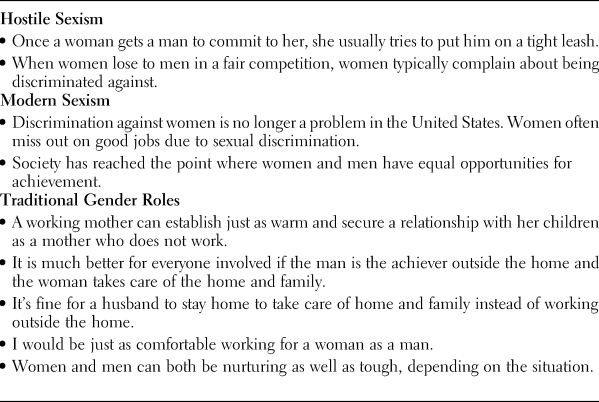
Scholars will likely continue to debate the effects of candidate, and voter, sex on electoral preferences. However, we argue that various attitudes about sex and gender—held by both men and women voters—are even more relevant to elections. This emphasis on gender attitudes has a parallel in the study of racial politics, where political scientists are well accustomed to investigating the implications of varying racial attitudes within racial groups (e.g., Kinder and Sanders Reference Kinder and Sanders1996). In recent years, this approach has become more popular in the study of gender and elections (Bracic, Israel-Trummel, and Shortle Reference Bracic, Israel-Trummel and Shortle2019; Cassese and Barnes Reference Cassese and Barnes2019; Glick Reference Glick2019; Godbole, Malvar, and Valian Reference Godbole, Malvar and Valian2019; McThomas and Tesler Reference McThomas and Tesler2016; Mo Reference Mo2015; Sanbonmatsu Reference Sanbonmatsu2002; Schaffner and Clark Reference Schaffner and Clark2017; Simas and Bumgardner Reference Simas and Bumgardner2017; Valentino, Wayne, and Oceno Reference Valentino, Wayne and Oceno2018). Our study builds on and extends this work by measuring a larger set of gender attitudes (see Table 1), investigating the primary stage, and using multiple candidate matchups to investigate whether gender attitudes are associated with support for likeminded candidates.
Gender attitude measures

Respondents were asked to indicate the extent to which they agreed or disagreed with each statement, choosing from the set: agree strongly, agree, agree slightly, disagree slightly, disagree, or disagree strongly.
The first attitude we investigate, hostile sexism, is rooted in Glick and Fiske's (Reference Glick and Fiske1996) conceptualization. The key components of hostile sexism are that women are inferior to men and that women attempt to control men (Glick and Fiske Reference Glick and Fiske2001). Recent publications have demonstrated that hostile sexism was strongly correlated with a preference for Trump over Clinton in 2016 (Cassese and Barnes Reference Cassese and Barnes2019; Glick Reference Glick2019; Schaffner and Clark Reference Schaffner and Clark2017; Valentino, Wayne, and Oceno Reference Valentino, Wayne and Oceno2018). While hostile sexism is explicitly negative, other types of gender attitudes are less negative.
The second type of attitude we measure is belief in traditional gender roles. This measure captures adherence to the idea that men and women occupy separate spheres and that women are naturally more suited to carrying out specific social roles, such as child-rearing. According to this view, women are kind and nurturing, although also less capable than men in the workplace (Burns and Kinder Reference Burns, Kinder and Berinsky2012). Glick and Fiske (Reference Glick and Fiske1996, 492) employ a similar concept, “benevolent sexism,” which includes “protective attitudes toward women, a reverence for the role of women as wives and mothers, and an idealization of women as romantic love objects.” While some studies show that women hold less hostile sexist attitudes than men on average, they are just as likely to subscribe to notions of traditional gender roles and endorse benevolent sexist attitudes (Glick and Fiske Reference Glick and Fiske2001). Interestingly, benevolent sexism has been modestly associated with support for Clinton over Trump in some studies (Cassese and Holman Reference Cassese and Holman2019; Glick Reference Glick2019).
The third type of gender attitude we examine is modern sexism. This is the belief that women are not disadvantaged in society by current institutions and culture. It includes a denial of discrimination against women and is correlated with a lack of support for policies designed to assist in women's equality. Similar to racial resentment, measures of modern sexism seek to capture how attitudes now viewed as socially unacceptable are translated into more socially acceptable beliefs about groups and society (Swim et al. Reference Swim, Aikin, Hall and Hunter1995). Previous studies have linked modern sexism to weaker support for Clinton relative to Trump (Godbole, Malvar, and Valian Reference Godbole, Malvar and Valian2019; Valentino, Wayne, and Oceno Reference Valentino, Wayne and Oceno2018).
CANDIDATES AND GENDER
As we have argued, the specific effects of voters’ gender attitudes often hinge on candidate attributes and behaviors beyond just their sex. Winter (Reference Winter2000) argues that political figures, both men and women, can become gendered, sometimes in unintended ways. For example, Michael Dukakis took part in a widely panned campaign stunt in a tank that led to “unmanly” associations, and Margaret Thatcher was largely perceived as more masculine than feminine. Apart from whether a person is viewed as characteristic of their gender, candidates may also position themselves as feminists—as advocates for women's equality—or not, with consequential effects. Consider a survey of the 2008 delegates to the Republican National Convention about their evaluations of Sarah Palin conducted by Sharrow et al. (Reference Sharrow, Strolovitch, Heaney, Masket and Miller2016). The party activists’ perceptions of the candidates were tied to the activists’ own views about appropriate gender roles in interaction with the candidates’ attributes. Among Republican convention attendees, more conservative or traditional gender attitudes predicted greater support for Palin, likely because Palin positioned herself in opposition to the women's movement (Sharrow et al. Reference Sharrow, Strolovitch, Heaney, Masket and Miller2016).
Along similar lines, we argue that the effects of gender attitudes in the 2016 primary and general elections depended on voters’ gender-relevant perceptions of Clinton, Sanders, Kasich, Cruz, and Trump. Were the candidates favorable to women's rights? Respectful toward women? Invested in progressive or traditional gender roles? Next, we discuss each candidate in turn.
Hillary Clinton's campaign conveyed several gender-related themes simultaneously: feminism, competence, as well as adherence to many traditional gender norms. Clinton's campaign portrayed her as tough and experienced (Lee and Lim Reference Lee and Lim2016) and, as discussed earlier, unabashedly focused on the importance of women's advancement and equality (Marcotte Reference Marcotte2015). Yet the campaign also tried to convey that its candidate could be more stereotypically female—feminine and empathetic (Corasaniti Reference Corasaniti2016). Of course, many voters also remembered her from her days as first lady, when she championed health care and child development (issues associated more with female than male leaders) and famously “stood by her man” after his affair, a move interpreted by the public as pro–family values (Winter Reference Winter2000). More generally, Clinton was a cautious, conventional presidential candidate. On the campaign trail, she often talked about her Christian faith, reading the Bible, and being a Methodist (Chozick Reference Chozick2016).
Bernie Sanders likewise portrayed himself as a feminist—even an “honorary woman” (Phillip Reference Phillip2016)—and his progressive policies with respect to women and gender mirrored these self-attributions. In these ways, he was aligned with Clinton. However, Sanders differed in other ways. As a democratic socialist, Sanders was an unconventional candidate oriented toward radical, systemic change (Azevedo, Jost, and Rothmund Reference Azevedo, Jost and Rothmund2017). On the campaign trail, Sanders could be combative and often took aim at Clinton in an aggressive way (Healy, Alcindor, and Peters Reference Healy, Alcindor and Peters2016).
Of course, the Republican candidates held more conservative views on sex and gender. However, Donald Trump was uniquely anti-feminist. He was hostile and hypermasculine and often used discriminatory language (Dittmar Reference Dittmar2016; Heldman, Conroy, and Ackerman Reference Heldman, Conroy and Ackerman2018). He used sexist language to denigrate both his male and female opponents—for example, insulting the appearance of Carly Fiorina and repeating an audience member who called Ted Cruz a “pussy” (Heldman, Conroy, and Ackerman Reference Heldman, Conroy and Ackerman2018). Trump's policy positions were in some cases at the fringe of acceptability in U.S. politics. For example, at one point, Trump argued that women who sought abortions should be punished, something not even the strongest pro-life politicians have promoted (Flegenheimer and Haberman Reference Flegenheimer and Haberman2016). Complicating matters, the socially conservative views that Trump expressed during the campaign did not reflect his past opinions (e.g., being pro-choice) or behaviors (e.g., multiple marriages and affairs).
By contrast, Trump's opponents were more norm abiding and rejected Trump's hostility toward women. During the campaign, Ted Cruz showed positive affect toward his wife and daughters and said that he would ask Fiorina to be his running mate if he won the nomination. Seeking to win over Republican women, Cruz's wife and daughter campaigned on his behalf, with Cruz commenting that he had been “blessed my whole life to be surrounded by strong women” (Glueck Reference Glueck2016). John Kasich struck a similar tone but went even further by sharply criticizing Trump's explicit sexism throughout the campaign (Gass and Collins Reference Gass and Collins2016; Strauss Reference Strauss2015).
This said, both Cruz and Kasich could not be mistaken for social progressives. As the most traditionally socially conservative candidate of the leading Republican contenders, Cruz was an early favorite of evangelical Christians (Martínez and Smith Reference Martínez and Smith2016). He espoused a commitment to traditional views of gender by opposing gender-neutral bathrooms as well as women serving in combat (Schleifer Reference Schleifer2016). Cruz was avowedly anti-abortion, even in cases of rape or incest (Chapin Reference Chapin2015). While Kasich did not focus on abortion in his campaign, as governor of Ohio, he emphasized his Christianity (King Reference King2013) and signed into law many restrictive abortion measures, receiving high marks from pro-life groups (Haberkorn Reference Haberkorn2016).
In short, we observe major differences between Democrats and Republicans with respect to their views on gender and women's issues, but we see a more complex mix among within-party candidates. On paper, Clinton and Sanders were similar; however, her campaign was more traditional and his more aggressive. Likewise, in the main, the Republican candidates held similar conservative views on sex and gender issues; however, Trump was an outlier with his hypermasculine and offensive behavior on the campaign trail, and Cruz was distinct with respect to his socially conservative bona fides.
OUR STUDY
Our general argument is that voters’ gender attitudes are multifaceted and can lead to different outcomes depending not only on a given public official's sex but also her or his gender-relevant attributes and attitudes.
We examine several research questions about the influence of citizens’ gender attitudes on their candidate evaluations in the 2016 election, including the nomination contests. First, were Democrats who held relatively more traditional and/or sexist gender attitudes less likely, all else being equal, to support Clinton during the primary? Do the observed patterns appear to be a function of candidate sex or other characteristics of the candidates? Second, moving to the other side of the aisle: given Trump's embrace of traditional masculinity and disrespectful comments about women, were Republicans who held relatively more traditional and/or sexist gender attitudes more likely to support him during the primary than his opponents? Finally, regarding the general election, were traditional and sexist attitudes in the public uniformly predictive of supporting Trump over Clinton? If so, did this appear to hinge on candidate sex or the fact that Clinton is a feminist and Trump is not?
We conducted our survey—carried out by Qualtrics—near the end of the 2016 presidential primary elections. Only voting-age U.S. citizens were included in the sample. We directed the survey company to survey equal numbers of men and women. In addition, given our focus on the two parties’ primaries, we also requested equal numbers of Democrats and Republicans.Footnote 1 Ultimately, we received 1,002 responses and our quotas were met (49% women and 51% men; 43% Republicans and 44% Democrats, including partisan “leaners”).
Each partisan subsample was similar to the estimated composition of the national parties (see Table A1 in the appendix in the supplementary material online). In addition to gender and party identification, we measured self-reported race, ethnicity, age, education, and income. There were only small differences between our sample and the national population. Using a 2014 Pew Research Center survey as our benchmark, we employ inverse-probability weighting to improve the representativeness of our sample when necessary. Note that the survey weighting does not substantively change our results.
The timing and context of the survey are important for interpreting our findings. The survey was fielded in late April 2016; 40 states had held their primaries. On the Republican side, the field had been reduced to Trump, Cruz, and Kasich. Only Cruz held a realistic chance of catching Trump in the delegate count, but all three candidates were still actively campaigning. At the same time, the Democratic primary process remained competitive as two final candidates, Clinton and Sanders, campaigned. We view this timing as ideal for a nation-wide survey of the major candidates for the nomination because they would have been familiar to nearly all partisans, regardless of the timing of their particular state's caucus or primary.
To analyze the research questions, we estimated the association between the three distinct types of gender attitudes and relative feelings toward the presidential candidates. The key independent variables are our measures of gender attitudes: modern sexism (MS), hostile sexism (HS), and endorsement of traditional gender roles (TGR). The final modern sexism scale includes three questions (α = 0.71), hostile sexism includes two questions (α = 0.68), and traditional gender roles includes five questions (α = 0.65). The full list of items is given in Table 1. We used both exploratory and confirmatory factor analysis to ensure that scale items were methodologically valid as distinct measures (see Table A2 in the appendix). Each scale is formed by a simple sum of the key loading factors; each question contributes equally to the scale. Each question (and, thus, scale) was coded so that higher scores indicate more sexist (or traditional) attitudes. Note that the scales are moderately correlated with each other, with α ranging from 0.29 to 0.40 depending on which pair is compared.
The 2016 presidential election cycle consisted of three different competitive races—the Democratic primary, the Republican primary, and the general election. We assessed all respondents’ favorability toward six individuals: Hillary Clinton, Bernie Sanders, President Barack Obama, Donald Trump, Ted Cruz, and John Kasich. We gauge candidate support with the use of feeling thermometers. Feeling thermometer scores provide more detail than candidate rankings or a simple binary vote choice and are a reliable measure of voter preferences when the target is salient, as in presidential elections (Lupton and Jacoby Reference Lupton and Jacoby2017).Footnote 2 We then analyze the difference in feeling thermometer ratings for specific pairs of political figures. Given that electoral choices are ultimately comparative, this difference measure captures voters’ preferences better than the independent candidate ratings.
We use a battery of variables to control for political and demographic explanations of voters’ candidate evaluations. We include party identification and economic and social ideology. For demographics, we include measures of race and ethnicity, gender, income, age, education, and religiosity. Party and ideology variables are coded so that higher scores are more Democratic or liberal. Income, education, and religiosity are ordinal variables. Age is continuous, measured in years. Gender is an indicator variable with female coded as 1. In the models, race and ethnicity are represented by indicator variables for African American and Hispanic. Note that all variables are coded to be on the 0–1 range for comparison of effect size (see Tables A4 and A5 in the appendix for more detail).
The gender attitudes we measure are related to some of the demographic and political control variables but not others (see Table A6 in the appendix). There is no statistically significant relationship between our measures of gender attitudes and age or gender; however, the gender attitude measures are negatively correlated with education and positively associated with religiosity. While it is common to observe intercorrelations among variables in public opinion research, there is some concern that models that include many correlated independent variables could result in biased estimated effect sizes. Penalized regression models (LASSO) that we conducted—available in the appendix and discussed in the final section of the article—reassure that the gender attitude effects we report are important and robust.
Each gender attitude scale as well as the full set of controls are included in the models discussed in the Results section. For our analyses of primary election comparisons, we interact the three gender attitude scales with a binary party identification dummy variable (for a given party's primary, the indicator variable represents the opposition party). This allows us to isolate the effects of gender attitudes on each group of partisans’ candidate preferences separately, while also investigating whether patterns differed among those in the out-party.
We discuss two types of comparisons for each election. First, we estimate the effects of gender attitudes on respondents’ comparative evaluations of a pair of candidates. For example, we model the difference in feelings toward Clinton and Sanders as a function of hostile sexism, modern sexism, and traditional gender roles. Second, we compare gender attitude coefficients from one model to those of a related matchup. For example, we assess whether the effect of hostile sexism differs when Clinton is contrasted with Sanders compared to when she is contrasted with Obama. To clearly visualize our results, we plot the predicted value of the dependent variable (the difference between two feeling thermometers, such as feelings toward Clinton minus feelings toward Sanders) for the full range of observed gender attitudes, separating effects by party and holding other variables constant. For ease of interpretation, we rescale the feeling thermometer difference measure to the original range [–100, 100] in the figures.
Finally, note that the appendix shows alternative specifications for each model, such as limiting the number of control variables or controlling for additional possible confounds. These models provide an important robustness check of our main findings.
RESULTS
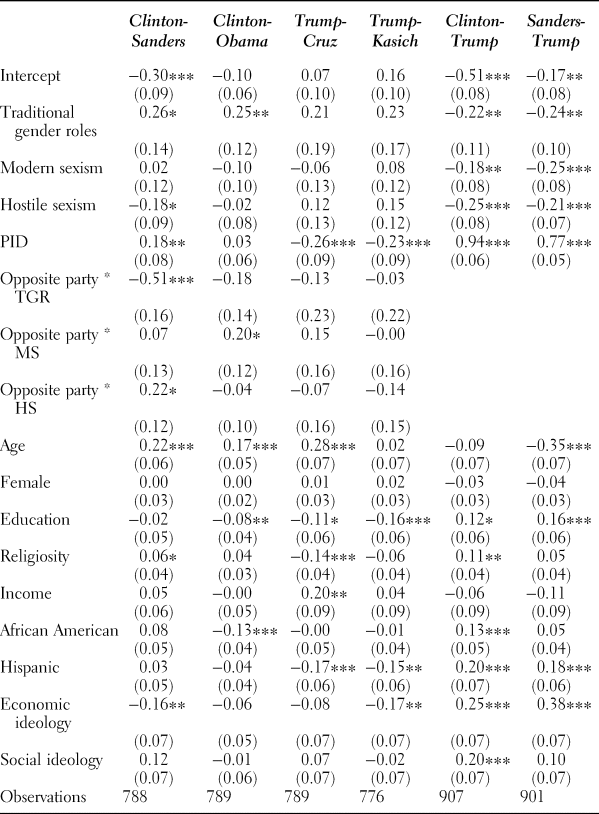
We first assess whether more sexist and traditional gender attitudes are associated with reduced support for Clinton compared to Sanders in the Democratic primary. These results are available in Table 2. We focus on Democratic identifiers for this comparison. Among Democrats, there are marginally significant effects of hostile sexism (b = –0.18, p = .06) and traditional gender roles (b = 0.26, p = .059) when comparing Clinton to Sanders. When respondents instead compare Clinton with Obama, the only significantly different gender attitude is traditional gender roles (b = 0.25, p = .045). Hostile sexism does not have a significant effect (b = –0.02, p > .1). Comparing the sets of coefficients between models with seemingly unrelated regression (SUR), only hostile sexism had a statistically significant different effect (X(1) = 4.74, p = .029).
Gender attitudes and candidate support

Each column displays coefficients (and standard errors) from a separate survey weighted linear regression model explaining the difference in feeling thermometer scores for a pair of candidates. The three gender attitude scales (traditional gender roles, modern sexism, and hostile sexism) are the key independent variables. In primary election comparisons, all partisans (including leaners) with complete data are included in the analysis; an “opposite party” indicator variable interacted with each gender attitude scale allows effects to vary by party. Note that in the general election analyses, all respondents are included.
*** p < .01; ** p < .05; * p < .1.
Figure 1 illustrates these relationships. Hostile sexism significantly decreases support for Clinton compared to Sanders, but it has no effect when Clinton is compared to Obama. This result lends credence to the conventional wisdom that some portion of Sanders's support was generated by negative attitudes toward women. This was not simply because Clinton was a woman, since hostile sexism did not differentiate feelings between Obama and Clinton, but was likely also due to voters’ perceptions of Sanders's campaign. In contrast, scoring higher on the traditional gender roles scale consistently predicted increased support for Clinton. In other words, Democrats who held more traditional views about men and women felt more warmly toward candidate Clinton than both Sanders and Obama. We explore possible explanations for this result in the Discussion section. Finally, modern sexism did not have an effect in either comparison.
Gender Attitudes and Candidate Evaluations among Democrats.

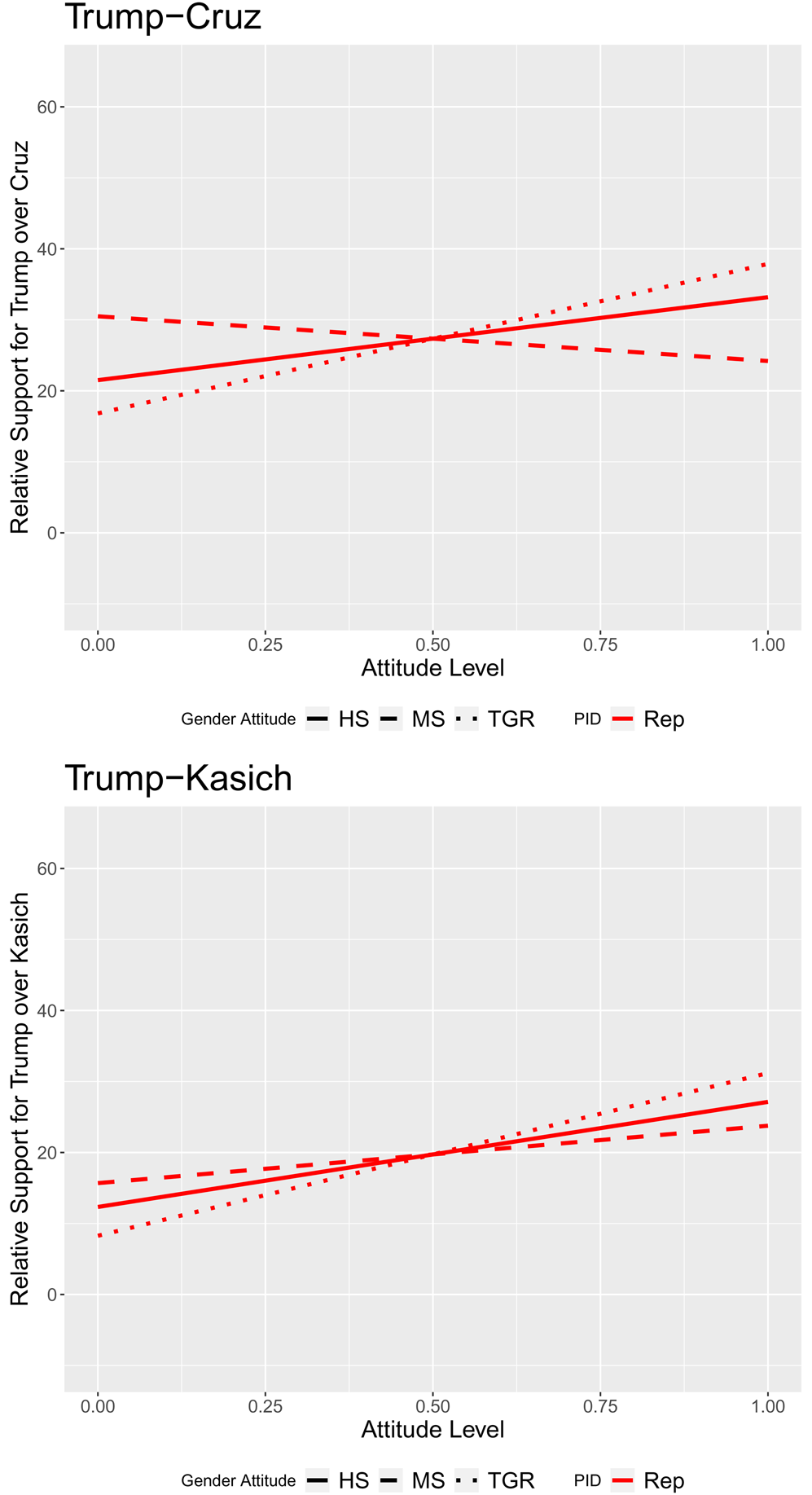
Next, we turn to the Republican nomination contest in order to analyze our second research question: did variation in gender attitudes map to support for Trump versus his rivals? Our primary population of interest for this comparison is Republican identifiers. See again Table 2. Traditional Gender Roles had the largest coefficient in explaining feelings toward Trump (b = .21 and .23 for comparisons to Cruz and Kasich, respectively), followed by hostile sexism (b = .12 and .15). However, these effects did not reach traditional thresholds of statistical significance. While no single gender attitude scale is statistically significant in these comparisons, a joint test for the set of three gender attitudes in the Trump-Kasich comparison is significant (X(3) = 8.58, p = .035). In short, greater sexism in general appeared to increase support for Trump compared to Kasich. The same test on the model comparing Trump to Cruz is not significant (X(3) = 3.57, p = .312).
In Figure 2, we provide a visualization of these results. There is an over 20-point increase (approximately 10% of the variable's range) in warm feelings toward Trump compared to the other Republican candidates over the range of agreement with traditional gender roles, and a 10- to 15-point increase in positive feelings toward Trump over the range of the hostile sexism scale. (Similar to the Democratic primary analyses, the effects of modern sexism were weaker and inconsistent.) While Trump attracted more support from individuals who held sexist and traditional views on gender than his Republican rivals, the associations we find are not as robust as those found among Democrats. We explore possible reasons for this in the Discussion.
Gender Attitudes and Candidate Evaluations among Republicans.

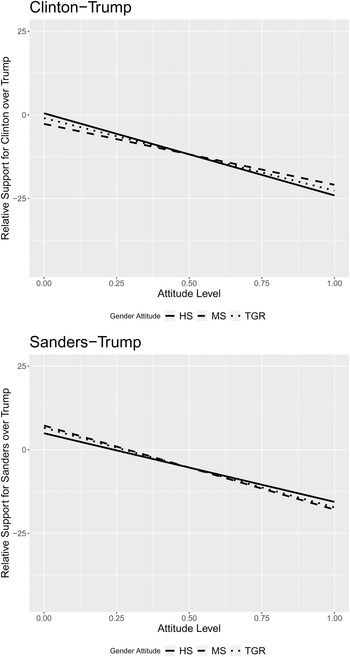
Our third investigation focuses on the general election. See the final two columns of Table 2. In this analysis, we include all partisan respondents in our statistical analysis. Each of the gender attitude scales has strong and significant effects in the two models (all p < .05), in the expected direction. Though there are some differences in the effects of gender attitudes on feeling thermometer ratings when Clinton is compared to Trump versus when Sanders is compared to Trump, our SUR model indicates these differences are not statistically significant.
Figure 3 illustrates these relationships. The full effect of each gender attitude measure corresponds with a 20-point drop in warm feelings for Clinton (top panel) or Sanders (bottom panel) compared to Trump.Footnote 3 Note that these effect sizes are relatively large. Taken together, the effect of the three gender attitude measures is similar in size to that of party identification.
Gender Attitudes and Candidate Evaluations among All Voters.

DISCUSSION AND CONCLUSION
Our analyses demonstrate that attitudes about gender are important in understanding electoral preferences in both the 2016 general election and primaries. In addition, our findings illustrate how crucial it is to measure a range of gender attitudes, because they often shape preferences differently. Finally, our study suggests that the electoral effects of gender attitudes are contingent on attributes of the candidates themselves—and not simply whether a candidate is male or female.
With respect to the Democratic primary, our findings suggest that Senator Bernie Sanders's favorability in the primaries was driven partly by hostile sexism. In other words, we find some support for the “Bernie Bro” hypothesis. We see two possible explanations for this relationship: first, Sanders ran a very aggressive campaign against Clinton, who he viewed as favored by the Democratic establishment as well as economic elites. His sometimes angry tone may have drawn those high in hostile sexism to him. Second, it may be the case that hostile sexists default to male candidates (see Winter Reference Winter2020) and that male candidates must take affirmative steps to avoid attracting support from hostile sexists when running against female candidates. (Recall that hostile sexism did not predict support for Obama over Clinton.)
This said, Democrats who expressed adherence to traditional gender roles felt more warmly toward Clinton than Sanders. The fact that this pattern also appears when Clinton is contrasted with Obama suggests the effect has more to do with Clinton's than Sanders's persona. The effect may be driven by Clinton's (relative) social conservatism or image as a traditional mother and wife, an image she has played up intermittently throughout her career (Heldman, Conroy, and Ackerman Reference Heldman, Conroy and Ackerman2018). Also note that the content of our measure of traditional gender roles overlaps somewhat with measures of “benevolent sexism,” which has been associated with positive views of Clinton (Cassese and Holman Reference Cassese and Holman2019; Glick Reference Glick2019).
Whatever the exact reason for this relationship among Democrats, it is worth noting that this pattern does not hold among Republicans—see the negative coefficient on the relevant interaction term in Table 2 as well as in Table A14 in the appendix.Footnote 4 While we should not put too much stock in this result, given that most Republicans would not have been paying close attention to the Democratic primary contest, it is possible that Republicans who score high on the traditional gender roles measure are less supportive of women running for office than their Democratic counterparts. (Note that this difference does not stem from different mean levels of support for traditional gender roles, as the distributions are similar across parties; see Figure A1 in the appendix.)
Turning to the Republican primary, we find some limited support for the notion that certain voters were attracted to, or repelled by, Donald Trump's blatant sexism and macho persona. Yet, while the effect sizes for hostile sexism and traditional gender roles were somewhat large—ranging between 10 and 20 points—the individual coefficients on these measures did not reach statistical significance (although they reached significance jointly in the Trump-Kasich analysis). In short, the associations between these attitudes and support for Trump varied too much across the survey respondents to yield statistically significant results given our sample size. Why this variation? Perhaps Trump's views about women were not as well-known to voters during the primary stage compared to the general election. Indeed, recent research indicates that beliefs about discrimination toward women became more related to views about Trump in 2018 compared to 2016 (Sides, Tesler, and Vavreck Reference Sides, Tesler, Vavreck, Patashnik and Schiller2020). Or, thinking about traditional gender roles specifically, maybe some traditional Republican voters were attracted to Trump's masculine persona but others were repulsed by his lack of respect for the institution of marriage.
Modern Sexism yielded the weakest and most inconsistent effects during the primary stage. This construct is closely associated with the conservative-liberal spectrum and broad opposition to (or support for) feminism. Given that the primary candidates—compared to their partisan rivals—did not differ considerably on this dimension, in hindsight, this is perhaps not surprising.
Finally, with respect to the general election comparisons, gender attitudes were important over and above the influence of ideology, party, age, sex, education, religiosity, income, race, and ethnicity. This is central to our thesis that attitudes about gender and women's issues matter in understanding political preferences. While our findings that those with more sexist and traditional gender attitudes preferred Clinton over Trump is not novel, our finding that roughly the same relationships appear in a hypothetical Sanders-Trump matchup is. This suggests that if Sanders had won the primary, voters with less traditional views about gender, more favorable feelings toward women, and a greater commitment to gender equality would have strongly preferred him to Donald Trump.
Our study is not without limitations. First, our questionnaire did not include any measures of racial prejudice, a construct that has been central to many accounts of the 2016 election. That said, we did include measures of two personality characteristics—authoritarianism and social dominance orientation—that political psychologists argue are proxies for prejudice, broadly construed (Duckitt and Sibley Reference Duckitt and Sibley2010). When including these measures, our results change only slightly (see Tables A7–A12 in the appendix). In some cases, the coefficients on the gender attitude variables are reduced slightly (e.g., from .18 to .15), but only in the Clinton-Sanders comparison do associated p-values rise to just above the p < .10 threshold. Further, as shown in LASSO analyses (see Figures A4 and A5 in the appendix), the importance of gender attitudes in explaining respondent evaluations is strong relative to the set of covariates.
A second limitation is the fact that our study focused on just one election year with at least two factors likely to make gender more salient: a woman was a serious contender for a major party's nomination and then secured that nomination for the first time, and the Republican primary contest included an outspoken sexist who then became that party's nominee. Prior works examining 2016 in conjunction with other elections have found gender attitudes to be especially important in 2016 (Cassese and Barnes Reference Cassese and Barnes2019; Schaffner and Clark Reference Schaffner and Clark2017; Sides, Tesler, and Vavreck Reference Sides, Tesler, Vavreck, Patashnik and Schiller2020; Valentino, Wayne, and Oceno Reference Valentino, Wayne and Oceno2018). Unfortunately, we cannot assess the counterfactual of a different woman running in the 2016 primary or general election. However, our theory and data lend some credence to the possibility that things would have been different had Cruz or Kasich secured the nomination. If we expand our lens to include the counterfactuals of a Clinton-Cruz or Clinton-Kasich matchup (see Table A13 in the appendix), the coefficients on the gender attitude measures are generally smaller than in the Clinton-Trump contest. Among the three gender attitude variables, there is a 40% to 80% decline in coefficient size when Trump is not the Republican candidate, depending on the comparison (only modern sexism in a Clinton-Cruz comparison remains the same). The drop in importance is largest for traditional gender roles (p < .1 in a SUR model) while the differences for the other variables are not statistically significant.
Since the 2016 election, a conventional wisdom has emerged that gender did not play a significant role in voters’ choices, although several recently published studies have argued the contrary. We join these scholars and extend their analyses in several ways: by examining a trio of gender attitudes in the primaries as well as the general election, and by assessing electoral counterfactuals to tease out why gender attitudes mattered as they did in 2016. We find that gender attitudes mattered less in the Republican primary than in the Democratic one, and that the patterns among Democrats were not always as one might predict. We also find suggestive evidence that a Sanders nomination would not have changed the pattern now observed by many scholars: in the general election, sexists of many stripes preferred Trump. At the same time, this association would likely have been dampened if a different man—Cruz or Kasich—had won the Republican nomination.
The analyses we present are suggestive but not definitive, especially for the general election. We measured candidate preferences six months before the general election, meaning that attitudes toward Clinton and Trump could have changed as the campaigns wore on. In addition, a general election with Sanders as the Democratic nominee, and/or someone other than Trump as the Republican nominee, would have played out differently in real time in myriad ways, perhaps leading to different patterns of results. These important caveats notwithstanding, our findings suggest that the complex interplay between candidates’ and voters’ gender-linked attitudes is an important force in U.S. electoral politics.
SUPPLEMENTARY MATERIAL
To view supplementary material for this article, please visit https://doi.org/10.1017/S1743923X21000155.
Meri T. Long is a Lecturer in the Department of Political Science at the University of Pittsburgh: mtlong@pitt.edu; Ryan Dawe is a PhD Candidate in the Department of Political Science at the Ohio State University: dawe.14@osu.edu; Elizabeth Suhay is an Associate Professor in the Department of Government, School of Public Affairs, at American University: suhay@american.edu