Implications
The effect of background before the entrance in a feedlot on meat quality in beef has been hardly studied for the literature available on this topic is very scarce, especially when the productive life of the animals is considered as a whole and animals are fed a common finishing diet. Our results show new information and complement the existent helping to understand the possible influence of the previous fattening production system, as grazing at an early stage provokes certain distinctive characteristics that are kept even after several months of concentrate feeding.
Introduction
Cattle breeds have been selected for their adaptation to a specific ambiance and productive system, in which they show, in theory, their best economical results. In Spain, as elsewhere, because of the agro-climatic conditions, intensive (INT) systems based on concentrates ad libitum and cereal straw, with young animals, are the most common type of beef production systems. Annually, 2.3 million bovine heads are slaughtered in the country, two-thirds, 67%, of which are classified as veal and young bulls (MARM, 2010). In some European Mediterranean countries, a significant proportion (18.13% in Spain) of the animals slaughtered is imported from other countries (such as France). The imported cattle come from countries where calves are reared in grazing pastures or fed mainly forage until late weaning. In addition, that type of production system is used locally in mountainous areas or in other productive environments when grass resources are sufficiently plentiful. In other situations, such as when grass is scarce, cows are milked or their reproduction is intensified, calves are early weaned. Therefore, in many fattening units, it is common to find calves of different origins and ages, which after fattening have similar weights and development based on the requirements of the destination market. Extensive (EXT) and INT systems are the two most common production systems before the fattening period. Calves from EXT systems graze on pasture until weaning (between 6 and 7 months), and those from INT systems are housed indoors, weaned at an early age (2 to 4 months) and reared with concentrate and cereal straw ad libitum, when their diet is switched to concentrate.
Currently, it is relatively well studied how the variations on feeding conditions including nutrition level, forage quality, feed type, and raw material composition can affect carcass and meat quality (French et al., Reference French, O’Riordan, Monahan, Caffrey, Vidal, Mooney, Troy and Moloney2000; Maltin et al., Reference Maltin, Lobley, Grant, Miller, Kyle, Horgan, Matthews and Sinclair2001; Del Campo et al., Reference Del Campo, Brito, Soares de Lima, Vaz Martins, Sañudo, San Julián, Hernández and Montossi2008), particularly on fatness score, fat colour and quality, which are important attributes from which consumers infer the quality of beef meat and their choices. Although the effects of forage- and grain-based feeding systems on beef have been investigated for more than 40 years, (Muir et al., Reference Muir, Deaker and Bown1998a; Moloney et al., Reference Moloney, Keane, Dunne, Mooney and Troy2008) usually these production systems (INT v. EXT or concentrate v. forage) have been evaluated during the finishing period. Very few studies have assessed the effects of production systems before the finishing period, even though production systems are varied and complex, including mainly the influence of the origin of the animals, age at weaning, diet and management before the fattening period. In this sense, Blanco et al. (Reference Blanco, Ripoll, Albertí, Sanz, Revilla, Villalba and Casasús2008, Reference Blanco, Villalba, Ripoll, Sauerwein and Casasús2009) studied the effects of early weaning on performance, carcass and meat quality, and Pordomingo et al. (Reference Pordomingo, Grigioni, Carduza and Volpi Lagreca2012) examined the feed backgrounding phase in cattle finished on pasture. Then, the objectives of this study were to assess the effect of production system before the finishing period on bovine productive characteristics and carcass, meat and fat quality in intensively finished cattle.
Material and methods
Animals
The study comprised 20 purebred Gascon young bulls. Gascon, which is one of the most common rustic breeds in France, has butchery traits that are similar to those of pure beef breeds (Renand et al., Reference Renand, Havy and Turin2002; Piedrafita et al., Reference Piedrafita, Quintanilla, Sañudo, Olleta, Campo, Panea, Renard, Turin, Jabet, Osoro, Oliván, Noval, García, García, Oliver, Gispert, Serra, Espejo, García, López and Izquierdo2003). Currently, in our days, the animals of the Gascon breed that are reared in Spain have a French origin, because an independent genetic pool does not yet exist, because of its relatively recent presence in the country (30 years).
All calves were commercial animals, of which 10 came from INT systems in Spain, where they were weaned early (3 to 4 months) and started to be fed with concentrate (45% corn, 32% barley, 20% soya bean and 3% trace mineral and vitamins supplement). The other 10 calves were reared with their dams in EXT conditions, which entailed grazing mountain pastures in the French Pyrenees until weaning at 7 to 8 months; EXT calves did not receive any supplementary food, being only feed with dams’ milk and pasture. For the finishing period, the two lots were housed at the Research Station CITA, Zaragoza, Spain, in two independent outdoors pens that provided free access to water, concentrate and straw.
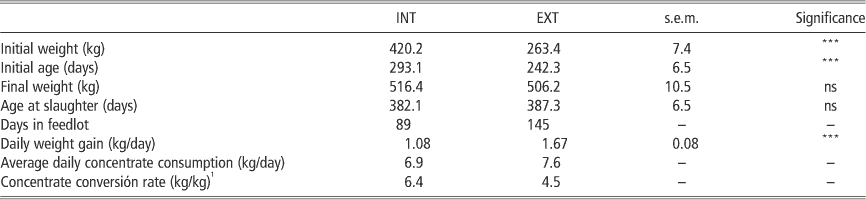
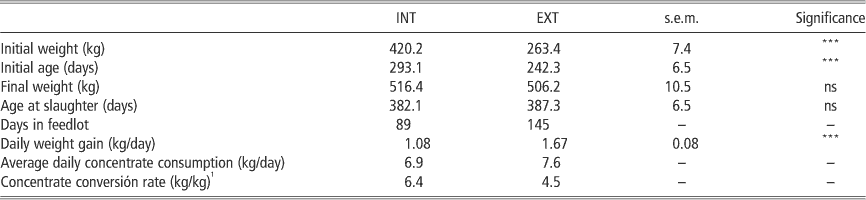
The adaptation period was 3 weeks. During this period, animals started to consume ad libitum the same commercial concentrate that would be used in the experimental period and straw. Productive parameters are described in Table 1. On average, the animals of INT and EXT lots started the experiment at 293.1 day and 242.3 day of age (s.e.m. 6.53), and 420.2 and 263.4 kg live (s.e.m. 7.41), respectively.
Effect of production system before the finishing period on productive parameters in Gascon young bulls
INT=intensive; EXT=extensive; ns=not significant; s.e.m.=standard error of mean.
*** P⩽0.001.
1 kg/kg: kg of concentrate/kg of weight gained.
All the animals were finished in the same fattening unit and under the same rearing conditions. Composition of commercial concentrate with which animals were fed was: corn (38.00%), barley (20.35%), gluten feed (15.00%), soya bean flour (7.52%), meal rapeseed (5.00%), meal palm seed (5.00%), beetroot pulp (4.00%), palm oil (2.71%), calcium carbonate (0.88%), sodium bicarbonate (0.50%), sodium chloride (0.50%), magnesium oxide (0.30%), trace mineral and vitamin supplement (0.24%), (EM (Mcal/kg DM): 3.296; TDN: 84.13; 13.5% CP, 5.6% ether extract, 6.4% crude fibre, 5.6% ash) and barley straw ad libitum. On average, the finishing period of the animals in the INT and EXT groups was 89 days and 145 days, respectively. In that period, the average daily weight gain of the EXT animals (1.67 kg/day) was significantly (P⩽0.001) higher than the rate of INT animals (1.08 kg/day). In addition, the average daily concentrate consumption was highest among the animals in the EXT group (7.6 v. 6.9), but the concentrate conversion rate (kg/kg) was lowest in the EXT group (6.4 v. 4.5). At ~13 months of age (382.1 and 387.3 days for INT and EXT, respectively) and an average life weight of 511.3±32.77 kg, the young bulls were slaughtered in an EU-licensed commercial abattoir (MercaZaragoza, Spain) about 6 km away from the fattening unit. To minimize pre-slaughter stress, the young bulls were transported and slaughtered on the same day. The animals were stunned using a captive bolt pistol and processed following standard commercial practices and EU regulations.
Carcass quality
Cold carcass weight was estimated as 98% of hot carcass weight after slaughter. Dressing percentage was calculated as the ratio between cold carcass weight and slaughter weight. Carcasses were graded visually for conformation and fatness based on the European Grading System Classification SEUROP (Directives ECC no. 1208/81 and no. 1026/91). Carcasses were chilled for 24 h at 4°C. At 24 h post-mortem, standard measurements were taken on the left half side following the same methodology described in Albertí et al. (Reference Albertí, Panea, Sañudo, Olleta, Ripoll, Ertbjerg, Christensen, Gigli, Failla, Concetti, Hocquette, Jailler, Rudel, Renand, Nute, Richardson and Williams2008), which was used to calculate several compactness indexes. Commercial cuts were obtained from the left half carcass. Four types of wholesale cuts, deboned and trimmed, were identified on the basis of differences in commercial value, dividing tissue composition in percentage of meat (extra, first, second, third categories), trim fat and bone.
The Longissimus dorsi (thoracis and lumborum) (LD) was excised from the right side. The sixth rib was removed, weighed and kept frozen (−20°C) before being thawed and dissected into muscle, fat (subcutaneous and intermuscular), bone and other tissues (tendons, fascias, blood vessels). Before the sixth rib was frozen, the LD of this rib was separated, weighed and divided in two parts for determinate haematic pigment and fatty acids.
Sampling and meat quality
At 24 h post-mortem, meat pH was measured using a CRISON 507 pH-meter and a penetration pH-electrode at the point of the third lumbar vertebra. The LD was sliced into steaks that were analysed without being frozen or kept frozen at −20°C. After thawing, the LD of the fifth rib was used to quantify the chemical composition (intramuscular fat) using Near Infrared Reflectance Spectroscopy (NIRS-Food Scan). The LD from the sixth rib was weighed and immediately analysed for concentrations of haematic pigments (Hornsey, Reference Hornsey1956) and water-holding capacity by expressible juice at day 7 of ageing. A 2-cm-thick steak from the seventh rib was used to measure water-holding capacity by drip loss, following 24 h of refrigeration at 4°C in a hermetic pot, and suspended in a net.
One day after sampling (at 48 h after slaughter), two 2.5-cm-thick steaks between the seventh and the ninth rib were packaged in polystyrene trays with a modified atmosphere (MAP 70% O2, 20% CO2, 10% N2) and refrigerated at 4°C and light (fluorescent lamp, 450 lux, 12 h/day) for 8 days being evaluated for instrumental colour. The development of meat colour in the CIE Lab space was assessed using a Minolta CM-2600d spectrophotometer with a 10° view angle and a D65 illuminant at 1, 4, 6 and 8 days after blooming. Three measurements were taken per sample.
For the texture analysis, the LD from the 10th to the 13th rib was divided into five 3.5-cm-thick steaks, vacuum-packed and aged either 1, 3, 7, 14 or 21 days before being stored frozen. After thawing for 24 h at 4°C, the steaks were analysed using an INSTRON 4301 (Instron Limited Corporation, High Wycombe, United Kingdom) and a compression cell (using raw meat), and a Warner–Bratzler cell (cooked meat), following the procedures described in Campo et al. (Reference Campo, Santolaria, Sañudo, Lepetit, Olleta, Panea and Alberti2000). The meat was cut into rectangular pieces of 1 cm2 cross-section, perpendicular to the direction of muscle fibres. Cooking losses were calculated in the same steak samples as Warner–Bratzler, obtained by weighing the meat before and after being heated in a water bath at 70°C.
For the sensory analyses, 2-cm-thick steaks from the lumbar region were vacuum-packed and aged for 1, 7 or 21 days before being frozen at −20°C. For the analyses, the steaks were thawed at 4°C for 24 h and cooked on a double-plate grill at 220°C until an internal temperature of 70°C was achieved. A trained nine-member panel with same characteristics described in Monsón et al. (Reference Monsón, Sañudo and Sierra2005) evaluated the sensory characteristics of 2×2 cm cooked samples based on a 10-cm semi-structured line scale from 0 (low intensity) to 10 (very intensity); the sensory profile was obtained in a specific training session. Panel members evaluated 10 attributes associated with the odour, texture and flavour. The attributes included beef odour, milk odour, fat odour, tenderness, juiciness, beef flavour, acid flavour, fat flavour, milk flavour and metallic flavour. The evaluations were performed in a sensory analysis laboratory and the panellists received samples while seated in individual cabins under controlled environmental conditions and red light.
A Minolta CM-2600d (Konika Minolta Inc.,Tokyo, Japan) spectrophotometer was used to measure the subcutaneous fat colour (CIE Lab space) of the loin between the fifth and 11th ribs, in areas where the fat was sufficiently thick. Blood clots and air bubbles were avoided. In each sample, fat colour was measured at three randomly selected points. The proportion of light reflected at each 10 nm between 450 and 510 nm in the subcutaneous fat was recorded and the absolute value of the integral of the translated reflectance spectrum (SUM) was calculated following Prache and Theriez (Reference Prache and Theriez1999). The reflectance spectrum was translated so that the reflectance value at 510 nm=0 (TR). In the translated spectrum, the integral value was calculated using the following equation in which TR i is the reflectance value at i nm:
 $$\eqalign{{\rm SUM}= (TR_{{{\rm 45}0}} /{\rm 2}{\plus}TR_{{{\rm 46}0}} {\plus}TR_{{{\rm 47}0}} {\plus}TR_{{{\rm 48}0}} {\plus}TR_{{{\rm 49}0}} \cr \quad{\plus}TR_{{{\rm 5}00}} {\plus}TR_{{{\rm 51}0}} /{\rm 2}){\times}{\rm 1}0$$
For the fatty-acid analyses, intramuscular fat was extracted from a specific portion of the LD at the sixth rib (following Bligh and Dyer, Reference Bligh and Dyer1959). To quantify the fatty-acid composition of the samples, the methyl ester preparation included KOH in methanol with C 19:0 as an internal standard. To identify the methyl esters of the fatty acids, we used an HP 6890 Gas Chromatograph (Agilent Technologies, Santa Clara, California, USA) that had an SP 2380 capillary column (100 m×0.25 mm×0.20 µm) (Carrillho et al., Reference Carrillho, López and Campo2009). Each sample was analysed twice.
Statistical analyses
Performance, carcass and meat attributes were assessed by analysis of variance using a GLM procedure (SPSS v. 15.0) in which production system (INT or EXT) before the finishing period was a fixed effect. In the analyses of water-holding capacity, texture and colour, ageing was included as a fixed effect that analysed the interactions with production system. In water-holding capacity, data were covaried by pH. For the sensory analysis, the data set was previously checked to restrict the analysis to the attributes that were used in a consistent way. None of the data was corrected as all attributes were consistently assessed. For each panellist, the ANOVA included the session, plate and treatment. A GLM procedure was performed including the mean per animal for each attribute in the restricted data set. In the model, production system, ageing, session and their interactions were evaluated. Differences between group means were assessed using Duncan’s Multiple Range Test (P<0.05). Beef colour development was analysed using the MIXED procedure for repeated measures.
Results and discussion
Carcass characteristics
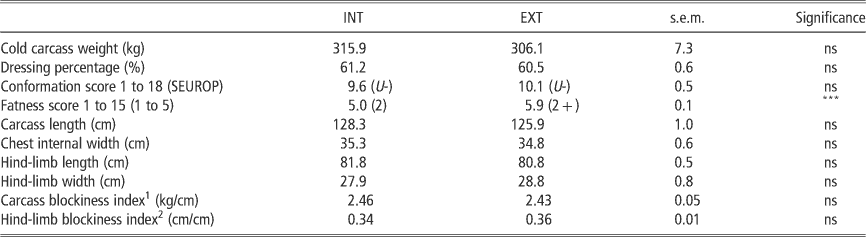
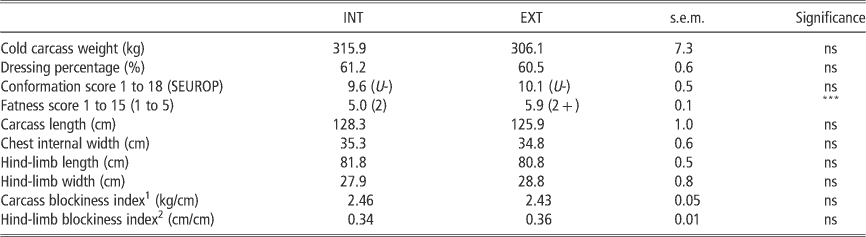
Gascon young bulls reared in either EXT or INT production systems did not differ significantly in average cold carcass weight or dressing percentage (Table 2). In addition, after the finishing period, production system did not have a significant effect on conformation score (U-); however, on average, EXT animals had fatness scores that were one point higher (P⩽0.001) than those of INT animals. Thus, animals refeeding after a nutritional restriction showed a higher kg of fat in carcass (Cassar-Malek et al., Reference Cassar-Malek, Hocquette, Jurie, Listrat, Jailer, Bauchart, Briand and Picard2004). Although, Blanco et al. (Reference Blanco, Ripoll, Albertí, Sanz, Revilla, Villalba and Casasús2008, Reference Blanco, Villalba, Ripoll, Sauerwein and Casasús2009) did not detect differences in the conformation or fatness scores of calves weaned at different ages.
Effect of production system before the finishing period on dressing percentage and carcass characteristics (classification and morphology) in Gascon young bulls
INT=intensive; EXT=extensive; ns=not significant; s.e.m.=standard error of mean.
1 Carcass blockiness index: cold carcass weight/carcass length.
2 Hind-limb blockiness index: hind-limb width/hind-limb length.
*** P⩽0.001.
In our study, the conformation scores indicated that the carcass measurements and indexes of the two groups of young bulls did not differ significantly. The same was seen in the study of Cerdeño et al. (Reference Cerdeño, Vieira, Serrano, Lavín and Mantecón2006), in which the carcass measurements of young bulls finished on concentrate ad libitum and those limited to 4 kg/day did not differ significantly. Thus, our findings could be expected because morphological differences are more strongly associated with breed type than with diet, especially when the animals’ requirements are minimally covered. The carcass traits of the young bulls in our study (Table 2) were similar to those in Piedrafita et al. (Reference Piedrafita, Quintanilla, Sañudo, Olleta, Campo, Panea, Renard, Turin, Jabet, Osoro, Oliván, Noval, García, García, Oliver, Gispert, Serra, Espejo, García, López and Izquierdo2003). In that study, Gascon young bulls reared in its typical production system (mean age at slaughter=723 days) had, on average, a dressing percentage of 61.3%, a conformation score of U- (9.5), a fatness score of 8 (3), a carcass blockiness index of 2.68 and a hind-limb compactness index of 0.37. The differences in the ages of the animals at slaughter might have contributed to the differences in the results of the two studies, because fatness and animal blockiness increase with age. In addition, if we compare with the study of Albertí et al. (Reference Albertí, Panea, Sañudo, Olleta, Ripoll, Ertbjerg, Christensen, Gigli, Failla, Concetti, Hocquette, Jailler, Rudel, Renand, Nute, Richardson and Williams2008) of several European breeds, our Gascon animals presented similar results to French specialized beef breeds (Charolais and Limousin) in conformation; however, in fatness score they were more similar to other local Spanish breeds.
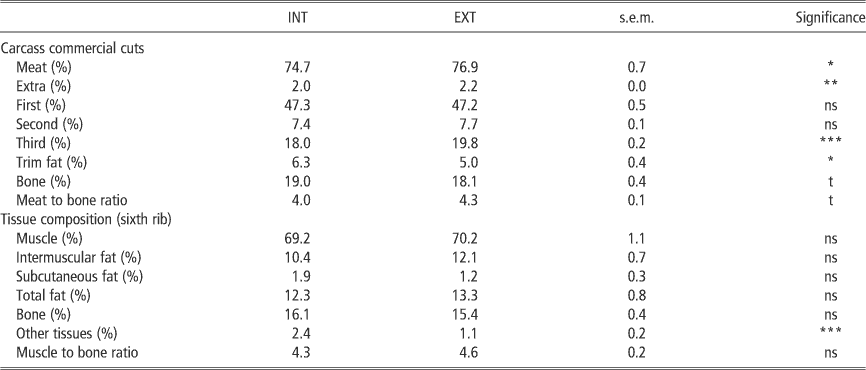
The proportions of all commercial cuts (P⩽0.05), extra-value cuts (P⩽0.01) and third-value cuts (P⩽0.001) were significantly higher in the animals from EXT systems than they were in those INT systems (Table 3). The mean percentage of trim fat was higher in the INT group than it was in the EXT group (P⩽0.05), opposite to the subcutaneous fatness scores mentioned above, and bone percentage tended to be higher in the INT group. In addition, the tissue composition of meat from the sixth rib did not differ significantly between the two groups of young bulls, according to Ducket et al. (Reference Duckett, Neel, Sonon, Fontenot, Clapham and Scaglia2007) where rib composition was unaffected by previously growth rate during the winter stocker period, regardless of the finishing system (concentrate v. pasture). Although the meat/bone ratio was higher in the EXT group than it was in the INT group, only differences in the percentage of other tissues appeared, a fact with low importance from commercial or biological point of view and without a clear explanation.
Effect of production system before the finishing period on the commercial meat cuts of the left half carcass and tissue composition in Gascon young bulls

INT=intensive; EXT=extensive; ns=not significant; s.e.m.=standard error of mean.
Extra-value cut group: fillet; first-value cut group: striploin, thick flank, topside, silver side, rump, eye round, heel, chuck, chuck tenderloin and shoulder clod; second-value cuts: shanks and shin, brisked and blade; third-value cuts: flank, ribs, neck and lean trimmings.
tP⩽0.10; *P⩽0.05; **P⩽0.01; ***P⩽0.001.
In cattle, weight, age and nutritional state, especially the energy content of the diet, can affect carcass composition (Del Campo et al., Reference Del Campo, Brito, Soares de Lima, Vaz Martins, Sañudo, San Julián, Hernández and Montossi2008). In addition, compensatory growth, which was exhibited by the young bulls in the EXT group, can influence carcass composition as shown in Cassar-Malek et al. (Reference Cassar-Malek, Hocquette, Jurie, Listrat, Jailer, Bauchart, Briand and Picard2004); however, the direction of the changes has differed among studies. Hornick et al. (Reference Hornick, Van Eenaeme, Clinquart, Díez and Istaesse1998) reported that, after the young bulls entered the fattening period and changed feeding systems, animals reared in grazing systems (which have relatively low energy content) exhibited higher percentage of carcass fat. Nevertheless, in another study (McPhee et al., Reference McPhee, Harden, Robinson, Dicker and Oddy2012), animals with lower daily gain during the backgrounding phase showed compensatory growth and had a lower carcass and intramuscular fat presence. Differences in breed (early or late maturing type), age of animals, duration and severity of restriction, and nutrition level and quality during the finishing period probably contributed to the differences in the findings of studies (Del Campo et al., Reference Del Campo, Brito, Soares de Lima, Vaz Martins, Sañudo, San Julián, Hernández and Montossi2008).
Meat quality
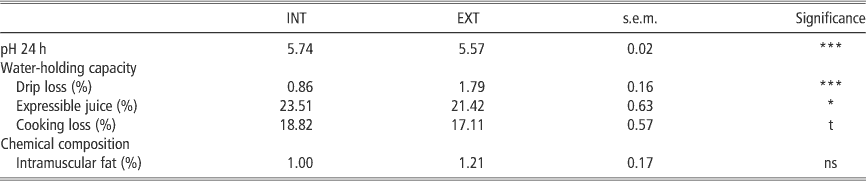
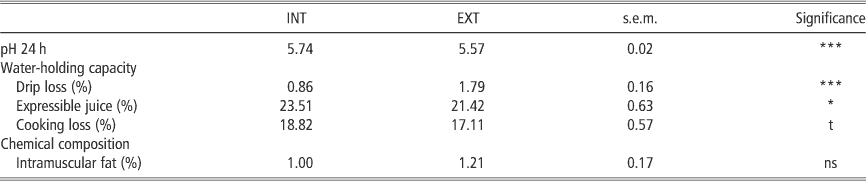
In our study, ultimate pH at 24 h was significantly (P⩽0.001) higher in the meat from young bulls from the INT than it was in animals in the EXT group, although no animals had a pH>5.8 (Table 4). According to Mounier et al. (Reference Mounier, Veissier, Andanson, Delval and Boissy2006), it could be thought that differences in the temperament and social behaviour of the individuals in each group might have contributed to the difference in ultimate pH.
Effect of production system before the finishing period on final meat pH, water-holding capacity and chemical composition of meat in Gascon young bulls
INT=intensive; EXT=extensive; ns=not significant; s.e.m.=standard error of mean.
tP⩽0.10; *P⩽0.05; ***P⩽0.001.
Drip loss and expressible juice differed significantly between the two systems; however, when the water-holding capacity data were covariated by pH, the differences were not significant (P>0.1). The effects of production system, ageing time and their interactions on cooking losses were not significant. In this sense, Pordomingo et al. (Reference Pordomingo, Grigioni, Carduza and Volpi Lagreca2012) found that the diet before finishing on pasture did not have a significant effect on cooking losses.
The meat from the two production systems did not differ significantly in intramuscular fat percentage (Table 4), which was similar to that reported by Renand et al. (Reference Renand, Havy and Turin2002), being a characteristic of this breed is its low fat content, result according to Cassar-Malek et al. (Reference Cassar-Malek, Hocquette, Jurie, Listrat, Jailer, Bauchart, Briand and Picard2004), where different nutritional restriction or feed ad libitum did not modify lipid content of the different muscles studied.
However, myoglobin content was significantly (P⩽0.001) higher in the meat from animals in the INT group (3.97 mg/g muscle) than it was in the EXT group (3.36 mg/g muscle to 0.10 s.e.m.). Gatellier et al. (Reference Gatellier, Mercier, Juin and Renerre2005) found that haem pigment concentrations were higher in animals that had been finished on a mixed diet than they were in animals finished on pasture. Although diet, age and exercise can affect meat colour (Del Campo et al., Reference Del Campo, Brito, Soares de Lima, Vaz Martins, Sañudo, San Julián, Hernández and Montossi2008), in our study, the two groups of young bulls had the same diet and options for exercise during the fattening period. Despite their experiences in the period before the finishing period, animals in the EXT group should develop more pigment because of exercise and grass diet. Haem pigment concentrations were between 2.7 and 4.5 mg/g, which is typical of other beef breeds (Sañudo et al., Reference Sañudo, Albertí, Campo, Olleta and Panea1998).
Production system before the finishing period had a significant (P⩽0.001) effect on all meat colour variables, except h* (P>0.10) (Table 5). In addition, display time had a significant (P⩽0.001) effect on all of the colour variables. The interaction between the two effects was significant. The meat from the INT group was less pale, had a lower L*, a higher C*, lower h* and a higher a* than did the meat from the EXT group (Figures 1, 2, 3); possibly, because of the higher haem pigment content of the latter (INT) and higher pH. In general, duration of display had a greater effect than did management system on meat colour variables. Lightness, chroma and hue varied significantly (P⩽0.001) over time and over a larger range (31% variation in chroma) than did the meat of the two management systems (4% variation in chroma, P<0.05). Display time has a significant effect on meat colour, mainly because of pigment oxidation (Muir et al., Reference Muir, Smith, Wallace, Cruickshank and Smith1998b).
Effect of production system before the finishing period on meat colour evolution (Lightness) in Gascon young bulls, packaged with modified atmosphere (MAP) (70% O2, 20% CO2, 10% N2) and commercial light exposure. a, b: indicate statistical differences (P⩽0.05) along display time in each production system. X, Y: indicate statistical differences (P⩽0.05) between production systems. INT=intensive; EXT=extensive.
Effect of production system before the finishing period on meat colour evolution (Chroma) in Gascon young bulls, packaged with modified atmosphere (MAP) (70% O2, 20% CO2, 10% N2) and commercial light exposure. a, b: indicate statistical differences (P⩽0.05) along display time in each production system. X, Y: indicate statistical differences (P⩽0.05) between production systems. INT=intensive; EXT=extensive.
Effect of production system before the finishing period on meat colour evolution (Hue) in Gascon young bulls, packaged with modified atmosphere (MAP) (70% O2, 20% CO2, 10% N2) and commercial light exposure. a, b: indicate statistical differences (P⩽0.05) along display time in each production system. X, Y: indicate statistical differences (P⩽0.05) between production systems. INT=intensive; EXT=extensive.
F values and significance of the production system before the finishing period and display time and their interaction on the colour parameters of meat packaged with modified atmosphere (MAP) (70% O2, 20% CO2, 10% N2) and commercial light exposure of meat from Gascon young bulls

ns=not significant.
*P⩽0.05; ***P⩽0.001.
Muir et al. (Reference Muir, Smith, Wallace, Cruickshank and Smith1998b) observed differences in the L* and a* of the meat from animals finished on grain or forage. Pordomingo et al. (Reference Pordomingo, Grigioni, Carduza and Volpi Lagreca2012) and French et al. (Reference French, O’Riordan, Monahan, Caffrey, Vidal, Mooney, Troy and Moloney2000) reported differences in b* being higher in animals with forage intake. It seems that meat colour differed between production systems during the finishing period (concentrate or forage). In addition, age at weaning and management before the finishing period can influence meat colour. For instance, Blanco et al. (Reference Blanco, Ripoll, Albertí, Sanz, Revilla, Villalba and Casasús2008) found that the meat from animals reared in pastures with their dams (as in our EXT group) had higher L* and b* than did the meat from those had been weaned early in INT production systems. In any case, both production systems produced meat that had a colour that ranged from pale red to pink, which is pleasing for most consumers. The Gascon meat has a high L*, a low a* and an intermediate b* compared with the meat of other European local breeds (Insausti et al., Reference Insausti, Beriain, Purroy, Albertí, Lizaso and Hernandez1999).
The texture of the meat from the two productive systems before the finishing period did not differ significantly. Ageing had significant effect on compression C 20% (P⩽0.001), C 80% (P⩽0.01) and shear force (maximum load) (P⩽0.001). Texture did not appear to be influenced by finishing diet, finishing period or production systems before the fattening period (Cerdeño et al., Reference Cerdeño, Vieira, Serrano, Lavín and Mantecón2006), at least not if muscle characteristics are not noticeably modified and the level of fatness is adequate. Maltin et al. (Reference Maltin, Lobley, Grant, Miller, Kyle, Horgan, Matthews and Sinclair2001) suggested that genotype and muscle type, rather than feeding regimen, have the greatest influence on muscular fibre characteristics. Realini et al. (Reference Realini, Duckett, Brito, Dallarizza and De Mattos2004) found differences in the texture of meat from animals fed with or without forage during the fattening period; however, the direction of the changes was not homogeneous. In addition, Realini et al. (Reference Realini, Duckett, Brito, Dallarizza and De Mattos2004) found that initial tenderness of the meat did not differ between pasture- and grain-fed animals; however, Del Campo et al. (Reference Del Campo, Brito, Soares de Lima, Vaz Martins, Sañudo, San Julián, Hernández and Montossi2008) found that tenderness was lower in pasture-fed animals and Kerth et al. (Reference Kerth, Braden, Cox, Kerth and Rankins2007) reported that initial tenderness was higher in meat from a grain-finished diet than in meat from a pasture or mixed-rations diet. In our study, the animals had a minimum of 3 months of a common finishing period, which might have diminished the differences that could be present before the finishing period.
In our study, ageing time had a significant effect on compression C 20%, and the values were similar to those reported by Campo et al. (Reference Campo, Santolaria, Sañudo, Lepetit, Olleta, Panea and Alberti2000). Ageing time and compression C 80% were not so correlated, as the latter is more associated with the connective tissue rather than myofibrils. Campo et al. (Reference Campo, Santolaria, Sañudo, Lepetit, Olleta, Panea and Alberti2000) found that ageing time had a significant effect on shear force (maximum load), but not on toughness. In our study (data not shown), C 20% decreased overall by 23.16% after the first 3 days, 41.58% after the first week and 41.71% after 2 weeks (tenderization rate relative to the first day).
The sensory attributes of the meat did not differ significantly between the two groups of young bulls from the two production systems that might have occurred because the sensory properties of the meat from the two groups converged during the finishing period. Other studies did not find differences in the sensory traits of finishing strategies, and Moloney et al. (Reference Moloney, Mooney, Troy and Keane2011) suggested that changes in the sensory quality of the meat from animals fed grass or concentrate during the finishing period are often caused by other factors such as the animal’s age, growth rate, carcass weight, fatness score or pre-slaughter management.
Ageing time had a significant effect on beef odour intensity (P⩽0.100), tenderness (P⩽0.001) and beef flavour intensity (P⩽0.01). Those attributes increased with ageing time (results not shown), but significantly only between days 1 and 7 for beef odour (from 4.54 to 4.86, 0.10 s.e.m.) and flavour notes (5.04 to 5.42, 0.09 s.e.m.), and between days 1, 7 and 21 of ageing for tenderness (from 4.16 to 5.67 and 6.43; 0.22 s.e.m), which is in agreement globally with other studies (e.g., Monsón et al., Reference Monsón, Sañudo and Sierra2005).
Fat quality
The values of L* (P⩽0.01), b* and C* (P⩽0.05), for subcutaneous fat, differed significantly between the two production systems. Blanco et al. (Reference Blanco, Ripoll, Albertí, Sanz, Revilla, Villalba and Casasús2008) did not detect differences in those traits between groups that differed in management and age at weaning. The subcutaneous fat from EXT animals had lower L* and higher b* and C* (Table 6) than did the INT animals, which is associated with the accumulation of carotenoids during the breeding period in mountains and meadows (Del Campo et al., Reference Del Campo, Brito, Soares de Lima, Vaz Martins, Sañudo, San Julián, Hernández and Montossi2008) because of the high concentrations of pigments in fresh pastures. In addition, Nuernberg et al. (Reference Nuernberg, Dannenberger, Nuernberg, Ender, Voigt, Scollan, Wood, Nute and Richardson2005) found that animals that had been finished on forage and grass exhibited significantly lower L* than did those finished on concentrate. However, there is some controversy over the causes of the colour variation between seasons or finishing diet, and over the pigment mobilization after grazing (Moloney et al., Reference Moloney, Keane, Dunne, Mooney and Troy2008). In this sense, the estimate of fat carotenoid pigment content (SUM) was lower in the INT group (197.7) than it was in the EXT group (215.9) and, as others have suggested, it could be used as a traceability parameter of grass feeding (Serrano et al., Reference Serrano, Prache, Chauveau-Duriot, Agabriel and Micol2006). In the Gascon bulls in our study, fat colour had a higher chroma (fat white–pink) than do some rustic French breeds (Renand et al., Reference Renand, Havy and Turin2002). That colour would be well received in markets where white fat is preferred (Del Campo et al., Reference Del Campo, Brito, Soares de Lima, Vaz Martins, Sañudo, San Julián, Hernández and Montossi2008).
Effect of production system before the finishing period on subcutaneous fat colour in Gascon young bulls

INT=intensive; EXT=extensive; ns=not significant; s.e.m.=standard error of mean.
*P⩽0.05; **P⩽0.01.
Effect of production system before the finishing period on fatty-acid composition (percentage of total fatty acids) from intramuscular fat in Gascon young bulls
INT=intensive; EXT=extensive; ns=not significant; s.e.m.=standard error of mean; SFA=saturated fatty acids; MUFA=monounsaturated fatty acids; PUFA=polyunsaturated fatty acids; CLA=conjugated linoleic acid.
tP⩽0.10; *P⩽0.05; **P⩽0.01; ***P⩽0.001.
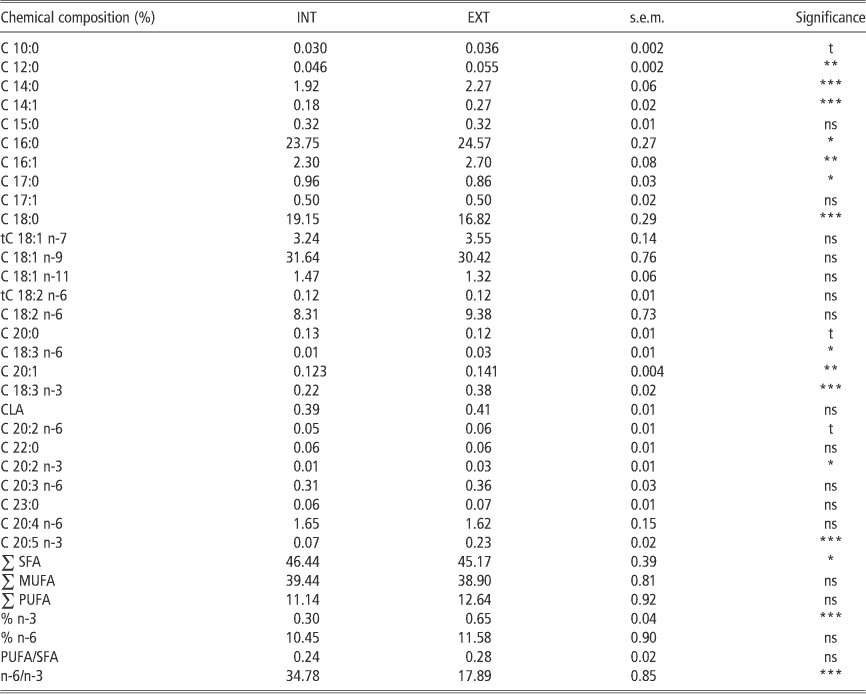
Although the meat from the animals in the two groups did not differ significantly in intramuscular fat percentage, they did differ in fatty-acid percentage (Table 7), especially of saturated fatty acids (SFA) (P⩽0.05), n-3 and n-6/n-3 ratio (P⩽0.001). The higher percentage of SFA in the meat from the INT group was mainly a consequence of the higher percentage of stearic acid (C 18:0), although percentages of lauric, miristic and palmitic (C 12:0, C 14:0, C 16:0) acids were higher in the EXT group. Similarly, Humada et al. (Reference Humada, Serrano, Sañudo, Rolland and Dugan2012) found that young bulls finished in INT systems had higher SFA percentages than did animals finished in semi-INT systems. In our study, production system before the finishing period did not affect monounsaturated fatty acid (MUFA) or polyunsaturated fatty acid (PUFA), as previously found in Gatellier et al. (Reference Gatellier, Mercier, Juin and Renerre2005). Neither n-6 proportion was affected (Humada et al., Reference Humada, Serrano, Sañudo, Rolland and Dugan2012).
Young bulls in the EXT group grazed for 7 months before fattening. Animals reared on grass have a higher percentage of n-3 fatty acids (Wood et al., Reference Wood, Richardson, Nute, Fisher, Campo, Kasapidou, Sheard and Enser2003) and a smaller and, therefore, more favourable n-6/n-3 ratio than do animals reared on silage or concentrate (Enser et al., Reference Enser, Hallet, Hewett, Fursey, Wood and Harrington1997). In our study, those differences in n-3 were due to the differences in the proportions of α-linolenic acid (C 18:3 n-3), eicopentaenoic acid (C 20:5 n-3) and C 20:2 n-3, which is similar to the results of Nuernberg et al. (Reference Nuernberg, Dannenberger, Nuernberg, Ender, Voigt, Scollan, Wood, Nute and Richardson2005), and Humada et al. (Reference Humada, Serrano, Sañudo, Rolland and Dugan2012). Blanco et al. (Reference Blanco, Ripoll, Albertí, Sanz, Revilla, Villalba and Casasús2008) did not find significant differences in the fatty acid profiles between the two groups and suggested that a fattening period of six months on the same diet would be sufficient to eliminate any differences in fatty acid profiles. In our study, however, even after 4.8 months on the same INT diet, differences were apparent in the meat from Gascon young bulls reared on either an EXT or an INT production system before the finishing period.
Conclusions
The results of this study suggest that a finishing period of 145 days (4.8 months) would be sufficient to eliminate differences that were caused by the production system before the finishing period such that the characteristics of the carcass (conformation, measurements and dressing percentage) and meat (chemical composition, texture and sensorial attributes) would be similar. Nevertheless, meat colour and fat characteristics such as colour or fatty-acid composition differed between production systems. Thus, young bulls from EXT systems partially retained the characteristics of animals that have been fed forage, such as fat with lower lightness and higher yellowness, as well as a higher percentage of n-3 fatty acids and a lower and more desirable n-6/n-3 ratio. Other factors such as ageing and display time globally seem to have more importance inside chain production, on some meat quality attributes than the type of production system previous to the finishing period.
Acknowledgements
This research was financed by European Project Programmes POCTEFA-OTRAC I 2009/010. The authors thank the OTRAC consortium members and the local government (DGA) for the PhD scholarship.