As part of a revision of the Leptogium saturninum group in North America, we described L. cookii D. F. Stone & Lendemer as a new species from the western United States and Canada (Stone et al. Reference Stone, Hinds, Anderson and Lendemer2016). The separation of L. cookii from other members of the group was based on a combination of morphological differences (isidium morphology, medulla anatomy and thallus colour) with support from molecular phylogenetic analyses. Unfortunately, in the protologue we selected as type a specimen that had not been sequenced and which subsequent study by Matthias Schultz and Bruce McCune has demonstrated is conspecific with L. saturninum (Dicks.) Nyl. s. str.
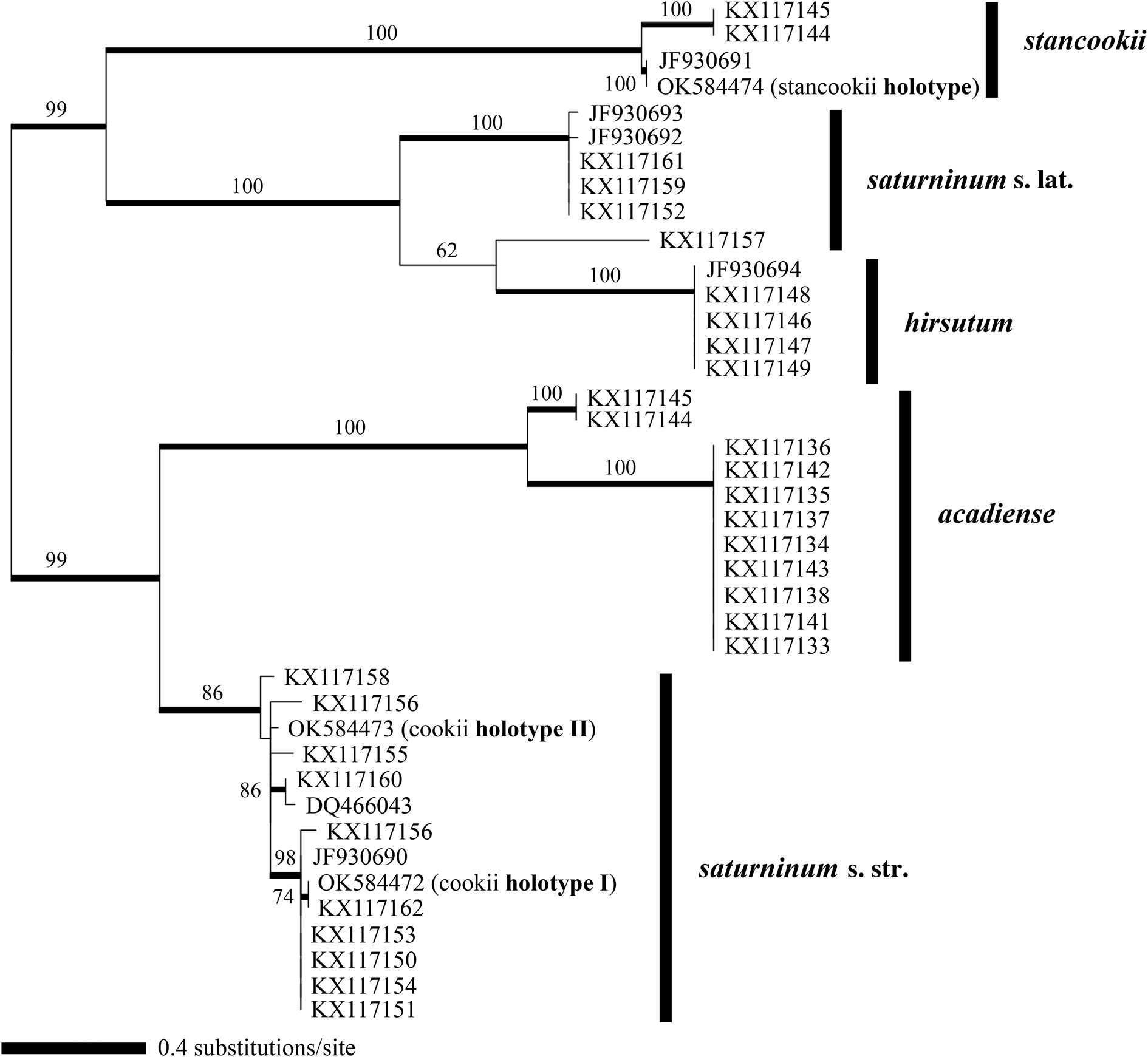
Two new ITS sequences were generated from different locations on the holotype of L. cookii (GenBank OK584472, OK584473), and a new ITS sequence was generated from an additional specimen that had previously been identified as L. cookii (GenBank OK584474). We inserted the newly generated ITS sequences into the alignment published by Stone et al. (Reference Stone, Hinds, Anderson and Lendemer2016) and reanalyzed it with the same maximum likelihood methods as were outlined in that publication. The two sequences from the holotype of L. cookii were recovered in a well-supported clade (ML: 86) with all other reference sequences of L. saturninum s. str. (Fig. 1). This result agrees with the morphological assessment of the holotype of L. cookii, which differs from the other original material morphologically in isidium shape, medulla anatomy and thallus colour. These characters instead agree with the current delimitation of L. saturninum s. str. following Stone et al. (Reference Stone, Hinds, Anderson and Lendemer2016). The newly generated sequence from material that agrees morphologically with the other sequenced specimens of L. cookii was recovered in a strongly supported clade (ML: 100) with the other reference sequences of that taxon.
Phylogeny of Leptogium saturninum and its relatives inferred from ITS sequence data and displayed as the most likely tree with midpoint rooting following Stone et al. (Reference Stone, Hinds, Anderson and Lendemer2016), but with the addition of newly generated sequences from the types of L. cookii and L. stancookii (both indicated by bold text). Thickened branches are those that were recovered with ML-BP support ≥ 70%. Sequence groups comprising morphologically defined entities recognized as species by Stone et al. (Reference Stone, Hinds, Anderson and Lendemer2016) are denoted with vertical black bars.

Based on the above information, the holotype of L. cookii corresponds to L. saturninum s. str. and the former name must be treated as a heterotypic synonym of the latter. The result is that the taxon previously referred to as L. cookii now lacks a validly published name. Here we introduce the name L. stancookii to accommodate the material previously referred to L. cookii and which agrees with the delimitation of that taxon by Stone et al. (Reference Stone, Hinds, Anderson and Lendemer2016) but is in conflict with the holotype. Importantly, we select a sequenced specimen as holotype and confirm that it belongs to the same strongly supported clade as other sequences derived from specimens of L. cookii.
Several morphological characters distinguish the two species. In both L. stancookii and L. saturninum, isidia initiate as bundles of several short fungal hyphal cells surrounding a small number of cyanobacterial cells, breaking through the upper cortex and disrupting the cortex. In L. saturninum, these isidia remain granular, while in L. stancookii they become unevenly cylindrical and often branched. This differs from isidia formation in L. compactum D. F. Stone & Lendemer and L. hirsutum Sierk, where cyanobacterial cells push upwards into a tiny papilla and the cortex expands in a continuous layer as the papilla enlarges. The thallus in L. stancookii is pale blue-grey, becoming brownish with age, while L. saturninum is medium to dark brown-grey to blackish, lacking the blue-grey colour when young. Near the thallus margins where isidia are beginning to form beneath the cortex, L. stancookii has an evenly blackened surface while L. saturninum has a pattern of dark speckles in angular groups on a brown surface. Finally, the anatomy of the medulla differs between the two species. In L. stancookii the medulla is made of hyphae that are angled but not perpendicular or parallel to the cortices, while in L. saturninum many hyphae are parallel or perpendicular to the cortices.
Leptogium saturninum (Dicks.) Nyl.
Act. Soc. Linn. Bordeaux, Ser. 3 21, 272 (1856).—Lichen saturninus Dicks., Fasc. Pl. Crypt. Brit. 2, 21 (1790).—Parmelia saturnina (Dicks.) Ach., Method. Lich. 221 (1803).—Collema saturninum (Dicks.) DC. & Lam. in Lamarck & de Candolle, Fl. Franc., ed. 3 2, 385 (1805).—Mallotium saturninum (Dicks.) Gray, Nat. Arr. Brit. Pl. 1, 399 (1821); type: Fasc. Pl. Crypt. Brit. 22, 22, tab. 6 (1790) (icon!—holotype); United Kingdom, Scotland, Perthshire, Glen Lochay, J. M. Crombie s. n. = Lich. Brit. Exs. no. 5 (BM[n.v.]—epitype).
Leptogium cookii D. F. Stone & Lendemer, Lichenologist 48, 410 (Reference Stone, Hinds, Anderson and Lendemer2016); type: USA, Alaska, Kenai Peninsula Co., Lake Clark National Park, near mouth of Horn Creek E of Chinita Ranger Station, 18 Jul. 2014, B. McCune et al. 35603 (NY!—holotype).
Leptogium stancookii D. F. Stone & Lendemer sp. nov.
Index Fungorum No.: IF558841
Type: USA, Alaska, Juneau Co., Tongass National Forest, Mendenhall Glacier Recreation Area, trail to Crescent Lake from Mendenhall Spur Rd, 4 Oct. 2011, on Alnus sitchensis, C. Derr Derr-4-Oct-01-F (NY!—holotype).
A diagnosis, detailed description and distribution map for this species were published previously under the name L. cookii by Stone et al. (Reference Stone, Hinds, Anderson and Lendemer2016: 410). As was the case for L. cookii, the epithet ‘stancookii’ honours Dr Stanton Cook, doctoral dissertation advisor of one of the authors (DS).
Acknowledgements
Thanks to Bruce McCune and Claudia Corvalán for generating the sequences that are newly published here. Additional thanks go to Matthias Schultz for first alerting us to this issue in conjunction with his studies of Leptogium from Katmai National Park. Financial support was in part provided by the OSC Lichen Herbarium Improvement Grant donated by Dr Shirley Tucker. We also thank Matthias Schultz and an anonymous reviewer for the comments on the manuscript.
Author ORCIDs
James C. Lendemer, 0000-0003-1186-0711; Daphne Stone, 0000-0001-5266-4958.