Introduction
The Alzheimer's Society (2018) estimates that the number of people diagnosed with dementia is around 850,000 in the United Kingdom, with this number forecast to rise to over 1 million by 2025. There are around 670,000 unpaid carers who provide a range of supports to persons with dementia (PWD). Caregiving is usually provided on a continuous basis and can influence carers’ well-being, creating what is referred to as “caregiver burden” (George and Gwyther, Reference George and Gwyther1986). High levels of burden are associated with depression (Riedel et al., Reference Riedel, Klotsche and Wittchen2016) and higher mortality rates (Schulz and Beach, Reference Schulz and Beach1999) in carers and also poorer care for the PWD (Brodaty et al., Reference Brodaty, McGilchrist, Harris and Peters1993). In order for health and social care interventions to be implemented to reduce burden it is imperative that the construct is adequately measured.
Caregiver burden appears to contain a high level of variability between cultures (Sousa et al., Reference Sousa, Santos, Turró-Garriga, Dias, Dourado and Conde-Sala2016) and indeed individuals. Subsequently, a few measures capture the construct's complexities and this perhaps restricts the success rates of interventions aiming to reduce burden, which to date have produced only small-moderate effects (Gilhooly et al., Reference Gilhooly2016). The Zarit Burden Interview (ZBI) (Zarit et al., Reference Zarit, Reever and Bach-Peterson1980) is a commonly used measure of burden in carers of PWD. It is a 22 item self-report scale, measuring the burden in areas of interpersonal relationships, finances, physical health, and social life as well as the burden associated with the PWD's behavior and functioning. The ZBI is widely used and has been translated into a number of languages, allowing for cultural comparisons to be made.
The ZBI sums items to create a total score, positioning burden as a unitary construct. However, research has found burden to be multi-dimensional and the ZBI to contain dimensions in addition to a global score. Springate and Tremont (Reference Springate and Tremont2014) used exploratory factor analysis (EFA) to examine the ZBI's factor structure in a sample of 206 carers of PWD in the USA. In an 18-item version of the measure, and three burden dimensions were identified, namely direct impact of caregiving, guilt, and frustration/embarrassment. Although these findings were limited by a majority Caucasian female sample, they supported burden as a multi-dimensional construct, particularly, as identified factors are in line with those found in alternative studies. For example, in a sample of 202 American carers, Knight et al. (Reference Knight, Fox and Chou2000) identified three similar factors using 14 ZBI items, such as embarrassment/anger, patient dependency, and self-criticism. This study also had greater generalizability than that of Springate and Tremont (Reference Springate and Tremont2014) with 29% of the sample being male and 34% being of African-American or other ethnicity. These factors were strengthened within the same study by use of confirmatory factor analysis (CFA) in a second independent sample of demographically similar participants. Flynn-Longmire and Knight (Reference Flynn-Longmire and Knight2011) also supported this factor structure, finding good model fit for Knight et al.’s (Reference Knight, Fox and Chou2000) three factors, in both Caucasian and African-American samples. Encouragingly, Ankri et al.’s (Reference Ankri, Andrieu, Beaufils, Grand and Henrard2005) ZBI factor analysis conducted with a French sample of 152 carers of PWD retained all 22 ZBI items to again produce three factors, such as effect on social and personal life, psychological burden, and guilt. Although item loadings differed between studies, these factors are conceptually similar to both Springate and Tremont (Reference Springate and Tremont2014) and Knight et al. (Reference Knight, Fox and Chou2000), suggesting that these areas may be particularly relevant to consider when assessing and intervening in caregiver burden.
In contrast, alternative research groups proposed a two-factor ZBI model based on a 12-item version of the measure. In 312 Canadian carers, Hébert et al. (Reference Hébert, Bravo and Préville2000) used CFA to find best model fit with two factors, i.e. role strain and personal strain. In an alternative Canadian sample of 413 carers, Bédard et al. (Reference Bédard, Molloy, Squire, Dubois, Lever and O'Donnell2001) supported this two-factor model, although their factor loadings differed from those of Hébert et al. (Reference Hébert, Bravo and Préville2000). In a further sample of 770 Canadian carers, O'Rourke and Tuokko (Reference O'Rourke and Tuokko2003) found that both an EFA and a CFA supported the two-factor model. All three studies supportive of the two-factor model were, however, carried out with Canadian samples, and when Cheng et al. (Reference Cheng, Kwok and Lam2014) used CFA to test this model with 395 Chinese carers, it did not fit the data. The Chinese sample data also showed poor fit to the three-factor model proposed by Springate and Tremont (Reference Springate and Tremont2014), Ankri et al. (Reference Ankri, Andrieu, Beaufils, Grand and Henrard2005), and Knight et al. (Reference Knight, Fox and Chou2000), suggesting that burden experience may be culturally specific. To date there exists no factor analysis of ZBI data within a UK sample, highlighting a knowledge gap in UK caregiver burden.
In addition to the ZBI factor structure, it is useful to consider relationships between burden factors and other variables relevant to the carer and PWD. In a UK sample of 74 carers for PWD, Campbell et al. (Reference Campbell2008) used multiple regression with ZBI total score as the dependent variable to investigate the predictive abilities of PWD and carer factors. Analysis identified that gender, confidence, role captivity, neuroticism, experience of adverse life events, overload, and relationship with the PWD accounted for 81.6% of the burden variance. This study was however limited by a modest sample size, restricting generalization. Furthermore, it used ZBI total score as the dependent variable, which is unlikely to have accurately accounted for burden experienced by carers due to the concept's variability.
Only Ankri et al. (Reference Ankri, Andrieu, Beaufils, Grand and Henrard2005) and Springate and Tremont (Reference Springate and Tremont2014) have explored relationships between carer/PWD variables and ZBI dimensions following factor analysis. Ankri et al. (Reference Ankri, Andrieu, Beaufils, Grand and Henrard2005) found “effect on personal and social life” to be associated with being a spouse to the PWD, increased functional dependence, and PWD's aggressiveness. “Psychological burden” was also related to increased PWD aggressiveness, while “guilt” was associated with being a child carer and depression. Ankri et al.’s (Reference Ankri, Andrieu, Beaufils, Grand and Henrard2005) analysis was however limited in its cross-sectional nature and would have benefitted from more complex inferential statistics. Springate and Tremont (Reference Springate and Tremont2014) extended these findings by use of multiple regression. They found higher levels of carer depression and younger age predicted both factor 1 (impact on life) and factor 2 (guilt). Factor 1 was also predicted by poorer carer relationship satisfaction with the PWD and less PWD functional independence. Factor 3 (embarrassment/frustration) was predicted by PWD behavioral problems and relationship satisfaction. These findings are valuable as they demonstrate that burden dimensions are predicted by a range of variables, many of which appear to amenable to intervention. Findings are, however, limited by the absence of measures reflecting the positive aspects of caregiving, which have been found to function as a protective factor against caregiver burden (Cohen et al., Reference Cohen, Colantonio and Vernich2002).
The current study aimed to expand on the work of Springate and Tremont (Reference Springate and Tremont2014) by carrying out an EFA of the ZBI in a UK sample of carers, something which to date had not been achieved. We also aimed to identify predictive variables for emerging factors, to provide further clarity on the relevance of these dimensions to UK carers of PWD.
Methods
Sample recruitment and procedure
This study was part of a wider study of carers of PWD. The wider study recruited carers via the Scottish Dementia Clinical Research Network (SDCRN). The SDCRN provided access to a database of carers throughout Scotland who were interested in taking part in research. A total of 511 carers from this database were approached, all of whom were sent an initial letter, participant information sheet, and expression of interest form. Those who wished to take part returned the expression of interest form and were sent a further information sheet, a consent form, and the questionnaire pack that included the measures described below. A total of 88 completed questionnaire packs were returned by participants approached in this way. The remaining 22 participants were recruited via voluntary carer groups and NHS clinicians, primarily to take part in an Acceptance and Commitment Therapy (ACT) group intervention. These participants completed this study's measures prior to attending their first group session.
Ethical approval for the wider study was received through South East of Scotland NHS Research Ethics Committee, NHS Lothian Research and Development, and the University of Edinburgh. All participants recruited via the wider study were anonymized in order for their data to be used in the current study. Ethical approval from the University of Edinburgh was granted once again for the current study specifically and a recommendation was provided from the South East of Scotland NHS Research Ethics Committee that no further ethical approval was required for use of the anonymized participant data.
Participants
Carers: A total of 110 carers participated: 35 males and 75 females. In total, 80.9% of carers were the spouse or partner of the PWD, while 19.1% were adult children. The average carer age was 70 years. Ethnicity was not recorded; however, all participants were English speaking and resided in Scotland. Paid carers were excluded and carers were only included if the person for whom they were caring for still resided at home.
Persons with dementia: The 110 PWD had a mean age of 77 years. All forms of dementia diagnosis were included. No active participation was required of PWD by this study, and all information on PWD was provided by carers.
Measures
Zarit Burden Interview (Zarit et al., Reference Zarit, Reever and Bach-Peterson1980): The original, 22-item ZBI was completed by carers rating their degree of burden on a Likert scale ranging from 0 to 4. Scores are summed to create a total, with scores above 21 indicating mild–moderate burden, above 41 indicating moderate–severe burden, and above 61 indicating severe burden. The measure has good internal consistency and test–retest reliability (Hébert et al., Reference Hébert, Bravo and Préville2000).
Experiential Avoidance in Caregiving Questionnaire (Losada et al., Reference Losada, Márquez-González, Romero-Moreno and López2014): The EACQ was used to measure experiential avoidance (EA) in the context of caring for PWD. EA relates to “persons being unwilling to remain in contact with particular private experiences (e.g. emotions) and taking steps to alter the form or frequency of these events and the contexts that occasion them” (Hayes et al., Reference Hayes, Wilson, Gifford, Follette and Strosahl1996, p. 1154). Carers were asked to rate 15 statements regarding EA and caregiving on a Likert scale ranging from 1 to 5. A total score is achieved by summing items, with higher scores indicating higher levels of EA. The author's report the EACQ's total score to have acceptable reliability (a = 0.70).
The Positive Aspects of Caregiving Scale (Tarlow et al., Reference Tarlow, Wisniewski, Belle, Rubert, Ory and Gallagher-Thompson2004): PACS is a nine-item scale measuring positive aspects of caregiving such as feelings of usefulness and importance. Carers used a five-point Likert scale to rate nine positive statements related to how caregiving makes them feel. Items are summed to create a total score with higher scores reflecting more positive caregiving experience. Scale reliability is very good (a = 0.89) (Tarlow et al., Reference Tarlow, Wisniewski, Belle, Rubert, Ory and Gallagher-Thompson2004).
The Dysexecutive Questionnaire (Wilson et al., Reference Wilson, Evans, Emslie, Alderman and Burgess1998): The DEX is a 20-item questionnaire measuring problems that may occur in dysexecutive syndrome in Dementia. Problems are measured by reference to changes in the PWD within four categories, namely emotional/personality, motivational, behavioral, and cognitive. Carers completed the DEX based on their experiences of the PWD using a five-point Likert scale. Items are summed to create a total score with higher scores indicating more problems for the PWD. Bennett et al. (Reference Bennett, Ong and Ponsford2005) found high internal consistency (a = 0.93) in the DEX for family member reports of patients with traumatic brain injury. More research is required to clarify the reliability of the DEX in carers of PWD specifically; however, the measure is widely used in this population.
Carer and PWD demographics: Carers completed a short questionnaire that obtained information on carer/PWD age, carer gender, and relationship to PWD. To protect PWD anonymity and to reduce disruption, no other PWD information was collected by this study.
Statistical analysis
Descriptive and inferential statistics were computed through use of SPSS version 22. An EFA was carried out on the 22-item ZBI using principal axis factoring with Oblimin rotation. Statistical significance was considered as p values below 0.05 and two-tailed tests were used. Relationships between factor scores and carer/PWD outcome measures were explored using Pearson correlations. Significant variables were then entered into three different multiple regression models using the forced-entry hierarchal method with each factor score functioning as a dependent variable.
Results
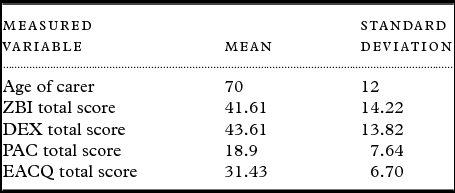
Mean ZBI score was 41.61 (see Table 1), indicating that the average participant in this study experienced moderate to severe burden (Zarit and Zarit, Reference Zarit and Zarit1987). Scores ranged from 14 to 69 (maximum possible score 88), with a median of 42. Item scores were normally distributed and the reliability of the whole scale was very good with an internal consistency of a = 0.91.
Mean and standard deviations of measured carer variables

Factor analysis was deemed to be a suitable statistical method as according to the Kaiser–Meyer–Alkin measure of sampling adequacy at 0.891, all items were found to measure a common factor. Bartlett's test of sphericity showed that the correlation matrix was suitable for factor analysis at 1033.99, p < 0.000. Five items were excluded from the factor analysis due to problematic correlation values (see Appendix 1). Three factors which had eigenvalues greater than 1 were extracted, accounting for 53.45% of the total variance, and all three factors were retained (see Table 2). The first factor that accounted for 43.29% of the variance reflects the direct impact of caregiving on carer's lives. The second factor, accounting for 5.73% of the variance, was characterized by uncertainty over the future. The final factor explaining 4.43% of the variance encompassed frustration and embarrassment.
Pattern matrix for principal axis factoring with Oblimin rotation

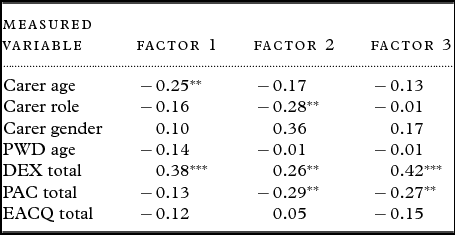
Scores on factor 1, direct impact of caregiving, were inversely correlated with carer age (r (108) = −0.25, p = 0.008) (see Table 3). Factor 1 scores were also associated with DEX total (r (108) = 0.38, p = 0.000). When multiple regression was applied with carer age and DEX total entered as predictors, only DEX total emerged as a significant predictor, explaining 14% of the variance (B = 0.028, t = 4.36, df = 108, p < 0.001), model fit: R₂ = 0.15, F(1,108) = 19.05, p < 0.001.
Correlations between PWD/carer variables and factor scores

*p < 0.05.
**p < 0.01.
***p < 0.001.
Factor 2, uncertainty over the future scores, was positively correlated with DEX total (r (108) = 0.26, p = 0.005) and inversely correlated with relationship to PWD (r (108) = −0.288, p = 0.002) with spouses scoring significantly lower on this factor than adult children (−0.13 vs. 0.59, t (108) = 3.125, p = 0.002). PAC total was also inversely related to factor 2 scores (r (108) = −0.291, p = 0.002). Multiple regression identified all correlated variables to emerge as significant predictors for factor 2, explaining 14% of the variance. DEX total: (B = 0.13, t = 1.92, df = 108, p < 0.05), relationship to PWD: (B = −0.509, t = −2.17, df = 108, p < 0.05), and PAC total: (B = −0.027, t = −2.25, df = 108, p < 0.05), model fit: (R₂ = 0.16, f (3,106) = 7.05, p < 0.01).
Frustration/embarrassment factor scores were positively correlated with DEX total (r (108) = 0.42, p = 0.000) and inversely correlated with PAC total (r = (108) = −0.27, p = 0.003). In multiple regression, both DEX total (B = 0.028, t = 4.37, df = 108, p < 0.01) and PAC total (B = −0.026, t = −0.196, df = 108, p < 0.05) emerged as significant predictors of factor 3, accounting for 20% of the variance. Model fit: R₂ = 0.217, F (2,107) = 14.81, p < 0.001.
Discussion
This study identified three dimensions of caregiver burden, namely direct impact of caregiving, uncertainty around the future, and frustration/embarrassment. In line with variance explained in similar studies (Ankri et al., Reference Ankri, Andrieu, Beaufils, Grand and Henrard2005; Springate and Tremont, Reference Springate and Tremont2014), these factors explained 53.45% of the total variance in the concept. Two factors identified in this study, such as direct impact of caregiving and frustration/embarrassment, are conceptually similar to factors found by Springate and Tremont (Reference Springate and Tremont2014) and Ankri et al. (Reference Ankri, Andrieu, Beaufils, Grand and Henrard2005) in the USA and French samples, respectively. Also, in line with these studies, the most variance was explained by a factor that encompasses the personal and objective impact of caregiving, highlighting the ongoing need for increased support and respite for carers across cultures.
“Guilt” did not emerge as a factor as it did in previous studies, with “uncertainty over the future” emerging instead. This is a new dimension and suggestions can be made regarding its occurrence in this sample. First, spousal carers scored significantly lower on this factor than adult-children. This is in line with Springate and Tremont (Reference Springate and Tremont2014) who found spouses reported significantly less “direct impact of caregiving” and “guilt” burden than adult-children. Adult-children may have busier lives than spouses, very often with child-care and working responsibilities in addition to caring for the PWD. Indeed, Conde-Sala et al. (Reference Conde-Sala, Garre-Olmo, Turró-Garriga, Vilalta-Franch and López-Pousa2010) found burden to be greater in adult-child carers for PWD generally, and particularly for those who had other familial duties. Subsequently, adult-children may feel particularly burdened by “uncertainty over the future” due to increased worry over how long they can maintain their level of caregiving in addition to other responsibilities. Additionally, this finding highlights that burden is experienced differently across carer roles and that tailored interventions, which target specific burden dimensions of different caregivers may be more effective in reducing the same. “Guilt” failing to emerge as a factor may be linked to the particularly high burden rate evidenced by this study's participants. The mean ZBI score of 41.6 falls within the moderate-severe range (Hébert et al., Reference Hébert, Bravo and Préville2000) and is higher than mean ZBI scores found by Springate and Tremont (Reference Springate and Tremont2014) (M = 38.03) and Ankri et al. (Reference Ankri, Andrieu, Beaufils, Grand and Henrard2005) (M = 32.9). Hypothetically, this higher level of burden may reduce guilt as carer awareness of how much they are doing may be greater.
DEX total score significantly predicted “direct impact of caregiving,” indicating that carers with greater difficulties experience higher levels of burden. This finding is consistent with Springate and Tremont (Reference Springate and Tremont2014) and reinforces the strength of the linear relationship between PWD dementia severity and caregiver burden. DEX total score was the only variable to predict all three burden factors, highlighting a need for carers of those at later stages of dementia to be offered increased support/respite due to the various dimensions of burden this can lead to.
PAC total score inversely predicted the newly emerged “uncertainty over the future” factor. This indicates that carers who report higher levels of positive aspects of caregiving experience less of this burden type. Similarly, PAC total score inversely predicated frustration/embarrassment. These findings are unique within the literature as although previous studies have found positive aspects of caregiving to be associated with lower levels of burden generally (Cohen et al., Reference Cohen, Colantonio and Vernich2002) and higher rated quality of life (Sánchez-Izquierdo et al., Reference Sánchez-Izquierdo, Prieto-Ursúa and Caperos2015), no other study has identified the predictive quality of positive aspects of caregiving to specific burden dimensions. Our findings suggest that having an increased awareness of positive aspects of caregiving provides a protective function against these burden types. Therefore, interventions that encourage carers to be mindful of the same may prove beneficial. An RCT by Losada et al. (Reference Losada2015) compared an ACT intervention (which incorporated mindfulness around carer values) to cognitive behavioral therapy (CBT) and treatment as usual for carers of PWD. They found 36% of ACT condition participants to be recovered at follow-up compared to 26.32% of CBT participants. Significant reduction in EA was also found only for ACT condition participants, highlighting the possible benefits of ACT over CBT for carers. Research in this area does however remain in its infancy and future studies comparing differences in specific burden dimensions pre- and post-ACT intervention would be a valuable addition to the evidence base.
In terms of limitations, this study's sample size was modest. A convenience sample of carers who had registered with a research agency was also used and therefore results may not generalize to the average carer of PWD. Nonetheless, our sample reported higher levels of burden than other caregiver samples in the current literature. It is unfortunate that although the sample consisted of UK-only residents, due to the anonymity of participants, it was not possible to identify cultural differences that have been identified in other studies (e.g. Flynn-Longmire and Knight, Reference Flynn-Longmire and Knight2011). Similarly, as this study used secondary data collected by a wider research project, it was restricted to use of the data that the wider project provided. As such, we could not report on important details such as type or duration of dementia and measure whether these variables were predictive of caregiver burden types. This is a limitation that we hope future research will seek to surpass via use of primary data.
This study has contributed to the knowledge base in finding caregiver burden to be a multi-dimensional construct. The study extended previous findings by use of a UK sample that had higher burden levels than samples from other countries. Although two of this study's factors namely “direct impact of caregiving” and frustration/embarrassment are similar to those found by Springate and Tremont (Reference Springate and Tremont2014) and Ankri et al. (Reference Ankri, Andrieu, Beaufils, Grand and Henrard2005), a new factor “uncertainty over the future” emerged. This provided further insight into burden, which varies across cultures and carer role. Our findings emphasize the need for burden to be measured dimensionally rather than as a unitary construct in order for specific dimensions to be targeted more effectively. Finally, this study provided novel information on variables, which predict burden dimensions. Uniquely, we highlighted the benefits of carers having an awareness of the positive aspects of caregiving. Future research may wish to build on these findings in order to contribute toward an evidence-base for interventions, which reinforce the positive aspects of caregiving, which this study has found function as a protective factor to this global health concern.
Conflict of interest
None.
Description of authors’ roles
Dr. K.J. Smith designed the study, received ethical approval, carried out all statistical analyses, and wrote the study in its current form. Dr. C. George collected the data used within the study as part of a wider research project, received ethical approval for the same, agreed to share the data within the research team of the current three authors and was involved in discussion regarding study design and data usage. Dr. N. Ferreira supported the design and statistical analysis.
Acknowledgments
This work was supported by the Scottish Dementia Clinical Research Network who received funding from Scottish Ministers through the Chief Scientist Office. The views expressed in this publication are those of the authors and not necessarily those of Scottish Ministers or the Chief Scientist Office.
Appendix 1
ZBI items removed prior to factor analysis
Item number
1. Do you feel that your relative asks for more help than he/she needs?
8. Do you feel your relative is dependent on you?
14. Do you feel that your relative seems to expect you to take care of him/her as if you were the only one he/she could depend on?
20. Do you feel you should be doing more for your relative?
21. Do you feel you could do a better job in caring for your relative?
Appendix 2
List of abbreviations
- ACT
Acceptance and Commitment Therapy
- CBT
Cognitive behavioral therapy
- CFA
Confirmatory factor analysis
- DEX
Dysexecutive Questionnaire
- EACQ
Experiential Avoidance in Caregiving Questionnaire
- EFA
Exploratory factor analysis
- PACS
Positive Aspects of Caregiving Scale
- PWD
Person(s) with dementia
- RCT
Randomized controlled trial
- SDCRN
Scottish Dementia Clinical Research Network
- UK
United Kingdom
- USA
United States of America
- ZBI
Zarit Burden Interview