




No CrossRef data available.
Article contents
Factors associated with location of death of children with cancer in palliative care
Published online by Cambridge University Press: 07 December 2005
Abstract
Objective: The aim of this study was to identify factors associated with location of death of patients receiving palliative care in a pediatric oncology unit.
Methods: A palliative care program was developed in the pediatric department in order to provide specialized attention to the patient and family in end-of-life. The program is coordinated by a nurse, delivering a simultaneous interdisciplinary team approach with focus on identification and training of a family care provider as well as local resources supplemented by support of a social worker and the community. All 87 patients in palliative care were followed by the team. The factors associated with the location of death (home or hospital) were evaluated for the 71 patients who died prior to analysis.
Results: Forty-two (59%) patients died at home. Factors significantly associated with dying at home were: male with an Odds Ratio (OR) = 3.80, 95% Confidence Interval (CI) = 1.26–11.76; public health insurance (OR) = 4.95, 95%[CI] = 1.03–26.75, low educational level of the caregiver (OR) = 11.11 95%[CI] = 1.65–94.66 and low educational level of the mother (OR) = 7.07 95%[CI] = 1.37–40.14. Gender was the only independent factor associated with location of death: a boy had a higher risk of dying at home, (OR) = 4.25, 95%[CI] = 1.37–13.21 when compared to a girl.
Significance of results: In our society we are still not able to provide hospice care or home care for all children, although increasing emphasis has been placed on utilizing local resources. Even though we had increased the number of desired home deaths, it is still a challenge to meet patients and families' requests. A team approach, the recognition of the factors involved, and adequate health and community support have helped us to meet the child and family's needs.
Information
- Type
- Research Article
- Information
- Copyright
- © 2005 Cambridge University Press
INTRODUCTION
Despite the advances in pediatric oncology and the technological resources available for treating childhood cancer, about 25% of children with cancer eventually die of their disease. The primary task of the multidisciplinary team for these patients and their families is to offer comfort and dignity by providing palliative care assistance. Many studies have shown that most terminally ill cancer patients prefer to die at home (Townsend et al., 1990; Karlsen & Addington-Hall, 1998). The question regarding exploration of the place of death and the factors associated with this event in our population has lead us to develop this study so that we could learn about it and improve the palliative care provided according to the setting. Regardless of whether the child with advanced cancer dies at home or in the hospital, he usually spends most of his time at home (Hinton, 1994). Feudtner et al. (2002) stated that there is an increasing number of children with complex chronic diseases dying at home. A home death seems to be desired by most of the patients and its success depends on many factors, such as family support and multidisciplinary team assistance (Robbins, 1998). The purpose of this study was to review the place of death of our pediatric patients in palliative care and to explore factors that predict death at home versus death in hospital.
METHODS
At the Pediatric Department of Centro de Tratamento e Pesquisa Hospital do Cancer, all 87 children from 1 to 22 years old (median 12 years old) in palliative care were followed prospectively and evaluated from May 1999 to December 2001, in accordance to the institutional ethics committee. Our palliative care program includes an interdisciplinary team approach (pediatric oncologist, nurse, psychologist, psychiatrist, social worker, physical therapist, nutritionist, specialists in pain control), coordinated by a nurse, dedicated exclusively to meet the patient's and families' needs and wishes. The team approach begins at the communication of the palliative condition of the patient and continues throughout his life and transition through death, including the coping and the bereavement process. The team interventions are discussed previously within the group with shared decision making process according to each area of expertise. The family-centered support allows the child to be maintained in the preferred setting (home or hospital) most of the time, using the following standards: 24 hour/7 day/week on call availability of a pediatric oncologist at the hospital and by the phone; contact with clinicians of the nearest to home hospital facility for the patient; education and training of the home caregiver; support for decision-making regarding treatment options; location of care and quality of life issues regarding their own beliefs; home visit by the social worker and providing access to community resources; early intervention for developing symptoms using complementary therapies such as acupuncture; and assistance with funeral arrangements.
The variables collected at the inclusion of palliative care included:
Social-demographic variables:
- Gender
- Age
- Race
- Health insurance
- Home care provider (family member which will be the main care provider after adequate training)
- Number of siblings
- Position within family composition
- Attendance to school
- Patient's educational background
- Home care provider's educational background
- Mother's educational background
- Father's educational background
Clinical and laboratory variables
- Diagnosis
- Play Performance Status (PPS) Lansky and Karnofsky scales
- Laboratory tests
- Palliative treatment proposed
Location of Death
In our department, we consider home deaths those that occurred at home as well as terminal admissions with less than 48 hours hospitalization. Whenever the patient's death occurred after 48 hours or more of hospitalization, independent of whether it was in our hospital or other hospitals, we considered it a hospital death.
Our proposal was to identify factors associated with location of death (home or hospital) using social-demographic, clinical, and laboratory variables. Information for the 35 variables was available for 70 patients. Information was recorded by a pediatric oncology nurse as well as by a pediatric oncologist on a form specifically designed for the palliative care group. At the time of evaluation, only 16 patients were alive. Follow up was lost in one case.
STATISTICAL ANALYSIS
We evaluated the factors associated with location of death among 35 variables. To determine which variable was associated with the risk of death in a hospital versus home, we created cross-tabulations of categorical variables that were evaluated through chi-square tests of significance and odds ratio tests. Variables which were associated with location of death with significance levels of p value < 0.20 were then included into a multivariate logistic regression model (Cox). In the final model, the level of statistical significance was equal to 5%.
RESULTS
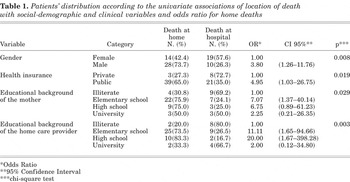
Regarding location of death, 59% of our patients died at home. Gender and health insurance were associated with location of death: 73.7% of the male patients died at home (OR = 3.8 and p = 0.008) and 65.0% of the patients with public insurance died at home (OR = 4.9 and p = 0.019). Although age was not statistically significant, we identified a tendency for more children between 6 to 10 years old to die at home (78.6%) than did the other ages (p = 0.362). There were no associations between location of death and race, family composition, educational background of the patient, educational background of the father, or religion. The educational background of the home care provider and the mother were also associated with location of death. Patients with an illiterate or university degreed home care provider/mother were more likely to die at the hospital than did the other educational backgrounds. Patients with a home care provider or a mother with an elementary education or a high school degree were more likely to die at home than did the other educational backgrounds. From children with illiterate home care providers, 80.0% died in the hospital: OR = 1.0 95%[CI]. From children with home care providers with university degrees, 66.7% died in the hospital: OR = 2.0 95%[CI] = (0.12–34,80); (p = 0.003). For patients whose mothers had elementary education, 75.9% died at home: OR = 7.07 95%[CI] = (1,37–40,14); (p = 0.029). For those patients whose mothers had a high school degree, 75.0% of them died at home: OR = 6.75 95%[CI] = (0.89–61.23); (p = 0.029). There was no association between location of death and clinical and laboratories variables, although regarding diagnosis, 68.8% of our patients with leukemia died at home while 50.0% of the patients with CNS tumors and 56.9% of the patients with solid tumors died at home (p = 0.651). The factors identified as significantly (p < 0.20) associated with location of death were: gender, health insurance category, educational background of the mother, and the educational background of the home care provider (Table 1).
Patients' distribution according to the univariate associations of location of death with social-demographic and clinical variables and odds ratio for home deaths

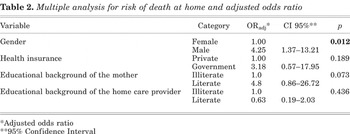
By using the Cox regression model, gender was the only independent factor associated with location of death (Table 2). Odds of dying at home were increased in male patients compared to female.
Multiple analysis for risk of death at home and adjusted odds ratio

DISCUSSION
One important step toward understanding the illness trajectory of cancer patients is to better understand the predictors of place of death (Bruera et al., 2002), in order to deliver adequate holistic care. Unfortunately for our population, the information regarding children's and families' preference for place of death was not available, making it difficult to determine whether they died in a setting of their choice.
Adam (1997) described that during the final 48 hours of life, patients experience increasing weakness and immobility, loss of interest in food and drink, difficulty swallowing, and drowsiness. The priority is then given to the control of symptoms and family support. This is a time when levels of anxiety, stress, and emotion can be high for patients, families, and other caregivers. It is important that the healthcare team adopts a sensitive yet structured approach. Reassurance that help is available can assist the family in choosing a place of death.
Many authors have described that age and gender are significant factors associated with location of death (Grande et al., 1998; Bruera et al., 1999). According to these studies, female and older patients were less likely to die at home, because of difficulties in accessing home care and the suggestion that men were less efficient as carers. In our study, the risk of dying at home increased independently only in the male gender. A boy had a higher risk to die at home than a girl (OR = 4.25), independent of their health insurance category, educational background of the mother, or the educational background of the home care provider. We could suggest that this result may reflect our cultural beliefs that males are taught to be strong and fearless, even though they tend to avoid hospitalization and painful procedures. Girls seem to be less fearful about hospitalization in our experience.
The concepts and reactions to fear and death in children vary according to the age as they are in particular cognitive phase (Anonymous, 2000). In our study, age was not statistically significant, although we have identified a tendency for more children between 6 to 10 years old to die at home (78.6%) than did the other ages (p = 0.362), suggesting that in this category, children may be more likely to start participating in the decision-making process and wish to stay at home.
Family composition was not significantly associated with location of death, although our findings have shown an increased number of home deaths when the patient was a second child. It may be related to the involvement of the older brother/sister in care giving. Cantwell et al. (2000) showed that the presence of more than one caregiver was also predictive of home death.
In our population, factors such as pain and low play performance status were not significantly associated with hospital deaths, suggesting that pain was not responsible for hospitalization, probably due to adequate pain control. As Bruera et al. (2002) found in their study, we believe the establishment of an integrated care system with interdisciplinary team and community support more likely increases the proportion of patients whose place of death reflects their preference, and probably results in more deaths at home. Although we had increased the number of desired home deaths, it still remains a challenge to meet patients and families' requests (Kurashima & de Camargo, 2003).
A home death involves many economic, cultural, supportive, and family-centered issues. In our society, most of the patients are from public insurance, which does not include access to home care. Even though we are still not able to provide hospice care or home care for all children, neither private nor public health insurance was significantly associated with location of death. As Bruera (1993) stated in his study, we also suggest that the increased emphasis placed on utilizing a family member as caregiver, and local resources have been helped us offer our children feasible care. These findings also suggest that the patients' preference for a home or a hospital death might be realized on a more consistent basis if a palliative care program were available.
The interdisciplinary team should advise and assist families in responding to the child's needs. Early development of a shared decision making program might enable children to receive end-of-life care with parents' involvement, and ultimately die where they feel more comfortable. Sharing family support and communication have been associated with positive long-term bereavement adjustment (Anonymous, 2000).
Although we have no previous analysis regarding location of death before the creation of the palliative care team, our study shows that we had decreased the number of hospital deaths with long periods of hospitalization. This may reassure the importance of a team approach to empower the patient and the family to achieve their own wishes.
Johnston (1999) has shown that taking care of the dying patient and his family is primarily a responsibility of the nursing team. In our interdisciplinary group, the nursing role begins with the recognition of the child's needs, an attempt to respect the child's wishes, the coordination of efforts to maintain a level of dignity, quality of life, and quality of care wherever he decides to be. Future studies may also identify the patients' and families' wishes, other specific characteristics, and the likelihood of a home/hospital death, giving us the resources to better address their wishes.
CONCLUSION
By identifying gender as one of the actual factors associated with location of death, it is possible to take the first step toward addressing individualized and adequate care as well as design future studies to provide adequate support in advance to whatever the patient might need. Strong interdisciplinary support through the creation of a palliative care team plays a fundamental role for patients without professional home care, as the basis of the care is centered on educating the primary care provider (family member). The team approach, the recognition of the other factors involved, and adequate health and community support will help us to improve the accomplishment of the child's wishes in the future.
References
REFERENCES
Anonymous.
(2000).
The pediatrician and childhood bereavement. American Academy of
Pediatrics. Committee on Psychosocial Aspects of Child and Family
Health.
Pediatrics,
105,
445–447.Google Scholar
Bruera, E.
(1993).
Palliative care in Latin America.
Journal of Pain and Symptom Management,
8,
365–368.Google Scholar
Bruera, E.,
Neumann, C.M.,
Gagnon, B.,
et al.
(1999).
Edmonton Regional Palliative Care Program: Impact on patterns of
terminal cancer care.
CMAJ, 10, 161(3),
290–293.Google Scholar
Bruera, E.,
Russell, N.,
Sweeney, C.,
et al.
(2002).
Place of death and its predictors for local patients registered at a
comprehensive cancer center.
Journal of Clinical Oncology,
20,
2127–2133.Google Scholar
Cantwell, P.,
Turco, S.,
Brenneis, C.,
et al.
(2000).
Predictors of home death in palliative care cancer patients.
Journal of Palliative Care,
16,
23–28.Google Scholar
Feudtner, C.,
Silveira, M.J., &
Christakis, D.A.
(2002).
Where do children with complex chronic conditions die? Patterns in
Washington State, 1980–1998.
Pediatrics,
109,
656–660.Google Scholar
Grande, G.E.,
Addington-Hall, J.M., &
Todd, C.J.
(1998).
Place of death and access to home care services: are certain patient
groups at a disadvantage?
Soc Sci Med,
47(5),
565–579.
Review.Google Scholar
Hinton, J.
(1994).
Can home care maintain an acceptable quality of life for patients
with terminal cancer and their relatives?
Palliative Medicine,
8,
183–196.Google Scholar
Johnston, B.
(1999).
Overview of nursing developments in palliative care. In
Palliative Care the Nursing Role,
Lugton, J. &
Kindlen, M. (eds.).
Edinburgh:
Churchill Livingstone.
Karlsen, S. &
Addington-Hall, J.
(1998).
How do cancer patients who die at home differ from those who die
elsewhere?
Palliative Medicine,
12(4),
279–286.Google Scholar
Kurashima, A.Y. &
de Camargo, B.
(2003).
Palliative and terminal care for dying children.
Med Pediatr Oncology,
40(1),
72.Google Scholar
Robbins, M.
(1998).
Evaluating Palliative Care: Establishing the Evidence Base.
New York:
Oxford Medical Pu.
Townsend, J.,
Frank, A.O.,
Fermont, D.,
et al.
(1990).
Terminal cancer care and patients' preference for place of
death: A prospective study.
BMJ,
301(6749),
415–417.Google Scholar
Patients' distribution according to the univariate associations of location of death with social-demographic and clinical variables and odds ratio for home deaths
Multiple analysis for risk of death at home and adjusted odds ratio
 You have
Access
- 28
- Cited by