Introduction
The provision of beds in the secure estate is anticipated to plateau (Centre for Mental Health, 2011) in conjunction with a policy drive to manage individuals in the least restrictive environment. At the same time, the use of the Mental Health Act 1983 to compulsorily detain individuals presenting with risky behaviour as a consequence of suspected or established mental disorder has continued to increase (Health & Social Care Information Centre, 2013). Diversion of mentally disordered offenders to hospital from custodial and other settings also remains an important policy direction (Bradley, Reference Bradley2009) with an ongoing drive to divert mentally disordered offenders from custody where appropriate. In the context of this complex interaction of policy, aversion to risk, and financial and ethical restrictions concerning the use of secure services, it is not unreasonable to anticipate that the psychiatric intensive care unit (PICU) and general services may encounter individuals with traditionally ‘forensic’ problems in routine clinical practice. This article concerns itself specifically with the issue of those who have a history of, present to services with, or demonstrate through the course of an admission, firesetting behaviours and risks, and proposes a care pathway approach for their assessment and management. Many professionals understandably use the terms ‘firesetting’, ‘arson’, and ‘pyromania’ interchangeably. By default, we shall restrict our terminology here to ‘firesetting’ or ‘firesetters’, classifying ‘arson’ as a distinct sub-group of firesetting that has attracted a conviction (see Box 1 for definitions).
Box 1 Definitions
1. Arson – the crime: this is defined in Section 1 of the Criminal Damage Act (1971), which refers to the unlawful destruction or damage of property (either actually or by intention), or reckless behaviour that might cause such destruction or damage, and also the intent to endanger the life of another in this way. Thus ‘arson’ comprises the specific criminal act of destruction, comprising the specific criminal act of intention; an ‘arsonist’ has been convicted of the crime of arson.
2. Firesetting – the behavioural phenotype: a broad definition encompassing the behavioural phenotype consisting of deliberate setting of fires, which may or may not have been prosecuted for a number of reasons
-
∙ Insufficiently severe to cause damage
-
∙ Fire not detected as deliberate
-
∙ Not possible to identify who has set the fire
-
∙ Insufficient evidence to secure a conviction
-
∙ Young age of the fire setter.
3. Pyromania – the psychiatric impulse control disorder: also known as pathological firesetting, the ICD-10 (F63.1) categorises it as a disorder of adult personality and behaviour: a ‘disorder characterized by multiple acts of, or attempts at, setting fire to property or other objects, without apparent motive, and by a persistent preoccupation with subjects related to fire and burning. This behaviour is often associated with feelings of increasing tension before the act, and intense excitement immediately afterwards.’ (World Health Organization, 2014). This behaviour cannot be more appropriately explained by organic mental disorder, intoxication with substances, mental illness such as schizophrenia, antisocial personality disorder or conduct disorder.
NB The DSM-5 (American Psychiatric Association, 2013) re-classified pyromania from a distinct disorder in itself to a subset of ‘impulse disorders not otherwise specified.’
There have been a number of recent publications (e.g. Gannon and Pina, Reference Gannon and Pina2010; Dickens et al. Reference Dickens, Sugarman and Gannon2011) which provide an in-depth analysis of various aspects of firesetting behaviour, from epidemiology, classifications and motivations to association with mental disorder. It is not our intention to discuss these in depth here as they provide detailed information for the interested reader. In order for the reader to make best use of the proposed care pathway however, there are some aspects that require further explanation. These include some of the recent evidence of an association between mental disorder and firesetting, and the action systems framework as a theory to understand motivations in firesetting.
Firesetting And Mental Disorder
The association between firesetting and mental disorder is reasonably well established, although complex and difficult to fully characterise. It has been extensively reviewed elsewhere (e.g. Dickens et al. Reference Dickens, Sugarman and Gannon2011), and we will only briefly outline the relationship here. The most persuasive data arises from the National Epidemiologic Study on Alcohol and Related Correlates (NESARC) (Blanco et al. Reference Blanco, Alegría, Petry, Grant, Simpson, Liu, Grant and Hasin2010), which demonstrated that a third of firesetters had a diagnosable mental disorder and more than half were diagnosed with a psychiatric disorder and had a psychological motive during the time of reporting. In particular, mental disorders associated with impulse dysregulation were strongly represented, including personality disorder, bipolar affective disorder and substance misuse. In relation to psychosis, Anwar et al. (Reference Anwar, Långström, Grann and Fazel2011) carried out a case control study using data from Swedish national registers for convictions and hospital discharge diagnoses. They calculated odds ratios for men and women with arson convictions having a schizophrenia diagnosis as 22.6 and 38.7 respectively, and for any other psychosis as 17.4 and 30.8 respectively. Arguably, given the prominence of psychotic illness in the inpatient environment, this study (in conjunction with the Blanco et al. (Reference Blanco, Alegría, Petry, Grant, Simpson, Liu, Grant and Hasin2010) data) may provide one of the most helpful indicators of the attention that should be given to firesetting screening, risk assessment and management in this group. With regard to the extent to which firesetting may be found within the healthcare setting, the total number of deliberate fires have fallen from 33 752 in 2001–02 to 12 791 in 2011–12, although as a percentage this has remained fairly stable. Reasons for this may include increased fire safety awareness and government policy, but could be reasonably be postulated to under-reporting in busy services, and for such behaviours to be more likely to lead to a criminal justice process prior to an admission.
Classification Systems And The Action Systems Model
There have been various classification systems and theoretical models proposed that attempt to describe firesetting. These can be broadly be described as typological (focusing on motivations) or incorporating systems theory. In a recent review, Gannon and Pina (Reference Gannon and Pina2010) noted that many of the traditional classifications have no empirically derived data and are usually lists of potential motivations and psychotherapeutic sexualised motivations that have been superseded (see Gannon and Pina (Reference Gannon and Pina2010) for a more detailed discussion of these). Instead an ‘Action Systems Framework’ as applied to firesetting has been developed, which satisfies multiple criteria for the evaluation of competing theories, these being: empirical adequacy, external consistency, unifying power, fertility and explanatory depth (Fritzon, Reference Fritzon2011).
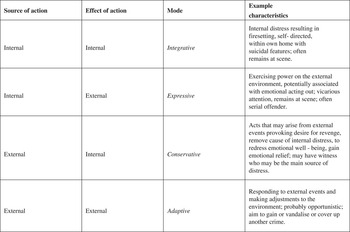
Fritzon (Reference Fritzon2011) applied systems theory to firesetting, and created the ‘Action Systems Model’. This model differentiates behaviour according to its origin (i.e. internal or external) and its desired locus of effect (internal or external). She described and developed the application of the four modes of functioning (expressive, conservative, integrative and adaptive) based on research in multiple studies (e.g. Almond et al. Reference Almond, Duggan, Shine and Canter2005). Figure 1 describes these modes of functioning.
Action Systems Model as applied to firesetting and arson

Miller and Fritzon (Reference Miller and Fritzon2007) also demonstrated concordance between the mode of functioning in relation to firesetting behaviour and self-harming behaviour, and comparison has also been made with the more established and evidenced model for sexual offending (Fritzon, Reference Fritzon2011). Overall, the Action Systems Model is evolving and gradually developing an evidence base to support a unifying explanatory theory for firesetting behaviour that has the potential to incorporate findings from other models and typologies. In so doing, it also forms a basis on which to begin to assess risk, and to identify and direct potential treatment modalities. We would encourage any clinician who encounters firesetting behaviour and wishes to gain a greater understanding of the individual motivation, to familiarise themselves with this model.
Care Pathways As A Strategy To Improve Quality
Care pathways are an increasingly used and recommended structure within health settings through which care can be delivered to a patient or group of patients in a logical and organised way. The ability to design and implement care pathways is an important clinical leadership skill. Originally derived from industrial and commercial settings using process mapping to enhance cost effectiveness, productivity and profitability, some of the fundamental concepts have been applied to healthcare processes and are recognised to occupy a core position in the provision of safe and effective healthcare. The National Institute for Health and Care Excellence (NICE) now develop evidence-based care pathways as a matter of routine. Through the mapping of processes within healthcare it is possible to estimate associated volumes of patients, costs of service delivery, and to identify areas for service improvement, as well as areas of good practice. They can also be used to compare processes and systems between different services, and provide a useful framework to make structured comparisons (for further examples of care pathway usage see e.g. Hillier et al. Reference Hillier, Lambourne and Gram Larsen2012; Spencer et al. Reference Spencer, Gilluley and Hillier2013).
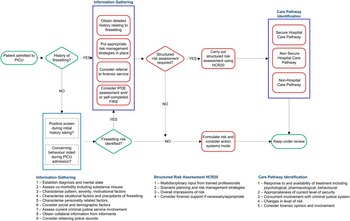
Figure 2 shows a proposed care pathway constructed through combining information based on research associations and findings relating to firesetting and mental disorder. The aim is to provide guidance as to how to approach patients admitted to hospital with firesetting risk or behaviour. The rationale for the approach is elaborated under the individual headings below.
Proposed care pathway for assessment and management of firesetting behaviour (colour online)

Clinical And Risk Assessment In The Picu: Rationale For The Care Pathway
Diagnostic considerations
Many mental disorders are associated with poor impulse control as a core feature of their psychopathology and behavioural disturbance. Psychosis, intellectual disability, autistic spectrum disorders, substance misuse disorder (especially alcohol) and cluster B personality disorders have been noted as having a stronger association with firesetting within forensic populations. Specialist assessment of intellectual functioning or screening for autistic spectrum disorder may be less common in the general inpatient setting, but should be borne in mind along the assessment pathway in those with firesetting behaviours. Although there is no data currently available, given the association with impulsivity that is emerging in other avenues of firesetting research, it may reasonably be speculated that adult manifest Attention Deficit and Hyperactivity Disorders may show association with this type of offending, as is becoming clear in other types of offending behaviour (e.g. Young and Thome, Reference Young and Thome2011).
Substance misuse
Any individual who demonstrates firesetting behaviour or risk factors should be carefully assessed for concomitant substance misuse problems. In particular, alcohol misuse has been found to have a high prevalence in a number of studies (e.g. Repo Reference Repo1998), and in female firesetters (e.g. Linaker Reference Linaker2000). Consideration should be given to referring to a dual diagnosis service or substance misuse liaison, where available.
History of and/or interest in firesetting
It may not be immediately obvious, or even known, if there is a history of firesetting behaviour. It is clearly important in such patients to establish the presence or absence of a history from the outset. An initial approach may simply involve asking one or two questions to make an assessment. Questions investigating whether they have, or have ever had any thoughts or history of using fire as a means to harm themselves or others, or whether they have ever engaged in any fire-play as a teenager or adult, may be a starting point. Positive answers to questioning of this nature should prompt more in-depth inquiry as to the specific circumstances, motivations, emotions, number of incidents, consequences, criminal justice involvement and other factors described above, to obtain a clear picture of the behaviour. If concerns are raised they should be further investigated, as described below.
Some patients may present with a known history of firesetting behaviour or arson convictions and should immediately prompt a detailed past and recent history and mental state examination characterising the firesetting behaviour. Similarly, any known history of fire interest in the past, either in the community or during previous admissions, threats or behaviour forming part of the circumstances of the current admission, or nursing staff noting some concerning behaviour relating to lighters, or threats to burn others whilst on the ward, warrants detailed investigation. Collateral sources of information should be obtained where possible, and in order to inform a risk assessment it is appropriate to obtain information that may be held on the Police National Computer under information sharing arrangements. Particular history taking of fire interest in a developmental and adult perspective should be obtained, identifying any deviant or pathological patterns of concern.
Structured risk assessment tools
In assessing the risk of firesetting in the inpatient setting (and indeed other forms of violence) validated structured assessment tools should be used. At present there is no specific tool to assess the risk of firesetting in the mentally disordered population. In the absence of such a tool, the inpatient clinician is directed toward the HCR-20 Version 3 (Guy et al. Reference Guy, Wilson, Douglas, Hart, Webster and Belfrage2013), which is validated as a structured risk assessment tool in mentally disordered populations. The main clinical utility of this tool is to assist in forming an overall impression of risk in the criteria of ‘low’, ‘moderate’ and ‘high’, based on characterising static and dynamic risk factors (scored as absent, unknown or present), allowing scenario planning to anticipate situations where risk may be increased and to identify strategies to reduce the risk. It is recommended that such an assessment is carried out in a multidisciplinary fashion by staff who have received appropriate training. There may be benefit in also obtaining a forensic psychiatric opinion for a variety of reasons, including: to support the risk assessment; to provide a specialist opinion regarding care pathway; and to advise on any outstanding medicolegal issues.
There are two other useful tools that may be employed in characterising a variety of factors relating to fire interests and setting in a patient. These are the Fire Interest Rating Scale (FIRS) and the Firesetting Assessment Schedule (FAS). The FIRS provides 14 descriptions of fire-related situations and the subject self-rates on a seven-point Likert scale how the scenario makes them feel, ranging from ‘most upsetting’ through to ‘very exciting’. The FAS provides 32 statements, 16 of which relate to cognitions and feelings prior to a fire, and 16 post-fire, and rated ‘never’, ‘sometimes’, or ‘usually’. The use of these in learning disabled populations has been described by Murphy & Clare (Reference Murphy and Clare1996).
Using information obtained from one or more of these risk assessment tools, the clinician is urged by the authors to develop a formulation to understand the relationship between the presentation and risk in the particular patient, which although not a step within the tools themselves can aid the clinical approach and management enormously.
Personality assessment
Concomitant assessment of personality using a semi-structured tool such as the International Personality Disorder Examination (IPDE; Loranger et al. Reference Loranger, Sartorius, Andreoli, Berger, Bucheim, Channabasavanna, Coid, Dahl, Diekstra, Ferguson, Jacobsberg, Mombour, Pull, Ono and Regier1994) may provide helpful information, allowing further insight into the relational aspects of firesetting behaviour in an individual in the context of their personality structure; for example antisocial personality traits or disorder are known to be associated with increased risk of firesetting (Blanco et al. Reference Blanco, Alegría, Petry, Grant, Simpson, Liu, Grant and Hasin2010) and characteristics of self-harm behaviour in women with personality disorder may indicate the action systems type which may be manifest in a potential firesetter. The importance of interpersonal inadequacy in the firesetting population is well established (e.g. Lewis and Yarnell, Reference Lewis and Yarnell1951; Rix, Reference Rix1994) and there has been considerable discussion of the role of individuals who are unable to effect change through socially acceptable means, using fire as a vehicle for this (e.g. Stewart, Reference Stewart1993). This may also be helpful in considering personality in the context of the Action Systems type.
Other areas
Impulsivity, anger, psychopathy and cognitive distortions are areas which are considered by expert consensus to have relevance in the risk assessment of firesetting, although as yet there remains little robust evidence (Doley & Watt, Reference Doley and Watt2011). Impulsivity plays a role in various theories of antisocial behaviour, but has not been specifically characterised in relation to firesetting. In contrast, anger has been identified as a precursor to firesetting, potentially as a disinhibiting factor as in its association with violence. Cognitive distortions describing offender relationships with antisocial attitudes and justifications for offending behaviour are well characterised in a diverse range of offending, in particular sexual offending, and have been postulated to impact on the employment of empathy. Psychopathy however, reflecting amongst other things a stable combination of persistent irresponsible behaviour, lack of empathy and deceitful behaviour, has not shown significant differences between arsonists and non-arsonists in a high-secure population (Labree et al. Reference Labree, Nijman, van Marle and Rassin2010).
Reporting of threats or fires
From a practical perspective, it is the view of the authors that any incidents, such as threats made by a patient to harm an individual or organisation through the use of fire or actual setting of fires on a ward, should be taken extremely seriously and prompt a report to the police who can take forward any criminal investigation as appropriate.
Risk Management Strategies In Inpatient Settings
The risk management of those who set fires when presenting to an inpatient setting will, in many respects, be guided by the risk assessment and the types of concurrent risk behaviours with which the individual is presenting. Active mental disorder and associated behavioural disturbance should be managed on a case by case basis using established inpatient risk management and treatment modalities. Without providing an exhaustive list, these will include pharmacological treatment of any active mental disorder and behavioural disturbance, supportive nursing care, with consideration of low stimulus environment or extra-care areas where available. If behavioural disturbance is not responsive to de-escalation then consideration should be given to the need for additional tranquillisation (including intramuscular medication) and supervised confinement. However, the important principle to bear in mind is that the risk of firesetting is elevated in such individuals, particularly in the context where impulsivity may be enhanced, such as following an argument with staff or another patient, in the context of active psychosis, or threats of self-harm.
Specific risk management strategies can be used to reduce the risk of a fire occurring; many of these are of a common-sense nature and we outline some suggestions in Box 2.
Box 2 Suggested practical risk management strategies specific to firesetting
-
∙ Ensure that there are clear procedures and rules regarding firesetting threats and behaviours, and that boundaries are known to patients and are adhered to.
-
∙ Ensure fire detection and safety equipment and fire safety procedures are known to staff.
-
∙ Take any threats to make a fire seriously, and consider as an opportunity to engage with a patient to obtain further information to inform the risk assessment.
-
∙ Pay close attention to the circulation of lighters or matches on the ward (count required), particularly at smoking times. Consider enhanced staff presence at these times.
-
∙ Be aware of accelerants being obtained or secreted (e.g. wax crayons, soap bars, tissue paper) and whether these are present on the ward.
-
∙ Consider whether 1:1 observations are appropriate if risk is escalating.
-
∙ Consider whether the treatment model, physical, procedural and relational security of the ward is sufficient to manage the risk.
Care Pathway Considerations
The care pathway for firesetters in the inpatient (non-forensic) setting will depend upon a number of factors including, for example: the presence of active mental disorder; response to treatment with medication of underlying mental disorder; co-morbidity of mental disorder or active substance misuse; and severity of behavioural disturbance. The care pathway should be additionally informed by the structured risk assessment, and assessment of personality. Owing to the absence of a specific tool to assess arson risk, this is subject to individual clinical experience with working with this patient group and using clinical judgement incorporating the information obtained through assessment. Specialist support and assessment from a forensic psychiatrist should be considered at an early stage, and ongoing liaison maintained throughout the assessment and treatment, particularly where there are changes or escalation in presentation with relation to firesetting behaviour. This may include threats made, actual fires set, or criminal charges brought.
Consideration of whether the level of security is appropriate should remain under constant review. The availability of appropriate treatment from a psychological perspective may not be available in the non-forensic setting, and this should be incorporated into care pathway decisions, again in consultation with forensic psychiatric services where such treatment is available. The involvement of the patient with the criminal justice or probation services may also be relevant, and this may be a care pathway through which access to treatment may be achieved, whether in a hospital, custodial or community setting, again informed by the risk assessment and broader clinical presentation.
Conclusion
The relationship between firesetting and mental disorder is an under-researched and poorly understood field. There is little information indicating the extent to which it is a problem within the non-forensic inpatient population, but the available research provides evidence of an association between firesetting and various mental disorders and substance misuse.
In this article we have attempted to propose a structure for the busy clinician to identify risk of firesetting behaviour, as well as to guide the assessment and management of such individuals encountered in the inpatient setting. From a practical clinical perspective, we have used the care-pathway approach, which is increasingly familiar and widely used. It may be the case that a similar or adapted approach may be appropriate for the management of individuals in the community.
In terms of future directions, this is an area of fertile ground for research. There is very little, if any, reliable information on the prevalence of firesetting within the non-forensic setting, and characterising the landscape would be an important first step. This may include in the inpatient setting and the community population managed by non-forensic mental health services.
In addition, there is no formal risk assessment or structured professional judgement tool available or adapted from existing approaches. The development of such would be of significant benefit in the assessment, risk formulation and risk management for this poorly understood population.
We are also mindful that this is a ‘first-attempt’ to provide a structured approach in assessing firesetting risk and guiding management. We would be grateful for feedback on the utility of this structure in clinical practice, and any recommendations from clinicians for adaptations and/or improvements.