Implications
The results of this study show that feeding dairy cows with whole-crop corn silage in two meals before and after grazing rather one meal before grazing increase pasture intake and 4% fat-corrected milk (FCM) yield. Results are relevant because they suggest an opportunity to improve cow’s performance with the same amount and type of feed on offer.
Introduction
In housed dairy production systems, where cows are fed total mixed rations, the quantity and quality of nutrients offered can be controlled. Diet formulations to meet cows’ requirements, in order to optimize milk production, have been extensively studied (Bargo et al., Reference Bargo, Muller, Kolver and Delahoy2003; Hills et al., Reference Hills, Wales, Dunshea, Garcia and Roche2015). In contrast, in grazing production systems, in which herbage is the main component of the diet, the interaction between plants, animals, and supplements and its effects on dry matter (DM) intake and productive performance have been less intensively studied (Chilibroste et al., Reference Chilibroste, Soca, Mattiauda, Bentancur and Robinson2007). Moreover, in such situations prediction of cow DM intake (Smit et al., Reference Smit, Taweel, Tas, Tamminga and Elgersma2005) as well as a nutrient concentration in the diet are uncertain due to the complexity of the grazing process (Chilibroste et al., Reference Chilibroste, Gibb and Tamminga2005; Peyraud and Delagarde, Reference Peyraud and Delagarde2013).
Herbage allowance may become restrictive due to seasonal variations in forage growth, periods of extreme rainfall, poor management decisions or any combination of the three. Under these circumstances restricting access time to pasture can be used as a management tool to increase grazing efficiency and pasture utilization (Chilibroste et al., Reference Chilibroste, Soca, Mattiauda, Bentancur and Robinson2007, Reference Chilibroste, Gibb, Soca and Mattiauda2015; Gregorini, Reference Gregorini2012). Restricting herbage allowance or access time to pasture reduces herbage DM intake and milk production by dairy cows (Chilibroste et al., Reference Chilibroste, Mattiauda, Bentancur, Soca and Meikle2012; Mattiauda et al., Reference Mattiauda, Tamminga, Gibb, Soca, Bentancur and Chilibroste2013), necessitating the provision of supplementary feeds to meet the nutritional requirements of the milking herd (Armstrong et al., Reference Armstrong, Tarrant, Ho, Malcolm and Wales2010; Peyraud and Delagarde, Reference Peyraud and Delagarde2013). Dairy cows may be supplemented with silage and concentrates, which are frequently offered separately during the day. Depending upon the composition, amount and when the supplements are offered, these can influence the timing and duration of grazing meals, herbage selection and digestive processes, and as a consequence dairy cow performance (Chilibroste et al., Reference Chilibroste, Dijkstra, Robinson and Tamminga2008).
Although cows can graze at any time throughout the day, major grazing events generally occur early in the morning (at sunrise), late morning (starting around 1100 h) and late in the afternoon or early evening (lasting until sunset) (Gibb et al., Reference Gibb, Huckle and Nuthall1998; Gregorini, Reference Gregorini2012). Intake rate is greater during the afternoon than during the morning grazing sessions, primarily due to higher bite rate and larger bite mass (Gibb et al., Reference Gibb, Huckle and Nuthall1998; Taweel et al., Reference Taweel, Tas, Dijkstra and Tamminga2004). Thus, provision of supplements during major grazing periods (GP) may disrupt normal grazing activity thereby reducing daily grazing time, herbage DM intake and animal performance (Gekara et al., Reference Gekara, Prigge, Bryan, Nestor and Seidel2005; Pulido et al., Reference Pulido, Muñoz, Lemarie, Wittwer, Orellana and Waghorn2009; Gregorini et al., Reference Gregorini, Soder and Waghorn2010).
Few studies have focussed on the importance of timing of supplementation on grazing dairy cow performance, and results have been variable. Sheahan et al. (Reference Sheahan, Gibbs and Roche2013) found that milk yield tended to increase when concentrate supplementation was offered to dairy cows in the morning after milking rather than in the afternoon, although the response was not associated with an increase in grazing time. However, Gekara et al. (Reference Gekara, Prigge, Bryan, Nestor and Seidel2005) showed that intake rate and herbage DM intake were greater when lactating beef cows received concentrate in the morning rather than in the afternoon. Mitani et al. (Reference Mitani, Takahashi, Ueda, Nakatsuji, Kondo and Okubo2005) reported that milk protein yield and nitrogen retention were greater when dairy cows were offered a corn silage-based supplement before grazing rather than after grazing when the access time to pasture was restricted. With dairy cows provided access to pasture for only 5 h, Al-Marashdeh et al. (Reference Al-Marashdeh, Gregorini and Edwards2016) reported that DM intake was greater when dairy cows received corn silage 9 h rather than 2 h before grazing, although no differences were found in milk and solid yields between treatments, changes in cow BW were decreased in the former treatment.
Our hypothesis was that by providing a corn silage supplement in two separate meals (before and after grazing) rather than offering it in only one meal (before or after the grazing session) would increase grazing time, herbage DM intake rate and total DM intake, and therefore milk production by dairy cows. The objective of this study was, therefore, to evaluate the effect of timing of corn silage supplementation on ingestive behaviour, DM intake, milk yield and composition in grazing dairy cows.
Materials and methods
Experimental design, animals and treatments
The experiment was carried out at the Experimental Research Station ‘Dr M.A. Cassinoni’ (EEMAC) of the School of Agronomy (Paysandú, Uruguay, 32°S, 58°W) in the late autumn and early winter period, with 1 week of adaptation (week 0) and 6 weeks of measurements (week 1 to 6). Animal procedures were approved by the Animal Experimentation Committee of the University of the Republic.
In total, 33 autumn-calving Holstein cows of 528±31.5 kg (means±SD) BW, body condition score (BCS) 2.35±0.199, yielding 22.4±3.49 kg milk/day at 48±17.0 days in milk were selected. During the pre-experimental period, cows grazed a second-year mixed grass and legume pasture (one 8-h session/day), received 2.7 kg DM/day of a commercial concentrate at each milking and 3.8 kg DM/day of corn silage after PM milking. Animals were blocked by parity (2, 3 and 4 or more lactations), milk yield and days in milk and randomly assigned to one of the three treatments. The pasture grazed during the experiment was a second-year mixed pasture of tall fescue (Festuca arundinacea), white clover (Trifolium repens), bird’s-foot trefoil (Lotus corniculatus), with a mean herbage mass measured to ground level of 1540±176.4 kg DM/ha. Each treatment group had access to a daily strip of pasture between 0900 and 1500 h and received 2.7±0.06 kg DM of a commercial concentrate at each milking (0430 and 1530 h). Whole-crop corn silage (3.8±0.04 kg DM/day) was offered in a single meal at 0800 h (Treatment AM n=10), equally distributed in two meals 0800 and 1700 h (Treatment AM-PM n=12) or a single meal at 1700 h (Treatment PM n=11) assigned in a randomized incomplete block design.
Daily strips of pasture for grazing were adjusted to provide a daily herbage allowance of 15 kg DM/cow (measured to ground level) based on the measurement of the pre-grazing herbage mass (kg DM/ha). The weights of concentrate and corn silage offered and refused were recorded on a daily basis to determine individual feed intake. Samples of the concentrate and corn silage, as offered, were collected every 14 days, dried at 60°C, and stored for subsequent analyses to determine chemical composition.
Cows were milked twice daily (0430 and 1530 h), and milk yields were recorded. Milk samples at each milking during 2 consecutive days per week were collected to determine milk fat, protein and lactose concentration with a MilkoScan (Model 133b; Foss Electric®, Hillerød, Denmark). Cow BCS in weeks 0, 2, 4 and 6 were estimated by visual observation using a five-point scale (Edmonson et al., Reference Edmonson, Lean, Weaver, Farver and Webster1989) by the same observer.
Herbage mass and pasture depletion
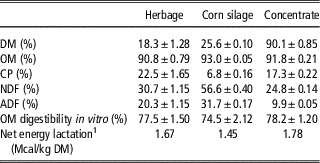
To determine the appropriate strip areas, herbage mass was calculated weekly using a double sampling technique adapted from Haydock and Shaw (Reference Haydock and Shaw1975). Every 14 days, three replicate sets of five sampling locations were selected within the areas to be grazed. The five locations were chosen to represent the shortest, the tallest and three areas of intermediate sward height. At each location, sward plate height was measured to the nearest 0.5 cm using a rising plate meter (RPM; Ashgrove Co., Palmerston North, New Zealand) and 30×30 cm squares of pasture on the same area were cut to ground level with shearing scissors. The cut herbage was collected, weighed and sampled for determination of DM content in order to calculate herbage DM mass and derive a linear regression relating it to sward plate height. Every week, the herbage mass was estimated by measuring the sward plate height with the RPM at 50 points within the paddocks and applying the regression calculated at the start of the current or previous week. The temporal pattern of pasture height depletion during grazing was estimated twice weekly, during weeks 4, 5 and 6, by measuring sward height with the RPM at 1-h interval while the cows were at pasture (minimum of 30 points/strip per hour). During weeks 2, 4 and 6, aliquot samples of the herbage cut from each of the five locations within the three replicates in order to determine herbage mass were bulked and sub-samples taken to determine their chemical composition (Table 1).
Mean±SD chemical composition of herbage representative of that selected by the cows, and corn silage and concentrate offered to dairy cows

DM=dry matter; OM=organic matter.
1 Estimated from the equation of NRC (2001).
Herbage dry matter intake
Individual herbage DM intake was determined in four cows per treatment (12 cows; four complete blocks) during 4 days in week 6 of the experiment, using n-alkanes (Dove and Mayes, Reference Dove and Mayes2006), with n-hentriacontane (n-C31) as an internal marker and n-dotriacontane (n-C32) dosed as an external marker. Herbage intake was estimated by subtracting the amount of n-alkanes derived from the supplements (silage and concentrate) according to Dove and Mayes (Reference Dove and Mayes2006). Over the 8 days before, and during the 4 days of intake determination (total 12 days, weeks 5 and 6) cows were dosed with a cellulose bolus containing 342.5±3.35 mg/day of n-alkane (n-C32) at each milking; thus, every cow received a daily dose of 685 mg/day. Herbage samples representing the forage selected by cows over the final 4 days were collected by hand plucking, from areas adjacent to the grazing plots followed by individual cows for 10 min every hour during the grazing sessions (Coates and Penning, Reference Coates and Penning2000). They were combined, dried at 60°C and stored until they were analysed for concentration of n-alkanes (n-C31, n-C32 and n-C33). Faeces samples were collected from the rectum of each cow after every milking on the final 4 days of the measurement period and immediately stored frozen at −20°C until they were analysed. To correct for the contribution made by the supplements to the diet, samples of the concentrate and corn silage were collected during these final 4 days, before feeding, and used to determine their DM content and n-alkane profiles (Dove and Mayes, Reference Dove and Mayes2006).
Grazing and ruminating activity
Grazing and ruminating activity were determined visually by three trained observers in weeks 4, 5 and 6. On 3 consecutive days, the grazing or ruminating activities of 12 cows (the same four complete blocks used to estimate herbage DM intake) were recorded every 15 min (Chilibroste et al., Reference Chilibroste, Mattiauda, Bentancur, Soca and Meikle2012). To examine temporal patterns of activity, data were collated within each successive 1-h observation period (OP1 to OP6). Bites rates were determined at the beginning and the end of weeks 4, 5 and 6 during three GP between 0900 and 1000 h (GP1), 1130 and 1230 h (GP2), and between 1400 and 1500 h (GP3). During each GP the observers counted the number of bites during 1 min (Chilibroste et al., Reference Chilibroste, Mattiauda, Bentancur, Soca and Meikle2012) by block and when completed (every 15 min), the procedure was repeated in all blocks until the end of each GP.
Chemical composition
The hand-plucked samples of herbage collected during the period of intake determination and the faeces samples were combined for each cow before analyses. All pasture, supplement and faeces samples were dried at 60°C to constant weight and ground through a 1 mm sieve. Hand-plucked samples of herbage were collected and composed by treatments on a weekly bases to determine DM, ash, CP, NDF, and ADF content according to Association of Official Analytical Chemists (1990) and ‘in vitro’ digestibility as described by Tilley and Terry (Reference Tilley and Terry1963). The supplements were sampled and analysed as the herbage samples. The n-alkane concentration of pasture, supplement and faeces samples were determined following the procedures described by Dove and Mayes (Reference Dove and Mayes2006).
Calculations and statistical analyses
Net energy for lactation (NEL) was calculated as described by National Research Council (NRC) (2001). Milk energy output was calculated as NEL (Mcal/day)=milk yield×[(0.0929×fat %)+(0.0563× true protein %)+(0.0395×lactose %)], using milk composition data derived weekly from analysis of the four consecutive samples (NRC, 2001). All statistical analyses were conducted using the SAS Systems program package (v. 9.2, SAS Institute Inc., Cary, NC, USA). Milk yield and composition and BCS were analysed in a mixed model with repeated measurements in time, using the MIXED procedure and a first-order autoregressive as the covariance structure. The Kenward–Rogers procedure was used to adjust the denominator degree of freedom. The model included treatment, week, and the treatment × week interaction (when P<0.20) as fixed effects and blocks as random effects. Dry matter intake data were analysed with a model that included treatment and blocks as fixed and random effects, respectively.
The number of observations of grazing and ruminating made at 15 min intervals were analysed with GENMOD procedure with a binomial distribution and a model that included block, week, treatment, OP and their interaction. Individual records of grazing activity were used to define the duration of the first grazing session and were analysed using the MIXED procedure with a model that included week and treatment as a fixed effect and block and day as a random effect. The number of bites per min (bite rate), were analysed using the MIXED procedure with a model that included week, treatment, GP and the interaction treatment × GP as a fixed effect and block and day as random. Based on the measurements of herbage DM intake, grazing time and grazing bites at week 6, herbage intake rate was calculated, and differences between treatments analysed with a model that included treatment and block as fixed and random effects, respectively. Correlation and regression coefficients between ruminating time and corn silage intake before access time to pasture were analysed using the CORR and REG procedures. Within each week, depletion rate of RPM height while cows were at pasture was calculated using the following model: y=a×exp(−kt), where a is the initial pasture height (before grazing), k the fractional disappearance rate of the pasture and t the hour from the beginning grazing session. NLIN procedure was used, and it converged with P>0.95. The estimated parameters a and k were compared using the MIXED procedure with a model that included treatment as a fixed effect. Least square means were separated using Tukey–Kramer tests (α=0.05), and means were considered to differ if P⩽0.05 and tendencies were declared if 0.05<P⩽0.10. Some methods were similar to those described by Mattiauda et al. (Reference Mattiauda, Tamminga, Gibb, Soca, Bentancur and Chilibroste2013).
Results
Dietary component analyses
Results of the analyses of samples collected as representative of the herbage, concentrate and corn silage eaten are presented in Table 1.
Milk yield and composition, and cow body condition score
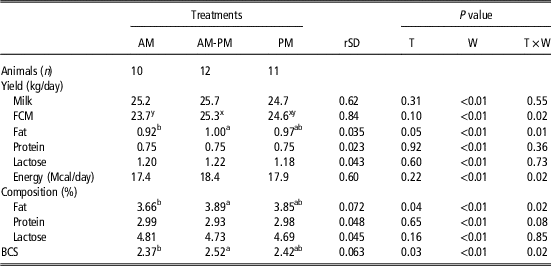
Results of ANOVA of milk and constituent yields, milk composition and BCS are shown in Table 2. There were no treatment effects on milk yield, or milk protein and lactose concentration and yields. However, overall mean fat percentage and yield were greater in AM-PM than in AM cows and were intermediate in PM cows. There were treatment × week interaction effects on fat percentage and yield, with within-week treatment effects occurring in weeks 3 and 6 (data not shown).
ANOVA of effect of treatment (T) and week (W) on milk yield, 4% fat-corrected milk (FCM) yield, estimated milk energy output, milk composition and body condition score (BCS) of strip-grazed dairy cows offered a daily ration of 3.8 kg dry matter of corn silage in a single meal at either 0800 h (AM) or 1700 h (PM), or in two equal meals at 0800 and 1700 h (AM-PM)

a,bMeans within a row with different superscript differ significantly at P<0.05.
x,yMeans within a row with the different superscript trend to differ at P<0.10.
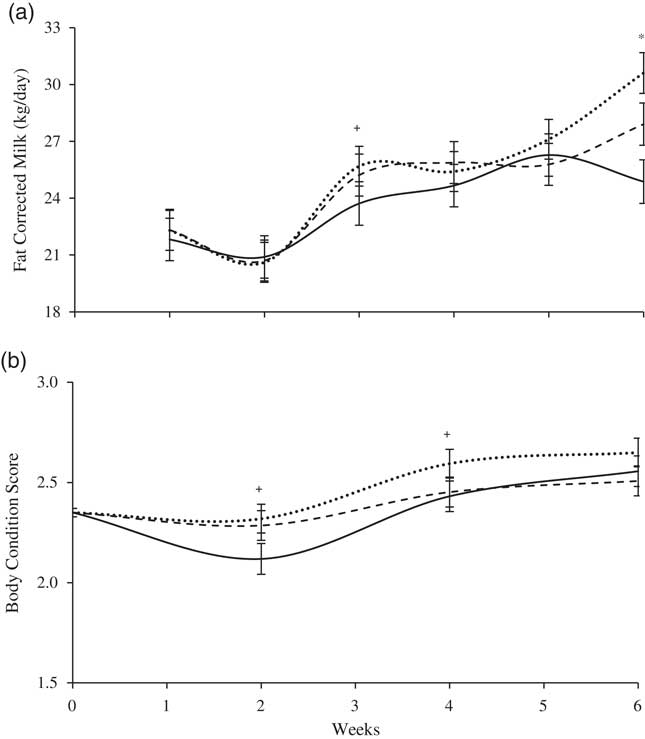
Mean 4% FCM yield was 1.6 kg/day higher (P<0.10) in AM-PM than in AM cows and intermediate in the PM cows. There was a treatment × week interaction effect on FCM yield, with within-week treatment effects occurring only in weeks 3 and 6 of the experiment (Figure 1a). Despite changes in FCM yield and milk fat were no differences in milk energy output between treatments. Cow BCS was greater in AM-PM than AM cows and intermediate in PM cows, and showed a treatment × week interaction effect, with within-week treatment effects occurring in weeks 2 and 4 (Figure 1b).
Milk yield 4% fat-corrected (a), and body condition score (b) of strip-grazed dairy cows offered corn silage at 0800 h (AM, ——), equally offered at 0800 and 1700 h (AM-PM, ∙∙∙∙∙∙) or at 1700 h (PM, - - - -). Within a week, *indicates the difference (P<0.05), +indicates a tendency to be different (P<0.10).

Dry matter intake, grazing behaviour and pasture depletion
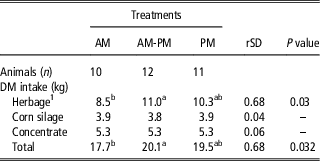
Mean daily DM intakes of herbage, corn silage and concentrate are shown in Table 3. Compared with the AM cows, treatment AM-PM cows achieved a greater daily herbage DM intake and, because the rations of silage and concentrate were entirely consumed by the cows, total intake of DM. Herbage and total daily DM intakes by PM cows were intermediate between those of AM-PM and AM cows.
Daily dry matter (DM) intake by strip-grazed dairy cows offered a daily ration of 3.8 kg DM of corn silage in a single meal at either 0800 h (AM) or 1700 h (PM), or in two equal meals at 0800 and 1700 h (AM-PM)

1 Herbage intake was estimated in four animals per treatment.
a,bMeans within a row with different superscript differ significantly at P<0.05.
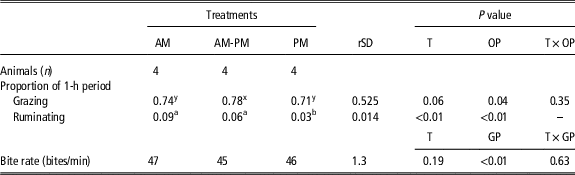
The overall proportion of observations during which cows were grazing tended to be different between treatments (P=0.06; Table 4). However, there were differences between the 1-h OP, but there was no interaction between treatment × OP. The overall proportion of observations, during which cows were observed ruminating differed between treatments being AM⩾AM-PM>PM cows and there was an effect of OP (Table 4).
ANOVA of effect of treatment (T) on the proportion of observations in experimental weeks 4, 5 and 6, in which strip-grazed dairy cows were grazing or ruminating during six consecutive 1-h observation periods (OP), and on bite rates counted during three non-consecutive 1-h grazing periods (GP) (0900 to 1000 h, 1130 to 1230 h and 1400 to 1500 h)

The three treatments consisted of cows being offered a daily ration of 3.8 kg DM of corn silage in a single meal at either 0800 h (AM) or 1700 h (PM), or in two equal meals at 0800 and 1700 h (AM-PM).
a,bMeans within a row with different superscript differ significantly at P<0.05.
x,yMeans within a row with the different superscript trend to differ at P<0.10.
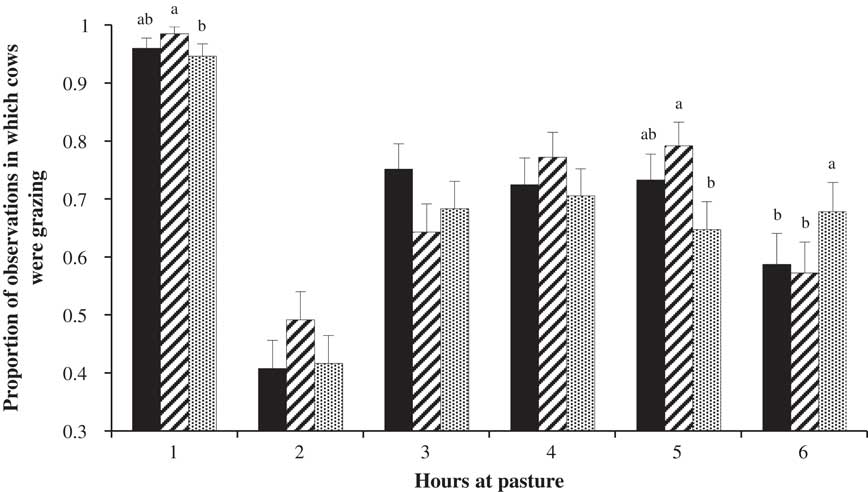
The proportion of observations during which cows were grazing was the highest in OP1, and the lowest in OP2, being intermediate in OP3, OP4 and OP5, and also intermediate but lower than OP3 to OP5 in OP6. The proportion of observations during which cows were grazing was greater in AM-PM than PM cows in OP1 and OP5, while differences were inverse in OP6 (Figure 2).
The proportion of visual observations in each hour at pasture during which cows were grazing, when offered corn silage either in a single meal before (AM,  ), in two equal meals before and after (AM-PM,
 ) or in a single meal (PM,
 ) after 6 h at pasture. a,bColumns within an hour with different letter differed at P<0.05.

There was no treatment effect on the duration of the first grazing meal (73, 85 and 76±8.1 min for treatments AM, AM-PM and PM, respectively). The number of observations of ruminating activity whilst at pasture was linearly correlated (r=0.72, P<0.01) with corn silage intake immediately before accessing the pasture. Assuming a ruminating bout duration of 15 min corresponding to each ruminating observation, linear regression analysis showed an increase of 7 min for each kg DM intake of corn silage before turnout; y=23.9+7.1 x where y is ruminating time (min) and x the corn silage DM intake before grazing session.
Mean bite rate was not affected by treatments (Table 4) but differed between the first second and third period of measurement: 51, 44 and 43±1.3 bites/min in GP1, GP2 and GP3, respectively. Intake rate was greater in AM-PM than AM cows and intermediate for PM cows: 31.0, 41.5 and 39.6±5.44 g DM/min in AM, AM-PM and PM; respectively. The hourly measurements of RPM height showed no treatment differences in the rate of height reduction. The fractional rate of height reduction in the three treatments could be represented by the joint expression y=31.52exp(−0.01t) (R 2=0.77), where y is the pasture RPM height, and t the time (h) since the cows entered the pasture.
Discussion
In the conditions of this experiment, where the time spent at pasture was restricted, dividing the corn silage supplement between two meals increased dairy cows’ performance (milk fat percentage and yield, FCM yield and BCS) as stated in our hypothesis. The difference in FCM yield between the AM-PM and AM cows tended to be different, with that of the PM cows being intermediate. Mitani et al. (Reference Mitani, Takahashi, Ueda, Nakatsuji, Kondo and Okubo2005) similarly reported an increase in milk fat percentage when a corn silage-based supplement (in a ratio 70 : 30 corn silage : concentrate) was offered to dairy cows after grazing compared with before grazing, even although the supplement was offered as a mixed ration and cows had two sessions at pasture over the day. In contrast, Al-Marashdeh et al. (Reference Al-Marashdeh, Gregorini and Edwards2016) found no differences in milk yield or composition when corn silage, similar to that offered in the present experiment, was offered 2 or 9 h before grazing to cows at an advanced stage of lactation (>28 weeks). Trevaskis et al. (Reference Trevaskis, Fulkerson and Nandra2004) and Sheahan et al. (Reference Sheahan, Gibbs and Roche2013) reported no differences in milk yield or composition due to the timing of concentrate supplementation when cows were at pasture for 24 h. Such contrasting results between experiments probably result from differences in the type of supplement (roughage v. concentrate), fasting time before grazing and the time allowed at pasture (5 or 6 h v. 24 h) affecting herbage DM intake and the interaction between the dietary components (Chilibroste et al., Reference Chilibroste, Gibb, Soca and Mattiauda2015). Cow BCS, as an approximate indicator of body reserves and energy balance (Meikle et al., Reference Meikle, Adrien, Mattiauda and Chilibroste2013), was greater in AM-PM than AM cows and intermediate in PM cows in contrast with the results reported by Al-Marashdeh et al. (Reference Al-Marashdeh, Gregorini and Edwards2016) where they found no changes in BCS between supplements treatments. The greater FCM yield and BCS in AM-PM cows than in the other treatments could be explained, at least partially, by a greater total DM intake due to greater herbage DM intake.
Herbage DM intake measured using the n-alkane technique showed that cows on treatment AM consumed less herbage than those on AM-PM, whereas herbage DM intake by cows receiving their full corn silage ration after grazing was intermediate between the other two treatments. In contrast to our results, Mitani et al. (Reference Mitani, Takahashi, Ueda, Nakatsuji, Kondo and Okubo2005) reported no differences in herbage DM intake due to the timing of supplementation when dairy cows had 5 h total access time split between two sessions at pasture. Similarly, cows allowed 24 h access to pasture, either with (Sheahan et al., Reference Sheahan, Gibbs and Roche2013) or without (Trevaskis et al., Reference Trevaskis, Fulkerson and Nandra2004) fresh allocation of pasture, showed no effect of supplement timing on herbage DM intake. Probably, in these latter experiments, the greater number of grazing sessions or longer time on pasture, in comparison to the present study, allowed cows to compensate for the effect of timing of supplementation on herbage DM intake as was reported by Gibb et al. (Reference Gibb, Huckle and Nuthall2000). Al-Marashdeh et al. (Reference Al-Marashdeh, Gregorini and Edwards2016) reported that similar to our study, herbage DM intake was lower when corn silage was offered 2 v. 9 h before the grazing session. The reduced DM intake in AM cows could be explained by the greater rumen fill hastening satiation (Gregorini et al., Reference Gregorini, Clark, Jago, Glassey, McLeod and Romera2009; Chilibroste et al., Reference Chilibroste, Gibb, Soca and Mattiauda2015) and the observed predisposition towards enhanced ruminating activity. On the other hand, although PM cows should present a lower rumen fill and conversely higher herbage DM intake, a lower ruminating during ingestion due to the higher intake rate exhibited by this treatment (Chilibroste et al., Reference Chilibroste, Soca, Mattiauda, Bentancur and Robinson2007) might have determined a less stable rumen environment with negative effects on rumen fermentation and microbial biomass growth (Chilibroste et al., Reference Chilibroste, Dijkstra, Robinson and Tamminga2008).
Ruminants, particularly dairy cows, show a grazing pattern with a daily frequency of three to five grazing events with major meals occurring during the early and late morning and late in the afternoon and evening (Gibb et al., Reference Gibb, Huckle, Nuthall and Rook1999). This pattern is flexible and is influenced by the environment as well as responding to behavioural adaptations to animal husbandry and grazing management (Gibb, Reference Gibb2006; Gregorini, Reference Gregorini2012). In this study, the restricted access time to pasture (6 h between morning and afternoon milking) limited the ability of cows to express a more natural temporal pattern of daily grazing activity, because the major grazing event that would normally occur in the late afternoon and early evening was prevented. The timing of corn silage supplementation could further impact on grazing behaviour and herbage DM intake as it might establish a different internal state (hunger or satiation stimuli) at the first and important grazing session, which changes cow reaction to the perception of the same feed resource (Gregorini et al., Reference Gregorini, Clark, Jago, Glassey, McLeod and Romera2009).
Providing the entire corn silage ration just before access to pasture (AM cows) may have directly affected the grazing process, due to satiety stimuli coming from the interaction between ingestive and digestive behaviour affecting short-time DM intake (Gregorini, Reference Gregorini2012). In contrast, when the same amount of supplement was offered and consumed in two meals (AM-PM), fermentation pattern and rumen environment could have been being more stable (Chilibroste et al., Reference Chilibroste, Dijkstra, Robinson and Tamminga2008), which might have stimulated more intensive grazing activity and hence greater herbage DM intake (Gregorini, Reference Gregorini2012).
Contrary to the differences in herbage DM intake measured using the n-alkane technique, treatments did not affect the duration of the first grazing session. In retrospect, the failure to detect significant differences in overall grazing activity (despite the tendency for higher grazing activity in AM-PM that in the other treatments) was probably due to the excessive interval (15 min) between observations, during which treatment differences in inter- and intra-meal intervals may not have been detected. Nevertheless, during the 1st h at pasture there was a small but significant treatment effect on the proportion of observations when cows were grazing, being higher in treatment AM-PM than PM and intermediate for AM cows. Due to the limited total time of 6 h that cows were allowed at pasture, the large proportion of cows devoted to grazing during the 1st h at pasture (OP1) fulfil a major contribution to total daily herbage DM intake (Chilibroste et al., Reference Chilibroste, Gibb, Soca and Mattiauda2015). During the 2ndh at pasture the incidence of grazing activity was very much reduced, being replaced to a large extent by increased ruminating activity (data not shown). During OP4 and OP5, cows were recorded grazing in more than 0.6 of observations, with a higher proportion occurring in AM-PM cows than in PM cows (Figure 2). In the last hourly OP6 grazing activity declined slightly in the AM and AM-PM cows, whereas PM cows grazed more than the previous one. As in the present experiment, but where cows were allowed access to pasture for 12 or 24 h, Trevaskis et al. (Reference Trevaskis, Fulkerson and Nandra2004) and Gekara et al. (Reference Gekara, Prigge, Bryan, Nestor and Seidel2005) reported no effect of timing of concentrate meal (morning v. afternoon) on total grazing time by lactating dairy and beef cows, respectively. Sheahan et al. (Reference Sheahan, Gibbs and Roche2013) similarly found no difference in total grazing time when dairy cows were offered 3 kg of concentrate either in the morning or afternoon, but did report that the morning grazing bout tended to be longer when cows received their supplement in the afternoon. Gibb et al. (Reference Gibb, Huckle and Nuthall2000) did not report differences neither in grazing nor in ruminating time when cows had access to 8 kg of concentrate twice a day in or out of parlour, but the number of grazing meals were greater for cows receiving concentrate out of parlour which supports the opportunities to modify ingestive behaviour through the use of timing of supplementation.
Ingestive behaviour determines herbage DM intake as a function of grazing time, bite mass and bite rate (Hodgson, Reference Hodgson1985; Chilibroste et al., Reference Chilibroste, Soca, Mattiauda, Bentancur and Robinson2007). In a review of the effect of supplements on cows at pasture, Bargo et al. (Reference Bargo, Muller, Kolver and Delahoy2003) reported that supplementation often reduces grazing time, but does not affect bite rate or bite mass. Although short-term herbage DM intake rate can be significantly affected by the time of day (Gibb et al., Reference Gibb, Huckle and Nuthall1998) and cow physiological state (Gibb et al., Reference Gibb, Huckle, Nuthall and Rook1999), it is primarily influenced by sward state, which constrains bite mass and in turn bite rate (Gibb, Reference Gibb2006). In the present study, measurements of the fractional reduction in RPM height while the cows were at pasture showed no difference between treatments, suggesting little or no effect on pasture structure modification. Nevertheless, cows have been shown to increase bite mass in response to decreased rumen fill (Chilibroste et al., Reference Chilibroste, Tamminga, Boer, Gibb and den Dikken2000; Gregorini et al., Reference Gregorini, Gunter, Masino and Beck2007). Thus, the significantly greater herbage DM intake by the AM-PM compared with the AM cows may have been achieved by the combined effect of small increases in bite mass and total grazing activity in response to their reduced rumen fill at the beginning of the grazing session. The amount of supplement consumed before being released to pasture had an undeniable impact on ruminating activity during much of the following 6 h; estimated ruminating time to increase by 7 min for each kilogram DM of corn silage consumed at the morning feed. This increased ruminating activity by AM cows was consistent with previous reports that, compared with unsupplemented cows, those receiving supplements increased the time they spent ruminating (Sheahan et al., Reference Sheahan, Kolver and Roche2011), and performed longer and more frequent ruminating bouts (Pérez-Prieto et al., Reference Pérez-Prieto, Peyraud and Delagarde2011). Sheahan et al. (Reference Sheahan, Gibbs and Roche2013) observed in dairy cows with 24 h access to pasture, that total ruminating time was greater when concentrate was supplemented in the afternoon rather than in the morning, due to increased ruminating during darkness. In our work, ruminating time was only measured during access time to pasture, which is probably not representative of rumination during the whole day. Whilst at pasture the time budgets for grazing and ruminating activity by the cows was constrained by the limited time available, so that the requirement for rumination and comminution of corn silage particles, albeit limited, impacted on grazing activity. Following afternoon milking, without the opportunity to graze, ruminating activity could have been far less constrained.
Conclusions
In the conditions of this experiment, with restricted access to pasture, cows receiving corn silage supplementation in two meals or a single meal after grazing increased DM intake, FCM yield and BCS compared with cows receiving it before grazing. A larger input (determined) and better synchronization of nutrients at rumen level (speculated) can be postulated as the main factors involved in the animal performance response. Both factors were mediated by changes in animal ingestive behaviour.
Acknowledgements
Special thanks to Dra. A. Meikle for her support and revision of this manuscript. The authors acknowledge Ing.Agr. F. Elizondo for his assistance throughout the field work. The first author would like to thank Elena Chilibroste for the edition of the manuscript and recognize to A.L. Astessiano and A. Casal for their assistance with the edition.
Declaration of interest
Authors do not have any actual or potential conflict of interest; financial, personal or other relationships with other people or organizations.
Ethics statement
This experiment received ethical approval from the Animal Experimentation and Ethical Committee of the University of the Republic.
Software and data repository resources
Data are not deposited in an official repository.