International law functions, in large part, because political activists can use domestic institutions to hold governing elites accountable to their international treaty obligations.Footnote 1 These challenges can be raised against the regime itself, as well as against domestic policies. Because of the potential for such challenges, governing elites face countervailing incentives regarding whether or not to ratify international treaties.Footnote 2 Ratifying comes with reputational benefits, as it allows governing elites to show that they are willing to co-operate with other states, which makes doing so widely appealing.Footnote 3 At the same time, the challenges that ratification can raise vis-à-vis governing elites’ domestic policies and practices decreases their incentive to sign on to these agreements. A significant body of literature is therefore dedicated to the study of the conditions under which governments are likely to ratify international treaties. However, ratification is not a straight up or down decision: governments do not simply adopt or not adopt international agreements. When they ratify, governing elites can, and often do, enter different types of reservations to qualify various aspects of their treaty commitments. We argue that including reservations as part of an analysis of the decision to ratify can help us better understand states’ decisions to commit.
Reservations, as widely discussed in the political science and international law literatures,Footnote 4 exclude part or vary the effect of a treaty, thus allowing governing elites to modify their obligations at ratification. Entering reservations therefore allows political elites to signal a commitment to co-operate by ratifying a treaty, while also allowing them to insulate domestic policies and practices that conflict with certain aspects of the treaty from challenges that could be raised by other political actors.Footnote 5 Executive elites play a particularly important role in this reservation process. They are the actors involved in the actual negotiation of international treaties and are officially charged with entering reservations to them.Footnote 6 We therefore expect the potential for international treaties to be used to challenge the policies and practices of executive elites, in particular, to be an important factor driving reservation decisions.
These ratification and reservation decisions can be modeled as the end stage of a negotiation wherein an executive can choose to push its actual treaty commitments closer to its own preferences than the agreement reached at the bargaining table. There are several ways executives can do so. They can ratify without substantive reservations, while entering reservations that influence the interpretation and enforcement of the treaty in their state (‘procedural’ reservations), while entering reservations that reduce or eliminate their legal obligations to certain parts of the treaty (‘article-qualifying’ reservations), or while entering reservations that subjugate the entire treaty to domestic law (‘treaty-qualifying’ reservations).Footnote 7 Understanding the variation in the types of reservations states enter is important, because reservations directly affect the obligations states take on when they ratify a treaty. In other words, reservations are not simply formal legal subtleties. They directly affect states’ compliance requirements. Depending on the specific reservations they enter, states could adopt different practices but still technically be in compliance with a treaty. To illustrate, consider the Convention on the Rights of Persons with Disabilities. Malaysia entered a reservation to this convention stating that under certain circumstances, it was not obliged to follow the clause calling for states to protect persons from torture or medical experimentation without consent and equal rights. Thus while other states may have to follow these provisions, the Malaysian Government has a legal loophole through which it does not have to abide by this part of the treaty. It would still, however, technically be in compliance with its legal obligations. Variation in reservations can thus lead to significant variation in co-operation – that is, it has a direct impact on what international co-operation ‘looks like’.Footnote 8 To understand international co-operation more generally, it is therefore also important not only to understand when executives are likely to ratify treaties, but also to account for how they are likely to ratify – that is, to understand the type of reservations they are likely to enter.
Focusing on human rights treaties – which tend to have the greatest number of reservationsFootnote 9 – we argue that executive elites’ decision regarding what reservations to enter when a treaty is ratified is a strategic choice. They choose whether and how to ratify in order to mitigate challenges that ratification creates vis-à-vis their political power and domestic policies. In particular, we argue that executives in states transitioning away from a more repressive regime will more readily ratify without entering substantive reservations than other types of regimes. In contrast, compared to non-repressive executives, executives in repressive regimes will less readily ratify human rights treaties and more readily enter agreements using treaty-qualifying reservations. Finally, executives who are more constrained relative to the legislature and judiciary will more readily enter procedural and article-qualifying reservations than those who are less constrained.
We test our argument using an original dataset that codes the ratification and reservation choices made by states across the human rights treaties registered with the United Nations.Footnote 10 Using an event history analysis, which allows us to analyze ratification and reservation decisions jointly, we compare how variation in domestic institutions affects the risk that executives will ratify human rights treaties in different ways – not ratifying, ratifying with particular types of reservations or ratifying without reservations. We find that executives in different types of regimes differ in their risk of ratifying in ways that are consistent with our theoretical argument. Combining an analysis of ratification with the decision regarding how to use reservations, our theory and analysis contribute to our understanding of treaty commitments, and thus also contribute to our understanding of international co-operation more generally.
MAKING RESERVATIONS WHEN RATIFYING
Executives are largely responsible for negotiating international treaties on behalf of the state. Once these treaties are ratified and in force,Footnote 11 however, other international and domestic actors can use them to challenge executive elites’ policies and practices. Reservations provide one way for executives to overcome such constraints, as they can use them as part of their legal defense when challenged.Footnote 12 Due to their involvement in the negotiation process, they often recognize what reservations might be necessary. Indeed, Bosniak’s discussionFootnote 13 of the Convention on the Rights of Migrant Workers notes that the use of reservations was actively discussed during the negotiation of the treaty, and thus key executive officials would be aware of where reservations would be needed.Footnote 14 In addition, it is often the executive involved in the negotiations who officially enters reservations to the treaty. Executive elites are therefore central actors when analyzing what states enter reservations, when and how they do so, and why.
Types of Reservations
Reservations can be classified according to the ways they can be used to deal with challenges to the executive and/or its existing policies. As Landman shows,Footnote 15 there are four main ways a treaty can be ratified, as defined by the types of reservations that can be entered.Footnote 16 In many cases, a treaty does not directly threaten the executive and does not challenge existing policies. As such, reservations that modify the substantive elements of the treaty are unnecessary. Thus the first category captures the ratification of a treaty ‘without any substantive reservations’. This can be done by ratifying without reservations, or by ratifying with reservations that are not related to the substance of the treaty (non-substantive reservations). For example, some elites use reservations to specify that their ratification of a treaty to which Israel is (or may become) a party does not constitute their recognition of Israel as a state. This type of reservation does not relate to the treaty’s substance, and is therefore not considered a substantive reservation. In both cases of ratification ‘without substantive reservations’ the actual application of the treaty is not affected. Ratification with any other type of reservation (substantive reservations) does affect the application of the treaty in some way.
Some executives face challenges based on the technical requirements of a treaty. As a legal instrument, a treaty can be interpreted in ways that challenge existing domestic policies, even if those policies are in line with the spirit of the treaty. This is particularly the case when treaty language is vague – which many human rights treaties are.Footnote 17 The second category of ratification therefore captures ratification with reservations that lay out procedures that will be used in the application and enforcement of the treaty. Executives can use such reservations, first, to specify how their state will interpret specific definitions and clauses laid out in the treaty. Secondly, they can use this type of reservation to control the interpretation of the treaty by highlighting a particular piece of domestic legislation that they argue is consistent with the principles of the treaty, stating that compliance with this legislation is sufficient for compliance with the treaty. Finally, when a treaty calls for the International Court of Justice (ICJ) to rule on disputes over the treaty, political elites can enter reservations stating that the ICJ cannot have jurisdiction to enforce the agreement against their state without explicit consent. Overall, these types of reservations give the executive some degree of control over the procedural application of the treaty by constraining how it can be interpreted and enforced. We refer to these types of reservations as ‘procedural reservations’.
However, in many cases the treaty itself may challenge the foundations of an executive’s policies and practices. At the same time, because of domestic and international pressure to ratify,Footnote 18 the executive may have an incentive to adopt the agreement for political expediency. In such cases, reservations could be used to reject or subject certain parts of the treaty to domestic law such that the treaty does not harm the executive, while at the same time allowing the executive to reap the benefits of ratification. Thus, the third and fourth categories capture the ratification of a treaty while at the same time rejecting certain parts in its application to their state.
The first of these categories captures ratification with reservations that reject specific clauses and/or articles of the treaty. These types of reservations allow executives to remove the application of the legal obligations that certain parts of the treaty create, and thus to keep in place key domestic policies that might be inconsistent with those obligations. For example, when ratifying the Convention on the Elimination of All Forms of Discrimination Against Women, Israel entered a reservation to Article 7(b) stating that where religious laws prohibited women from serving as judges in religious courts, the treaty would not apply. We refer to these types of reservations, which qualify the legal obligations associated with a particular part of a treaty, as ‘article-qualifying reservations’.
The last category captures ratification with reservations that apply to the treaty as a whole. The most common type of reservation that falls into this category is characterized by statements that the entire treaty will be subsumed under domestic or religious law, and that compliance must be interpreted using that law rather than explicit treaty language. These types of reservations allow political elites to qualify the application of the legal obligations created by a treaty as a whole, thus protecting key domestic policies that might be inconsistent with the general purpose of that treaty. For example, when the elites of El Salvador ratified the Convention on the Rights of Persons with Disabilities and its Optional Protocol, they entered a reservation stating that the treaty, as a whole, would only be enforced ‘to the extent that its provisions do not prejudice or violate the provisions of any of the precepts, principles and norms enshrined in the Constitution of the Republic of El Salvador’. We refer to these types of reservations, which apply to the enforcement of the treaty as a whole, as ‘treaty-qualifying reservations’.
Focusing on the use of these different types of reservations, we seek to provide a more holistic explanation of when and how states choose to commit themselves to human rights treaties. In doing so, we integrate the decision to enter particular reservations into the decision to ratify. We argue that the risk that an executive will ratify a human rights treaty in a particular way (that is, using particular types of reservations) differs depending on the specific nature of the challenges that ratification can raise for that executive.
EXECUTIVE POWER AND INTERESTS
There are a number of mechanisms at both the international and domestic levels through which international treaties can be used to check executives’ power. When analyzing human rights treaties, the challenges that could potentially be raised by other domestic actors are particularly important to consider. First, most human rights treaties concern the relationship between a state and its citizens rather than between states. Secondly, and relatedly, human rights treaties rely on domestic enforcement, as international enforcement mechanisms between states (such as reciprocity) are not likely to be in effect. Finally, domestic institutions are also particularly important to consider because human rights treaties often use ambiguous language in order to secure wide participation,Footnote 19 leaving them open to interpretation at both the legislative and judicial levels.Footnote 20 Because the costs of including reservations to human rights treaties are fairly low for many governments relative to the benefits of ratification, using reservations can be an appealing solution,Footnote 21 helping executives protect their policies and practices from challenges that can be raised by other domestic actors. The potential for such challenges depends on a state’s institutional characteristics.
We argue that the challenges that human rights treaties pose to executives depend on several factors including their current policies and practices and the relative power of the executive compared to the legislative and judicial branches of government. We expect executives to use different types of reservations depending on the specific challenges they face. First, with regards to variation in policies and practices, we argue that human rights treaties do not challenge the executive in regimes that are transitioning away from more repressive regimes, and can even provide support for policies they want to keep in place. If anything, ratifying without reservations is likely to help these regimes more than most. They are therefore likely to ratify human rights treaties without entering reservations. On the other end of the spectrum, human rights treaties have the potential to be used to pose significant substantive challenges to executives in repressive regimes. Such regimes are therefore likely to be more reluctant to ratify human rights treaties, in general. When they do ratify (potentially because of international pressure to do so),Footnote 22 they are likely to use treaty-qualifying reservations more readily than non-repressive executives in order to protect the policies and practices they use to remain in power. Part of the risk to the executive and its policies also depends on the degree to which they are constrained by the legislative and judicial branches of government. These risks depend on how the treaty is interpreted and implemented, rather than the substantive nature of the agreement. They therefore do not necessarily need to use treaty-qualifying reservations more than other regimes. Instead, we argue that more constrained executives are more likely to use mid-range reservations – procedural and article-qualifying reservations, in particular – in order to control how other domestic elites can invoke the treaty. Overall, the institutional characteristics of a state influence executives’ likelihood of using different types of reservations.
Executives Transitioning from Repressive Regimes
The executives of states transitioning away from more repressive regimes – that is, states in which governing democratic elites have only recently come into power – face a different set of incentives than other regimes. Because the regime has not been solidified, the executives of transitioning states are likely to make strategic decisions based on a desire to protect the regime. We argue that ratifying human rights treaties, and doing so without entering reservations, is one strategic choice that can help them do so.
Ratifying human rights treaties allows governing elites to signal their intent to institute democratic reforms to both domestic and international audiences.Footnote 23 More importantly, we argue that ratifying helps the political elites of transitioning democracies ‘lock in’ domestic policies related to human rights in order to guard against non-liberal elements that might threaten their political power.Footnote 24 As Goodman describes,Footnote 25 ‘locking in’ human rights commitments can achieve this goal in three ways. It can: (1) guard against the policies of a future non-liberal government by protecting rights such as minority rights that they might try to violate, (2) ‘hedge against’ a non-liberal takeover and (3) help prevent the growth of non-liberal elements in the first place, by guaranteeing political rights such as the freedom of speech.Footnote 26
Similarly, there are significant economic benefits – in terms of increased trade, foreign direct investment and foreign aid – associated with establishing a commitment to the rule of lawFootnote 27 and protecting physical integrity rights.Footnote 28 These economic benefits can further strengthen the regime. Both ‘locking in’ civil and political rights and helping to secure the economic benefits associated with adhering to human rights standards more generally can therefore help support the political power of the executives of a transitioning democracy.
Reservations weaken these benefits. Most importantly, reservations provide loopholes for governing elites to avoid having to adopt new policies, which in some cases might be quite costly, in order to follow international standards. Using reservations therefore does not provide as strong a ‘lock-in’ commitment, and thus as strong a defense against non-liberal challengers that might threaten the regime. Non-liberal challengers could also exploit the loopholes created by reservations to slip back into repressive ways if they are able to gain political power. In addition, the material benefits (such as increased trade and aid) that stem from respecting human rights are largely based in actual human rights practices rather than in human rights commitments alone.Footnote 29 If reservations prevent states from adopting the policies needed to protect human rights, the material benefits of having good human rights standards are unlikely to manifest.
The benefits of ratifying human rights treaties are therefore strong for the executives of transitioning democracies. By ‘locking in’ human rights policies and providing economic benefits, they can help protect and solidify the position of the governing regime. Using reservations can diminish these effects. We therefore expect the executives of transitioning democracies to ratify more readily than other regimes and to do so without substantive reservations.Footnote 30 This argument leads to the following testable hypothesis.
Hypothesis 1: All else constant, relative to other types of executives, executives in states transitioning away from more repressive regimes should have a greater risk of ratifying human rights treaties, and more specifically, a greater risk of doing so without entering substantive reservations.
Repressive Executives
Some executive elites rely on domestic practices that violate human rights in order to remain in power.Footnote 31 These are precisely the practices that international human rights treaties are designed to inhibit. They include physical integrity protections such as freedom from torture, but also more political freedoms such as freedom of movement, freedom of assembly, freedom of expression and electoral self-determination.Footnote 32 Human rights treaties therefore conflict with the interests of repressive executives, increasing the potential for challenges to be raised against the domestic practices they use to retain political power.Footnote 33 Relative to the executives of other types of regimes, we therefore expect the executives of repressive regimes to be more reluctant to ratify human rights treaties.
However, they might still ratify these treaties even if somewhat reluctantly, as executives face international pressures to ratify human rights treaties.Footnote 34 Repressive systems also tend to have weak domestic institutions, lessening legislative and judicial elites’ ability to hold executives accountable to their international commitments, and thus making ratification potentially less costly.Footnote 35 Moreover, as Vreeland shows,Footnote 36 repressive elites might even receive some domestic benefits from ratification, as ratifying a human rights treaty can potentially assuage domestic challengers who are criticizing the regime. At the same time, however, ratifying an international treaty is a long-term commitment, and repressive elites face uncertainty about the future. They do not know how domestic institutions might change, and when and how challengers might arise. The treaties they ratify could potentially be used in the future to raise challenges to the regime.Footnote 37
We argue that reservations – particularly treaty-qualifying reservations – allow governing elites in these regimes to hedge against this possibility. These reservations prioritize domestic law over the treaty as a whole. They can thus help repressive elites reduce the risk that political actors and institutions could draw on those treaties to challenge domestic laws that allow them to use rights-violating policies to remain in power. For example, when ratifying the Convention on Torture, elites of the United Arab Emirates added a reservation stating that ‘the lawful sanctions applicable under national law, or pain or suffering arising from or associated with or incidental to these lawful sanctions, do not fall under the concept of “torture” defined in article 1 of this Convention or under the concept of cruel, inhuman or degrading treatment or punishment mentioned in this Convention’. This reservation allowed executive elites to protect domestic policies that might conflict with the overall objective of the convention, but that they need in place to safeguard their political power from ‘unlawful’ challenges. Overall, we therefore expect that executive elites who use repressive tactics to remain in power will ratify with treaty-qualifying reservations more readily than the elites of less repressive regimes.Footnote 38 Together, these arguments lead to a second testable hypothesis.
Hypothesis 2: All else constant, relative to other types of executives, those in repressive regimes should be more reluctant to ratify human rights treaties in general, and should have a greater risk of entering treaty-qualifying reservations when they do ratify.
Constrained Executives
It is not only repressive executives or executives who face a strong potential to return to a repressive regime that can have their policies and practices challenged. All executives face potential challenges if they ratify human rights treaties, because the implementation and enforcement of international treaties is largely carried out by other domestic elites. Political elites in the legislature often enact domestic legislation implementing (or at least based on) these treaties, and political elites in the judiciary are largely charged with enforcing them. However, human rights treaties often include vague and imprecise language and clauses.Footnote 39 In the implementation and enforcement process, legislative and judicial elites can potentially interpret such language in ways executives did not intend, and in a way that challenges particular policies executives have in place. Yet this concern does not affect all regimes equally. Legislatures and judiciaries that have greater power relative to the executive have greater potential to raise such challenges effectively. Executives facing more powerful legislatures and judiciaries (that is, executives who are more ‘constrained’ in their power) therefore have a greater incentive to try to pre-empt such challenges from being raised in the first place. We argue that procedural and article-qualifying reservations, in particular, can help executives avoid these types of challenges by specifying precisely how a particular clause will be interpreted when being enforced in their state (procedural reservations) or by eliminating that clause from application to their state altogether (article-qualifying reservations). We therefore expect more constrained executives to more readily use these types of reservations than those who are less constrained in their power.Footnote 40
Procedural reservations allow executive elites to specify how various aspects of the treaty must be interpreted in their state. They thus constrain legislative and judicial elites’ ability to raise challenges to executives’ domestic policies and practices by interpreting and using the treaty in ways the executive did not intend upon ratification. For example, the Convention on the Rights of the Child states that children have a right to life, but is agnostic on when childhood begins. When ratifying this treaty, governing elites in France therefore entered a reservation stating: ‘The Government of the French Republic declares that this Convention, particularly article 6, cannot be interpreted as constituting any obstacle to the implementation of the provisions of French legislation relating to the voluntary interruption of pregnancy.’ This reservation clarifies the interpretation of when ‘childhood’ will be considered to begin in the treaty’s enforcement in France. By doing so, the governing elites of France protected policies regarding the termination of pregnancy that were currently in place from being challenged by legislative or judicial elites invoking a different interpretation of when childhood begins.
Article-qualifying reservations allow executives to remove particular clauses with which specific domestic policies might not perfectly align. By doing so, they can protect those policies from challenges that could be raised by invoking the treaty. In particular, because treaty creation is a multilateral decision-making process involving elites from different states that have different interests regarding which human rights norms to protect and how to protect them, there might be some specific language in the resulting treaty that does not align with all of the executive elites’ own domestic policies – or at least that could potentially be interpreted in a way that does not align with those policies.Footnote 41 For example, the Convention on the Rights of the Child stipulates that children should be able to acquire nationality, to the extent that it is possible. However, some states have domestic policies in place that restrict nationality based on descent. Executives in these states might want to avoid committing to treaty language that could obligate them to change their policies to allow the children of foreigners to become nationals of their own state. Article-qualifying reservations can help deal with this problem. For example, addressing this nationality issue when ratifying the Convention on the Rights of the Child, Switzerland entered a reservation stating that: ‘The Swiss legislation on nationality, which does not grant the right to acquire Swiss nationality, is unaffected.’Footnote 42
In both cases – that is, when governing elites use procedural and/or article-qualifying reservations – legislative elites are prevented from using a treaty as a basis for passing new laws that alter current domestic policies that executives want to protect, and judicial elites are prevented from using the treaty as a basis for a legal ruling that challenges those policies and corresponding practices. The more power that other political elites have relative to the executive (that is, the more constrained the executive’s power), the greater the incentive executive elites have to use procedural and/or article-qualifying reservations when they ratify a human rights treaty, and thus the greater the risk that they will do so. This argument leads to the following testable hypothesis.
Hypothesis 3: All else constant, the greater the constraints on the executive’s political power, in general, the greater the risk that the executive will ratify a human rights treaty with procedural and/or article-qualifying reservations.
Legislative and Judicial Constraints
Digging deeper into the logic of the argument about executive constraint, we expect to see executives entering procedural and article-qualifying reservations regardless of whether it is the legislature or the judiciary that has more power than the executive. However, the magnitude of these effects may vary when these factors are separated out. First, when the legislature has greater power than the executive, we argue that procedural and article-qualifying reservations are likely to be used more readily. As discussed above, the executive might want to prevent a more powerful legislature from passing legislation that implements an international treaty using an interpretation of vague language that the executive did not intend upon ratification.
It is also important to note, however, that in some states (for example, the United States), legislative elites have veto power over the ratification of human rights agreements. They can potentially use that veto power to compel the executive (who officially enters the reservations at the international level) to enter reservations that help ensure that their policies (and ability to set domestic policy) cannot be challenged by other elites invoking the language of the international treaties they ratify. For example, the head of the US Senate Foreign Relations Committee stated in his report regarding the ratification of the International Covenant on Civil and Political Rights (ICCPR) that:
The Committee recognizes the importance of adhering to internationally recognized standards of human rights. Although the US record of adherence has been good, there are some areas in which US law differs from the international standard. For example, the Covenant prohibits the imposition of the death penalty for crimes committed by persons below the age of eighteen but US law allows it for juveniles between the ages of 16 and 18.Footnote 43 In areas such as these, it may be appropriate and necessary to question whether changes in US law should be made to bring the United States into full compliance at the international level. However the Committee anticipates that changes in US law in these areas will occur through the normal legislative process.Footnote 44
In other words, legislative elites in the US Senate wanted to prevent the ratification of the ICCPR from constraining their ability to control the creation of US law in this issue area. A reservation was therefore entered to deal with this issue, stating that ‘the United States reserves the right, subject to its Constitutional constraints, to impose capital punishment on any person (other than a pregnant woman) duly convicted under existing or future laws permitting the imposition of capital punishment, including such punishment for crimes committed by persons below eighteen years of age’.
Regardless of whether legislative or executive elites are the ones pushing to protect policies, the logic underlying when and where reservations should be used is the same. We expect to see procedural and article-qualifying reservations used more readily by executives who face greater legislative constraints. They might do so to protect their own policies and interests, and/or to protect the interests of a legislature that has formal or informal veto power over ratification. This argument leads to the following testable hypothesis.
Hypothesis 4: All else constant, the greater the veto power of the legislature relative to the executive, the greater the risk that the executive will ratify a human rights treaty with procedural and/or article-qualifying reservations.
The power of the judiciary relative to the executive also likely influences executives’ reservation choices. In particular, the judiciaries of some states have broad interpretative powers that they hold independently of the executive. In these states, executive elites have little control over how the treaties they ratify will be enforced by domestic courts. When ratifying a human rights treaty, they therefore risk that it will be enforced in ways that do not correspond to how they intended the treaty to be interpreted and applied when they ratified it. The risk can be amplified by the fact that international courts can rule on many of these treaties, which can influence the domestic interpretation of treaties. Executive elites of states with an independent judiciary have no control over such judicial processes. When these executives ratify a human rights treaty, they therefore risk that future rulings made by their courts could go against their own intentions and interests.
We argue that political elites can exert a degree of control over their judiciaries’ ability to interpret and apply human rights treaties by entering procedural and/or article-qualifying reservations. For example, governing elites in several states added reservations to allow flexibility in a clause of the International Convention on the Rights of the Child, which stated that jailed juveniles and adults must be treated separately. As an illustration, the Government of Canada stated in a reservation that it ‘accepts the general principles of article 37 (c) of the Convention, but reserves the right not to detain children separately from adults where this is not appropriate or feasible’.Footnote 45 By entering reservations that guaranteed flexibility in this matter, governing elites protected themselves from being held in violation of the treaty by their courts, should circumstances (such as a shortage of cells or no nearby juvenile facilities) result in juveniles being housed with adults.
The power of an independent judiciary can therefore influence executives’ decisions regarding whether to enter reservations and what types of reservations to enter. This leads to a final testable hypothesis.
Hypothesis 5: All else constant, the greater the independence of the judiciary from executive control, the greater the risk that the executive will ratify a human rights treaty with procedural and/or article-qualifying reservations.
EMPIRICAL ANALYSIS
We argue that executives with different policies and practices, and with different degrees of constraint relative to other domestic elites, vary in their risk of ratifying human rights treaties in different ways. Some are reluctant to ratify at all, some readily ratify while entering certain types of reservations, and others readily ratify without entering any reservations. The nature of the potential challenges that ratifying human rights treaties creates for different executives drives their ratification choices. To test this argument, we draw on an original dataset that codes the types of reservations entered by states to all human rights treaties registered with the United Nations. The sample includes twenty-three treaties, and all states in the international system.Footnote 46
The key independent variables are indicators of various regime characteristics. First, we code a variable indicating whether the executive is in a state transitioning away from a more repressive regime (transitioning executive). We code this variable using the Polity IV ‘competitiveness of participation’ indicator,Footnote 47 coding an executive as ‘transitioning’ if it falls in the ‘transitioning’ category of this variable and was more repressive before this regime came to power.Footnote 48 Secondly, we code a variable indicating whether the executive is in a repressive regime (repressive executive). We again use the Polity IV ‘competitiveness of participation’ indicator, coding an executive as repressive (in our more general sense) if it falls either in the ‘repressive’ or ‘suppressive’ categories of this measure. These are states that prohibit political opposition entirely, or where the government either limits the amount of political opposition or excludes a substantial proportion of the adult population from participation. We argue that because both of these types of executives limit opposition, they are the most likely to use repressive tactics to do so. They thus both fit our more general category of ‘repressive’ executives. Thirdly, we code a variable indicating the degree to which the executive is constrained in its power relative to other domestic elites. We code this variable using the Polity IV ‘executive constraints’ indicator.Footnote 49 Greater values of this measure indicate a greater degree of constraint on the executive.Footnote 50
Digging deeper into the nature of the constraints on the executive, we code variables indicating greater legislative and judicial power. For the legislature, we use the PolConIII variable from the Political Constraint Dataset,Footnote 51 which measures the strength of legislative veto players. It accounts for the number of effective veto players, the extent to which veto players come from different political parties, and the alignment of the legislative and executive branches. Higher numbers on this scale indicate more legislative veto players, and that these veto players have preferences that differ from those of the executive. For the judiciary, we use Linzer and Staton’s estimate of judicial independence.Footnote 52 This measure is based on a range of indicators and accounts for measurement error and missingness. Greater values indicate greater judiciary independence.
While we focus our analysis on the role of the executive in the ratification/reservation process, it is important to note that several other factors have been argued to play a key role in this process. First, several scholars have shown that a state’s legal system affects the likelihood that states will include reservations.Footnote 53 States with legal systems based in Islamic law are more likely to include reservations, as are states whose legal system is based on common law. Secondly, these factors have also been found to explain ratification, more generally,Footnote 54 and thus need to be taken into account in our analysis. In addition, the literature shows that states are more likely to ratify a human rights treaty when more states have already ratified it.Footnote 55 We therefore include a variable capturing the (logged) number of states that have previously ratified a given treaty.Footnote 56
Description of the Models
Ratifying with different types of reservations can be modeled as different ways of experiencing the ‘event’ of ratification. As such, event history models (duration models) are routinely used to model the general phenomenon of treaty ratification.Footnote 57 We therefore follow the literature in arguing that an event-history approach is most useful for testing our argument. However, our analysis is more complex than previous models of ratification. In particular, we take into account the fact that there are multiple ways that states can experience the ratification ‘event’ – that is, executives can ratify with different types of reservations. We are interested in how different factors influence the risk of ratification in these different ways.
We therefore use multiple event-history models to account for each of these ways of ratifying; the unit of analysis is treaty-country-year. For each human rights treaty, we have observations for each country over time. The observations start in the year the treaty was first open for ratification, and end when that particular country ratified the treaty.Footnote 58 This modeling approach has several benefits. First, it allows us to model and directly account for variation in the risk of a country’s ratification across different ratification events, as well as for each event over time.Footnote 59 Secondly, using multiple models allows independent variables to exert varying effects across different ways of ratifying (that is, across different models). Indeed, executives’ risk of ratifying (that is, their ratification ‘hazard’) can vary depending on the specific type of ratification event being considered, providing support for our argument that breaking out the types of ratification is informative. For example, political elites’ risk of ratifying without any substantive reservations is likely different from their risk of ratifying with a treaty-qualifying reservation.
Thirdly, the hazard rate of ratification with different types of reservations that underpin the analyses can vary over time. In other words, the chance a state will ratify two years after a treaty is open for ratification (given that it has not ratified it before) is likely different than the chance a state will ratify thirty years after a treaty is open for ratification (given that it has not ratified it before). Indeed, this is the case with our data, as illustrated by the baseline hazard estimates reported in the Appendix. We need a model that can capture the fact that these underlying hazard rates vary over time. The duration model does just this.Footnote 60
The event-history approach also allows us to address issues of right- and left-hand censoring.Footnote 61 Moreover, as we explicitly argue, reservation decisions are intertwined with ratification decisions. While most empirical studies of states’ use of reservations look only at those states that have ratified,Footnote 62 as we note above, discussions about reservations are evident during the treaty negotiations themselves. When deciding to ratify, elites discuss the nature and type of reservations they would use if they were to ratify, and whether such reservations are permissible.Footnote 63 The decision regarding whether or not to ratify is thus linked to the decision regarding how to ratify. By estimating multiple event-history models, we capture the link between the two by treating the use of different types of reservations as different types of ratification events to be studied.
One alternative would be to use a selection model (for example, a Heckman model). Such an approach would account for the right-hand censoring by running two equations. The first equation would model the decision to ratify, and the second would model the use of reservations.Footnote 64 However, such an approach treats ratification and reservations as separate processes that have interrelated errors, whereas our theory conceives of these processes as happening simultaneously. Moreover, because these models do not account for duration dependence, we argue that using event-history models best fits our theoretical argument.
The results of our event-history analyses are reported in Tables 1 and 2.Footnote 65 The tables report hazard ratios for each model, which indicate the chance that a state from the ‘treatment group’ (for example, a state with a repressive executive) that has not experienced some event (ratification in a particular way) by time t will experience the event at that moment in time relative to the chance that a state from the ‘control group’ (for example, a state with a non-repressive executive) that also had not experienced the event by time t will experience it at that moment in time. Values greater than 1 indicate that a particular type of executive has an increased risk of ratifying in a particular way relative to other types of executives, and values less than 1 indicate a decreased risk. Standard errors for all models are clustered by country-treaty in order to account for potential unobserved heterogeneity across these different dyads.Footnote 66
Analyzing Transitioning and Repressive Executives’ Ratification Choices

Note: hazard ratios are reported. Standard errors are clustered by country-treaty and reported in parentheses. *p<0.10, **p<0.05
Analyzing Executive Constraints and the use of Reservations

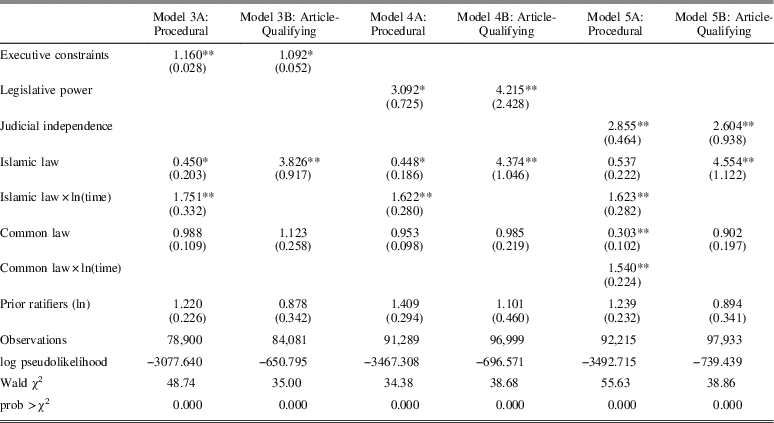
Note: hazard ratios are reported. Standard errors are clustered by country-treaty and reported in parentheses. *p<0.10; **p<0.05
Overall, the results of these models are consistent with the predictions of our argument about how different types of executives choose to ratify human rights treaties. Based on these models, smoothed hazard function estimates are also derived, and illustrate three important things about the results. First, the hazard rate (which shows the chance that a state will ratify in a particular way at any given point in time conditioned on the fact that it has not yet done so) varies over time in all of the models. The event-history approach is therefore appropriate, as it allows these varying hazard rates to be taken into account without having to specify the functional form of the underlying risk. Secondly, while there are some exceptions, the models show a general trend that the hazard rate associated with ratification in a particular way decreases over time. In other words, the longer a state holds out to ratify a human rights treaty in a particular way, the lower the chance that it will now do so. Thirdly, the values of the hazard rates showing the chance that a state will ratify in a particular way at any given point in time (conditioned on not having ratified by that point) are small. This is not surprising, as there are few treaty-country-years in which ratification takes place when compared to the full set of treaty-country-years in which ratification was possible.Footnote 67 This set of cases is even smaller when considering ratification with particular types of reservations – leading to lower hazard rates for ratification in those ways. It is therefore important to note that while the hazard rates may seem small, the chance of ratifying at any given moment in time is fairly small. Seen in perspective, the results are therefore substantively meaningful. More importantly, the difference between the hazard rates of ratification in various ways for different types of executives is significant. Our theory is designed to predict these differences.
Transitioning Executives
Models 1A and 1B test Hypothesis 1, and the results are consistent with its predictions. They show that the executives of states transitioning away from a more repressive regime have a significantly greater risk of ratifying a human rights treaty, in general, than those in other types of regimes (Model 1A). They also have a significantly greater risk of ratifying without entering any substantive reservations compared to all other types of executives (Model 1B). These results are demonstrated by the fact that the hazard ratio associated with the Transitioning Executive variable in Models 1A and 1B is greater than 1 and statistically significant at the 95 per cent confidence level.
The actual value of the hazard ratios also provides important substantive information about their differences in ratification choices. The hazard ratio of 1.34 associated with the Transitioning Executive variable in Model 1A indicates that if both a transitioning and non-transitioning executive have not ratified a human rights treaty by time t, the executive in the state transitioning away from a more repressive regime has a chance of ratifying it at that point in time that is about 34 per cent greater than the chance that the executive not in a transitioning regime will do so.
An analysis of smoothed hazard function estimates can help illustrate this increased risk. About ten years after a treaty opened for ratification, conditional on the fact that they have not yet done so, a transitioning executive has about a 3.9 per cent chance of ratifying it at that point in time, while a non-transitioning executive only has a 2.9 per cent chance. Consistent with the general trend in all models, those hazard rates decrease over time. Thirty years after a treaty opened for ratification, given that they have not yet ratified, a transitioning executive has a 1.8 per cent chance of doing so at that point in time, while a non-transitioning executive has only a 1.35 per cent chance.Footnote 68 Overall, throughout the time a treaty is open for ratification, the chance that an executive who has not yet ratified a treaty will do so at any given point in time is greater for transitioning executives than it is for non-transitioning executives.
Transitioning executives also have a greater chance of ratifying human rights treaties without entering substantive reservations than non-transitioning executives. The hazard ratio of 1.41 associated with the Transitioning Executive variable means that at any given point in time, if both a transitioning executive and a non-transitioning executive have not yet ratified a human rights treaty without substantive reservations, the transitioning executive has 1.41 times the chance of doing so compared to the non-transitioning executive. Smoothed hazard function estimates help illustrate this. Ten years after a treaty opened for ratification, conditional on not yet having done so, a transitioning executive has a 2.75 per cent chance of ratifying without a substantive reservation at that point in time, while a non-transitioning executive only has a 1.95 per cent chance. A transitioning executive who has held out for thirty years without ratifying without substantive reservations has a 1.13 per cent chance of doing so at that point in time while a non-transitioning executive who has held out for thirty years only has a 0.8 per cent chance. Overall, conditional on not yet having done so by any given point in time, transitioning executives have a 41 per cent greater chance of ratifying without substantive reservations than non-transitioning executives.
In general, the difference between the ratification strategies of transitioning and non-transitioning executives is significant. Executives of states transitioning away from more repressive regimes have a greater risk of ratifying human rights treaties, and of ratifying those treaties without entering substantive reservations, compared to other types of executives. While the actual hazard rates are relatively low, the difference in ratification strategies is substantively meaningful. Given that there are a small number of cases of ratification compared to the full set of treaty-country-years in which ratification was possible, the chance of ratification at any given point in time is small. The substantive difference in the risk that transitioning and non-transitioning executives will ratify, and ratify without substantive reservations, is thus significant. These results are in line with our theory about the incentives of executives in a state moving away from a more repressive regime face when ratifying human rights treaties. They have incentives to lock in the benefits of democratic reform – both political and economic – by ratifying human rights treaties that obligate themselves and subsequent regimes to uphold certain human rights standards, and to make those obligations as strong as possible. The increased risk associated with ratification and ratification without substantive reservations for executives in transitioning regimes is consistent with this argument.
Repressive Executives
Models 2A and 2B test Hypothesis 2, and yield results consistent with our argument. Compared to non-repressive executives, repressive executives have a significantly lower risk of ratifying human rights treaties, all else constant, but have a greater risk of ratifying with treaty-qualifying reservations. These results are demonstrated by the fact that the hazard ratio associated with the Repressive Executive variable is less than one in Model 2A and is greater than one in Model 2B. In both models, these differences in risk are statistically significant at the 95 per cent confidence level.
The results are also substantively significant. The hazard ratio of 0.8 associated with the Repressive Executive variable in Model 2A shows that repressive executives who have not yet ratified a human rights treaty by any given point in time have a chance of ratifying that is only 80 per cent as high as the chance that a non-repressive executive will ratify. For example, the smoothed hazard function estimates show that, conditional on not yet having ratified, ten years after a treaty is opened for ratification a non-repressive executive has a 3.3 per cent chance of doing so at that point in time while a repressive executive has only a 2.65 per cent chance. Thirty years after a treaty opened for ratification, given that it has not yet ratified, a non-repressive executive has a 1.5 per cent chance of ratifying at that point in time while a repressive executive only has a 1.2 per cent chance.Footnote 69 Overall, repressive executives have a lower chance of ratifying, which is about 80 per cent the size of the chance a non-repressive executive will do so.
In contrast, repressive executives have a greater risk than non-repressive executives of ratifying with treaty-qualifying reservations. The hazard ratio of 1.77 reported in Model 2B shows that a repressive executive has 1.77 times the chance of ratifying with a treaty-qualifying reservation compared to a non-repressive executive. Substantively, the smoothed hazard function estimates show that, conditional on not yet having done so, a repressive executive has a 0.08 per cent chance of ratifying with a treaty-qualifying reservation ten years after a treaty opened for ratification, while a non-repressive executive has only a 0.045 per cent chance. That hazard rate largely decreases over time, and thirty years after a treaty opened for ratification, given that he or she has not yet ratified with a treaty-qualifying reservation, a repressive executive has a 0.0575 per cent chance of doing so at that point in time while a non-repressive executive has only a 0.0325 per cent chance. Overall, the difference between repressive and non-repressive executives’ choices about the use of treaty-qualifying reservations is significant. At any given point in time, the chance of doing so is almost twice as great for repressive executives as it is for non-repressive ones.
In general, while the hazard rates are small, there are a small number of observations of ratification (and even fewer observations of ratification with treaty-qualifying reservations) compared to the full set of treaty-country-years in which ratification was possible. The overall chance of ratifying (and ratifying with treaty-qualifying reservations) at any given point in time is therefore low. Thus even if the differences between repressive and non-repressive executives’ ratification strategies are small in absolute terms, the results showing that these differences are significant are substantively meaningful when taken in perspective. These results are consistent with our argument about the incentives repressive executives face when ratifying human rights treaties, which often conflict with their political policies and practices. It therefore makes sense that repressive executives are at a decreased risk of ratifying human rights agreements relative to other types of executives, and an increased risk of using reservations that protect their domestic policies and practices from a wide array of potential challenges (that is, using treaty-qualifying reservations) if they do ratify. These findings provide more nuanced information about when and why repressive executives ratify human rights agreements. While their choice to ratify may seem perplexing given the challenges it raises for their domestic policies, once the types of reservations that can be added at ratification are accounted for, it is considerably less so.
Executive Constraints
Models 3A and 3B test Hypothesis 3. Consistent with our argument, the results show that executives facing greater constraints on their power have a greater risk of ratifying human rights treaties while using procedural and/or article-qualifying reservations. In both models, the Executive Constraint variable has a hazard ratio larger than one, and the increased risk is statistically significant at the 95 per cent confidence level for the use of procedural reservations (Model 3A) and at the 90 per cent confidence level for the use of article-qualifying reservations (Model 3B). Substantively, the results in Model 3A show that at any given point in time, given that they have not yet done so, the most constrained type of executive has a chance of ratifying with a procedural reservation that is 2.43 times the chance that the least constrained type of executive will do so. Similarly, the results in Model 3B show that given that they have not yet done so, the chance that the most constrained type of executive will ratify with an article-qualifying reservation at any given point in time is 1.7 times the chance that the least constrained type of executive will do so.Footnote 70
Analyzing the smoothed hazard function estimates, conditional on not having already done so, an executive facing significant constraints has a 0.9 per cent chance of ratifying with a procedural reservation ten years after a treaty opened for ratification and a 0.125 per cent chance of ratifying with an article-qualifying reservation. Executives facing few constraints have only a 0.37 and 0.073 chance, respectively.Footnote 71 Thirty years after a treaty opened for ratification, given that they have not yet done so, a constrained executive has a 0.22 per cent chance of ratifying with a procedural reservation at that point in time, and a 0.08 chance of ratifying with an article-qualifying reservation. A largely unconstrained executive has only a 0.09 and 0.047 per cent chance, respectively. Overall, constrained executives have a significantly greater chance of ratifying with a procedural or article-qualifying reservation than unconstrained executives. That chance is almost 2.5 times as great for procedural reservations and almost twice as great for article-qualifying reservations.
Digging deeper into the sources of these executive constraints, Models 4A and 4B test Hypothesis 4 (which focuses on the role of legislative constraints) and Models 5A and 5B test Hypothesis 5 (which focuses on the role of judicial constraints). First, the results show that executives facing a more powerful legislature have an increased risk of ratifying with procedural and/or article-qualifying reservations. This is demonstrated by the hazard ratios greater than one that are associated with the Legislative Power variable in Models 4A and 4B. This increased risk is statistically significant – holding at the 95 per cent confidence level in both models. Substantively, the results of Model 4A show that for two executives who have made it to any given point in time without ratifying with a procedural reservation, an executive facing the most legislative constraints has 2.25 times the chance of doing so compared to an executive facing the fewest legislative constraints. In addition, the results of Model 4B show that for two executives who have not ratified with an article-qualifying reservation by any given point in time, an executive facing the most legislative constraints has 2.82 times the chance of doing so compared to an executive facing the fewest legislative constraints.Footnote 72 Executives facing strong legislative constraints have a significantly greater risk of ratifying with procedural and/or article-qualifying reservations than those facing fewer legislative constraints.
Smoothed hazard function estimates further illustrate these results. Conditional on not yet having done so, an executive facing a powerful legislature has a 0.97 per cent chance of ratifying with a procedural reservation ten years after a treaty opened for ratification, and a 0.1755 per cent chance of doing so with an article-qualifying reservation. Executives facing weak legislatures have only a 0.43 and 0.0625 per cent chance, respectively. Thirty years after a treaty opened for ratification, given that they have not yet done so, an executive facing a powerful legislature has a 0.27 per cent chance of ratifying with a procedural reservation at that point in time and a 0.14 per cent chance of ratifying with an article-qualifying reservation. These are significantly greater than the chance executives facing a weak legislature will do so. If they have not yet ratified with these reservations thirty years after a treaty opened for ratification, executives facing a weak legislature have only a 0.12 per cent chance of ratifying with a procedural reservation at that point in time and a 0.05 per cent chance of ratifying with an article-qualifying reservation. Overall, the difference in ratification strategies for states facing legislatures of varying strengths is significant. An executive facing a powerful legislature has over two times the chance of ratifying with a procedural reservation compared to an executive facing a weak legislature, and almost three times the chance of ratifying with an article-qualifying reservation. This difference in ratification strategies is consistent with our argument.
Judicial constraints also influence executives’ reservation decisions in important ways. The results of Models 5A and 5B report hazard ratios associated with the Judicial Independence variable that are greater than one. In states where the judiciary is more independent from executive control, executives have an increased risk of ratifying with procedural and/or article-qualifying reservations that is statistically significant at the 95 per cent confidence level. Substantively, the results from Model 5A show that for two executives who have not yet ratified a human rights treaty with a procedural reservation by any given point in time, the one facing the greatest level of judicial independence has a chance of doing so that is 2.81 times the chance that the one facing the least independent type of judiciary will do so. Similarly, as illustrated by the results of Model 5B, for two executives who have not yet ratified with an article-qualifying reservation, an executive facing the most independent type of judiciary has 2.57 times the chance of doing so compared to an executive facing the least independent type of judiciary.Footnote 73 Executives facing a more independent judiciary have a significantly greater chance of ratifying with procedural and/or article-qualifying reservations than those facing a less independent judiciary.
Smoothed hazard function estimates help illustrate these results. Conditional on not yet having done so, ten years after a treaty opened for ratification, an executive facing a highly independent judiciary has a 1.05 per cent chance of ratifying with a procedural reservation at that point in time, while an executive facing a judiciary that is significantly less independent only has a 0.375 per cent chance of doing so. Similarly, an executive facing an independent judiciary has a 0.15 per cent chance of ratifying with an article-qualifying reservation at that point in time, while an executive facing a largely non-independent judiciary has only a 0.058 per cent chance. Thirty years after a treaty opened for ratification, given that it has not yet done so, an executive facing a highly independent judiciary has a 0.24 per cent chance of ratifying with a procedural reservation and a 0.095 per cent chance of ratifying with an article-qualifying reservation at that point in time. An executive facing a significantly less independent judiciary has only a 0.085 and 0.037 per cent chance, respectively. Overall, the difference in ratification strategies predicted by our theory is significant. An executive facing a highly independent judiciary has almost three times the chance of ratifying with a procedural reservation and over 2.5 times the chance of ratifying with an article-qualifying reservation compared to an executive facing a significantly less independent judiciary.
Overall, these results are consistent with our theory about how executives’ reservation decisions are influenced by the constraints they face. The difference in ratification strategies of executives facing varying levels of constraint is significant. While the hazard rates themselves are small, there are very few cases of ratification with procedural and/or article-qualifying reservations compared to the full set of treaty-country-years in which ratification was possible. The chance of ratifying with these reservations at any given point in time, in and of itself, is thus small. The differences in the hazard rates for constrained and unconstrained executives that we find are therefore substantively significant. These findings are consistent with the larger literature on reservations, as they align with Hill’s argument that the regimes most likely to use reservations are those that face the most constraints to comply with a treaty’s provisions.Footnote 74 Going one step further, we find that executives who are more constrained in their power have an increased risk of ratifying with specific types of reservations – procedural and/or article-qualifying reservations. Characteristics of states’ domestic institutions, in particular, play a key role. The constraints that stem from the existence of a legislature with greater veto power or the existence of a more independent judiciary exert especially significant effects on executives’ reservation decisions.
CONCLUSION
Human rights treaties are only effective if governing elites can be held accountable to their treaty commitments. In this article, we have taken a broad look at human rights agreements to determine which factors best explain the ways in which executives may ratify these treaties. Across different states, the domestic actors who can challenge executives’ policies and practices vary widely depending on the particular institutions in place. Executives in different states therefore face different incentives when deciding whether or not to ratify a human rights treaty and what reservations, if any, to enter when doing so. We have shown that key characteristics of executive elites’ position within the state influence how they are likely to use reservations upon ratification. In particular, executives from states transitioning away from a more repressive regime more readily ratify without entering substantive reservations. Repressive executives, in contrast, are generally more reluctant to ratify and are most at risk of ratifying with treaty-qualifying reservations. Finally, executives that are more constrained in their power relative to the legislature and judiciary more readily use procedural and/or article-qualifying reservations than less constrained executives.
Interestingly, the results also seem to indicate that legislative constraints substantively impact executives’ use of article-qualifying reservations to the greatest extent, while the greatest substantive impact of judicial independence is on the use of procedural reservations. The findings produce a number of questions. Is there something more going on here regarding the particular type of constraints executives face? What drives their choice to use procedural reservations to a greater degree when faced with judicial constraints, but article-qualifying reservations to a greater degree when faced with legislative constraints? Addressing this issue is clearly worthy of future investigation.
While we focused on political institutions, understanding the role of a state’s legal system also has important implications for executives’ ratification decisions, opening up another path for future work. Indeed, previous research shows that having a legal system based on Islamic law or common law influences whether or not a state is likely to ratify human rights treaties. While they are not the focus of our analysis, the results demonstrating how legal system type and reservation choice are related provides interesting insights into the role legal issues might play – not only in political elites’ decisions regarding whether or not to ratify a treaty, but also in deciding what reservations, if any, to enter. For example, the results from Models 1A and 2A show that Islamic law and common law states are more reluctant than states with other types of legal systems to ratify human rights treaties, in general, and the results from Model 1B show that they are especially more reluctant to ratify without any substantive reservations. Model 2B further shows that when these states do ratify, they more readily do so with treaty-qualifying reservations than states with other types of legal systems. Furthermore, as the results in Table 2 show, states with legal systems based on Islamic law also more readily ratify with article-qualifying reservations, while common law states have neither a greater nor a lesser risk of ratifying with either procedural or article-qualifying reservations than states with other types of legal systems. These findings are interesting, and suggest that ratification is not as simple as an up or down decision. Once we take into account the different ways that states can ratify, the relationships between legal system and ratification are more nuanced than they might appear. While these relationships were not the main focus of this study, this finding suggests that the legal system influences how states are likely to ratify, and that this issue is worthy of further investigation.
Overall, our analysis of the types of reservations likely to be used in different political settings has important implications, as two dual processes are at work when states ratify human rights treaties with reservations. As several scholars have argued, the use of reservations can increase co-operation both by fostering state commitmentFootnote 75 and by allowing ‘stronger’ treaties characterized by deeper co-operation.Footnote 76 At the same time, however, reservations are unilateral actions taken by states and may hinder co-operation by minimizing the obligations states take on, or by subjecting international commitments to domestic law. This flexibility can be exploited, and states that include more severe reservations tend to have worse human rights practices.Footnote 77 Is the benefit they extract in terms of commitment worth it in terms of outcomes, or do reservations provide too much flexibility, such that they end up inhibiting the goal of the treaty? Our findings imply that these dual processes likely vary depending on the reasons why reservations are included in the first place. It is therefore important to explore the ratification and reservation processes in greater detail. Helping us understand when and, more importantly, how states ratify international human rights treaties, we took a first step towards understanding a much larger puzzle about treaty commitment and international co-operation in human rights, more generally.
However, several interesting questions remain. In particular, the focus in this article was on human rights treaties, which often use vague language, and thus states often use reservations to define and qualify their application to their state. Yet states use reservations in many different types of treaties, some of which are much more specific in their obligations, including environmental treaties, treaties dealing with disarmament, and those dealing with matters regarding co-operation in criminal law. Do the same processes that characterize states’ use of reservations when ratifying human rights treaties characterize their reservation choices when ratifying these other types of treaties? Given that reservations qualify treaty commitments, this is an important question that future research should answer in order to better understand co-operation in these other issue areas as well.