INTRODUCTION
Since the emergence of the global biodiesel industry, production has addressed environmental concerns by reducing demand for fossil fuels and also contributed to social development though job generation (Visser et al. Reference Visser, Filho, Martins and Steward2011). Expansion of the biodiesel industry in recent years has led to a glycerine-saturated market; thus, effort directed to use its high-energy content in animal feed is an environmentally friendly strategy (Serrano et al. Reference Serrano, Branco, Teixeira and Osmari2014). Crude glycerine (CG) can be converted into volatile fatty acids (VFA) in the rumen, mainly into propionate (Hales et al. Reference Hales, Kraich, Bondurant, Meyer, Luebbe, Brown, Cole and McDonald2013). Propionate is the major glucogenic precursor in ruminants or it can be absorbed through the rumen epithelium and oxidized in the liver, increasing energy available for animal utilization (Remond et al. Reference Remond, Souday and Jouany1993). From a glucogenic perspective, the inclusion of glycerine would increase dietary glucogenic potential when glycerine replaces maize in beef cattle diets (Benedeti et al. Reference Benedeti, Paulino, Marcondes, Maciel, da Silva and Faciola2016).
According to Drouillard (Reference Drouillard2008), the addition of glycerine may improve the efficiency of ruminants fed forage more than those fed concentrate diets. However, although CG is a viable feed ingredient for ruminants consuming roughage-based diets (Hess et al. Reference Hess, Lake and Gunter2008a ), there is a lack of data examining CG as a primary energy source ingredient for grazing beef cattle. In addition, it has been observed that most recent research with grazing cattle only evaluated partial replacement of maize by CG (Silva-Marques et al. Reference Silva-Marques, Zervoudakis, Hatamoto-Zervoudakis, Cabral, Alexandrino, Neto, Werner Koscheck, Rondena Pesqueira Silva and Goncalves da Silva2015).
Replacing up to 600 g/kg of maize with CG for grazing beef cattle has been shown not to affect voluntary intake (Godoes et al. Reference Godoes, Marques, Zervoudakis, Jose Neto, Koscheck, Silva, Soares and Melo2015), ruminal synthesis of nitrogenous compounds (Oliveira et al. Reference Oliveira, Marques, Zervoudakis, Soares, Melo, Macedo, Arruda and Silva2015), or nitrogen (N) retained (Sampaio et al. Reference Sampaio, Silva-Marques, Zervoudakis, Hatamoto-Zervoudakis, Jose Neto, Silva, Soares and Batista2015). Nevertheless, nutritional and metabolic effects of total replacement of maize by CG have not been evaluated. There is still little information on the use of CG in protein-energy supplements for grazing beef cattle, particularly regarding the optimal level of dry ground maize replacement by CG (Botini et al. Reference Botini, De Moraes, De Moraes, Pina, De Paula, Hoffmann, Stinguel, Socreppa and De Meneses2015).
Therefore, the objective of the current study was to evaluate the effects of replacing dry ground maize with CG in protein-energy supplements on voluntary intake, digestibility and N utilization of grazing cattle during the rainy season. It was hypothesized that CG may fully replace dry ground maize as an energy source without compromising nutritional parameters.
MATERIAL AND METHODS
All procedures involving animals were approved by Brazilian committee for care and experimentation.
Experimental design, animals and supplements
The experiment was performed from March to May 2009 during the rainy season in Sinop, Mato Grosso, Brazil (11°50′S, 55°38′W). Five Nellore bulls averaging 332 ± 29·6 kg initial body weight (BW) were used in a 5 × 5 Latin square design. The bulls were kept under continuous grazing in individual Marandu palisade grass (Urochloa brizantha cv. Marandu) paddocks of approximately 0·32 ha. Animals were allocated randomly to the paddocks at the beginning of each experimental period. In order to minimize the possible effects of paddocks on experimental treatments, the bulls were rotated among the five paddocks every experimental period.
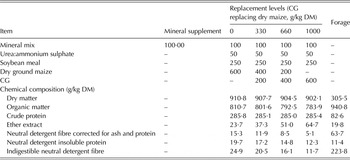
Five supplements were evaluated: mineral supplementation (control, only ad libitum access to a mineral mixture: ~100 g/animal/day) and protein-energy supplementation (offered at 4 g supplement/kg BW/day) with different CG levels (0, 330, 660 and 1000 g/kg) replacing dry ground maize (Table 1). The mineral mixture comprised (as-fed basis): 500·00 g/kg dicalcium phosphate, 477·75 g/kg sodium chloride, 14·00 g/kg zinc sulphate, 7·00 g/kg copper sulphite, 0·50 g/kg cobalt sulphite, 0·50 g/kg potassium iodide and 0·25 g/kg sodium selenite. The CG was acquired from a soybean oil-based biodiesel production company (Fiagril, Lucas do Rio Verde, Mato Grosso, Brazil) and had the following chemical composition: 876·2 g dry matter (DM)/kg as-fed basis, 126·62 g ether extract (EE)/kg DM, 49·2 g sulphate ash/kg DM, 34·8 g chloride/kg DM, 55·6 g sodium chloride/kg DM, 1·00 mg methanol/kg DM and 810·9 g glycerol/kg DM. A mixture (85:15) of CG and maize gluten meal (600 g crude protein (CP)/kg DM) was used to obtain a product with 90·0 g/kg CP, the soybean meal content was the same in all protein-energy supplements.
Feed ingredients and chemical composition of supplements and forage

CG, crude glycerine; DM, dry matter.
Experimental procedures and sampling
Each experimental period lasted 15 days, with 7 days for supplement adaptation and 8 days for sample collection. On the first day of each experiment period, a pasture collection was performed to determine total DM and potentially digestible DM (pdDM) mass/ha. The area to be sampled was delimited with an iron square (0·5 × 0·5 m) at four random sites in each experimental paddock. The forage samples were cut with scissors at ground level; aliquots of each collected sample were taken and composite samples prepared for each paddock. Sampling for qualitative assessment of the pasture consumed by the animals was obtained by hand-plucked sampling (Johnson Reference Johnson and t'Mannetje1978). Average forage mass during the experiment was 6 ± 1·4 t DM/ha and 5 ± 1·8 t of potentially degradable DM/ha.
Faecal DM excretion was estimated using titanium dioxide as an external marker. The marker (15 g/day) was introduced with the aid of an applicator through the oesophagus of each animal at 10·00 h for nine consecutive days. The first 6 days were used for marker adaptation and then the last 3 days were used for faecal grab collection (taken from the rectum) at 08·00, 14·00 and 16·00 h. The faecal samples were oven-dried (55 °C for 72 h) and processed in a knife mill (1- and 2-mm). Pooled samples were produced for each animal and experimental period. On the 14th day of each experimental period, urine spot samples were obtained before (06·00 h) and after the morning supplementation (10·00 h). Samples were filtered through cheesecloth and a 10-ml aliquot was separated, diluted with 40 ml sulphuric acid (H2SO4) (0·036 N), and frozen (−20 °C) for subsequent quantification of the levels of creatinine, urea and purine derivatives (PD). Concomitantly to the urine samples, blood was collected from the jugular vein of each bull using test tubes containing separator gel and a coagulation accelerator (BD Vacutainer SST II Advance, São Paulo, SP, Brazil). Samples were centrifuged (2700 g for 20 min) to obtain the serum, which was frozen (−20 °C) to evaluate the urea. To evaluate the ruminal ammonia nitrogen (NH3-N) concentration, samples of ruminal fluid were taken on the 9th day of each experimental period before (06·00 h) and after the morning supplementation (10·00 h). Samples were collected by oesophageal tube from the liquid-solid interface of the rumen mat and filtered through a triple layer of cheesecloth. An aliquot of 40 ml was subsequently separated, fixed with 1 ml of H2SO4 (1:1) and frozen (−20 °C) for a posterior NH3-N analysis.
Chemical analysis
Pooled samples of each material ground through 1-mm sieves (forage, faeces and ingredients used to produce the supplement) were analysed according to analytical procedures of the AOAC (1990) for: DM (method 934·01), organic matter (OM, calculated from ash content; method 924·05), CP (obtained by total N determination using the micro-Kjeldahl technique and a fixed conversion of 6·25; method 920·87) and EE (determined gravimetrically after extraction with petroleum ether in a Soxhlet instrument; method 920·85). The faecal samples were evaluated for titanium dioxide content according to the colorimetric technique described by Titgemeyer et al. (Reference Titgemeyer, Armendariz, Bindel, Greenwood and Löest2001). Neutral detergent fibre determination corrected for ash and protein (NDFap) analysis was based on the procedures described by Mertens (Reference Mertens2002). The samples were treated with heat-stable α-amylase, omitting sodium sulphite, and correcting for residual ash and protein (Licitra et al. Reference Licitra, Hernandez and Van Soest1996). Indigestible neutral detergent fibre (iNDF) was quantified by in-situ incubation procedures with Ankom bags (F57) for 288 h in samples processed at 2 mm.
The percentage of pdDM in the forage in each experiment period was estimated according to Paulino et al. (Reference Paulino, Detmann, Valadares Filho, Valadares Filho, Paulino, Paulino, Figueiredo, Barros, Diniz, Marcondes, Chizzotti, Fonseca and Benedeti2008):
 $${\rm pdDM} = 0{\cdot}98 \times (100 - {\rm NDF}) + ({\rm NDF} - {\rm iNDF})$$
where 0·98 is true digestibility coefficient of the cell content.
To estimate the total voluntary DM intake (DMi, kg/day), iNDF (internal marker) was used in the following equation:
 $${\rm DMi} = \left[ {\displaystyle{{[({\rm FE} \times {\rm iFC}) - {\rm iS}]} \over {{\rm iFoC}}} \times 1000} \right] + {\rm DMSI}$$
where FE is faecal excretion (g DM/day), iFC is internal marker concentration in faeces (g/g), iS is iNDF intake from supplement (g/day), iFoC is iNDF forage concentration (g/g) and DMSI is supplement DM intake (kg/day).
After thawing, urine samples were pooled by animal and experimental period and then analysed for creatinine concentration estimated by the modified Jaffé method (Bioclin K016-1), total N content (method 920·87; AOAC 1990), and allantoin and uric acid (Chen & Gomes Reference Chen and Gomes1992). Total urinary volume was estimated using the ratio of creatinine excretion per unit of BW to its concentration in the urine (Chizzotti et al. Reference Chizzotti, Valadares Filho, Valadares, Chizzotti, Campos, Marcondes and Fonseca2006). Excretion of PD was calculated from the sum of the amounts of allantoin and uric acid excreted in the urine. From this finding, the absorbed purines (AP, mmol/day) were calculated by the following equation according to Barbosa et al. (Reference Barbosa, Valadares, Valadares Filho, Pina, Detmann and Leão2011):
 $${\rm AP} = \displaystyle{{({\rm PD} - (0{\cdot}30 \times {\rm B}{\rm W}^{0{\cdot}75})} \over {0{\cdot}80}}$$
where 0·30 × BW0·75 is the endogenous PD excretion and 0·80 is the recovery of AP as urinary PD.
The microbial N synthesis in the rumen (Nmic, g/day) was calculated as follows:
 $${\rm N}_{{\rm mic}} = \displaystyle{{70 \times {\rm AP}} \over {0{\cdot}93 \times 100 \times 0{\cdot}137}}$$
where 70 is the N content of purines (mg/mmol), 0·93 represents the true digestibility of purines, and 0·137 is the average N-purines:N-total ratio in the bacteria isolated from the rumen (Barbosa et al. Reference Barbosa, Valadares, Valadares Filho, Pina, Detmann and Leão2011).
Statistical analysis
Orthogonal contrasts were used to determine the effect of treatments: mineral v. protein-energy supplementation; and linear, quadratic and cubic effects of CG levels in supplements. Statistical procedures were conducted by means of PROC GLM of SAS (Statistical Analysis System, version 9.2), adopting statistical significance at P ⩽ 0·05 and tendencies were considered at 0·05 < P ⩽ 0·10.
RESULTS
Intake
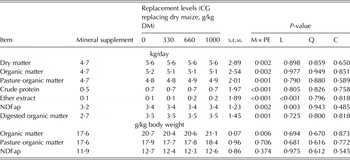
Bulls that received protein-energy supplements had greater (P < 0·01) DM, OM pasture, CP, EE, NDFap and digested OM (DOM) intakes than those receiving only mineral supplementation. No differences were observed among CG levels with regard to DM, OM pasture, CP and DOM intakes. However, there was a positive linear effect (P < 0·001) of the CG level on EE intake (Table 2).
Effect of replacing dry ground maize with crude glycerine (CG) on voluntary intake of grazing Nellore bulls

DM, dry matter; NDFap, neutral detergent fibre corrected for ash and protein; M × PE, mineral × protein-energy supplementation; L, Q, and C, linear, quadratic, and cubic effects of CG level in supplements, respectively.
Digestibility coefficients
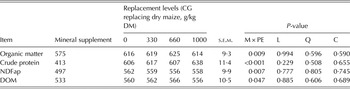
Protein-energy supplementation increased (P ⩽ 0·01) OM, CP and NDFap digestibility coefficients compared with mineral supplementation. The dietary concentration of DOM was greater (P < 0·05) in animals receiving protein-energy supplementation. There was no effect of CG levels on digestibility coefficients and dietary concentration of DOM (Table 3).
Effect of replacing dry ground maize with crude glycerine (CG) on total digestibility coefficients (g/kg) and content of digested organic matter (g/kg of DM) of grazing Nellore bulls

DM, dry matter; NDFap, neutral detergent fibre corrected for ash and protein; DOM, dietary concentration of digested organic matter; M × PE , mineral × protein-energy supplementation; L, Q, and C, linear, quadratic, and cubic effects of CG level in supplements, respectively.
Nitrogen utilization and microbial N synthesis
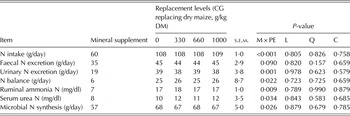
The total N intake (NI) and urinary N excretion (NU) decreased (P ⩽ 0·001) and faecal N excretion (NF) tended to be lower (P = 0·09) in bulls fed mineral supplement, resulting in a lower N retained (P < 0·05) when compared with animals fed protein-energy supplements. The ammonia concentration (NH3-N), serum urea N concentration (SUN), and Nmic were increased (P ⩽ 0·05) with protein-energy supplementation, but they were not influenced by the CG levels (Table 4).
Effect of replacing dry ground maize with crude glycerine (CG) on nitrogen (N) metabolism, ruminal ammonia N concentration, serum urea N concentration and microbial N synthesis of grazing Nellore steers

DM, dry matter; M × PE, mineral × protein-energy supplementation; L, Q, and C, linear, quadratic, and cubic effects of CG level in supplements, respectively.
DISCUSSION
Protein-energy supplementation for beef cattle grazing tropical pasture can improve forage intake up to protein levels near to 100 g CP/kg DM (Sampaio et al. Reference Sampaio, Detmann, Paulino, Valadares Filho, Souza, Lazzarini, Paulino and Queiroz2010). Detmann et al. (Reference Detmann, Paulino, Valadares Filho and Huhtanen2014) reported that above this dietary CP level, microbial N requirements would be met and further stimulation on forage digestion would no longer be observed. In ruminants fed tropical forage-based diets, the positive effects of N supplementation on fibre degradation in the rumen is typically observed when NH3−N concentration is above 8 mg/dl of ruminal fluid (Detmann et al. Reference Detmann, Paulino, Valadares Filho and Huhtanen2014). In addition, 13 mg/dl NH3-N is necessary to maximize the voluntary forage intake, which corresponds to approximately 120 g CP/kg DM (Detmann et al. Reference Detmann, Paulino, Mantovani, Valadares Filho, Sampaio, Souza, Lazzarini and Detmann2009).
Considering the average dietary CP content (78·7 g/kg) and NH3-N concentration of animals receiving only mineral supplement (6·89 mg/dl, Table 4), adverse effects associated with restrictions on the degradation of insoluble fibre on voluntary forage intake would be expected. In fact, these arguments are corroborated by lower digested OM intake and total NDFap digestibility observed in bulls receiving only mineral supplementation.
The greater NU in animals that received protein-energy supplements was possibly caused by the higher concentration of NH3-H in the rumen, which caused greater transfer of N to the bloodstream and increased the SUN concentration (Table 4). However, bulls receiving the protein-energy supplement improved N balance (NB), although there were greater N losses (NF and NU) as a result of improvement in N status in the animal body.
Overall, the main benefits of protein-energy supplementation appear to be due to the increase in N deposition in the animal body, measured by NB, which suggests a possible effect of the N status improvements in the animals’ bodies. This means higher gains and improved efficiency of nutrient use in grazing cattle production systems (Figueiras et al. Reference Figueiras, Detmann, Valadares Filho, Paulino, Batista, Rufino, Valente, Reis and Franco2015).
Regarding the CG effects, EE intake increased linearly with the replacement of ground maize by CG in supplements. This result was expected as CG addition raised the lipid content in supplements. In addition, since there was no effect on pasture DM intake, the EE intake variation would be due to the EE composition of CG present in the supplements. The greater EE intake in bulls receiving CG levels (20·32–25·60 g/kg DM) did not affect the DM intake, Nmic or total NDFap digestibility, which is in agreement with Hess et al. (Reference Hess, Moss and Rule2008b ), who reported that 50–60 g EE/kg DM inhibit microbial synthesis and use of dietary fibre, reducing DM intake. Other studies of grazing cattle supplemented with CG containing 800·0 g/kg glycerol have reported similar patterns (Godoes et al. Reference Godoes, Marques, Zervoudakis, Jose Neto, Koscheck, Silva, Soares and Melo2015; San Vito Reference San Vito2015).
According to Parsons et al. (Reference Parsons, Shelor and Drouillard2009), lower inclusion of glycerine could be beneficial to livestock growth, but concentrations >50 g/kg DM might create an unhealthy rumen, reducing DM intake. However, Hess et al. (Reference Hess, Lake and Gunter2008a ) suggested that CG can be added at 150 g/kg DM to forage-based ruminant diets without affecting DM intake negatively. In the present study, inclusion of CG did not exceed 78 g/kg DM, an amount lower than that described by Parsons et al. (Reference Parsons, Shelor and Drouillard2009) to decrease DM intake in cattle (120 g/kg DM). According to San Vito (Reference San Vito2015), the propionate metabolism resulting from these concentrations of CG (120 g/kg DM) would probably not be sufficient to act on receptors present in the rumen-reticulum and activate the satiety centre. In agreement with this affirmation, CG levels did not affect DOM intake. Although CG contributes more energy per unit of DM than maize (Monnerat et al. Reference Monnerat, Oliveira, Paulino, Mezzomo, Silva, Silva, Ferreira, Oltjen, Kebreab and Lapierre2013), the dietary DOM concentration was not affected by CG levels. Additionally, DM digestibility was not affected by the CG levels in the current study, showing that energy intake (DOM) was not influenced by CG inclusion in the diet.
Regarding digestibility related to CG levels, San Vito (Reference San Vito2015) did not observe any negative effect on fibre digestibility of warm-season grasses, an observation similar to the present study. However, in some studies the inclusion of CG in the diets causes a decrease in fibre utilization by the animals (Parsons et al. Reference Parsons, Shelor and Drouillard2009). Abo El-Nor et al. (Reference Abo El-Nor, AbuGhazaleh, Potu, Hastings and Khattab2010) observed reductions in NDF digestibility and bacterial DNA concentrations of Butyrivibrio fibrisolvens and Selenomonas ruminantium with increasing levels of glycerine in the diet of cows. However, Hess et al. (Reference Hess, Lake and Gunter2008a ) reported that CG can be added at 150 g/kg DM to forage-based ruminant diets without affecting DM or fibre digestibility negatively, which is in agreement with the results of the present study.
Wang et al. (Reference Wang, Liu, Huo, Yang, Dong, Huang and Guo2009) suggested that rapid microbial adaptation and fast ruminal glycerine turnover, as well as high VFA production (Benedeti et al. Reference Benedeti, da Silva, de Paula, Shenkoru, Marcondes, Monteiro, Amorati, Yeh, Poulson and Faciola2015), may be possible reasons for a lack of negative effects on fibre digestibility. In addition, it has also been suggested that micro-organisms adapt to glycerol feeding, as rates of disappearance increase with increased days of feeding glycerol (Krehbiel Reference Krehbiel2008). For beef cattle grazing tropical pasture during the rainy season, San Vito (Reference San Vito2015) hypothesized that CG at low concentrations (1–10 g/kg) has no effect on growth, adhesion or cellulolytic activity but had a negative effect on fibre digestion.
The CP intake (NI), digestibility parameters and Nmic were not affected by the energy-protein treatments as shown by similar ruminal NH3-N concentration with increasing CG levels. These results are in agreement with those reported by Abo El-Nor et al. (Reference Abo El-Nor, AbuGhazaleh, Potu, Hastings and Khattab2010) and San Vito (Reference San Vito2015). Other studies have found that increased CG in the diet was correlated with a linear decrease in ruminal NH3-N concentrations (Wang et al. Reference Wang, Liu, Huo, Yang, Dong, Huang and Guo2009). In the current study, for all GC levels, NH3-N concentration was higher than 8 mg/dl, which is considered the minimum value for appropriate ruminal fermentation (Detmann et al. Reference Detmann, Paulino, Mantovani, Valadares Filho, Sampaio, Souza, Lazzarini and Detmann2009). In addition, the same NH3-N ruminal concentration in the present study may be related to the same CP intake. Thus, independent of the CG level, CP protein intake was available in the rumen environment to be degraded into NH3-N. Therefore, providing an adequate N supply and, consequently, an adequate NH3-N concentration is the first priority for optimizing fermentative digestion of forage (Detmann et al. Reference Detmann, Paulino, Valadares Filho and Huhtanen2014).
The absence of differences for Nmic can be associated with the similar results observed for digestibilities with increasing CG levels in the supplements. These results suggest that all the CG levels provided adequate amounts of N that was available in the rumen for microbial N synthesis. Thus, it can be inferred that the estimated values for Nmic support the theory that CG inclusion does not adversely alter the population of micro-organisms in the rumen micro-environment (Serrano et al. Reference Serrano, Branco, Teixeira and Osmari2014).
CONCLUSIONS
Total dry ground maize replacement by CG as an energy source in protein-energy supplements for grazing beef cattle, offered at an amount of 4 g/kg of BW, exerted no changes on pasture intake, digestibility and N utilization.
The authors wish to thank the Fundação de Amparo à Pesquisa do Estado de Mato Grosso – (FAPEMAT, Brazil) for providing financial support.