Experiments and discussion
The cultivated peanut (Arachis hypogaea L.) is divided botanically into two subspecies. Subsp. hypogaea is further divided into two botanical varieties, var. hypogaea and var. hirsuta Köhler, and subsp. fastigiata Waldron is further divided into vars. aequatoriana Krapov. & W.C. Gregory, fastigiata, peruviana Krapov. & W.C. Gregory and vulgaris Harz (Krapovickas and Gregory, Reference Krapovickas and Gregory1994). Cultivars containing high oil are preferred for oil collection or bio-diesel production, whereas cultivars containing low oil are preferred for making lower calorie snack foods. Peanut oil contains a high amount of oleic acid. Consuming oils with high levels of oleic acid is believed to be beneficial to human health by reducing low-density lipoproteins (LDL), maintaining high-density lipoprotein (HDL), slowing down atherosclerosis and reversing the inhibitory effect of insulin production (Vassiliou et al., Reference Vassiliou, Gonzalez and Garcia2009). In addition, various studies suggest that bio-diesel with high levels of methyl oleate will have excellent characteristics with regard to ignition quality, NOx emissions and fuel stability (Durrett et al., Reference Durrett, Benning and Ohlrogge2008). Therefore, peanut oil with high levels of oleic acid is preferred for both human consumption and bio-diesel production. Due to higher oil content, higher level of oleic acid and higher oil yield (gallons of oil/acre) than soybean, peanut as a potential feedstock has recently drawn a great deal of attention for bio-diesel research. The U.S. germplasm collection of Arachis with over 10,000 accessions is maintained by USDA–ARS, Plant Genetic Resources Conservation Unit in Griffin, Georgia. Although the fatty acid composition from the U.S. peanut germplasm core collection has been surveyed (Hammond et al., Reference Hammond, Duvick and Wang1997), the variability of oil content and fatty acid composition among subspecies and botanical varieties is unclear. The objectives of this study were to (1) determine the variability for oil content and fatty acid composition among subspecies and botanical varieties and (2) determine the correlation between fatty acids and oil content.
Eighty-three peanut accessions representing two subspecies and six botanical varieties were selected (Supplementary Table S1, available online only at http://journals.cambridge.org). Seeds from each accession were planted in 10-foot long plots in Byron, GA in 2008. A Maran pulse nuclear magnetic resonance (NMR, Resonance Instruments) was used for determination of the oil percentage. Oil percentage was determined from physiologically matured seeds on a 0% H2O basis by using the formula (100(% oil))/(100 − %H2O) and then converted into g/kg. Fatty acid composition of peanut seeds was analyzed using a Hewlett Packard 5890 series II gas chromatography (GC, Agilent, Palo Alto, CA, USA), calculated as percentage and then converted into g/kg. For sample preparation, three to five peanut seeds were ground to a fine powder in a coffee bean grinder. A small amount (approximately 150 mg) of ground powder was transferred into a 16 × 100 mm disposable test tube, and 5 ml n-heptane (Fisher Scientific, Springfield, NJ, USA) was added to extract the oil. For conversion of fatty acids to methyl esters, 500 μl of 0.5 N sodium methoxide (NaOCH3) in methanol solution were added to the test tube and mixed with the sample. The reaction proceeded for 2 h, and then 7 ml distilled water was added to the test tube for separating the organic layer from the aqueous layer and peanut residue (45 min). Afterward, 1.5 ml from the organic layer containing methyl esters was transferred to a 2 ml autosampler vial for GC analysis. Fatty acid composition was determined by identifying and calculating relative peak areas. A Pearson's coefficient analysis was performed to determine significant correlations. An analysis of variance was performed on the data, and means were separated using Tukey's multiple comparison procedure.
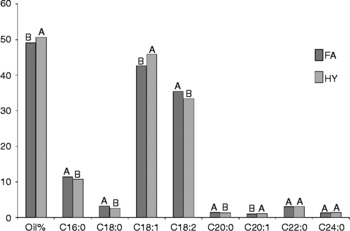
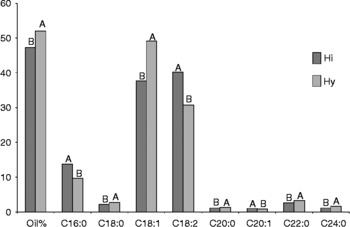
The oil content of the subsp. hypogaea was higher than that of the subsp. fastigiata (507 vs. 491 g/kg, P < 0.05; Fig. 1). Furthermore, within subsp. hypogaea, the oil content of var. hypogaea was higher than that of the var. hirsuta (520 vs. 473 g/kg, P < 0.05; Fig. 2). Our result was consistent with a previously published result (Barrientos-Priego et al., Reference Barrientos-Priego, Isleib and Pattee2002) in which var. hirsuta was also identified as a botanical variety with relatively low oil content. Within subsp. fastigiata, the oil contents of the var. peruviana and var. vulgaris, both 491 g/kg, were not significantly different from any of the botanical varieties; however, the oil content of var. fastigiata was significantly higher than that of the var. peruviana (500 vs. 483 g/kg, P < 0.05; Supplementary Fig. S1, available online only at http://journals.cambridge.org). The PI 506419 (A. hypogaea subsp. hypogaea var. hypogaea) contained significantly more oil (56.2%) than 60 of the accessions tested, and the PI 576616 (A. hypogaea subsp. hypogaea var. hirsuta) contained 41.7% oil, which was significantly less than 74 of the accessions tested. These two accessions would be good parents to use for developing high and low oil cultivars, respectively.
Comparison of oil content and fatty acid composition among subspecies. X-axis represents different chemical traits and Y-axis is expressed in percentage. If the letters are the same above the bars for the same biochemical trait, there is no significant difference between means.

Comparison of oil content and fatty acid composition among botanical varieties within the subspecies hypogaea.

Significant variability in fatty acid composition was also detected among 83 peanut accessions (Supplementary Table S2, available online only at http://journals.cambridge.org). Significant variability in six fatty acids was detected between the peanut subspecies (Fig. 1). Subsp. hypogaea differed from subsp. fastigiata in having a higher proportion of oleic acid (459 vs. 427 g/kg) and lower proportions of linoleic acid (334 vs. 356 g/kg), palmitic acid (109 vs. 115 g/kg) and stearic acid (26 vs. 33 g/kg). Furthermore, significant differences between the two botanical varieties within the subsp. hypogaea were detected for eight fatty acids (Fig. 2). In comparison with var. hirsuta, var. hypogaea contained a higher proportion of oleic acid (491 vs. 377 g/kg) and lower proportions of palmitic acid (97 vs. 138 g/kg) and linoleic acid (308 vs. 402 g/kg). Significant variability in eight fatty acids was also detected among the four botanical varieties within subsp. fastigiata (Supplementary Fig. S1, available online only at http://journals.cambridge.org), but the differences were much smaller than those between botanical varieties within subsp. hypogaea (Fig. 2).
No highly significant correlations were detected between oil content and any of the eight fatty acids. However, significant negative correlations of oleic acid with palmitic acid (r = − 0.79, P < 0.0001) and linoleic acid (r = − 0.96, P < 0.0001) were also detected, consistent with the previously published result (Hammond et al., Reference Hammond, Duvick and Wang1997). The negative correlation indicates that when the amount of oleic acid is increased in the peanut-breeding programs, the amounts of palmitic acid and linoleic acid will be significantly decreased. These negative correlations are required for developing cultivars with high oil content and oleic acid and low palmitic and linoleic acids for both human consumption and bio-diesel production.
Our preliminary results indicate that significant variability in the oil content and fatty acid composition has been detected among botanical varieties. The subsp. hypogaea var. hypogaea is a good source for identification of accessions with high oil content and high oleic acid. Thus, for further screening the U.S. peanut germplasm for high oil content and high oleic acid, efforts should be focused on this botanical variety.
Acknowledgements
The authors thank Mr Brandon Tonnis for his excellent assistance on chemical analysis and reviewers for useful suggestions and comments on the manuscript.