Introduction
Numerous studies have highlighted the enormous relevance of economic knowledge and expertise within financial organizations and markets. To name just a few, areas of expertise include accounting (Power Reference Power2010), risk management (Kalthoff Reference Kalthoff2005; Mikes Reference Mikes2009; Millo and MacKenzie Reference Millo and MacKenzie2009), valuation of economic entities (Beunza and Garud Reference Beunza, Garud, Callon, Millo and Muniesa2007; Hägglund Reference Hägglund, Kalthoff, Rottenburg and Wagener2000; Svetlova Reference Svetlova2012), pricing, as well as “engineering” of financial instruments (Lépinay Reference Lépinay2011; MacKenzie and Millo Reference MacKenzie and Millo2003; Svetlova Reference Svetlova, Jansen, Schröter and Stehr2009), and forecasting (Svetlova Reference Svetlova2010). It has remained an open question, though, how these knowledge practices outside the “academy” and their peculiar employments of models can be adequately theorized. From the perspective of academic economics, one might subsume them under the rubric of “applied economics.”Footnote 1 This would imply that we could understand a certain knowledge practice in financial organizations and markets by starting from the appropriate theoretical model and then follow its specification and adaptation by practitioners. This way of understanding practical uses would also reflect the order of the discipline, which attributes highest value to theoretical, model-related work and treats “applied” (e.g. econometric) works as peripheral (Breslau and Yonay Reference Breslau and Yonay1999; Fourcade Reference Fourcade2006; Maas and Morgan Reference Maas and Morgan2012; Morgan Reference Morgan2012). However, as will be shown in this article, knowledge within financial organizations is constituted according to distinct epistemic norms, professional identities, and practices; these norms, identities, and practices cannot be deduced from those of academic economics. I will more specifically argue that while economic models are of highest value in the academic field, this hierarchy can in fact be inversed within certain areas of finance.
What could be the potential use of models within financial organizations and markets, if this use is not based on theoretical interests and a scientific commitment to rigorous methodological work? One influential perspective on this question is provided by classic sociological studies of capitalism. Max Weber and Werner Sombart, for instance, argue that capitalism is synonymous with systematic profit-seeking. The rationalistic core of capitalist enterprises naturally leads capitalists to draw on scientific and technological solutions (Sombart Reference Sombart and Harms1931; Weber [1920] Reference Weber2002). Models, in that sense, can be understood as the most developed technologies for performing formalized, systematic calculations: They serve to compute prices on the basis of relevant numerical variables (costs, risks, etc.); they allow forecasts to be systematically controlled for errors and thus “optimized.” Some of the more recent work, which focuses on the abundant use of models in contemporary enterprises and markets, draws (often implicitly) on these arguments. For instance, Michel Callon (Reference Callon and Callon1998) posits that models allow actors with limited cognitive capacities to live up to the ideal of economic rationality (see also Callon Reference Callon and MacKenzie2007; MacKenzie Reference MacKenzie2008).Footnote 2
However, much of the detailed empirical work on knowledge and modeling practices in financial organizations and markets does not entirely support these arguments. For instance, Ekaterina Svetlova (Reference Svetlova2010) studies how financial traders use the Black-Scholes-Merton (BSM) formula, which has been, according to finance theory, the most advanced calculative device for valuating financial options and futures. Svetlova notes that practitioners do not believe that this specific or any other model could adequately reduce the complexity of markets;Footnote 3 nevertheless, the BSM-model is widely used by practitioners because it can be artfully and creatively manipulated (Svetlova Reference Svetlova, Jansen, Schröter and Stehr2009, 128). This example shows that traders draw on models, but are not “rationalized” by these devices (Svetlova Reference Svetlova2012, 3–4). Often, traders even prefer models with simple logics and unrealistic assumptions over complex, perhaps more realistic ones because the former can be better manipulated.
Other studies confirm that models are not necessarily used because of their inherent calculative capacities. Yuval Millo and Donald MacKenzie (Reference Millo and MacKenzie2009), for instance, find that traders, risk managers and regulators use BSM despite its acknowledged failure in calculating correct market prices. Their explanation of this phenomenon is that the model becomes a sort of “boundary object” (Leigh Star Reference Leigh Star2010; Leigh Star and Griesemer Reference Leigh Star and Griesemer1989): It forms “the boundaries between groups through flexibility and shared structure” (Leigh Star Reference Leigh Star2010, 603) and thereby facilitates coordination of increasingly complex organizational and intra-organizational operations in the derivatives markets. For instance, models enable financial firms “to express risks in accessible terms and to construct a clear picture of potential market situations and possible reactions” (Millo and MacKenzie Reference Millo and MacKenzie2009, 644). As the model has become “a common language” (ibid., 650), it also starts to facilitate governance capacities of regulatory agencies. A similar observation is made in Annette Mikes’ comparative study of risk management practices: In one bank, she observes that a risk management model has reached the “status as a common denominator and language of risk” (Mikes Reference Mikes2009, 32). Thus, in these examples, organizational and institutional dynamics, rather than the logic of rational calculation, are important for explaining the spread of a model (for a more general sociological perspective on these processes, see Meyer Reference Meyer2010).
Another, equally widespread observation is that certain professional groups involved in decision making processes sidestep numerical calculations and instead rely on other, incommensurable criteria and rationalities. Herbert Kalthoff (Reference Kalthoff2011) invents the concept of “undoing calculation” for this operation, which he describes as a temporally delimited shift of attention away from calculation.Footnote 4 Such operations may correspond with negative attitudes of certain professional groups towards model calculations. These groups often express outright doubt about the accuracy or validity of models. For instance, Mikes observes that senior risk managers at a particular bank openly question the calculability of risks, instead relying on “experience-based judgment [as] the key to operational risk control” (Mikes Reference Mikes2009, 28). Svetlova also shows that portfolio managers deviate from model assumptions in order to arrive at non-consensus, “original” views (Svetlova Reference Svetlova2012, 13). Another example is provided by Frank Mars (Reference Mars1998) in his study of financial analysis: He observes that, within a bank, economists produce forecasts of macroeconomic variables which should, according to the “top-down approach,”Footnote 5 be used as inputs to the models of equity analysts. Mars shows, though, that analysts most of the times ignore economists’ forecasts. Firstly, analysts believe that economists’ forecasts are highly uncertain and often fail. Secondly, many equity analysts question the causalities implied by the top-down approach. They argue that the value of “their” companies is only marginally influenced by macroeconomic trends.
Thus, according to these empirical case studies, models often play a part in performing complex tasks in financial organizations. However, practices mostly do not follow a simple logic of “applying models” (in the sense of academic economics) or of rationalizing or optimizing decision-making. In fact, there exists no uniform convergence between finance and model use towards ever greater calculative rationality. Rather, calculation itself often seems to be more complex than numerical, model-bound computation: Actors have a pragmatic or skeptical attitude towards the capacities of models, and they often cope with their shortcomings or manipulate models in order to achieve pre-defined results; some groups even “undo” model values and arrive at decisions qualitatively. At the same time, a particular model may be used within financial organizations and markets not primarily as a powerful or “handy” calculation device, but rather as a “boundary object” that different professional groups can appropriate according to their own interests and perspectives. These uses, then, demand that attention be given to the intertwinement of model(ling) practices and institutional dynamics. Moreover, once a model is institutionally established, it is not sacrosanct: Certain occupational, organizational, or professional groups can de-legitimate model calculations.
However, while the existing literature draws attention to the socio-cultural diversity of modeling and model use, it is difficult to extract consistent explanations of how these variations have come about or what effects they produce. For instance, it might be the case that a specific kind of modeling and model use can be explained with reference to (changes within) organizational settings (Mikes Reference Mikes2009), professional roles (Mars Reference Mars1998) or investment styles (Svetlova Reference Svetlova2012). The proposal of this paper, therefore, is to identify the heterogeneous cultures of expertise (Wansleben Reference Wansleben2013) within organizations and markets and to provide case-specific explanations of the relations between different cultural values and practices (Bourdieu Reference Bourdieu1979).Footnote 6
This paper explores what cultures of expertise we might find when empirically studying the process of forecasting exchange rates in a bank that is commercially involved in the currency markets. In terms of modeling and model use, foreign exchange forecasting promises to be a particularly interesting case: When studying the economic literature on this subject, we find that the most prominent academic efforts of modeling actual exchange rate movements were made after the fall of Bretton Woods. These efforts, associated with monetary macroeconomists such as Rudiger Dornbusch (Reference Dornbusch1976) and Jacob Frenkel (Reference Frenkel1976), were strongly dedicated to an international general equilibrium perspective, sticking to the doctrine of purchasing power parity (“law of one price”). At the same time, these economists took notice of the increasing significance of global foreign exchange markets and therefore newly conceptualized the influence of expectations on the allocation of funds.Footnote 7 In order to synthesize these two aspects, it was assumed that market participants form expectations regarding macroeconomic variables when making their allocation decisions (i.e., following Muth's (Reference Muth1961) rational expectation hypothesis). However, when different variants of monetary models were put to an econometric, “out-of-sample” test in the early 1980s, they all failed (Meese and Rogoff Reference Meese and Rogoff1983). This negative result has since been established as a “central fact of life [as] there is remarkably little evidence that macroeconomic variables have consistent strong effects on floating exchange rates” (Frankel and Rose Reference Frankel, Rose and Grossman1995, 1709). The failure of the models has provoked an alternative perspective on foreign exchange markets, refraining from macroeconomic assumptions and asking how investors empirically form their expectations (e.g. Frankel Reference Frankel1993; Lyons Reference Lyons2001). Sociology has contributed to this empirical project. For instance, Urs Bruegger (Reference Bruegger1999) has undertaken an ethnography of foreign exchange traders in global banks (see also Bruegger Reference Bruegger, Kalthoff, Rottenburg and Wagener2000; Knorr Cetina and Bruegger Reference Knorr Cetina and Bruegger2002) in order to explore how they actually trade. In this study, Bruegger shows that trading is based, first of all, on having experience in the markets. This experience commences with junior traders’ socialization on trading floors, it includes having observed prices and market information on trading screens for many years and it means having gone through many uncertain situations of decision-making (for corresponding studies of other financial markets, see Abolafia Reference Abolafia1996; Zaloom Reference Zaloom2006). The specific knowledge, which builds up with experience, relates to traders’ on-going observations and forecasts of market developments. Traders may understand price developments in terms of “fundamentals” such as macroeconomic developments. They thus build up “views,” “stories,” and “big pictures” about growth, inflation, interest rates, etc., which make them “bullish” (positive) or “bearish” (negative) on a particular currency. Accordingly, traders select economic news on their screens, confirming or questioning their views. Traders may also adopt a chartist or “technical” concept of markets, developing and interpreting graphic representations of price and volume data. Additionally, most traders also consider flow information (information about high-volume transactions) and rumors.
However, according to Bruegger, traders emphasize that these interpretations and forecasts do not make up the whole, and maybe even not the most critical knowledge, which qualifies a good trader. Equally or more important are the competences of being disciplined, vigilant, and capable of controlling one's emotions. For markets, according to traders, are “open concepts” (Knorr Cetina 2009b) and change unexpectedly all the time, affording a trader's constant attention, spontaneous rethinking, and courage. Neither the development of views nor the exercise of discipline and attention, rely on modeled knowledge. For instance, Karin Knorr Cetina writes: “In currency spot transactions, trading tends to be a form of informed tracing – a form of following and anticipating the flow grounded more in a continually ‘worked’ and prepared structure of feeling than in modes of calculation” (Knorr Cetina Reference Knorr Cetina2009a, 22).
Thus, the literature already presents us with quite different cultures: While academic economists still struggle with how they can model foreign exchange movements according to a certain set of macroeconomic variables, the empirical study of foreign exchange traders portrays a culture of ignorance towards modeling. This tension is of great interest for the question of how foreign exchange forecasting is practiced in banks. For, on the one hand, banks are organizations, which cannot rely on the idiosyncratic and individual knowledge of their traders but require consistent and explicit foreign exchange forecasts for internal planning purposes and external audiences. Therefore, banks have economics divisions and foreign exchange analysis teams which produce forecasts on a regular basis. Reference to “experience” or “gut feelings” might not be appropriate in order to rationalize market developments publicly and explicitly (Garfinkel [1967] Reference Garfinkel2008; Garfinkel and Sacks Reference Garfinkel, Sacks and Garfinkel1986). On the other hand, banks are market-related: They employ traders and produce forecasts for actual decision-making. As long as the rationalities of speculative traders, especially those in banks and large funds, dominate the markets (see, for instance, BIS 2010), their knowledge has an almost self-evident weight for explaining or forecasting market dynamics (Soros Reference Soros1994). This poses the problem, then, of a possible conflict between different cultures of expertise or even a struggle for domination between different groups (traders, economists, analysts) within the organization.
I will now turn to my own empirical study. In the next section, I will first give some more detailed information about the cases and then describe the process of forecasting exchange rates. This description will highlight the coordinated efforts of various teams responsible for different forecasts (growth, interest rates, exchange rates, etc.), the rationale of choosing a specific model of foreign exchange forecasting, and the analysts’ translation of forecasts into views. This description should prepare the analysis provided in the next section, where I relate two kinds of attitudes and uses of models with two different cultures of expertise, labeled “pragmatic econometrics” and “market expertise,” respectively. Models, in the first case, serve as generators of consistency and as devices of observing time series data, while in the second case, they are anchors for committing to views on possible future expectation changes. In the concluding section, I will discuss the generalizability of these findings and provide some arguments for why the market expertise culture dominates the pragmatic econometrics culture.
The process of forecasting exchange rates at a bank
While some studies on equities analysis exist (Wansleben Reference Wansleben, Cetina and Preda2012), experts in currency markets have hitherto been neglected. This is thus the first study in this field. It was motivated by the observation that foreign exchange expertise, both macroeconomic and market-related, is conducted by different expert groups (particularly economists and analysts). In order to explore these cultures of expertise, I conducted interviews and observed participants in both large and medium-sized banks in London, Frankfurt, and Zurich, all of which have foreign exchange research and trading divisions. While the general intention was to identify the “epistemic profile” (Knorr Cetina Reference Knorr Cetina, Camic, Gross and Lamont2011) of the kind of economic expertise conducted within financial organizations, I also observed considerable diversity among banks and individuals. However, I here largely concentrate on patterns between practices, identities, and structural roles (Abbott Reference Abbott, Ragin and Becker1992). In fact, participants describe themselves and their environments according to more general classification schemes (“actors’ categories”) that the sociologist can start with, contextualize as acts of articulation, and thereby see how these acts relate to what is going on elsewhere within a network (Collins Reference Collins, Meusburger, Welker and Wunder2008; Latour Reference Latour2005).
The particular case study that this paper is based on consisted of six weeks of participant observation during July/August 2009 and additional interviewing at one of the largest German banks. This bank has subsidiaries in some of the major global cities but its headquarters and main businesses are located in Frankfurt. The bank is involved in retail, wholesale, and investment banking as well as wealth management.Footnote 8 All foreign exchange expertise is produced by the Economics Research Division, which is attached to the investment banking arm. This division consists of approximately twenty-five economists (including a “chief economist”) responsible for the forecast of macroeconomic aggregates as well as fixed income, commodities, and foreign exchange strategy analysis teams with about six analysts each. I focus on this bank and its economics division because of the richness of my data: A combination of participant observations, qualitative interviews, and document analysis allows me to reconstruct the process of forecasting and disentangle as well as relate the different cultures of expertise.
I now provide a description of the forecasting process, which involves three distinct institutionalized practices: The overall, coordinated forecasting in the economics division, the specific, model-based forecasting of exchange rates by a specialized economist, and the analyst team's production of a “view.”
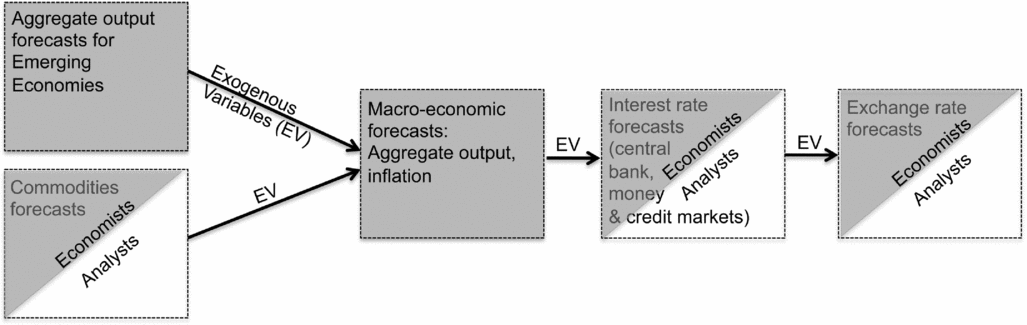
(a) Forecasting work within the economics division. The forecasting process at the bank usually follows a monthly cycle and commences at the order of the chief economist, the division's head. After the forecasting procedure is initiated, the economics division's five different forecasting teams revise their respective forecasts (see fig. 1).Footnote 9 This is a “process” in the sense that the teams’ forecasts are arranged sequentially in order for each subsequent team to be able to use the input of the previous teams. A foreign exchange analyst describes this process as follows:
Forecasting is a process in which, first, commodities and emerging market researchers present their forecasts, these are then included into the forecasts of our macroeconomists who predict aggregate output, inflation, etc. The central bank analysts use these macroeconomic forecasts to predict the key policy rate developments in different countries, then follow the interest rate and yield analysts who predict the credit market rates and the interest rates for long-term bonds. And finally, we from the FX [foreign exchange analysis, LW] team feed all the input into our model, the economist calculates the FX model forecast and we analysts discuss the results with him. (Interview extract, head of analyst team, February 2009)
The forecasting process of the investigated bank. (Source: author's reconstruction)

Thus, the bank has not one integrated model for all variables.Footnote 10 Rather, each of the mentioned teams uses its own model to forecast a specific macroeconomic variable and/or financial asset but can draw on the input of other teams’ forecasting efforts as exogenous variables to their models.
The technology that facilitates the coupling between the forecasts is a system of folders on intra-organizational servers with linked Excel files. Thus, when a forecast is recalculated, forecasting values change in the file with the respective model; these changes of values then directly feed into Excel files for other forecasts. In fact, the folder system has become a mirror of the interdependencies of the forecasting process: One forecaster claims that the current links between the Excel files “have become so complex that nobody either understands how they actually work, nor can change the system without potentially destroying the entire structure” (Interview during field study, member of economics division, July 2009).
(b) Model-based foreign exchange forecasting. As mentioned in the quotation above, exchange rates are forecast at the end of the process, after aggregate output, inflation, and interest rates have already been calculated. How do the foreign exchange forecasters proceed? An economist has developed the currently used model for forecasting the euro-US dollar exchange (EUR-USD) rate some years ago and has published a paper about this econometric work. In this paper, he argues that the rationale of his model is not to test or even develop a theory of exchange rate movements. Rather, modeling has “the more humble objective of identifying macroeconomic variables which enable the best possible forecast of exchange rates at six and twelve months ahead” (quotation from the internal publication). This statement reflects the objective of the economist to produce the best possible predictions from the data rather than to test theories. It also reflects a situation of theoretical underdeterminism: The economist is well aware that no macroeconomic foreign exchange rate (FX) model yet exists which has survived rigorous econometric testing. Hence, in an interview, the economist states that “economics cannot provide any good FX model.”Footnote 11 Accordingly, the economist abstains from a commitment to any particular theory. Apart from Balassa and Samuelson and their theories of productivity differences, the economist's working paper makes no explicit references to academic works. The economist rather “picks” possible explanatory variables from all major approaches of FX theorizingFootnote 12: real interest rate differentials, net foreign assets, foreign direct investments, trans-border securities flows, and differences of countries’ positions within the growth cycle. Clearly, the economist prefers variables with high correlation coefficients as compared to variables, which are backed by a “clean economic argumentation” (interview during field studies, “foreign exchange economist,” July 2009). He then correlates these variables with past EUR-USD movements, thus, simulating their predictive power.
The results are ambiguous: No variable can be identified as the best predictor but some (among them productivity differences; expected growth differences; nominal and real interest rate differences in the money and credit markets; the crude oil price) show some explanatory power. The problem then is how these variables might perform in an ex ante forecast (see Evans Reference Evans1999, 44). Hence, not just correlation counts but rather the ability to give an independent estimate of the presumably predictive variables. This narrows the economist's choices considerably. In the interview, he states:
I can only use a limited number of explanatory variables. “Net foreign assets of banks” is a variable, which shows a very good correlation with exchange rates but there simply exists no estimation for it. Equally, “basic balance” is highly correlated but the forecasts for this variable, as found on Bloomberg, are simply crap. Therefore, I need to use less correlated variables but which are predictable and which we actually predict here in the bank. (Interview during field study, “foreign exchange economist,” July 2009)
Hence, the economist makes a pragmatic choice based on available forecasts within the organization. By drawing on this input, the economist arrives at the currently used model that predicts the EUR-USD exchange rate with two variables, namely the interest rate differentials for US treasuries vs. the bonds of Euro member states, and productivity differences between the US and Europe. The respective values for the variables stem from the internal interest rate forecasts produced by the other bank economists and “KLEMS”Footnote 13 as a measure of productivity.
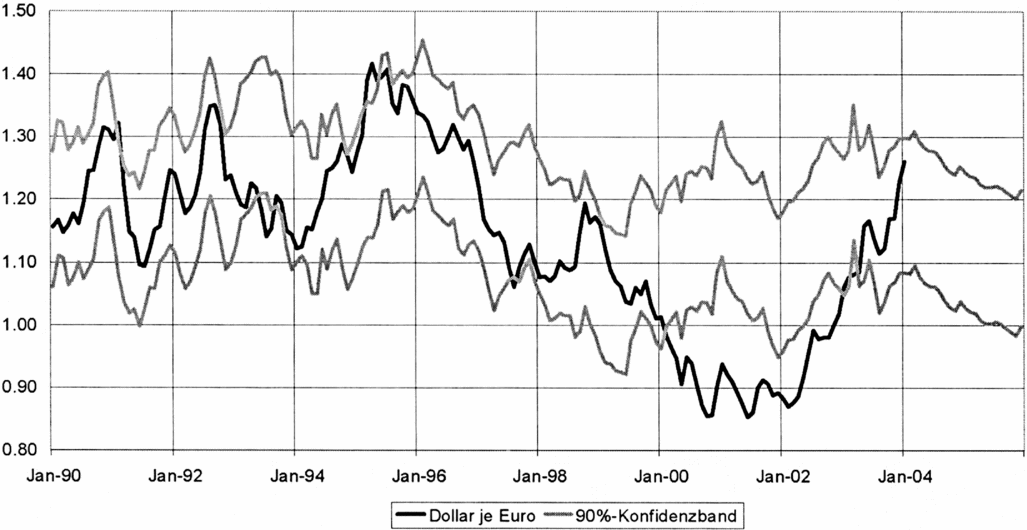
While the economist regards this model as reasonable, he acknowledges that it is far from perfect. For one, it can only predict movements roughly, i.e. within a 90 per cent confidence interval. It can also hardly predict whether the exchange rate will go up or down within the short term, i.e. within the next weeks. More important for the economist, however, is that over three periods – during the mid 1990s, during the 2001–2002 recession, and during the financial and economic crisis of 2007–2010 – the EUR-USD exchange rate deviated from its model path considerably, and for extended periods of time (see fig. 2). These model errors, then, become occurrences the economist further elaborates on. He is able, for instance, to explain the model error during the 1990s by factoring in the US current account deficit. The economist states:
For sure, you can try to integrate the current account into your model. But I have not done that explicitly. For, first of all, it is very difficult to quantify this factor. And secondly, such special factors change frequently so formalizing them would not improve the model in the long run. (Interview during field study, “foreign exchange economist,” July 2009)
Thus, deviances from the model path make the economist think of possible other, non-permanent explanatory factors.Footnote 14 He does not include those factors in the model architecture but corrects the model forecast with a separate econometric estimate.
The model forecast, 1990–1994. Black: EUR-USD (actual); grey: 90 per cent confidence interval (model forecast). (Source: author's field research [publication of the investigated bank])
Still, the economist faces the problem that even though the model has performed reasonably well in the past, it might not do so in the future: He is well aware of the miserable performance of foreign exchange models in general and about the specific problem that models, if at all, only work for limited periods of time. The economist has no particular theoretical view on exchange rate developments but quite a different rationale for the success or failure of his models: He thinks that models succeed when they are in-synch with what variables market participants focus on when valuating one currency as compared to another. The economist reflects, though, that this investor-focus might change over time, requiring a new model:
The EUR-USD exchange rate can only be predicted by any combination of explanatory variables for a limited period of time. . . . The reason is herding. Herding means that, at each time, investors and analysts only consider a limited set of variables. They thereby focus on what they think others will select as information. . . . Additionally, herding is reinforced by a high degree of uncertainty in any expectation formation. . . . Thus, any foreign exchange forecast should consist of two steps: First, one needs to investigate which fundamental factors currently drive herd behaviour. Hereby, the proposed models can serve as a tool. Secondly, one needs to predict when the herd behaviour potentially changes, which are the causes, and which new factors might then, after the behavioural change, determine expectations. (Quotation from the internal publication)
Hence, while the economist, in several other passages of the paper, uses the notion of equilibrium, he in fact does not model any “fair value.” With reference to “herding,” he also restrains from drawing on the assumption of rational expectations (that is a critical element of most macroeconomic models). Rather, his model choice is determined by what he thinks the “herd” of investors currently uses as explanatory variables, given a general situation of uncertainty. Hence, he may very well switch from one model to another, simply reflecting his expectation that investors will, in the near future, select other information when forming their expectations. The economist therefore has not one but four models at his disposal. And while he currently uses model no. 3, he still tests the three other models regularly.
(c) Analysts’ Views. As indicated in fig. 1, the economist, when producing foreign exchange forecasts, cooperates with a team of foreign exchange analysts, which sits, separated from the economist, on the trading floor of the bank. In fact, early during my field studies, I asked one of the analysts on the floor for the name of the economist “who produces the forecasts.” The analyst answering my question specified that the economist only runs models, while forecasting authority rests with the analyst team. Thus, the analysts regard themselves as the primary authorities in the forecasting process. This becomes particularly evident in their attitude towards the economist's model. One analyst states, for instance: “The model result does not become our forecast directly. We always ask first: What does the model tell us in a particular situation?” (Interview extract, head of analyst team, February 2009). In concrete terms, this means that the economist “delivers” the model forecast to the analysts who then treat this forecast as a resource with limited value for their own work. The analysts’ own choice of relevant factors and considerations when producing a forecast is not econometric. Accordingly, analysts mostly even do not speak of a forecast but rather of their “view.” Views combine the model predictions of the economist with analysts’ own observations. This becomes evident in the following description:
Because of the positioning indicators and the current themes in the markets, we expect another dynamic than the one predicted by our model. We read the research of other banks, we speak to the clients directly or via sales, we listen to what the traders say and thereby try to develop an intuition of what are the themes that momentarily move EUR-USD. (Interview extract, head of analyst team, February 2009)
Market observations especially influence the short- (up to six months) to mid-term expectations (up to twelve months). For the longer term (twenty-four months), the analysts often maintain the model values. Analysts’ work thus consists of making qualitative judgments regarding the “path” that leads from the present (current price), through the near future (market dynamics), to the long-term forecast (the model value of a currency): “We establish the path that leads from the present situation to the model value manually. For often we expect, on the basis of our observations, specific short-term dynamics” (Interview extract, head of analyst team, February 2009).
The decision regarding the view is taken during a meeting of the analysts with the economist. During this meeting, the following is discussed: what does the model “tell” the analysts within a specific market situation, what other current developments must be taken into account, and how to position the bank's view in relation to the “consensus” (the average, calculated from all available forecasts) and the views of particular competitors. After various arguments are expressed and a decision reached, the head of FX analysis scribbles the forecasts for the most important currency pairs (G10) and for certain intervals (monthly, quarterly, and annual) on a sheet of paper. The analysts then manually type the respective numbers into the team's central forecasting file. After the Excel file has been updated, the analysts prepare a special report in order to publish the revised view. This report includes a table, comparing former and revised forecasts, a graph, and an accompanying text (between two to four pages), spelling out the arguments for the revised view. In the text, analysts combine the various macroeconomic and market-related factors that underpin their view. In most reports, the analysts rely on a narrative according to which “temporary” aspects (positioning indicators, non-economic news, etc.) will give way to macroeconomic factors (which they have supposedly predicted correctly).
Two cultures of expertise in the bank
Thus, the foreign exchange forecast “travels” within the bank, from the economics department to the workplaces of the analysts on the trading floor. Econometric forecasting is combined with a peculiar sort of qualitative judgment or “overlay.” I now aim to interpret this “traveling” as a movement from one culture of expertise to another. Surely, the different cultures are not clear-cut and are in fact highly related.Footnote 15 I will still argue, however, that analysts’ market-driven and market-focused culture is somewhat different from that of economists, who practice a pragmatic econometrics.
(a) Economists’ pragmatic econometrics. Thus, the first culture to be described is found at the economics division of the bank. Entering the workspace of this division, one observes several economists sitting in a large open-plan office in front of computers where they mainly work with Excel and other data-related software. The work atmosphere is calm and focused. With the exception of the chief economist, members of the economics division only rarely have client-meetings, interviews with the press, or other involvements in the bank's commercial activities. Especially for someone who has spent most of his time on the trading floor, the calm atmosphere, but also the dress and informal behavior are striking: You barely encounter an economist wearing a tailored suit or handling a blackberry nervously.
However, the economists’ specific culture not only contrasts with what is going on in other parts of the bank. The contrast with “academic economics” is also relevant. One of the economists provides the following, very characteristic and plausible portrayal of his and his colleagues’ work:
We are not an academic research institution; we are a research division of a bank. So we should not develop new theories or study detailed economic questions but we should capture the current situation and analyze data. We should answer the question of what's relevant, what's irrelevant and what the data do tell us about the future. (Interview extract, member of the economics division, August 2009)
This self-description implies two important features of bank economists:Footnote 16 First, they see themselves as dissimilar from academic economists because of their specific context of work: As members of an organizational unit within a bank, the economists have genuine epistemic interests, but must also compromise with the interests of clients, other members of the organization, and, ultimately, the senior management. Practically, this first of all implies that the economists have to produce forecasts and texts for regular weekly, monthly and bi-monthly publications that should be adequate for a broad audience of (potential) bank clients (i.e., investors and senior managers of corporations). Secondly, drawing on their oftentimes excellent knowledge of theories, models, and methods (most hold a PhD in economics), the bank economists’ primary question is how they can use these epistemic resources in order to get the on-going forecasting work done. As the quotation above expresses, this also means that priority is given to the analysis of data, with a low commitment to particular theoretical viewpoints. The economists at the bank thus are a classic example of what Robert Evans calls “weak econometricians” (Evans Reference Evans1999, 85). This notion also adequately captures what the foreign exchange economist meant when he acclaimed his “more humble aim” of providing forecasts rather than developing or testing theories.
Models are critical instruments for this culture of pragmatic econometric forecasting. As one economist describes, models not only facilitate the knowledge work but also coordinate organizational processes within the division: “Models’ function is not necessarily to forecast correctly but consistently. That's because models enable us to feed our bank's expectations about growth, inflation, interest rates, etc. systematically into all market forecasts” (Interview during field study, member of economics division, July 2009).
Thus, models enable the economists to design an overall consistent forecasting process. For models imply relations of dependencies between the economic aggregates, expressed as dependent and independent variables. These relations translate into the forecasting process by suggesting a sequence of different forecasting steps. The implied causalities of models become the criteria for deciding which aggregates should be forecasted first in order to be used as explanatory variables in the subsequent forecasts. The economists recognize that causalities can be ambiguous or even circular.Footnote 17 However, once a sequence is established, it defines not only the status-quo causality but also becomes part of the organizational routine. Every month, when new forecasts are produced, the sequence is activated and produces suboptimal, but consistent results. Hence, modeling stands for expectable, repeatable procedures and it provides organizationally shared rationalizations for why things are done that way rather than differently (Scott Reference Scott2003, 25).
This model-based design of the forecasting process generates consistency in yet another sense: Not only the procedures, but also the results of the forecasts become consistent. That is because a change of forecast of one economic aggregate engenders, according to the sequence of forecasting steps, corresponding changes in the subsequent forecasts. Econometric modeling can generate this consistency because econometric models entail quantitative parameters that specify how the change of one variable impacts the change of another. Economists regard that kind of consistency as a major criterion for the quality of their work. It seems, as the following two quotations indicate, that they are observed by and observe other economic divisions accordingly: “Our forecasts are based on a consistent economic picture. As a research division, promoting a consistent economic picture is very important indeed.” “The quality of a research division is signaled by the fact that it delivers a ‘geared’ forecast. Because, in the long run, only a consistent forecasting process facilitates credibility and sustainability” (Interview extracts, economists of two different banks, March and July 2009).
However, it would surely be too limited to think of models only in terms of the generation of intra-organizational consistency. After all, as the discussion of the foreign exchange modeling has shown, even within the framework of a consistent forecasting process, there is considerable room for choices for the individual teams. This is especially true for the foreign exchange forecaster because he can draw on the forecasts of all other teams and still remain consistent (see fig. 1). Thus, other criteria should contribute to the choice, construction, and usage of a model. I argue that the teams’ primary concern is with the time series data. Thus, we here have another case, where modeling is not so much oriented towards variable-centered explanation, but more towards observation. Harro Maas and Mary S. Morgan describe this modeling-as-observation in the following way:
The econometric model operates as an instrument that both turns raw data into numerical relations and works to seek out hidden numbers. It is not so much an observation and recording device but an observation and revealing device rather like the modern fMRI scans, which produce sophisticated versions of the traditional X-rays. (Maas and Morgan Reference Maas and Morgan2012, 19)
A very good example of this modeling-as-observation practice is in fact provided by the foreign exchange forecaster within the bank: He uses any combination of variables with explanatory power without taking too much regard of “thorough economic reasoning.” In fact, the economist even explicitly argues that instead of looking for a foreign exchange theory, the task of the forecaster is to capture the variables that the majority of market participants will look at in the future. As the market has “bounded rationality” and is ruled by imitation effects, expectations cannot be identical to any theory. The economist, as described above, therefore refrains from a complete model to explain exchange rate movements, but instead uses more than one model in order to have several observational devices at disposal. To be sure, the choice of one as compared to another set of variables is based on measurement. This measurement, though, is not a statistical test of a theoretical explanation. For, in a situation of weak statistical evidence and systematic forecasting errors, the economist still has to make a pragmatic choice among the variables he wants to use. For that purpose, he can well draw on a suboptimal, but simple model. Simplicity is especially important for dealing with forecasting errors. For simple models can more easily be adjusted “by hand.” As one analyst elegantly put it: “A model then serves the purpose of motivating explanations of the deviances from the model” (Interview during field study, member of the analyst team, July 2009).
(b) Market expertise. Hence, for the bank economists, models are essential: Without them, the organizational set-up would break down and hardly any observation of time series data could be made. While the team of foreign analysts of the bank belongs to the same organizational unit, and interacts with the economists frequently, its culture of expertise can still be distinguished from that of economists. First, analysts’ work does not consist of observing and forecasting time series data but rather of observing and analyzing the markets. This is most obvious when we encounter the analysts at their usual places of work on the bank's huge trading floor: Here, they confront between four to six computer screens. The screens display information provided by Bloomberg, Reuters, and other services. Other than on economists’ screens, figures, words, curves, and even colors on analysts’ screens change continuously. Accordingly, analysts’ attention is almost entirely captured by that on-going “flow” of information (Knorr Cetina Reference Knorr Cetina2003 and Reference Knorr Cetina2009a; Knorr Cetina and Preda Reference Knorr Cetina and Preda2007). Observation, then, means to literally “see” how prices react (or fail to react) to economic news and other information.Footnote 18 On the basis of these observations, analysts identify more or less consistent patterns. One highly relevant construct within this process of pattern recognition is that of “themes”: Themes are series of news, which refer to macroeconomic or political developments and can stretch over several days or weeks (a particular crisis, an unresolved political conflict, a new strategy by a central bank, etc.). Evidently, the analysts are interested in “market themes,” i.e., in news that the majority of market participants focus on for a certain period of time. If analysts have correctly identified the prevailing market themes, they may be able to explain the current trend in the exchange rate movement. However, the analysts are aware of how uncertain their observational knowledge remains: How long a trend may last, or when it will break down or be reversed, is very hard to guess.
Secondly, analysts’ knowledge is much closer to market activity. Again, this fact becomes already evident from the spatial organization of work: On the trading floor, the analyst team is surrounded by traders and salespeople. Interactions with traders are routinized through daily Morning Meetings and more spontaneous interactions across desks. In these situations, analysts are directly challenged by traders’ demands and interests. Moreover, salespersons also constantly approach analysts on the floor or by phone with client requests. More generally, the floor is a space that changes its characteristics in synchronicity with the markets. That is because, depending on the arrival of news, the amount of client demands, the extent of profit opportunities, etc., noise levels and visual attention are adapted (Beunza and Stark Reference Beunza, Stark, Pinch and Swedberg2008, 266). For the analysts’ practice of market observation, this immersion into the market atmosphere is very important: On the floor, analysts can learn how to produce expertise that is relevant for actual risk-taking. Thus, traders are relevant interaction-partners for analysts because the former allow the latter to become “gameworthy.”Footnote 19 That implies, for instance, learning how to select information from what traders deem relevant or what traders consider their peers are interested in.Footnote 20 Moreover, within the floor context, analysts learn how market participants manage their knowledge and information: As described in the introduction, traders permanently act under uncertainty, mostly relying on gut feelings and embodiments. Thus, their knowledge is never “complete” (Schütz [1975] Reference Schütz2003, 235) before they have to make a decision. Through socialization on the floor, analysts learn to adopt this attitude and express their “views,” based on incomplete knowledge.
These peculiarities of analysts’ culture of expertise can best be exemplified when we imagine how newcomers arrive at the job: They quickly learn to put their “economics” aside and rather develop new observational and social competences. For instance, during my field studies, one junior analyst told me that her main problem was that at her former employer, a small bank, she would only occasionally take an interest in the exchange rates but never watch Bloomberg constantly. Now, in the new environment, she still needs to get used to this new practice of observation. Moreover, she should learn to judge the relevance of information even without drawing on the usual models.
Let me now come back to the question of how analysts’ culture intersects with the forecasting process. As described above, after the economist has produced a model-prediction for a certain exchange rate, he “delivers” his results to the analyst team. When analysts receive the model forecast, they are confronted with a piece of knowledge that is not at the center of their own knowledge culture. Rather, based on their own expertise, analysts criticize modeling and question the capacity of the model forecasts to generate useful market knowledge. Their first critique concerns the variable-centered perspective, which is implied by the model architecture. As one analyst put it: “The different aspects that become part of the forecast are more complex than any normal model can possibly capture” (Interview during field study, member of the analyst team, July 2009). The analyst here contrasts an approach based on variables, limited to quantitative information, with his concept of market themes, which can include numerical, linguistic, and emotive elements. The second criticism concerns the tension between the temporality of models and the temporality of markets. As shown above, economists’ forecasts, embedded in organizational routines and econometric logics, are mostly provided for and revised according to periods of one month; most time series data is also updated monthly. This, then, becomes the minimal temporal unit in the economists’ grid of observation and forecasting. By contrast, the analysts observe exchange rate movements permanently on their screens and recognize the respective hourly and daily price dynamics. For the economists, short-term dynamics can, at best, be ignored and at worst lead to asynchronies between the independent, macroeconomic variables and the price data. For the analysts, though, short-term dynamics are not so much a problem of modeling but rather the very object of interest: In “real time,” they identify which information has engendered a new trend, allowing educated guesses about price movements in the near future. These conflicting temporalities lead analysts to assume that, short- to mid-term, models are useless:
Our models rather work in the mid-term, let's say some quarters ahead. Up until then, developments are driven by other factors that we do not formally model because they change too quickly. Positioning indicators, for instance, indicate how the market will react during the following couple of days and weeks. These indicators momentarily work very well but last year we could not use them at all. Therefore, we do not formally model the short-term. (Interview extract, head of analyst team, February 2009)
The most crucial distinction, though, concerns the two different goals of the forecasting effort: As argued above, economists know of the shortcomings of any model and choose the model that promises intra-organizationally consistent results and observations of time series data. The analysts, by contrast, see forecasting as the act of committing to a particular view. What a view spells out is a possible scenario about how market expectations could change in the future. Future expectations are principally unknown but analysts can propose a view about their possible evolution to the market audience. A successful view therefore does not depend on econometric calculation but rather on skill, intuition, and “a bit of luck,” as one analyst described. Most important, though, is the capacity to arrive at one's own opinion: “You’ve always got to have an opinion where the market is going. . . . Thus, providing a view first and foremost means: having an opinion” (Interview during field study, member of analyst team, July 2009). How strong an opinion you have becomes evident in how far you dare to deviate from the “consensus.” This deviation, much like a financial position, should be evaluated in relation to possible gains in and risks of losing status.Footnote 21 These criteria conflict considerably with economists’ aims. As one economist says: “The analysts hold an aggressive view. They want to take a clear positioning. The question dividing me from them is: Do you care for your mean forecasting error or do you accept failing four times just to beat the gun once?” (Interview during field study, “foreign exchange economist,” July 2009).
As described above, the analysts have the authority for deciding what foreign exchange forecast is published. Thus, their culture of expertise, to some extent, dominates that of the economists. The consequence is that the model forecast is ultimately used according to their culture. As described, the analysts delimit the use of the model forecast to the long-term (twenty-four months), while they choose a particular short- to mid-term path based on their observations.
One possible interpretation of this form of model use is that the analysts stick to the normative, but counterfactual, expectation of a long-term equilibrium which brings the exchange rate back to its “fair value” (Langenohl Reference Langenohl2007, 101–104; Miyazaki Reference Miyazaki2003, 259). This interpretation has some validity because most analysts indeed believe in the superior rationality of markets. However, there exists another reason for why analysts draw on the model, which is not ideological but pragmatic: Within the forecasting process, the model serves as an anchor. The concept of anchoring means that some, mostly random value is selected as a starting point for an estimation process which, in turn, considerably biases the results of the estimation (Tversky and Kahneman Reference Tversky and Kahneman1974, 1128). The model forecast works similarly: It provides values for the long-term foreign exchange rate development. However, the analysts do not frame these values as tried and tested results of econometric calculation. They rather use them in accordance with their own forecasting practice: This firstly means that the numerical values facilitate the construction of the short- to mid-term paths of change. In that sense, analysts speak of a directional, rather than a point forecast (Bruegger Reference Bruegger1999, 69). Asynchronous, long-term forecasting values, as compared to current market prices, become advantages rather than handicaps of the model because they allow analysts to claim a corresponding short- and mid-term change in the exchange rate movement. This can be potentially attractive for analysts if they aim to claim a very visible, bullish or bearish, position. Second, the model facilitates the construction of stories: For the model predictions also imply predictions concerning important macroeconomic variables, especially interest rates. When arguing for their views, analysts selectively refer to these underlying explanatory variables. However, analysts do not use them as calculations but rather as more or less plausible, more or less original elements for the construction of narratives, which are included in their publications.
Changing hierarchies between cultures of expertise?
For both economists and analysts, models serve as different tools in the forecasting process. These differences are here interpreted in terms of the distinct cultures of expertise: Economists and analysts, while being members of one organizational unit in a bank, define their epistemic core differently (data analysis vs. market observation), operate in different work environments, follow different routines and adopt different styles. Models, for economists, generate inter-team consistency and serve as devices of observing quantitative data. Their attitude towards models is that of users who stick to what provides sub-optimal and simple structures. Errors in forecasting are unavoidable but should be reduced to a minimum. For analysts, by contrast, models are marginal and foreign because of the dominant role of observational practices. Their attitude is that of model critique; analysts use market language in order to question the validity of model forecasts and claim authority in the forecasting process. However, analysts still use models as anchors for the construction of paths and stories about possible future expectation changes. The aim of these constructions is to arrive at convincing and original views, which make an analyst team distinguishable from other, competing teams. The crucial argument here is not that bank economists and analysts live in entirely different worlds (even as their cultural differences have micro- and meso-structural underpinnings) but that variations in practices, identities, orientations, etc. within a bank become classified and hierarchically related by the participants themselves (Bourdieu Reference Bourdieu1979): Analysts subordinate economists’ pragmatic econometrics to a culture that is defined by constant attention to market-relevant information and struggles for positioning.
This article discusses the forecasting process in a single bank. However, the notion “cultures of expertise” suggests that the practices and self-descriptions observed here are not just the outcomes of local idiosyncrasies. While I cannot draw on a representative sample of foreign exchange forecasters in order to generalize my observations, I can still suggest that the identified cultures fit into a larger picture of developments in the global currency markets: As the statistics of the Bank for International Settlements show, in the 1990s, the markets were still under the control of large global banks and their traders (“cambists”) (Barker Reference Barker2007). For instance, in 1992, 69 per cent of global turnover was constituted by transactions between banks while foreign exchange deals of non-banks were comparatively marginal: Other financial institutions (funds, investment firms, insurances, etc.) contributed 12 per cent of turnover, and non-financial firms about 17 per cent (BIS 1995). Both financial and non-financial firms dealt with banks and also acquired their expertise via the banks. For the foreign exchange divisions of large banks, then, this marginal customer business was no great priority and it sufficed to provide clients with regular, but infrequent reports and model-based forecasts about the foreign exchange markets. As was also the case at the bank described above, the economics divisions could very well provide such expertise as part of their general macroeconomic forecasting work without much help from market analysts. However, since the 1990s and especially during the 2000s, a significant share of speculative FX activities has begun to take place outside of the traditional interbank market, leading to enormous growth in overall foreign exchange turnover.Footnote 22 This growth is, among others, driven by financial institutions such as hedge funds, pension funds and insurance. While there exists no reliable figure on financial institutions’ market share, we can notice a remarkable growth within the category of “non-dealing financial institutions,” to which financial institutions belong (together with small banks and central banks): With $1.9 trillion daily turnover in 2010, up from $97 billion in 1992, this “category” now produces more volume than the dealers produce among themselves (BIS 2010; King and Rime Reference King and Rime2010; King et al. Reference King, Osler and Rime2011).Footnote 23 Most importantly, many institutional investors enter the foreign exchange markets with interests and capacities quite different from those of the clients in the 1990s: They concentrate large sums of capital and specialize in searching for opportunities for profitable investment (Simon et al. Reference Simon, Millo, Kellard and Engel2011). This development suggests that a speculative knowledge culture, first exclusively shared by cambists (Knorr Cetina and Bruegger Reference Knorr Cetina and Bruegger2002), now becomes relevant for a more diversified and distributed group of market participants. The peculiar relationship between two cultures of expertise, as described above, then, is a contingent, but quite plausible response to these developments: Banks, on the one hand, still need a consistent economic picture for internal planning purposes but also as a tool of communication with their general client base (investors, corporations etc.). Bank economists, often led by a highly visible chief economist, take responsibility for developing and promoting this picture. On the other hand, the banks, while often reducing their proprietary trading units,Footnote 24 aim to acquire the largest possible share of the new customer foreign exchange market because the deals of institutional investors promise large fees.
Banks competing for these clients therefore form or enlarge teams of foreign exchange analysts and give the latter expert group more responsibility and authority in the forecasting process. The analysts should both respond to institutional investors’ on-going requests for market-specific expertise and acquire high status positions in relation to other analysts in order to attract new customers. Thus, these developments show quite clearly why producing market expertise, in the form of observations, views and stories, becomes a much more legitimate and important activity in the contemporary global foreign exchange markets.