Language acquisition is a process characterized by remarkable consistency. The significant homogeneity of the order and timing of language milestones (e.g., Brown, Reference Brown1973), however, provide a challenge to researchers who are interested in individual differences in language development. Researchers have demonstrated significant variability in the timing of production of syntactic structures in the case of late language learners (Johnson & Newport, Reference Johnson and Newport1989) and of child maltreatment (Eigsti & Cicchetti, Reference Eigsti and Cicchetti2004), among others. The current study was motivated by this previous work to examine language-specific effects of early deprivation in the caregiving environment after adoption into a more stable setting, because such perturbations could reveal some of the causal mechanisms underlying differences in the language acquisition process. Models of typical developmental processes are strengthened when they are grounded in, and accommodate, cases of atypical development. International adoption presents a unique situation in which early adversity, linked to changes in stress-regulating systems, is followed by a sharp discontinuity of experience (e.g., Croft et al., Reference Croft, Beckett, Rutter, Castle, Colvert and Groothues2007; Rutter, Reference Rutter2007); as such, this population may open a window into the cognitive “building blocks” of language acquisition. In the current study, we examine subtle differences in language abilities in children adopted to the United States from international institutions, and probe for relationships between these language abilities and domain-general differences in implicit learning, explicit memory, and cognitive control. We hypothesize that the neural effects of institutionalization-related stress provide a mechanism linking these domain-general cognitive processes to language abilities.
Why International Adoption?
The population of international adoptees is growing. In 2008 (fiscal year), 17,438 visas were issued by the State Department of the United States for international child adoptees (US Department of State, 2009). There is a large and rapidly growing literature describing short- and long-term outcomes in postinstitutionalized children that illustrates the multisystem effects of institutionalization on child development. Physical changes are most readily apparent; children adopted from countries within Eastern Europe experience 1 month of growth delay for every 5 months of institutionalization (Johnson, Reference Johnson2000); furthermore, one of five adoptees has major medical problems, and most have delays in gross motor (65%–70%) and fine motor (50%–82%) skills, smaller head sizes (70%), socioemotional delays (53%), and language delays (59%) when assessed shortly after adoption (Albers, Johnson, Hostetter, Iverson, & Miller, Reference Albers, Johnson, Hostetter, Iverson and Miller1997). Although adoptees from China may have somewhat better outcomes, they still exhibit delays in growth, motor skills, and speech and language skills (Cohen, Lojkasek, Zadeh, Pugliese, & Keifer, Reference Cohen, Lojkasek, Zadeh, Pugliese and Kiefer2008) and often show persistent emotion regulation problems (Tottenham et al., Reference Tottenham, Hare, Quinn, McCarry, Nurse and Gilhooly2010).
Physical challenges often resolve within the first few years after adoption (van IJzendoorn, Bakermans-Kranenburg, & Juffer, Reference van IJzendoorn, Bakermans-Kranenburg and Juffer2007). However, many formerly institutionalized children experience longer lasting cognitive and behavior problems (van der Vegt, van der Ende, Ferdinand, Verhulst, & Tiemeier, Reference van der Vegt, van der Ende, Ferdinand, Verhulst and Tiemeier2009; Verhulst, Althaus, & Versluis-den Bieman, Reference Verhulst, Althaus and Versluis-den Bieman1990a), particularly when adopted after 24 months (Gunnar, van Dulmen, & International Adoption Project Team, Reference Gunnar and van Dulmen2007). One consistent behavioral outcome has been higher rates of disorganized attachment in adoptees that seem to be related to the duration of deprivation (O'Connor & Rutter, Reference O'Connor and Rutter2000). In one study, a large proportion (36%) of postinstitutionalized children exhibited disorganized attachment relationships (compared to 15% in comparable normative samples; van Londen et al., Reference van Londen, Juffer and van IJzendoorn2007). The results across a variety of studies have suggested a dose–response function, with more problems seen in children who spent longer periods in institutions (Gunnar, Reference Gunnar, Nelson and Luciana2001).
Findings remain controversial, however, with several studies indicating that international adoptees exhibit no more behavior problems than nonadopted children (Brand & Brinich, Reference Brand and Brinich1999; Kim, Shin, & Carey, Reference Kim, Shin and Carey1999). Similarly, an epidemiological study (Verhulst et al., Reference Verhulst, Althaus and Versluis-den Bieman1990a) found better functional skills in some social domains for an adopted group. In a study of cognitive development, a sample of 70 early-adopted (at age 5.5 months) children assessed at age 13.7 months was at expected chronological age norms for psychomotor and mental development indices (van Londen et al., Reference van Londen, Juffer and van IJzendoorn2007).
Language and International Adoption
In the context of language abilities, the reported findings in studies of language achievement for international adoptees are highly variable. A number of studies have found evidence that language skills are essentially intact after several years in an English-speaking home. For example, Geren, Snedeker, and Ax (Reference Geren, Snedeker and Ax2005) find evidence of rapid acquisition and similar patterns of vocabulary acquisition in a young sample of adoptees from China. Based on parent report, one study found that structural and semantic aspects of language were intact, with some evidence of weakness in pragmatic language skills (Glennen & Bright, Reference Glennen and Bright2005). Multiple studies have detected no difference in language skills as a function of age of adoption in international adoptees from orphanages alone (Glennen, Reference Glennen2007; Krakow, Tao, & Roberts, Reference Krakow, Tao and Roberts2005) and orphanages and foster homes (Pollock, Reference Pollock2005).
In contrast, several groups have suggested that at least some subsets of international adoptees may exhibit ongoing language difficulties. Children adopted prior to 12 months appear less likely to have later delays, whereas two studies using direct observation and assessment found that children adopted after the 12-month point show language delays in proportion to the length of time spent in institutions (Glennen & Masters, Reference Glennen and Masters2002; Miller & Hendrie, Reference Miller and Hendrie2000). Another study of a group of children adopted from Romania, compared to a group of within-country (UK) adoptees, found an important threshold at 18 months, such that children adopted after that age who showed early expressive language delays continued to experience language deficits at 6 and 11 years (Croft et al., Reference Croft, Beckett, Rutter, Castle, Colvert and Groothues2007). However, for children who spent up to 42 months in institutions, and who had speech sounds at the time of arrival, there was no relationship between duration of institutionalization and language and cognitive skills. In general, children with early delays (at age 1) continue to be delayed at later ages (e.g., 2 years; Glennen, Reference Glennen2007). Language skills are associated with age of adoption, with particularly important cutoffs at 12 or 18 months. This set of studies suggests that expressive language, and syntax in particular, may be more vulnerable to disruption, at least in the short term, than language comprehension (Windsor, Glaze, Koga, & The Bucharest Early Intervention Project Core Group, Reference Windsor, Glaze and Koga2007).
In assessing language delays, some data suggest that although there is significant early language catchup, delays may become salient again when children reach school age and must use their language to accomplish more complex academic and cognitive goals (Saetersdal & Dalen, Reference Saetersdal, Dalen, Altstein and Simon1991). For example, Glennen and Bright (Reference Glennen and Bright2005) collected parent and teacher surveys for a group of 6- to 9-year-old children adopted from eastern Europe. Results indicated that 17% were receiving special education services, and fully 54% had psychiatric diagnoses (most commonly, attention-deficit/hyperactivity disorder). Further, their current social skills were predicted by expressive vocabulary measured at age 2 to 3 years. In contrast, Scott, Roberts, and Krakow (Reference Scott, Roberts and Krakow2008) studied a group of 24 children ages 7 to 8 adopted from China using performance on standardized tasks and a spontaneous story narration. Most children were average or above average relative to test norms; 2 of the children (8%) were in the clinical range on these measures.
Problems with language are likely to have a cascade of effects on academic and socioemotional functioning (Lyon, Alexander, & Yaffe, Reference Lyon, Alexander and Yaffe1997); a number of studies of nonadopted children with early unremediated language deficits suggest that a significant proportion (65%) go on to develop reading impairments (Snowling, Bishop, & Stothard, Reference Snowling, Bishop and Stothard2000). International adoptees are more likely to receive intervention and preventive services, and studies suggest that a majority will catch up completely, but that a subgroup will continue to exhibit significant delays (Roberts et al., Reference Roberts, Pollock, Krakow, Price, Fulmer and Wang2005; Scott et al., Reference Scott, Roberts and Krakow2008). For example, in the Roberts et al. (Reference Roberts, Pollock, Krakow, Price, Fulmer and Wang2005) study of Chinese adoptees, 94% of the adoptees were within or above the average range; 6% scored more than 1.25 SD below the mean for standardized language assessments, a figure which approximates the prevalence (2.5%–4%) of language delays in a similar nonadopted Cantonese-speaking population (Wong et al., Reference Wong, Lee, Lieh-Mak, Yeung, Leung and Luk1992).
Children nurtured in initially difficult circumstances show remarkable plasticity. Longitudinal studies have demonstrated that some children, typically those with the most impairment at the outset, continue to show developmental improvements even a decade after adoption (Beckett et al., Reference Beckett, Maughan, Rutter, Castle, Colvert and Groothues2006). Age of adoption (or the related variable, duration of institutionalization) has generally been found to be an important contributor to later outcomes, with early-adopted children (those who spent shorter periods in institutional care) faring better than their later-adopted peers (Croft et al., Reference Croft, Beckett, Rutter, Castle, Colvert and Groothues2007; Gunnar et al., 2007; McGuinness, McGuinness, & Dyer, Reference McGuinness, McGuinness and Dyer2000; Rutter, Reference Rutter1998; Tottenham et al., Reference Tottenham, Hare, Quinn, McCarry, Nurse and Gilhooly2010; Verhulst, Althaus, & Versluis-den Bieman, Reference Verhulst, Althaus and Versluis-den Bieman1990b). Preadoptive conditions are also important for long-term outcomes (including self-esteem and psychological health; Andresen, Reference Andresen1992; Cederblad, Hook, Irhammar, & Mercke, Reference Cederblad, Hook, Irhammar and Mercke1999); differences in results may reflect differences in the typical standards of care across countries of origin.
The wide variability of outcomes for international adoptees is secondary, in part, to methodological differences. In some studies, language is assessed via parent report, which may introduce a bias based on parent expectations; other studies rely on standardized verbal IQ scales (e.g., Roy, Rutter, & Pickels, Reference Roy, Rutter and Pickles2000); these global scores, which aggregate performance across a variety of low-level cognitive processes, may impact our ability to detect more subtle impairments. Furthermore, some studies recruit a comparison sample; others compare adoptees to standardized test norms. This may be a particularly important methodological point. International adoptees are typically adopted into resource-rich homes, by families with a relatively high standard of living (socioeconomic status [SES], which is calculated on the basis of family education, occupation, and income). Studies from the typical language acquisition literature have consistently demonstrated a marked effect of SES on language acquisition, with higher SES children showing richer vocabularies and more complex syntax at relatively earlier ages (Hart & Risley, Reference Hart and Risley1995; Hoff-Ginsberg, Reference Hoff-Ginsberg1991, Reference Hoff-Ginsberg1998). As such, comparing performance of adoptees to standardized test norms may be informative about clinically relevant outcomes, but risks missing subtle differences in developmental attainment.
Potential Physiological and Psychological Stress of Orphanage Rearing
There are many diverse influences on outcomes in international adoptees, including (but not limited to) chronic untreated middle ear infections and other immune system mechanisms (Coe & Laudenslager, Reference Coe and Laudenslager2007; Shirtcliff, Coe, & Pollak, Reference Shirtcliff, Coe and Pollak2009), exposure to environmental contaminants (Johnson, Reference Johnson2000), and lack of social experience (Gunnar, Bruce, & Grotevant, Reference Gunnar, Bruce and Grotevant2000). It is well established that institutionalization is characterized by nonindividualized and noncontingent caregiving. Altogether, a growing body of research indicates that the experience of institutionalization leads to alterations in the development and activity of glucocorticoid-related stress hormones via a complex and possibly synergistic set of influences (Gunnar, Morrison, Chisholm, & Schuder, Reference Gunnar, Morison, Chisholm and Schuder2001). Glucocorticoids are regulated via the hypothalamic–pituitary–adrenal axis. Institutionalization has been found to impact the biological systems involved in stress responses (including glucocorticoid levels; Kertes, Gunnar, Madsen, & Long, Reference Kertes, Gunnar, Madsen and Long2008; and see Gunnar & Quevedo, Reference Gunnar and Quevedo2007). For example, studies of international adoptees have found an association between duration of institutionalization and dysregulation of glucocorticoids in children with a history of international adoption (Wismer Fries, Shirtcliff, & Pollak, Reference Wismer Fries, Shirtcliff and Pollak2008), with the degree of deprivation in the institutions influencing corticoid levels, potentially reflecting changes in the regulation of glucocorticoid receptor gene expression (Kertes et al., Reference Kertes, Gunnar, Madsen and Long2008). For a more in-depth discussion of long-term impact on glucocorticoid functioning in humans as a function of early deprivation, the reader is referred to Kertes et al., Reference Kertes, Gunnar, Madsen and Long2008.
Animal models (e.g., Meaney, Szyf, & Seckl, Reference Meaney, Szyf and Seckl2007) and human neuroimaging experiments provide complementary insights as to how the psychosocial stress of early adverse rearing and environmental demands can induce long-lasting behavioral and neuroanatomical impairments (as reviewed in Marshall & Kenney, Reference Marshall and Kenney2009). Although emphasis has been placed on hippocampal-dependent learning systems (Kirschbaum, Wolf, May, Wippich, & Hellhammer, Reference Kirschbaum, Wolf, May, Wippich and Hellhammer1996; Liu, Diorio, Day, Francis, & Meaney, Reference Liu, Diorio, Day, Francis and Meaney2000; Luine, Martinez, Villegas, Margarinos, & McEwen, Reference Luine, Martinez, Villegas, Magarinos and McEwen1996; Lupien & McEwen, Reference Lupien and McEwen1997; Monk & Nelson, Reference Monk and Nelson2002; Newcomer et al., Reference Newcomer, Selke, Melson, Hershey, Craft and Richards1999; Sandi, Reference Sandi, Loscertales and Guaza1997; Wolkowitz et al., Reference Wolkowitz, Reus, Weingartner, Thompson, Breier and Doran1990), the prefrontal cortex has been a recent focus of inquiry as well (Arnsten & Goldman-Rakic, Reference Arnsten and Goldman-Rakic1998; Liston et al., Reference Liston, Miller, Goldwater, Radley, Rocher and Hof2006; Liston, McEwen, & Casey, Reference Liston, McEwen and Casey2009). Both systems are essential in higher order cognitive processes and implicated in language acquisition and competency
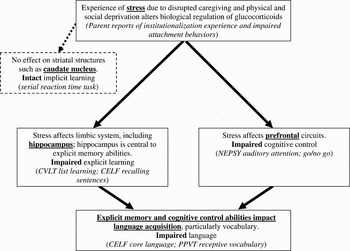
Frontohippocampal brain circuits, including the hippocampus and amygdala, are highly sensitive to chronic stress (Arnsten & Goldman-Rakic, Reference Arnsten and Goldman-Rakic1998; Liston et al., Reference Liston, Miller, Goldwater, Radley, Rocher and Hof2006, Reference Liston, McEwen and Casey2009; Tottenham et al., Reference Tottenham, Hare, Quinn, McCarry, Nurse and Gilhooly2010); these circuits are central to learning and memory functioning (Teyler & DiScenna, Reference Teyler and DiScenna1987). The hippocampus is critically involved in learning and memory; relevant for the present study, numerous studies have suggested that phonological memory abilities are strongly related to later vocabulary skills (Adams & Gathercole, Reference Adams and Gathercole2000; Hanten & Martin, Reference Hanten and Martin2001), both over the course of development (Rodrigues & Befi-Lopes, Reference Rodrigues and Befi-Lopes2009) and across various disorders (Archibald & Gathercole, Reference Archibald and Gathercole2006; Gathercole, Alloway, Willis, & Adams, Reference Gathercole, Alloway, Willis and Adams2006). Some researchers have proposed specific links between explicit memory processes and the acquisition of vocabulary, or the lexicon (Ullman, Reference Ullman2001). Collectively, these data raise the possibility that the stressful experience of institutionalization impacts the integrity and functioning of the hippocampal explicit memory system, which in turn could impact some aspects of language development; this proposal is outlined in Figure 1.
Hypothesized model of stress-affected brain systems, associated cognitive processes, and subsequent impacts on language skills in internationally adopted children. Measures from the current study are in italics. CVLT, California Verbal Learning Test—Children's Version; CELF, Clinical Evaluation of Language Fundamentals—Fourth Edition; PPVT, Peabody Picture Vocabulary Test.

Chronic stress also appears to impact on another brain region, that of the prefrontal cortex. Animal models suggest that early maternal deprivation can lead to changes in prefrontal cortex (Dent, Okimoto, Smith, & Levine, Reference Dent, Okimoto, Smith and Levine2000), and cognitive control has been shown to be particularly sensitive to the influences of stress in rodents (Liston et al., Reference Liston, Miller, Goldwater, Radley, Rocher and Hof2006, Reference Liston, McEwen and Casey2009) and primates (Arnsten & Goldman-Rakic, Reference Arnsten and Goldman-Rakic1998). Consistent with these animal studies, a positron emission tomography study of 10 Romanian adoptees found decreased metabolism in prefrontal cortex, as well as orbital frontal gyrus, lateral temporal cortex, bilateral hippocampus, amygdala, and brain stem (Chugani et al., Reference Chugani, Behen, Muzik, Juhasz, Nagy and Chugani2001). Among other processes, the prefrontal cortex is important in cognitive control, the ability to suppress attention, and responses to irrelevant information, particularly highly salient stimuli (Allport, Reference Allport, Heuer and Sanders1987). Research has linked the executive process of cognitive control to sentence comprehension in both adults (Novick, Trueswell, & Thompson-Schill, Reference Novick, Trueswell and Thompson-Schill2005) and children (Choi & Trueswell, in press). Cognitive control may play a role in language acquisition as well as comprehension, as demonstrated in studies of infant speech perception (Conboy, Summerville, & Kuhl, Reference Conboy, Sommerville and Kuhl2008) and bilingualism (Carlson & Meltzoff, Reference Carlson and Meltzoff2008).
Model of Orphanage Effects on Language and Cognitive Development
The approach of studying internationally adopted children permits us to gain traction on several important theoretical issues. There has been extensive work linking domain-general cognitive mechanisms to later language acquisition. For example, studies from the typical language acquisition literature have examined relationships between early perceptual abilities and later word learning (Kuhl, Reference Kuhl, McCardle, Colombo and Freund2008; Yeung & Werker, Reference Yeung and Werker2009) and vocabulary acquisition and later syntactic skills (Hudson & Eigsti, Reference Hudson and Eigsti2003). Other research has examined statistical regularities that appear be accessible to language learners. This latter line of work provides an important control for the relationship between institutionalization-related stress and its impact on cognitive processes. Specifically, a number of studies have suggested that language learners are sensitive to the regularities of language structure (e.g., Maye, Werker, & Gerken, Reference Maye, Werker and Gerken2002; Saffran, Aslin, & Newport, Reference Saffran, Aslin and Newport1996; Saffran, Johnson, Aslin, & Newport, Reference Saffran, Johnson, Aslin and Newport1999) and that the ability to implicitly learn these regularities may be important in language acquisition, as demonstrated by a series of studies of children with specific language impairment, who require significantly more exposure to the implicit regularities of language structure before they show any evidence of learning (Evans, Saffran, & Robe-Torres, Reference Evans, Saffran and Robe-Torres2009). Implicit learning is related to a network of brain areas, including the caudate nucleus; this region appears relatively insensitive to the effects of chronic stress. Thus, although implicit learning is important for language acquisition, it is not expected to be especially influenced by the experience of institutionalization; again, Figure 1 lays out this model.
The present study addresses several issues. Given the conflicting findings in the literature, we examine the language-specific effects of the institutionalization experience in a group of school-age children. Whereas several studies find language delays and deficits, others have found age-appropriate abilities. The current study directly assesses language skills, in a sample of adopted children and SES-matched nonadopted controls, to gain further perspective on language outcomes in middle childhood. A better understanding of the impact of institutionalization on language, after the children have acquired the new language, is relevant for helping to identify and remediate areas of likely challenge for this population of children. We predict that the children with the longest durations of institutionalization will show impairments in language abilities, even when taking into account the length of time that they have been exposed to English.
Thus far, it has been difficult to pinpoint the mechanism underlying subtle but long-term language delays. A study of adoptees who, by virtue of their early life experiences, vary significantly in their cognitive abilities, may illuminate links between language acquisition and domain-general cognitive processes. Findings may reveal associations between processes that are typically confounded in maturation; because international adoptees may exhibit a specific pattern of cognitive deficits, associations across systems are more likely to emerge. We proposed a mechanism subserving these cognitive changes: specifically, we hypothesize that exposure to chronic stress, operationalized as the duration of institutionalization, has specific neural effects on cognitive processes that are involved in language acquisition.
The present study was designed to test a model, shown in Figure 1, linking specific low-level cognitive processes to language skills. Cognitive processes were identified as (a) critical in language acquisition (explicit memory, cognitive control, and implicit learning) and (b) linked to brain circuits that are either highly sensitive to chronic stress (hippocampus and prefrontal cortex) or as relatively stress insensitive (dorsal striatum; note that ventral striatum may be sensitive to stress due to projections from amygdala to that region). Participants completed a battery of standardized and experimental tasks that assessed language skills as well as explicit memory, cognitive control, and implicit learning. We also assessed nonverbal IQ to account for domain-general developmental delays. The longer institutionalized participants were predicted to perform worse on explicit memory and cognitive control measures, with no predicted differences for implicit learning tasks. All three cognitive processes were predicted to relate to language abilities, which were in turn expected to differ in adoptees relative to nonadopted children. Nonverbal IQ was also explored, to probe for generalized developmental delays. In summary, the goal of the present work was to assess the long-term effects of institutionalization on language acquisition, as well as effects on distal (i.e., those not directly involving language) cognitive processes.
Methods
Participants
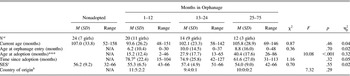
Seventy children (44 males, 34 females) between the ages of 4 and 13 participated in the study (M age = 8 years, 6 months, SD = 2 years, 4 months; range = 48–158 months); see Table 1. Participants with a history of international adoption were recruited from a clinical database at the Yale International Adoption Clinic (n = 579) and through word of mouth (n = 14); potential participants had to have lived in the United States for a minimum of 1 year. Of the 110 in the clinic database that were contacted by phone and eligible, 59 children participated (49%). Participants were excluded if there was an existing diagnosis of fetal alcohol syndrome as determined by a developmental pediatrician (C.W.; n = 5) or a history of international foster family care, but not orphanage life (n = 8), leaving a final sample of 46 adoptees. A comparison sample of 24 nonadopted children was recruited through word of mouth, and via referrals from adopted participants. Children were included as controls if they met age criteria and had experienced no reported disruptions in caregiving (e.g., death of a parent). Consent and assent were obtained prior to testing, and procedures followed all applicable human subjects guidelines.
Demographic information for adopted and nonadopted children

aThere were no group differences for gender, χ2 (3, n = 78) = 6.89, p = .08.
bCountries of origin: eastern Europe (Lithuania, Romania, Russia, Ukraine), northeastern Asia (China, Korea), Latin and South America (Peru, Columbia), and Southeast Asia (Cambodia, Vietnam). There were no proportional differences in the country of origin for adoptees.
cSocioeconomic status (SES) according to Hollingshead (Reference Hollingshead1975); possible range = 8–66.
***p < .001.
The adopted sample was divided into three groups based on the length of time each child spent in an orphanage; note that duration of institutionalization correlated highly (r = .65, p < .001) with age of adoption. The correlation was not perfect, as some children were given up for adoption at birth (n = 27) and others were given up at a later period (n = 19), ranging from as young as 1 month to as old as 48 months (M = 8.0, SD = 13.1). Sample grouping was designed to permit the evaluation of specific time points that have been found in previous studies to demarcate important differences in developmental outcomes.
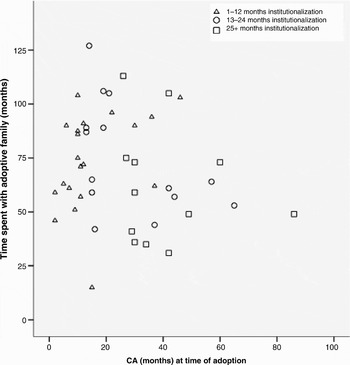
The four groups (1–12 months, 13–24 months, and 25+ months in orphanage care, and nonadopted controls) were matched on a number of variables, as shown in Table 1: current chronological age, F (3, 66) = .87, p = .46, η2p = 0.04; gender, χ2 (3, n = 70) = 7.23, p = .07; and SES (Hollingshead, Reference Hollingshead1975), F (3, 66) = 0.486, p = .69, η2p = 0.02. The similarity in SES across groups, including nonadopted controls, is particularly important, given the likelihood that international adoptees will be adopted by higher SES families (Gauthier & Genessee, Reference Gauthier and Genessee2007). In addition, the adopted groups did not differ in how long they had spent with their adoptive families (“Time since adoption” in Table 1), F (2, 43) = 1.16, p = .32, η2p =0.05, and the relationship between the length of time spent in an institution and time spent in the United States was not correlated, r (46) = −.16, p = .30. This is particularly important given findings from the animal literature that indicate some reversibility of the effects of maternal deprivation in early life on cognitive functioning in adulthood (Bredy, Humpartzoomian, Cain, & Meaney, Reference Bredy, Humpartzoomian, Cain and Meaney2003). Participants had, on average, been in the United States for over 5 years; one participant had been adopted 15 months prior to evaluation. A scatterplot showing length of time in adoptive family as a function of age of adoption is shown in Figure 2. Groups were also matched on the age at which their biological families gave them up for adoption, F (2, 43) = 0.36, p = .70, η2p = 0.02. As expected, the three adopted groups differed significantly in age at time of adoption, such that the children who spent a longer period in institutions were also older at the time of adoption.
A scatterplot showing the length of time in an adoptive family as a function of age of adoption. CA, chronological age.

Birth locations for the adopted participants were organized into four geographic regions: eastern Europe (Lithuania, Romania, Russia, Ukraine), northeastern Asia (China, Korea), Latin and South America (Peru, Columbia), and Southeast Asia (Cambodia, Vietnam). The data are provided in Table 1. Across groups, there were no differences in country of origin, χ2 (6, n = 46) = 7.32, p = .29.
The participants spanned a wide age range (4–13 years). This variability was important in allowing us to recruit children who varied in the length of time they were institutionalized, and length of time spent in an adoptive home, which in turn revealed the effect of institutionalization on low-level cognitive processes. Time spent in the adoptive home has been shown to exert positive effects on development, and as such is likely to exert the opposite effects on performance relative to time spent in an institution (Tottenham et al., Reference Tottenham, Hare, Quinn, McCarry, Nurse and Gilhooly2010). As a control for this factor, and to control for the amount of exposure that a child had to English, length of time spent in an adoptive home was included as a covariate for all analyses. For nonadopted children, chronological age (which also comprises duration of exposure to English) was entered in lieu of time in adopted family.Footnote 1
Procedure
Children and a parent (a father, in three cases) participated in a 3- to 4-hr assessment, which took place at the Developmental Cognitive Neuroscience Lab at the University of Connecticut. Parents completed several written questionnaires and participated in interviews with a licensed clinical psychologist (I.-M.E.) or a graduate research assistant with training in clinical assessment. Children completed a battery of measures with a research assistant in an adjoining room. They were offered numerous breaks as needed. Upon completion of the session, participants received financial compensation, and adoptive families later received a written report documenting the child's current cognitive and language functioning. All participants, with the exception of two 4-year-old control and two 5-year-old adopted children, were able to complete all measures within a single session; these latter participants completed the remaining measures at a second session.
Adoptive history
Parents responded to questions about their children as part of a structured interview. They were asked about the child's birth history, the quality and characteristics of the orphanage placement, the child's developmental level (age, cognitive, language, motor, and social skills) at the time of adoption, and the challenges the family faced during the first 6 months after the child joined the family. Detailed data from this interview are reported elsewhere (Eigsti et al., Reference Eigsti, Weitzman and Mayo2009) and are currently being prepared for publication. To assess the parent–child attachment relationship at the time of the evaluation, we administered the Disturbance of Attachment Inventory (Smyke, Loscertales, & Guaza, Reference Smyke, Dumitrescu and Zeanah2002) to parents of both adopted and nonadopted participants. Questions probed for behaviors that characterize children with dysregulated attachment, such as not seeking comfort preferentially from one's caregiver, lack of reticence with unfamiliar adults, or warily monitoring a caregiver's mood. Items, which fell into three mutually exclusive categories (inhibited insecure attachment, disinhibited insecure attachment, and dysregulated use of caregiver as a secure base), were analyzed as a total score. A subset (20%) of questionnaires were double coded and reliability was high (>95%).
Language assessment
Language
To assess language skills, children completed core subtests of the Clinical Evaluation of Language Fundamentals—Fourth Edition (CELF; Semel, Wiig, & Secord, Reference Semel, Wiig and Secord2003). The CELF evaluates a student's general language ability. Participants completed tasks assessing their ability to interpret spoken directions of increasing length and complexity (concepts and following directions), listen to and repeat sentences of increasing length and complexity (recalling sentences), formulate spoken sentences of increasing length and complexity using words and pictures provided by the examiner (formulated sentences), and understand and express relationships between words that are related by semantic class features (word classes).
There were four 4-year-old participants who completed the six subtests of the preschool form of the CELF (CELF-P; Semel, Wiig, & Secord, Reference Semel, Wiig and Secord2004). For the CELF-P, children completed six subtests asking them to interpret spoken sentences of increasing length and complexity (sentence structure), to follow directions using concepts containing logical operations (linguistic concepts), to demonstrate knowledge about dimension, location, quantity, and equality by pointing to a picture that best identifies a concept (basic concepts), to imitate orally presented sentences (recalling sentences in context), to name common concepts (formulating labels), and to demonstrate knowledge of morphological rules in a sentence-completion task (word structure). For all participants, the core language scaled score was considered as an estimate of current language functioning, as this measure comprises both receptive and productive vocabulary, morphology, and syntactic language abilities.
Vocabulary, or lexical skill, is the language domain that was hypothesized to be most associated with explicit memory skills (e.g., Gathercole, Hitch, Service, & Martin, Reference Gathercole, Hitch, Service and Martin1997). The Peabody Picture Vocabulary Test, Third Edition (PPVT-3; Dunn & Dunn, Reference Dunn and Dunn1997) was used to assess receptive vocabulary skills.
Domain-general cognitive assessments
Explicit memory
Explicit memory was assessed with the California Verbal Learning Test—Children's Version (CVLT; Delis, Kramer, Kaplan, & Over, Reference Delis, Kramer, Kaplan and Ober1994). In this well-studied list-learning task, children hear a list of 15 common words that fall into one of three categories (clothing, fruit, or toys) and are asked to recall as many words as possible. After repeating the list over five trials, the child hears and repeats back a new distraction list; this is followed by free recall of the original list. After a 20-min delay, the list is recalled from memory, followed by a recognition memory test. Children did not complete the cued recall short delay task, which does not appear to account for additional variance in performance (O'Jile, Schrimsher, & O'Bryant, Reference O'Jile, Schrimsher and O'Bryant2005). List memory on the first trial following the interference list and for the 20-min delay list comprised the explicit memory variables.
Cognitive control
Cognitive control is defined as sustained attention and susceptibility to competing information, was also hypothesized to reflect early stress experiences via their impact on prefrontal cortical area. Cognitive control was assessed with an experimental as well as a standardized measure. First, children completed an experimental go/no-go task that has been shown to be sensitive to subtle but enduring individual differences (e.g., Eigsti et al., Reference Eigsti, Zayas, Mischel, Shoda, Ayduk and Dadlani2006). In the go/no-go task, the child's task was to press a button (“go”) in response to frequent (75%) visually presented targets (Pokemon cartoon characters), but to avoid responding (“no-go”) to an infrequent (25%) nontarget (a distinctive Pokemon character). Performance was evaluated with d prime (d′), a measure of response sensitivity that includes both misses and false alarms, and including reaction time (RT) as a covariate to control for speed–accuracy trade-offs. The NEPSY auditory attention task, which demands sustained attention, response inhibition, and goal maintenance, provided a second cognitive control task. In this task, children followed recorded instructions to place colored shapes into a box; after several minutes, the task undergoes a shift, such that when they hear instructions about one color, they must respond with a different color. This task assesses both sustained attention as well as inhibitory control.
Implicit learning
Finally, implicit learning abilities have been proposed as particularly relevant for syntactic development (e.g., Ullman, Reference Ullman2001). However, implicit learning is associated with brain structures (e.g., caudate nucleus) hypothesized to be less impacted by institutionalization-related stress. Implicit learning was assessed in an experimental serial RT (SRT) task. Children were presented with a cartoon stimulus that appeared in one of four boxes; a 10-item Nissen–Bullmer sequence governed the location in which the stimulus appeared. Trials were presented in blocks of 100, where the second, third, and fifth blocks used the fixed sequence, and (to control for simple motor learning) the first and fourth used a pseudorandom order. Responses were collected via touch-screen, and differences in RT between the fourth and fifth blocks (controlling for age and accuracy) provided the dependent measure.
Nonverbal IQ
The relationship between explicit memory and language functioning could potentially be moderated by domain-general IQ skills; for example, the experience of institutionalization could lead to generalized delay or impairment. To provide an estimate of IQ independent of memory and language abilities, and thus to address the specificity of the hypothesized relationship between explicit memory and language skills, children completed the object series/matrices subtest of the Stanford–Binet Intelligence Scales, Fifth Edition (Roid, Reference Roid2003). This task asks children to choose the best option to complete a series of objects, and depends on nonverbal responses.
Results
Preliminary analyses
Prior to all inferential statistics, dependent variables were examined for deviations from normality and sphericity. All of the dependent variables were distributed normally. Effect sizes were calculated with partial eta squared (η2p), which describes the percentage of the variance (effect + error) in the comparison accounted for by the relevant variable.
Previous studies of internationally adopted children suggest an association between duration (in months) of institutionalization and the severity of problems in a variety of domains, particularly for children adopted after age 12 months, suggesting the presence of ceiling effects or other attenuating variables in earlier adopted children (Beckett et al., Reference Beckett, Maughan, Rutter, Castle, Colvert and Groothues2006; Rutter & O'Connor, Reference Rutter and O'Connor2004). To address the possibility of a developmental shift in vulnerability occurring at the 12-month point, as well as to examine the role of the duration of the stressful institutionalization experience, we analyzed our data using two complementary strategies. First, we examined possible group differences among children who spent only 1–12 months in orphanage care, compared with children who spent 13–24 or more than 25 months in orphanage care; nonadopted children formed the fourth group for comparison. Planned comparisons were analyzed as multivariate analyses of covariance of the dependent variables, with months in the United States as a covariate. Second, correlational analyses and hierarchical regression were used to examine the extent to which duration of institutionalization accounted for variance in the data. Correlations from 0.5 to 1.0 are described as strong, 0.3–0.5 as moderate, and 0.1–0.3 as weak.
Some task data were missing due to experimenter error or equipment problems. Missing data included Disturbance of Attachment Inventory scores (adopted group, n = 2; comparison group, n = 5), CELF core language scores due to missing subtest scores (n = 3, n = 2), PPVT (adopted group, n = 4), NEPSY (n = 4, n = 1), go/no-go task (n = 8, n = 1), and implicit learning (n = 6, n = 2). Missing data were distributed equally between adopted and control groups, χ2 (4, n = 70) = 7.08, p = .13. In addition, four participants did not receive NEPSY scaled scores, because their age (4 years) precluded scoring relative to standardized norms. Analyses included all available data.
Institutionalization and attachment
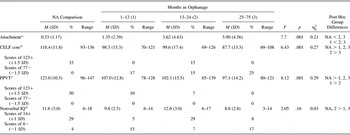
Although physiological markers of stress were not available, parents completed an interview that reported the presence of child behaviors suggesting disorganized or insecure attachment relationships to caregivers. These data indicated that there was a significant difference, across all groups, for the number of current disorganized/insecure attachment behaviors at the time of evaluation, controlling for time (in months) spent with the adoptive family, F (1, 39) = 4.94, p = .004, η2p = 0.21. The data (shown in Table 2) indicate that 21% of the variance in disorganized or insecure attachment behaviors was accounted for by group (length of time in an orphanage). Furthermore, for adoptees only, the duration of institutionalization was significantly and moderately correlated with disorganized/insecure attachment behaviors, controlling for time spent with the adoptive family, r (40) = .441, p = .003. These data were consistent with the hypothesis that institutional caregiving was noncontingent and associated with behavior and stress dysregulation, as it led to more behaviors indicating insecure or disordered attachment for the adopted participants.
Attachment Interview and standardized language and IQ assessments

Note: The F test refers to a group comparison of adoptees and controls. NA, nonadopted.
aAccording to the Disturbance of Attachment Inventory; number of insecure/disorganized attachment behaviors (possible range = 0–24).
bAccording to the Clinical Evaluation of Language Fundamentals (CELF) core language; scaled score: M=100, SD = 15.
cAccording to the Peabody Picture Vocabulary Test, Third Edition (PPVT); scaled score: M = 100, SD = 15.
dAccording to the Stanford–Binet Intelligence Scales, Fifth Edition; scaled score: M = 10, SD = 3.
Language and cognitive measures
Language assessment
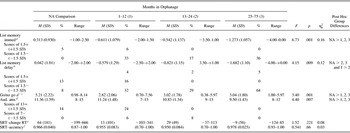
A primary goal of this study was to examine the long-term effects of institutionalization on language, after children had spent a significant period in an English language environment (>12 months; 74 months on average across groups). Participants completed the CELF, which assesses language knowledge across several language domains. Findings indicated that the adopted group scores were at the mean for the standardization sample (M = 95.7, SD = 15.9), but significantly lower (22 points, more than 1 SD in difference) than the comparison sample (M = 118.4, SD = 11.8), controlling for time in the United States, F (1, 62) = 19.13, p < .001, η2p = 0.24. The effect size indicated that 24% of the variance in CELF core language scores was accounted for by adoption group status. Results are presented in Table 2.
The mean for CELF core language scores is set at 100, with a standard deviation of 15. In the present study, impairment in functioning was defined at 1.5 SD below the mean, and participants were assessed as falling in the average, impaired, or above average range. Data are shown in Table 2. They indicate that none of the comparison participants were in the impaired range, and 33% were in the above-average range. In contrast, for the adopted participants, the scores of 15%–35% fell in the impaired range, depending on the group. Furthermore, performance on the CELF in the adoptive group was associated with the duration of institutionalization, controlling for time spent with an adoptive family, r (40) = −.305, p = .049, a correlation in the moderate range. The longer a child spent institutionalized, the lower his or her scores were likely to be, even taking into account the length of a child's experience in an English-speaking environment.
For the core language scores, effect sizes were large, suggesting that an important proportion of the variance in scores was accounted for by group status. We highlight the finding that the adoptive group scores were generally in the average range, indicating a lack of long-term impairments in language for most participants. However, the notion of “average” is relative to the tests' standardization samples. The adoptive participants were generally of high SES status (M = 56 in all groups), a factor that is robustly correlated with better performance on language tasks in large studies of typically developing children (Hart & Risley, Reference Hart and Risley1995; Hoff-Ginsberg, Reference Hoff-Ginsberg1998). Data from the comparison group are consistent with this finding, with an average score on the CELF core language measure in the high average range (M = 118). In this regard, when participants are high in SES, performance relative to an SES-matched group may be more informative than the performance of adoptees relative to test norms, as it permits us to more accurately assess the impact of the institutionalization experience on language skills.
Receptive vocabulary was assessed using the PPVT-3. The findings provided in Table 2 show a clear impact of institutionalization, with significant group differences between adoptees and the comparison group, controlling for duration of exposure to English, F (1, 63) = 20.16, p < .001, η2p = 0.24, with each group of adoptees scoring significantly lower than the comparison group (ps < .01). However, the correlation between institutionalization and PPVT-3 scores did not reach significance, r (39) = −.29, p = .07. The PPVT-3 has a mean of 100 and a standard deviation of 15; none of the participants scored in the clinical range. Fifty percent of the comparison group scored in the above-average range, whereas between 0% and 10% of adoptees scored in that range. The PPVT-3 data suggest that institutionalization had more limited effects on vocabulary, or that receptive vocabulary is more easily “ameliorated” by time spent with an adoptive family.
Explicit memory
Declarative memory has been linked in many prior studies to language skills, particularly to vocabulary development, because of the need for the phonological form of a word to be encoded in short-term memory (e.g., Gathercole et al., Reference Gathercole, Hitch, Service and Martin1997). If institutionalization is associated with language deficits, explicit (i.e., declarative) memory is very likely to be implicated. Results from the CVLT showed a significant main effect of institutionalization on memory, controlling for time in the United States; data are presented in Table 3. There was a significant group difference in number of items recalled (no delay), F (3, 63) = 3.69, p = .02, η2p = 0.16, with adopted participants recalling fewer items. Similarly, adoptees recalled significantly fewer items after a 20-min delay, F (3, 63) = 2.91, p = .04, η2p = 0.12. Furthermore, institutionalization was significantly and weakly correlated with number of items recalled after a delay, controlling for time in the United States, r (41) = −.26, p = .04. There was no correlation between duration and items recalled with no delay, r (41) = −.18, p = .12. The findings were consistent with a significant association between duration of institutionalization and memory abilities. Furthermore, vocabulary (PPVT-3) scores were moderately correlated with CVLT recall after a delay, r (41) = .473, p = .002, in adoptive participants, but unassociated in the comparison group, r (24) = .07, p = .76; correlational data are shown in Table 4.
Experimental memory, learning, and cognitive control assessments

Note: F test refers to group comparison of adoptees and controls.
aList memory after interference trial, California Verbal Learning Test, Children's Edition (CVLT); z score: M = 0, SD = 1.
bCVLT list memory, 20-min delay; z score: M = 0, SD = 1.
cCalculated as d′ on the go/no go task; higher scores = more accurate performance.
dNEPSY auditory attention; scaled score: M = 10, SD = 3.
eSerial reaction time (SRT), presented as the difference in RT (ms) from Block 5 (sequenced) to Block 4 (random).
fSRT task–accuracy, averaged across three sequenced blocks.
Cross-domain correlational analyses of core language and explicit memory, cognitive control, implicit learning, and NVIQ

Note: Adopted participants are above the diagonal and comparison participants are below the diagonal. The critical correlations of core language skills and other cognitive processes are in bold. NVIQ, nonverbal IQ.
aCore language score according to the Clinical Evaluation of Language Fundamentals.
bList memory on a 20-min delay according to the California Verbal Learning Test, Children's Edition.
cCognitive control on NEPSY auditory attention.
dCognitive control on performance on the go/no go task.
eImplicit learning on the serial reaction time task as the difference in reaction time (ms) in Blocks 4 and 5.
fNVIQ according to the Stanford–Binet Intelligence Scales, Fifth Edition (square root transform of the difference between final random and sequenced blocks).
†p < .10. *p < .05. **p < .01. ***p < .001.
To assess memory on items recalled with no delay, the CVLT uses a T score, with a mean of 50 and a standard deviation of 10. On this measure, the adopted participants had a mean score of 42.5, significantly lower than the mean of 51.7 for the comparison group, but still within the average range. The adoptees had a total of 12 participants (27%) with scores more than one standard deviation below the mean; the comparison group had two participants (9%) with scores in that range. To assess performance on number of items recalled after a 20-min delay, the CVLT uses z scores, with a mean of zero and a standard deviation of one. On this measure, the adopted participants had a mean score of −0.768, significantly lower than the mean of +0.313 for the comparison group, but still within the average range. However, the adoptees had a total of 19 participants (37%) with scores that were more than 1 SD below the mean; in comparison, the comparison group had just two participants (8%) with scores in the below-average range.
On average, explicit memory skills for adoptees were in the low end of the average range, with few participants in the above-average range, but a significant proportion of the adopted group showed impairments that were clinically significant. Few of the adopted participants (and only ones from the 1–12 month group) were in the above-average range.
Cognitive control
Cognitive control refers to the active maintenance of goals and the means to achieve them. For example, someone raised in the United States has a bias to look to the left when crossing the street, to avoid oncoming traffic; when visiting a country where traffic flows in the opposite direction, this highly overlearned bias must be actively overridden. Two assessments of cognitive control were included: a go/no-go task and the NEPSY auditory attention task. Findings from the go/no-go task showed an significant main effect of group, controlling for RT and time spent in the United States, F (1, 57) = 5.09, p = .03, η2p = 0.08, such that the comparison group had significantly higher (more accurate) d′ scores than adoptees (5.21, SD = 2.22, vs. 2.94, SD = 1.86, respectively; refer to Table 3). The relationship between d′ and duration of institutionalization was in the moderate range and approached significance, controlling for time in the United States and RT, r (34) = .32, p = .05. These data suggest that the adopted group as a whole was less able to inhibit inappropriate responses, and that task differences were sensitive to duration of institutionalization.
In the auditory attention task, adopted participants had significantly lower scaled scores than the comparison group, F (1, 58) = 4.05, p = .049, η2p = 0.07 (see Table 3). Duration of institutionalization and sustained attention showed a trend toward a weak correlation, r (36) = −.30, p = .07, indicating that later-adopted participants were less able to stay on task and inhibit attention to irrelevant information. All but one adopted participant scored in the average range, suggesting that effects of institutionalization were subtle and did not lead to significant impairment. Taken together, data from the go/no-go and auditory attention measures suggest significant group differences in cognitive control; however, performance was only weakly associated with institutionalization, indicating that these differences were small.
Implicit learning
Implicit learning has been closely related to language acquisition in some theoretical accounts due to its role in learning about bottom-up statistical regularities that lie at the core of rudimentary language processes. In contrast to explicit memory and cognitive control, however, the neural substrates of implicit learning (e.g., dorsal striatum) are not thought to be as sensitive to the effects of psychological stressors (Tottenham et al., Reference Tottenham, Hare, Quinn, McCarry, Nurse and Gilhooly2010). If so, implicit learning should show limited or no effects of institutionalization. To test this possibility, participants completed an implicit learning (SRT) task. In the implicit SRT task, learning was assessed via the change in RT between blocks two, three, and five, all of which consisted of sequenced items. There was evidence of learning, in that there was a significant main effect of Block for RT in a repeated-measures analysis of variance controlling for age, F (2, 110) = 4.84, p = .01, η2p = 0.08, with RT decreasing across the three blocks (significant linear effect, F (1, 55) = 5.89, p = .02, η2p =0.10. However, adoption status was not a significant group difference, F (2, 114) = 1.22, p = .30. Similarly, a one-way analysis of variance comparison of adopted and nonadopted participants revealed a lack of group differences in SRT performance, for the difference between the two final structured and random blocks, F (1, 57) = 1.21, p = .28, η2p = 0.02. Months of institutionalization was uncorrelated with SRT task performance (difference between two final blocks), r (35) = .03, p = .86. Data are presented in Table 3. The data indicate that institutionalization had relatively little impact on implicit learning; adopted participants were just as able as the comparison group to learn an embedded pattern.
Intellectual functioning
It is possible that the association between language, cognitive abilities, and institutionalization, could be mediated largely by IQ; that is, the institutionalization experience could depress cognitive functioning in a domain-general fashion. Participants completed a subtest of the Stanford–Binet Intelligence Scales, which is the object series task. This task, which is the primary nonverbal subtest, asks children to choose the best option to complete a series of objects. Results indicated that the adopted participants as a group scored as highly as the comparison group, F (1, 67) = 2.04, p = .16, η2p = 0.03 (refer to Table 2). Duration of institutionalization did not correlate with IQ scores, r (43) = .02, p = .88. These data suggest no particular association between institutionalization and domain-general cognitive abilities. It does not appear that longer institutionalized children showed a generalized decrement in cognitive ability.
Cross-domain correlational analysis
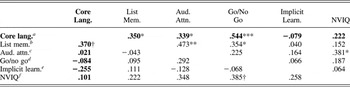
A final question remains: what are the associations among language skills and, conversely, the lower level cognitive processes including explicit memory, cognitive control and implicit learning? Correlational analyses were used to address this issue, with data split by group (adoptees vs. the comparison group); these data are shown in Table 4. Findings indicated that, in adoptees, CELF core language scores were significantly associated with CVLT declarative memory (e.g., list memory) over a 20-min delay (r = .35, p = .02) and with cognitive control as assessed in the auditory attention (r = .34, p = .04) and go/no-go (r = .54, p = .001) tasks. Correlations were all in the moderate or strong range. In contrast, there was no association between core language scores and implicit learning (calculated as the change in RT in the final sequenced and final random blocksFootnote 2; r = −.082, p = .63) or nonverbal IQ (r = .22, p = .15). The comparison participants, in contrast, showed no significant relationships among domains. None of the correlations for the adopted versus comparison groups differed significantly (zs < 2.1, ps > .10).
Discussion
The present study was designed to illuminate links between language and cognitive processes, by directly assessing these processes in a large sample of 46 internationally adopted children compared to 24 nonadopted, socioeconomically matched typically developing children, ages 4–13 years. One primary goal was to shed light on language abilities in internationally adopted children, addressing the conflicting findings in the literature. A second goal was to determine which top-down and bottom-up cognitive processes implicated in language abilities may be least and most affected by prior institutionalization, and examine the linkage between these processes and any language deficits. Finally, drawing on the study findings, the present study outlines a candidate mechanism by which early postnatal stress leads to these effects by linking institutionalization to changes in brain structures that drive cognitive processes.
Consistent with some findings in the literature, results from the present study indicated that adoptees continue to lag behind their nonadopted peers on standardized language assessments. Although most adopted participants scored in the average range, their language skills as assessed with the CELF were lower than those of the matched comparison group; in total, 19% of the adoptees (and none of the comparison group) scored more than 1.5 SD below the mean, indicating a clinically significant delay. Receptive vocabulary, measured with the PPVT, was also significantly lower in adoptees than in the comparison group (M = 103.3 and 123.0, respectively), but none of the participants scored 1.5 SD below the mean. Scores for the language measures were significantly and moderately associated with the duration of institutionalization. Thus, standardized language assessments indicated that on average, adopted participants were performing in the average range, but that one out of five adoptees exhibited clinically significant delays on the CELF. It is notable that, with a few exceptions, none of the children in the adopted group was receiving services through the schools to address speech–language delay.
The contradiction between this findings and previous studies suggesting catch-up (Geren et al., Reference Geren, Snedeker and Ax2005; Krakow et al., Reference Krakow, Tao and Roberts2005) may reflect the heterogeneous nature of the sample in the current study, which was drawn from a variety of countries; the Geren et al. and Krakow et al. samples, in contrast, consisted entirely of children adopted from China. It may be the case that conditions in Chinese institutions are associated with better long-term outcomes. Another possibility is that the present study is based on the comparison of the adopted participants to a comparison sample, rather than test norms. Our comparison group was also matched for current SES, which is particularly important given the typically higher SES of adoptive families (Gauthier & Genessee, Reference Gauthier and Genessee2007). Finally, reports in the literature vary dramatically in the kind of language data collected (direct assessment with standardized or spontaneous language tasks versus parent report) and the age of children collected. The present data, which are drawn from a relatively older school-age population and include direct standardized assessments, could be interpreted as showing somewhat negative long-term impacts of institutionalization on language development for the group, with tremendous individual variability (with approximately four-fifths of participants at the average level for their age, but one-fifth of children continuing to show clinically significant delays).
The present study found that institutionalization was associated with performance on multiple measures of explicit memory, including immediate recall of word lists and recall after a 20-min delay, in an explicit memory task (the CVLT). Specifically, adoptees had significantly lower scores than the nonadopted children, with 39% of adoptees performing at 1.5 SD below the mean, in the clinically significant range. Previous work has established close links between short-term memory capacity and word learning (Gathercole et al., Reference Gathercole, Hitch, Service and Martin1997); given this finding, one would predict that adoptees would know significantly fewer words (e.g., would have smaller vocabularies). Our data (shown in Table 4) are consistent with this prediction, and the significant association between language and memory performance in adoptees further supports the links between these processes in language acquisition.
In addition to group differences in CELF core language and memory scores, data from two cognitive control tasks (go/no-go and NEPSY auditory attention) showed that, as a group, the adopted children were less able to regulate attention and actions, consistent with early adversity leading to dysregulation of the development of prefrontal cortical structures or connectivity. Furthermore, the extent to which individual adopted children experienced these difficulties was weakly associated with the duration of their institutionalization experience. However, this association was only a trend once length of time they had spent in the United States was controlled. This task in part relies on regions of the striatum (frontostriatal circuitry), a region not expected to exhibit significant vulnerability to stress, which may explain the lack of robust effects (Durston, Thomas, Worden, Yang, & Casey, Reference Durston, Thomas, Worden, Yang and Casey2002; Vaidya et al., Reference Vaidya, Austin, Kirkorian, Ridlehuber, Desmond and Glover1998). Nonetheless, this finding is consistent with dampening of prefrontal activity and connections with psychological stress in humans and animals (Liston et al., Reference Liston, Miller, Goldwater, Radley, Rocher and Hof2006, Reference Liston, McEwen and Casey2009). The same frontostriatal circuitry has also been implicated in word generation tasks (Tremblay & Gracco, Reference Tremblay and Gracco2006); as such, future studies of international adoption could employ word generation and word fluency paradigms to assess language-specific aspects of prefrontal functioning.
The final experimental assessment examined implicit learning, which has been proposed to be critical for syntactic development (Ullman, Reference Ullman2001). Participants were able to learn the sequence embedded in the location of targets, as shown in an overall decrement in RT to sequenced stimuli across blocks of an experimental SRT task. There were no group-specific differences in RT, and no relationship between length of institutionalization and learning within this task. These findings suggest no association between institutionalization and bottom-up implicit learning; such a finding is consistent with recent reports of no abnormalities in neural systems underlying this type of statistical learning (e.g., structure or function of dorsal striatum) in previously institutionalized children (Tottenham et al., Reference Tottenham, Hare, Quinn, McCarry, Nurse and Gilhooly2010).
The current data are consistent with a hypothesized model linking language outcomes to lower level cognitive processes, which are in turn impacted by the stress associated with institutionalization. Future work will draw on a different form of implicit learning, known as spatial context learning, associated with activity in medial temporal circuits, with the prediction of a relationship between institutionalization and learning in such tasks (reflecting the impact of early stress on such brain circuits).
Consistent with some previous indications that general cognitive ability does not specifically correlate with the duration of institutionalization (at least in children ages 6–42 months; Croft et al., Reference Croft, Beckett, Rutter, Castle, Colvert and Groothues2007), the current data exhibited no relationship between nonverbal IQ and duration; moreover, the adopted participants did not differ from the comparison group in nonverbal IQ scores. In contrast, some groups have found a significant relationship between cognitive ability and duration of orphanage care and relatively limited evidence of “catch-up” (Nelson et al., Reference Nelson, Zeanah, Fox, Marshall, Smyke and Guthrie2007; O'Connor, Rutter, Beckett, Keavney, & Kreppner, Reference O'Connor, Rutter, Beckett, Keaveney and Kreppner2000), for children reared in situations of severe deprivation. One potentially relevant influence is the effect of age of placement into a family on IQ. Because a greater proportion of our participants (n = 25 or 54%) were placed by age 12 months (in contrast to, e.g., Nelson et al.'s 2007 Bucharest sample, of which n = 14 or 23% were placed by age 18 months), the current data are likely to reflect the more positive outcomes in IQ associated with earlier removal from institutionalization.
The approach of studying internationally adopted children permits us to gain traction on several questions. Addressing multiple conflicting prior findings in the literature, the present data, which rely on direct language assessments of adoptees compared to a sample of SES-matched children, show subtle but enduring language deficits in the adopted group. Although fully 80% of adopted participants scored within or above the average range across language subtests, the remaining 20% were in the clinically impaired range, suggesting that a large subgroup continues to struggle with language. Such difficulties place adoptees at greater risk for academic, psychological, and social problems. In addition, these results may be informative for teachers and family members, who may be surprised to learn of enduring language delays in their generally well-adapted, nativelike child.
Going beyond the assessment of language skills, the present study provides evidence for a specific link between language skills and specific cognitive processes, including explicit memory and cognitive control, but not including implicit learning. Several limitations to the present study, however, merit discussion. Children adopted from other countries form a group that is highly heterogeneous. The present study as well as research in this field must grapple with controlling or accounting for variability in the quality of caregiving prior to adoption, first language experience, early nutritional history, toxic exposures, and reasons for adoptive placement. Adding to the variability is that most of these factors may be unquantifiable. One important generalization is that, even in the best institutions, children still experienced less-individualized and less-contingent care.
An additional significant limitation is that our participants' adoptive histories were based exclusively on parent report, which in turn was based on institutional records of questionable reliability. Adopted participants had experienced a variety of circumstances prior to adoption. Some had been faced with significant deprivation of basic resources (food, medical care), others had shared a small number of caregivers with a large set of children, and others reportedly had experienced abusive maltreatment. These adversities tended to be shared across countries, although the adoptees who were born in Eastern Europe and Northern Asia were housed with significantly larger groups of children (average of one caregiver to 6 children for the former, and one to 10 for the latter) than children from Southeast Asia and South America (one caregiver for 2 children, on average), a difference that was significant, F (3, 29) = 8.83, p < .001, η2p = 0.50. That the results were consistent with study hypotheses in the face of this variability suggests a meaningful relationship between brain areas, cognitive functions, and high-level outcomes such as language development. In addition, the variability of the sample likely broadens the generalizability of findings.
Another study limitation that merits specific mention involves the cognitive abilities of birth parents. Studies have long reported the relatively stable and heritable nature of IQ (e.g., Plomin, Pedersen, Lichtenstein, & McClearn, Reference Plomin, Pedersen, Lichtenstein and McClearn1994); in this case, the (unknown) IQ of adoptees' birth parents is likely to have a significant influence on the abilities of their biological children. However, in a study that compared adopted school-age orphans raised in institutions, to a similar group raised by relatives in the same communities, the institutionalized group had higher IQ scores (Whetten et al., Reference Whetten, Ostermann, Whetten, Pence, O'Donnell and Messer2009). This suggests that the adoptive family environment may mute the contribution of biological parent IQ, making biological parent IQ less salient over time.
A final limitation is that, in addition to the impact of stress, language skills are certainly influenced by exposure to language; internationally adopted children were, as a group, exposed to less language-specific stimulation and social interaction, at least with adults. This influence is likely complementary to that of changes in the stress system; unfortunately, deprivation of language input (as a function of duration of institutionalization) is almost completely confounded with stress (as a function of duration of institutionalization). Institutionalization was associated with changes in cognitive systems less directly related to language input, including declarative memory and cognitive control, suggesting that these effects may not be identical; however, language input was not directly measured or addressed in the current study design.
Rather than a generalized effect of institutionalization on all cognitive functions, this study suggests a more specific impact on the cognitive processes of explicit memory and cognitive control. These data are consistent with findings of a relationship between chronic stress and changes in hippocampal and prefrontal circuits, which are associated with these cognitive processes. Implicit learning and nonverbal IQ were both essentially unaffected by institutionalization; implicit learning is associated with a brain region (the striatum) that is largely unaffected by stress. The data are consistent with the hypothesis that two processes (explicit memory and cognitive control) that are associated with stress-sensitive brain regions (hippocampus and prefrontal cortex) are affected by institutionalization; in contrast, implicit learning is associated with a less stress-sensitive region (striatum) and appears relatively unaffected. Nonverbal IQ scores also suggest that stress does not negatively impact all cognitive processes in a general fashion. To summarize, stress exerts a fairly specific set of influences on brain development; these brain changes, in turn, entail a profile of intact and affected neurocognitive processes, which is associated with a pattern of strengths and weaknesses in international adoptees.
The data from international adoptees and nonadopted comparison children also show clear links between domain-general cognitive processes of explicit memory and cognitive control and language skills. Contrary to our hypotheses, language skills appeared uncorrelated with implicit learning, which has been proposed to be central in the acquisition of syntax (Ullman, Reference Ullman2001). It is possible that, because our sample of participants did not vary greatly in their implicit learning abilities, there was insufficient variability in scores and therefore insufficient power to detect a correlation. Alternatively, it is possible that the nonverbal SRT task used here is too dissimilar from the pattern-extraction necessary for language acquisition (but see a study in which language delays in children with specific language impairment were specifically associated with performance on a tone-based implicit learning task; Evans et al., Reference Evans, Saffran and Robe-Torres2009).
The findings offers a possible pathway by which disrupted early caregiving can lead to long-term language abilities that, despite being in the average range, may nonetheless leave one-fifth of internationally adopted children lagging behind. These difficulties with language, memory, and cognitive control are likely to have cascading effects on other academic and socioemotional domains. In the present study, we propose a framework in which stress causes neural changes, which in turn lead to cognitive changes; these may help to illuminate the cognitive foundations and brain bases of language acquisition, both in the case of international adoption, and also in typical development.