Introduction
Surgical resection is the principle treatment for most parotid tumours. In recent decades, partial superficial parotidectomy for benign parotid tumours has been increasingly advocated owing to reduced tumour recurrence and morbidityReference Johnson, Ferlito, Fagan, Bradley and Rinaldo1 and decreased operation duration, cosmetic defects, Frey’s syndrome incidence, sensory impairment and facial palsy (transient or permanent) compared with superficial parotidectomy.Reference Ciuman, Oels, Jaussi and Dost2, Reference Roh, Kim and Park3 However, partial superficial parotidectomy may increase the risk of sialocele.Reference Witt4
Following parotidectomy, most of the remaining parotid tissue retains its secretory function and drainage capacity.Reference Rameh, Hourany-Rizk, Hamdan, Natout and Fuleihan5 Roh and colleagues demonstrated that the parotid gland salivary flow rate was higher after partial parotidectomy because more functional parotid tissue is preserved.Reference Roh, Kim and Park3 Saliva leakage from the remaining salivary tissue may increase the need for post-operative drainage and increase the sialocele formation risk after partial superficial parotidectomy because more normal salivary parenchyma is preserved.Reference Witt4 The bipolar vessel-sealing device delivers a precise amount of energy using a feedback-controlled electrothermal sealer to seal tissue by denaturing collagen and elastin.Reference Kennedy, Stranahan, Taylor and Chandler6 Vessels and tissue bundles grasped by the jaws of this device are simultaneously sealed and separated, with limited thermal injury to adjacent tissues.Reference Harold, Pollinger, Matthews, Kercher, Sing and Heniford7 Thermal spread (beyond the tissues within the forceps jaws) was estimated to be between 1.5 and 3.3 mm in various experimental histological studies.Reference Prokopakis, Lachanas, Helidonis and Velegrakis8 It is theoretically possible that sealing the remaining parotid parenchyma with this device during parotidectomy can minimise saliva leakage and decrease the degree of post-operative drainage. The length of hospital stay is associated with the amount of post-operative drainage for parotid surgery. To decrease medical costs, shorter hospital stays and out-patient procedures are becoming increasingly popular. In this study, we investigated factors predicting post-operative drainage requirements and assessed the possible benefits of using a bipolar vessel-sealing device for partial superficial parotidectomy.
Materials and methods
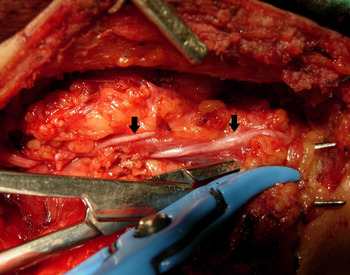
A prospective case-control study was conducted at an academic tertiary referral centre in southern Taiwan and approved by the Human Research Ethics Committee of Chang Gung Memorial Hospital. A total of 49 consecutive patients underwent partial superficial parotidectomy without neck dissection performed by a single surgeon between 1 January 2008 and 31 December 2011. Twenty of these patients were assigned to the bipolar vessel-sealing device group and underwent surgical resection of parotid tumours. The remaining 29 patients representing the control group underwent an identical procedure but without the use of the sealing device. Standard partial superficial parotidectomy was performed from the main trunk to the peripheral branches of the parotid gland in both groups. In the bipolar vessel-sealing device group, parotid parenchyma was sealed and separated using this device (Figure 1), and the operating (cut–closure) time was recorded. A closed vacuum ball drainage system was placed in all patients, and the amount of post-operative drainage was recorded at 8-hour intervals. Drains were removed when the drainage rate was less than 10 ml over a 24-hour period. Clinicopathological characteristics including age, sex, body weight, tumour size and pathology, and history of hypertension, diabetes mellitus and smoking were recorded. Pre-operative and post-operative facial nerve function were evaluated using the House-Brackmann scale.
Photograph showing vessels, salivary ductules and parotid parenchyma being grasped by the jaws of the bipolar vessel-sealing device for simultaneous sealing and separation (arrows represent facial nerve branches).

Statistical analyses were performed using unpaired t-tests for normally distributed data. The Mann–Whitney U-test was used for all other analyses, including those involving smaller samples. Multiple linear regression analysis was performed to assess the predictive value of the independent variables. The chi-square test was used for cross-comparisons, and Pearson's correlation was determined to assess the relationship between variables. A p value of less than 0.05 was taken to indicate statistical significance.
Results
The mean age of the 49 patients undergoing partial superficial parotidectomy without neck dissection was 51.5 years: 34 (69.4 per cent) were men and 15 (30.6 per cent) were women. The mean operating time was 181 minutes, and the mean volume of post-operative drainage was 38 ml. No wound infection was noted.
Influence of predictive factors
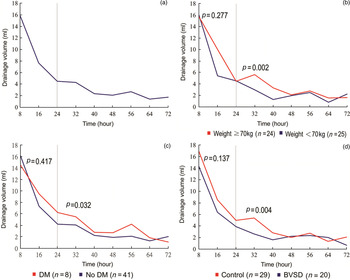
The post-operative drainage pattern was characterised by a rapid decline during the first 24 hours (Figure 2A); therefore, 24 hours was used as the cut-off point for further analyses. Of the predictive factors included in the analysis, none were significantly associated with drainage over the first 24 hours, except for smoking status. There was a trend towards increased drainage in smokers (p = 0.056). After 24 hours, body weight (r = 0.398, p = 0.005), body mass index (r = 0.294, p = 0.040) and height (r = 0.354, p = 0.013) correlated positively with the drainage amount. The median body weight (70 kg) was used to divide patients into two groups for analysis purposes. The higher weight group (p = 0.002; Figure 2B) and diabetes mellitus patients (p = 0.032; Figure 2C) had significantly greater drainage volumes over this period.
Graphs showing the (a) overall post-operative drainage pattern, and by (b) body weight, (c) presence of diabetes mellitus and (d) use of bipolar vessel-sealing device. Grey lines indicate the 24-hour time points. DM = diabetes mellitus; BVSD = bipolar vessel-sealing device

Influence of the bipolar vessel-sealing device
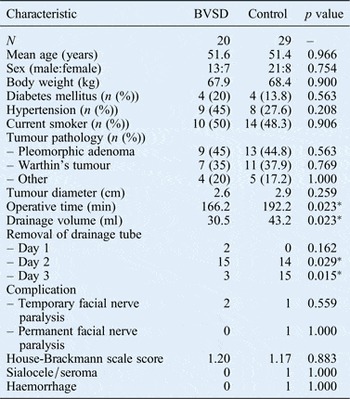
Patient characteristics were similar in the bipolar vessel-sealing device and control groups (Table I). The mean operating time was significantly shorter in the bipolar vessel-sealing device group (166.2 ± 33.9 minutes) than in the control group (192.2 ± 40.9 minutes; p = 0.023), with a mean reduction of 26 minutes. Total drainage (30.5 ± 15.2 ml vs 43.2 ± 20.5 ml, p = 0.023) and drainage after 24 hours (5.9 ± 6.2 ml vs 12.7 ± 9.5 ml, p = 0.004; Figure 2D) were significantly lower in the bipolar vessel-sealing device group vs the control group. The drain was removed within 48 hours in a significantly greater proportion of bipolar vessel-sealing device (85 per cent) vs control patients (48.3 per cent; p = 0.031). There was no inter-group difference in post-operative House-Brackmann scale scores. A single patient in the control group experienced wound haemorrhage in the post-operative recovery room and required further operative measures to achieve haemostasis. Moreover, one patient in the control group developed sialocele on post-operative day 17, which resolved after aspiration. There was no inter-group difference in the number of complications (Table I).
Characteristics of bvsd and control groups

* Clinically significant. BVSD = bipolar vessel-sealing device; min = minutes
Multivariate analysis
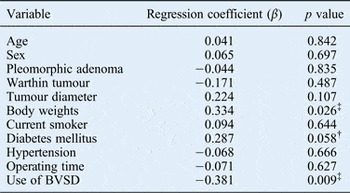
In multiple linear regression analysis (p = 0.025), body weight (β = 0.334, p = 0.026) and use of the bipolar vessel-sealing device (β = −0.381, p = 0.009) were significantly associated with the amount of drainage after 24 hours. There was a trend towards more drainage after 24 hours in diabetes mellitus patients (β = 0.287, p = 0.058). Age, sex, hypertension, smoking status, tumour pathology and diameter, and operating time did not correlate with the amount of drainage (Table II).
Regression analysis of variables influencing post-operative drainage after 24 hours*

* r2 = 0.413, p = 0.025
†Marginal significance; ‡clinical significance. BVSD = bipolar vessel-sealing device
Discussion
Partial superficial parotidectomy is increasingly being used to treat parotid tumours because of the reduced associated morbidity and similar oncological outcome compared with superficial parotidectomy.Reference Johnson, Ferlito, Fagan, Bradley and Rinaldo1, Reference McGurk, Thomas and Renehan9, Reference Guntinas-Lichius, Klussmann, Wittekindt and Stennert10 In addition, a greater amount of salivary parenchyma with normal secretory function is preserved during the partial procedure. Before transected margins are replaced by fibro-fatty tissues, persistent saliva leakage increases the drainage volume and the sialocele formation risk. Witt reported that the sialocele incidence is higher for partial vs near-total superficial parotidectomy because more salivary parenchyma remains.Reference Witt4 In this study, we aimed to prevent saliva leakage by sealing the remaining salivary parenchyma using a bipolar vessel-sealing device. During hepatic resection, this device can effectively seal intrahepatic biliary radicals and decrease post-operative bile leakage.Reference Alexiou, Tsitsias, Mavros, Robertson and Pawlik11, Reference Romano, Garancini, Caprotti, Bovo, Conti and Perego12 It is also safe for parotid surgery and associated with a reduced operating time.Reference Prokopakis, Lachanas, Helidonis and Velegrakis8, Reference Colella, Giudice, Vicidomini and Sperlongano13, Reference Hahn and Sorensen14 Our study noted a significant reduction in operating time and drainage amount and an absence of sialocele formation.
Although early drain removal is important after parotid surgery, predictive factors for post-operative drainage have not been assessed to date, and there is no standard of care for post-operative drainage in patients undergoing parotidectomy. When Harris and colleagues assessed the safety of drain removal in 15 parotidectomies, drainage volume was less than or equal to 50 ml after 24 hours.Reference Harris, Doolarkhan and Fagan15 In one case, a seroma developed on post-operative day seven. Mofle and Urquhart removed drains when the 8-hour drainage volume was less than 5 ml in 69 superficial parotidectomy patients, and reported the seroma formation incidence to be 2 per cent.Reference Mofle and Urquhart16 In our study, drains were removed when the drainage volume was less than 10 ml over a 24-hour period. Drainage rapidly declined within the first 24 hours after partial superficial parotidectomy and continued to decrease slowly thereafter (Figure 2A). Therefore, we suggest that a drain can be safely removed during the first post-operative day. To predict the suitability of drain removal according to this schedule, multivariate analysis was conducted. This revealed a trend towards increased drainage after 24 hours in diabetes patients (p = 0.058; Table II). However, this was expected because diabetes is associated with delayed wound healing and consequently with increased drainage.Reference Greenhalgh17
Body weight (p = 0.026) and use of the bipolar vessel-sealing device (p = 0.009) were significantly associated with drainage after 24 hours (Table II). After oral intake, increasing saliva leakage may occur prior to wound healing. Our data showed that sealing the residual parotid parenchyma using the bipolar vessel-sealing device could prevent leakage from the secretory ducts, decrease post-operative drainage and shorten the drain placement period. Body weight was also a risk factor for increased post-operative drainage; however, the mechanism underlying this association is unknown. Inoue et al. demonstrated that saliva flow rate and gland size are positively associated with body weight.Reference Inoue, Ono, Masuda, Morimoto, Tanaka and Yokota18 Patients with a high body weight have relatively larger parotids; therefore, more residual gland is present after tumour resection. Notably, when the bipolar vessel-sealing device and control groups were assessed separately, a significant association remained between body weight and drainage volume after 24 hours in the control group (p = 0.044) but not in the bipolar vessel-sealing device group (p = 0.254). After sealing, body weight was not associated with post-operative drainage. In patients with a high body weight, use of the bipolar vessel-sealing device helped to decrease drainage and shorten the drain placement period.
• Twenty-four hour drain placement is sufficient after partial superficial parotidectomy
• The bipolar vessel-sealing device is a safe, effective method of decreasing post-operative drainage
• Longer post-operative drain placement is advised for patients with a high body weight or diabetes mellitus
Conclusion
The bipolar vessel-sealing device can be safely used during partial superficial parotidectomy to reduce both the operating time and post-operative drainage volume. Twenty-four-hour drain placement is sufficient for most patients undergoing partial superficial parotidectomy. In patients with a high body weight or diabetes mellitus, drainage increases significantly after partial superficial parotidectomy and drainage should therefore be maintained for a longer period.
Acknowledgements
We thank all members of the Head and Neck Oncology Group, Kaohsiung Chang Gung Memorial Hospital, for their help in this study