In ‘The mobility transition revisited’, Jan and Leo Lucassen invite us to compare. They already provide a strong temporal comparison between European mobility before and after the Industrial Revolution. They also provide excellent tools for further comparison with other parts of the world. The crux of their comparative method is to break up migration into an array of mobilities that includes emigration, immigration, colonization, urbanization, seasonal, and labour (soldiers and sailors), and to develop methods of quantification for these categories that can be readily adapted to other contexts. Most importantly, these categories create the possibility of nuanced comparisons between different structures of mobility, rather than just crude comparisons between societies that are more or less ‘mobile’ or ‘modernized’.
In his 1971 article, ‘The hypothesis of a mobility transition’, Wilbur Zelinsky also distinguished different kinds of mobility and how they emerged and declined over time along with the process of modernization.Footnote 1 By applying this method to the quantification of early modern migrations, the Lucassens retain the methodological strength of Zelinsky’s analysis while undermining the basic assumption of a total transition from an immobile to a mobile society. Instead, the Lucassens demonstrate that the increased European mobility of the nineteenth century was largely due to the sharp increase in transatlantic migration, urbanization, and the tripling of nearly all forms of mobility in Russia. At the same time, internal colonization and mobility associated with military and naval service actually declined. The mobility transition (if we still wish to call it that) was less a transformation from an immobile to a mobile society than a shift in the predominant forms and locations of mobility.
Zelinsky’s assumptions about the linkage of a mobility transition, a demographic transition, and ‘modernity’ are further undermined when we realize that over 50 million Chinese and Indians moved into Southeast Asia and nearly 30 million Chinese moved to Manchuria during the period of mass European emigration.Footnote 2 Yet neither India nor China underwent the same demographic transition and massive urbanization as Europe in this period. The changes that took place in Europe were specific to that continent. They cannot be theoretically generalized without a more rigorous comparison to other regions that also experienced large increases of migration but under different conditions. The Lucassens provide us with tools to compare these mass emigrations in the context of other forms of mobility and how they changed over time.
The main challenges in applying the Lucassens’ method cross-regionally are in the choice of units and refinement of categories. These two problems are closely entwined. Should we compare the entire continent of Asia to Europe, or only East Asia, or only China (which still had nearly twice the population of Europe before 1800)? If we choose to compare China, would it not make more sense to then compare it to another empire, such as the Ottoman, the British, or the Russian? Once we do that, the categories of emigration and colonization start to seem less clear, as ‘emigrants’ to the Americas or Siberia suddenly become mostly ‘colonizing’ migrants. Similarly, military mobility looks more like colonization within an expanding agricultural empire (especially when military positions are hereditary) and more like labour migration in a context of competing states that are heavily reliant on mercenaries.
Fortunately, the very difficulty of translating and applying categories trans-regionally is itself inseparable from understanding the broad patterns of change. It can provide insight into qualitative and institutional differences across regions and political units that augment our understanding of the quantitative comparisons. The difficulties will also suggest ideas for the construction of new categories and methods.
Europe and China
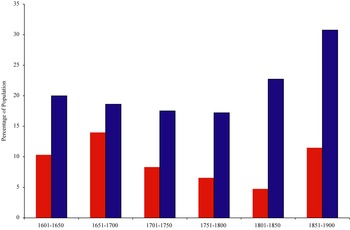
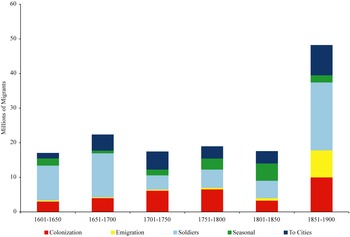
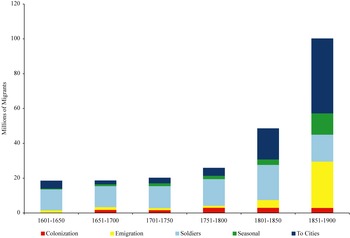
East Asia (China, Japan, and Korea) is perhaps the region of the world most readily susceptible to a comparative analysis based on the Lucassens’ categories. Although data for Qing dynasty (1644–1911) China are still much more speculative than those for Europe, it is still possible to compile a crude comparison that can suggest future avenues of research. Figures 1 to 3 compare overall mobility in China and Europe from 1600 to 1900.Footnote 3Figure 1 compares total mobility rates for each region as a proportion of the average population for each fifty-year period. Figures 2 and 3 show the proportions of each category of mobility within each region. All three figures must be read in the context of one other. The figures should also be read in the context of regional population growth. The population of China was about 50% greater than that of Europe for most of this period, except for the late seventeenth and late nineteenth centuries, when China was wracked by wars. Most significantly, the Chinese population grew much more quickly than Europe’s in the eighteenth century, possibly reaching rates as high as 0.8% a year.Footnote 4 Total migration would have had to grow more rapidly than in Europe just to maintain steady mobility rates. Similar population growth rates were not seen in Europe until the ‘demographic transition’ of the nineteenth century. In contrast, Chinese growth declined to about 0.5% a year in the first half of the nineteenth century and may have remained stagnant or declined during the rebellions and disasters of the 1850s to 1870s. Unlike China, however, Europe’s demographic expansion was accompanied by an even more massive growth in particular types of mobility.
Mobility rates in China and Europe, 1600–1900. Source: see note 3.

Mobility in China, 1600–1900. Source: see note 3.

Mobility in Europe, 1600–1900. Source: see note 3.

A few things emerge immediately from these charts. The first is the enormous importance of the military in European mobility before the nineteenth century: nearly all of the difference between European and Chinese mobility rates from 1700 to 1850 can be attributed to military mobility. Second is the importance of colonization in China: much more than in Europe, migration in China was about settling the frontiers. Third, the rates for all forms of Chinese mobility (except seasonal migration) probably declined from 1650 to 1850, in contrast to the rapid growth of European urbanization and emigration after 1800. And fourth, China also underwent a nineteenth-century increase of mobility. It started later than the European transition but was equally significant quantitatively. The Chinese transition was characterized by the growth not only of emigration and urbanization but also of military migration linked to the wars and rebellions of the 1850s to 1870s. It was a transition of a different kind – linked to, but not the same as the European transition.
Colonization and emigration
Colonization seems to be one of the main features that distinguishes Chinese mobility from that of Europe, and is key to understanding the high population growth from 1650 to 1800.Footnote 5 From 1680 to 1850, at least ten million people moved to frontiers at the edges of the empire, including Sichuan and Yunnan in the south-west, Taiwan, Manchuria, and the far north-west, including Mongolia and Xinjiang.Footnote 6 Millions more settled the mountain areas in the interior of China, with favoured destinations gradually shifting from the south to the north-west from the late Ming to the nineteenth century.Footnote 7
Specific policies towards these migrations fluctuated over time and place, but in the long term colonization was part of an overall imperial strategy of using the wealth of the core regions to help subsidize the settlement, stability, and military security of the frontiers. Relatively coercive migrations in the early years of the Qing quickly gave way by the 1680s to more indirect encouragements that included subsidies, tax breaks, and easy access to residence papers. Movement into interior hill regions was subject to the least regulation, whether positive or negative. Some frontiers, on the other hand, remained subject to restrictions, such as the prohibition of female migrants to Taiwan and the complete (albeit unsuccessful) prohibition of Han migration to Manchuria from the 1680s to 1860s. The general trend over the eighteenth century, however, was towards a tolerant laissez-faire approach with limited state interventions, which was largely an effect of the imperfect effectiveness of official attempts to encourage or restrict migration.
By the turn of the nineteenth century, the frontiers were filling and colonization declined. Migrations to Sichuan, Taiwan, and the southern hill areas were the first to dwindle in the late eighteenth century, and most other flows had seriously declined by the 1820s.Footnote 8 Colonization picked up again after the 1870s. At least three million people moved into the areas of the Yangtze delta that had been depopulated by the Taiping Rebellion. But the most significant movement came with the gradual opening of Manchuria after the 1860s. By the 1890s this had become one of the largest mass migrations in human history, with over thirty million migrants by the 1940s.Footnote 9
At first glance, this looks entirely different from the European migration patterns measured by the Lucassens. Chinese colonizers averaged about 7 million migrants per fifty years from 1700 to 1800, and over 9 million from 1850 to 1900. In contrast, Europeans averaged 1.7 million from 1650 to 1750, and then 3 million from 1750 to 1900. Chinese colonization rates (as a proportion of total population) were also more than double those for Europe at all times except the first half of the nineteenth century. Moreover, colonization within the Russian empire accounted for 80% of European colonizers from 1600 to 1800, and all of them after 1800. Colonization in non-Russian Europe was insignificant.
Instead, European emigration was a much more significant flow, far surpassing Chinese rates. Chinese emigration did increase gradually over the eighteenth and early nineteenth centuries, as the predominantly merchant flows were augmented by increased numbers of miners and agriculturalists. But it is unlikely that Chinese emigrants amounted to more than 400,000 for any fifty-year period before the 1850s, as compared to an average of 1.5 million emigrants from Europe from 1550 to 1800.
However, this is a misleading contrast, the effect of comparing an empire (China) to a continent that cut across at least ten empires (Europe). Emigration and colonization – whether to the Americas, the Russian Steppes, or Taiwan – were similar in their mix of merchants and agricultural settlers. It is only the arbitrary choice of boundaries that makes them look different, although the addition of African slaves into the mix would generate more significant distinctions. Only a small fraction of emigrants from Europe left imperial boundaries before the nineteenth century (mostly Russians to the Ottoman empire and captives to North Africa). If we use empires as the units of comparison, colonization rates within the Qing, British, and Iberian empires were fairly similar, and Russia becomes the colonization empire par excellence, with rates three times those of any other empire before 1800. Likewise, the combined colonization and emigration rates for China and Europe look fairly comparable before 1800.Footnote 10 The lesson here is that empires seemed to play an important role in channelling long-distance mobility and agricultural settlement in many parts of the world before the nineteenth century.
Migration to cities
By most accounts, urbanization rates in Europe were about double those of China before 1800 (about 9% and 4.5% respectively) and then diverged even more in the nineteenth century.Footnote 11 This urbanization gap is often an important feature of comparative development histories. The provisioning of food for cities, urban culture, and institutions are often seen as key to understanding European economic growth and the Industrial Revolution.Footnote 12
Any differences between Chinese and European cities should not, however, extend to include differences in urban migration rates. Given the more rapid population growth in China, urban migration rates also had to be high if only to maintain a steady urbanization rate. This can be seen in the fact that, even though the urbanization rate did not grow in China, the urban population grew faster than in Europe. According to Tertius Chandler, the number of Chinese cities among the largest seventy-five cities of the world rose from twelve in 1600 to nineteen in 1750. European cities maintained a steady average of about twenty-four cities over the same period.Footnote 13
Precise calculations are plagued with difficulties and lack of data, especially for China. But, by taking the rates of natural decrease used by the Lucassens for Europe before 1800 and applying them to China, we get urban migration rates that were probably higher in China than Europe in the late seventeenth century, similar in the early eighteenth century, and then declining to perhaps half as much by 1800. Migration to the new coastal cities in China such as Shanghai and Tianjin began to pick up in the late nineteenth century, but rates of modern urban migration would not start to catch up to Europe until well into the twentieth century.
While colonization clearly played an important role in the Qing empire and in the expansion of the Chinese population, we should not think of it as an alternative to urban migration that led to a different developmental path for China. Colonization rates within the British empire were often higher than those within the Qing empire, and yet England remained one of the most urbanized places in the world. Urban migration was nearly as important as frontier migration in China, and probably only slightly lower than in Europe until the late eighteenth century. But urban migration in China seems to have hit a wall in the late 1700s, at the same time as colonization decreased and just as European urbanization was entering a new era.
Seasonal migration
Seasonal migration is a wild card, based on untested assumptions and extremely scanty evidence for both China and Europe. The Lucassens project seasonal migration based on a survey for western Europe in 1811 and some estimates for nineteenth-century Russia.Footnote 14 We do not yet even have this skeletal data to rely on for China. Unfortunately, as with urban migration, much is at stake in this category, since seasonal mobility and wage labour are key categories for understanding the histories of economic and social development.
The Lucassens cite Ken Pomeranz and R. Bin Wong in support of their assertion that ‘proletarian migration’ was less significant in China, and that indicators for mobilities other than colonization were lower in China.Footnote 15 The argument for China is that, especially in core areas, labour was drawn into intensified family agriculture and home industry rather than wage labour. But perhaps we should not look for seasonal labour in the core areas, as was the case in Europe, but in the more peripheral areas and for purposes other than wage labour.
Extensive qualitative evidence exists to show that many villages specialized in skills and trades that required migrant lifestyles.Footnote 16 Secret brotherhoods of mobile men, often transportation workers, were increasingly common in south China over the eighteenth century.Footnote 17 By the end of that century, armies could hire nearly half a million men as porters, craftsmen, and other labourers for distant frontier campaigns. In a period when the military increasingly relied on the market for its logistics, this implies the existence of fluid regional labour markets.Footnote 18 Most significantly, seasonal labour was pervasive in migration to the hill regions, especially in the early years. Colonists, at times called ‘shack people’, often started out as seasonal migrants, harvesting forest products, growing low-maintenance crops such as maize and sweet potatoes during the down time between planting and harvests at home, and working on large farms claimed by the earliest migrants. Wage labour was also more common outside the highly commercialized core areas.Footnote 19 The majority of cases regarding wage labourers that made it to the Board of Justice came from provinces at the edges of China, with the total number of labour cases increasing sharply in the late eighteenth century.Footnote 20
All we can do at this point, pending further empirical research, is to resist a priori and teleological assumptions about the connection between mobility and proletarianization, or even between mobility and commercialization (i.e. the most mobile parts of China were not the most commercialized). This also means that we will have to forgo any simple assumptions about the linkage between mobility and economic development.
Soldiers and sailors
Armies produced the most significant proletarian migrations in Europe. The inclusion of military and naval labour is perhaps the Lucassens’ most innovative contribution to understanding mobility. In terms of most general descriptions of migrant labour, they fit the bill perfectly. They were predominantly young men intending to travel for temporary periods to earn wages, but they often failed to return, whether because of death or permanent relocation. Not infrequently, they even ended up married to local women. What better description than this of people behaving similarly to the labour migrants of the nineteenth century whom we know so well?Footnote 21
This understanding of military mobility only partially translates to China. The ranks of the elite banner armies, varying in number from 180,000 to 300,000 over the course of the Qing dynasty, were filled only through inheritance. They lived in garrisons and, despite some leakage and a gradual (over centuries) adoption of Chinese language and customs, were exhorted to remain distinct from the local populations.Footnote 22 The Green Standard Army, in contrast, did depend on recruits. It averaged over 600,000 troops, including naval units, over the period of its existence until its abolition in the early twentieth century. Service was nominally for life, although soldiers could retire in cases of old age or injury, so a constant stream of recruits was necessary. Recruits were often taken from the local population next to a garrison, and lived at home with their families while serving. But they were also often transferred to frontier garrisons and war zones.Footnote 23 During the White Lotus Rebellion at the turn of the nineteenth century, the Qing also began to recruit local militia and to incorporate bandits and pirates into military service.
When Chinese armies were active during the seventeenth century, overall Chinese mobility was similar to European. But from the 1680s to 1840s, the Chinese armies were mostly peacetime armies. Major frontier campaigns had ended by the 1760s, and the most significant role of armies was to secure the frontiers and garrison the cities, thus supporting massive colonization and urban migration.Footnote 24 However, the armies themselves only rarely generated the massive employment and markets that were seen in Europe.
Aggregating mobilities
In the broadest terms, Chinese migration before the 1830s tended to move outwards towards unsettled areas and peripheries, with colonizers, frontier garrisons, and seasonal farmers accounting for up to two-thirds of Chinese migrants. European migration moved inwards: migrants to cities, seasonal workers to core areas, and soldiers drawn into the constant feuds between these cores accounted for up to three-quarters of all European migrants. In other words, Europeans were more likely to move to places where they would die; Chinese were more likely to move to places where they would be fertile and multiply.
However, these differences do not capture distinctions between Europe and China so well as they capture the distinctions between an empire and a conjunction of states. If we were to look at any one of the European empires, we would find migration patterns closer to those of the Chinese. The huge armies and navies of Europe were the major difference. China was a relatively undisputed hegemon with the luxury to secure its frontiers. The European empires, in contrast, were in relentless competition with each other, drawing their subjects into military conflicts that were endlessly voracious of human life.
By the late eighteenth century, Chinese mobility began to cramp up, as the frontier and cities stopped expanding. Europe, by contrast, was just entering a new age of mass mobility, shaped by the new technologies of the Industrial Revolution, which supported massive cities and long-distance emigration. The American and Siberian frontiers of Europe were still expansive and relatively unpopulated in 1800. After years of channelling much mobility into warfare, the demographic and geographic expansion of Europeans was just beginning in 1800. Over the next hundred years, mobility rates increased by nearly 50%, while the significance of military migrations fell by over half. In the place of military labour, urban migration rates quadrupled, as did long-distance migration that could now properly be called ‘emigration’ (in that it left the borders of both Europe and its empires). The population of Europe doubled, cities tripled and quadrupled in size, and the standard of living continued to improve – a transformation that looks even more impressive if we include the ex-colonies in the Americas. The technological transformations of the Industrial Revolution shaped much of this transformation, but the relatively unsettled frontiers with their massive resources were part of the broader picture. New states and self-governing colonies on these frontiers offered the kinds of protection and stability that had once been available on the Chinese frontiers, without being a drain on the revenues of Europe as they had been on the Chinese core.
These processes expanded quickly to China as well, which experienced its own transition later in the nineteenth century. In China this transition included a shift of mobility away from peripheral areas and towards the coastal regions most connected to the outside world – experienced both as a fifteen-fold increase in emigration and as the growth of new coastal cities. It was also experienced as a rise of disorder and violence that consumed many potential young male migrants. The extent to which mass military mobilization in China was a response to the same global pressures as coastal migration is unclear. Ecological and political pressures within the empire surely had much greater importance. But China, Russia, and the Atlantic world (and the Indian Ocean world also) all shared similarly timed transformations in their mobility regimes, although each of those transitions was of a different nature.
Is there anything distinctive about the patterns of early modern European mobility that might help us understand the causes of nineteenth-century divergence? The comparative evidence suggests that the most fruitful place to look is not in the cities or frontiers but in the huge European military endeavours. Not only did armies and navies generate over half of European migration before 1800, but they were also the cutting edge of many of the processes most often associated with the rise of modernity. These armies were the largest employers of wage labour anywhere in the world, and voracious consumers of agricultural and manufactured commodities. They pioneered new forms of organization, discipline, logistics, and technology. The collaboration between sovereigns and financiers helped to forge new commercial and property laws and strong state apparatuses. Among all forms of human mobility, this is the place to begin looking for developments that contributed to the European economic transformation of the nineteenth century.
As we reach the end of this comparative exercise, we also reach the limits of the empires and states that have produced a home for the Lucassens’ categories. Beyond these limits we start to find those nomadic peoples, roaming sea-folk, shifting agriculturalists, itinerant long-distance traders and caravaneers, and hunter-gatherers, who have remained unaccounted for in this analysis. But they, too, have undergone a mobility transition, one of the gradual enclosure and eradication of their forms of mobility. Indeed, the very processes of militarization, frontier settlement, and seasonal migration that are quantified in this article – not to mention the data-gathering institutions that have made this quantification possible – were largely responsible for their demise. In measuring mobility in these terms, we are at the same time measuring, naturalizing, and taking part in the expansion of a certain mobility regime at the expense of others.