Introduction
Lasers are commonly used in ENT adult and paediatric surgical procedures, with carbon dioxide (CO2), argon, potassium titanyl phosphate (KTP) and neodymium-doped yttrium aluminium garnet lasers all having been utilised across a range of procedures. They provide a number of benefits, including faster healing and recovery times, higher precision, and improved accessibility within small operating fields.Reference Rebeiz1,Reference Zhang, Liang, Sun, Guan, Meng and Zhao2
Surgical laser use comes with the risk of airway and non-airway fire, damage to healthy tissue, and injury to operating theatre staff. The use of any surgical laser requires a designated laser safety operator, who is responsible for: maintaining a laser safety protocol, performing pre-operative laser safety checks (Table 1), operating laser controls and completing laser use documents. However, all individuals who manage patients undergoing laser surgery have a responsibility to have received formal training in the safe use of lasers in the operating theatre setting.3,Reference Smalley4
Pre-operative laser safety checks

WHO = World Health Organization
Because of the rare yet catastrophic consequences of laser emergencies, laser use and its safety requirements have the potential to be taught using non-technical skills training with simulated scenarios. Non-technical skills incorporate situational awareness, communication, decision-making, teamwork and leadership. Poor situational awareness and a lack of communication have been implicated in near-miss events in the operating theatre. Non-technical skills training in simulation aims to improve these skills and reduce the risk of such events.Reference Agha, Fowler and Sevdalis5
The undertaking of a laser safety course remains a core requirement for completion of the otolaryngology Intercollegiate Surgical Curriculum Programme, and is therefore an essential component to allow conclusion of otolaryngology training in the UK. A lot of institutions run laser safety training courses, but many do not incorporate simulation as part of their programmes, nor to our knowledge has anyone attempted to validate these courses. This project aimed to develop a comprehensive laser safety course involving both technical and non-technical simulation skills, to evaluate their utility for teaching laser use in otolaryngology.
Materials and methods
Course format
The laser course was designed as a 1-day course, provided free of charge for otolaryngology trainees in the West of Scotland Deanery. The course was divided into three components.
First, there was lecture-based teaching, covering the following topics: laser physics and safety, lasers in paediatric ENT, and lasers in adult ENT.
Second, there was a non-technical skills simulation involving two simulated laser scenarios (Figure 1). Scenario one concerned laser safety (Supplementary material 1, available online). The candidate was expected to undertake a structured approach for a laser safety check, ensuring a patient undergoing laser cordectomy is safe for the operating theatre. Embedded in the scenario are several ‘human errors’ that would potentially put the patient at risk. Scenario two concerned airway fire (Supplementary material 2, available online). The candidate was expected to recognise the causes of airway fire, secondary to laser use. Appropriate strategies should be instigated to extinguish the fire, and future complications should be anticipated.
Non-technical laser simulation.

Third, there was a technical simulation. Each trainee was required to undertake a laser safety check, following a laser safety protocol, including securing a safe environment, before aiming and firing the laser at an inert object, to allow training in laser beam focusing and ensuring accuracy of the guiding beam. These simulations were undertaken on separate occasions, for each attendee, for both the CO2 laser using a micromanipulator and the KTP laser using a fibre.
Course faculty, facilities and equipment
Technical and non-technical simulation was performed in situ in a laser-safe operating theatre, with the use of a CO2 surgical laser and an operating microscope. During the simulation scenarios, conducted using a Laerdal Medical SimMan® simulator, neither the laser nor the anaesthetic machine were switched on, for safety reasons.
Each simulation scenario was recorded using a smartphone and tripod. A separate observation room was utilised, where a live video-feed was displayed on a projector, linked to the smartphone using Apple TV®. This allowed real-time observation by participants and faculty staff, while maintaining the ‘realism’ of the scenario. This also enabled post-hoc evaluation of the trainees’ actions in a simulation debriefing session.
Faculty members were trained to provide feedback in the simulation setting, with two of the faculty members ‘acting’ in each scenario as the anaesthetist and the operating theatre scrub nurse.
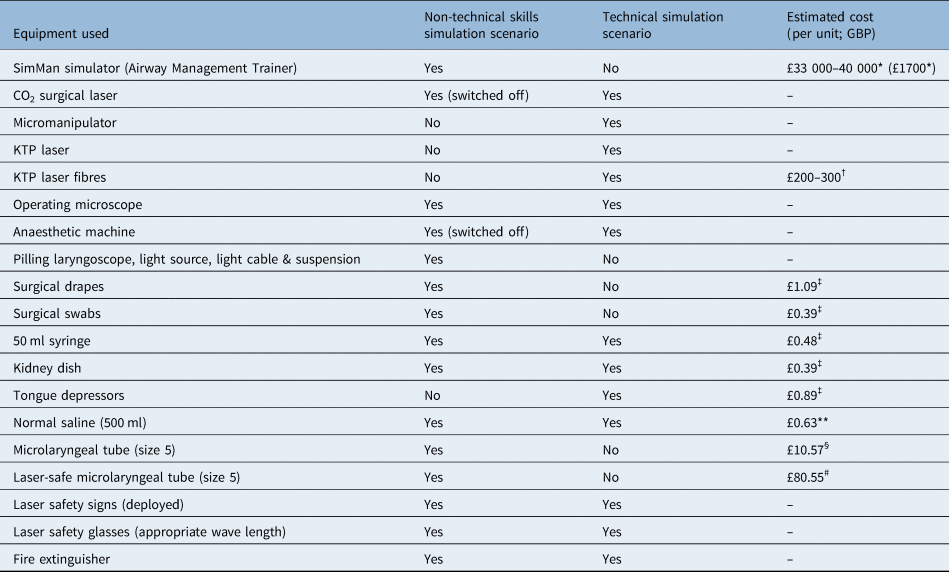
A list of the equipment used, including costs for any potential upfront expenditures, is provided in Table 2.
Equipment required for the technical and non-technical skills simulation scenarios

Costs were estimated for single-use items or potential upfront costs for the course, based on the following suppliers: *Laerdal Medical, †Carlton Surgical Supply, ‡Medisave, **Baxters Healthcare UK, §Covidien Products and #Sheridan LTS. CO2 = carbon dioxide; KTP = potassium titanyl phosphate
Participant evaluation
The course participants were: nine otolaryngology trainees from the West of Scotland Deanery (specialty trainees in years four to eight (‘ST4’ to ‘ST8’)) and two otolaryngology consultants.
Following the course, each participant was provided with a questionnaire. This was designed to provide feedback for the course, and to assess the adequacy of the simulation scenarios using a five-point Likert scale. Each simulation scenario was assessed according to the following criteria: scenario realism, relevance of the scenario learning points, utility of the simulation as a tool to teach each scenario, and the overall utility of the scenario for improving learning. A score of 4 or more was set as the validation threshold.
Results
All 11 participants completed the questionnaire. None of the trainees had previously attended a laser safety course, although 10 participants had used a laser during an otolaryngology procedure.
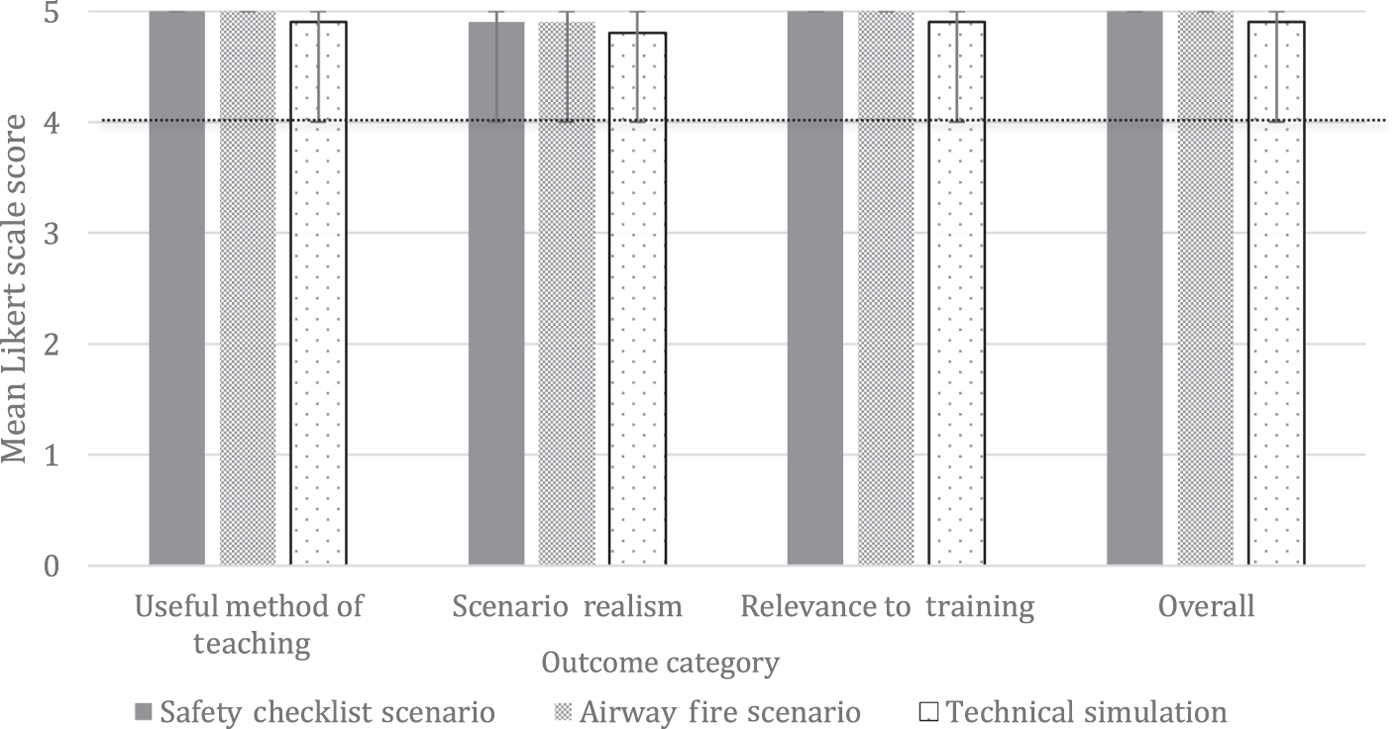
The simulation scenarios were well received by participants. The ‘laser safety’ scenario achieved median scores of 5 for: utility as a teaching tool (range = 5–5), scenario realism (range = 4–5), relevance of learning points (range = 5–5) and overall (range = 5–5). The ‘airway fire’ scenario also achieved median scores of 5 for: utility as a teaching tool (range = 5–5), scenario realism (range = 4–5), relevance of learning points (range = 5–5) and overall (range = 5–5). Therefore, both scenarios were validated as educational tools when teaching laser use to otolaryngology trainees. Figure 2 displays the questionnaire results in graphical form.
Bar chart showing the mean Likert scale scores for each simulation scenario, with error bars indicating the data range for each category. A validation threshold is displayed (dotted line).

Similarly, participants valued the technical simulation, with all respondents stating that they ‘agree’ or ‘strongly agree’ that the inclusion of hands-on training was useful. Qualitative feedback reflected these findings, with participants almost unanimously stating that hands-on and simulation training were most useful. Aspects for course improvement included ‘more practical aspects’. The utility of simulation to enhance the learner experience was also expressed: ‘Laser safety simulation … was well structured, and applying knowledge into practice is very helpful’.
An assessment of course costs is provided in Table 2. The in situ nature of the non-technical simulation negates reusable equipment costs, especially if the course is delivered during scheduled operating theatre down-time. The cost of a projector and the SimMan model is provided, for instances where in situ simulation equipment is not immediately available, as well as the costs for an alternative Laerdal Airway Management Trainer. The initial total cost for all equipment required to set up the course (excluding the SimMan simulator) is £486.99–586.99. Following this initial expenditure, all items except tongue depressors and normal saline would be reusable in future courses.
Discussion
This article describes the practical aspects surrounding the development of a laser safety course, and demonstrates enhanced learning through the use of simulation training. The inclusion of simulation as a tool in teaching laser use in otolaryngology was strongly supported by all participants, with trainees stating that technical and non-technical simulation training enriched the learning experience. Both the ‘laser safety’ and the ‘airway fire’ scenarios were validated for use as simulation tools.
Justification of simulation use in surgical training can be demonstrated in pedagogical, ethical and practical terms.Reference Brown6 From a pedagogical point of view, simulation allows trainees to gain instant feedback in a risk-free environment, and to learn by repetition, which may not be safe in a clinical setting. The ethical justification of simulation lies in the fact that there is reduced practice on patients directly, and so the clinical risk is lower. From a practical point of view, simulation allows trainees to spend more time in an operating theatre environment than may be possible during their clinical hours. At a time when surgeons are increasingly subspecialised and accountable for the efficient use of operating theatre time, there is often less time for a trainee to practise their surgical skills on patients.
Laser safety is an area that lends itself to simulation. Laser emergencies (e.g. airway fire) are fortunately rare, yet as a consequence otolaryngology trainees would be unlikely to have any experience in dealing with these complications. Furthermore, non-technical skills simulation in acute clinical emergencies has been shown to increase clinical performance and self-reported trainee confidence.Reference Green, Tariq and Green7 Therefore, the course's application of non-technical skills training in emergency simulation scenarios will have the added benefit of improving a trainee's performance within a team environment, in the setting of laser use. Current American Society of Anesthesiologists’ guidelines recommend the greater adoption of laser safety education as a means to reduce the risk of operating theatre fires.Reference Apfelbaum, Caplan, Barker, Connis, Cowles and Ehrenwerth8
Given the requisite laser safety requirements, practical laser dissection courses can be prohibitively expensive for otolaryngology trainees. This is because any cadaveric or animal model dissection requires specialised facilities equipped to deal with lasers, and the laser itself has to be reserved specifically for simulation use.
This article describes a high-fidelity, low-cost laser safety course that is popular with trainees, and which satisfies the Intercollegiate Surgical Curriculum Programme curriculum requirement. A detailed breakdown of equipment costs is provided in Table 2, with an estimated single initial investment of £486.99–586.99 required. The course methodology has been made available in this article, allowing its adoption at other sites, and therefore democratisation of the course. This will also aid in standardisation of laser safety training across the specialty. To the authors’ knowledge, this article represents the first description of using in situ non-technical skills simulation training for teaching laser use in otolaryngology.
• The use of lasers in otolaryngology requires staff education, to ensure safe practice
• Simulation training has the potential to optimise staff training in laser use
• This article describes the creation of a comprehensive laser safety course utilising simulation
• Technical and non-technical skills simulation training enhanced the laser use learning experience
• Validation of simulation scenarios and detailing of course methodology allows democratisation of the laser course
Conclusion
This article describes the methodology required to establish a laser safety course using non-technical skills simulation, allowing the democratisation of laser education and training. The course, and in particular the inclusion of simulation training, received excellent feedback from the otolaryngology trainees and consultants who participated. Consequently, it has been recognised as a laser safety course sufficient for the otolaryngology ‘Certificate of Completion of Training’. Future plans being considered for adoption include the use of synthetic simulation models to allow laser airway dissection, and the inclusion of other allied clinical specialists (e.g. anaesthetists and operating theatre nurses) to improve laser skills acquisition in all members of the operating theatre team.
Competing interests
None declared
Supplementary material
The supplementary material for this article can be found at https://doi.org/10.1017/S0022215119001506