

The horse industry in France, key facts and figures
At the end of 2010, France's equine population was estimated at 950 000, a number only slightly lower than populations in Germany and the United Kingdom (1 millionFootnote 1 each in 2009; Liljenstolpe, Reference Liljenstolpe2009). Combined, these three countries have more than half of Europe's total equine population. Horses in France, however, see a wider variety of uses than those in Germany or the United Kingdom (Heydemann et al., Reference Heydemann, Boyer, Couzy, Dornier, Madeline, Morhain and Ragot2011).
Small-sized, job-creating businesses
A wide spectrum of businesses is involved in the horse industry, working across its many sectors, such as horseracing, equestrian sport and leisure activities, draught animals and meat production and with a number of trades specific to each segment.
A diversity of businesses with mixed economic results
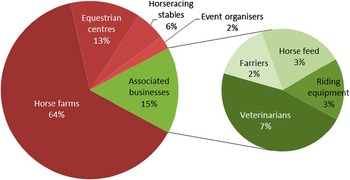
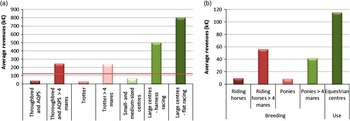
There are two primary types of business working in the horse industry.Footnote 2 There are businesses directly linked to horses that breed, promote and use them, and businesses that provide associated trades to those businesses and individuals. In 2009, there were 53 300 industry businesses in France (Reseau REFErences, 2009), of which 64% were breeders and rearers and 15% were in associated trades (Figure 1). Associated trades often do not work exclusively in the horse industry, and for many horses are an opportunity to diversify their business. Farmers, too, may diversify their business through horse boarding and through other services for horse owners (Figure 2).
Division of businesses in the horse industry (Réseau REFErences, 2011a).

Average revenues for breeders and equestrian centres in the (a) horseracing and (b) equestrian sport and leisure activity segments (Réseau REFErences, 2011a; AQPS: Other than Thoroughbred).

These businesses were estimated to have combined total revenues of 12.3 billion euro in 2008, of which 1.5 billion euro came from agricultural activities. Bets from horseracing amounted to 9.5 billion euro (77%), of which slightly more than 7 billion was paid out to bettors as winnings (Réseau REFErences, 2011a). Revenues from horseracing largely exceed those from other segments. Turnover from the breeding and rearing segment averages less than the turnover from equestrian centres and other activities using horses (Figure 2). Such data, however, cloud substantial differences. Depending on the business size, revenues from equestrian centres range from €12 000 to €450 000, whereas half of all breeders and rearers report no revenue at all (Réseau REFErences, 2011a).
One in three businesses is located in the Lower Normandy, Pays de la Loire and Rhône-Alpes regions. Breeding and rearing activities are well developed in the northwest of France, whereas horse use is more prevalent in the southwest.
Short-term employment and an increasingly female workforce
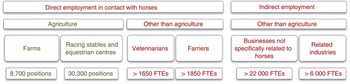
A large proportion of horse industry businesses are small and family-owned. Less than half have more than a single employee, and <10% have more than five employees. There are, however, around 39 000 agricultural workers and 32 800 non-agricultural full-time equivalents (FTE) employed in the industry (Heydemann et al., Reference Heydemann, Boyer, Couzy, Dornier, Madeline, Morhain and Ragot2011, Réseau REFErences, 2011a). Breeding and rearing businesses that earn little have few employees. They make up only 12% of the horse industry's total number of workers and FTEs, but represent 64% of its businesses (Figure 3). Agricultural work is concentrated around horseracing stables and equestrian centres, which are larger and have higher turnovers.
Classification and distribution of horse industry employment (Heydemann et al., Reference Heydemann, Boyer, Couzy, Dornier, Madeline, Morhain and Ragot2011; Réseau REFErences, 2011a).

Agricultural workers tend to be young, with an average age of 30. The industry generally has very high turnover rates, with one-third of its workforce renewed each year. Although gender parity is by and large the norm, women are overrepresented in equestrian centres but underrepresented in positions such as professional riders and trainer-coaches. Women have little representation in horseracing posts that deal with performance achievement, such as jockeys, drivers and coaches (Le Mancq, Reference Le Mancq2007). On average, women with qualifications and responsibilities equal to men tend to have positions that are less highly valued or less recognised socially (Reference Chevalier and LebeauxChevalier and Lebeaux, 2008). The hiring of women across all sectors has largely driven growth in employment figures, and women are starting to predominate overall (Heydemann et al., Reference Heydemann, Boyer, Couzy, Dornier, Madeline, Morhain and Ragot2011). Volunteerism, although unmeasured, is also very important to the horse industry. A number of horse races and equestrian events could not be held without the help of volunteers.
Horse industry businesses are small, numerous, diverse and create a wide variety of employment opportunities.
Difficult to calculate the trade balance
Available data, unfortunately, do not allow the balance of trade to be calculated with precision, although they do shed some light on exchanges being carried out.
France ranks fourth worldwide in horse exports (Lebrun, Reference Lebrun2010), with 4963 live horses declared for export to French Customs authorities in 2011.Footnote 3 According to Customs figures, the equine trade balance was +57.4 million euro in 2011, a figure that appears to be on the rise (Direction générale des douanes et droits indirects, 2012). However, records from the national SIRE database show that ∼7000 riding horses were imported in 2011, a figure exceeding Customs’ records of exports and which has been steadily rising in recent years. In 2011, 2750 racehorse exports were recorded.Footnote 4 However, industry stakeholders agree that imports exceed this number, leading to a negative balance of trade.
The market for horsemeat is split into two: an import sector for red meat and adult horses worth 89.8 million euro in 2010, and an export sector for rosé meat and foals worth 49.9 million euro in 2010. Red meat imports tend to be from North and South America. Exports of live animals mainly go to Italy, whereas exports of meat mostly go to Belgium (Réseau REFErences, 2011a). The market for horsemeat has been declining, both in volume and value, for a number of years. In 2010, however, the drop in imports for both live animals and meat was twice as sharp as the drop in exports. As a result, the trade balance was halved, but remained in the red at −39.9 million euro (Réseau REFErences, 2011a).
While France is well placed on the international market, competition is strong and seems to be increasing owing to the rise in horse imports.
The role of horses in land-use management
Horses are able to live in a highly varied terrain, including difficult, unproductive environments and disused agricultural areas, in particular lands previously used to raise ruminants. In this way, horses contribute to maintaining outdoor spaces and to preserving landscapes. This is particularly true, given the fall in numbers of other herbivores. While stocks of other herbivores have been falling, horse populations remained stable between 2000 and 2010 (Réseau REFErences, 2011a). Horse populations that are stable preserve an animal presence in areas where livestock is otherwise disappearing. Horses use about 5% of France's permanent grasslands, representing 0.5 million hectares of pasture (Vial et al., Reference Vial, Perrier-Cornet and Soulard2011). Indirectly, horses also use farmland that produces fodder and crops. The total land area used by horses is 2 million hectares (Reseau REFErences, 2009). Of this area, a significant part is maintained by privately owned horses that often live on small plots. Varying by region, between 30% and 90% of all horses are privately owned and are directly managed by their owners (Vial and Aubert, Reference Vial and Aubert2011). Although small plots run counter to agricultural and urbanising real estate interests, they are complimentary to them from an urban planning point of view. Horses in peri-urban areas use land that is ‘in transition’, being no longer agricultural but not yet urbanised. More than simply using the space, the development of horse-driven economic activities, such as equestrian tourism, contributes to local economic development by creating riding trails and jobs (Vial et al., Reference Vial, Perrier-Cornet and Soulard2011).
Horses as a tool for social inclusion
While the social aspect of equestrian activities is well-known, horses can also help people better integrate with society. Although statistics on this aspect of horse use are not widely available at present, there are numerous such initiatives.
Horse-assisted activities have been used for over 20 years by a number of care facilities, in particular for young children diagnosed with autism and autism-related disorders, psychoses and behavioural and attachment disorders. Horse-assisted activities can effectively rehabilitate communication and social skills by exposure to cognitive, sensory and motor experiences (Fondation Adrienne et Pierre Sommer, 2010). Horse-assisted activities have also been used successfully as therapy for people with multiple disabilities (Fondation Adrienne et Pierre Sommer, 2010). Horses can also act as mediators for people in high-risk groups. In Aveyron, France, for example, horses are used to help young people learn a trade. More than 95% of those in the programme – most of who would be considered ‘at risk’ – received a vocational qualification in equine care. In prison, horses shake up group social hierarchies. They can help inmates relearn to communicate with others, prepare for their return to society or can act as a simple comfort. In addition to people with disabilities or at risk, horse-assisted activities can be useful to others as well. In the corporate world, horses have become a coaching tool. They act as facilitators, highlighting strengths and weaknesses, and revealing personality types. The main benefit is that as any insight ‘comes from the horse’ there is no stigma attached (Fondation Adrienne et Pierre Sommer, 2010).
These examples serve to illustrate the diversity of possible social roles that horses may play. They also show the huge potential for new horse-assisted activities that could be developed.
The horse industry operates largely through small businesses, and often even private individuals. Nevertheless, the horse industry is dynamic, generating both income and employment, while also providing clear social and environmental benefits.
Trends in horse use
The term ‘horse industry’ covers a gamut of activities because of the extensive and varied ways in which horses are used.
Changes in horse use
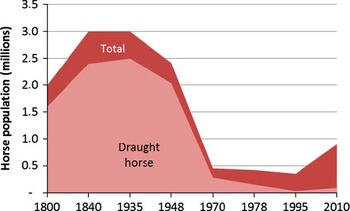
Horse use has changed profoundly over time. At the end of the 19th century, draught horses were omnipresent. They did agricultural work in the countryside and pulled trams in cities. At the time, riding horses were mostly used by the military. The development of motor engines in the 20th century rendered horses unnecessary, and by 1970 French horse populations had been reduced sixfold (Figure 4). Despite the promotion of horsemeat consumption and a shift of draught horse breeds towards meat production, draught horse populations continued to fall until the end of the 20th century (Digard, Reference Digard2004). Trends for riding horses were similar; the move from military riding towards civilian riding that began at the beginning of the 20th century was not enough to prevent the decrease in riding horse populations. It was only with the development of leisure riding, in particular pony riding, over the past 20 years that horse populations have started to climb. Riding horse populations now even exceed the highpoint reached in the 20th century. Growth in the use of horses for leisure activities has also been of benefit to draught horse populations, which are again increasingly being used for traction and municipal services (Heydemann et al., Reference Heydemann, Boyer, Couzy, Dornier, Madeline, Morhain and Ragot2011).
Horse populations in France (Digard, Reference Digard2004; Heydemann et al., Reference Heydemann, Boyer, Couzy, Dornier, Madeline, Morhain and Ragot2011).

The growth of leisure practices has been accompanied by an increasing diversity in the ways horses are used. At the same time, it is increasingly the women who use horses. At the start of the 20th century, female horse riders were almost unknown. In 2010, more than 75% of riding club members were women. As the use diversifies, there are a growing number of practices where horses are not necessarily ridden, such as work in hand and other ‘ethological’ and natural horsemanship methods.
Horseracing has seen a very different set of changes. The very first horse races were held at village festivals and are difficult to date. Flat racing was first imported from the United Kingdom by the French aristocracy in the 18th century. The first organised harness races were held in September 1836 in Cherbourg. The French betting company PMU was established in 1930 and the trifecta bet in 1954, both contributing to the popularity of horseracing (Heydemann et al., Reference Heydemann, Boyer, Couzy, Dornier, Madeline, Morhain and Ragot2011).
Equestrian practices have radically changed over the centuries and have adapted to society's changing needs and expectations. Once an instrument for work, horses are now a source of entertainment.
A variety of riding and racing possibilities
From riding lessons to races, and trail riding to the organisation of sport competitions, there is a wide range of equine activities offered by numerous outlets.
Riding is France's third largest sport federation and is widely practised independently
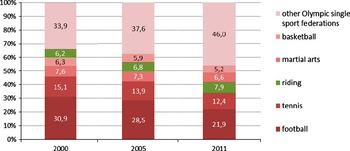
With more than 700 000 members in 2011, the French Equestrian Federation (FFE) is the third largest sport federation in France after football and tennis, with 2 million and 1 million members each, respectively. It is, however, the sport federation with the most women members. The fifth largest federation in 2000, FFE membership has since increased more than 64% in 10 years. Although the shares of the other top five sport federations have continued to fall, FFE membership has grown (Figure 5). Equestrianism is practised in nearly 7800 FFE clubs or groups, of which 5000 are equestrian centres and 1800 are horse farms or owners’ stables (Heydemann et al., Reference Heydemann, Boyer, Couzy, Dornier, Madeline, Morhain and Ragot2011). More than 80 000 competitive events have been held, mostly for show jumping. On the club circuit, 52 000 events in around 20 disciplines have been held, with 23 000 amateur and professional championships and more than 7800 championships for young riders. However, only one rider in five is involved in the competition (Heydemann et al., Reference Heydemann, Boyer, Couzy, Dornier, Madeline, Morhain and Ragot2011). Many other equestrian activities exist such as riding lessons, horseback excursions and trekking. Many horse riders who own their horses ride without being members of any organised club. As a result, the total number of riders is estimated at more than 1.5 million (Réseau REFErences, 2011b), in other words, more than double the membership of the FFE.
Changes in the relative share of memberships to Olympic single-sport federations, 2000 to 2011 (French Ministry of Sport, 2012).

Horseracing and betting, popular through the ages
Gambling is becoming increasingly popular in France. The sharp growth in revenues for the country's national lottery operator, Française des jeux, clearly demonstrates this, rising to 76.2% between 2000 and 2011.Footnote 5 Horserace betting is well liked in France, and France ranks fourth in the world for value of bets placed. Each year, approximately 2 billion bets are placed. In 2011, the value of bets placed equalled 10.075 billion euro.Footnote 6 This amount is in constant progression and increased to 60% between 2000 and 2011. In 2011 – the second year of open competition in France's gambling market – only 1.6% of total bet value was registered online by the nine licensed non-PMU operators. With so many bettors, the PMU organises ∼18 000 races in France each year, of which 8000 are largely for the benefit of PMU betting. Around 30 000 horses and 10 000 owners participate in races each year. Of the races, 62% are harness races and trotting races under saddle, 26% are flat races and 12% are steeplechase. Approximately 2800 certified individuals are employed in training horses, although a growing number of new companies are offering breaking and pre-training services (Heydemann et al., Reference Heydemann, Boyer, Couzy, Dornier, Madeline, Morhain and Ragot2011).
Renewed use of animal traction
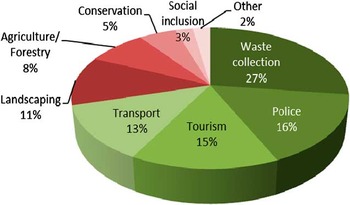
Draught horses in France are slowly finding their place again in the modern world through the renewed need for animal traction as much in cities as in rural and peri-urban areas. In sensitive or fragile environments, animal traction can complement the use of motorised machinery and can be very effective because it is gentler on ground and on ecosystems (Ayache, Reference Ayache2010). In very isolated areas, horses can be used to transport equipment or materials. Horses can also be of benefit to smaller market gardens, to vineyards or to forestry operations interested in organic agriculture and in new, less-intrusive agricultural practices, or to operations that want to cultivate a particular image. Irrespective of the aim, these practices can be put in place by purchasing a horse directly or through arrangements with hired horses. In urban areas, horses are once again finding their place through tourism (Rossier, Reference Rossier2004) and for municipal services. In 2012, a French national commission found 212 municipalities using horsesFootnote 7 for a wide variety of purposes (Figure 6). In 18% of these municipalities, horses were being used for at least two different tasks.
Municipal horse use in France (French national territorial commission for horses, Out of 247 uses of horse, 23 are in study or test phases; Heydemann et al., Reference Heydemann, Boyer, Couzy, Dornier, Madeline, Morhain and Ragot2011).

A decline in horsemeat consumption
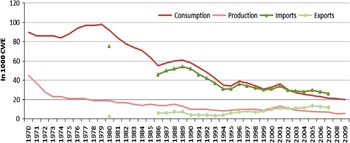
Horsemeat consumption in France has continually fallen since the 1980s (Figure 7). In 2009, ∼20 000 tonnes of horsemeat were consumed. The production of horsemeat in France is well below consumption levels and has been on the wane since the 1970s. The fall is partly because of the movement against the practice but largely because of the administration of drugs considered to render horsemeat unfit for consumption.
French horsemeat market, in thousands of tonnes of carcass weight equivalent (CWE; FranceAgriMer).

The uses described here do not form an exhaustive list but rather a representative sample of principal current horse uses for which data are available. The social and environmental uses outlined in paragraphs ‘The role of horses in land-use management’ and ‘Horses as a tool for social inclusion’ should be added to this list.
Horse breeding, development and trade
The wide use made of horses requires a wide diversity of horse types that in turn necessitate different breeding, promotion and trade methods.
Fragmented breeding
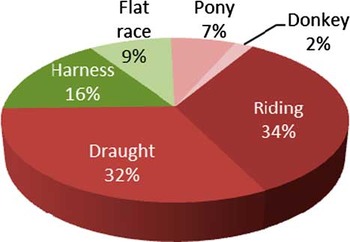
As of 2010, 63 different breeds of equines – of which only 26 are French in origin – are recognised and monitored in France: 23 purebreds, 10 draught horses, 11 ponies and seven donkeys (Réseau REFErences, 2011a). 20% of all horse farms are not listed in the breed registry. For draught horses, there is a split between traditional breeding centres and the main production areas. Horses from main production area of south-western France are kept on mountainous land and often range freely. This production is geared mainly towards meat and represents more than 40% of draught broodmare populations (Heydemann et al., Reference Heydemann, Boyer, Couzy, Dornier, Madeline, Morhain and Ragot2011). In total, there are 42 700 breeders working on 35 000 breed farms. Two-thirds of the horses bred are for riding or for draught work (Figure 8). However, 80% of the farms have only one or two mares (Réseau REFErences, 2011a) and 85% of breeders do not specialise in breeding. Of the non-specialist breeders, 40% are otherwise employed in work that is generally neither agricultural nor connected to horses in some way (Heydemann et al., Reference Heydemann, Boyer, Couzy, Dornier, Madeline, Morhain and Ragot2011). Foreign horse breeds make up only 9% of the French horse population. This number is steadily rising; however, it is proving popular because they are often bred specifically for recreational purposes.
Horse breeding in France, 2009 (Heydemann et al., Reference Heydemann, Boyer, Couzy, Dornier, Madeline, Morhain and Ragot2011).

At present, horse breeders make use of stallions from private stud farms and stallion owners, and of the France Haras. France Haras was created as a provisional measure to take over the activities of the State-owned Haras nationaux, France's leading breeding stables, with a view to transferring stud farm activity to private stud farms. Statistics on stud farms and stallion owners are limited, but there were estimated to be 376 sperm collection and breeding facilities for Selles Français and 145 for French Trotters in 2011.Footnote 8 Although Thoroughbreds may only breed through live cover, French Trotters may be artificially inseminated using non-transported semen, whereas other breeds may use transported, or even frozen, semen. In 2009, 60% of the riding horses were sired through artificial insemination. Embryo transfer is not widely practiced in horses and represented only 2% of pregnancies in 2009. It is mostly used for sport mares still in competition (Heydemann et al., Reference Heydemann, Boyer, Couzy, Dornier, Madeline, Morhain and Ragot2011). Cloning is extremely rare at present.
Horse training
Before they are used, horses must be trained and taught what will be expected of them. This allows the animal's performance to be evaluated and creates market-ready horses.
Young sport horses aged 4 to 6 have a specific training programme developed by the French Equine Association (SHF). In 2010, the programme contained nearly 7900 tests across six disciplines: show jumping, eventing, dressage, combined driving, endurance riding and hunter. There are ∼16 000 horses and ponies involved in 130 000 starts, 85% of which were in show jumping (Réseau REFErences, 2011a). In addition to performance, breed characteristics and gait are recorded when the horses are put through their final tests. Tests are organised in two training streams for show jumping, eventing and dressage: classic, geared towards professional riders, and open, designed for amateurs.Footnote 9
Trotters may not participate in races until they have successfully completed a 2000-m qualification test within the time specified for their age and discipline. Qualification tests are mostly conducted at the age of 2 and, on average, 40% of each generation qualify (Réseau REFErences, 2011a). Trotters that do not qualify are put on the market for meat or as riding horses, where they compete with horses that have been bred for sport or for recreational purposes (Rossier, Reference Rossier2004). Although qualification testing does not exist for flat racing, underperforming flat-race horses may still be directed towards the sport and recreation markets.
Horses must be broken before specialised training. A growing number of companies break horses, although very few perform this service alone, making data on this activity hard to come by.
The trade-in horses
Racehorse sales – up for auction
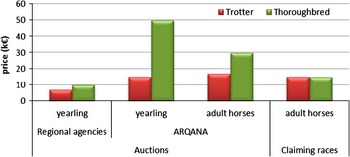
Racehorses are mostly sold at auction. Every year, about 10% of each generation of trotting horse and 20% of each generation of gallop horses – a total of about 3000 horses of all ages each for trot and gallop – are put up for auction. Only 65 to 75% of the horses are sold, however. Horse auctions in France are for the most part organised by a national agency, ARQANA, or by various regional agencies. There are also ‘claiming races’ where horses may be purchased following the race using a secret ballot auction system. In 2009, auctions for gallop horses totalled ∼75 million euro, whereas auctions for trotting horses totalled 25 million euro (Heydemann et al., Reference Heydemann, Boyer, Couzy, Dornier, Madeline, Morhain and Ragot2011). Sale prices vary widely by horse and by sale type (Figure 9) and are also highly volatile. The highest price paid in 2011 for a Thoroughbred sold through ARQANA was 1.7 million euro for a yearling purchased in Deauville.
Average racehorse sale price by type and by type of sale, 2009 (Heydemann et al., Reference Heydemann, Boyer, Couzy, Dornier, Madeline, Morhain and Ragot2011).

Riding horses – an imbalanced supply and demand
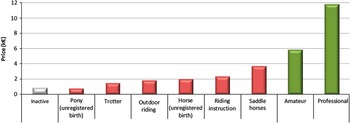
The riding horse market is valued at ∼200 million euro per year for 50 000 horses and ponies bought and sold, of which 10% are imports (Couzy and Godet, Reference Couzy and Godet2010). In the hopes of selling high, 60% of breeders want to produce horses for professional use. In reality, 70% of purchased horses are for recreational use and teaching, 25% for amateur competition and only 5% for professional competition (Heydemann, Reference Heydemann2006). With the exception of horses for professional competition, sale prices are, on average, less than the production cost for the horse – at least 5000 euro over 3 years (Figure 10; Couzy and Godet, Reference Couzy and Godet2010).
Average sale price for riding horses and ponies by horse type and use (Heydemann, Reference Heydemann2006).

In general, there are three main types of horses available on the market: (1) elite horses that are relatively expensive and bred for competition; (2) horses without pedigree or rescued horses that are generally quite inexpensive, although not very sought-after; (3) sport horses unable to perform at the requisite level that are withdrawn from competition and sold at a loss. Generally, these types of horses are not suited to recreational use. In addition to these three main types are horses of all ages and abilities, trained or untrained, sold by individuals at considerably different prices, and at times sold well below market price. This creates competition among horse producers and pulls prices downwards. The mismatch between the horses on offer and the needs of horse users is characteristic of the horse market.
Increasingly strong international competition
In 2010, 10 328 horses were imported, almost half of which were riding horses, while 35% were racehorses and 15% were ponies (Réseau REFErences, 2011b). Over the past 10 years, riding horse imports increased fivefold and pony imports 10-fold, whereas racehorse imports increased only by a factor of 1.4. Over 25 breeds of riding horses were imported; Andalusians were most popular, followed by Dutch Warmbloods and Shetland Ponies. Horses imported for dressage competitions seem to perform better on average than French horses; the same is not true for horses imported for show jumping. Although horses imported for recreational use tend to be more expensive than French horses, they are specifically designed for leisure purposes or have sought-after physical traits. Limited production of dressage and recreational horses in France accounts for imports of these animals, whereas imports of show jumping horses demonstrate strong international competition in this market and better organised foreign distribution channels (Heydemann, Reference Heydemann2012).
Whether riding for leisure or for competition, many people are willing to purchase a horse that meets their needs on the international market if they cannot find one on the French market.
Organisation of the industry
The traditional segmentation of the horse industry created specific structures for its various parts, with IFCE, France's national horse and equitation institute, as the public supervisory body for the industry as a whole. There are a number of other umbrella organisations as well:
-
1. Regional horse councils represent the industry at a local level. The industry is represented at national and EU levels by the National Federation of Horse Councils.
-
2. GESCA, an association of businesses that promotes and coordinates interaction among various industry sectors, particularly with regard to legislative changes and reform.
-
3. France's National Horse Federation, FNC, the dedicated horse agency within the National Federation of Farmers’ Unions, FNSEA.
Horseracing
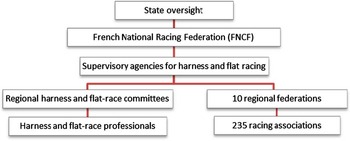
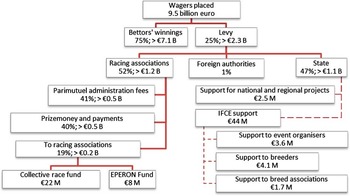
Horseracing has traditionally been highly structured (Figure 11). It is centred on two parent companies: France Galop, for flat racing, created in 1995 following the merger of three organisations, and SECF, created in 1864 for harness racing (throughout this report, the term ‘harness racing’ includes trotting races under the saddle). Both companies aim to encourage and improve racehorse breeding and to promote horseracing. They are involved in horseracing administration, disciplinary action and finance. Through their training centres and management of 10 racetracks, they are also involved in the organisation of races. These two companies fall under the purview of a national federation that also manages the laboratory for anti-doping in horseracing, LHC and the EPERON fund (see Figure 12: Wagers and industry funding, 2009 (Heydemann et al., Reference Heydemann, Boyer, Couzy, Dornier, Madeline, Morhain and Ragot2011)). At a local level, regional federations and committees are responsible for managing races, setting the race calendar and so on (Heydemann et al., Reference Heydemann, Boyer, Couzy, Dornier, Madeline, Morhain and Ragot2011).
Organisation of horseracing industry (Heydemann et al., Reference Heydemann, Boyer, Couzy, Dornier, Madeline, Morhain and Ragot2011).

Wagers and industry funding, 2009 (Heydemann et al., Reference Heydemann, Boyer, Couzy, Dornier, Madeline, Morhain and Ragot2011).

In addition, there are a number of organisations operating across the industry to manage betting (PMU, PMH, other licensed operators), the organisation of races in Paris (GTHP), training (AFASEC) and staff retirement (ORPESC). There are also organisations on all levels for breeders, stud owners, trainers, jockeys, drivers, owners, enthusiast and brokers for both flat and harness racing (Heydemann et al., Reference Heydemann, Boyer, Couzy, Dornier, Madeline, Morhain and Ragot2011).
Horsemeat industry
Created in 2002, Interbev Équins, the horse division of France's livestock and meat industry association, oversees the horsemeat market.Footnote 10 It brings together horsemeat industry stakeholders such as producers, merchants, coops, businesses, horse butchers, distributors and the foodservice industry. The industry supply side is managed by France Trait, the association responsible for the nine breeds of draught horse, while the distribution side is managed by 19 producers’ organisations that are mainly responsible for selling the product. The producers’ organisations also develop regional brands, offer technical support and information to producers and manage financial assistance (Heydemann et al., Reference Heydemann, Boyer, Couzy, Dornier, Madeline, Morhain and Ragot2011). In a broad way, CIV (France's centre for meat information), established in 1987, also contributes. Through industry professional and communication campaigns, it improves knowledge of beef, pork, mutton and horse meats, the livestock and meat industries, as well as social issues such as nutrition, food safety, the environment and animal health and welfare.Footnote 11
Sport, recreational and workhorses
The first organisation in this category to be recognised by the government was FIVAL, a federation of sport horse associations. It was created in 1997 and brought together both upstream users, such as breeders and stud owners, and downstream users, such as equestrian centre operators and merchants. It failed to meet the needs of its different associations and has not been active since 2008 (Heydemann et al., Reference Heydemann, Boyer, Couzy, Dornier, Madeline, Morhain and Ragot2011). Since then, industry stakeholders have reorganised themselves. The French Equine Association, SHF, founded in 1865, became the supervising agency for racehorses and ponies in 2011. SHF brings together those involved in the production, promotion and sale of young racehorses. The FFE, created in 1987 following the merger of three national agencies, is responsible for horseracing and for developing high-level competition. In 2012, the French association for working equines was established by France Trait, the regional breeds association and the French donkey and mule association to oversee activity related to working horses. Its aim is to encourage breeding, training, promotion and sale of draught horses, donkeys, mules and regional breeds and to foster their use. In addition to these main organisations, there are a host of other professional groups working across all aspects of the industry, including breeding, horse use and promotion.
Funding
Levies on horserace betting contribute to funding for the horse industry as a whole (Figure 12). The racing industry receives funding to organise races and to maintain race facilities through a collective fund financed through levies and through prize money and other incentives. Other industry segments receive financing through the EPERON fund in support of regional and national equestrian projects. In addition to direct financing through race levies, government funding for sport, leisure and work horse industries is also given through IFCE or through support for national and regional projects.
Racing, horsemeat, sport, recreational and work horse industries are all organised independently and have their own institutional structures. They are, however, closely tied through the horse industry's funding structure as a whole.
Equine research in France
There are many government agencies involved in equine research in France, including INRA, IFCE, ANSES, CNRS and the country's veterinary universities. Horses are, however, generally treated as one animal among many in thematic multispecies laboratories. Although horses benefit from advances made with other species, this situation can be detrimental to the visibility of equine research both in France and abroad. Across all agencies, funding for equine research is estimated at 7 million euro with 47 FTE staff. There are three experimental herds: Chamberet and Le Pin for IFCE and Nouzilly for INRA. Additional financing is provided by IFCE, the EPERON fund, a number of regional governments, the French National Research Agency and others (Heydemann et al., Reference Heydemann, Boyer, Couzy, Dornier, Madeline, Morhain and Ragot2011).
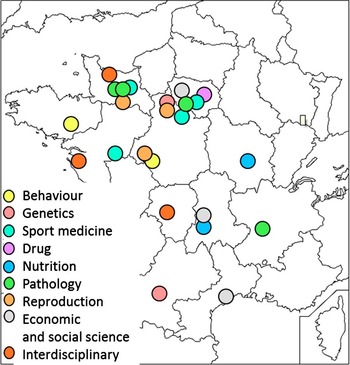
Between 2004 and 2006, France was the sixth largest publisher of equine-related scientific publications, behind the United States, the United Kingdom, Germany, Brazil and Poland, producing 4% of publications worldwide (Les Haras Nationaux, 2008). French equine research centres deal with a wide range of topics but are spread across the country, which may hinder information sharing (Figure 13). In recent years, research on horseriders is on the rise across France (not shown in Figure 13).
Primary equine research centres in France (IFCE).

As in most other countries, more than 50% of publications in France deal with pathology, treatment and prevention (Les Haras Nationaux, 2008). The importance of genetics and behavioural studies is rapidly growing and it is important that France maintain its leading position in these fields. Progress in genetics is strongly tied to advances in sequencing and advanced genome analysis technologies. Genomics may become a highly powerful tool for the early detection of pathologies, of the predispositions thereto, and of aptitude towards certain disciplines or performance levels. Growth in behavioural studies has gone hand in hand with the emergence of concerns about animal welfare, animal learning capacities, the profiling of breed temperaments and improving human–animal interactions. In 2011, the Hippolia Foundation was established to coordinate scientific equine research in France. Its aims are to strengthen and promote research and training programmes dealing with the health, welfare and performance of equines. The foundation will strongly promote French equine research.
Industry concerns
The horse industry has grown in a context of evolving horse use, changing policies towards horses and developing technologies. Although industry structure was never formalised, it largely operated with State support. This support is increasingly being called into question at present. The horse industry is nevertheless an important creator of direct and ancillary employment and the source of numerous recreational activities. Horses provide a link between the past and the present, between cities and the countryside, and performance and pleasure. The industry brings together a wide variety of stakeholders whose interests may at times be divergent, but who tend to be united by the same passion for horses. This chapter concludes with the main concerns expressed by industry players during interviews carried out for this report and through findings from French Senate and Economic, Social and Environmental Council records and from the REFErences network. The chapter looks largely at short-term visions that only partly align with the long-term analyses made by the panel on future trends presented in the following chapter.
Job security, a concern for employees and employers
The horse industry is an important creator of employment in general and of agricultural employment in particular. This employment tends to be unstable, however, and has a high turnover rate, notably affecting young people, 48% of whom quit after 1 year (Cordilhac et al., Reference Cordilhac, Lefebvre and Mahon2011). Amateur or recreational riders who take up careers in the horse industry and become disillusioned may serve to explain this phenomenon in part (Chevalier and Le Mancq, Reference Chevalier and Le Mancq2010). Employers recognise that working conditions in horse-related employment are often difficult, with low salaries and with schedules that may be poorly compatible with family life unless measures for job flexibility are put in place. All this may come as an unpleasant surprise to young people driven by their passion for horses and their desire to work with them. The high turnover rate incurs substantive economic costs for businesses as well. It hinders the personal development of people working in the industry as they are unable to gain sufficient experience to become specialists in their field. These issues are coupled with concerns about job security. By allowing equestrian centres to increase staff costs while maintaining constant prices, value added tax (VAT) reductions in 2005 did serve to improve job security. Nevertheless, 56% of employees, women particularly, have insecure employment today. Many worry that the VAT increase will exacerbate the situation, particularly given the current economic climate under which it is difficult to assess a potential impact of higher consumer prices. The large numbers of volunteers and enthusiasts in relation to the number of professionals further create ambiguity as to the professional nature of employment in the industry, given that few have any specific training in the field. Furthermore, available training courses are not always suitable, the entry level for training is often problematic and for many professions there is no specialised training that would allow young people to prepare their entry into the labour force. Consequently, there is a disparity between candidate skills and employer expectations.
Industry ‘professionals’?
There is a problematic divide in the horse industry between ‘professionals’ and ‘enthusiasts’, with each group setting its own definitions of the two categories (Gesca, 2009). Breeders, seeing themselves as ‘professionals’ because they try to make a living from breeding, feel that non-professionals are unfair competition and that non-professionals unduly receive government support, given that horses are not their livelihood. They also criticise non-professionals for having taken control of professional associations. They feel non-professional breeding is far removed from economic imperatives and this is not counterbalanced by any added value, in terms of a more scientific approach to breeding, for example. Some feel that professional breeding and business interests are mutually exclusive. With the industry operating largely through non-professional breeders, others believe there are too few true professional breeders for such a distinction to be of use. Others consider that a middle ground could be found by offering business support rather than support to individual breeders, by encouraging youth empowerment, and by granting financing based on an assessment of individual policies and objectives rather than financing for certain categories of business or individuals. The difficulty in distinguishing professional and non-professional breeders contributes significantly to the lack of transparency in the French riding horse market. Also detrimental is the ‘conversion’ of race and sport horses to recreational use, which limits real opportunities for both leisure and high-performance horses and thus is a limit to breeders as well.
The question of professional v. non-professional also applies to high-level riders. They are not financially able to make a living from riding alone and must be otherwise employed.
Uncertain financing for the horse industry
The ability of the industry to weather trying economic conditions is quite hard to assess. A person driven by passion may be inclined to carry on their work, even after failing, by spending increasing amounts of their own money. This skews self-regulatory market forces by distorting demand. Consequently, the economic performance of various industry stakeholders varies considerably and may be a matter of concern to some depending on their own personal financial resources. Overall, a decline in the number of horse farms can be observed. Breeders say that they must deal with the high price of veterinarians, of semen and of overhead costs in general, as well as with sharply increasing international competition.
Economic performance for racehorse breeders and trainers is also falling and is affected by a decline in the number of owners. The racing segment, like many others, operates through the financial largesse of individuals who are able to invest money without the expectation of a return, a necessary aspect of flat racing. The prospect of declining funding owing to introduced competition from online betting further exacerbates concerns for the economic prospects of the segment.
The French government has long overseen the horse industry through the Haras nationaux, the country's national breeding stables. As this institution gradually refocuses its operations, government support to the industry is being reduced, causing many to feel uneasy.
Real estate, a local concern
Growth in equestrian-related activities requires land, the availability of which varies by region. Although land issues have not been widely discussed at a national level, they are an important concern locally. Regional workshops organised as part of this report have highlighted this situation. Viewpoints differ greatly. In Languedoc Roussillon, for example, the focus was on the considerable land resources no longer used by agriculture. In peri-urban areas, the main concern was the very stiff competition between agriculture, urbanisation and equestrian activities, with soaring prices prohibitive to agriculture and equestrian activities in some areas.
Nostalgia and innovation: the evolution of equestrianism
It is important to many industry stakeholders to encourage ridership in equestrian centres. Learning to ride is a time-consuming process that requires discipline and is at times uncomfortable. This may put off potential riders, leading to the high rate of attrition seen for riding lessons, particularly through the first year of practice. Equestrian centres do not always have the types of horses necessary for clients eager to see results and unfamiliar with horses and the dangers they may present. Clients may thus become disheartened and give up riding. However, innovations in teaching techniques have now made it possible to attract young riders. However, the growth in children's riding and recreational equestrianism has met with opposition from those who favour traditional horsemanship, technical skills and graceful riding on the basis of training, effort and perseverance. Riding centres and their staff are themselves often torn between passion for traditional riding and the need to manage their finances. Some professionals worry that market pressures may result in lowered standards for teaching and for instructors that may stymie the riders’ ability to progress to higher levels of the sport (Tourre-Malen, Reference Tourre-Malen2009).