Introduction
Streptococcus suis is an important pathogen in swine, causing a wide range of diseases including arthritis, meningitis, pneumonia, septicaemia, endocarditis and abscesses. In humans, particularly those in close contact with pigs or pig products, it has been reported that meningitis and/or septicaemia followed by deafness can occur.Reference Staats, Feder, Okwumabua and Chengappa1
Although its human pathogenicity has been recognised for more than 40 years,Reference Perch, Kristjansen and Skadhauge2 human infection from S suis was thought to occur only sporadically, until a large outbreak in China in July 2005 attracted renewed public and scientific interest.Reference Yu, Jing, Chen, Zheng, Zhu and Wang3 A 2007 review by Lun et al. identified a total number of 409 reported cases worldwide, mostly occurring in China, Thailand and the Netherlands.Reference Lun, Wang, Chen, Li and Zhu4 The Thai cases in this review included 47 patients from four articles published between 2001 and 2004.Reference Fongcome, Pruksakorn, Mongkol, Tharavichitkul and Yoonim5–Reference Suankratay, Intalapaporn, Nunthapisud, Arunyingmongkol and Wilde8
In 2006, the largest case series was reported by Chiang Mai University Hospital, involving 41 patients with S suis infection in Thailand. The overall mortality rate was 19.5 per cent. Post-meningitis hearing loss was identified in 30.7 per cent.Reference Wangkaew, Chaiwarith, Tharavichitkul and Supparatpinyo9 Interestingly, only three of the 41 cases appeared retrospectively to have had a history of exposure to swine or pork products. Two studies by Fongcome and colleagues,Reference Fongcome, Pruksakorn, Mongkol, Tharavichitkul and Yoonim5, Reference Fongcom, Tharavichitkul, Pongprasert and Punchaburi10 however, reported 10 and 19 cases of S suis infection, variously, from Lamphun province (next to Chiang Mai province) in northern Thailand. All cases in these two studies had a history of raw pork or uncooked pig's blood consumption prior to their illness. Additionally, most had a history of chronic alcohol consumption.
The current paper presents the results of an additional 40 cases of S suis infection identified at our institution since January 2003. We assessed the mode of acquisition of S suis infection, the probable predisposing factors aggravating this infection, and details concerning survivors' long term hearing loss and vestibular function. We also present strategies which may prevent S suis infection, in the absence of an effective vaccine.
Materials and methods
The study was conducted at Chiang Mai University Hospital from January 2003 to January 2007. Clinical data for all patients identified as having S suis infection, obtained from clinical specimens forwarded to our central microbiological laboratory, were retrospectively collected and entered onto a preprinted data form. Survivors were contacted via telephone or post and asked to participate in the study and also to have their hearing and vestibular function further evaluated.
The microbiological procedures used to clarify S suis as the causative pathogen were similar to those used by Wangkaew et al., Reference Wangkaew, Chaiwarith, Tharavichitkul and Supparatpinyo9 that is, use of a biochemical method and confirmation with API 20 streptococcus commercial kits. Specific serotyping of S suis isolates was not available at the time of this study.
Hearing was assessed in a soundproof room using a Madsen OB822 audiometer (Madsen, Copenhagen, Denmark). Hearing loss related to S suis infection was assumed probable if there were: subjective complaints of hearing loss acutely related to S suis exposure, i.e. within two weeks of infection; and a weighted pure tone average threshold (for 500, 1000, 2000 and 3000 Hz) without an air–bone gap >25 dB in one or both ears, in the absence of other explainable causes.
The degree of hearing loss was defined according to hearing thresholds, as mild (i.e. 26–40 dB), moderate (41–55 dB), moderate to severe (56–70 dB), severe (71–90 dB) or profound (>90 dB).Reference Kileny, Zwolan, Cummings and Flint11
Vestibular function was assessed with bithermal caloric testing (with 30 and 44°C water stimulation) using Hortmann neuro-otometry electronystagmography (ENG) recording. The caloric excitability difference was interpreted according to the formulae of Jongkees et al. Reference Jongkees, Maas and Philipszoon12 and Barber and Stockwell.Reference Barber and Stockwell13 Patients were considered to have vestibular impairment related to their S suis infection if there was: an excitability difference <25 per cent compared with the opposite side; and no function on one or both sides.
This retrospective study was approved by the ethics committee of the Faculty of Medicine, Chiang Mai University, Thailand.
Results
Forty adult patients with culture-proven S suis infection were identified at Chiang Mai University Hospital between January 2003 and January 2007. Over this four year period, the numbers of cases admitted each year was eight, 11, 18 and three, respectively. Patients comprised 30 men and 10 women; the mean age was 55 (range 27–82) years. The patients came from several provinces in northern Thailand, but mainly from Chiang Mai province (85 per cent). Streptococcus suis infection occurred mainly during the rainy season, from May to August (70 per cent, vs 30 per cent presenting at other times). Fifty-two per cent of patients were farmers or labourers, 33 per cent were officials or merchants, and 15 per cent were housewives.
There was a history of consumption of raw pork and/or uncooked pig's blood, with a mean time of 3.1 days (range 2 hours to two weeks) prior to the onset of symptoms related to S suis infection in 62.5 per cent (25/40) of cases. In 25 per cent (10/40), there was a history of direct contact with pigs or raw pork (four butchers and six cooks). Of the 37 cases with available data, 18 (49 per cent ) had a history of significant alcohol consumption (i.e. chronic regular drinking or heavy binge-drinking at the time of infection). Sixty-three per cent of patients (25 cases) appeared to have been previously healthy, whereas 37 per cent (15 cases) had an underlying illness, including diabetes, cirrhosis, hypertension and hyperlipidaemia in 10, two, two and one patients, respectively.
The clinical manifestations of acute S suis infection included meningitis with or without sepsis, sepsis alone, and infective endocarditis, in an approximate ratio of 2:1:1 (19, 11 and 10 patients, respectively). Of the 19 patients with meningitis, 17 had accompanying sepsis. One patient who developed meningitis and sepsis 7 hours after consumption of pork and pig's blood simultaneously developed endophthalmitis of the left eye, with eventual permanent blindness. Of the 11 patients with sepsis alone, one was a diabetic who developed sepsis with severe endophthalmitis of the right eye three days after skin contact, requiring enucleation with prosthetic replacement. One other patient had sepsis with peritonitis.
The overall mortality rate was 20 per cent (eight of 40 cases). Deaths from sepsis and infective endocarditis occurred in five and three patients, respectively.
Of the 32 survivors, hearing and vestibular testing was performed in 26 and 22 cases, respectively. Among the 19 meningitis survivors, only 15 were available for the hearing test. Fourteen of 15 meningitis survivors noted hearing loss developing over a time period ranging from hours to as long as nine days after infection. Eleven of the meningitis survivors had a hearing test performed within the first two weeks of infection. Hearing was reassessed often, with a mean follow up of 17 months (range six to 30).
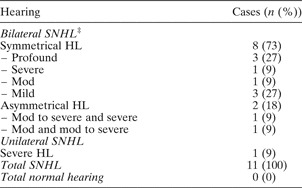
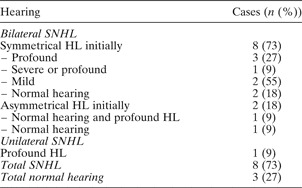
The initial audiograms conducted at two weeks post-infection demonstrated sensorineural hearing loss (SNHL) in all 11 meningitis cases thus studied (100 per cent); 10 cases were bilateral and one unilateral (Table I). Moderate to severe hearing loss or profound deafness was found in six of these 11 cases. Within the mean follow-up period of 17 months, persistent SNHL was found in eight of 11 (73 per cent) patients. There were six survivors with bilateral hearing loss (hearing loss was profound in three patients, severe to profound in one and mild in two) and two with unilateral profound deafness. Hearing improved in five cases (three developed normal hearing bilaterally), typically within one to six months post-meningitis (Table II).


Patterns of hearing recovery and subsequent imaging studies occasionally revealed interesting findings. A 56-year-old butcher with bilateral SNHL developing one week post-infection had complete recovery of hearing in one ear, only to have the other ear diagnosed with profound deafness at six-month follow up.
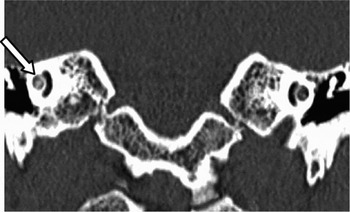
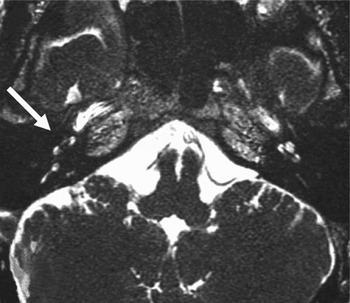
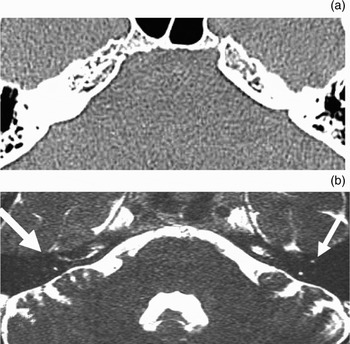
In another interesting case, a 44-year-old, regular heavy drinker experienced bilateral severe hearing loss on the third day of meningitis. Periodic hearing tests over the ensuing two years showed persistent right-sided severe hearing loss and left-sided profound hearing loss. Computed tomography (CT) and magnetic resonance imaging (MRI) scans of the inner ears at 22 months post-infection revealed findings compatible with labyrinthitis ossificans (more severe on the right side) (Figures 1 to 3).
Coronal computed tomography scan of the temporal bone. Right cochlea side shows faint high attenuation in the apical turn of the cochlea (arrow), suggestive of labyrinthitis ossificans.

Axial magnetic resonance imaging scan of the temporal bone of the same patient shown in Figure 1. Right side shows loss of high signal intensity of fluid within the apical turn of the cochlea (arrow), suggestive of labyrinthitis ossificans.

Imaging studies for the same patient shown in Figure 1. (a) Coronal computed tomography scan of the temporal bones shows intact bony superior semicircular canals bilaterally. (b) Axial magnetic resonance imaging scan of the temporal bones shows loss of high signal intensity of fluid in the anterior limb of the right membranous superior semicircular canal (thick arrow), compared with the left canal (thin arrow).

Of the four out of 15 meningitis survivors who did not undergo early hearing evaluation, three denied any hearing loss and one noticed unilateral hearing loss 2–3 hours post-infection. Sequential hearing tests in this group (the last performed at 48 months post-infection) revealed that two patients had bilateral normal hearing while the other two had mild unilateral SNHL.
Caloric testing was performed in 14 post-meningitis patients, with a mean follow-up of 22 (range 16–40) months. Two patients were excluded, one due to hydrocephalus and the other due to treatment with antiepileptic medication which might have affected the ENG interpretation.Reference Barber and Stockwell13 Of the 12 patients available for review, vestibular impairment was found in 50 per cent (six of 12 cases); four had absent caloric responses bilaterally and two had absent responses unilaterally. In the four patients with absent bilateral caloric responses, five of the ears had profound deafness, one had severe hearing loss and two had mild hearing loss. The two cases with absent caloric responses unilaterally also had profound deafness on the same side.
Of the five sepsis cases available for review, two were excluded due to unilateral deafness following herpes zoster oticus and chronic otitis media. Of the remaining three cases, two denied any hearing or balance impairment and had normal hearing and caloric test results. The third case was that of a 42-year-old man who developed a persistent, left-sided, sudden SNHL on day nine of sepsis, without signs of meningitis. Treatment was provided without a confirmatory lumbar puncture at the time. Repeat hearing and vestibular testing at 42 months continued to reveal deafness with an absent caloric response on the affected side.
All five of six cases with infective endocarditis were available for review (one was excluded due to chronic otitis media). These five patients denied any hearing- or balance-related symptoms and had normal hearing and vestibular function.
Only five meningitis cases with confirmed bilateral hearing loss received adjunctive systemic steroid therapy. Four cases received intravenous dexamethasone 5 mg every 6 hours for two weeks, then oral dexamethasone or prednisolone with gradual discontinuation over two weeks. The fifth case received oral prednisolone 50 mg/kg/day on a tapering dose for three weeks).
Periodic hearing tests for the next one to two years showed variable outcomes 5 meningitis cases who received adjunctive systemic steroid therapy. Three cases improved, with hearing returning to normal in one or both ears. In one case, the hearing loss on one side progressed to complete deafness. In another case, there was no change in the patient's bilateral profound deafness.
Discussion
Since the first description of human infection, in Denmark,Reference Perch, Kristjansen and Skadhauge2 S suis has become recognised as a serious zoonostic pathogen and has been reported worldwide in countries with swine production.Reference Lun, Wang, Chen, Li and Zhu4 In Thailand, from the first report in 1987 to the most recent report in 2006, there have been a total of 15 publications covering 127 patients, in whom meningitis, sepsis and endocarditis have been the three most frequent clinical manifestations (involving 69, 30 and 24 cases, respectively).Reference Fongcome, Pruksakorn, Mongkol, Tharavichitkul and Yoonim5–Reference Fongcom, Tharavichitkul, Pongprasert and Punchaburi10, Reference Phuapradit, Boongird, Boonyakarnkul, Niramarnsakul, Ponglikitmongkol and Vorachit14–Reference Vilaichone, Mahachai and Nunthapisud22
Our findings regarding S suis are similar and confirm the fact that this infection is not uncommon within our country. We speculate that the real number of cases in Thailand and other countries could be even higher, perhaps due to clinicians' general unawareness, amongst other factors. Kay et al. Reference Kay, Cheng and Tse23 noted that, in many of the published reports, the organism was initially commonly mistaken for S pneumoniae, S viridans or group D enterococci before its true identity became apparent. Of interest is Fongcome and colleagues'Reference Fongcom, Tharavichitkul, Pongprasert and Punchaburi10 report that, of 28 cases of blood cultures initially reported as positive for S viridans in patients exposed to swine or raw pork, 67.86 per cent were eventually identified as S suis.
Overall, there was a tendency for S suis infection to occur during the rainy season, as seen in both our and Wangkaew and colleagues' reports (70 per cent = 28/40 cases of our study compared with 76 per cent = 31/41 cases of Wangkaew's study).Reference Wangkaew, Chaiwarith, Tharavichitkul and Supparatpinyo9 Studies from Hong Kong identified a higher occurrence during the hottest months of the year.Reference Kay, Cheng and Tse23 One might reasonably conclude that these conditions cause more stress and precipitate S suis infection in pigs,Reference Staats, Feder, Okwumabua and Chengappa1 which will then infect humans.
Human infection is usually related to occupational exposure to pigs or unprocessed pork.Reference Arends and Zanen24, Reference Dupas, Vignon and Geraut25 Only 25 per cent of our patients had a history of direct skin contact with swine or raw pork products, while 75 per cent had a history of consuming raw pork and/or uncooked pig's blood hours to days prior to their illness. Similar findings were found in two reports by Fongcome and colleagues,Reference Fongcome, Pruksakorn, Mongkol, Tharavichitkul and Yoonim5, Reference Fongcom, Tharavichitkul, Pongprasert and Punchaburi10 including 29 cases, suggesting that the main portal of entry for the organism was via the oral or alimentary mucosa. The reason for the high frequency of infection via the oral route in many Thai patients is probably due to the popularity of traditional raw pork and uncooked pig's blood consumption (served with alcoholic beverages). Reports from Hong Kong by Kay et al. Reference Kay, Cheng and Tse23 noted that many of their patients had no history of injury, giving rise to the possibility of a respiratory or oral route of infection. These authors also suggested that the oral route might explain the diarrhoea found in 15 per cent of their cases.
In our study, we identified a history of chronic alcohol consumption in nearly 50 per cent of affected patients, and 37 per cent had underlying co-morbidity (most frequently diabetes).
While alcohol consumption has been rarely documented in previous reports, Suankratay and colleagues' 2004 studyReference Suankratay, Intalapaporn, Nunthapisud, Arunyingmongkol and Wilde8 found that 75 per cent (nine of 12 cases) of S suis infected patients had a history of significant alcohol consumption. Infectious complications of alcohol abuse are widely acknowledged, and it is possible that alterations of immune regulation lead to immunodeficiency, which increases susceptibility to certain infectious diseases.Reference Cook26 Alcohol-induced liver disease is also well recognised, which in turn might aggravate the condition of infected patients. In a pivotal study by Wangkaew et al., Reference Wangkaew, Chaiwarith, Tharavichitkul and Supparatpinyo9 from our institution, low serum albumen and high serum total bilirubin levels significantly correlated with higher mortality rates in 41 patients with S suis infection.
Hearing and vestibular impairment were the main sequelae in our patients with S suis meningitis. In our study, the time of occurrence of hearing loss after infection ranged from a few hours to nine days; this is similar to findings from other studies reported in the world literature, in which occurrence times varied from one to 12, two to seven and one to 21 days, variously.Reference Donsakul, Dejthevaporn and Witoonpanich7, Reference Kay, Cheng and Tse23, Reference Clements, Hamilton, Clifton-Hadley and O'Reilly27
Dupas et al. Reference Dupas, Vignon and Geraut25 reported in 1992 that ataxia and deafness occurred in 50–75 per cent of meningitis patients and persisted in at least half of all cases. Kay and colleagues' reviewReference Kay, Cheng and Tse23 of cases from Europe and Asia found that an initial unilateral or bilateral hearing loss was likely to remain permanently in 47 and 64 per cent of cases, respectively.
Our study demonstrated that patients who underwent a hearing test done within the first two weeks of infection had varying degrees of SNHL, mostly bilaterally. While numbers remained small, after one to six months 27 per cent of those patients affected saw their hearing improve somewhat. Unfortunately, the majority of patients had persistent hearing loss, of which half had bilateral unserviceable hearing (i.e. severe to profound deafness).
To date, there has been no confirmed human temporal bone study of S suis infection. Animal experiments, however, have demonstrated suppurative labyrinthitis, with the bacteria invading the perilymph via the cochlear aqueduct.Reference Kay28 It is possible that the cochlear modiolus may be another route for infection into the inner ear, as revealed by Merchant and Gopen'sReference Merchant and Gopen29 study of 20 human temporal bones from patients with acute meningitis and suppurative labyrinthitis caused by meningogenic bacteria. In two of four acute cases of S suis meningitis reported by Donsakul et al., Reference Donsakul, Dejthevaporn and Witoonpanich7 there was MRI evidence of labyrinthitis. In our patient with bilateral unserviceable hearing and vestibular loss post-meningitis, CT and MRI scans performed two years later demonstrated findings consistent with labyrinthitis ossificans, the final stage of suppurative labyrinthitis.Reference Davis, Cummings and Flint30
Half of our meningitis cases which underwent caloric testing demonstrated vestibular impairment. All had SNHL on the affected side. Kay et al. Reference Kay, Cheng and Tse23 found evidence of vestibular involvement in 50 per cent and hearing loss in 80 per cent of their series of 20 meningitis cases. In the aforementioned study by Merchant and GopenReference Merchant and Gopen29, all bones with suppurative labyrinthitis showed cochlear involvement, but the vestibular organs were affected in only half. It is still not clearly understood why vestibular function was preserved in the other half of these authors' cases. Perhaps the ultrastructural anatomy of the vestibular system and its blood vessels was different or ‘tighter’, compared with the cochlea.
While the use of steroids as an adjunct to antibiotic therapy for pneumococcal meningitis has been demonstrated to significantly reduce the incidence of SNHL,Reference van de Beek, de Gans, McIntyre and Prasad31 the same cannot be said for S suis infection. Nevertheless, Vilaichone et al. Reference Vilaichone, Vilaichone, Nunthapisud and Wilde6 have recommended that corticosteroids be used as adjunctive treatment, based on the high incidence of hearing loss in S suis meningitis patients. In our series, the benefit of steroid treatment in the prevention of deafness cannot be concluded, due to the small number of cases (with complete periodic hearing follow up in only five cases) and also the variable hearing outcome.
Interestingly, one of our patients with suspected sepsis developed deafness on day nine of illness, without signs of meningitis and without having a lumbar puncture performed. There are at least three possible explanations for this. Firstly, the patient might have had unrecognised, subclinical meningitis. Secondly, haematogenous spread of bacteria to the inner ear may have occurred. Thirdly, the patient might have had a coincidental, idiopathic type of sudden SNHL related to a vascular or viral aetiology.Reference Davis, Cummings and Flint30
On another topic, the development of endophthalmitis appears to be an uncommon sequela of S suis infection and has been reported in 1–3 per cent of cases.Reference Vilaichone, Vilaichone, Nunthapisud and Wilde6, Reference Kay, Cheng and Tse23 In our study, endophthalmitis was found in two of 40 cases (5 per cent); in both patients, it occurred unilaterally.
In the absence of an effective human vaccine,Reference Lun, Wang, Chen, Li and Zhu4 control of animals infected with S suis should prevent transmission to humans. We believe that infection can be controlled by continued veterinary education and by the education of those at high risk (i.e. farmers and butchers) and those in the general population exposed to raw pork or uncooked pig's blood, typically consumed at traditional cultural events.
The decreasing number of cases of S suis infection, comparing Wangkaew and colleagues' study (41 cases in 2.7 years from 2000 to 2002)Reference Wangkaew, Chaiwarith, Tharavichitkul and Supparatpinyo9 and our own study (40 cases in 4.1 years from 2003 to 2007), both from the same institution, is another point of interest. From January 2006 to January 2007, only three cases were identified. A change in the virulence of S suis strains is probably not a valid explanation, given the similar mortality rate in the two studies (20 vs 19.5 per cent).
• Forty cases of culture-proven Streptococcus suis infection are presented
• Consumption of raw pork and/or uncooked pig's blood was found in 62.5 per cent of patients
• Almost 50 per cent were long term regular or heavy alcohol drinkers
• A high mortality rate (20 per cent) was observed
• Permanent hearing loss and vestibular impairment are frequently associated with meningitis
• In the absence of an effective vaccine for S suis, the role of physicians involves not only diagnosis and treatment but also raising public awareness and knowledge of this tragic yet in many ways preventable disease
One possible reason, however, might be related to the public awareness campaign which has been undertaken in Thailand since April 2005, concerning the risks of Streptococcus suis infection and neurological sequelae from the consumption of raw pork and pig's blood. The campaign working group consists of volunteer faculty members of Chiang Mai University together with the Thai Rural Ear Nose and Throat Foundation, with the cooperation of relevant government departments and the private sector. The campaign's activities include organising symposia and lectures for both the medical professional and lay public, especially in northern Thailand. There are ongoing public forums with educational programmes via public communication: television, radio, newspaper, posters, the Internet and fact sheets. There is reason to believe that an increasing public awareness of human S suis infection and its causes will lead to decreased rates of infection and decreased morbidity and mortality.
Conclusion
Streptococcus suis infection has been a relatively common occurrence in northern Thailand, where consumption of raw pork dishes and/or uncooked pig's blood remains a favourite cultural tradition. Unfortunately, infection with S suis causes significant morbidity and mortality. When meningitis develops, there is an increased risk that an infected individual will develop permanent SNHL and vestibular impairment, although a small number might be expected to show some recovery. In the absence of an effective vaccine, the role of physicians should include not only disease diagnosis and initiation of specific treatment, but also cooperation with groups working to improve public awareness and education regarding this infection, in order to prevent its occurrence and serious long term consequences.
Acknowledgements
We thank Professor John Rutka, Department of Otolaryngology-Head and Neck Surgery, University of Toronto, Canada, and Associate Professor Nopporn Sittisombat, Department of Microbiology, Chiang Mai University, for their kind advice and encouragement.