INTRODUCTION
Chickpea (Cicer arietinum L.) is the world's third most important pulse crop, with a total annual production of 10.4 million tons from 11.5 million hectares with an average seed yield of 905 kg ha−1 (FAO, 2010) and very important source of protein in the range of 17–26%. It is even more important for India as the country's production accounts for 67% of the global chickpea production and constitutes about 40% of India's total pulse production. About 90% of world's chickpea is grown under rain-fed conditions and experiences terminal drought stress during the reproductive phase resulting in heavy yield losses accounting 3.4 million ha (Sharma, Reference Sharma2004–2005). Better drought-adopted genotypes could more effectively be bred when traits that confer yield under drought stress conditions can be identified and used as selection criteria (Kashiwagi et al., Reference Kashiwagi, Krishnamurthy, Crouch and Serraj2006; Ludlow and Muchow, Reference Ludlow and Muchow1990).
Research on drought tolerance still has to deal with many complicated aspects concerning root traits. The reason is that the root is difficult to visualize and extremely sensitive to the surrounding environmental factors. Rooting depth and density are among the main drought avoidance traits identified to confer seed yield under terminal drought environments (Kumar et al., Reference Kumar, Nandwal, Devi, Sharma, Yadav and Waldia2010; Subba Rao et al., Reference Subba Rao, Johansen, Slinkard, Rao, Saxena and Chauhan1995; Turner et al., Reference Turner, Wright and Siddique2001). In the rain-fed environments, the depth of rooting is often cited as an important criterion because it has a major influence in determining the potential supply of water from the deep soil and helps in yield improvement (Kashiwagi et al., Reference Kashiwagi, Krishnamurthy, Upadhyaya, Krishna, Chandra, Vadez and Serraj2005; Krishnamurthy et al., Reference Krishnamurthy, Kashiwagi, Upadhyaya and Serraj2003; Saxena et al., Reference Saxena, Krishnamurthy and Johansen1993). Despite important differences between cultivars or genotypes, the dynamics of root growth and its genetic variability have been little researched in chickpea. The genotypes identified could be utilized as valuable alternative sources for diversification and deep-rooted lines could be included in a breeding programme. The present studies were conducted with the objective to assess the extent of genetic variation available for the root system traits in relation to their morphophysiological characters in some genotypes of chickpea.
MATERIALS AND METHODS
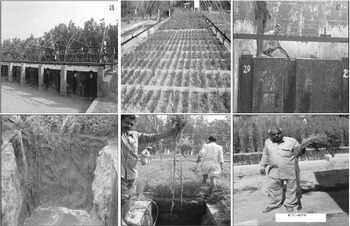
Five genotypes of chickpea, viz. ICCV-4958, H-208, HC-5, RSG-931 and CSJ-379 having wide adaptability to drought prone areas at national level were evaluated for various root characteristics during the rabi season of 2008–2009. The experiment was repeated during the year 2009–2010 and the pattern of results was almost similar; hence the data of one year, i.e., 2008–2009 are given in this paper. The experimental material was planted under rainout shelter with specially constructed facilities of concrete microplots (6-m long, 1-m wide and 1.5-m deep) connected with iron gates and washing tanks (Figure 1), filled with sandy soil and irrigated up to field capacity at Crop Physiology Field Laboratory, Agronomy Research Farm, CCS Haryana Agricultural University, Hisar, Haryana, India (29°10′ N, 75°46′ E, 215 m altitude). The seeds were surface-sterilised in 0.2% mercuric chloride, washed with distilled water and inoculated with Rhizobium culture Ca-181. The plots were fertilised with 15 kg N ha−1 and 40 kg P2O5 ha−1 as basal dose before sowing.
(a) Microplots side view; (b) neutron probes; (c, d, e and f) washing of root system.

Each genotype was sown in four rows of 1-m length with inter row spacing of 30 cm and plant spacing of 10 cm under two environments, namely irrigated (I: two irrigations of 6-cm depth each at flowering and pod filling) and rain-fed (R: one irrigation of 30-mm equal to long-term average seasonal rainfall). The experiment was conducted in a randomised complete block design with three replications. The plots were kept weed-free by hand weeding and intensive protection measures were taken against pod borer (Helicoverpa armigera).
Five plants were randomly taken from one replication for recording the biomass of leaves, stems, roots and nodules at full bloom of all the genotypes under both the environments. Plants were taken out with roots after thorough washing of the sand by water jet gently.
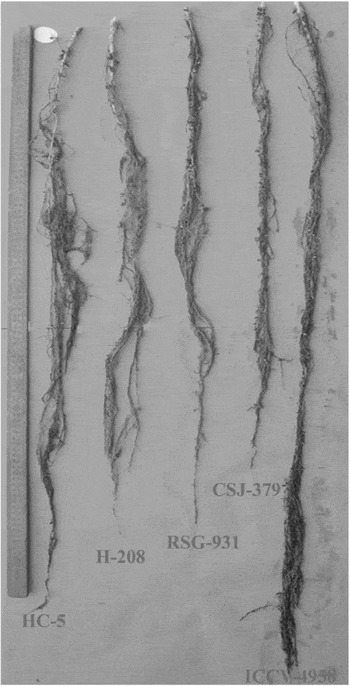
The shoot and root lengths were measured with metre rod (Figure 2). The root/shoot ratio was computed on dry weight basis. The average of five plants in each replication was determined for each treatment. The plants sampled from each replication were separated into leaf, stem, root and nodules and were oven-dried at 80 °C for 72 h till their constant weight.
Rooting depth of chickpea genotypes under rain-fed conditions.

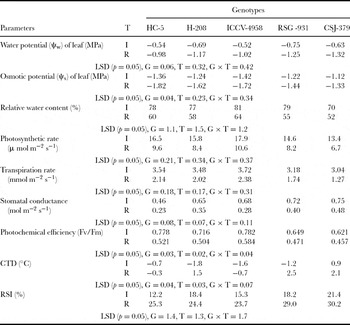
The plant–water relation parameters and other observations of third fully expanded leaf from top were recorded between 10 h and 12 h at full bloom stage, i.e. 87–102 days after sowing (DAS) in irrigated and 78–92 DAS under rain-fed conditions. The leaf water potential (ψw) was measured by pressure chamber (PMS Instrument Co., Albany, OR, USA), relative water content (RWC %) of leaf by Weatherley's method (Weatherley, Reference Weatherley1950) and osmotic potential (ψs) of leaf by vapour pressure osmometer (Model 5100-B, Wescor, Logan, USA). The rates of photosynthesis (μmol m−2 s−1) and transpiration (mmol m−2 s−1) and stomatal conductance (mol m−1 s−1) were measured with a portable photosynthesis system (Infrared Gas Analyzer, CIRAS-1, PP Systems, UK). Photochemical efficiency/quantum yield of photosystem II was determined in intact plants in the field with an OS-30P chlorophyll flurometer (Opti-Science, Inc., Hudson, NY, USA). Initial (Fo) and maximum (Fm) fluorescence were recorded and variable fluorescence (Fv) was derived by subtracting Fo from Fm. Photochemical efficiency/quantum yield, which is Fv/Fm ratio, was than calculated. Transpiration cooling, i.e. canopy temperature depression (CTD °C) was measured using infrared thermometer (Model AG-42 Tele-temp Corp, CA, USA). Relative stress injury (RSI %) was determined by recording the electrical conductivity of the third fully expanded leaf leachates in deionized water at 25 and 100 °C (Sullivan and Ross, Reference Sullivan, Ross, Mussell and Staples1979). Leaf samples of uniform size were taken in test tubes containing 10 ml of deionized water in two sets. One set was kept at 25 °C for 30 min and another set at 100 °C for 15 min in boiling water bath and their respective electrical conductivity (Ec1 and Ec2) were measured by conductivity meter. RSI (%) was calculated with the following formula:

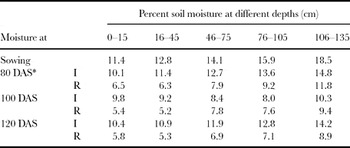
At harvest, five plants were randomly taken from remaining replications for recording seed yield and expressed as gram per plant. Soil moisture of 0–15 cm soil depth was determined by gravimetric method. The soil moisture at 16–45, 46–75, 76–105 and 106–135 cm soil depth was recorded by neutron moisture meter (Model 2651 Troxler Laboratories, Raleigh, NC, USA) (Figure 1b). This observation was recorded at 20 days interval starting from 80, 100 and 120 DAS (Table 1).
Moisture content (%) in different layers of soil profile under irrigated (I) and rain-fed (R) conditions.

* DAS = Days after sowing.
Data were subjected to analysis of variance (ANOVA) using online Statistical Analysis Package (OPSTAT, Computer Section, CCS Haryana Agricultural University, Hisar, Haryana, India) and treatment means were compared by the least significant differences (LSD) (p = 0.05) test.
RESULTS AND DISCUSSION
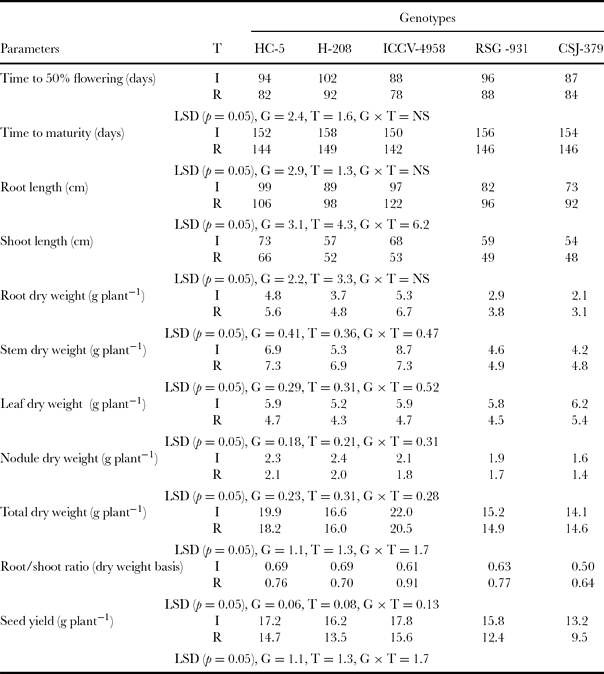
Soil moisture status for rain-fed and irrigated conditions is presented in Table 1. The soil moisture in the soil surface was around 11.4% (up to 15-cm depth) and 18.5% (up to 135-cm depth) at sowing. The soil surface was almost dry (less than 5.8%) and maximum water was absorbed from the soil depth in the range of 45–135 cm at 120 DAS under rain-fed conditions (Table 1). The effectiveness of the imposed drought stress in rain-fed plots was indicated by difference in phenology, growth behaviour, crop dry weight and leaf water status between the rain-fed and irrigated regimes. The chickpea genotypes differed significantly for time to 50% flowering. In ICCV-4958, 50% flowering commenced in 78 days as compared with 92 days in H-208 under rain-fed conditions. Plants grown under rain-fed conditions flowered and matured earlier than those grown under irrigated conditions (Table 2). There was large variability among the genotypes for rooting depth both under irrigated and rain-fed conditions in the microplots (Table 2, Figure 2). The roots penetrated to a maximum depth of 92 to 122 cm at full bloom stage under rain-fed conditions. The rooting depth remained higher under rain-fed than irrigated environment. Under rain-fed conditions, the roots grew deeper to extract moisture from the lower profiles of the soil thereby avoiding drought. Under rain-fed conditions, the roots of ICCV-4958 and HC-5 reached a soil depth of more than 100 cm, whereas the roots of CSJ-379 and RSG-931 did not grow beyond 92 cm and 96 cm, respectively. Under irrigated conditions, the roots were able to grow to a maximum depth of 99 cm in HC-5 and 73 cm in CSJ-379.
Phenology, growth parameters at full bloom and seed yield at maturity of chickpea genotypes under irrigated (I) and rain-fed (R) conditions.
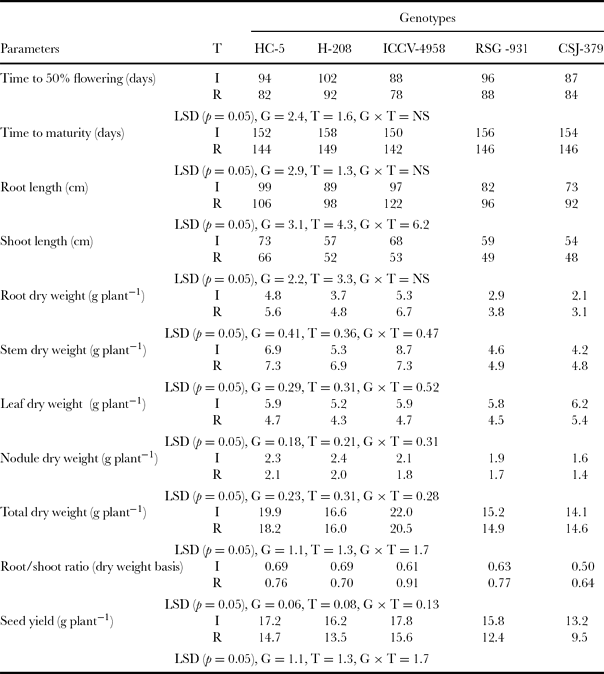
G = genotype; T = treatment; NS = non-significant.
Genotypes differed significantly in shoot length and shoot dry weight at this stage under rain-fed conditions. The genotype HC-5 had the maximum (73 cm) whereas CSJ-379 had the minimum (54 cm) shoot length. The genotype ICCV-4958 produced the maximum shoot dry weight (8.7 g plant−1) and CSJ-379 the lowest (4.2 g plant−1) under irrigated conditions. Under rain-fed conditions, the moisture stress reduced the plant height but reverse was true for root depth and had increased the biomass partitioning towards the roots. Ratio of root to shoot on dry weight basis also showed vast range of variation. The genotype ICCV-4958 exhibited significantly higher value, i.e. 0.91 than other genotypes, under rain-fed conditions. Among the genotypes, root dry weight per plant of ICCV-4958 (6.7 g) and HC-5 (5.6 g) was significantly higher than that of RSG-931 (3.8 g) and CSJ-379 (3.1 g) (Table 2). At full bloom, about 29 and 33% of the total dry matter was diverted in the roots of HC-5 and ICCV-4958, respectively, under rain-fed conditions. There was a significant variation for seed yield. Genotypes ICCV-4958 and HC-5 with deep root system produced high seed yield, i.e. 15.6 g and 14.7 g per plant, respectively, under rain-fed conditions. These differences in yield under rain-fed conditions were clearly associated with the depth of root penetration, suggesting that drought avoidance by better extraction of soil moisture was an important mechanism of drought tolerance.
The leaf water potential, osmotic potential and relative water content of leaf in genotypes HC-5 and ICCV-4958 were –0.98 MPa, –1.82 MPa, 60% and –1.02 MPa, –1.72 MPa, 64%, respectively as compared with –1.25 MPa, –1.44 MPa, 55% and –1.17 MPa, –1.62 MPa and 58%, –1.32 MPa, –1.33 MPa, 52% in RSG-931, H-208 and CSJ-379, respectively, under rain-fed conditions. The photosynthetic rate was significantly reduced by drought in all genotypes and the CTD values were more negative (Table 3). These indicate the importance of prolific and deep root systems in keeping the canopy cooler for longer time perhaps due to water extraction by deep rooting (Kashiwagi et al., Reference Kashiwagi, Krishnamurthy, Upadhyaya and Gaur2008). Compared with irrigated conditions, the rates of photosynthesis and transpiration and the values of stomatal conductance declined significantly under rain-fed conditions. The data indicated that terminal drought tolerant chickpea genotypes, i.e. HC-5 and ICCV-4958, had lower canopy stomatal conductance (Table 3) under rain-fed conditions, which saved water in the soil profile and made it available during the pod development and grain filling stages. Recently, Zaman-Allah et al. (Reference Zaman-Allah, Jenkinson and Vandez2011a) has indicated that the regulation of leaf water loss under both irrigated and non-irrigated conditions also appear to be important and generally tolerant genotypes had lower stomatal conductance at the vegetative stage. The parameters identified in this experiment along with water use by individual genotypes of chickpea at different growth stages (Zaman-Allah et al., Reference Zaman-Allah, Jenkinson and Vandez2011b) could be used as reliable indicators in studying the terminal drought tolerance mechanism.
Leaf water status, photosynthetic and transpiration rates, stomatal conductance, photochemical efficiency, relative stress injury and canopy temperature depression at full bloom of chickpea genotypes under irrigated (I) and rain-fed (R) conditions.

G = genotype; T = treatment.
The rates of photosynthesis and transpiration and photochemical efficiency/quantum yield as indicated by Fv/Fm ratios were in the range of 6.7 to 10.6 (μmol m−2 s−1), 1.27 to 2.38 (mmol m−2 s−1) and 0.457 to 0.584 for the plants grown under rain-fed conditions, while under irrigated conditions these values were in the range of 13.4 to 17.9 (μmol m−2 s−1), 3.04 to 3.72 (mmol m−2 s−1) and 0.621 to 0.782. Genotypes HC-5 and ICCV-4958 also maintained a higher photosynthetic and transpiration rates and Fv/Fm ratio than others. Genotype CSJ-379 was having the highest value of stomatal conductance 0.48 (mol m−2 s−1) under rain-fed conditions and found to be the most sensitive. The RSI (%) value was also the highest in CSJ-379 (30.2%) and the lowest (21.4%) in H-208 for plants grown under rain-fed conditions. The CTD exhibited significant differences among the genotypes. Under rain-fed conditions, genotypes ICCV-4958 and HC-5 with deep root system were shown to have more negative values, i.e. –0.7°C and –0.3°C, respectively (Table 3), suggesting transpiration rate was being maintained under drought by the extraction of soil moisture from deeper in the soil profile. Based on lysimetric studies for water use pattern in 20 chickpea genotypes under the conditions of terminal drought, Zaman-Allah et al. (Reference Zaman-Allah, Jenkinson and Vandez2011b) emphasised that the next critical component of tolerance in chickpea was the conservative use of water early in the cropping cycle. This was explained partly by a lower canopy conductance, which resulted in more water availability in the soil profile during reproduction leading to higher reproductive success.
Screening for drought tolerance without consideration of the root traits may be incomplete since root biomass, volume and distribution vary depending upon the surrounding environment (Matsui and Singh, Reference Matsui and Singh2003). The size of micro plot in this method did not pose any limitations for root growth and root distribution was natural. The results of this study indicate that under rain-fed conditions, genotypes ICCV-4958 and HC-5 were drought-tolerant, which showed higher dry matter of roots, rooting depth, root/shoot ratio, photosynthetic rate, better plant water status, low membrane injury and cooler canopy temperature, and these traits were directly associated with higher seed yield per plant in these genotypes than others. Genotypes ICCV-4958 and HC-5 could be utilized in crop improvement programmes as sources of chickpea breeding for drought tolerance.
Acknowledgements
The authors are grateful to Dr. R. P. Bansal, Associate Director, Publication, CCS Haryana Agricultural University, Hisar, Haryana, India, for critical reading of the manuscript.