Fluid overload is frequently noted in children after congenital heart surgery requiring cardiopulmonary bypass.Reference Morgan, Zappitelli and Robertson1 Fluid overload in this setting is likely secondary to a pro-inflammatory state induced by cardiopulmonary bypass, haemodilution, and exposure of blood to a non-endothelialised circuit surface.Reference Milovanovic, Bisenic and Mimic2 In addition, fluid overload could be caused by oliguria in patients with acute kidney disease, low cardiac output, and excessive fluid for haemodynamic stabilisation or resuscitation.Reference Stein, de Souza and Belettini3,Reference Pradeep, Rajagopalam and Kolli4
Fluid overload has been associated with increased risk of acute kidney injury, and both fluid overload and acute kidney injury have been documented to increase duration of mechanical ventilation, increase length of hospital stay, and increase mortality in the post-operative setting.Reference Sutherland, Zappitelli and Alexander5–Reference Selewski, Cornell and Lombel7
The management of fluid overload remains challenging in this patient population. Some of the strategies to manage fluid overload are fluid restriction, diuretics, and peritoneal dialysis.Reference Barhight, Soranno, Faubel and Gist8 No consensus has been reached as to whether or not, one of these strategies is the optimal treatment for fluid overload in children after congenital heart surgery.Reference Kwiatkowski, Menon and Krawczeski9 A randomised controlled trial comparing peritoneal dialysis versus furosemide concluded that peritoneal dialysis allows superior fluid management with better clinical outcomes, especially in patients with high risk of developing acute kidney injury and fluid overload.Reference Kwiatkowski, Goldstein, Cooper, Nelson, Morales and Krawczeski10 Peritoneal dialysis has been used in the post-operative setting in children since the 1970s.Reference Ozker, Saritas and Vuran11 Many centres prophylactically place peritoneal dialysis catheters in neonates or patients felt to be at high risk for fluid overload.Reference Goldstein12 Peritoneal dialysis offers the following theoretical benefits: fluid removal, fluid clearance, and relief of intra-abdominal venous congestion. All of these may improve renal function.Reference Madenci, Stoffan and Rajagopal13 This study aimed to determine the effect of peritoneal dialysis on hospital length of stay, cost of hospitalisation, and mortality utilising a large national inpatient database.
Materials and methods
Institutional review board approval was not necessary as this study utilises deidentified data from a national database. This cross-sectional study follows the Helsinki declaration.
Kids’ Inpatient Database
The Kids’ Inpatient Database, made available by the Healthcare Cost Utilization Project by the Agency for Healthcare Research and Quality, is a large database designed to capture data from community, non-rehabilitation hospital admissions in the United States of America. Community hospitals are defined differently by the database when compared to the definition used by some healthcare providers. The definition used by the database is as follows: “All non-Federal, short-term, general, and other specialty hospitals”. Freestanding and non-freestanding children’s hospitals are both included as are teaching and non-teaching hospitals. Discharges of patients less than 20 years of age are included in the database. Rehabilitation and long-term acute care hospitals are excluded from this database. Patients from all regions of the United States of America with a variety of payer types are captured in this database. Data from a total of 44 states are captured.
Patient identification
Data regarding hospital admissions were obtained from all six available iterations of the database, spanning from 1997 to 2012. Patients with CHD having undergone congenital heart surgery were included in the final analysis. The determination of CHD and congenital heart surgery were made based using International Classification of Diseases-9 coding as delineated below. Primary and secondary diagnosis fields were used to collect these data. Only patients under 18 years of age were included in this analysis.
Data identification and collection
Demographic information including gender and race were collected for each admission. Admission characteristics such as admission month, length of stay, and cost of stay were collected as well. Information regarding co-morbid conditions was also collected. Overweight or obese patients were identified using 278.00, 278.01, and 278.02. Acute kidney injury was identified using 584.9. Heart failure was identified using 428.0 to 428.9. Arrhythmias were identified using codes 427.0 to 427.42 as well as 426.0 to 426.13.
CHD was identified using several International Classification of Diseases-9 codes: double-outlet right ventricle using 745.11, atrioventricular septal defect using 745.60, partial anomalous pulmonary venous connection using 747.42, total anomalous pulmonary venous connection using 747.41, transposition of the great arteries using 745.10, congenitally corrected transposition using 745.12, hypoplastic left heart syndrome using 746.7, atrial septal defect using 745.61, ventricular septal defect using 745.5, pulmonary atresia with ventricular septal defect using 746.01, tricuspid atresia using 746.1, Ebstein anomaly using 746.2, truncus arteriosus using 745.0, and coronary artery anomaly using 746.85.
Congenital heart surgery was identified using the following codes: codes 35.10 through 35.14 for valvuloplasty with no valve replacement, 35.20 through 35.28 for valvuloplasty with replacement, codes 35.50 through 35.73 for septal defect repair (including atrioventricular septal defect repair), 35.81 for complete repair of tetralogy of Fallot, 35.82 for pulmonary venous repair, 35.83 for complete repair of common arterial trunk, 35.84 for arterial switch operation for transposition, 35.91 for atrial switch operation for transposition, 35.92 for right ventricle to pulmonary artery conduit, 39.22 for Blalock–Tausig shunt, and 37.51 for heart transplant. Pulmonary stenosis was identified using 746.02. Peritoneal dialysis was identified using 54.98.
Statistical analysis
A cross-sectional study was conducted. Continuous variables are reported using mean and standard deviation, while categorical variables are reported using absolute frequency and percentages. Continuous variables were analysed using a student t-test or Mann–Whitney U-test as appropriate with categorical variables being analysed using Chi-square test. Baseline characteristics, cardiac morphology, congenital heart surgery, and other co-morbidities were compared between those with and without peritoneal dialysis.
A regression was then performed to determine factors associated with peritoneal dialysis using this as the dependent variable. Next, logistic regression analysis was conducted to determine risk factors for increased length of hospitalisation, cost of hospitalisation, and inpatient mortality. While these served as dependent variables in separate regression analyses, the independent variables included peritoneal dialysis, peritonitis, and other variables. The other variables included were co-morbidities and cardiac diagnoses that had a significant p value in univariate analysis. Due to the non-parametric nature of some of the included variables, non-parametric regression analyses were conducted. Cost of stay used represents the total charges recorded for the admission. Figures were adjusted for inflation using 2018 as the reference year for easier understanding of numerical figures by readers. All statistical analysis was done using SPSS Version 20.0 (Chicago, Illinois, United States of America).
Results
Cohort characteristics, univariate analyses
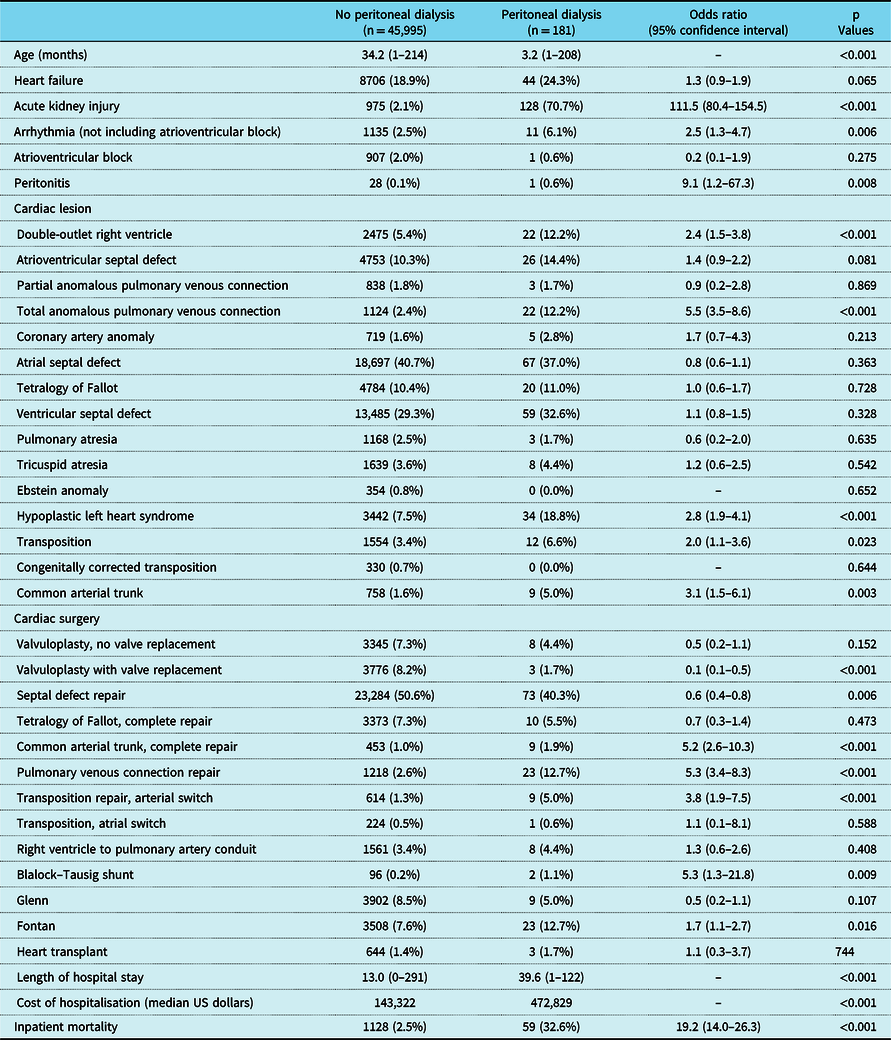
A total of 46,176 admissions with congenital heart surgery under 18 years of age were included in the final analyses. Of these, 181 (0.4%) utilised peritoneal dialysis. The mean age was lower in those with peritoneal dialysis at 7.6 months compared to 39.6 months in the group without peritoneal dialysis (Table 1). In regard to co-morbidities, heart failure, tachyarrhythmias, and peritonitis were more prevalent in those with peritoneal dialysis. The following cardiac lesions were noted with greater prevalence in those with peritoneal dialysis: double-outlet right ventricle, total anomalous pulmonary venous connection, hypoplastic left heart syndrome, transposition, and common arterial trunk (Table 1). The following cardiac surgeries were more prevalent in those with peritoneal dialysis: valvuloplasty with valve replacement, septal defect repair, common arterial trunk, pulmonary venous connection repair, arterial switch, Blalock–Taussig, and Fontan (Table 1).
Characteristics of admissions with congenital heart surgery where peritoneal dialysis was and was not utilised

Hospital admission characteristics, univariate analyses (Table 1)
Median length of admission was greater in those with peritoneal dialysis (39.6 days versus 13.0 days, p < 0.001). Median cost of admission was also greater in those with peritoneal dialysis ($449,780 versus $149,418, p < 0.001). Inpatient mortality was 32.6% in those with peritoneal dialysis which was greater than the 2.5% inpatient mortality noted in those without peritoneal dialysis (odds ratio 19.2; 95% confidence interval 14.0, 26.3; p < 0.001).
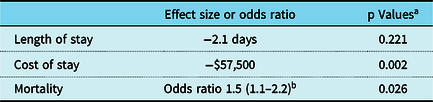
The independent effect or odds ratio of peritoneal dialysis on length of stay, cost of stay, and inpatient mortality based on results of regression analysis with model taking into account: age, arrhythmia, acute kidney injury, transposition, double-outlet right ventricle, hypoplastic left heart syndrome, total anomalous pulmonary venous connection, and peritonitis

a p value < 0.05. p Values were performed using Chi-square test.
b In parenthesis, 95% confidence interval of the odds ratio.
Impact of peritoneal dialysis on admission characteristics, regression analysis (Table 2)
Admissions with peritoneal dialysis were independently associated with increased odds of mortality (odds ratio 1.5, 95% confidence interval 1.1, 2.2, p = 0.026). Other factors in the regression that were significantly associated with increasing the odds of mortality were age less than 1 year, arrhythmia, acute kidney injury, double-outlet right ventricle, total anomalous pulmonary venous connection, transposition, hypoplastic left heart syndrome, and peritonitis. The other independent variables in the regression analysis were significantly associated with decreased total charges (−$57,500, p = 0.002). Length of stay was also assessed in the regression analysis but was not significantly associated with decreased length of stay (−2.1 days, p = 0.221).
Discussion
Fluid overload and acute kidney injury are serious complications in children after congenital heart surgery, with a documented prevalence as high as 45%.Reference Wilder, Yu, Donohue, Goldberg and Blatt14 No consensus has been reached as to how to best prevent fluid overload or acute kidney injury or how to manage these conditions if they develop. Peritoneal dialysis appears as a reasonable strategy to help manage fluid removal and clearance from a physiological point of view, but limited data exist to demonstrate that this provides benefit when compared to fluid restriction and dieresis.Reference Toda and Sugimoto15 The current study demonstrated an independent association of peritoneal dialysis with increased mortality. Yet to be defined are the concrete indications of peritoneal dialysis, its complications and the technical particularities such as timing, content of solutions, and volume for prophylactic management of fluid overload and acute kidney injury in this population.Reference Chen, Cao, Hu, Chen and He16 For example, Bojan and colleagues demonstrated that initiating peritoneal dialysis earlier (first 24 hours) was significantly associated with a decrease in mortality, compared to those with delayed dialysis (after 24 hours).Reference Bojan, Gioanni, Vouhe, Journois and Pouard17
This study included 46,176 paediatric congenital heart surgery admissions. Of these, 181 (0.4%) utilised peritoneal dialysis. While the percentage appears low, the absolute number of admissions in the peritoneal dialysis group represents the largest cohort that has been described in this specific setting.Reference Flores, Loomba and Elhoff18 Previously, the largest study was the one conducted by Madenci and colleagues in 2013 and included 28,259 patients.Reference Madenci, Thiagarajan, Stoffan, Emani, Rajagopal and Weldon19 Although several centres have reported the use of peritoneal dialysis for the treatment of fluid overload and acute kidney injury after congenital heart surgery,Reference Fleming, Bohn and Edwards20–Reference Weng, Hsieh, Huang, Lin and Pan25 this multi-centre cohort demonstrated that peritoneal dialysis is still utilised in a relatively low proportion of paediatric congenital heart surgery admissions.
While general physiologic states in which peritoneal dialysis may be advantageous have been identified, specific indications within these remain elusive.Reference Giuffre, Tam, Williams and Freedom21,Reference Chan, Ip, Chiu and Cheung23 Historically and currently, the prophylactic placement of a peritoneal dialysis catheter has depended on physician preference.Reference Wilder, Yu, Donohue, Goldberg and Blatt14,Reference Sorof, Stromberg, Brewer, Feltes and Fraser26 This decision is often based on thorough assessment of the likelihood that fluid overload or acute kidney injury may develop in the post-operative setting based on characteristics such as age, complexity of the congenital heart surgery, and duration of cardiopulmonary bypass.Reference Alkan, Akcevin and Turkoglu27 Thus, disease severity or the perception of severity still appears to be the major factors for determining the use of peritoneal dialysis. This is likely the explanation for why the patients in the peritoneal dialysis cohort had a lower mean age of admission and had associated co-morbidities like heart failure, tachyarrhythmias, peritonitis, and acute kidney injury. Additionally, the prevalence was significantly higher with more complex cardiac surgeries such as the arterial switch, pulmonary venous connection repair, common arterial trunk repair, and placement of a Blalock–Taussig shunt.Reference O’Brien, Clarke and Jacobs28
Data from previous studies would have led one to intuitively hypothesise that admissions utilising peritoneal dialysis would have a shorter length of stay, lower cost, and lower mortality; this, however, was not consistent with the findings of the current study. Regression analyses demonstrated that inpatient mortality was actually greater in the admissions with peritoneal dialysis, while length and cost of hospital stay were lower. This likely is a function of early post-operative death in the peritoneal dialysis group, which may be secondary to increased severity of illness in the peritoneal dialysis group. This is supported by the increased prevalence of a number of co-morbidities in the peritoneal dialysis admissions. Mahon et al also found a significant correlation between length of stay, costs of admission, and mortality in children with peritoneal dialysis.Reference Redpath Mahon, Richardson, Neu and Warady29
To our knowledge, this study is the largest retrospective study describing the associations of peritoneal dialysis in congenital heart surgery admissions. However, this study is not without its limitations. First and foremost, these data are prone to coding error. Diagnoses and procedures could only be identified as being present if they are coded and thus undercoding could present an issue. Also, errant coding could also lead to inappropriate attribution of a diagnosis or procedure. Nonetheless, even if the absolute frequencies are susceptible to this, the large numbers should help moderate the impact of this on the degree of associations noted. Additionally, not all International Classification of Diseases-9 codes have been validated in the paediatric population. The precise timing of peritoneal dialysis initiation cannot be determined. Nor can the indications of peritoneal dialysis be captured from the database. It is possible that the effect of peritoneal dialysis mortality may differ in those who received prophylactic peritoneal dialysis versus those who had a catheter placed and dialysis initiated after reaching a certain threshold of illness. Also, each centre differs in the technique for catheter placement, filtration rate, and other technical aspects of peritoneal dialysis itself. Such characteristics may also impact associated outcomes. It is also important to note that admissions without peritoneal dialysis may have consisted of various fluid restriction and diuresis strategies. Important to mention, due to International Classification of Diseases-10 code implementation in 2015, the data in this study were limited until 2012 to focus only on International Classification of Diseases-9 codes.
Conclusion
Congenital heart surgery admissions in which peritoneal dialysis was used differed in characteristics to those in which peritoneal dialysis was not utilised. Regression analyses demonstrated that peritoneal dialysis was independently associated with increased mortality which may be due to increased severity of illness in the peritoneal dialysis as demonstrated by higher prevalence of co-morbidities in this group. This study is limited due its design and highlights the need for additional future investigations.
Acknowledgements
None.
Financial Support
This research received no specific grant from any funding agency commercial, or not-for-profit sectors.
Conflicts of Interest
None.