1 Introduction
The magnetic fields observed in various astrophysical bodies, such as the planets, the Sun, stars, galaxies, etc., are believed to be self-sustained by turbulent dynamos (Moffatt Reference Moffatt1978; Parker Reference Parker1979; Krause & Rädler Reference Krause and Rädler1980; Ruzmaikin, Shukurov & Sokoloff Reference Ruzmaikin, Shukurov and Sokoloff1988; Kulsrud Reference Kulsrud2004; Brandenburg & Subramanian Reference Brandenburg and Subramanian2005; Jones Reference Jones2011). In an electrically conducting plasma, conversion of the kinetic energy into magnetic energy, without any electric current at infinity, is known as dynamo action, which leads to amplification of a weak seed magnetic field. Magnetic fields exhibit coherence over a range of scales, from smaller to much larger than the outer scale of the turbulence. Systems lacking ordered motion, such as clusters of galaxies, predominantly host a fluctuation dynamo (Murgia et al.
Reference Murgia, Govoni, Feretti, Giovannini, Dallacasa, Fanti, Taylor and Dolag2004; Vogt & Enßlin Reference Vogt and Enßlin2005; Kucher & Enßlin Reference Kucher and Enßlin2011; Bhat & Subramanian Reference Bhat and Subramanian2013), whereas those with large-scale motion, such as the Sun, galaxies, etc., also support a large-scale dynamo (see Charbonneau Reference Charbonneau2010; Beck Reference Beck2012; Chamandy et al.
Reference Chamandy, Subramanian and Shukurov2013a
,Reference Chamandy, Subramanian and Shukurov
b
; Chamandy et al Reference Chamandy, Shukurov, Subramanian and Stoker2014, and references therein). The dynamo origin of the galactic magnetic field seems unchallenged. Helical turbulence has been considered to be the key driver for a large-scale dynamo, which could operate even in systems without mean motion. For example, both analytical calculations and numerical simulations reveal that, even in the absence of differential rotation or mean motion, a large-scale magnetic field grows due to helically forced turbulence by what is known as an
 ${\it\alpha}^{2}$
effect (Brandenburg & Subramanian Reference Brandenburg and Subramanian2005). However, it is not clear whether astrophysical turbulence has a mean helicity that is large enough to sustain such a large-scale turbulent dynamo. This brings us to a following natural question: Could the large-scale magnetic fields grow if the helicity of the turbulence vanishes on average? Kraichnan (Reference Kraichnan1976) was the first to study this problem by considering
 ${\it\alpha}$
(which is a measure of the mean kinetic helicity of the turbulence) as a stochastic variable, with zero mean, and demonstrated that the
 ${\it\alpha}$
fluctuations lead to a decrement of the turbulent diffusivity, and, if sufficiently strong, they could give rise to the growth of the mean magnetic field by the process of negative diffusion. Moffatt (Reference Moffatt1978) generalized this model to include a statistical correlation between the fluctuating
 ${\it\alpha}$
and its spatial gradient, and found that this contributes a constant drift velocity to the dynamo action, but it does not affect the dynamo condition. Both Kraichnan (Reference Kraichnan1976) and Moffatt (Reference Moffatt1978) have essentially considered white-noise
 ${\it\alpha}$
fluctuations, as has been explicitly shown by Sridhar & Singh (Reference Sridhar and Singh2014, hereafter SS14), who extended previous studies by also studying the memory effects, giving rise to new interesting mechanisms.
The SS14 model is limited to fairly low wavenumbers because their first-order smoothing approximation (FOSA) calculation of the mean electromotive force (EMF) ignored turbulent resistivity. The present paper remedies this, obtaining a new expression for the mean EMF that predicts a significant modification of dynamo action at intermediate and large wavenumbers. We show that the inclusion of the resistive term in the present work to determine the mean EMF is a non-trivial extension of the SS14 model, even leading to qualitatively new predictions for the growth rates at intermediate and large wavenumbers. Considering deterministic Roberts flows, Rheinhardt et al. (Reference Rheinhardt, Devlen, Rädler and Brandenburg2014) discussed the role of finite memory for the existence of the dynamo. Based on numerical experiments of passive scalar diffusion and kinematic dynamos, Hubbard & Brandenburg (Reference Hubbard and Brandenburg2009) investigated turbulent transport where the turbulence possesses memory. These works highlight the importance of the memory effects on the turbulent transport processes and demonstrate that the turbulent transport coefficients can be significantly different from those cases where the correlation times of the turbulence are nearly vanishing.
A number of previous studies have exploited the idea of
 ${\it\alpha}$
fluctuations to study the large-scale dynamo mechanism in a wide variety of contexts. As many astrophysical sources possess differential rotation, the focus has been on the understanding of large-scale dynamos due to fluctuating
 ${\it\alpha}$
in a shearing background (Sokolov Reference Sokolov1997; Vishniac & Brandenburg Reference Vishniac and Brandenburg1997; Silant’ev Reference Silant’ev2000; Proctor Reference Proctor2007, Reference Proctor2012; Sur & Subramanian Reference Sur and Subramanian2009; Richardson & Proctor Reference Richardson and Proctor2012). In the context of the solar dynamo, Silant’ev (Reference Silant’ev2000) proposed a new dynamo mechanism by considering an inhomogeneous distribution of
 ${\it\alpha}$
fluctuations in a differentially rotating atmosphere. The important difference in the present work is that the
 ${\it\alpha}$
fluctuations considered here are statistically stationary and homogeneous. The numerical simulations of Brandenburg et al. (Reference Brandenburg, Rädler, Rheinhardt and Käpylä2008), Yousef et al. (Reference Yousef, Heinemann, Schekochihin, Kleeorin, Rogachevskii, Iskakov, Cowley and McWilliams2008) and Singh & Jingade (Reference Singh and Jingade2015) demonstrated large-scale dynamo action in a shear flow with turbulence that is, on average, non-helical. This problem of the shear dynamo was taken up in a number of analytical works where the quantity
 ${\it\alpha}$
was assumed to be strictly zero, i.e. it vanishes pointwise in both space and time (Kleeorin & Rogachevskii Reference Kleeorin and Rogachevskii2008; Rogachevskii & Kleeorin Reference Rogachevskii and Kleeorin2008; Sridhar & Subramanian Reference Sridhar and Subramanian2009a
,Reference Sridhar and Subramanian
b
; Sridhar & Singh Reference Sridhar and Singh2010; Singh & Sridhar Reference Singh and Sridhar2011). Based on the results of Sridhar & Subramanian (Reference Sridhar and Subramanian2009a
,Reference Sridhar and Subramanian
b
), Sridhar & Singh (Reference Sridhar and Singh2010) and Singh & Sridhar (Reference Singh and Sridhar2011), it was realized that the mean magnetic field cannot grow if
 ${\it\alpha}$
vanishes strictly (i.e. if it vanishes everywhere instantaneously). Heinemann, McWilliams & Schekochihin (Reference Heinemann, McWilliams and Schekochihin2011), McWilliams (Reference McWilliams2012) and Mitra & Brandenburg (Reference Mitra and Brandenburg2012) considered temporal
 ${\it\alpha}$
fluctuations and reported the growth of the second moment of the mean magnetic field, i.e. the mean magnetic energy. However, it must be noted that the possibility of the growth of also the first moment existed in the calculations of Mitra & Brandenburg (Reference Mitra and Brandenburg2012), where the growth occurs by the process of negative diffusion. This issue was also clarified in a recent work by Squire & Bhattacharjee (Reference Squire and Bhattacharjee2015), who proposed an interesting magnetic shear-current effect as being responsible for shear dynamos.
It was realized in Sridhar & Singh (Reference Sridhar and Singh2014), and also shown in the present work, that negative diffusion remains the only possibility for driving mean-field dynamos in such fluctuating
 ${\it\alpha}$
calculations, so long as these fluctuations are delta-correlated in time. On the other hand, the process of negative diffusion is, in a sense, self-limiting, as it would increasingly create smaller-scale structures, where the necessary assumption of scale separation cannot continue to be valid indefinitely. This would eventually lead to breakdown of the two-scale framework. Given such limitations posed by the process of negative diffusion, or, in other words, strong
 ${\it\alpha}$
-fluctuation-dominated dynamos, it is desirable to seek possibilities of mean-field dynamo action when there are only weak
 ${\it\alpha}$
fluctuations. Sridhar & Singh (Reference Sridhar and Singh2014) found the possibility of the growth of the mean magnetic field also in the case of weak
 ${\it\alpha}$
fluctuations when they took memory effects into account. Although many of the previous works included shear in their studies, this highlights the importance of fluctuations in
 ${\it\alpha}$
, which have indeed been measured in the simulations of Brandenburg et al. (Reference Brandenburg, Rädler, Rheinhardt and Käpylä2008). Estimations of such
 ${\it\alpha}$
fluctuations in various astrophysical sources will be of immense value.
The aim of the present paper is to explore large-scale dynamo action, arising solely due to an
 ${\it\alpha}$
that is varying stochastically in space and time, with zero mean. We define our model in § 2. Using the FOSA, we derive an integro-differential equation governing the evolution of the large-scale magnetic field in § 3. This equation is non-perturbative in the
 ${\it\alpha}$
-correlation time
 ${\it\tau}_{{\it\alpha}}$
. We first consider the case of white-noise
 ${\it\alpha}$
fluctuations (i.e.
 ${\it\tau}_{{\it\alpha}}=0$
) without any further approximation. Assuming small but non-zero
 ${\it\alpha}$
-correlation time,
 ${\it\tau}_{{\it\alpha}}\neq 0$
, and slowly varying mean magnetic field, we simplify the integro-differential equation to a partial differential equation (PDE) in § 4. Without loss of generality, we explore in § 5 one-dimensional propagating modes and solve the dispersion relation to obtain an explicit expression for the growth rate function. In § 6 we study dynamo action due to Kraichnan diffusivity and Moffatt drift. We conclude in § 7.
2 Definition of the model
Let us consider a fixed Cartesian coordinate system with unit vectors
 $(\boldsymbol{e}_{1},\boldsymbol{e}_{2},\boldsymbol{e}_{3})$
, where
 $\boldsymbol{x}=(x_{1},x_{2},x_{3})$
denotes the position vector, and
 $t$
is the time variable. We model small-scale turbulence in the absence of mean motions as random velocity fields,
 $\{\boldsymbol{v}(\boldsymbol{x},t)\}$
, and consider an ensemble with its members corresponding to different realizations of the velocity field
 $\boldsymbol{v}$
. Denoting by
 $\langle ~\rangle$
the ensemble average, which obeys standard Reynolds rules (see e.g. Brandenburg & Subramanian Reference Brandenburg and Subramanian2005), and assuming that the ensemble has (i) zero-mean isotropic velocity fluctuations, (ii) uniform and constant ensemble-averaged kinetic energy density per unit mass, and (iii) slow helicity fluctuations, we write
 $$\begin{eqnarray}\displaystyle \langle v_{i}\rangle =0,\quad \langle v_{i}v_{j}\rangle ={\it\delta}_{ij}v_{0}^{2},\quad \left\langle v_{i}\frac{\partial v_{j}}{\partial x_{n}}\right\rangle ={\it\epsilon}_{inj}\,{\it\mu}(\boldsymbol{x},t), & & \displaystyle\end{eqnarray}$$
where
 $v_{0}^{2}=\langle v^{2}/3\rangle$
, two-thirds of the ensemble-averaged kinetic energy density per unit mass, and
 ${\it\mu}(\boldsymbol{x},t)=\langle \boldsymbol{v}\boldsymbol{\cdot }(\boldsymbol{{\rm\nabla}}\times \boldsymbol{v})\rangle /6$
, one-sixth of the ensemble-averaged helicity density. Let
 $\ell _{0}$
be the size of the largest eddies and
 ${\it\tau}_{c}$
be the velocity correlation time. By slow helicity fluctuations we mean that the spatial and temporal scales of variation of
 ${\it\mu}(\boldsymbol{x},t)$
are assumed to be much larger than
 $\ell _{0}$
and
 ${\it\tau}_{c}$
.
Let
 $\boldsymbol{B}(\boldsymbol{x},t)$
be the mesoscale magnetic field, obtained by averaging over the above ensemble. This requires a scale separation such that the typical scales of
 $\boldsymbol{B}(\boldsymbol{x},t)$
are much larger than
 $\ell _{0}$
. Then the space–time evolution of
 $\boldsymbol{B}(\boldsymbol{x},t)$
is given by the following equations (Moffatt Reference Moffatt1978; Krause & Rädler Reference Krause and Rädler1980; Brandenburg & Subramanian Reference Brandenburg and Subramanian2005):
 $$\begin{eqnarray}\displaystyle \frac{\partial \boldsymbol{B}}{\partial t}=\boldsymbol{{\rm\nabla}}\times [{\it\alpha}(\boldsymbol{x},t)\boldsymbol{B}]+{\it\eta}_{T}{\rm\nabla}^{2}\boldsymbol{B},\quad \boldsymbol{{\rm\nabla}}\boldsymbol{\cdot }\boldsymbol{B}=0, & & \displaystyle\end{eqnarray}$$
where
 $$\begin{eqnarray}\displaystyle \left.\begin{array}{@{}c@{}}{\it\alpha}=-2{\it\tau}_{c}{\it\mu}(\boldsymbol{x},t),\\ {\it\eta}_{T}={\it\eta}+{\it\eta}_{t}=\text{total diffusivity},\\ {\it\eta}=\text{microscopic diffusivity},\quad {\it\eta}_{t}={\it\tau}_{c}v_{0}^{2}=\text{turbulent diffusivity}.\end{array}\right\} & & \displaystyle\end{eqnarray}$$
The above simple expressions for the turbulent transport coefficients
 ${\it\alpha}$
and
 ${\it\eta}_{t}$
are valid only in specialized conditions – specifically, under the FOSA assuming isotropic turbulence, when the high-conductivity limit is considered in conjunction with the so-called ‘short-sudden’ approximation, where the velocity correlation time
 ${\it\tau}_{c}$
is much smaller than its turnover time
 ${\it\tau}_{0}$
(Courvoisier, Hughes & Tobias Reference Courvoisier, Hughes and Tobias2006).
In the ‘double-averaging scheme’ being employed here, the helicity fluctuations are modelled by fluctuating
 ${\it\alpha}$
, which makes (2.2) a stochastic PDE. (The concept of double averaging has been discussed in a number of previous works (see e.g. Kraichnan Reference Kraichnan1976; Sokolov Reference Sokolov1997). We refer the reader to § 11 of Moffatt (Reference Moffatt1983) for an excellent account of a successive averaging scheme over a number of widely separated scales, leading to a successive renormalization of turbulent transport.) As we are finally interested in scales much larger than the scales of the mesoscale field, with quantity
 ${\it\alpha}$
being smooth around mesoscale but fluctuating at larger scales, we can repeat the averaging procedure to obtain the evolution of the large-scale field. Here, the important step is to consider a super-ensemble over which
 ${\it\alpha}(\boldsymbol{x},t)$
is a statistically stationary, homogeneous, random function of
 $\boldsymbol{x}$
and
 $t$
, with zero mean,
 $\overline{{\it\alpha}(\boldsymbol{x},t)}=0$
. The two-point space–time correlation function of fluctuating
 ${\it\alpha}$
is
 $$\begin{eqnarray}\displaystyle \overline{{\it\alpha}(\boldsymbol{x},t){\it\alpha}(\boldsymbol{x}^{\prime },t^{\prime })}=2{\mathcal{A}}(\boldsymbol{x}-\boldsymbol{x}^{\prime }){\mathcal{D}}(t-t^{\prime }), & & \displaystyle\end{eqnarray}$$
with
 $$\begin{eqnarray}\displaystyle 2\int _{0}^{\infty }{\mathcal{D}}(t)\,\text{d}t=1,\quad {\mathcal{A}}(\mathbf{0})={\it\eta}_{{\it\alpha}}\geqslant 0. & & \displaystyle\end{eqnarray}$$
Here
 ${\it\eta}_{{\it\alpha}}$
is the
 ${\it\alpha}$
diffusivity, introduced first by Kraichnan (Reference Kraichnan1976). Let us define the correlation time for the
 ${\it\alpha}$
fluctuations as
 $$\begin{eqnarray}\displaystyle {\it\tau}_{{\it\alpha}}=2\int _{0}^{\infty }\text{d}t\,t{\mathcal{D}}(t). & & \displaystyle\end{eqnarray}$$
The mesoscale field is split as
 $\boldsymbol{B}=\overline{\boldsymbol{B}}+\boldsymbol{b}$
, where
 $\overline{\boldsymbol{B}}$
is the large-scale magnetic field, which is equal to the super-ensemble average of the mesoscale field, and
 $\boldsymbol{b}$
is the part of the magnetic field that fluctuates on the mesoscale, simply referred to as the fluctuating magnetic field from here onwards. Applying Reynolds averaging to (2.2) and assuming
 $\overline{{\it\alpha}(\boldsymbol{x},t)}=0$
, we obtain the following equations governing the dynamics of the large-scale magnetic field:
 $$\begin{eqnarray}\displaystyle \frac{\partial \overline{\boldsymbol{B}}}{\partial t}=\boldsymbol{{\rm\nabla}}\times \overline{\mathbf{\mathscr{E}}}+{\it\eta}_{T}{\rm\nabla}^{2}\overline{\boldsymbol{B}},\quad \boldsymbol{{\rm\nabla}}\boldsymbol{\cdot }\overline{\boldsymbol{B}}=0, & & \displaystyle\end{eqnarray}$$
where
 $$\begin{eqnarray}\displaystyle \overline{\mathbf{\mathscr{E}}}=\overline{{\it\alpha}(\boldsymbol{x},t)\boldsymbol{b}(\boldsymbol{x},t)}. & & \displaystyle\end{eqnarray}$$
To calculate
 $\overline{\mathbf{\mathscr{E}}}$
, the mean EMF, we need to solve for the fluctuating field,
 $\boldsymbol{b}(\boldsymbol{x},t)$
, whose evolution is determined by
 $$\begin{eqnarray}\displaystyle & \displaystyle \frac{\partial \boldsymbol{b}}{\partial t}=\boldsymbol{{\rm\nabla}}\times [{\it\alpha}\overline{\boldsymbol{B}}]+\boldsymbol{{\rm\nabla}}\times [{\it\alpha}\boldsymbol{b}-\overline{{\it\alpha}\boldsymbol{b}}]+{\it\eta}_{T}{\rm\nabla}^{2}\boldsymbol{b}, & \displaystyle\end{eqnarray}$$
 $$\begin{eqnarray}\displaystyle & \displaystyle \boldsymbol{{\rm\nabla}}\boldsymbol{\cdot }\boldsymbol{b}=0,\quad \text{with initial condition }\boldsymbol{b}(\boldsymbol{x},0)=\mathbf{0}. & \displaystyle\end{eqnarray}$$
 ${\it\alpha}$
and
 ${\it\eta}_{t}$
, and it is desirable to understand the effects of fluctuations in all components of more general tensorial
 ${\it\alpha}_{ij}$
and
 ${\it\eta}_{ij}$
. This is beyond the scope of the present investigation and will be the subject of a future study.
3 Equation for the large-scale magnetic field
To derive a closed equation for the large-scale magnetic field, we first solve for the small-scale magnetic field. Following the standard closure technique known as the FOSA, or, in other words, a quasi-linear approach, where we ignore the mode coupling term in the fluctuating field equation, we drop the term
 $\boldsymbol{{\rm\nabla}}\times [{\it\alpha}\boldsymbol{b}-\overline{{\it\alpha}\boldsymbol{b}}]$
from (2.8), but retain the
 ${\it\eta}_{T}{\rm\nabla}^{2}\boldsymbol{b}$
term. (SS14 dropped the
 ${\it\eta}_{T}{\rm\nabla}^{2}\boldsymbol{b}$
term too, for simplicity, from the evolution equation for the fluctuating magnetic field, while studying the shear dynamo problem. They pointed out that this would result in overestimation of growth rates for large wavenumbers. This is confirmed later in this work.) Thus the small-scale magnetic field evolves as
 $$\begin{eqnarray}\displaystyle \left(\frac{\partial }{\partial t}-{\it\eta}_{T}{\rm\nabla}^{2}\right)\boldsymbol{b}=\boldsymbol{{\rm\nabla}}\times \boldsymbol{M},\quad \boldsymbol{{\rm\nabla}}\boldsymbol{\cdot }\boldsymbol{b}=0,\quad \boldsymbol{b}(\boldsymbol{x},0)=\mathbf{0}, & & \displaystyle\end{eqnarray}$$
where
 $\boldsymbol{M}(\boldsymbol{x},t)={\it\alpha}(\boldsymbol{x},t)\overline{\boldsymbol{B}}(\boldsymbol{x},t)$
is a stochastic source field. Let us define the spatial Fourier transform of, say,
 $\boldsymbol{b}(\boldsymbol{x},t)$
, denoted by
 $\widetilde{\boldsymbol{b}}(\boldsymbol{k},t)$
, and its inverse transform as
 $$\begin{eqnarray}\displaystyle \widetilde{\boldsymbol{b}}(\boldsymbol{k},t)=\int \text{d}^{3}x\,\exp (-\text{i}\boldsymbol{k}\boldsymbol{\cdot }\boldsymbol{x})\boldsymbol{b}(\boldsymbol{x},t)\quad \text{and}\quad \boldsymbol{b}(\boldsymbol{x},t)=\int \frac{\text{d}^{3}k}{(2{\rm\pi})^{3}}\exp (\text{i}\boldsymbol{k}\boldsymbol{\cdot }\boldsymbol{x})\widetilde{\boldsymbol{b}}(\boldsymbol{k},t). & & \displaystyle \nonumber\\ \displaystyle & & \displaystyle\end{eqnarray}$$
Fourier-transforming equation (3.1), we get after some algebra
 $$\begin{eqnarray}\displaystyle \left(\frac{\partial }{\partial t}+{\it\eta}_{T}k^{2}\right)\widetilde{\boldsymbol{b}}=\text{i}\boldsymbol{k}\times \widetilde{\boldsymbol{M}},\quad \boldsymbol{k}\boldsymbol{\cdot }\widetilde{\boldsymbol{b}}=0,\quad \widetilde{\boldsymbol{b}}(\boldsymbol{k},0)=\mathbf{0}, & & \displaystyle\end{eqnarray}$$
where
 $$\begin{eqnarray}\displaystyle \widetilde{\boldsymbol{M}}(\boldsymbol{k},t)=\frac{1}{(2{\rm\pi})^{3}}\int \text{d}^{3}k^{\prime }\,\widetilde{{\it\alpha}}^{\,\ast }(\boldsymbol{k}^{\prime },t)\widetilde{\overline{\boldsymbol{B}}}(\boldsymbol{k}+\boldsymbol{k}^{\prime },t). & & \displaystyle\end{eqnarray}$$
The solution to (3.3) satisfying the constraints
 $\boldsymbol{k}\boldsymbol{\cdot }\widetilde{\boldsymbol{b}}=0$
and
 $\widetilde{\boldsymbol{b}}(\boldsymbol{k},0)=\mathbf{0}$
may be obtained by direct integration, which gives
 $$\begin{eqnarray}\displaystyle \widetilde{\boldsymbol{b}}(\boldsymbol{k},t)=\int _{0}^{t}\text{d}t^{\prime }\,\exp [-{\it\eta}_{T}k^{2}(t-t^{\prime })]\,[\text{i}\boldsymbol{k}\times \widetilde{\boldsymbol{M}}(\boldsymbol{k},t^{\prime })]. & & \displaystyle\end{eqnarray}$$
We use (3.4) to calculate the Fourier transform of the mean EMF:
 $$\begin{eqnarray}\displaystyle \widetilde{\overline{\mathbf{\mathscr{E}}}}(\boldsymbol{k},t) & = & \displaystyle \int \text{d}^{3}x\,\exp (-\text{i}\boldsymbol{k}\boldsymbol{\cdot }\boldsymbol{x})\,\overline{\mathbf{\mathscr{E}}}(\boldsymbol{x},t)=\int \text{d}^{3}x\,\exp (-\text{i}\boldsymbol{k}\boldsymbol{\cdot }\boldsymbol{x})\,\overline{{\it\alpha}(\boldsymbol{x},t)\,\boldsymbol{b}(\boldsymbol{x},t)}\nonumber\\ \displaystyle & = & \displaystyle \frac{1}{(2{\rm\pi})^{3}}\int \text{d}^{3}k^{\prime }\,\text{d}^{3}k^{\prime \prime }\,{\it\delta}(\boldsymbol{k}^{\prime }+\boldsymbol{k}^{\prime \prime }-\boldsymbol{k})\,\overline{\widetilde{{\it\alpha}}(\boldsymbol{k}^{\prime },t)\,\widetilde{\boldsymbol{b}}(\boldsymbol{k}^{\prime \prime },t)}\nonumber\\ \displaystyle & = & \displaystyle \frac{1}{(2{\rm\pi})^{3}}\int \text{d}^{3}k^{\prime }\,\text{d}^{3}k^{\prime \prime }\,{\it\delta}(\boldsymbol{k}^{\prime }+\boldsymbol{k}^{\prime \prime }-\boldsymbol{k})\nonumber\\ \displaystyle & & \displaystyle \times \int _{0}^{t}\text{d}t^{\prime }\,\exp [-{\it\eta}_{T}k^{\prime \prime 2}(t-t^{\prime })]\,[\text{i}\boldsymbol{k}^{\prime \prime }\times \overline{\widetilde{{\it\alpha}}(\boldsymbol{k}^{\prime },t)\widetilde{\boldsymbol{M}}(\boldsymbol{k}^{\prime \prime },t^{\prime })}].\end{eqnarray}$$
The above expression for
 $\widetilde{\overline{\mathbf{\mathscr{E}}}}(\boldsymbol{k},t)$
is given in terms of the quantity
 $\overline{\widetilde{{\it\alpha}}(\boldsymbol{k}^{\prime },t)\widetilde{\boldsymbol{M}}(\boldsymbol{k}^{\prime \prime },t^{\prime })}$
, which has to be calculated. Using (3.3) for
 $\widetilde{\boldsymbol{M}}$
,
 $$\begin{eqnarray}\displaystyle \overline{\widetilde{{\it\alpha}}(\boldsymbol{k}^{\prime },t)\widetilde{\boldsymbol{M}}(\boldsymbol{k}^{\prime \prime },t^{\prime })}=\frac{1}{(2{\rm\pi})^{3}}\int \text{d}^{3}k^{\prime \prime \prime }\,\,\overline{\widetilde{{\it\alpha}}(\boldsymbol{k}^{\prime },t)\widetilde{{\it\alpha}}^{\ast }(\boldsymbol{k}^{\prime \prime \prime },t^{\prime })}\;\widetilde{\overline{\boldsymbol{B}}}(\boldsymbol{k}^{\prime \prime }+\boldsymbol{k}^{\prime \prime \prime },t^{\prime }) & & \displaystyle\end{eqnarray}$$
is a convolution of the large-scale magnetic field and the Fourier-space two-point correlator of the stochastic
 ${\it\alpha}$
. Using (2.4) we write the following expression for the two-point correlator in Fourier space:
 $$\begin{eqnarray}\displaystyle \overline{\widetilde{{\it\alpha}}(\boldsymbol{k}^{\prime },t)\widetilde{{\it\alpha}}^{\ast }(\boldsymbol{k}^{\prime \prime \prime },t^{\prime })} & = & \displaystyle \int \text{d}^{3}x^{\prime }\,\text{d}^{3}x^{\prime \prime \prime }\,\exp (-\text{i}\boldsymbol{k}^{\prime }\boldsymbol{\cdot }\boldsymbol{x}^{\prime }+\text{i}\boldsymbol{k}^{\prime \prime \prime }\boldsymbol{\cdot }\boldsymbol{x}^{\prime \prime \prime })\,\overline{{\it\alpha}(\boldsymbol{x}^{\prime },t){\it\alpha}(\boldsymbol{x}^{\prime \prime \prime },t^{\prime })}\nonumber\\ \displaystyle & = & \displaystyle 2{\mathcal{D}}(t-t^{\prime })\int \text{d}^{3}x^{\prime }\,\text{d}^{3}x^{\prime \prime \prime }\,\exp [-\text{i}(\boldsymbol{k}^{\prime }\boldsymbol{\cdot }\boldsymbol{x}^{\prime }-\boldsymbol{k}^{\prime \prime \prime }\boldsymbol{\cdot }\boldsymbol{x}^{\prime \prime \prime })]{\mathcal{A}}(\boldsymbol{x}^{\prime }-\boldsymbol{x}^{\prime \prime \prime }).\nonumber\\ \displaystyle & & \displaystyle\end{eqnarray}$$
Using new integration variables
 $\boldsymbol{r}=\boldsymbol{x}^{\prime }-\boldsymbol{x}^{\prime \prime \prime }$
and
 $\boldsymbol{r}^{\prime }=(\boldsymbol{x}^{\prime }+\boldsymbol{x}^{\prime \prime \prime })/2$
, we get
 $$\begin{eqnarray}\displaystyle \overline{\widetilde{{\it\alpha}}(\boldsymbol{k}^{\prime },t)\widetilde{{\it\alpha}}^{\ast }(\boldsymbol{k}^{\prime \prime \prime },t^{\prime })} & = & \displaystyle 2{\mathcal{D}}(t-t^{\prime })\int \text{d}^{3}r\,\text{d}^{3}r^{\prime }\,\exp [-\text{i}(\boldsymbol{k}^{\prime }-\boldsymbol{k}^{\prime \prime \prime })\boldsymbol{\cdot }\boldsymbol{r}^{\prime }-{\textstyle \frac{1}{2}}\text{i}(\boldsymbol{k}^{\prime }+\boldsymbol{k}^{\prime \prime \prime })\boldsymbol{\cdot }\boldsymbol{r}]{\mathcal{A}}(\boldsymbol{r})\nonumber\\ \displaystyle & = & \displaystyle 2{\mathcal{D}}(t-t^{\prime })(2{\rm\pi})^{3}\,{\it\delta}(\boldsymbol{k}^{\prime }-\boldsymbol{k}^{\prime \prime \prime })\widetilde{{\mathcal{A}}}(\boldsymbol{k}^{\prime }),\end{eqnarray}$$
where
 $$\begin{eqnarray}\displaystyle \widetilde{{\mathcal{A}}}(\boldsymbol{k})=\int \text{d}^{3}r\,\exp (-\text{i}\boldsymbol{k}\boldsymbol{\cdot }\boldsymbol{r}){\mathcal{A}}(\boldsymbol{r}) & & \displaystyle\end{eqnarray}$$
is a complex spatial power spectrum of
 ${\it\alpha}$
fluctuations, with
 $\widetilde{{\mathcal{A}}}(-\boldsymbol{k})=\widetilde{{\mathcal{A}}}^{\ast }(\boldsymbol{k})$
, because
 ${\mathcal{A}}(\boldsymbol{r})$
is a real function. From equations (3.6) and (3.8) we write
 $$\begin{eqnarray}\displaystyle \overline{\widetilde{{\it\alpha}}(\boldsymbol{k}^{\prime },t)\widetilde{\boldsymbol{M}}(\boldsymbol{k}^{\prime \prime },t^{\prime })}=2{\mathcal{D}}(t-t^{\prime })\widetilde{{\mathcal{A}}}(\boldsymbol{k}^{\prime })\widetilde{\overline{\boldsymbol{B}}}(\boldsymbol{k}^{\prime }+\boldsymbol{k}^{\prime \prime },t^{\prime }). & & \displaystyle\end{eqnarray}$$
When (3.10) is substituted in (3.5) we obtain a compact expression for the EMF:
 $$\begin{eqnarray}\displaystyle \widetilde{\overline{\mathbf{\mathscr{E}}}}(\boldsymbol{k},t)=2\int _{0}^{t}\text{d}s\,{\mathcal{D}}(s)\left\{\widetilde{\boldsymbol{U}}(\boldsymbol{k},s)\times \widetilde{\overline{\boldsymbol{B}}}(\boldsymbol{k},t-s)\right\}, & & \displaystyle\end{eqnarray}$$
where
 $$\begin{eqnarray}\displaystyle \widetilde{\boldsymbol{U}}(\boldsymbol{k},s)=\int \frac{\text{d}^{3}k^{\prime }}{(2{\rm\pi})^{3}}\,\exp [-{\it\eta}_{T}(\boldsymbol{k}-\boldsymbol{k}^{\prime })^{2}s]\,\text{i}(\boldsymbol{k}-\boldsymbol{k}^{\prime })\widetilde{{\mathcal{A}}}(\boldsymbol{k}^{\prime }). & & \displaystyle\end{eqnarray}$$
Fourier-transforming equation (2.6), the equations governing the large-scale field are
 $$\begin{eqnarray}\displaystyle \frac{\partial \widetilde{\overline{\boldsymbol{B}}}}{\partial t}=\text{i}\boldsymbol{k}\times \widetilde{\overline{\mathbf{\mathscr{E}}}}-{\it\eta}_{T}k^{2}\,\widetilde{\overline{\boldsymbol{B}}},\quad \boldsymbol{k}\boldsymbol{\cdot }\widetilde{\overline{\boldsymbol{B}}}=0. & & \displaystyle\end{eqnarray}$$
Thus the set of equations (3.11)–(3.13) describe the evolution of the large-scale magnetic field,
 $\widetilde{\overline{\boldsymbol{B}}}$
. Solving these in full generality is beyond the scope of the present investigation, and we study this system of closed equations analytically in useful approximations.
3.1 White-noise
 ${\it\alpha}$
fluctuations

Before studying finite-memory effects, we consider the exactly solvable limit of white-noise (i.e. delta-correlated in time)
 ${\it\alpha}$
fluctuations, for which the normalized correlation function is
 ${\mathcal{D}}_{WN}(t)={\it\delta}(t)$
, the Dirac delta-function. This gives
 ${\it\tau}_{{\it\alpha}}=0$
from (2.5), implying that the memory effects are ignored. The focus of this section is to understand the dynamo behaviour due to white-noise
 ${\it\alpha}$
fluctuations. From (3.11) the mean EMF for white noise is
 $$\begin{eqnarray}\displaystyle \widetilde{\overline{\mathbf{\mathscr{E}}}}_{WN}(\boldsymbol{k},t)=\widetilde{\boldsymbol{U}}(\boldsymbol{k},0)\times \widetilde{\overline{\boldsymbol{B}}}(\boldsymbol{k},t), & & \displaystyle\end{eqnarray}$$
which, as expected, depends on the large-scale field at the present time only. The quantity
 $\widetilde{\boldsymbol{U}}(\boldsymbol{k},0)$
may be simplified as
 $$\begin{eqnarray}\displaystyle \widetilde{\boldsymbol{U}}(\boldsymbol{k},0) & = & \displaystyle \text{i}\boldsymbol{k}\int \frac{\text{d}^{3}k^{\prime }}{(2{\rm\pi})^{3}}\,\widetilde{{\mathcal{A}}}(\boldsymbol{k}^{\prime })-\int \frac{\text{d}^{3}k^{\prime }}{(2{\rm\pi})^{3}}\,\text{i}\boldsymbol{k}^{\prime }\widetilde{{\mathcal{A}}}(\boldsymbol{k}^{\prime })\nonumber\\ \displaystyle & = & \displaystyle \left.\text{i}\boldsymbol{k}{\mathcal{A}}(\mathbf{0})-\frac{\partial {\mathcal{A}}({\bf\xi})}{\partial {\bf\xi}}\right|_{{\bf\xi}=\mathbf{0}}=\text{i}\boldsymbol{k}{\it\eta}_{{\it\alpha}}+\boldsymbol{V}_{M}.\end{eqnarray}$$
Here,
 ${\it\eta}_{{\it\alpha}}$
is the
 ${\it\alpha}$
diffusivity defined in (2.4), and
 $\boldsymbol{V}_{M}$
is the Moffatt drift velocity (Moffatt Reference Moffatt1978; Sridhar & Singh Reference Sridhar and Singh2014). Both
 ${\it\eta}_{{\it\alpha}}$
and
 $\boldsymbol{V}_{M}$
are constants by definition. Substituting (3.14) into (3.13) and using (3.15), we get the following PDE for the large-scale magnetic field:
 $$\begin{eqnarray}\displaystyle \frac{\partial \widetilde{\overline{\boldsymbol{B}}}}{\partial t}+[{\it\eta}_{K}k^{2}+\text{i}\boldsymbol{k}\boldsymbol{\cdot }\boldsymbol{V}_{M}]\widetilde{\overline{\boldsymbol{B}}}=\mathbf{0},\quad \boldsymbol{k}\boldsymbol{\cdot }\widetilde{\overline{\boldsymbol{B}}}=0. & & \displaystyle\end{eqnarray}$$
Here
 $$\begin{eqnarray}\displaystyle & \displaystyle {\it\eta}_{K}={\it\eta}_{T}-{\it\eta}_{{\it\alpha}}=\text{Kraichnan diffusivity}, & \displaystyle\end{eqnarray}$$
 $$\begin{eqnarray}\displaystyle & \displaystyle \boldsymbol{V}_{M}=-\left(\frac{\partial {\mathcal{A}}({\bf\xi})}{\partial {\bf\xi}}\right)_{{\bf\xi}=\mathbf{0}}=\int _{0}^{\infty }\overline{{\it\alpha}(\boldsymbol{x},t)\boldsymbol{{\rm\nabla}}{\it\alpha}(\boldsymbol{x},0)}\,\text{d}t=\text{Moffatt drift velocity},\qquad & \displaystyle\end{eqnarray}$$
 ${\it\alpha}$
diffusivity contributes a decrement to the diffusivity, and hence aids dynamo action (Kraichnan Reference Kraichnan1976; Moffatt Reference Moffatt1978; Sridhar & Singh Reference Sridhar and Singh2014). The solution to (3.16) is given by
 $$\begin{eqnarray}\displaystyle \widetilde{\overline{\boldsymbol{B}}}(\boldsymbol{k},t)=\widetilde{{\mathcal{G}}}(\boldsymbol{k},t)\,\widetilde{\overline{\boldsymbol{B}}}(\boldsymbol{k},0),\quad \boldsymbol{k}\boldsymbol{\cdot }\widetilde{\overline{\boldsymbol{B}}}=0, & & \displaystyle\end{eqnarray}$$
where
 $$\begin{eqnarray}\displaystyle \widetilde{{\mathcal{G}}}(\boldsymbol{k},t)=\exp \{-{\it\eta}_{K}k^{2}t-\text{i}(\boldsymbol{V}_{M}\boldsymbol{\cdot }\boldsymbol{k})t\}. & & \displaystyle\end{eqnarray}$$
Equations (3.18) and (3.19) provide complete solution to the problem of white-noise
 ${\it\alpha}$
fluctuations, where the growth or decay of the mean magnetic field
 $\widetilde{\overline{\boldsymbol{B}}}$
is determined by the Green’s function
 $\widetilde{{\mathcal{G}}}(\boldsymbol{k},t)$
. We note some general properties below.
-
(i) Weak
${\it\alpha}$
fluctuations have
${\it\eta}_{{\it\alpha}}<{\it\eta}_{T}$
so that
${\it\eta}_{K}>0$
. In this case, modes of all wavenumbers
$\boldsymbol{k}$
decay. -
(ii) Strong
${\it\alpha}$
fluctuations have
${\it\eta}_{{\it\alpha}}>{\it\eta}_{T}$
so that
${\it\eta}_{K}<0$
. This belongs to the case when the
${\it\alpha}$
diffusivity compensates and overcomes the total (turbulent plus microscopic) diffusivity
${\it\eta}_{T}$
. This leads to the growth of modes of all wavenumbers
$\boldsymbol{k}$
by the process of negative diffusion which was first obtained by Kraichnan (Reference Kraichnan1976). It may be noted that the process of negative diffusion is, in a sense, self-limiting, as it would increasingly create smaller-scale structures, where the necessary assumption of scale separation cannot continue to be valid indefinitely. This would eventually lead to breakdown of the two-scale framework. -
(iii) The Moffatt drift velocity
$\boldsymbol{V}_{M}$
contributes only to the phase and does not determine the growth or decay of the large-scale magnetic field.


Therefore, the necessary condition for dynamo action for white-noise
 ${\it\alpha}$
fluctuations is that they must be strong, i.e.
 ${\it\eta}_{K}<0$
. It is necessary to consider
 ${\mathcal{D}}(t)\neq {\it\delta}(t)$
to explore memory effects, which will have
 ${\it\tau}_{{\it\alpha}}\neq 0$
. This is studied in the next section.
4 Large-scale magnetic fields when
${\it\tau}_{{\it\alpha}}$
is small

Now we extend our analysis to include the effects of finite memory of fluctuating
 ${\it\alpha}$
. By assuming small
 ${\it\tau}_{{\it\alpha}}$
, we reduce the general integro-differential equation, given by (3.11)–(3.13), to a PDE governing the evolution of large-scale magnetic field which evolves over times much larger than
 ${\it\tau}_{{\it\alpha}}$
. Then we first consider the Kraichnan problem with non-zero
 ${\it\tau}_{{\it\alpha}}$
, but without Moffatt drift
 $\boldsymbol{V}_{M}$
, which is studied in detail in § 6.
4.1 Derivation of the governing equation
We note that the normalized time correlation function,
 ${\mathcal{D}}(t)$
, has a singular limit: i.e.
 $\lim _{{\it\tau}_{{\it\alpha}}\rightarrow 0}{\mathcal{D}}(t)={\mathcal{D}}_{WN}(t)={\it\delta}(t)$
. Here we wish to consider non-zero but small
 ${\it\tau}_{{\it\alpha}}$
, which implies that the function
 ${\mathcal{D}}(t)$
is significant only for times
 $t\leqslant {\it\tau}_{{\it\alpha}}$
and becomes negligible for larger times. We simplify the mean EMF given by (3.11), together with (3.12), by solving the time integral for small
 ${\it\tau}_{{\it\alpha}}$
. Since the limit
 $\lim _{{\it\tau}_{{\it\alpha}}\rightarrow 0}\widetilde{\overline{\mathbf{\mathscr{E}}}}(\boldsymbol{k},t)=\widetilde{\overline{\mathbf{\mathscr{E}}}}_{WN}(\boldsymbol{k},t)=\widetilde{\boldsymbol{U}}(\boldsymbol{k},0)\times \widetilde{\overline{\boldsymbol{B}}}(\boldsymbol{k},t)$
is evidently non-singular, we make the ansatz that, for small
 ${\it\tau}_{{\it\alpha}}$
, the EMF can be expanded in a power series in
 ${\it\tau}_{{\it\alpha}}$
:
 $$\begin{eqnarray}\displaystyle \widetilde{\overline{\mathbf{\mathscr{E}}}}(\boldsymbol{k},t)=\widetilde{\overline{\mathbf{\mathscr{E}}}}_{WN}(\boldsymbol{k},t)+\widetilde{\overline{\mathbf{\mathscr{E}}}}^{(1)}(\boldsymbol{k},t)+\widetilde{\overline{\mathbf{\mathscr{E}}}}^{(2)}(\boldsymbol{k},t)+\cdots \,, & & \displaystyle\end{eqnarray}$$
where
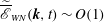 $\widetilde{\overline{\mathbf{\mathscr{E}}}}_{WN}(\boldsymbol{k},t)\sim O(1)$
and
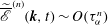 $\widetilde{\overline{\mathbf{\mathscr{E}}}}^{(n)}(\boldsymbol{k},t)\sim O({\it\tau}_{{\it\alpha}}^{n})$
for
 $n\geqslant 1$
. Below, we verify this ansatz up to
 $n=1$
, for slowly varying magnetic fields.
We wish to determine
 $\widetilde{\overline{\mathbf{\mathscr{E}}}}(\boldsymbol{k},t)$
, which is correct to first order in
 ${\it\tau}_{{\it\alpha}}$
, for
 $t\gg {\it\tau}_{{\it\alpha}}$
. Since
 ${\mathcal{D}}(s)$
is strongly peaked for times
 $s\leqslant {\it\tau}_{{\it\alpha}}$
and becomes negligible for larger
 $s$
, as mentioned above, most of the contribution to the integral in (3.11) comes only from short times
 $0\leqslant s<{\it\tau}_{{\it\alpha}}$
. Hence in (3.11) we can (i) set the upper limit of the
 $s$
integral to
 $+\infty$
, and (ii) keep the terms inside the
 $\{~\}$
in the integrand up to only first order in
 $s$
. Below, we first work out
 $\widetilde{\boldsymbol{U}}(\boldsymbol{k},s)$
and
 $\widetilde{\overline{\boldsymbol{B}}}(\boldsymbol{k},t-s)$
correct up to
 $O(s)$
.
-
(i)
$\widetilde{\boldsymbol{U}}(\boldsymbol{k},s)$
to
$O(s)$
: Taylor expansion of the function
$\widetilde{\boldsymbol{U}}(\boldsymbol{k},s)$
gives (4.2)Let us rewrite
$$\begin{eqnarray}\displaystyle \widetilde{\boldsymbol{U}}(\boldsymbol{k},s)=\widetilde{\boldsymbol{U}}(\boldsymbol{k},0)+s\left.\frac{\partial \widetilde{\boldsymbol{U}}}{\partial s}\right|_{s=0}+O(s^{2}). & & \displaystyle\end{eqnarray}$$
$\widetilde{\boldsymbol{U}}(\boldsymbol{k},s)$
, correct up to
$O(s)$
, as (4.3)where
$$\begin{eqnarray}\displaystyle \widetilde{\boldsymbol{U}}(\boldsymbol{k},s)=\boldsymbol{P}(\boldsymbol{k})+s\,\boldsymbol{Q}(\boldsymbol{k}), & & \displaystyle\end{eqnarray}$$
(4.4)
$$\begin{eqnarray}\displaystyle & \displaystyle \boldsymbol{P}(\boldsymbol{k})=\widetilde{\boldsymbol{U}}(\boldsymbol{k},0)=\text{i}\boldsymbol{k}{\it\eta}_{{\it\alpha}}+\boldsymbol{V}_{M}\quad \text{(from equation (3.15))}, & \displaystyle\end{eqnarray}$$
(4.5)The integrand in (4.5) can be expanded to obtain the following expression for
$$\begin{eqnarray}\displaystyle & \displaystyle \text{and}\quad \left.\boldsymbol{Q}(\boldsymbol{k})=\frac{\partial \widetilde{\boldsymbol{U}}}{\partial s}\right|_{s=0}=-\text{i}{\it\eta}_{T}\int \frac{\text{d}^{3}k^{\prime }}{(2{\rm\pi})^{3}}\,(\boldsymbol{k}-\boldsymbol{k}^{\prime })^{2}(\boldsymbol{k}-\boldsymbol{k}^{\prime })\widetilde{{\mathcal{A}}}(\boldsymbol{k}^{\prime }). & \displaystyle\end{eqnarray}$$
$\boldsymbol{Q}(\boldsymbol{k})$
(see appendix A): (4.6)where
$$\begin{eqnarray}\displaystyle \boldsymbol{Q}(\boldsymbol{k})=-{\it\eta}_{T}k^{2}(\text{i}\boldsymbol{k}{\it\eta}_{{\it\alpha}}+\boldsymbol{V}_{M})-2{\it\eta}_{T}(\boldsymbol{k}\boldsymbol{\cdot }\boldsymbol{V}_{M})\boldsymbol{k}+\text{i}\boldsymbol{k}{\it\eta}_{T}C_{1}+2\text{i}{\it\eta}_{T}\boldsymbol{k}\boldsymbol{\cdot }\overleftrightarrow{\boldsymbol{C}_{2}}-{\it\eta}_{T}\boldsymbol{C}_{3},\qquad & & \displaystyle\end{eqnarray}$$
${\it\eta}_{{\it\alpha}}$
and
$\boldsymbol{V}_{M}$
are the constants defined in (2.4) and (3.17), respectively, which shows that they depend on the spatial correlation function
${\mathcal{A}}$
and its first spatial derivative. Both these constants have appeared already in Sridhar & Singh (Reference Sridhar and Singh2014). But
$C_{1}$
(scalar),
$\overleftrightarrow{\boldsymbol{C}_{2}}$
(dyad) and
$\boldsymbol{C}_{3}$
(vector) are three new constants given by (see appendix A) (4.7a-c )which depend on second- or third-order spatial derivatives of
$$\begin{eqnarray}\displaystyle C_{1}=\left[{\rm\nabla}^{2}{\mathcal{A}}({\bf\xi})\right]_{{\bf\xi}=\mathbf{0}},\quad \overleftrightarrow{\boldsymbol{C}_{2}}=\left[\boldsymbol{{\rm\nabla}}\boldsymbol{{\rm\nabla}}{\mathcal{A}}({\bf\xi})\right]_{{\bf\xi}=\mathbf{0}},\quad \boldsymbol{C}_{3}=\left[{\rm\nabla}^{2}\{\boldsymbol{{\rm\nabla}}{\mathcal{A}}({\bf\xi})\}\right]_{{\bf\xi}=\mathbf{0}}, & & \displaystyle \nonumber\\ \displaystyle & & \displaystyle\end{eqnarray}$$
${\mathcal{A}}$
. Thus, in general, the mean EMF will be determined by five constants
$({\it\eta}_{K},\boldsymbol{V}_{M},C_{1},\overleftrightarrow{\boldsymbol{C}_{2}},\boldsymbol{C}_{3})$
, which can all be explicitly found once the form of the spatial correlation function
${\mathcal{A}}({\bf\xi})$
is chosen. To keep the analysis simple, we assume that the function
${\mathcal{A}}({\bf\xi})$
is such that its second- or higher-order spatial derivatives are negligible at
${\bf\xi}=\mathbf{0}$
, and therefore we ignore the constants
$C_{1}$
,
$\overleftrightarrow{\boldsymbol{C}_{2}}$
and
$\boldsymbol{C}_{3}$
in the present work. Thus we write (4.8)
$$\begin{eqnarray}\displaystyle \boldsymbol{Q}(\boldsymbol{k})=-{\it\eta}_{T}k^{2}\boldsymbol{P}(\boldsymbol{k})-2{\it\eta}_{T}(\boldsymbol{k}\boldsymbol{\cdot }\boldsymbol{V}_{M})\boldsymbol{k}. & & \displaystyle\end{eqnarray}$$
-
(ii)
$\widetilde{\overline{\boldsymbol{B}}}(\boldsymbol{k},t-s)$
to
$O(s)$
: Taylor expansion of the function
$\widetilde{\overline{\boldsymbol{B}}}(\boldsymbol{k},t-s)$
gives (4.9)where it is assumed that
$$\begin{eqnarray}\displaystyle \widetilde{\overline{\boldsymbol{B}}}(\boldsymbol{k},t-s)=\widetilde{\overline{\boldsymbol{B}}}(\boldsymbol{k},t)-s\frac{\partial \widetilde{\overline{\boldsymbol{B}}}(\boldsymbol{k},t)}{\partial t}+\cdots \,, & & \displaystyle\end{eqnarray}$$
$|\widetilde{\overline{\boldsymbol{B}}}|\gg s|\partial \widetilde{\overline{\boldsymbol{B}}}/\partial t|\gg s^{2}|\partial ^{2}\widetilde{\overline{\boldsymbol{B}}}/\partial t^{2}|\gg s^{3}|\partial ^{3}\widetilde{\overline{\boldsymbol{B}}}/\partial t^{3}|$
, etc. In order to find
$\widetilde{\overline{\boldsymbol{B}}}(\boldsymbol{k},t-s)$
, which is correct up to
$O(s)$
, we need
$\partial \widetilde{\overline{\boldsymbol{B}}}/\partial t$
in (4.9) only up to
$O(1)$
. Using (4.1) together with (3.14) and (3.15) in (3.13) we find (4.10)which is substituted in (4.9) to obtain
$$\begin{eqnarray}\displaystyle \left.\frac{\partial \widetilde{\overline{\boldsymbol{B}}}}{\partial t}\right|_{O(1)}=\text{i}\boldsymbol{k}\times \widetilde{\overline{\mathbf{\mathscr{E}}}}_{WN}(\boldsymbol{k},t)-{\it\eta}_{T}k^{2}\widetilde{\overline{\boldsymbol{B}}}=-[\text{i}\boldsymbol{k}\boldsymbol{\cdot }\boldsymbol{P}+{\it\eta}_{T}k^{2}]\widetilde{\overline{\boldsymbol{B}}}, & & \displaystyle\end{eqnarray}$$
(4.11)Then, from the above analysis, we may write
$$\begin{eqnarray}\displaystyle \widetilde{\overline{\boldsymbol{B}}}(\boldsymbol{k},t-s)=\widetilde{\overline{\boldsymbol{B}}}(\boldsymbol{k},t)[1+s(\text{i}\boldsymbol{k}\boldsymbol{\cdot }\boldsymbol{P}+{\it\eta}_{T}k^{2})]+O(s^{2}). & & \displaystyle\end{eqnarray}$$
(4.12)Noting that
$$\begin{eqnarray}\displaystyle & & \displaystyle \widetilde{\boldsymbol{U}}(\boldsymbol{k},s)\times \widetilde{\overline{\boldsymbol{B}}}(\boldsymbol{k},t-s)=\boldsymbol{P}(\boldsymbol{k})\times \widetilde{\overline{\boldsymbol{B}}}(\boldsymbol{k},t)\nonumber\\ \displaystyle & & \displaystyle \qquad +\,s[(\text{i}\boldsymbol{k}\boldsymbol{\cdot }\boldsymbol{P}+{\it\eta}_{T}k^{2})\boldsymbol{P}(\boldsymbol{k})\times \widetilde{\overline{\boldsymbol{B}}}(\boldsymbol{k},t)+\boldsymbol{Q}(\boldsymbol{k})\times \widetilde{\overline{\boldsymbol{B}}}(\boldsymbol{k},t)]+O(s^{2}).\end{eqnarray}$$
$\widetilde{\overline{\mathbf{\mathscr{E}}}}_{WN}(\boldsymbol{k},t)=\boldsymbol{P}(\boldsymbol{k})\times \widetilde{\overline{\boldsymbol{B}}}(\boldsymbol{k},t)$
and using the definition of
$\boldsymbol{Q}(\boldsymbol{k})$
as given in (4.8), we get (4.13)Using (4.13) and the properties of
$$\begin{eqnarray}\displaystyle \{~\}\text{of (3.11)} & = & \displaystyle \widetilde{\overline{\mathbf{\mathscr{E}}}}_{WN}(\boldsymbol{k},t)\nonumber\\ \displaystyle & & \displaystyle +\,s\{(\text{i}\boldsymbol{k}\boldsymbol{\cdot }\boldsymbol{P})\,\widetilde{\overline{\mathbf{\mathscr{E}}}}_{WN}-2{\it\eta}_{T}(\boldsymbol{k}\boldsymbol{\cdot }\boldsymbol{V}_{M})\,\boldsymbol{k}\times \widetilde{\overline{\boldsymbol{B}}}(\boldsymbol{k},t)\}+O(s^{2}).\end{eqnarray}$$
${\mathcal{D}}(t)$
, given in (2.4) and (2.5), we solve the integral over
$s$
in (3.11) to obtain the mean EMF: (4.14)accurate to
$$\begin{eqnarray}\displaystyle \widetilde{\overline{\mathbf{\mathscr{E}}}}(\boldsymbol{k},t)=\widetilde{\overline{\mathbf{\mathscr{E}}}}_{WN}(\boldsymbol{k},t)+{\it\tau}_{{\it\alpha}}\{(\text{i}\boldsymbol{k}\boldsymbol{\cdot }\boldsymbol{P})\,\widetilde{\overline{\mathbf{\mathscr{E}}}}_{WN}-2{\it\eta}_{T}(\boldsymbol{k}\boldsymbol{\cdot }\boldsymbol{V}_{M})\,\boldsymbol{k}\times \widetilde{\overline{\boldsymbol{B}}}(\boldsymbol{k},t)\} & & \displaystyle\end{eqnarray}$$
$O({\it\tau}_{{\it\alpha}})$
, which verifies the ansatz of (4.1) up to
$n=1$
, as claimed. We note that (4.14) for the mean EMF is valid only when the large-scale magnetic field is slowly varying. To lowest order, this condition can be stated as
$|\widetilde{\overline{\boldsymbol{B}}}|\gg {\it\tau}_{{\it\alpha}}|\partial \widetilde{\overline{\boldsymbol{B}}}/\partial t|$
. Using (4.10) for
$\partial \widetilde{\overline{\boldsymbol{B}}}/\partial t$
, we see that the sufficient condition for (4.14) to be valid is that the following two dimensionless quantities be small: (4.15)Substituting (4.14) in (3.13) we obtain the following PDE governing the evolution of the large-scale magnetic field:
$$\begin{eqnarray}\displaystyle |{\it\eta}_{K}k^{2}{\it\tau}_{{\it\alpha}}|\ll 1,\quad |kV_{M}{\it\tau}_{{\it\alpha}}|\ll 1. & & \displaystyle\end{eqnarray}$$
(4.16)
$$\begin{eqnarray}\displaystyle \frac{\partial \widetilde{\overline{\boldsymbol{B}}}}{\partial t}=\{[-{\it\eta}_{K}k^{2}-{\it\eta}_{{\it\alpha}}^{2}k^{4}{\it\tau}_{{\it\alpha}}+(\boldsymbol{k}\boldsymbol{\cdot }\boldsymbol{V}_{M})^{2}{\it\tau}_{{\it\alpha}}]+\text{i}(\boldsymbol{k}\boldsymbol{\cdot }\boldsymbol{V}_{M})[2({\it\eta}_{{\it\alpha}}+{\it\eta}_{T})k^{2}{\it\tau}_{{\it\alpha}}-1]\}\,\widetilde{\overline{\boldsymbol{B}}}. & & \displaystyle \nonumber\\ \displaystyle & & \displaystyle\end{eqnarray}$$











4.2 The Kraichnan problem with non-zero
${\it\tau}_{{\it\alpha}}$

First we consider the Kraichnan problem and extend it to include finite
 ${\it\tau}_{{\it\alpha}}$
in order to understand the combined effect of the
 ${\it\alpha}$
fluctuations when
 $\boldsymbol{V}_{M}=\mathbf{0}$
, but
 ${\it\eta}_{{\it\alpha}}>0$
and
 ${\it\tau}_{{\it\alpha}}>0$
. SS14 defined a length scale whose corresponding wavenumber was
 $$\begin{eqnarray}\displaystyle k_{{\it\alpha}}=({\it\eta}_{{\it\alpha}}{\it\tau}_{{\it\alpha}})^{-1/2}>0. & & \displaystyle\end{eqnarray}$$
This is used to define high or low wavenumbers (
 $k$
);
 $|k|>k_{{\it\alpha}}$
are called high wavenumbers, and
 $|k|<k_{{\it\alpha}}$
are called low wavenumbers. When
 $\boldsymbol{V}_{M}=\mathbf{0}$
, one of the two conditions in (4.15) are met trivially, and the other one implies that
 $|k|$
must be small enough such that
 $|{\it\eta}_{K}k^{2}{\it\tau}_{{\it\alpha}}|\ll 1$
. Using (4.17) and setting
 $\boldsymbol{V}_{M}=\mathbf{0}$
in (4.16), we get
 $$\begin{eqnarray}\displaystyle \frac{\partial \widetilde{\overline{\boldsymbol{B}}}}{\partial t}=-{\it\eta}_{K}k^{2}\left[1+\frac{{\it\eta}_{{\it\alpha}}}{{\it\eta}_{K}}\left(\frac{k}{k_{{\it\alpha}}}\right)^{2}\right]\widetilde{\overline{\boldsymbol{B}}},\quad \text{with}~\boldsymbol{k}\boldsymbol{\cdot }\widetilde{\overline{\boldsymbol{B}}}=0. & & \displaystyle\end{eqnarray}$$
The solutions are of the exponential form,
 $\widetilde{\overline{\boldsymbol{B}}}(\boldsymbol{k},t)=\widetilde{\overline{\boldsymbol{B}}}_{0}(\boldsymbol{k})\exp ({\it\gamma}t)$
, where
 $\boldsymbol{k}\boldsymbol{\cdot }\widetilde{\overline{\boldsymbol{B}}}_{0}(\boldsymbol{k})=0$
. Substituting this in (4.18), we get the growth rate as
 $$\begin{eqnarray}\displaystyle {\it\gamma}=-({\it\eta}_{K}k_{{\it\alpha}}^{2})\left(\frac{k}{k_{{\it\alpha}}}\right)^{2}\left[1+\frac{{\it\eta}_{{\it\alpha}}}{{\it\eta}_{K}}\left(\frac{k}{k_{{\it\alpha}}}\right)^{2}\right],\quad \text{when}~|{\it\eta}_{K}k^{2}{\it\tau}_{{\it\alpha}}|\ll 1. & & \displaystyle\end{eqnarray}$$
Following SS14 we normalize the growth rates by the characteristic frequency
 $({\it\sigma})$
, which is defined as
 $$\begin{eqnarray}\displaystyle {\it\sigma}=|{\it\eta}_{K}|k_{{\it\alpha}}^{2}=\left(\frac{|{\it\eta}_{T}-{\it\eta}_{{\it\alpha}}|}{{\it\eta}_{{\it\alpha}}}\right)\frac{1}{{\it\tau}_{{\it\alpha}}}\geqslant 0. & & \displaystyle\end{eqnarray}$$
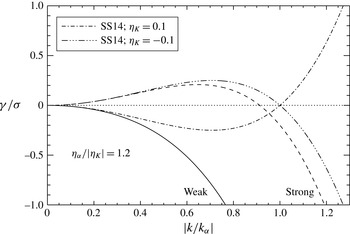
Below we consider the behaviour of the growth rate as a function of the wavenumber, for weak and strong
 ${\it\alpha}$
fluctuations, and show this in figure 1 where we also show the corresponding results of SS14 to illustrate some qualitative differences. (We note, however, that the expressions for the growth rates in SS14 were simpler and did not explicitly depend on the factor
 ${\it\eta}_{{\it\alpha}}/|{\it\eta}_{K}|$
.)
Weak
 ${\it\alpha}$
fluctuations: This case has
 $0<{\it\eta}_{{\it\alpha}}<{\it\eta}_{T}$
, so that
 ${\it\eta}_{K}$
is positive. The normalized growth rate (
 ${\it\gamma}/{\it\sigma}$
) may be expressed as
 $$\begin{eqnarray}\displaystyle \frac{{\it\gamma}}{{\it\sigma}}=-\left(\frac{k}{k_{{\it\alpha}}}\right)^{2}\left[1+\frac{{\it\eta}_{{\it\alpha}}}{|{\it\eta}_{K}|}\left(\frac{k}{k_{{\it\alpha}}}\right)^{2}\right],\quad \text{when}~|k|\ll \frac{k_{{\it\alpha}}}{\sqrt{{\it\sigma}{\it\tau}_{{\it\alpha}}}}. & & \displaystyle\end{eqnarray}$$
The growth rate is negative definite for finite
 $k$
and it is a monotonically decreasing function of the wavenumber (solid curve in figure 1). This is even qualitatively different from SS14 where the high wavenumbers always grow for weak
 ${\it\alpha}$
fluctuations (dash-dotted curve). This also highlights the fact that the inclusion of the resistive term in the fluctuating field equation is a non-trivial extension of the SS14 model.
Growth rate
 ${\it\gamma}/{\it\sigma}$
as a function of
 $|k/k_{{\it\alpha}}|$
, when
 $\boldsymbol{V}_{M}=\mathbf{0}$
. Weak (
 ${\it\eta}_{K}>0$
) and strong (
 ${\it\eta}_{K}<0$
)
 ${\it\alpha}$
fluctuations correspond to solid and dashed curves, respectively. Results of SS14 are also shown; dash-dotted and triple-dot-dashed curves correspond to weak and strong
 ${\it\alpha}$
fluctuations, respectively.

Strong
 ${\it\alpha}$
fluctuations: This case has
 $0<{\it\eta}_{T}<{\it\eta}_{{\it\alpha}}$
, so that
 ${\it\eta}_{K}$
is negative. The normalized growth rate (
 ${\it\gamma}/{\it\sigma}$
) may be expressed as
 $$\begin{eqnarray}\displaystyle \frac{{\it\gamma}}{{\it\sigma}}=+\left(\frac{k}{k_{{\it\alpha}}}\right)^{2}\left[1-\frac{{\it\eta}_{{\it\alpha}}}{|{\it\eta}_{K}|}\left(\frac{k}{k_{{\it\alpha}}}\right)^{2}\right],\quad \text{when}~|k|\ll \frac{k_{{\it\alpha}}}{\sqrt{{\it\sigma}{\it\tau}_{{\it\alpha}}}}. & & \displaystyle\end{eqnarray}$$
In this case the growth rate can be positive for a range of wavenumbers, before becoming negative at larger wavenumbers (dashed curve in figure 1). This is qualitatively similar to the results of SS14 (triple-dot-dashed curve) in this regime and the differences at large wavenumbers arise due to reasons mentioned above.
Thus the necessary condition for dynamo action is that the
 ${\it\alpha}$
fluctuations must be strong, i.e.
 ${\it\eta}_{K}<0$
. Recall that this is, in a sense, similar to the white-noise or the original Kraichnan model, but we note the following important difference: in the white-noise case, the growth rate increases monotonically with wavenumber (
 $k$
) for strong
 ${\it\alpha}$
fluctuations, with largest allowed wavenumbers (smallest allowed length scales) growing the fastest; whereas, here, we find that the growth rate is a non-monotonic function of
 $k$
, and, as a result, there exists a wavenumber cutoff at some large
 $k$
beyond which the growth rate turns negative. This makes it a special dynamo as the magnetic power at smallest length scales would be suppressed due to the existence of the wavenumber cutoff (see dashed curve in figure 1), thus enabling a bona fide large-scale dynamo, unlike the white-noise case, where much of the magnetic power lies at the smallest allowed length scales.
It would indeed be interesting if even weak
 ${\it\alpha}$
fluctuations could lead to large-scale dynamo action. In the next section we explore the combined effect of
 $\boldsymbol{V}_{M}\neq 0$
and
 ${\it\tau}_{{\it\alpha}}\neq 0$
, and ask the following question: When both
 ${\it\tau}_{{\it\alpha}}$
and
 $\boldsymbol{V}_{M}$
are non-zero, could large-scale magnetic fields grow even when
 ${\it\alpha}$
fluctuations are weak, i.e. when
 ${\it\eta}_{K}>0$
?
5 Growth rates of modes when
${\it\tau}_{{\it\alpha}}$
is non-zero

We consider one-dimensional propagating modes for the general case when all the parameters
 $({\it\eta}_{{\it\alpha}},\boldsymbol{V}_{M},{\it\tau}_{{\it\alpha}})$
can be non-zero. Below, we derive the dispersion relation and study the growth rate function. When the wavevector
 $\boldsymbol{k}=(0,0,k)$
points along the ‘vertical’ (
 $\pm \boldsymbol{e}_{3}$
) directions,
 $\widetilde{\overline{B}}_{3}$
must be uniform and is of no interest for dynamo action. Hence we set
 $\widetilde{\overline{B}}_{3}=0$
, and take
 $\widetilde{\overline{\boldsymbol{B}}}(k,t)=\widetilde{\overline{B}}_{1}(k,t)\boldsymbol{e}_{1}+\widetilde{\overline{B}}_{2}(k,t)\boldsymbol{e}_{2}$
. The equation governing the time evolution of this large-scale magnetic field is obtained by setting
 $k_{1,2}=0$
,
 $k_{3}=k$
and
 $\widetilde{\overline{B}}_{3}=0$
in equation (4.16):
 $$\begin{eqnarray}\displaystyle \frac{\partial \widetilde{\overline{\boldsymbol{B}}}}{\partial t}=\{[-{\it\eta}_{K}k^{2}-{\it\eta}_{{\it\alpha}}^{2}k^{4}{\it\tau}_{{\it\alpha}}+(kV_{M3})^{2}{\it\tau}_{{\it\alpha}}]+\text{i}kV_{M3}[2({\it\eta}_{{\it\alpha}}+{\it\eta}_{T})k^{2}{\it\tau}_{{\it\alpha}}-1]\}\widetilde{\overline{\boldsymbol{B}}}. & & \displaystyle\end{eqnarray}$$
We note that each component of the mean magnetic field evolves independently of the other components. The nature of this dynamo is therefore different from standard
 ${\it\alpha}^{2}$
or
 ${\it\alpha}{\it\omega}$
dynamos, where the evolutions of the various components are coupled with each other, thus facilitating a cross-coupling dynamo. We seek modal solutions of the form
 $$\begin{eqnarray}\displaystyle \widetilde{\overline{\boldsymbol{B}}}(k,t)=\left[\widetilde{\overline{B}}_{01}(k)\boldsymbol{e}_{1}+\widetilde{\overline{B}}_{02}(k)\boldsymbol{e}_{2}\right]\exp ({\it\lambda}t), & & \displaystyle\end{eqnarray}$$
and substitute it in (5.1) to obtain the following dispersion relation:
 $$\begin{eqnarray}\displaystyle {\it\lambda}=[-{\it\eta}_{K}k^{2}-{\it\eta}_{{\it\alpha}}^{2}k^{4}{\it\tau}_{{\it\alpha}}+(kV_{M3})^{2}{\it\tau}_{{\it\alpha}}]+\text{i}kV_{M3}[2({\it\eta}_{{\it\alpha}}+{\it\eta}_{T})k^{2}{\it\tau}_{{\it\alpha}}-1]. & & \displaystyle\end{eqnarray}$$
Of particular interest is the growth rate
 ${\it\gamma}=\text{Re}\{{\it\lambda}\}$
, because dynamo action corresponds to the case when
 ${\it\gamma}>0$
. From the dispersion relation (5.3) we have
 $$\begin{eqnarray}\displaystyle {\it\gamma}=-\,{\it\eta}_{K}k^{2}-{\it\eta}_{{\it\alpha}}^{2}k^{4}{\it\tau}_{{\it\alpha}}+(kV_{M3})^{2}{\it\tau}_{{\it\alpha}}. & & \displaystyle\end{eqnarray}$$
We refer the reader to appendix B for some properties of the growth rate function in terms of useful dimensionless parameters and to appendix C for their physical meanings.
6 Dynamo action due to Kraichnan diffusivity and Moffatt drift
Now we turn to the most general case when both Kraichnan diffusivity and Moffatt drift are non-zero, and
 ${\it\alpha}$
fluctuations have finite correlation times. SS14 defined a new time scale involving
 ${\it\eta}_{K}$
and
 $V_{M3}$
as
 $$\begin{eqnarray}\displaystyle {\it\tau}_{\ast }=(|{\it\eta}_{K}|/V_{M3}^{2})>0. & & \displaystyle\end{eqnarray}$$
We provide below the expressions for dimensional growth rate
 ${\it\gamma}$
as a function of the wavenumber
 $k$
, for weak and strong
 ${\it\alpha}$
fluctuations. It turns out that the nature of dynamo action depends on whether
 ${\it\tau}_{{\it\alpha}}$
is smaller or larger than
 ${\it\tau}_{\ast }$
.
Weak
 ${\it\alpha}$
fluctuations: This case has
 $0<{\it\eta}_{{\it\alpha}}<{\it\eta}_{T}$
, so that
 ${\it\eta}_{K}$
is positive. From (5.4), the dimensional growth rate may be expressed as
 $$\begin{eqnarray}\displaystyle {\it\gamma}={\it\sigma}\left\{\left[\frac{{\it\tau}_{{\it\alpha}}}{{\it\tau}_{\ast }}-1\right]\left(\frac{k}{k_{{\it\alpha}}}\right)^{2}-\frac{{\it\eta}_{{\it\alpha}}}{|{\it\eta}_{K}|}\left(\frac{k}{k_{{\it\alpha}}}\right)^{4}\right\}, & & \displaystyle\end{eqnarray}$$
where the characteristic frequency
 ${\it\sigma}$
is defined earlier in (4.20). We consider the following two cases.
-
(i) Case
${\it\tau}_{{\it\alpha}}<{\it\tau}_{\ast }$
: In this case the growth rate
${\it\gamma}$
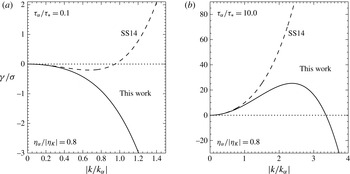
is negative at all wavenumbers, as may be seen from the solid curve in figure 2(a). -
(ii) Case
${\it\tau}_{{\it\alpha}}>{\it\tau}_{\ast }$
: Here the growth rate is positive for a range of wavenumbers and it is a non-monotonic function of
$k$
. Starting from zero, it first increases with
$k$
, attains a maximum positive value, (6.3)and then it decreases monotonically for larger
$$\begin{eqnarray}\displaystyle {\it\gamma}_{max}=\frac{{\it\sigma}|{\it\eta}_{K}|}{4{\it\eta}_{{\it\alpha}}}\left[\frac{{\it\tau}_{{\it\alpha}}}{{\it\tau}_{\ast }}-1\right]^{2},\quad \text{at}~|k|=k_{max}=k_{{\it\alpha}}\left[\frac{|{\it\eta}_{K}|}{2{\it\eta}_{{\it\alpha}}}\left(\frac{{\it\tau}_{{\it\alpha}}}{{\it\tau}_{\ast }}-1\right)\right]^{1/2}, & & \displaystyle\end{eqnarray}$$
$k$
, turning negative at sufficiently high wavenumber (solid curve in figure 2
b). We note that the growth rate becomes negative at high enough wavenumbers, thus exhibiting a high-wavenumber cutoff, which would enable a bona fide large-scale dynamo with suppression of magnetic power at smaller scales.


Growth rate
 ${\it\gamma}/{\it\sigma}$
plotted as a function of
 $|k/k_{{\it\alpha}}|$
for weak
 ${\it\alpha}$
fluctuations; shown by solid curves. Panels (a) and (b) correspond to the case when
 ${\it\tau}_{{\it\alpha}}/{\it\tau}_{\ast }=0.1$
and
 $10.0$
, respectively. Dashed curves correspond to the results of SS14.

Strong
 ${\it\alpha}$
fluctuations: This case has
 $0<{\it\eta}_{T}<{\it\eta}_{{\it\alpha}}$
, so that
 ${\it\eta}_{K}$
is negative. From (5.4), the dimensional growth rate may be expressed as
 $$\begin{eqnarray}\displaystyle {\it\gamma}={\it\sigma}\left\{\left[\frac{{\it\tau}_{{\it\alpha}}}{{\it\tau}_{\ast }}+1\right]\left(\frac{k}{k_{{\it\alpha}}}\right)^{2}-\frac{{\it\eta}_{{\it\alpha}}}{|{\it\eta}_{K}|}\left(\frac{k}{k_{{\it\alpha}}}\right)^{4}\right\}. & & \displaystyle\end{eqnarray}$$
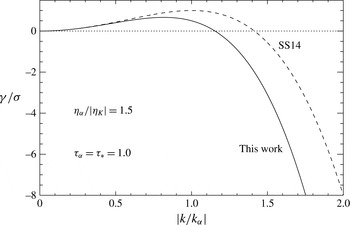
As shown by the solid curve in figure 3, the growth rate
 ${\it\gamma}$
starts from zero at
 $|k|=0$
, increases with
 $k$
to reach a maximum positive value,
 $$\begin{eqnarray}\displaystyle {\it\gamma}_{max}=\frac{{\it\sigma}|{\it\eta}_{K}|}{4{\it\eta}_{{\it\alpha}}}\left[\frac{{\it\tau}_{{\it\alpha}}}{{\it\tau}_{\ast }}+1\right]^{2},\quad \text{at}~|k|=k_{max}=k_{{\it\alpha}}\left[\frac{|{\it\eta}_{K}|}{2{\it\eta}_{{\it\alpha}}}\left(\frac{{\it\tau}_{{\it\alpha}}}{{\it\tau}_{\ast }}+1\right)\right]^{1/2}, & & \displaystyle\end{eqnarray}$$
beyond which it begins to decrease monotonically, and becomes negative for sufficiently large wavenumbers.
Growth rate
 ${\it\gamma}/{\it\sigma}$
plotted as a function of
 $|k/k_{{\it\alpha}}|$
for strong
 ${\it\alpha}$
fluctuations; shown by solid curve. Dashed curve correspond to the results of SS14.

In both figures 2 and 3 we also show the corresponding results of Sridhar & Singh (Reference Sridhar and Singh2014) to illustrate some qualitative differences. (We note, however, that the expressions for the growth rates in SS14 were simpler and did not explicitly depend on the factor
 ${\it\eta}_{{\it\alpha}}/|{\it\eta}_{K}|$
.) We notice good agreement at low wavenumbers whereas at large wavenumbers the theory of Sridhar & Singh (Reference Sridhar and Singh2014) overpredicts the growth rates. They had already pointed out that such overestimation of growth rates at large wavenumbers would be expected, as they dropped the diffusion term from the evolution equation for the fluctuating magnetic field. In the present analysis, where we retain this term, we find that it affects the growth rate
 ${\it\gamma}$
in such a way that it now always exhibits a large-wavenumber cutoff beyond which
 ${\it\gamma}$
becomes negative. At large wavenumbers, the new predictions for the growth rates are even qualitatively different from the results of the SS14 model and have only been possible due to a non-trivial extension of the previous work. Particularly interesting is the possibility of dynamo action in the case of weak
 ${\it\alpha}$
fluctuations due to finite Moffatt drift, where a window of small to intermediate wavenumbers allows dynamo growth (see figure 2
b).
7 Conclusions
We have developed a theory of large-scale dynamo action where the mean magnetic field grows solely due to an
 ${\it\alpha}$
parameter that is varying stochastically in space and time with zero mean. Using the first-order smoothing approximation or the quasi-linear approach, we derived a closed integro-differential equation governing the evolution of the large-scale magnetic field, which is non-perturbative in the
 ${\it\alpha}$
-correlation time (
 ${\it\tau}_{{\it\alpha}}$
). This is the main result of this paper, where we have generalized the Kraichnan–Moffatt model (Kraichnan Reference Kraichnan1976; Moffatt Reference Moffatt1978), to include effects of non-zero
 ${\it\alpha}$
-correlation time, in a spirit similar to that of Sridhar & Singh (Reference Sridhar and Singh2014). We, however, note that Sridhar & Singh (Reference Sridhar and Singh2014) included shear in their analysis while ignoring the diffusion term from the fluctuating field equation, whereas here we ignore shear but include the diffusion term, which is necessary for making comparisons with results from future numerical experiments. We show that statistically anisotropic
 ${\it\alpha}$
fluctuations give rise to a drift velocity, called Moffatt drift, which contributes a new term in the mean EMF. We first applied our model to the exactly solvable case of white-noise (
 ${\it\tau}_{{\it\alpha}}=0$
)
 ${\it\alpha}$
fluctuations, in which case the mean EMF is identical to the Kraichnan–Moffatt model and the evolution of the mean magnetic field depends on two constants, namely, the Kraichnan diffusivity (
 ${\it\eta}_{K}$
) and the Moffatt drift (
 $\boldsymbol{V}_{M}$
). We confirm earlier findings (Kraichnan Reference Kraichnan1976; Moffatt Reference Moffatt1978; Sridhar & Singh Reference Sridhar and Singh2014) that when
 ${\it\tau}_{{\it\alpha}}=0$
, (i) the necessary condition for dynamo action is that the fluctuations must be strong, and (ii) the Moffatt drift contributes only to the phase and does not determine the growth or decay of the large-scale magnetic field.
In order to explore memory effects of fluctuating
 ${\it\alpha}$
on dynamo action, we considered non-zero
 ${\it\tau}_{{\it\alpha}}$
. Assuming that the
 ${\it\tau}_{{\it\alpha}}$
is small and the large-scale magnetic field is slowly varying, we reduce the general integro-differential equation to a PDE and state sufficient conditions for its validity. Here each component of the mean magnetic field evolves independently of the other components. We provided an explicit expression for the growth rate of the mean magnetic field and studied its behaviour as a function of wavenumber (
 $k$
), for different choices of parameters involved. Some salient results may be stated as follows.
-
(i) In the absence of the Moffatt drift, the necessary condition for dynamo action is that the
${\it\alpha}$
fluctuations must be strong. This is, in a sense, qualitatively similar to the white-noise or the original Kraichnan model, except that, here, we find the growth rate to be a non-monotonic function of
$k$
, thus exhibiting a wavenumber cutoff beyond which it becomes progressively negative. -
(ii) For non-zero
${\it\tau}_{{\it\alpha}}$
, the Moffatt drift contributes positively to the dynamo growth and it can always facilitate large-scale dynamo action if sufficiently large, even in the case of weak
${\it\alpha}$
fluctuations. -
(iii) In the most general case when both the Kraichnan diffusivity and the Moffatt drift are non-zero, and
${\it\tau}_{{\it\alpha}}$
is finite, we find the possibility of dynamo growth in both regimes (weak and strong) of
${\it\alpha}$
fluctuations. We also determine the growth rate and corresponding wavenumber of the fastest-growing mode. -
(iv) We find that there always exists a wavenumber cutoff at some large
$k$
beyond which the growth rate turns negative, irrespective of weak or strong
${\it\alpha}$
fluctuations. This makes it a special dynamo as the magnetic power at smallest length scales would be suppressed, thus enabling a bona fide large-scale dynamo.


Thus a minimal extension of the Kraichnan–Moffatt model to include effects of finite memory results in a large-scale dynamo, driven by the Moffatt drift, which arises in the presence of statistically anisotropic
 ${\it\alpha}$
fluctuations. Such a possibility was first discussed in Sridhar & Singh (Reference Sridhar and Singh2014). It is particularly intriguing to find that even weak
 ${\it\alpha}$
fluctuations could lead to the growth of the mean magnetic field due to finite Moffatt drift, where the maximum growth occurs at intermediate length scales (approximately a few
 $k_{{\it\alpha}}$
). Owing to the
 $k^{2}$
contribution to the growth rate, the Moffatt-drift-driven dynamo appears to be of negatively diffusive type, with coefficient of (negative) turbulent diffusion being
 $V_{M3}^{2}{\it\tau}_{{\it\alpha}}$
. However, it is different from the usual picture of negative diffusion where the maximum growth occurs at smallest length scales. Therefore, while the usual negative diffusion cannot continue indefinitely in the mean-field framework for reasons stated earlier, the Moffatt-drift-driven dynamo does not have such limitations, resulting in a bona fide large-scale dynamo action. This analysis leading to new contributions to the mean EMF is expected to find applications in the context of astrophysical dynamos, such as disk dynamos, the solar dynamo, etc. Numerical as well as analytical explorations of this new class of large-scale dynamos, by also considering fluctuations in all components of tensorial transport coefficients
 ${\it\alpha}_{ij}$
and
 ${\it\eta}_{ij}$
, will be the focus of a future investigation.
Acknowledgements
I thank S. Sridhar for suggesting this problem and for useful discussions. Hospitality provided by RRI, Bangalore, India, where this work began during my visit in November 2014, is gratefully acknowledged. I also thank L. Chamandy for a critical reading of an earlier version of the manuscript and for providing many useful suggestions. I thank all the anonymous referees for many useful suggestions and criticisms, which have improved the quality of the present paper.
Appendix A. Derivation of equations (4.6) and (4.7)
To simplify the integral in (4.5), let us first expand
 $(\boldsymbol{k}-\boldsymbol{k}^{\prime })^{2}(\boldsymbol{k}-\boldsymbol{k}^{\prime })$
in the integrand and write
 $\boldsymbol{Q}(\boldsymbol{k})$
as
 $$\begin{eqnarray}\displaystyle \boldsymbol{Q}(\boldsymbol{k}) & = & \displaystyle -\text{i}{\it\eta}_{T}\left\{k^{2}\boldsymbol{k}\underbrace{\int \frac{\text{d}^{3}k^{\prime }}{(2{\rm\pi})^{3}}\widetilde{{\mathcal{A}}}(\boldsymbol{k}^{\prime })}_{\text{I}}-k^{2}\underbrace{\int \frac{\text{d}^{3}k^{\prime }}{(2{\rm\pi})^{3}}\boldsymbol{k}^{\prime }\widetilde{{\mathcal{A}}}(\boldsymbol{k}^{\prime })}_{\text{II}}-2\boldsymbol{k}\underbrace{\int \frac{\text{d}^{3}k^{\prime }}{(2{\rm\pi})^{3}}(\boldsymbol{k}\boldsymbol{\cdot }\boldsymbol{k}^{\prime })\widetilde{{\mathcal{A}}}(\boldsymbol{k}^{\prime })}_{\text{III}}\right.\nonumber\\ \displaystyle & & \displaystyle \left.+\,\boldsymbol{k}\underbrace{\int \frac{\text{d}^{3}k^{\prime }}{(2{\rm\pi})^{3}}k^{\prime 2}\widetilde{{\mathcal{A}}}(\boldsymbol{k}^{\prime })}_{\text{IV}}+2\underbrace{\int \frac{\text{d}^{3}k^{\prime }}{(2{\rm\pi})^{3}}(\boldsymbol{k}\boldsymbol{\cdot }\boldsymbol{k}^{\prime })\boldsymbol{k}^{\prime }\widetilde{{\mathcal{A}}}(\boldsymbol{k}^{\prime })}_{\text{V}}-\underbrace{\int \frac{\text{d}^{3}k^{\prime }}{(2{\rm\pi})^{3}}k^{\prime 2}\boldsymbol{k}^{\prime }\widetilde{{\mathcal{A}}}(\boldsymbol{k}^{\prime })}_{\text{VI}}\right\}.\nonumber\\ \displaystyle & & \displaystyle\end{eqnarray}$$
Writing the spatial correlation function as
 $$\begin{eqnarray}\displaystyle {\mathcal{A}}({\bf\xi})=\int \frac{\text{d}^{3}k^{\prime }}{(2{\rm\pi})^{3}}\,\exp (\text{i}\boldsymbol{k}^{\prime }\boldsymbol{\cdot }{\bf\xi})\,\widetilde{{\mathcal{A}}}(\boldsymbol{k}^{\prime }), & & \displaystyle\end{eqnarray}$$
we can express the integrals I–VI in (A 1) as follows:
 $$\begin{eqnarray}\displaystyle \left.\begin{array}{@{}c@{}}\displaystyle \text{I}={\mathcal{A}}(\mathbf{0}),\quad \text{II}=-\text{i}[\boldsymbol{{\rm\nabla}}{\mathcal{A}}({\bf\xi})]_{{\bf\xi}=\mathbf{0}},\quad \text{III}=-\text{i}\boldsymbol{k}\boldsymbol{\cdot }[\boldsymbol{{\rm\nabla}}{\mathcal{A}}({\bf\xi})]_{{\bf\xi}=\mathbf{0}},\\ \displaystyle \text{IV}=-[{\rm\nabla}^{2}{\mathcal{A}}({\bf\xi})]_{{\bf\xi}=\mathbf{0}},\quad \text{V}=-[(\boldsymbol{k}\boldsymbol{\cdot }\boldsymbol{{\rm\nabla}})\boldsymbol{{\rm\nabla}}{\mathcal{A}}({\bf\xi})]_{{\bf\xi}=\mathbf{0}},\quad \text{VI}=\text{i}[{\rm\nabla}^{2}\{\boldsymbol{{\rm\nabla}}{\mathcal{A}}({\bf\xi})\}]_{{\bf\xi}=\mathbf{0}}.\end{array}\right\}\quad & & \displaystyle\end{eqnarray}$$
Using (A 3) in (A 1), we obtain (4.6), with definitions of
 $C_{1}$
(scalar),
 $\overleftrightarrow{\boldsymbol{C}_{2}}$
(dyad) and
 $\boldsymbol{C}_{3}$
(vector) as given in (4.7). Also, recall that
 ${\mathcal{A}}(\mathbf{0})={\it\eta}_{{\it\alpha}}$
and
 $-[\boldsymbol{{\rm\nabla}}{\mathcal{A}}({\bf\xi})]_{{\bf\xi}=\mathbf{0}}=\boldsymbol{V}_{M}$
. Whereas our model does not specify the form of
 ${\mathcal{A}}({\bf\xi})$
, which is by construction a large-scale quantity, but otherwise an arbitrary function, we restrict our present analysis to the limit
 $\ell _{{\mathcal{A}}}>\ell _{\overline{B}}$
, where
 $\ell _{{\mathcal{A}}}$
and
 $\ell _{\overline{B}}$
are typical scales of variation associated with
 ${\mathcal{A}}$
and large-scale magnetic field, respectively. In this case the terms IV–VI involving
 $C$
in the above expressions can be safely ignored in comparison to the rest of the terms in (A 1).
Appendix B. Dimensionless growth rate function
The expression for the growth rate as given in (5.4) may be written in a dimensionless form using the parameters first defined in SS14:
 $$\begin{eqnarray}\displaystyle {\it\Gamma}={\it\gamma}{\it\tau}_{{\it\alpha}},\quad {\it\beta}={\it\eta}_{{\it\alpha}}k^{2}{\it\tau}_{{\it\alpha}},\quad {\it\varepsilon}_{K}={\it\eta}_{K}k^{2}{\it\tau}_{{\it\alpha}},\quad {\it\varepsilon}_{M}=kV_{M3}{\it\tau}_{{\it\alpha}}. & & \displaystyle\end{eqnarray}$$
There is just one constraint involving
 ${\it\beta}$
and
 ${\it\varepsilon}_{K}$
, coming from
 ${\it\beta}+{\it\varepsilon}_{K}={\it\eta}_{T}k^{2}{\it\tau}_{{\it\alpha}}>0$
. Thus the parameter ranges are given by
 $$\begin{eqnarray}\displaystyle 0\leqslant {\it\beta}<\infty ,\quad {\it\beta}+{\it\varepsilon}_{K}>0,\quad |{\it\varepsilon}_{K}|\ll 1,\quad |{\it\varepsilon}_{M}|\ll 1, & & \displaystyle\end{eqnarray}$$
where the latter two conditions come from (4.15). Multiplying (5.4) by
 ${\it\tau}_{{\it\alpha}}>0$
, we obtain the dimensionless growth rates
 $$\begin{eqnarray}\displaystyle {\it\Gamma}=-({\it\varepsilon}_{K}+{\it\beta}^{2})+{\it\varepsilon}_{M}^{2} & & \displaystyle\end{eqnarray}$$
as a function of the three dimensionless parameters
 $({\it\beta},{\it\varepsilon}_{K},{\it\varepsilon}_{M})$
. Of these, the two parameters
 $\left({\it\varepsilon}_{K},{\it\varepsilon}_{M}\right)$
can be taken to be independently specified, taking positive and negative values, so long as their magnitudes are small. But
 ${\it\beta}\geqslant 0$
is subject to the constraint
 ${\it\beta}+{\it\varepsilon}_{K}>0$
. Therefore we can rewrite the conditions of (B 2) as
 $$\begin{eqnarray}\displaystyle \left.\begin{array}{@{}c@{}}|{\it\varepsilon}_{K}|\ll 1,\quad |{\it\varepsilon}_{M}|\ll 1,\\ \text{for }{\it\varepsilon}_{K}\leqslant 0,\text{ have }|{\it\varepsilon}_{K}|<{\it\beta}<\infty ;\quad \text{for }{\it\varepsilon}_{K}>0,\text{ have }0\leqslant {\it\beta}<\infty .\end{array}\right\} & & \displaystyle\end{eqnarray}$$
The dynamo condition is determined by a surface in three-dimensional parameter space (spanned by
 ${\it\beta},{\it\varepsilon}_{K},{\it\varepsilon}_{M}$
) at which
 ${\it\Gamma}=0$
, separating the dynamo region (with
 ${\it\Gamma}>0$
) from the non-dynamo region (with
 ${\it\Gamma}<0$
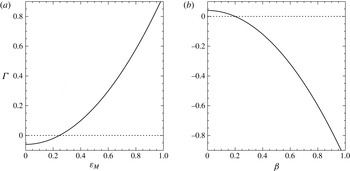
). In figure 4 we plot the growth rate function
 ${\it\Gamma}$
as a function of single parameter, keeping the other two parameters fixed. Figure 4(a,b) show
 ${\it\Gamma}$
as functions of
 ${\it\varepsilon}_{M}$
and
 ${\it\beta}$
, respectively, with positive
 ${\it\varepsilon}_{K}\;(=0.05)$
, which corresponds to weak
 ${\it\alpha}$
fluctuations. At fixed
 ${\it\varepsilon}_{K}$
and
 ${\it\beta}$
,
 ${\it\Gamma}$
increases quadratically with
 ${\it\varepsilon}_{M}$
, whereas it decreases quadratically with
 ${\it\beta}$
at fixed
 ${\it\varepsilon}_{K}$
and
 ${\it\varepsilon}_{M}$
. We note that the Moffatt drift, together with finite correlation time of
 ${\it\alpha}$
fluctuations (parametrized by
 ${\it\varepsilon}_{M}$
), contributes positively to the dynamo growth and can always facilitate large-scale dynamo action if sufficiently strong, even in the case of weak
 ${\it\alpha}$
fluctuations.
Growth rate function
 ${\it\Gamma}$
plotted as a function of (a)
 ${\it\varepsilon}_{M}$
for
 ${\it\beta}=0.1$
, and (b)
 ${\it\beta}$
for
 $|{\it\varepsilon}_{M}|=0.3$
; in both the cases,
 ${\it\varepsilon}_{K}=0.05$
.

Appendix C. Possible physical meanings of the parameters
If the spatial correlation function
 ${\mathcal{A}}(\boldsymbol{r})$
varies over scales of order
 $\ell _{{\mathcal{A}}}$
, then the Moffatt drift speed
 $V_{M}\sim {\it\eta}_{{\it\alpha}}/\ell _{{\mathcal{A}}}$
, giving from (6.1)
 ${\it\tau}_{\ast }\sim |\,f-1|\ell _{{\mathcal{A}}}^{\,2}/{\it\eta}_{{\it\alpha}}$
, with factor
 $f\equiv {\it\eta}_{T}/{\it\eta}_{{\it\alpha}}$
. Note that
 ${\it\tau}_{\ast }$
is a parameter that can be uniquely determined once the form of
 ${\mathcal{A}}(\boldsymbol{r})$
is specified, whereas
 ${\it\tau}_{{\it\alpha}}$
is defined independently by temporal correlation function
 ${\mathcal{D}}(t)$
using (2.5). Two interesting limits can be sought: (i) when
 ${\it\eta}_{T}\ll {\it\eta}_{{\it\alpha}}$
,
 ${\it\tau}_{\ast }\sim \ell _{{\mathcal{A}}}^{\,2}/{\it\eta}_{{\it\alpha}}$
, and (ii) when
 ${\it\eta}_{T}\gg {\it\eta}_{{\it\alpha}}$
,
 ${\it\tau}_{\ast }\sim f\ell _{{\mathcal{A}}}^{\,2}/{\it\eta}_{{\it\alpha}}$
, i.e. for weak
 ${\it\alpha}$
fluctuations, it is larger by factor
 $f$
(with
 $f\gg 1$
). The wavenumber
 $k_{{\it\alpha}}$
as defined in (4.17) signifies the inverse diffusion length due to
 ${\it\alpha}$
diffusivity
 ${\it\eta}_{{\it\alpha}}$
. Similarly the modified turbulent diffusion, or Kraichnan diffusivity
 ${\it\eta}_{K}$
has an associated resistive scale with corresponding wavenumber, say,
 $k_{K}=1/\sqrt{{\it\eta}_{K}{\it\tau}_{{\it\alpha}}}$
. The dimensionless parameters
 ${\it\beta}$
and
 ${\it\varepsilon}_{K}$
as defined in (B 1) characterize the wavenumbers of the modal mean-field solutions in units of
 $k_{{\it\alpha}}$
and
 $k_{K}$
, respectively, whereas
 ${\it\varepsilon}_{M}$
normalizes it by the distance traversed by Moffatt drift speed in time
 ${\it\tau}_{{\it\alpha}}$
.