Introduction
People with serious mental illness (SMI; schizophrenia, bipolar disorder, and severe/chronic mood and anxiety disorders) are more likely to initiate smoking and less likely to quit (Lasser et al., Reference Lasser, Boyd, Woolhandler, Himmelstein, McCormick and Bor2000; McClave, McKnight-Eily, Davis, & Dube, Reference McClave, McKnight-Eily, Davis and Dube2010). Technology-based interventions dramatically extend the reach of behavioral interventions for quitting smoking (e.g., An et al., Reference An, Betzner, Schillo, Luxenberg, Christenson and Wendling2010), and interactive and tailored website cessation programs have been shown to facilitate cessation for the general population (Myung, McDonnell, Kazinets, Seo, & Moskowitz, Reference Myung, McDonnell, Kazinets, Seo and Moskowitz2009; Shahab & McEwen, Reference Shahab and McEwen2009; Taylor et al., Reference Taylor, Dalili, Semwal, Civljak, Sheikh and Car2017). Outcomes from these approaches are enhanced by modest ‘low touch’ support from a clinician (Taylor et al., Reference Taylor, Dalili, Semwal, Civljak, Sheikh and Car2017).
Human-centered design processes can facilitate high-quality internet intervention designs (IDEO.org, 2015). Yet, standard web-based interventions may not be easily usable by some smokers, particularly those who most need help with quitting smoking, such as people with SMI (Brunette et al., Reference Brunette, Ferron, Devitt, Geiger, Martin and Pratt2012), whose cognitive impairments (Keefe & Eesley, Reference Keefe, Eesley, Lieberman, Stroup and Perkins2006) impede use and comprehension of standard interventions. For example, the American Lung Association has a cessation website, Freedom From Smoking, with high-quality content designed for the general population, not people with SMI, and many features of this website make it difficult to use among people with cognitive impairment (e.g., visually complex pages with multiple units of text and pictures displayed, links away from the content, etc.) (Rotondi, Spring, Hanusa, Eack, & Haas, Reference Rotondi, Spring, Hanusa, Eack and Haas2017).
Using principles of design for people with disabilities (Anonymous, 2010), mobile behavioral interventions have been designed for people with SMI and tailored with adaptations driven by iterative usability testing to ensure minimal cognitive burden (Ben-Zeev et al., Reference Ben-Zeev, Kaiser, Brenner, Begale, Duffecy and Mohr2013; Ferron et al., Reference Ferron, Brunette, McHugo, Devitt, Martin and Drake2011; Rotondi et al., Reference Rotondi, Sinkule, Haas, Spring, Litschge and Newhill2007). Using these design principles, we developed a prototype of the tailored, smoking cessation intervention adapted from the American Lung Association's Freedom from Smoking program (2019). We chose to use this intervention because an in-person version of Freedom From Smoking has been tailored for people with SMI and used with pharmacotherapy in research and clinical practice for 20 years (e.g., Addington, el-Guebaly, Campbell, Hodgins, & Addington, Reference Addington, el-Guebaly, Campbell, Hodgins and Addington1998; Evins et al., Reference Evins, Cather, Deckersbach, Freudenreich, Culhane and Olm-Shipman2005, Reference Evins, Cather, Pratt, Pachas, Hoeppner and Goff2014; George et al., Reference George, Ziedonis, Feingold, Pepper, Satterburg and Winkel2000, Reference George, Vessicchio, Sacco, Weinberger, Dudas and Allen2008), thus providing appropriate content for a mobile intervention that could expand the reach of the behavioral intervention.
Using an iterative developmental process to enable rapid evaluation (Hall, Reference Hall2001; IDEO.org, 2015), we started with a partial prototype, called Let's Talk About Quitting Smoking, that contained core content. We conducted usability testing of this prototype among 11 people with SMI psychotic disorders (Brunette, Ferron, Gottlieb, Devitt, & Rotondi, Reference Brunette, Ferron, Gottlieb, Devitt and Rotondi2016a) to ensure that the intended users were able to benefit from the intervention (Stoddard, Augustson, & Mabry, Reference Stoddard, Augustson and Mabry2006). Eighty-three percent used it independently and were very satisfied. We then built a comprehensive prototype with complete intervention content. We report here the next step of testing among 20 smokers with SMI.
Aims
We aim to determine feasibility and preliminary efficacy of the Let's Talk About Quitting Smoking intervention on multiple devices in SMI smoker's home environments over 2 months.
Methods
Intervention development
Overview
Based on the Theory of Planned Behavior, the web-based intervention aimed to address attitudes, social norms, and perceived behavioral control for smoking and cessation treatment (Ajzen, Reference Ajzen1991, Reference Ajzen2006). The intervention utilized standard evidence-based behavioral techniques for smoking cessation (Association) adapted for people with SMI (Cather, Mays, & Gottlieb, Reference Cather, Mays and Gottlieb2007). As noted above, this adapted American Lung Association (ALA) behavioral intervention has been used successfully for many years as an in-person intervention combined with pharmacotherapy (Addington et al., Reference Addington, el-Guebaly, Campbell, Hodgins and Addington1998; Evins et al., Reference Evins, Mays, Rigotti, Tisdale, Cather and Goff2001, Reference Evins, Cather, Deckersbach, Freudenreich, Culhane and Olm-Shipman2005, Reference Evins, Culhane, Alpert, Pava, Liese and Farabaugh2008, Reference Evins, Cather, Pratt, Pachas, Hoeppner and Goff2014; George et al., Reference George, Ziedonis, Feingold, Pepper, Satterburg and Winkel2000, Reference George, Vessicchio, Termine, Bregartner, Feingold and Rounsaville2002, Reference George, Vessicchio, Sacco, Weinberger, Dudas and Allen2008). Our intent was to translate the tailored in-person intervention into a web-based, mobile format to expand the reach of a tailored behavioral cessation intervention for people with SMI.
The adapted Freedom From Smoking intervention content is presented in 12 modules (mimicking the 12-week intervention), which included 48 brief, linear, interactive sessions and a ‘library’ of educational sheets, videos, and personal reports. The intervention sent automated reminders at set intervals to users’ text or email address to remind them to use the program.
The digital behavioral intervention session content
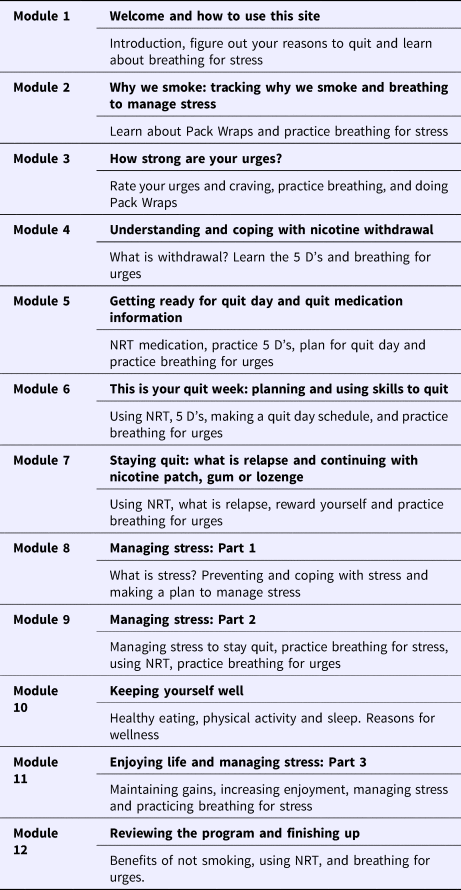
Within 12 modules, including 48 sessions, the intervention content encouraged users to list reasons for quitting, track the circumstances associated with their smoking, learn and practice the five Ds, including deep breathing and other simple coping strategies to use when trying not to smoke (see Table 1). Additionally, users learned about why nicotine replacement therapy (NRT) and other cessation medications can help with quitting and how to talk to a doctor about getting medications. The sessions guided users set a quit date and make a detailed plan for activities during that day. Additional content focused on managing stress without smoking, maintaining use of cessation medication to prevent relapse; and dealing with a slip without relapsing to daily smoking. Sixteen sessions (33%) dealt directly with helping users learn how to cope with urges and deal with stress. The content was also designed to help users maintain their motivation to quit smoking. The skills listed above were demonstrated by male and female characters, whose quit stories unfolded throughout the program.
Let's Talk About Smoking module names and content summary

Each of the 12 modules had three to five sessions, two or three of which contained informational content and two or three of which contained content that prompted and guided skill practice. The sessions were interactive and included video demonstrations, practice exercises, and questions to engage the user and reinforce learning (Binder, Reference Binder1996). The sessions were intended for daily use over 5–10 min each. Key cessation skills, such as using NRT and using breathing to cope with urges, were repeated intermittently throughout the intervention to give users the opportunity to review and practice the skill. Each session ended with fun facts and inspirational quotes that aimed to reinforce use of the session.
The ‘library’
This feature consisted of easy-to-read information on one- or two-page sheets about smoking, quitting, cessation treatment, managing stress, relaxed breathing, and personal reports created by the user (e.g., ‘My Reasons to Quit’). Twelve video quit stories demonstrated successful quitting using cessation treatment. Videos that guided breathing for relaxation and breathing for coping with urges were also available in the library.
Development and design considerations
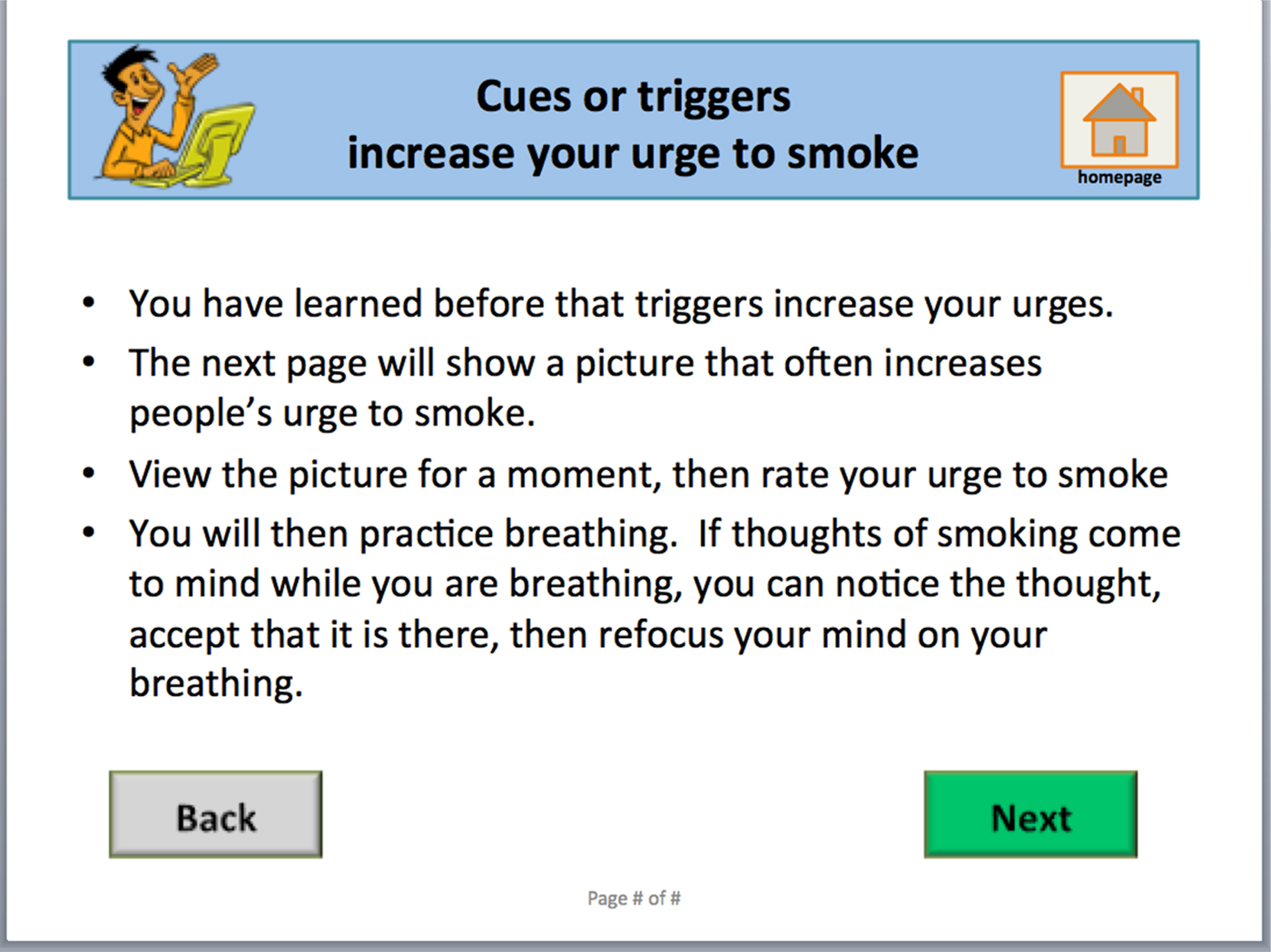
Details of design considerations have been previously published (Brunette et al., Reference Brunette, Rotondi, Ben-Zeev, Gottlieb, Mueser and Robinson2016b). The interface design aimed to minimize reliance on cognitive functions (Mayer & Moreno, Reference Mayer and Moreno2003) that are often impaired in people with SMI (Keefe & Eesley, Reference Keefe, Eesley, Lieberman, Stroup and Perkins2006). We used a ‘weak-modular design,’ including linear sessions with a shallow hierarchy (e.g., only 2–3 links deep) and explicit labels (e.g., descriptive labels on buttons and links) (Rotondi, Eack, Hanusa, Spring, & Haas, Reference Rotondi, Eack, Hanusa, Spring and Haas2015). The sessions, intended to be used in order, guided users to learn smoking cessation information and skills. To improve focus on and learning of the website content, pages were presented sequentially, rather than requiring scrolling down a single page, because scrolling requires simultaneous cognitive skills: assessment of need to scroll, physical hand coordination of scrolling, and continued refocusing on a new area to read. Instead, viewing material on sequential pages guides the user to consume one ‘chunk’ of information at a time (Anonymous, 2010). Pages were designed with large font, simple text or video, and large buttons to enhance user's ability to view, understand, and interact with the content (see Figure 1). Text-to-speech software enabled audio presentation of the content, a feature that also enhances learning and is preferred by people with SMI (Ferron et al., Reference Ferron, Brunette, McGurk, Xie, Frounfelker and Cook2012).
Screenshot of page from Module 4, Session 5: Practice Breathing for Urges.

The intervention was programed for use on computers, tablets, or smartphones. As computers have large screens, keyboards, and mouse capability, which improve viewing and interactive capacity for those with cognition, dexterity, and vision problems, we encouraged participants to use on a laptop computer over phones and tablets. We used the Drupal content management system as the intervention framework and Hypertext Preprocessor (PHP) as the programing language to implement the interactive portions of the website and the user's preference for audio. For text-to-speech capability, we used the Vocalware web service to generate the spoken text on our web server. The Nexmo service was used to generate text messages and emails at preset intervals to remind users to engage with the program. The reminders were sent to users if they had not used the site in the past 3 days, 7 days, and weekly thereafter if they had not used the site.
Overview of study design
The study protocol was approved by the Dartmouth and the New Hampshire Department of Health and Human Services Committees for the Protection of Human Subjects. After providing informed consent, participants completed baseline assessments. Trained research staff then provided a brief, interactive training session on how to access and use the intervention prototype. Participants were then assessed at 4-week and 8-week follow-up visits.
Study participants
Participants were recruited via community mental health clinic (CMHC) waiting room flyers and CMHC clinician invitation. Interested individuals called or met with a trained researcher employed at the CMHC who provided information about the study. If a person was interested and appeared to be eligible, the researcher obtained informed consent, formally assessed eligibility, and completed the baseline assessment that day or within 2 weeks of contact. Inclusion criteria were: age over 17 years, documented clinic chart diagnoses of SMI with associated long-term disability, and receiving outpatient treatment at the mental health center. Participants were daily smokers who stated that they were interested in quitting during the next month. They were fluent in English and willing and able to give informed consent. No prior computer experience was required.
Fifty potential participants were screened, eight were ineligible due to active drug or alcohol dependence, seven were ineligible due to no longer receiving services at the clinic, nine were ineligible because they were not a daily smoker or they were not interested in trying to quit, two were not clinically stable, one was cognitively impaired, and three declined to participate. Twenty were eligible and proceeded with the study.
Intervention and evaluation protocol
After baseline assessment, participants met with a trained research nurse who briefly assessed the participant's technology needs and requirements. If needed, a participant could borrow a laptop computer with a jetpack for wireless Internet, which was checked out to them at this visit. Using a manualized protocol, the research staff instructed participants on how to use the intervention. Participants were required to practice accessing the web-based intervention several times until they demonstrated adequate understanding of the process. The research staff instructed participants to use the website program approximately five times a week. The research nurse then offered each participant a pharmacy voucher for a 2 week supply of nicotine replacement therapy lozenges with an information sheet for standard use according to the package insert, and referred participants to the intervention for information about nicotine replacement therapy. If the participant wished, the researcher would accompany the participant to the pharmacy, one block from the clinic, to obtain the lozenges. Research staff called subjects during the first week to remind them to use the intervention and to provide assistance regarding technical problems. Staff were available for technical assistance at other times as needed. At 4- and 8-week follow-up assessment clinic visits, trained staff interviewed participants to assess smoking characteristics and satisfaction with the intervention. Participants who borrowed a computer returned it at the 8-week study visit.
Measures
Trained research staff reviewed mental health center charts for demographics, psychiatric diagnoses, and insurance status. They conducted a structured interview at baseline and follow-up assessments to obtain additional subject history, mental health symptoms, smoking characteristics, as well as satisfaction with and reactions to the intervention with the following measures. Mental health symptom distress was assessed with the Modified Colorado Symptom Index (Conrad et al., Reference Conrad, Yagelka, Matters, Rich, Williams and Buchanan2001). The six-item Fagerström test for nicotine dependence was used to assess cigarettes per day and nicotine dependence (Heatherton, Kozlowski, Frecker, & Fagerstrom, Reference Heatherton, Kozlowski, Frecker and Fagerstrom1991). Intention to quit was assessed with a single item (DiClemente et al., Reference DiClemente, Prochaska, Fairhurst, Velicer, Velasquez and Rossi1991). Abstinence at follow-up was assessed by obtaining self-reported no smoking for the past 7 days, confirmed by expired breath carbon monoxide ⩽8 ppm using the Bedfont Scientific CoVita Smokelyzer (Haddonfield, NJ). We used this cutoff to be consistent with other smoking cessation studies in people with SMI (Evins et al., Reference Evins, Cather, Pratt, Pachas, Hoeppner and Goff2014), although some researchers use a cutoff of 10 or <10 in this population (George et al., Reference George, Vessicchio, Sacco, Weinberger, Dudas and Allen2008; Williams et al., Reference Williams, Anthenelli, Morris, Treadow, Thompson and Yunis2012) as spending time with other smokers or in smoking environments is common in this group and secondhand smoke leads to higher breath CO.
The administrative function of the intervention provided data on number of logins, number of page views, minutes of use, and session ratings. At the end of each session, the users viewed a page that asked them to rate the session (1 star = I did not like it, 2 stars = I liked it a little, 3 stars = I liked it quite a bit, and 4 stars = I liked it very much). Thus the satisfaction ratings were provided immediately after using the session, and in private to enhance validity and to reduce bias due to social desirability. Additionally, research staff maintained detailed qualitative notes regarding each participant's technical questions and usability problems. At the final visit, an adapted version of the Perceived Usefulness and Ease of Use Scale, a brief, semi-qualitative interview (Davis, Reference Davis1989) gathered reactions to and satisfaction with web-based intervention components.
Statistical analysis
Descriptive statistics were used to characterize the study group as well as to present feasibility and outcome data. The smoking outcome for the participant who did not attend the final assessment was set as smoking, rather than missing.
For time using intervention sessions, we avoided skewing means by setting outlying time data to missing (minutes in use of intervention sessions greater than 3 standard deviations from the mean). Paired t-tests were used to test changes in continuous variables (mean cigarettes/day) over time. Analyses were completed using SAS 9.4.
Results
Participants
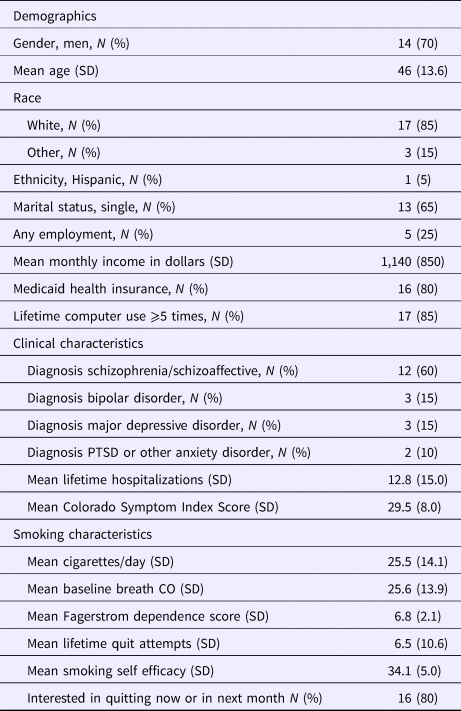
Among the 20 participants, 14 (70%) were men, 12 (60%) were diagnosed with schizophrenia spectrum disorder, and the mean age was 46 (SD = 13.6) years (Table 2). Participants smoked a mean of 25.6 (SD = 14.1) cigarettes per day, had high levels of dependence (mean Fagerström score 6.8, SD = 2.1), and had tried to quit an average of 6.5 (SD = 10.6) times over their lives.
Baseline characteristics of study participants

N, number; SD, standard deviation; PTSD, posttraumatic stress disorder; CO, carbon monoxide.
Intervention and protocol feasibility
Three participants (15%) used the intervention on their smartphone, 17 participants (85%) used the intervention on a computer, including nine who borrowed a computer and jetpack hotspot to use the intervention; all participants returned the computer fully intact. Participants accessed an average of 23.6 (SD = 17.05; median = 17.5; range 1–48) of the 48 sessions. They accessed the intervention on an average of 12.05 (SD = 10.57; median = 9, range 2–28) days and used it for an average of 231.64 (SD = 227.13; median = 158.18; range 4.89–955.21) min over the 8-week period. The average amount of time spent on each learning session ranged from 4.4 to 23.1 min (SD from 1.6 to 24.7). Eleven participants reported that they used nicotine replacement therapy to some degree during the treatment period (nine used lozenge, one used patch, three used gum, and two of the lozenge users also used gum). Participants did not obtain other cessation pharmacotherapy.
Participation in the research assessment protocol was very high. Nineteen of the 20 participants (95%) returned for the research assessment at the 2-month follow-up.
Intervention usability
Two participants (10%) were observed to have significant barriers in using the intervention due to their mental illness. One participant continued to have difficulty with dexterity and information processing despite extensive coaching, so he decided to use the website with his therapist. After completing the first eight modules, another participant was concerned that the computer might be monitoring her; these feelings of paranoia led her to stop using the intervention.
Satisfaction and qualitative feedback
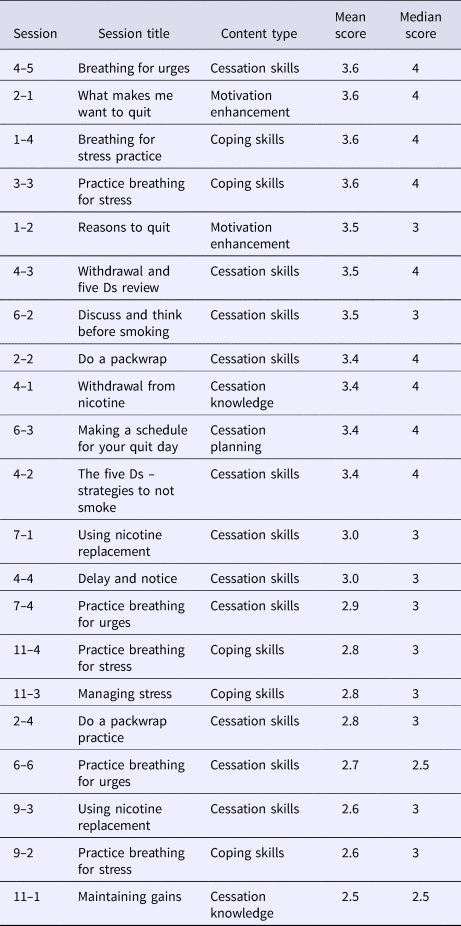
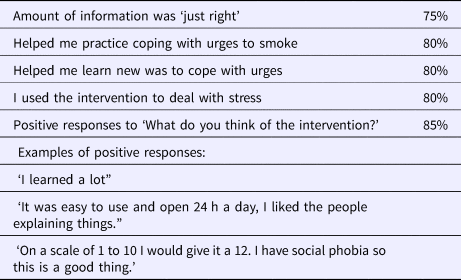
Most participants reported they were highly satisfied with the website. Participants rated 87% of the sessions 3 or greater on a 1–4 scale (4 = ‘I liked it very much’). The highest rated sessions are shown in Table 3, and included a range of core content related to increasing motivation and learning skills for coping and quitting. As shown in Table 4, most participants provided positive feedback about the amount and type of information and activities in the intervention. For example, one participant said, ‘It was easy to use and open 24 h a day, I liked the people explaining things.’
Highest and lowest scoring sessions in Let's Talk About Quitting Smoking (range 1–4)

Participant feedback regarding intervention

Seven of the 10 lowest rated sessions were sessions that repeated content that had previously been presented at least twice and were rated highly the first time they were presented (e.g., practicing breathing, doing a packwrap, and coping with stress), but even these sessions received an average of 2.5 on a 1–4 scale (Table 3). Four participants (20%) said they either they did not like the repetition of some content or that the intervention contained too much information. One participant with extensive computer experience found the program ‘too easy’ and ‘repetitive.’ When asked, ‘what would make the website more helpful to people like you who are trying to quit smoking,’ participant suggestions included: Improve the quality of audio and its' functionality on phones, less repetition, and more time (e.g., weeks) to use the intervention.
Efficacy
At the 8-week assessment, one-quarter (n = 5) of participants had reduced the number of cigarettes they smoked per day, and 10% (n = 2) had biologically verified abstinence from smoking. Mean cigarettes per day were 25.6 (SD = 14.07) at baseline and 20.31 (SD = 11.69) at the 8-week follow-up (p = 0.10).
Discussion
We tested a web-based smoking cessation intervention with evidence-based cessation content and tailored design to enhance usability (Ferron et al., Reference Ferron, Brunette, McHugo, Devitt, Martin and Drake2011; Rotondi et al., Reference Rotondi, Sinkule, Haas, Spring, Litschge and Newhill2007) within a second developmental study among 20 smokers with SMI. In this 8-week, ‘low touch’ pilot study of the Let's Talk About Quitting Smoking intervention, participants were able to independently use the intervention, reported high satisfaction, and 10% achieved biologically verified point prevalence abstinence.
Regarding usability and feasibility of intervention and the study protocol, overall participation in the website was high among the majority of participants after one to two sessions of training and technical assistance. Participants used just under half of the sessions on average, but amount of use varied from very low to very high. This is consistent with variations in engagement seen within in-person, telephone, and other web-based interventions in which participants are not paid to attend sessions. For example, in a recent study of two website-based cessation interventions (Bricker et al., Reference Bricker, Sridharan, Zhu, Mull, Heffner and Watson2018), about 50% of participants used the intervention websites for 1 week out of the 52-week intervention period. Participation in this study protocol was also very high – only one of 20 (5%) dropped out of the study protocol at the 8-week follow-up. Interactions with the research staff, who briefly coached participants in website use and provided technical assistance as needed, clearly facilitated use of the intervention and may be an important component of technology-based interventions in people with SMI (Ben-Zeev, Drake, & Marsch, Reference Ben-Zeev, Drake and Marsch2015; Brunette et al., Reference Brunette, Rotondi, Ben-Zeev, Gottlieb, Mueser and Robinson2016b; Gottlieb, Romeo, Penn, Mueser, & Chiko, Reference Gottlieb, Romeo, Penn, Mueser and Chiko2013).
Regarding satisfaction, participants rated the most of the content very highly. Ratings were made privately by clicking on stars immediately at the end of each session, representing immediate reactions to the content, and avoiding bias due to social desirability. The planned repetition of key content was acceptable to most of the study group, but a small minority did not like the repeated opportunities to practice skills. For example, the top scoring session was ‘Breathing for urges,’ a behavioral session appearing in Module 4. Two of the lowest scoring sessions were ‘Practice breathing for urges,’ which appeared in Modules 6 and 7. Other factors could explain low scores on some sessions, although we did not see other patterns in the session scores, including a preference for supportive vs. behavior change content. In future implementation of the intervention, instructions for practice sessions could be edited to help users avoid unwanted repetition, the text to speech software could be upgraded, while the overall intervention content, including high-quality videos should be maintained.
Cessation outcomes from this pilot trial were promising. Ten percent of users quit, and 25% cut down on their smoking after using the website for 8 weeks, a rate that is comparable with endpoint outcomes attained by Internet-based interventions used by smokers in the general population (Civljak, Stead, Hartmann-Boyce, Sheikh, & Car, Reference Civljak, Stead, Hartmann-Boyce, Sheikh and Car2013; Etter, Reference Etter2006; Swartz, Noell, Schroeder, & Ary, Reference Swartz, Noell, Schroeder and Ary2006; Taylor et al., Reference Taylor, Dalili, Semwal, Civljak, Sheikh and Car2017). Abstinence outcomes were similar or better than previous trials testing supported referral to a telephone Quitline among smokers with SMI (Brunette et al., Reference Brunette, Pratt, Bartels, Scherer, Sigmon and Ferron2018; Morris et al., Reference Morris, Waxmonsky, May, Tinkelman, Dickinson and Giese2011).
Regarding cutting down, return to a previous level of smoking after cutting down is common among smokers, but cutting down on cigarettes has also been shown to be a step toward cessation (Hughes & Carpenter, Reference Hughes and Carpenter2006). Further, cutting down has been associated with reduced mortality among heavy smokers (e.g., Gerber, Myers, & Goldbourt, Reference Gerber, Myers and Goldbourt2012). Planned smoking reduction has been explicitly studied as a behavioral strategy used with medication for cessation (Klemperer, Hughes, Solomon, Callas, & Fingar, Reference Klemperer, Hughes, Solomon, Callas and Fingar2017; Wang et al., Reference Wang, Connock, Barton, Fry-Smith, Aveyard and Moore2008; Wu, Sun, He, & Zeng, Reference Wu, Sun, He and Zeng2015). While smoking reduction was not a planned outcome for this study, this behavioral intervention does contain content reviewing how to use NRT or behavioral strategies such as positive self talk and distraction to ‘skip cigarettes’ prior to a quit attempt as well as to avoid smoking to prevent relapse among those who have become abstinent. Although use of NRT was recommended by the intervention, only about half of participants even tried NRT, thus future implementations with this tool would need to utilize additional strategies to support use of NRT and other pharmacotherapy.
This technology-delivered intervention with evidence-based content for smokers with SMI impairments (who have very high rates of smoking) would be scalable within settings that do not have tobacco treatment specialists readily available, such as mental health clinics, primary care clinics, or peer support centers (Ben-Zeev et al., Reference Ben-Zeev, Drake and Marsch2015; Brunette et al., Reference Brunette, Rotondi, Ben-Zeev, Gottlieb, Mueser and Robinson2016b).
Limitations of this pilot study included enrollment (by design) of a small number of participants at one clinic with limited gender and racial/ethnic diversity. Prototype testing with small numbers is a cost effective strategy to enable rapid evaluation of new technology tools or to test tools in new populations (Hall, Reference Hall2001; IDEO.org, 2015). Usability and feasibility testing is a key component of website development that can ensure that the intended users are able to benefit from the website (Stoddard et al., Reference Stoddard, Augustson and Mabry2006). Future controlled studies are needed to test the efficacy of this promising mobile strategy to deliver standard behavioral cessation treatment tailored for people with SMI.
Conclusions
This pilot study indicates that use of this tailored, cessation intervention on home laptop computers or smartphones is feasible and promising among people with schizophrenia and other SMIs. Further controlled research is needed to evaluate efficacy. Mobile behavioral interventions have the capacity to dramatically extend the reach of behavioral treatment for this population of smokers.
Author ORCIDs
Mary F. Brunette, 0000-0002-0713-8745
Financial support
Funding for this research was provided via a pilot grant to Brunette from National Institute on Drug Abuse P30DA029926 (Marsh), from the National Cancer Institute R01CA168778 (Brunette), and from the Centers for Disease Control and Prevention U48DP005018 (Adachi). The findings and conclusions in this paper are those of the authors and do not necessarily represent the official position of the funding agencies.
Conflict of interest
Dr. Brunette had funding from Alkermes to conduct research on medication for the treatment of schizophrenia and alcohol use disorder. The remaining authors report no known conflicts of interest.
Ethical standards
The authors assert that all procedures contributing to this work comply with the ethical standards of the relevant national and institutional committees on human experimentation and with the Helsinki Declaration of 1975, as revised in 2008.