INTRODUCTION
Dioxygen and its chemical derivatives such as superoxide anions, hydroxyl radicals and hydrogen peroxide emerged in the earth's biosphere as by-products of cellular metabolism. Living organisms have developed various defence mechanisms to cope with these highly aggressive chemicals. Antioxidant enzymes including superoxide dismutase, catalase, peroxidase and oxygenases are a primary defence against reactive oxygen molecules (reviewed in Jaenicke and Decker, Reference Jaenicke and Decker2004). Tyrosinases (EC 1·14·18·1) are also contributable to the removal of oxygen by incorporating the molecule into organic compounds. The enzymes catalyse hydroxylation of tyrosine into dihydroxyphenylalanine (DOPA; monophenol oxidase activity) and oxidation of DOPA into DOPA quinone (diphenol oxidase activity) (Sánchez-Ferrer et al. Reference Sánchez-Ferrer, Rodríguez-López, García-Cánovas and García -Carmona1995). Tyrosinases contain a binuclear copper active site and form the type-3 copper protein family together with catecholoxidases, which mediate oxidation of o-diphenols to quinones, and hemocyanins, which act as oxygen carriers (Decker and Tuczek, Reference Decker and Tuczek2000; Burmester, Reference Burmester2002; Aguilera et al. Reference Aguilera, McDougall and Degnan2013).
Tyrosinases are ubiquitously distributed across a variety of taxa ranging from bacteria to mammals, which demonstrates their early origin in the evolution of life (van Gelder et al. Reference van Gelder, Flurkey and Wichers1997; Andreini et al. Reference Andreini, Banci, Bertini and Rosato2008; Aguilera et al. Reference Aguilera, McDougall and Degnan2013). Nonetheless, the proteins exhibit substantial difference in primary structure, which affects the substrate binding pocket and the substrate accessibility, and the composition of functional domains related to the taxonomical positions of donor organisms (van Gelder et al. Reference van Gelder, Flurkey and Wichers1997; Aguilera et al. Reference Aguilera, McDougall and Degnan2013). This structural heterogeneity seems to play an important role in the functional diversification of tyrosinases including roles in pigmentation, innate immunity, sclerotization and wound healing (Aguilera et al. Reference Aguilera, McDougall and Degnan2013 and references therein). Based on the structural conservation and domain architecture, tyrosinases are categorized into three subclasses, namely secreted α-, cytosolic β-, and membrane-bound γ-subclasses (Aguilera et al. Reference Aguilera, McDougall and Degnan2013). The multifaceted tyrosinase genes might be descendent from a common ancestor via two ancient gene duplication events in metazoan animals, which was followed by the differential loss and expansion of the multiplied genes in specific phyla (Burmester, Reference Burmester2002; Esposito et al. Reference Esposito, D'Aniello, Squarzoni, Pezzotti, Ristoratore and Spagnuolo2012; Aguilera et al. Reference Aguilera, McDougall and Degnan2013).
In parasitic trematodes, tyrosinases provide enzymatic activity essential for the formation of eggshells (Cordingley, Reference Cordingley1987). The proteins are produced in mature vitellocytes and packed within a secreting vacuole, termed vitelline droplet, together with eggshell precursor proteins (Smyth and Halton, Reference Smyth and Halton1983). Following activation in the ootype, tyrosinases convert tyrosine residues on eggshell proteins into DOPA quinones. The DOPA quinones are then cross-linked to other amino acids such as tyrosine and lysine on adjacent proteins to form the sclerotized eggshell (Cordingley, Reference Cordingley1987). The cross-linking reactions are accompanied by changes in the colour and autofluorescence of the eggshell components (Kelly and von Lichtenberg, Reference Kelly and von Lichtenberg1970). Trematode tyrosinases display high degrees of similarity in their structural properties and spatial expression patterns, as has been demonstrated in Schistosoma mansoni (Fitzpatrick et al. Reference Fitzpatrick, Hirai, Hirai and Hoffmann2007), Schistosoma japonicum (Cai et al. Reference Cai, Bae, Zhang, He, Jiang and He2009), Clonorchis sinensis (Bae et al. Reference Bae, Cai, Kim, Sohn and Kong2013), and Paragonimus westermani (Bae et al. Reference Bae, Kim, Ahn, Kim and Kong2015).
Clonorchis sinensis is a digenean trematode that parasitizes the bile ducts of mammalian hosts including humans. Human infection (i.e. clonorchiasis) occurs by eating raw or undercooked freshwater fish containing infective metacercariae of the parasite. Clonorchiasis is prevalent in several areas of Asian countries such as China, Korea and Vietnam, where it causes great socio-economic and public health burdens (Lun et al. Reference Lun, Gasser, Lai, Li, Zhu, Yu and Fang2005). Approximately 35 million people suffer from the parasitic disease (Keiser and Utzinger, Reference Keiser and Utzinger2009). In addition to the typical clinical symptoms including abdominal pain, mechanical obstruction of the hepatobiliary ducts, cholangiectasis and biliary stones (Lun et al. Reference Lun, Gasser, Lai, Li, Zhu, Yu and Fang2005), chronic infection of C. sinensis in humans appears to lead to high incidences of cholangiocarcinoma (Bouvard et al. Reference Bouvard, Baan, Straif, Grosse, Secretan, El Ghissassi, Benbrahim-Tallaa, Guha, Freeman, Galichet and Cogliano2009; Shin et al. Reference Shin, Oh, Masuyer, Curado, Bouvard, Fang, Wianqnon, Sripa and Hong2010). The egg of parasitic helminthes is not only responsible for maintenance of the parasitic life cycle and their population growth, but is also an etiological factor that induces chronic inflammation (Cho et al. Reference Cho, Kong, Yun, Kang, Kim, Chung and Yang2000; Hoffmann et al. Reference Hoffmann, Wynn and Dunne2002; Fairfax et al. Reference Fairfax, Amiel, King, Freitas, Mohrs and Pearce2012). Therefore, understanding of the evolution of egg formation-related genes and their induction profiles in response to particular host environments is essential for the development of strategies to control infectious diseases caused by egg-laying parasites.
In this study, we analysed tyrosinase genes isolated in the genomes of C. sinensis and other digenean trematodes by focusing on the characterization of their evolutionary history. Cestode and planarian genomes were included in the primary screening to form comparative groups. Induction profiles of individual paralogous genes were also examined in C. sinensis during its maturation/development and in response to the exogenous stimuli specific in the infected host environment such as O2 and bile.
MATERIALS AND METHODS
Genome- and transcriptome-wide survey of tyrosinase genes
The draft genome sequences of multiple species selected for this study, including that of C. sinensis, were downloaded from each of the web-based databases indicated in Supplementary Fig. 1. The databases included the Chinese National Human Genome Center at Shanghai (http://lifecenter.sgst.cn/schistosoma/cn/schistosomaCnIndexPage.do), GenBank (http://www.ncbi.nlm.nih.gov/), GeneDB (http://www.genedb.org/), Joint Genome Institute (JGI, http://genome.jgi-psf.org), Sanger Institute (http://www.sanger.ac.uk/) and SmedGD (http://smedgd.neuro.utah.edu/). The genomic sequences were queried with the tyrosinase sequences of Neurospora crassa (CAE81941), C. sinensis (GAA27975, GAA32069, GAA48882 and GAA48883; Bae et al. Reference Bae, Cai, Kim, Sohn and Kong2013), Caenorhabditis elegans (NP_491709) and human (NP_000363) through a series of searches with the stand-alone and web-based Basic Local Alignment Search Tool (BLAST). Transcriptomic and proteomic databases were similarly surveyed in their respective databases or in GenBank. Redundant expressed sequence tag (EST) sequences were aligned with one another using the CAP3 program (Huang and Madan, Reference Huang and Madan1999) to construct a consensus contig. Nucleotide sequences obtained from the transcriptome and/or EST databases were further used as queries for the BLAST searches of genomic sequences. Finally, the retrieved proteins or coding DNA sequences (CDSs) were filtered to eliminate redundant sequences, by comparing chromosomal gene sequences matched to the respective molecules. Otherwise, a 95% similarity cutoff was considered for speciation of paralogous proteins. Open reading frames (ORFs) and translated amino acid sequences of all transcripts were predicted using ORF Finder (http://www.ncbi.nlm.nih.gov/). The similarity patterns and specific HMM profiles of the putatively translated amino acid sequences were analysed using BLASTp (E-value cutoff 1 × 10⁻⁵) and InterProScan (version 5.0; http://www.ebi.ac.uk/Tools/pfa/iprscan5/), respectively. The hydrophobic signal peptides and transmembrane domains were examined using SignalP (http://www.cbs.dtu.dk/services/SignalP/) and TMPred (http://www.ch.embnet.org/software/TMPRED_form.html).
The identities (or names) of tyrosinases are distinguished by their protein accession numbers for convenience. For those genes, of which protein products were not retrieved, the accession numbers of expressed sequence tags are presented as their unique identities.
Phylogenetic analyses
The full amino acid sequences of the trematode tyrosinase-like proteins were aligned using MUSCLE (Edgar, Reference Edgar2004) and manually optimized using GeneDoc (Nicholas and Nicholas, Reference Nicholas and Nicholas1997). The alignment was examined with ProtTest (version 2.4; Abascal et al. Reference Abascal, Zardoya and Posada2005) to determine the best-fit model of protein sequence evolution. Based on the LG + G + I model as selected by ProtTest, a phylogenetic analysis was conducted using Bayesian inference implemented in MrBayes (version 3.2.6; Ronquist and Huelsenbeck, Reference Ronquist and Huelsenbeck2003) through the server at CIPRES Science Gateway V.3.3 (https://www.phylo.org/). Bayesian posterior probabilities were calculated by the Markov chain Monte Carlo (MCMC) method (2 × 10⁶ generations, two runs with four chains, sampling every 1000 generations). The default values of the program were used to set the other parameters. A 50% majority-rule consensus tree was made with multiple phylogenetic trees to determine the posterior probabilities at different nodes. In addition, a maximum likelihood tree was constructed with PhyML (version 3.1; Guindon et al. Reference Guindon, Dufayard, Lefort, Anisimova, Hordijk and Gascuel2010) by selecting identical substitution model. Branch support was inferred using the non-parametric Shimodaira-Hasegawa-like approximate likelihood ratio test (SH-aLRT) provided by PhyML. The resulting tree was displayed by TreeView (Page, Reference Page1996). Position-by-position evolutionary rates were estimated using the MEGA program (Tamura et al. Reference Tamura, Stecher, Peterson, Filipski and Kumar2013).
Analysis of exon-intron architectures and chromosomal synteny
Chromosomal DNA sequences of tyrosinase genes were extracted from genomic databases of donor organisms by web-based or stand-alone BLAST searches using CDSs of the respective genes. The exon-intron architectures were determined by aligning the genomic sequences with their CDSs. The accuracy of exon-intron boundaries were verified by confirming the presence of the splice site consensus sequence (GT-AG rule; Mount, Reference Mount1982). The intron sites were compared to one another by referencing their positions in the sequence alignment of tyrosinase proteins, which was used in the phylogenetic analysis. The insertional phase of each intron relative to the reading frame was also examined (phase 0, between two consecutive codons; 1, between the first and second bases of a codon; 2, between the second and third bases of a codon).
Chromosomal segments or scaffolds encompassing the tyrosinase gene loci were retrieved from the genome browsers of Schmidtea mediterranea (SmedGD version 3.1; http://smedgd.neuro.utah.edu/) and S. mansoni (SchistoDB versions 3.0 [http://schistodb.net/schisto/] or Sanger Institute). Genome browsers in GenBank were scanned to obtain the chromosomal tyrosinase maps in C. sinensis and Opisthorchis viverrini. The nucleotide sequences of these segments were compared with those of C. sinensis in a pairwise manner using the BL2Seq program at NCBI (expect threshold: 0·001 for comparison between C. sinensis and O. viverrini sequences; 10 in other cases). GenBank proteomic databases of the respective species were also examined with the amino acid sequences of C. sinensis proteins detected in the retrieved segments (BLASTp algorithm; E-values < 1 × 10⁻⁶). A match of target species with the highest BLAST score was considered to be syntenic, if it occupied a region near tyrosinase in the corresponding chromosomal segments. The relative position and orientation of the proposed syntenic genes were also compared during the analysis.
Expression profiles of C. sinensis tyrosinase genes
Clonorchis sinensis metacercariae, which were collected from freshwater fish in an area of Korea, were administered orally into the stomach of Sprague-Dawley rats through a gavage needle (150 metacercariae per rat). Worms were collected from the rat's bile ducts at regular intervals from 4 to 140 days post-infection (dpi). Protocols for C. sinensis infection, maintenance of animals and recovery of the parasite under anaesthesia were approved by the Institutional Review Board of Gachon University (protocol number GIACUC-R2014005). Animals were housed in accordance with guidelines from the Association for the Assessment and Accreditation of Laboratory Animal Care (Thailand).
Total RNAs were extracted from C. sinensis worms (>30 worms/stage) using QIAzol solution and an RNeasy Mini kit (Qiagen, Hilden, Germany). Following removal of contaminating DNAs using an RNase-free DNase (New England Biolabs, Ipswich, MA), the RNAs were used in the complementary DNA (cDNA) synthesis with the iScript cDNA synthesis kit (Bio-Rad, Munich, Germany). Relative amounts of tyrosinase transcripts in the cDNA samples were estimated via quantitative real-time polymerase chain reaction (qPCR) with gene-specific primers (Supplementary Table S1). The C. sinensis β-actin gene (DF143505) was selected as a reference gene. The qPCR was conducted using the SYBR Green Master Mix and the CFX96 detection system following the manufacturer's instructions (Bio-Rad Laboratories, Hercules, CA). Control reactions without cDNA samples were included and melt curve analyses were performed to ensure the presence of a single amplicon. Each reaction was conducted in triplicate and the results were presented as mean ± standard deviation (s.d.). The relative expression level of each gene was calculated against the reference β-actin gene (2−ΔCT ; Livak and Schmittgen, Reference Livak and Schmittgen2001). Student's t tests were used for statistical analysis. A probability level (P value) of <0·05 was considered to be statistically significant.
Live 28-day-old C. sinensis worms (10 worms/group) were incubated with RPMI-1640 media (phenol red- and serum-free, pH 7·2) supplemented with various amounts of bile salts (0·01, 0·02 and 0·04%; Sigma-Aldrich, Oakville, ON, Canada) at 37 °C in 5%-CO2 incubators. Using N2 gas, the O2 levels in the incubators were equilibrated to 1, 5 and 20%, respectively, during the incubation period. After 8 h incubation, the fold change in expression of tyrosinase genes was calculated with respect to that in un-incubated C. sinensis worms (2−ΔΔCT method; Livak and Schmittgen, Reference Livak and Schmittgen2001) via the quantitative reverse transcription PCR (qRT-PCR) method as described above. The 7- and 12-day-old worms (50 worms per group) were similarly incubated for 8 h under the 20%-O2 conditions. Total RNAs were extracted from the worms, as well as from un-incubated worms of the same ages. The RNA samples were used in the qRT-PCR analysis to estimate the relative expression levels of tyrosinase genes (2−ΔCT method).
RESULTS
Tyrosinase genes in the platyhelminth genomes
The tyrosinase genes in the draft genomes of parasitic flatworms were analysed by a series of BLAST searches. In addition to the four genes described in our earlier work (Bae et al. Reference Bae, Cai, Kim, Sohn and Kong2013), a partial sequence encoding a further tyrosinase (GAA54899) was detected in the C. sinensis genome (Trematoda: Opisthorchiida; see also Aguilera et al. Reference Aguilera, McDougall and Degnan2013). Schistosoma mansoni and S. japonicum (Trematode: Strigeidida) genomes encoded two paralogous genes, as were described in previous reports (Fitzpatrick et al. Reference Fitzpatrick, Hirai, Hirai and Hoffmann2007; Cai et al. Reference Cai, Bae, Zhang, He, Jiang and He2009). Additional proteins detected in the proteomic databases of these parasites were either allelic variants (identity values >95%) or simple redundant versions. The redundancy was verified by overlapping the genomic loci of two proteins in question. In O. viverrini (Trematoda: Opisthorchiida), five genes appeared to comprise tyrosinase paralogs (XP_009170910-1, XP_009170910-2, XP_009170911, XP_009173140 and XP_009169523; see next section), whereas Fasciola hepatica (Trematoda: Plagiorchiida) contained two tyrosinase genes (CCMX01034015 and CCMX01024173). Similar to the fifth C. sinensis tyrosinase, O. viverrini gene encoding the XP_009169523 protein was found to be partially determined. No tyrosinase gene was retrievable from the cestodes, including Echinococcus granulosus, Echinococcus multilocularis, Taenia solium (Cestoda: Cyclophyllidea: Taeniidae) and Hymenolepis microstoma (Cestoda: Cyclophyllidea: Hymenolepididae). However, a protein identified in the GenBank database of Spirometra erinaceieuropaei (AGC74039; Cestoda: Diphyllobothriidea: Diphyllobothriidae) showed strong structural similarity to the γ-subclass tyrosinases (E-values < 8 × 10−60 in a BLASTp search).
The draft genome and transcriptome shotgun assembly (TSA)/EST databases of S. mediterranea (Platyhelminthes: Turbellaria: Tricladida) were also queried to obtain tyrosinase sequence information. Multiple transcripts detected in the planarian TSA/EST databases were assigned to six tyrosinase genes (GAKN01000997, GAKN01006835/GAKN01006427, GAKN01001049, GAKN01005471, GAKN01007889/GAKN01004968 and JN983828/AY067481). The chromosomal loci of these genes were mapped to different genomic contigs (contig numbers 7108, 5589, 1071, 2182, 116 and 627, respectively). The current GenBank databases of other turbellarians did not include any gene/protein orthologous to the S. mediterranea tyrosinases. Multiple γ-subclass tyrosinases were identified in other metazoan taxa such as Capitella teleta (Annelida), Saccoglossus kowalevskii (Hemichordata), Ciona intestinalis (Tunicata) and Branchiostoma floridae (Cephalochordata), as well as species in the Craniata (see next section). Of these, C. intestinalis and S. kowalevskii contained additional genes homologous to α- and/or β-subclass tyrosinases. All the proteins identified in other organisms shown in Supplementary Fig. 1, including C. elegans (Nematoda), Daphnia pulex (Crustacea), Lottia gigantean (Mollusca) and Nematostella vectensis (Cnidaria), exhibited much higher similarity to the C. elegans protein (NP_491709; σ-subclass), which was in agreement with previous studies (Esposito et al. Reference Esposito, D'Aniello, Squarzoni, Pezzotti, Ristoratore and Spagnuolo2012; Aguilera et al. Reference Aguilera, McDougall and Degnan2013; Bae et al. Reference Bae, Cai, Kim, Sohn and Kong2013). No tyrosinase homolog was identified in the genomes of Strongylocentrotus purpuratus (Echinodermata), Trichoplax adhaerens (Placozoa) and Monosiga brevicollis (Choanoflagellata). Interestingly the basal metazoan species Suberites domuncula (Demospongiae) possessed a tyrosinase gene of γ-subclass (CAE01389).
Phylogenetic relationships among platyhelminth tyrosinases
The primary structures of platyhelminth tyrosinases were compared with those of other γ-subclass tyrosinases and tyrosinase-related proteins. The full amino acid sequences of these proteins, rather than narrow-region restrictions, were thoroughly aligned (data not shown; for examples, see Bae et al. Reference Bae, Cai, Kim, Sohn and Kong2013, Reference Bae, Kim, Ahn, Kim and Kong2015). These proteins displayed similarities in their domain architecture, which comprised the Cys-rich epidermal growth factor-like domain (ELD) and a binuclear copper centre (Aguilera et al. Reference Aguilera, McDougall and Degnan2013; Bae et al. Reference Bae, Cai, Kim, Sohn and Kong2013). Hydrophobic amino acids were primarily detected in the N- (signal peptide) and C-terminal (transmembrane domain) ends of tyrosinase-like proteins identified in the sponge and deuterostomians with a few exceptions. However, the C-terminal transmembrane domain was absent in the majority of the platyhelminth proteins. In addition to the annelide proteins, only a single S. mediterranea protein (JN983828) contained the transmembrane domain. The structural analysis further suggested that one of the O. viverrini proteins (XP_009170910) was an artificial concatemer comprising two distinct polypeptide sequences. Unique identities of these ligated proteins, annotated as XP_009170910-1 and XP_009170910-2, were confirmed by the isolation of ESTs, specifically matched to the respective proteins (Ov_Contig3473/Ov_Contig396 and OV1_c1641). After removal of gaps (coverage cutoff 95%), the alignment was used in the phylogenetic analyses (380 amino acid positions; Supplementary File 1).
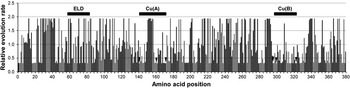
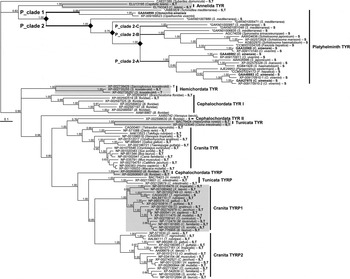
The relative evolutionary rate of each amino acid position differed in the trimmed alignment, while the rates were substantially low in the Cu(B) domain (Fig. 1). A Bayesian phylogenetic tree rooted with the S. domuncula protein (CAE01389) separated lophotrochozoan proteins from their deuterostomian homologs (posterior probabilities 0·83 and 0·99; Fig. 2). The lophotrochozoan tyrosinases were distinctly grouped according to their donor organisms at the phylum level (Annelida vs Platyhelminthes; posterior probabilities 1·00). Tyrosinases identified in platyhelminths were divided into two major clades, which were designated P_clade 1 and P_clade 2 (posterior probabilities 0·99 and 1·00), of which the later clade further split into multiple sub-clades; most of the trematode proteins comprised two paraphyletic sub-clades (P_clade 2-A and P_clade 2-B; posterior probabilities 1·00), while the C. sinensis GAA54899 and O. viverrini XP_009169523 proteins belonged to the more ancient P_clade 1. Two S. mediterranea proteins were included in the P_clade 2-B (GAKN01006835; posterior probability 1·00) and P_clade 1 (JN983828; posterior probability 0·99), respectively. Meanwhile, a pair of S. mediterranea proteins (P_clade 2-C; posterior probability 1·00) showed polytomic relationships with the subclades P_clade 2-A and P_clade 2-B. Genes encoding the two remaining Schmidtea proteins (GAKN01005471 and GAKN01007889) seemed to be originated from a series of gene duplication, which had occurred during an early evolutionary phase of the P_clade 2 lineage. The deuterostomian proteins other than those of S. kowalevskii were clustered into either the tyrosinase (TYR) or tyrosinase-related protein (TYRP) clades. A member(s) of TYRP clade was not identified in S. kowalevskii. In a maximum-likelihood tree, these tyrosinase proteins showed phylogenetic relationships similar to those observed in the Bayesian tree (Supplementary Fig. 2).
Position-by-position evolutionary rates of platyhelminth tyrosinase sequences. The amino acid sequences of platyhelminth tyrosinases were aligned and used to estimate the relative evolutionary rate at each amino acid position by using the maximum likelihood algorithm of MEGA. Black bars mark the positions of major functional domains including the epidermal growth factor-like domain (ELD) and the binuclear copper center [Cu(A) and Cu(B)]. Arrowheads indicate histidine residues that comprise the active centre.

Bayesian phylogenetic tree of tyrosinases (TYR) and tyrosinase-related proteins (TYRP) in animal taxa including Clonorchis sinensis (bold letters). The 50% majority-rule consensus tree was constructed using the alignment of their amino acid sequences with MrBayes and rooted with the Suberites domuncula protein (CAE01389). The identity of each protein was distinguished by its GenBank accession number and the scientific name of its donor organism in parenthesis. Italicized accession numbers with asterisks denote proteins, for which sequence information was predicted using mRNA sequences. The numbers at the nodes represent Bayesian posterior probabilities. Proteins conserving a signal peptide and transmembrane domain are marked with ‘S’ and ‘T’, respectively. P_clade 1 and 2 categorize members of two major lineages detected in the subtree of platyhelminth proteins. Solid diamonds indicate nodes that represent the gene duplication events, which may have occurred in the common ancestors of turbellarians and neodermatans.

Chromosomal features of tyrosinase genes
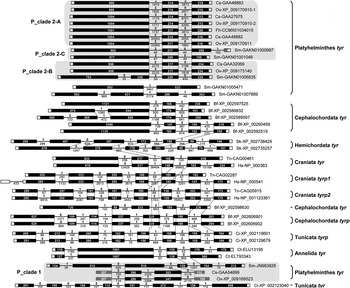
Chromosomal sequences of the major trematode genes composed of three exons and two introns, of which positions and phases were tightly conserved among these orthologs (P_clade 2-A and P_clade 2-B; Fig. 3). The S. mediterranea genes closely related to the sub-lineages possessed introns at orthologous positions, whereas Smed-GAKN01000997 and Smed-GAKN01006835 were found to have gained a third intron in their 3′- and 5′-region, respectively. The exon-intron architectures were significantly different in the other S. mediterranea genes (GAKN01005471, GAKN01007889 and JN983828), while the JN983828 gene shared two orthologous introns with the P_clade 1 lineage genes of C. sinensis (GAA54899) and O. viverrini (XP_009169523). Genes identified in other taxa showed respective conservation patterns related to the phylogenetic positions of donor organisms. Instances of intron conservation across the animal taxa were also observed in the structural comparison. Interestingly, Capitella genes shared an intron with the most ancestral S. mediterranea gene (JN983828; Fig. 3).
Exon-intron composition of tyrosinase (tyr) and tyrosinase-related protein (tyrp) genes. Coding DNA sequences are presented with solid squares in proportion to their relative sizes and the 5′- and 3′-untranslated regions are marked with open squares with a voluntary length. The partially determined exons in the P_clade 1 genes of Clonorchis sinensis and Opisthorchis viverrini are marked with grey squares. Intervening introns are indicated by solid lines with a fixed length. The lengths of exons and introns in bp are indicated at the corresponding positions. Numerals 0, 1 and 2 show the phases of each intron. Orthologous introns that share positioning and phase among tyrosinase genes are indicated by vertical dotted lines Species abbreviations used are Cs, Clonorchis sinensis; Ov, Opisthorchis viverrini; Fh, Fasciola hepatica; Sm, Schmidtea mediterranea; Bf, Branchiostoma floridae; Sk, Saccoglossus kowalevskii ; Tn, Tetraodon nigroviridis; Hs, Homo sapiens; Ci, Ciona intestinalis; and Ct, Capitella teleta.

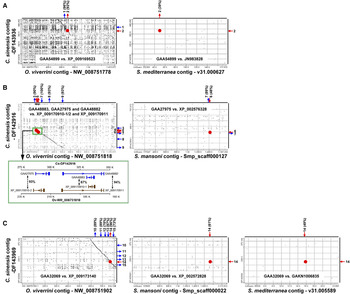
The nucleotide sequences of genomic scaffolds occupied by tyrosinase genes were compared between C. sinensis and other platyhelminths using BL2Seq (Fig. 4). Clonorchis sinensis scaffold (DF142916) containing tyrosinases of the P_clade 2-A lineage displayed a significant similarity to the counterpart sequence of O. viverrini (NW_008751818; 87% nucleotide identity over 400-kb stretch). BLASTp searches revealed that four genes residing near tyrosinases have syntenic relationships in these parasites (E-values < 2 × 10−96, blue arrows in upper panel of Fig. 4). Relative orientations of these syntenic genes were also preserved in the homologous blocks. Of the three tyrosinase genes, two genes were separated by approximately 11 kb- and 15 kb-agenic regions in C. sinensis and O. viverrini, respectively, whereas the third gene was located opposite in the first intron of the other tyrosinase gene (green box in Fig. 4). Furthermore, these liver flukes possessed conserved nucleotide blocks approximately 260 kb (76% identity, six syntenic genes) and 190 kb (81% identity, two syntenic genes) in length that encompassed tyrosinase genes of the P_clade 2-B and P_clade 1 lineages, respectively. In S. mansoni, only the large subunit ribosomal protein L31e gene appeared to form short synteny with the P_clade 2-A tyrosinase (E-value 1 × 10−36), whereas no nucleotide block with considerable identity to those of C. sinensis and O. viverrini was detected (expected threshold 10). No tyrosinase-containing synteny was recognized in the genomic contigs of S. mediterranea (Fig. 4).
Bl2seq alignments of the genomic regions encompassing platyhelminth tyrosinase genes belonging to the P_clade 1 (A), P_clade 2-A (B) and P_clade 2-B (C). The Bl2seq analyses were performed using tyrosinase-containing genomic contigs of Clonorchis sinensis (y axes) and their orthologous chromosomal segments in Opisthorchis viverrini, Schistosoma mansoni, and Schmidtea mediterranea (x axes). Syntenic genes detected in the C. sinensis (right y axes) and other platyhelminth (upper x-axes) contigs are marked with blue or red (tyrosinase) arrows, for which the direction reflects relative orientation of respective gene: 1, protein RMD5 homolog A; 2, tyrosinase; 3, NADH dehydrogenase (ubiquinone) 1 alpha; 4, tyrosinase; 5, tyrosinase; 6, tyrosinase; 7, large subunit ribosomal protein L31e; 8, protocadherin Fat 1; 9, hypothetical protein; 10, death-associated protein kinase 1; 11, testicular acid phosphatase homolog; 12, lysosomal acid phosphatase; 13, eggshell protein (TES superfamily); 14, tyrosinase; and 15, insulin receptor tyrosine kinase. Percentage identities between the C. sinensis proteins and their orthologs are also presented on the upper x-axes. Tyrosinase positions are marked with red circles on the diagonal lines exhibiting significant matches between the compared genomic contigs. The diagram in a green box depicts a comparison of genomic order between the C. sinensis and O. viverrini tyrosinases belonging to the P_clade 2-A.

Expression profiling of C. sinensis tyrosinase genes
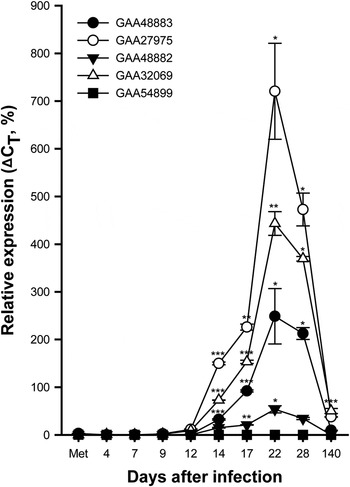
The transcriptional profiles of tyrosinase genes during the development/maturation of C. sinensis were examined by qRT-PCR. As shown in Fig. 5, the mRNA transcripts of tyrosinase genes were not readily detected in metacercariae and juveniles younger than 10 days old, whereas expression of most genes were induced exponentially in 12- to 22-day-old worms, after which the expression levels were gradually decreased. The relative expression levels significantly differed among the five paralogous genes at each developmental stage; GAA27975 and GAA54899 displayed the highest and the lowest expression levels, respectively (e.g. 720·4 ± 100·57 vs 0·1 ± 0·02 in 22-day-old worms). The minor GAA54899 gene maintained a basal expression level throughout development/maturation.
Expression profiles of the Clonorchis sinensis tyrosinase genes during development/maturation of the parasite. Relative amounts of the respective tyrosinase transcripts were measured in total RNAs extracted from whole C. sinensis worms at various developmental stages, as indicated in the graph legend, by qRT-PCR. The calculations are based on the independent technical triplicates (n = 3, mean ± s.d.). The significance of expression change at a certain stage was statistically tested by comparing the expression level with that of the previous stage using the Student's t-test. P value, *<0·05; **<0·01; and ***<0·001.

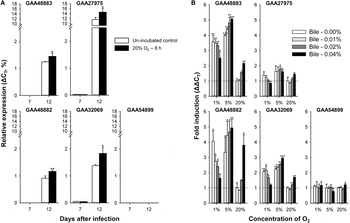
The effects of exogenous factors including O2 and bile on the expression levels of tyrosinase genes were examined via the ex host treatment of live worms and subsequent qRT-PCR analyses. In 12-day-old worms treated with 20% O2 for 8 h, expression levels of the main tyrosinase genes were slightly increased compared with those in un-incubated control worms (1·17–1·33 fold; P value < 0·05), although this exogenous factor did not affect tyrosinase genes in 7-day-old worms (Fig. 6A). Interestingly, this O2-dependent induction pattern significantly changed in the fully mature C. sinensis adults (4-wk-old) (Fig. 6B). No significant gene induction was observed in worms treated with the atmospheric level of O2. However, expression of the major tyrosinase genes was significantly enhanced up to 5-fold in worms treated with low oxygen levels (1 and 5%). The fold changes in expression of these genes (GAA4882 > GAA48883 > GAA32069 > GAA27975) were inversely proportional to their relative transcriptional activities at that developmental stage (GAA4882 < GAA48883 < GAA32069 < GAA27975; Fig. 5). In addition to O2, bile also affected tyrosinase genes; treatment of bile enhanced and repressed tyrosinase gene expression under 5/20%- and 1%-O2 conditions, respectively, in a dose-dependent manner. In contrast to these highly inducible genes, the low-expressed GAA54899 gene did not significantly respond to treatment with these exogenous factors (Fig. 6B). The effect of bile on the expression level of tyrosinase genes could not be determined with the 7- and 12-day-old worms, because it was extremely difficult to collect sufficient worms for the experimentation.
Effects of oxygen and bile on the expressions of Clonorchis sinensis tyrosinase genes. (A) The 7- and 12-day-old worms were incubated for 8 h under 20%-O2 conditions. Relative expression levels of tyrosinase genes were compared with those observed in un-incubated worms of the same age by qRT-PCR. (B) The 28-day-old worms were incubated in media supplemented with various amounts of bile for 8 h under 1-, 5- and 20%-O2 conditions before tyrosinase expression levels were examined by qRT-PCR. The expression changes were presented as fold inductions compared to those in un-incubated control worms of the same age. The calculations are based on the independent technical triplicates (n = 3, mean ± s.d.). The significance of expression changes following exogenous stimuli was statistically tested by comparing the expression levels or fold inductions with those in the un-incubated control groups using the Student's t-test. P value, *<0·05; **<0·01; and ***<0·001.

DISCUSSION
The egg is the central resource responsible for the transmission and propagation of parasitic trematodes in an ecosystem that includes human populations. The agent also comprises the major etiological factors related to the generation of pathobiological changes in infected individuals (Cho et al. Reference Cho, Kong, Yun, Kang, Kim, Chung and Yang2000; Hoffmann et al. Reference Hoffmann, Wynn and Dunne2002; Fairfax et al. Reference Fairfax, Amiel, King, Freitas, Mohrs and Pearce2012). Therefore, any strategy that aims to reduce parasite fertility may be highly effective for both the control of parasite transmission and the abatement of clinical symptoms induced by the parasite infection. We had previously investigated the structural and biochemical properties of four tyrosinase genes, which were identified in our EST database, and their role associated with egg formation in C. sinensis (Bae et al. Reference Bae, Cai, Kim, Sohn and Kong2013). The recent completion of the C. sinensis genome draft (Wang et al. Reference Wang, Chen, Huang, Sun, Men, Liu, Luo, Guo, Lv, Deng, Zhou, Fan, Li, Huang, Hu, Liang, Hu, Xu and Yu2011) allowed us to detect a fifth tyrosinase sequence (GAA54899), of which amino acid sequence had been incorporated into a phylogenetic analysis (Aguilera et al. Reference Aguilera, McDougall and Degnan2013). In the present study, we primarily focused our analysis on the evolutionary features of C. sinensis tyrosinases with respect to their platyhelminth orthologs, in addition to their induction profiles against exogenous stimuli.
Like neodermatan flatworms such as trematodes, monogeneans and pseudophyllidean cestodes (Shinn, Reference Shinn1993; Swiderski and Xylander, Reference Swiderski and Xylander2000), free-living turbellarians and marine polychaete annelids depend on tyrosinase for the formation of sclerotized eggshells (Eckelbarger and Grassle, Reference Eckelbarger and Grassle1983; Ishida and Teshirogi, Reference Ishida and Teshirogi1986; Shinn, Reference Shinn1993). In contrast, the advanced cyclophyllidean cestodes generate a keratin-type eggshell cross-linked by disulphide linkage (Arfin and Nizami, Reference Arfin and Nizami1986). The phylogenetic distribution of the γ-subclass tyrosinases closely mirrored that of sclerotin-type eggshells across lophotrochozoans (Fig. 2). The subclass members were identified in trematodes (C. sinensis, F. hepatica, O. viverrini, P. wertermani and Schistosoma spp.), pseudophyllidean (S. erinaceieuropaei), triclad (S. mediterranea), and polychaete (C. teleta). However, no orthologous genes were identified within the genome drafts of taeniid cestodes including E. multilocularis (10× coverage, mapping of 89% sequences on the respective chromosomes; Tsai et al. Reference Tsai, Zarowiecki, Holroyd, Garciarrubio, Sanchez-Flores, Brooks, Tracey, Bobes, Fragoso, Sciutto, Aslett, Beasley, Bennett, Cai, Camicia, Clark, Cucher, De Silva, Day, Deplazes, Estrada, Fernández, Holland, Hou, Hu, Huckvale, Hung, Kamenetzky, Keane and Kiss2013), as was previously predicted at the protein level (Smyth and McManus, Reference Smyth and McManus1989 and references therein). Interestingly, the marine demosponge S. domuncula (phylum Porifera) also expressed the γ-subclass tyrosinase, whereas equivalent genes were not identified in early metazoans such as T. adhaerens (Placozoa) and N. vectensis (Cnidaria). The sponge protein was likely to be involved in the production of the protocatechuate molecule for the energy metabolism of symbiotic bacteria (Müller et al. Reference Müller, Grebenjuk, Thakur, Thakur, Batel, Krasko, Müller and Breter2004). Taken together, these results suggest that the tyrosinase genes have undergone expansions and losses specific to the lineages of parasitic neodermatans.
The numbers of tyrosinase paralogs differed among platyhelminth species: six genes in the order Tricladida (S. mediterranea), five genes in the Opisthorchiida (C. sinensis and O. viverrini) and two genes in the Strigeidida (Schistosoma spp.) and Plagiorchiida (F. hepatica). The branching patterns in the phylogenetic trees demonstrated that these tyrosinase genes might have been duplicated at least three times before the divergence of turbellarian and neodermatan lineages (marked by solid diamonds in Fig. 2 and Supplementary Fig. 2). The last duplication resulted in generation of the two main paralog lineages detected in trematode species (P_clade 2-A and P_clade 2-B). The earlier duplication events appeared to have been accompanied by both the loss of one of resulting paralogs and the acquisition of novel exon-intron configurations (Fig. 3). Considering that the Strigeidida has diverged from other trematode lineages including the Plagiorchiida and Opisthorchiida during an early evolutionary phase (e.g. see Yang et al. Reference Yang, Zhao, Wang, Feng, Tan, Lei, Zhao, Hu and Fang2015), the P_clade 1-lineage genes were likely to have been deleted independently in each of the neodermatan genomes, except for those in opisthorchiids. However, the S. mediterranea genes, especially the GAKN01005471 gene and P-clade 2-C members (GAKN01000997 and GAKN01001049), made this evolutionary scenario somewhat ambiguous. Future investigations that include tyrosinase genes in turbellarians comprising the Macrostomida, Polycladida and Tircladida (other than S. mediterranea), as well as monogeneans, would further clarify lineage-specific expansions and/or losses of tyrosinase genes across the Platyhelminthes.
The metacercaria of C. sinensis excysted in the duodenum of definitive host migrates directly into the bile ducts through the ampulla of Vater (Kim et al. Reference Kim, Yoo, Kwak, Seok and Hong2011), where the parasite develops male and female sex organs as early as 7 dpi in experimental rats. Following the sexual maturation, the worm begins to express the tyrosinase and eggshell precursor protein genes coinciding with generation of the tanned uterine eggs (Bae et al. Reference Bae, Cai, Kim, Sohn and Kong2013; Fig. 5). In F. hepatica that also sexually matures in the bile duct, multiple physicochemical factors such as bile, which are specific to the ductal environment, have been proposed as triggers for the sexual maturation/reproduction (Robinson et al. Reference Robinson, Colhoun, Fairweather, Brennan and Waite2001; Hanna et al. Reference Hanna, Cromie, Taylor and Couper2006). In 28-day-old C. sinensis adult, the tyrosinase gene expressions showed a tendency to increase in response to ex host bile treatment. This inductive response was repeatedly observed in worms incubated under 20%-O2 condition (Fig. 6B). Taken together the negligible levels of tyrosinase induction in 7-day-old worms stimulated with 20% O2 (Fig. 6A), which also thrive in the bile ducts and lack of tyrosinase expression in metacercariae treated with bile (our un-published data), it seemed apparent that host bile does not act as the initial trigger, but serves to further up-regulate expression of tyrosinase genes. The results obtained with 7-day-old worms further indicated that the development of sexual organs is completed prior to the induction of tyrosinase genes, even though the main factors that initiate the developmental process are currently unknown (Bae et al. Reference Bae, Cai, Kim, Sohn and Kong2013; Figs 5 and 6). Bile and O2 might affect only those worms with fully developed sex organs to induce the vitellocyte-specific tyrosinase genes.
Evolutionary events affecting eggshell formation-related genes are likely to be significantly influenced by the host and/or natural environments encountered by parasite's eggs to maximize the survival rates of fertilized ova/developing embryos. Eggs of most platyhelminths including trematodes and pseudophyllidean cestodes hatch in external aquatic environments, whereas those of cyclophyllidean cestodes hatch within their intermediate hosts (Shinn, Reference Shinn1993). Therefore, cyclophyllidean cestodes have developed a molecular mechanism to generate a thin keratin-type eggshell, which is easily broken down by mammalian digestive secretions, rather than conserving the ability to produce a sclerotin-type eggshell (Johri, Reference Johri1957). This evolutionary process seems to have been accompanied by the loss of tyrosinase genes in the genomes of advanced cestodes. Considering the roles of eggs in tissue-invading helminths, our data regarding the evolution of tyrosinase genes among parasitic flatworms, as well as the induction profiles of C. sinensis tyrosinases, could be applicable in egg production-related control strategies for parasitic diseases including clonorchiasis.
SUPPLEMENTARY MATERIAL
The supplementary material for this article can be found at https://doi.org/10.1017/S003118201700083X.
ACKNOWLEDGEMENTS
The authors would like to express their profound gratitude to Professor Woon-Mok Shon of the Department of Parasitology, Gyeongsang University School of Medicine, Korea for their generous provision of C. sinensis metacercariae.
FINANCIAL SUPPORT
This work was supported by the Basic Science Research Program of the National Research Foundation of Korea (NRF), which was funded by the Ministry of Science, ICT and Future Planning (NRF-2013R1A1A2012011).