Rarely in the public law domain has an analytical construct experienced such ubiquitous yet undertheorized application as has the term constitutional revolution. It is an idea that has been generously applied to all manner of things that are dissimilar in significant respects. Yet much as “there is no general agreement on the necessary and sufficient characteristics of revolution” (Kotowski Reference Kotowski and Sartori1984, 5), so too is there no broadly accepted understanding for the concept’s specific constitutional derivative. What is more, the association of revolution with a modifier that on first notice provokes more confusion than illumination poses an additional challenge for users of the term: demonstrating the utility of a seemingly oxymoronic terminological linkage.
The larger challenge, however, and the focus of this article, is to sharpen conceptual clarity in the way we depict constitutional change, specifically that species of change that entails significant breaks or departures in the workings of the constitutional order. Such discontinuities can take varied forms, ranging from the embrace of wholly new constitutional arrangements to the textual or interpretive displacement of long-standing expectations about how matters of constitutive import are to be resolved. While it is only stating the obvious to point to change as the common variable in all the instances that are commonly referred to as constitutional revolutions, much of the controversy surrounding the use of the term has to do with disagreement concerning the nature of that change: most importantly, how much of it is required to convincingly attach the revolutionary label to any given altered state of constitutional affairs, and how quickly must it come about?
The task is a formidable one and is well known to students of revolution, constitutional or otherwise. As the historian Crane Brinton (Reference Brinton1952, 26) observed, “the social scientist cannot measure change by [an] exact thermometer, and say exactly when ordinary change boils over into revolutionary change.” Yet if exactitude in ascertaining the precise moment when one form of change becomes another is elusive, conceptual assumptions regarding revolutionary transitions are less indeterminate: they presume a rupture in continuity that is stark and decisive. Absent a clear determination that such is the case, we might as well, in accordance with this understanding, drop the term’s first letter and describe what has transpired as evolutionary. But first we might take heed of Bruce Ackerman’s (Reference Ackerman1992, 47) sound advice: “A systematic comparison of evolutionary and revolutionary exercises in constitutionalism should be high on the agenda of future researchers.”
Ackerman himself has of course weighed in famously in connection with the constitutional revolution conundrum. His theory of constitutional change is well known for the capaciousness of its revolutionary understanding, such that the successful repudiation of the past, conjoined with the higher law transformation of a nation’s political identity, need not be tethered to just those moments when repudiation and renewal display the formal attributes of conventional revolutionary activity. The punctuation of American history by “successful exercises in revolutionary reform” (Ackerman Reference Ackerman1991, 19) is for Ackerman both a refutation of Burkean incrementalism and an occasion for celebrating the transformative potential of acts of collective and self-conscious mobilization as they may decisively redirect a nation’s governing principles and practices. Borrowing selectively from Hannah Arendt’s celebrated work on revolution, Ackerman (Reference Ackerman1992, 206) accepts most of the normative and empirical implications of the finding commonly linked to the Arendtian understanding: “a Constitution is a natural culmination of a successful revolution.”
Ackerman’s own theory of constitutional transformation centers on the “constitutional moment,” a now iconic demarcation in our constitutional literature that, particularly in his comparative work, provides only a short window of opportunity for achieving revolutionary change (Weill Reference Weill2006). “The long term costs of a short-term failure to act at the moment of revolutionary triumph are easy to underestimate” (Ackerman 1992, 65). Such is the influence of Ackerman’s contribution that “it [is now] conventional wisdom to expect a revolution—‘thunder and lightning … [and] fire’ [Exodus 19:16]—as prerequisites to achieving a constitutional transformation, especially one of the magnitude necessary to transform a political system” (Weill 2006, 465). In this article I question this assumption and argue that with respect to transformations of the constitutional variety, the standard criteria for revolutionary certification are inadequate and deficient. On my account, a constitutional revolution can be said to exist when we are confronted with a paradigmatic displacement, however achieved, in the conceptual prism through which constitutionalism is experienced in a given polity. In some cases this achievement will unfold in an incremental progression and without the benefit of the sort of dramatic rupture and follow-up that one has come to associate with revolutionary activity of the generic type. This shifting of focus from the process through which change occurs to the substance of the change wrought should lead to more sensitive and accurate assessments of the historic meaning of constitutional change. The shift in emphasis I propose will accommodate more examples of revolutionary constitutional change than reliance on one’s intuition might have imagined, although in each purported instance of such transformation the claim that it has occurred will require persuasive argument about the extent of substantive constitutional displacement in order realistically to secure a high measure of scholarly agreement and certification. The effort, however, is worth pursuing if only to avoid an unfortunate obfuscation, one that obscures the radical nature of constitutional change by emphasizing the evolutionary manner of its attainment.
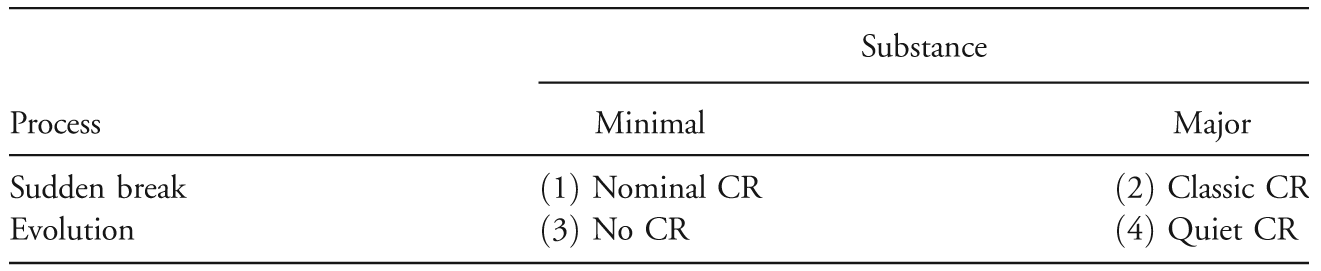
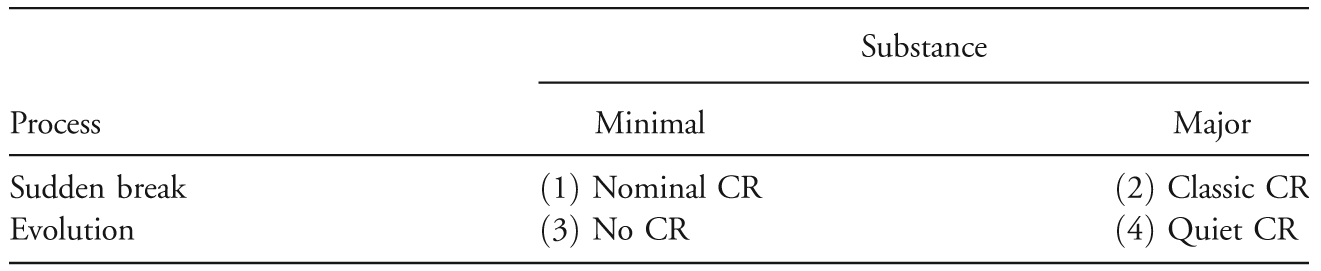
In table 1, 1 and 3 lack the substantial, paradigm-shifting displacement that would indicate the presence of a constitutional revolution, even if in 1 the occurrence of a new constitution after a successful (social or political) revolution could easily lead one to conclude otherwise. In fact, however, a dramatic rupture in political continuity that produces minimal change in the constitutional experience of the polity achieves a constitutional revolution in name only. By contrast, when major constitutional transformation follows a radical break (2), applying the constitutional revolution label to the occasion would appear to be an obvious move. More controversial, however, are those instances in which a polity experiences a substantial reorientation in constitutional practice and understanding absent the revolutionary political moment (4) that is present in the classic variant. While more open to interpretive contestation, these constitutional transformations are no less revolutionary for the incremental aspect that marks their arrival.
Section I will discuss several of the standard criteria for establishing the existence of a revolutionary event in the context for which it is in least need of adjectival assistance. Thus, when the word revolution stands alone, we may infer that the reference is to the overthrow of an established government or political system. It is only when the word appears alongside another (e.g., sexual, industrial, or intellectual) that we know we are being asked to contemplate a revolutionary situation at some distance from the standard politically freighted instance. In these cases the meaning of the dual construction takes on a more metaphorical representation, connoting a sudden or marked change in the circumstances attendant the designated subject matter. A strikingly new pattern of sexual interaction, a restructuring of the production of material goods, or a novel way of viewing the world may or may not be accompanied by those attributes we ascribe to a stand-alone revolution; what makes them arguably revolutionary is the magnitude of the changes occurring within their particular contextual settings.Footnote 1
The constitutional revolution is a more complicated case whose meaning is not discernible in exclusively metaphorical terms. A revolution of this type might, after all, culminate in the displacement of an existing government or political system, which is only to say that constitutional change is a genus of political transformation and cannot therefore so easily be abstracted from the original conceptual formulation. However, that there are constitutional revolutions whose transformative impact appears negligible—or at least not obvious—is reason enough to pursue the idea in its various permutations, thus enabling us to retain the descriptive nomenclature of revolution while attempting to enhance the analytical bite of the concept.Footnote 2
In Section II, I discuss various types of change that might be considered revolutionary in their constitutional import. Constitutional revolutions can occur in the form of a governing set of rules and principles establishing a constitutional order on the basis of a political revolution that had overturned a previous regime or as a major change in the constitutional order emerging within the parameters of an extant constitutional setting and without any, or at least without significant, violence or illegality. In either case, their impact will be experienced through both political and social avenues of expression, sometimes decidedly so in one direction or another. The distinctions between legal and illegal constitutional transformations and between the subsequent political and social changes are by no means unambiguously clear, but a close familiarity with specific cases enables one to account for changes that might be sufficiently far-reaching to be plausibly recognized as revolutionary. This ambiguity—inevitable, it should be said, in what is an essentially interpretive presentation—may be disturbing to some who may, however, appreciate it as a provocation to further reflection (i.e., what follows may raise as many questions as it answers).
I go on to argue that approaching the analytical task as a specific articulation of the more general account of how constitutional orders change their identities best advances this aspiration. I give special attention to the engine driving such change: constitutional disharmony. Within the context of the dissonance endemic to the constitutional condition, what may appear to fall short of revolutionary execution often comes across very differently. Indeed, the disharmonies of constitutional politics ensure that a nation’s constitution will over time come to mean quite different things; this discord bestows a divided legacy that provides ample resources for those engaged in the pursuit of major course corrections in constitutional direction and commitment.
Section III presents two notable instances of constitutional transformation that are paradigm shifting with respect to the manner in which constitutional development was henceforth to unfold within their respective polities. If the accustomed rendering of revolutionary transitions conjures up images of speedy replacement of the old with the new, we need to recognize that a more deliberate, incremental pace comports with the changes produced by some constitutional revolutions. The cases to be considered—the United States and Ireland—both involve a major reorientation in constitutional commitment that illustrates the conceptual importance of this recognition. What happened in these two constitutional locales supports the argument that when constitutional development assumes a radical departure from previous experience, the transformative significance of what has transpired ought not to be minimized or negated by the extended period that accompanies the consolidation of revolutionary aspirations. Exceptional in many respects as was the unfolding of the Irish and American constitution-making experiences, in their progressions through rupture, aspiration, and consolidation they were very much exemplars of a more familiar story line associated with the constitutional revolution.
In Section IV, I suggest that the Irish and American examples highlight the workings of a political dynamic that is present in all regimes. The actual playing out of this dynamic will of course vary considerably in accordance with the intensity and configuration of disharmonic constitutional politics in different places, but this variation ought not to obscure a fundamental ubiquity in the unfolding of constitutional development in regimes of disparate character.
I. Basic Meanings
After listening to a brief explication of the author’s ideas on the subject of revolution, a scholar at the institution with which he is affiliated responded critically: “Certain words have basic meanings that can be bent, but should not be broken. ‘Revolution’ means a large change in a short period of time. How large? You can define that. How short? You can define that. But what you should not do—in my opinion—is say that a change can be revolutionary regardless of its size or regardless of the length of time over which it occurs. Because to do so would eviscerate any distinction between ‘revolution’ and ‘evolution.’”Footnote 3
The scholar’s objection was well founded, based as it was on an extensive literature that is generally supportive of the point he was making. How to respond? A satisfactory rejoinder could do worse than begin with Giovanni Sartori’s (Reference Sartori and Sartori1984, 26) simple truth: “In a natural language almost no word is … endowed with only one meaning.” While his insight ought not to function as a license for tendentiously conjuring up any meaning at will, it should serve a useful enough purpose if it directs our attention to the elasticity of concept formation, particularly as this recognition relates to context-specific application of the basic idea in question.Footnote 4 First, however, we should briefly highlight some of the important benchmarks widely set forth for establishing what is required if one is to find oneself in the presence of a revolution.
A. The Standard Instance
The predominant view in the social science literature concerning the generic concept is rather straightforward. Thus, “there is a general consensus that a minimally necessary characteristic of revolution is some wholesale and unconstitutional replacement of the governing body” (Kotowski Reference Kotowski and Sartori1984, 416). The consensus is also well represented in the philosophical literature of the law; as the Austrian legal theorist Hans Kelsen (Reference Kelsen2006, 117) concluded, a revolution occurs “whenever the legal order of a community is nullified and replaced by a new order in an illegitimate way … not prescribed by the first legal order.” In addition, for most theorists of revolution, illegitimate nullification and displacement of the political order must be accompanied by violence.Footnote 5 In her classic work on the subject, Hannah Arendt, although idiosyncratic in many of her reflections on revolution, was fully supportive of this orientation. It then followed for Arendt (Reference Arendt1977) that the idea of the constitutional revolution made sense only as a descriptive term to refer to what happens when a violent rupture in political continuity liberates a people from oppression and then leads to the adoption of a freedom-enhancing constitution. In the nexus between a specific revolutionary event and an ensuing constitution, the reality of a constitutional revolution ultimately depends on whether the meaning of the first has any substantive constitutive significance. Unreal would be any depiction of a revolution that somehow was directly traceable to an existing constitution without seeking that charter’s destruction and replacement.
Accordingly, the American Revolution was both a revolution and a constitutional revolution, but the “New Deal Revolution” of a century and a half later has, unless one is speaking metaphorically, no coherent meaning.Footnote 6 The same incomprehension would be the response to other events in such far-flung places as Israel, South Africa, the United Kingdom, and Hungary that, whatever their differences, have been characterized as constitutional revolutions despite displaying little of the decisive rupture and repudiation that is often viewed as the necessary predicate for recognition as such. Here, then, we have our first critical conceptual distinction, and it speaks less to the substance of constitutional change than to its originating source. Consistent with conventional accounts, to be revolutionary requires contra-constitutional action; as we will see, however, to have that activity (or other activity that may not be so obviously illegal) identified as revolutionary in a constitutional sense, the focus will have to shift from the process to the result produced by that process, namely, constitutive arrangements of substantially different orientation from what preceded it. In the familiar telling, we are left with a rather straightforward definition of a constitutional revolution: the establishment of a new constitutional order after the illegal overturning of a previous order.Footnote 7 The sequential, linear aspect of this rendering avoids the oxymoronic difficulty subsumed in the joining of seemingly contradictory terms.Footnote 8 A political revolution occurs and then, as Arendt (and Ackerman) stipulated, a constitution is framed to consolidate the achievements of the revolution. Importantly as well, the consolidation culminates in the rapid ascendancy of novel governing arrangements.
Another significant and related distinction pertains to the substance of the change associated with the idea of revolution, although transcending the distinction is a broader agreement that however the variable of change is to be conceptualized, it must fit within the understanding just elaborated, namely, that the transformation be decisive and nonincremental. Here again the literature on the generic term helps in thinking about the more restricted concept. It reveals that the deepest fault line among theorists lies at the social/political divide, with conceptual outcomes hinging on whether the term “revolution” is to be more closely aligned with class conflict and social change or political breakdown and structural change. These of course are not mutually exclusive categories; as Christopher Kotowski (Reference Kotowski and Sartori1984, 409) correctly points out, “Everyone would agree that the French Revolution was a true revolution; however, different authors will characterize the event as either the birth of a new order or as the ‘breakdown’ of a system.”Footnote 9 Yet consensus is lacking on the extent of the change necessary for revolutionary success and certification: political change may be a necessary condition, but is it in at least some circumstances a sufficient condition?Footnote 10
For some the answer is most assuredly not. So, for example, Barrington Moore (Reference Moore1966, 112) says of the American Revolution that since it “did not result in any fundamental changes in the structure of society, then there are no grounds for asking whether it deserves to be called a revolution at all.” However, in Charles Tilly’s (Reference Tilly1978, 193) rendering, “A revolutionary outcome is the displacement of one set of power holders by another.” Unless, however, this minimalist view of political breakdown and displacement is linked to a more substantive reorientation in political aspiration and commitment, it offers a somewhat hollow conceptual alternative to the expansive transformation imagined by Moore and the others in the societal reconfiguration school. Perhaps the most prominent—albeit controversial—substantive counter is Hannah Arendt’s (Reference Arendt1977, 25) insistence that the goal of political liberty define the revolutionary project. “Only … where the liberation from oppression aims at least at the constitution of freedom can we speak of revolution.” The power of the people to bind the future through the entrenchment of principles that constituted the people as the legitimate source of sovereign authority was the essence of the revolutionary achievement.Footnote 11 In accordance with the perspective advanced in this article, Moore is wrong in denying revolutionary meaning to the constitutional achievement of 1787 because of its insufficiently social significance; Tilly is correct in acknowledging its revolutionary importance, albeit for the wrong reasons (i.e., the displacement of power holders must be accompanied by displacement in constitutional orientation and experience); and Arendt is justified in finding in the redirection of constitutional aspiration to the achievement of political liberty a sufficient basis for affirming 1787 as a constitutional revolution but mistaken in limiting such an affirmation to only one type of historic displacement.
At the constitutional level, this debate expresses itself in various ways. The most explicit manifestation is the text itself; in the American case, for example, Moore’s questioning of the revolutionary bona fides of the American Revolution is arguably supported by the inattention of the 1787 document to social transformation. Of course that same document, with its opening invocation of the people as the source of governing power—commonplace today but strikingly original at the time of its writing—presents equally compelling evidence for Arendt’s celebration of the American achievement as the purest form of revolutionary accomplishment. In contrast there are the many constitutions—Cuba’s, for example—that not only proclaim their revolutionary agenda as the culmination of a successful (and violent) overthrow of an unjust regime but do so without concealing the goal of societal upheaval they are designed to facilitate.Footnote 12 Starting from Moore’s premises, Cuba’s was a successful revolution (in the empirical sense); from Arendt’s, the absence of a freedom agenda negates its—and the constitution’s—revolutionary pretensions.
Both of these examples fall under the heading of illegal ruptures, in which a new constitution follows the forced ending of the previous order.Footnote 13 Additional contrasts may be drawn as well from instances of constitutional displacement occurring within the parameters of arguable legality. These are cases of paradigmatic change unrelated to the overthrow of a prior constitutional order but which involve activities whose irregular or extraordinary character have the potential for being strongly challenged over their questionable legitimacy.
The American experience is illustrative. Thus, the adoption of the Fourteenth Amendment, undoubtedly the most consequential formal change in American constitutional development, “would never have been ratified if the Republicans had followed the rules laid down by Article Five of the original Constitution” (Ackerman Reference Ackerman1991, 45). Yet however dubious the legality of the process by which the Constitution was altered, even more interesting are the competing interpretations of the resulting substantive changes in constitutional understanding and meaning: (1) The illegality of the incorporation is consistent with the transgressive nature of the changes, which, in their radical reconfiguration of governing principles, were the culmination of a violent campaign to uproot the original constitutional design.Footnote 14 (2) The irregularities of the ratification process are not so different from those accompanying the adoption of the 1787 document, and in both instances the extraordinary efforts were driven by a desire to redeem the original promise of the revolution through major course corrections in constitutional direction. This second understanding can further mean either or both of the following statements: (a) By its major displacement of power to the national level, the amendment sought a breakdown of the structure of exclusiveness that had confined the practice of political freedom to ascriptively privileged groups. (b) By its major displacement of power to the national level, the amendment created the potential for a substantial adjustment in the relative social standing of previously marginalized groups and the eradication of entrenched societal inequalities.
A range of similar interpretive possibilities presents itself for other countries—for example, South Africa, India, Ireland, Hungary—where the intrasystemic path to fundamental change has engendered controversy with respect to both the procedures implemented to pursue it and the nature of the change to which it leads. Whether those transformations are portrayed as mainly political or social, the revolutionary rhetoric that accompanies them often does not match the incrementalism that follows the constitutional break. It is for this reason that in her study of constitutional design in deeply divided societies, Hanna Lerner (2011, 39) asks us to look closely at “the relationship between constitution-making and time: whether the constitution represents a revolutionary moment or rather marks a beginning of an evolutionary process linked to gradual social and political change.” Yet as we will see, a constitution can be both a revolutionary moment and the commencement of measured and continuing change. Particularly in the case of constitutional revolutions not connected to certifiable revolutionary upheavals, their aspirational character necessarily entails a high degree of uncertainty in establishing their ultimate transformative impact. To be sure, it is also true that what contemporaneous political actors insist is a revolutionary moment in constitutional development will sometimes later be confirmed as an event of decidedly lesser significance.
B. Another View
How do we account for a constitutional revolution that occurs within an intact constitutional setting? In what sense would such a construction embody conceptual coherence?
Again, the generic concept should be our point of departure. In going there, Sartori’s discussion of the “semantic field” may help to enhance the appeal of a seemingly defiant conundrum. In essence it asks us to consider a concept’s elasticity by situating it in relation to neighboring terms; surely types of violence represent a semantic field within which revolution would find easy affinity, but so too would types of illegal political change (Kotowski 1984). These semantic fields, of course, are compatible with the above articulation of the constitutional revolution, but they fall short of legitimating any claim of authenticity for the alternative meaning. For that to happen we would need some connection to a more inclusive terminological neighborhood, the most obvious candidate being types of radical political or social transformation. One type that qualifies for incorporation within the field would be intraconstitutional changes that arguably leave the document with a significantly altered identity, so much so that it might lead someone to question whether such “legal” changes were indeed legitimate. Such questioning has occasionally arisen in the face of constitutional amendments deemed unconstitutional for substantive reasons, but the notion that these constitutionally prescribed changes are illegitimate is not an internationally dominant officially sanctioned position, as it represents the understanding of only a small minority of countries (Jacobsohn Reference Jacobsohn2006; Albert Reference Albert2009; Halmai Reference Halmai2012).
An emphasis on far-reaching constitutional transformation is all the more compelling if we consider that it is sometimes the case that this kind of change is notably absent from those transitions that are both violent and illegal. Take, for example, the Egyptian Revolution of 2011. As of this writing nothing definitive can be said about it, certainly with respect to the magnitude and scope of the broader changes accompanying the overthrow of the long-serving authoritarian government and the subsequent deposing in 2013 of the ill-fated government that took its place. But an emerging narrative has become increasingly evident in which the revolutionaries of Tahrir Square, diverse as they were in their goals and aspirations, confront a disturbing reality of frustrated hopes and unfulfilled expectations. For some the symbol of their disappointment came quickly in the guise of a new constitution whose construction seemed designed to maintain the power and privileges of the prerevolutionary regime. For others this same document shifted power ominously to groups within the society long identified with hostility toward liberal democratic precepts, a view vindicated when the new president who embodied the agenda of these groups wasted little time in governing illiberally. His removal left Egyptians anticipating the drafting of yet another constitution, but given that the next round of constitution making was to be directed and administered by the ruling military, confidence in the quality of the resulting product could hardly be at a very high level. That it will not be the same constitution as its predecessor is certain, even differing in substantial respects from it; nevertheless, a pervasive sense that not much will change as a result of its adoption has set in, even as the events associated with the dislocations of the revolution and its extended aftermath are credited with changing the political landscape and dynamic of the Middle East.
By the metrics of the standard instance, Egypt experienced both a revolution and a constitutional revolution.Footnote 15 But was it anything more than a nominal constitutional revolution? That a revolution occurred in 2011 is not in doubt, nor is there doubt that the revolutionaries had as one of their principal goals the replacement of the old regime’s constitution. Still, did a constitutional revolution actually take place? The linkage between revolution and constitution was noted in the preamble of the first replacement constitution, which declared that the Egyptian people are “determined to achieve the objectives of their peaceful revolution.” The body of the document, consisting of 236 articles, established the framework and guiding principles through which these revolutionary objectives were presumably to be achieved. But as the deep divisions over the drafting process glaringly revealed, there were substantial disagreements concerning the substance of the objectives to which the people were committed. In addition to a deficiency of common purpose about matters central to constitutional identity, striking resemblances between the new constitution and its 1971 predecessor were difficult to miss, notably Article 2, which affirmed that the “Principles of Islamic Sharia are the principal source of legislation.” So if constitutional continuity is extensive with respect to both critical provisions in the document itself and the weaknesses attributed to it by long-standing rivals embracing contrasting understandings of the revolution’s meaning, what basis is there for comprehending these constitutional developments in revolutionary terms?
The revolutionary repudiation of the constitutional order of the immediate past, followed by the drafting of a new constitution by a constituent assembly, may satisfy the minimal conceptual criteria associated with such transitional sequences of events, but the absence of a clearly defined and profoundly felt directional shift in constitutional orientation fails to meet the more rigorous requirements of the substantive model of the constitutional revolution. However, that model presumes the tentativeness of any initial judgments since the confirmation of a paradigmatic displacement requires a retrospective judgment at a distance from the initial rupture in constitutional continuity. Had, for example, the Muslim Brotherhood and President Muhammad Morsi succeeded in establishing a constitutional theocracy on the basis of “credible sources accepted in Sunni doctrines” (Art. 219), then it would be easier to affirm the achievement of a genuine constitutional revolution; thus, the paradigmatic change in the experience of constitutionalism in Egypt would have been decisive—if for many also deeply disheartening—in rendering a judgment on the nature of the transformation.
The overreaching of Morsi and the Muslim Brotherhood prevented that from happening, and the subsequent assertion of authoritarian military rule nullified any possibility that constitutional import could be associated with the revolutionary transformation of 2 years earlier. The revolutionary “moment” initiated a new round of contestation amid the surroundings of a fundamentally altered political and legal environment. “Modern Egypt has long been torn between multiple and at times even contradictory identities; … above all [tensions between] secularism and religiosity have characterized the country for at least forty years” (Hirschl Reference Hirschl2010, 105). The freshly minted constitutional text offered one side of this contested terrain an advantage in translating the political revolution into a constitutional revolution of a certain stripe. The latter did not occur, but the same interests that disputed the legitimacy of the first constitution-making process will continue in the pursuit of their preferred constitutional vision. If they succeed—something that, if it should happen, must await the interactions on multiple levels of political, cultural, and economic forces representing long-standing disharmonies within the polity—then the illusory or nominal variant will likely reemerge as an authentic realization of the constitutional revolution.
Radical changes may yet be in store for that nation; typically, extended periods of time are required to assess the fallout from major ruptures in political continuity. As we will see, the abruptness of a break in political continuity is not incompatible with subsequent incremental change. But now consider a very different case—South Africa—that experienced “a revolution … but one achieved constitutionally, in the sense that the previous constitutional disposition was turned on its head, and … the content of the new dispensation differed radically from the previous one” (Ackermann 2004, 646). Here too questions remain about just how much the lives of South Africans have changed as a result of this new dispensation, yet that the Constitution, the oft-referred-to “birth certificate of a nation,” has fundamentally elevated prospects for significant and far-reaching change is not seriously contested. As was proudly asserted by one of the justices in an early and important case for the new South African Supreme Court, “Viewed in context, textually and historically, the fundamental rights and freedoms have a poignancy and depth of meaning not echoed in any other national constitution” (DuPlessis v. DeKlerk, 3 SA 850 [1996]).
How better to capture the essence of this momentous development than by recognizing it as a constitutional revolution? But we can do so only with a modification of the first definition, a revision that requires distancing the concept from the semantic fields that had earlier figured so prominently in its derivation. With the assistance of a clearer distinction between the general concept of revolution and its more particular constitutional variant, we can derive a more inclusive definition that will incorporate some constitutional narratives that fit the standard revolutionary criteria but also others that would be excluded (e.g., South Africa). Accordingly, a constitutional revolution can be said to exist when we are confronted with a paradigmatic displacement, however achieved, in the conceptual prism through which constitutionalism is experienced in a given polity. This leaves open the possibility that a revolutionary displacement could develop within the constraints of legality, although establishing whether those constraints have actually been respected will almost certainly be contested. While such an occurrence would not conform to the contra-constitutional criterion previously stipulated, any illegally established postrevolutionary constitutional order that was acceptable as a constitutional revolution under the first definition would qualify under the second as long as the novelty of that order was distinguished by the required paradigmatic shift in content. Thus, the innovation of a constitutional revolution lies as much in how a polity refocuses its constitutional vision than in how it has repudiated its past. As Andreas Kalyvas (2008, 7) asks, “Why do radical political changes need to be associated with ruptures, disruptions, and discontinuity?”
II. (R)evolutionary Constitutional Change
Once the conditions for a constitutional revolution are divested of their blatantly extralegal character, the types of change that can be accommodated under this second heading include (1) new constitutional arrangements sanctioned by authority of the previous constitutional order (e.g., Hungary, South Africa), (2) new constitutional arrangements imposed by an external power (e.g., Japan, Iraq), (3) major constitutional departures legislatively enacted (e.g., Canada, Great Britain), (4) major constitutional departures secured through the use of the amendment power (e.g., United States), and (5) major constitutional departures engineered through the interpretive power and reach of a court of law (e.g., Israel). Inasmuch as the terminology of revolution is used to describe significant changes in the constitutional condition of polities of widely different circumstance, one should expect considerable disagreement regarding application of the concept to these varied transitions. Indeed, experience shows that the legitimacy of the results flowing from the actions associated with each of the aforementioned types will, with varying intensity, be called into question. The first two in particular, entailing as they do clear separations from immediately antecedent constitutional practice, will appear to many as not having been divested of their patently illegal character. The status of a new constitutional beginning launched in the highly irregular manner involved in these situations possesses an inherently ambiguous quality that cannot help but affect the perceived legality of the transitions. The latter three have the potential as well to engender skepticism concerning the appropriateness of the method employed; more than that, however, their connection to revolutionary, as opposed to evolutionary, change will be doubted. Precisely because the shifts in constitutional direction emerging from these sorts of political activities are initiated and driven by constitutionally sanctioned institutions wielding procedurally correct power, it may be difficult to appreciate the paradigm-altering potential inherent within them.
When, for example, we encounter constitutional displacement resulting from ordinary legislation, which proceeds in so routine and deliberate a manner as easily to avoid early recognition as a potentially pivotal moment in a polity’s constitutional narrative, the revolutionary implications of the effort will likely not be widely apparent. Indeed, in Ackerman’s (1992, 16) familiar distinction between lower and higher lawmaking, in which revolutionary change can be certified as such only by “meeting the obstacles prescribed by the higher law making system,” a manipulation of the “ordinary way of parliamentary democracy” cannot culminate in transformations of revolutionary consequence. Yet consider that the “constitutional revolution” in Israel stemmed from the Knesset’s passage of two Basic laws in 1992 that led a prominent member of the Supreme Court to question “whether the Knesset members themselves were aware of the ‘revolution’ they were generating.”Footnote 16 Justice Aharon Barak, the revolution’s principal proponent and defender, himself said of the legislators who adopted the laws, “They didn’t know what it meant, or at least they didn’t think they were doing something special.”Footnote 17 For Barak, however, it was very special, as it enabled the court over which he presided to legitimize judicial review and establish the “normative superiority” of rights. This in itself was a revolutionary achievement, even if it stemmed from the workings of the lower lawmaking system.
Similarly, the “quiet” transformation currently under way in Great Britain is in full compliance with legal norms; how transformative it will become is very uncertain, as are the revolutionary objectives of its proponents. Both the ongoing devolution of power away from the British Parliament and the adoption of the Human Rights Act in 1997 may very well “cause a ‘paradigm shift’ in the foundations of British Constitutional Law” (Bogdanor Reference Bogdanor2005, 90), but as with developments in Israel, considerable time may have to pass before their revolutionary authenticity and significance can be assessed and, then, possibly confirmed.Footnote 18 For example, with the benefit of hindsight, the English Reform Acts of 1867 and 1884, both of which represented extraordinary regime-defining expansions in the franchise, are strong candidates for inclusion under the rubric of constitutional revolutions. As one careful student of those developments has noted, “Britain has proved that a new beginning may be possible through an evolutionary process rather than a mega-moment” (Weill Reference Weill2006, 466).
These sorts of developments are difficult to reconcile with the “revolutionary” presumption of a radical, sudden break or rupture that culminates in the rapid ascendancy of novel governing arrangements. As applied to those revolutions we have designated as constitutional, the presumption needs to be modified in order to fit the conditions associated with this specific categorical type. Before elaborating, it is worth reiterating that for a constitutional revolution to be properly designated as such there must be, at a minimum, a discernible transformation in the substance of a polity’s constitutional identity. Erroneous would be the description of a transition in a nation’s constitutional experience as revolutionary if it can be shown that the change in question, however noteworthy, was less than paradigm shifting in meaning and consequence. Did the doctrinally innovative achievements of the New Deal “constitutional revolution,” even if amounting to a “paradigm shift” (Balkin and Levinson Reference Balkin and Levinson2001) in constitutional law, qualify as genuinely revolutionary given the arguably narrow spectrum of jurisprudential choice available to actors in the United States?Footnote 19 Was Justice Barak’s self-described “constitutional revolution” properly labeled in the face of criticism that the important innovations it provided the Israeli constitutional order were consistent with a natural progression in democratic political development?Footnote 20 Questions of this sort can also be raised in connection with other purported constitutional revolutions; no doubt the predictably varied responses to them would reflect the inherently interpretive nature of the process by which such determinations are made.
If considered, however, within the context of the disharmony endemic to the constitutional condition, we may perceive the conceptual issues quite differently. There are two dimensions along which such dissonance fuels the development of constitutional identity: the first is internal to the document (assuming one exists) and includes alternative visions or aspirations that may embody different strands within a common historical tradition; the second entails a confrontational relationship between the constitution and the social order within which it operates (Jacobsohn Reference Jacobsohn2010). While not likely to hasten the sort of disequilibrium that precedes a dramatic revolutionary upheaval of the generic type, circumstances may arise that trigger a revolutionary dynamic from within the environs of a preexisting constitutional disharmony.
The ubiquity of conflict and constitutional change is an old story, and it extends both horizontally across national boundaries and vertically across generations. Vicki Jackson (Reference Jackson2008, 1280) has embellished the story smartly: “All societies have conflicts, and ongoing conflict within society often motivates constitutional change. … Whether constitutions emerge in the wake of fundamental regime change … or from within an ongoing democratic polity, whether they are regarded as ‘clean breaks’ or as incrementalist change, constitutions provide links to a particular past—perhaps imagined and mythic, and certainly partial.” Jackson’s insight underscores a prominent theme in this article: change that results in profound modification of constitutional practice and vision—whether the result of a political rupture in regime stability or the outgrowth of an existing set of political arrangements—has a restorative dimension to it that typically entails the galvanizing of latent, if not entirely quiescent, sources within a conflicted tradition having deep roots in a nation’s history.Footnote 21
The dissonance of constitutional politics guarantees that a polity’s constitution will possess different meanings over the course of its history; such disharmony creates a splintered bequest that culminates in a readily available deposit of ideas for those involved in the pursuit of historic constitutional course corrections. In the American case the argument for constitutional revision was, as we will see, a redemptive effort to revive the animating spirit of founding principles that the Federalists interpreted as requiring a more powerful central authority to fulfill a promise to anchor sovereign authority in popularly accountable governing institutions. What is more, the original break with colonial governance had appealed to an older legal tradition—rooted not in popular sovereignty but in the imperfect accountability of the common law—that had itself known its share of adversarial friction within the larger political tradition of British imperial rule. And if we project ahead, through the struggle to save the Union that culminated in adoption of game-changing amendments, through the next century’s extended and heatedly contested effort to nationalize policy-making authority, to today’s Tea Party–inspired campaign to innovate and transform by returning to a pre-Federalist understanding of constitutional meaning, one cannot help but be struck by the recurring pattern of generational linkage, whereby arguably revolutionary intentions are advanced through invocation of one side of a divided past.
A similar pattern presents itself in the constitutional politics of other locales. The adoption of the postwar Japanese Constitution can be seen as a chapter in a larger story of constitution making in which the Japanese and American collaborators drew on the incongruities in the Meiji Constitution of the previous century to extend the logic of the nonauthoritarian strand of that “incomplete” revolution to infuse the new constitutional identity with a strong commitment to popular governance. The constitution of 1889 was a bundle of contradictions, capable of justifying liberal-democratic rule and authoritarian governance. A culmination of the Meiji Revolution—a restoration actually—it embodied competing visions of the state and the individual, imperial rule and Western reforms. Among other factors, this has led some scholars to discredit the depiction of the 1946 Japanese Constitution as some kind of alien transplant; rather, it represented the emergence of a new constitutional identity from the cauldron of disharmony embodied in the incomplete constitutional revolution of the previous century.Footnote 22 In Hahm and Kim’s (2010, 826, 828) trenchant analysis of the Japanese case, “In order to establish a new democratic polity, the Constitution had to be seen as somehow connected to, and drawing from, certain principles, if not precedents, in the nation’s history.” And so “the whole Meiji era was … recast as an inspiration for a new democratic constitution.”Footnote 23
Given the resilience of entrenched principled contestation, incompleteness may well be an endemic feature of constitutional revolutions, no matter the regime type. So, to cite another example, students of the Iranian constitutional revolution of 1906 have emphasized the “dynamic intermixture of the old and the new, the renewed and the invented,” in their accounts of this historic turning point in that nation’s constitutional progression (Azimi Reference Azimi2008, 2). As Fakhreddin Azimi notes, “a novel understanding of governance” emerged from this transformation, featuring the radical idea of “citizens as bearers of equal political and civil rights” (2). Yet with this new awareness there remained an older understanding of where sovereignty was to be situated, and the contradiction embodied in these antithetical constitutive assumptions became an enduring part of the legacy of a constitutional revolution defined as much by what it did not resolve as by what it did. Indeed, in Nader Hashemi’s (Reference Hashemi2010, 50) account, “The present conflict in Iran … is rooted in this legacy of the unresolved ideological dispute over the proper location of political sovereignty in the early twentieth century.” See also Afary (Reference Afary1996) and Sohrabi (Reference Sohrabi2011). In contrast with Iran, Japan’s ultimate resolution has been in favor of a citizen-driven principle of constitutional legitimacy, even as old tensions and contradictions remain to further refine the results of the postwar constitutional revolution.
India presents another prominent example, although in this instance the disharmonic balance between temporal and spiritual commitments was not viewed as promisingly in terms of its potential for creative coexistence. Rather, the constitutional project had a distinctly subversive aspect to it, with religion targeted by the framers as an impediment to be overcome in the interest of creating a more hospitable environment for a just society (Jacobsohn Reference Jacobsohn2003). Here the revolutionary paradigm resonates with an enduring theme in Indian history, one captured well in a scarcely known observation by Alexis de Tocqueville (Reference Tocqueville1962, 480): “India cannot be civilized as long as she conserves her religion and her religion is so intermingled with the structure of its social state, of its customs and of its laws.” Indigenous versions of this insight were prominently represented at the Constituent Assembly, as reflected in delegate K. M. Panikar’s (Reference Panikar1967, 265) comment, “If the State considers that certain religious practices require modification by the will of the people, then there must be power for the State to do it.” So deep was religion’s penetration into the fabric of Indian life, and so historically entwined was it in the configuration of a social structure that was by any reasonable standard manifestly unjust, that the framers’ hopes for a democratic polity meant that state intervention in the spiritual domain could not be constitutionally foreclosed.
The prevailing social structure, while deeply rooted in centuries of religious and cultural practice, was contestable in accordance with sources from within the Indian tradition that are also part of what Edmund Burke referred to as the prescriptive constitution.Footnote 24 History revealed disharmony within established traditions and between the dominant strand and the existing social order. Constituent Assembly excavations of the ancient Ashokan example, as well as invocations of more recent nonconforming Hindu voices from the 19th century, show how continuity in the construction of a constitutional identity can draw on alternative (and even dissenting) sources within one tradition and then reconstitute them to serve as a reproach to other strands (and their societal projections) within the same tradition.Footnote 25 In examining this construction, the indication that a constitutional revolution has occurred is to be found in the displacement of a dominant strand or commitment with that of its dissenting counterweight. The construction is manifest in the Constitution of India; how fully realized the displacement has proved to be remains contestable.
III. Two Cases
A. United States 1787
The extent to which innovations in constitutional practice and orientation will ultimately be seen as having vindicated their most visionary advocates may be decisively affected by their very ordinariness. Thus, a presumption of radical change does not readily attach to those shifts that stem from the regularity of prescribed process. Rather, when things go off constitutional course we are more likely to judge the results as potentially far-reaching and path breaking, for better or worse. People rely on constitutions to order change. Such reliance can mean one of two things—or both. In the first meaning, the rules and principles that make up a constitution’s content are used to influence the character of the changes that occur within a society committed to the rule of law. If the constitution is working well, then changes that flow from the choices made by individuals, groups, and institutions will be orderly, which is to say in conformity with the procedures set out in the governing document. In the second meaning, the constitution is committed to ensuring not only that change occur in an orderly legal manner but that the substance of the changes is compatible with the document’s essential commitments. Thus, constitutions may be viewed as instruments to order change in the sense of prescribing both type and degree of transformation in accordance with directives enshrined in key textual provisions.
The change that resulted in the adoption of the Constitution of 1787 was famously not achieved in compliance with the text of the Articles of Confederation. “The very convening of the convention may be considered as a ‘de-constituent’ step, on the verge of a legal revolution” (Klein and Sajo 2012, 426).Footnote 26 That the Constitutional Convention was acting illegally in effectively replacing the articles with a new charter is less interesting, however, than the question of exactly what was wrought by the change. It is a question most intriguingly raised by James Madison in his defense of the convention’s dubiously sanctioned transformative undertaking. In Federalist 40, he posed the question in a way that speaks directly to our concern in this article, as he focused on “the boundary between authorized and usurped innovations; between that degree of change which lies within the compass of alterations and further provisions, and that which amounts to a transmutation of government” (Lodge 1888). In other words, did a constitutional revolution just occur?
Madison’s response is revealing in terms of the conceptual distinctions set out earlier. While conceding that the alterations made in Philadelphia were “irregular,” that they were “instituted by some informal and unauthorized propositions,” he maintains that the changes, “substantial” though they were, amounted to an “expansion of principles which are found in the articles of confederation.” Still, we are quickly informed that such faithful adherence to the core commitments of the earlier document is perhaps more consequential than this purported exercise in continuity might suggest. “The misfortune under the [articles] has been, that these principles are so feeble as to justify all the charges of inefficiency which have been urged against it, and to require a degree of enlargement which gives to the new system the aspect of an entire transformation of the old” (Lodge 1888).Footnote 27 Had the Constitution emerged more in line with Anti-Federalist thinking, it too would have been seen as falling within the constitutional tradition of the colonial period. But it would not have bequeathed to Americans a constitutional solution that, in its contribution to political science, was truly original in concept and scope.
What are we to make of this “degree of enlargement” that has an “aspect of an entire transformation of the old”? If it is simply a course correction (“correcting the errors” of the articles), then in what sense, if at all, can the move from the document drafted by the Continental Congress to the one later framed by the Constitutional Convention be construed as revolutionary? If the “fundamental principles of the Confederation” were, as Madison (Federalist 40) took pains to point out, “not within the purview of the convention,” then how can one describe the work of that body as anything other than, well, conventional?
Reflecting further on the second meaning of constitutionally ordered change best addresses the conundrum. Whereas the first connotation assumes a well-functioning constitution that contemplates rigid compliance with the legal forms—including procedures for amendment—prescribed in the document, the second envisions the possibility of malfunction, a condition that exists when constitutional forms fail to advance the substance of the constitution’s animating principles. When this occurs we might say that the disjuncture between form and substance is evidence for the absence of constitutional order, which Madison could invoke as justification for “informal and unauthorized” actions to secure the harmony between form and substance that our aspiration for a just constitutional settlement requires. Indeed, that is exactly what he does in arguing, with specific reference to the most revolutionary of passages in the Declaration of Independence, “that in all great changes of established governments, form ought to give way to substance” (Federalist 40).
The mention of that revolutionary document is critically important. Recall the two definitions of the constitutional revolution presented earlier, the first of which—any illegally established postrevolutionary constitutional order—is surely applicable to the ratification of America’s first charter in 1781. The second more inclusive construction focused on the substance and outcome of a constitutional displacement—however achieved—that leaves the experience of constitutionalism in a very different place from where it had previously been. In this account, rupture and discontinuity are not defining criteria for establishing the presence of a constitutional revolution. The sort of revolutionary displacement involved under this second heading originates and develops within the domain of legality, although it may reach its destination only after a controversial passage through questionable extralegal terrain. Madison’s insistence on the principled continuity of the first constitution and its 1787 replacement provides both efforts with a common source of revolutionary inspiration; his defense of the irregularity of the movement from one to the other does not contradict his belief that only with the proposed changes can the revolutionary promise of the rupture from British rule effectively be realized.
Indeed, Madison’s emphasis on continuity speaks to a larger point. In his discussion of Arendt’s views on revolution, Kalyvas (2008, 227) notes in connection with the break with colonial governance that “the American revolutionaries were able to avoid the language and practice of absolute ruptures,” relying “on a pre-existing legal layer … which remained intact during the entire period of political foundation.” Also, “By refusing to eliminate them, the American revolutionaries remained within the law even during such exceptional moments” (227). If we take the entire period of foundation to include both constitutional framings, then Madison’s argument in Federalist 40 may be seen to contain a deeper significance for theorizing the constitutional revolution. Thus, the “course correction” of 1787 represents a familiar example of constitutional identity formation in which a divided legacy serves as a continuing resource for those seeking major change in the workings of the constitutional order (Jacobsohn 2010). A fundamental, even radical, departure in a nation’s constitutional way of doing things may be presented as an effort to revive a superior approach, one previously displaced in the vortex of political contestation. Or put another way, Madison was engaged in an activity essential to the success of constitutional revolutions, particularly of the second type: enhancement of the outcome’s legitimacy by insisting on its restorative intent.Footnote 28
B. Ireland 1937
Article I states: “The German Reich is a republic. State authority derives from the people.” The numerous flaws in the ill-fated Weimar Constitution should not diminish the significance of this revolutionary affirmation. As the first German constitution to embody the principle of popular sovereignty, the document occupies a unique place in the history of constitutionalism. As a constitutional revolution, however, there was nothing unique in the manner of this new republic’s emergence: the 1918 overthrow of the imperial structures of the Bismarckian state was a direct by-product of the outcome of a war.
Yet its significance has been famously diminished. Thus, another by-product of the 1918 German Revolution was the “jurisprudence of crisis” (Jacobson and Schlink 2000), and it has provided legal scholars of the 20th century with a treasure trove of philosophical reflection on law and the state. At the center of this jurisprudential effusion was Carl Schmitt, whose critique of Weimar constitutionalism is also worth considering in relation to other countries, for example, Ireland, where a contemporaneous constitutional transformation was an outgrowth of the same war. Seen in the light of Schmitt’s critique, the Irish case can help address one of the more vexing conceptual challenges of constitutional revolution theorizing, the problem of rupture and continuity.
Schmitt (1928/2000, 294) called into question the revolutionary importance of the 1918 revolution. “The new German Reich is a constitutional democracy. It has a constitution, just as it had a constitution under the monarchy; here, in the ‘constitutional,’ lies an essential continuity linking today’s Reich with the old Reich of 1871. … There is no break, no revolution in the strict legal sense between the old and the new form of state. A constitutional democracy replaced a constitutional monarchy. The German Reich is not simply a democracy but a constitutional democracy.”Footnote 29 What is more, through the Versailles Treaty the integrity of the nation had been badly compromised, rendering what the regime’s champions trumpeted as their crowning accomplishment—popular sovereignty—a hollow achievement. “The Reich has not gained complete sovereignty, and this lack of political substance would relativize the importance of any constitution” (295).
Schmitt’s argument serves as a skeptical rejoinder to the classical model of the constitutional revolution, which was easily identifiable as a new constitutional order that succeeded the forceful removal of a previous order. What, however, was presented as straightforward is, in Schmitt’s account, subject to two objections: (1) Revolutionary political change (i.e., illegal, violent upheaval that produces a substitution of one form of government for another) is not a prelude to constitutional revolution absent a break in continuity that culminates in an authentic expression of popular sovereignty. (2) To the extent that internal constitutional transformation is shaped by the exertion of political power external to the sovereign will of the nation, it diminishes the constitutional significance of even postrevolutionary new beginnings.
Now consider Ireland, which has a story that in its two-stage developmental progression (spanning 15 years) recalls the American case (spanning 11 years) and in its entanglement with an intrusive foreign power evokes the Japanese experience. The Constitution of the Irish Free State was adopted in 1922 after a sequence of events that included a bloody conflict with Great Britain that culminated in the Anglo-Irish Treaty establishing dominion status for the newly independent state and a division among Irish political leaders over the acceptance of the treaty that would lead to a civil war, the conclusion of which in 1923 failed to end the debate over the legitimacy of the new constitutional creation. Despite a number of amendments in the following years reducing the formal dependency of the Irish on the British, a government formed in 1932 under the leadership of Eamon de Valera was determined to replace the Free State Constitution with a new document that would officially end all treaty ties and establish a constitutional republic. This goal was achieved in 1937 after a draft constitution was adopted by a referendum, a development described by one of Ireland’s leading constitutional commentators as “a break in legal continuity; … a supplementing of one Grundnorm (albeit a disputed one) by another; and thus, legally speaking … a revolution” (Hogan and Whyte 2003, 51).
There are two ways in which the Irish developments of 1937 can be depicted as a constitutional revolution, and both display conceptually significant similarities to the American case. Recall Madison’s claim that the changes wrought by the Constitutional Convention represented an “expansion of principles which are found in the articles of confederation.” The new constitution was not so much a rejection of the old as it was its fulfillment or completion, an occasion for correcting the earlier failure to align the form and substance of the effort’s animating principles. It was an exercise in continuity that was also revolutionary in a constitutional sense because it provided closure to the regime reordering initiated previously.Footnote 30 Also, the irregularity of the major course correction—its questionable legality—provided the second constitutional moment with a measure of radical separation that one expects to see in a revolutionary scenario. The coupling of rupture and continuity may seem paradoxical, but it is a familiar conceptual association for the sort of constitutional change with which we are concerned.
An important assessment of the Irish Free State Constitution published 10 years after its adoption described the achievement as an “essentially republican constitution” that embodied the “theoretical postulates of a revolutionary upheaval” more than the “legislative crystallization of an organic development” (Kohn 1932, 80). More recently it was said of the 1922 constitution that it “followed the rituals of a new beginning, but there was no constitutional moment.” There was no “radical change, [i]nstead, the Free State’s constitutional order was gradually reduced to the basic structure of the Westminster system” (Kissane 2011, 55). That same analysis identified the 1937 developments as a “constitutional revolution,” one, however, manifesting “substantial continuity” with important commitments from 1922, namely, to “personal rights, religious freedom, and an independent judiciary” (62). Notably it did not include as a continuing commitment what the earlier account had emphasized, “the principle of the sovereignty of the people as the fundamental and the exclusive source of all political authority” (Kohn 1932, 80).Footnote 31
As in the American case, the question raised by these differing perspectives is one of form and substance played out in an extended transformational progression spanning two major ruptures in constitutional continuity. In each instance the first break followed a violent struggle to secure independence from Great Britain, resulting in complete success for the Americans and partial success for the Irish, the latter being unable to obtain autonomy over the framing and adoption of their new constitution. In each instance, too, the initial effort was the occasion for deep partisan division over the direction of the new constitutional undertaking that led eventually to a second break, which in turn enabled a subsequent group of framers to attempt to redeem the revolutionary promise of their predecessors. “The American Constitution,” Hannah Arendt (1977, 145) wrote, “finally consolidated the power of the Revolution.” Similarly, “the purpose [behind the Irish Constitution of 1937] was to consolidate rather than to experiment and start anew” (Kissane 2011, 57).
If the redemptive effort at the second transformational moment is successful—as it was in both countries—then it becomes necessary to belabor the point that a revolution is a process, not an event or “moment.” The extended Irish layout underscores a reality that can easily be obscured in the more concentrated form in which constitutional revolutions often present themselves. This in turn should inform the rejoinder to Schmitt’s argument, which, insistent on a radical break in constitutional continuity as the basis for revolutionary validation, can easily, through a too narrowly focused appraisal of the initial displacement, lead to a misreading of the resulting protracted rollout of change. The transition to popular will as the legitimate source of sovereign authority is not likely to occur abruptly, and in some cases it may require an extended conversion period. To the extent that such is required, this will also diminish the force and appeal of Schmitt’s second objection since the presence of external sovereign intervention in the substitution of one title to rule for another may now just as easily be viewed as a necessary stage in the changeover that culminates in genuine transformation as it may the fatal subversion of a people’s aspiration for a more just popular regime.
Depicting the adoption through a plebiscite of the 1937 constitution as a constitutional revolution relies on the commonly held illegal framing of the document outside the scope of extant authority and, of course, on the severance of the remaining Free State impediments to the expression of an authentic popular sovereign will. These achievements are themselves not severable since the Constituent Assembly that enacted the Free State Constitution expressly denied to the legislature the power to amend the document contrary to the treaty between Great Britain and Ireland. Eamon de Valera, the prime mover behind the new constitution, in fact bypassed the legislature (which was relegated to a pro forma role in the process) and the Constituent Assembly; in light of the existing constitution’s provisions, the irregularity of the process was blatant—and deliberately so. Still, an alternative understanding holds that “the authority of the Constituent Assembly which enacted the Constitution of 1922 itself derived from the people … and so the enactment by the people of the Constitution of 1937, whilst in breach of the Constituent Act, maintained the same legitimation as that Act” (Phelan 1997, 358).
This latter effort to salvage a legally sanctioned constitutional rewrite, although surely strained, nevertheless helps clarify the constitutional revolution question in Ireland and the question more generally. According to this view, a “legal revolution” occurred in 1937, as also happened in 1922, which saw “a legal revolution based on popular sovereignty.”Footnote 32 However important the dispute among Irish historians regarding the legalities of the 1937 constitution, more important here is the eminently plausible characterization—also of course in dispute (i.e., a civil war was fought over it)—of the earlier source of constitutional authority as having been popularly grounded. As pointed out previously, agreement on whether a revolutionary displacement has occurred within the constraints of legality will typically be difficult to achieve. Critical, though, is whether the displacement, however achieved, is of paradigmatic significance for the way constitutionalism is henceforth experienced. Undoubtedly the incorporation of the Anglo-Irish Treaty within the terms of the 1922 constitution compromised the sovereign integrity of the new venture.Footnote 33 Still, to deny that the securing of independence from a regime famously known for its institutionally based locus of sovereign authority, and the subsequent adoption by a Constituent Assembly of a document explicitly committed to the principle of popular sovereignty, was a signal achievement in radical constitutional transformation is a very difficult argument to sustain.
As more material has become available concerning the drafting of the 1937 constitution, we learn that de Valera’s purpose in submitting the document for approval in a plebiscite was to highlight the new republic’s fresh start; doing so in this manner would give vivid symbolism to its principal and long-delayed substantive achievement: popular sovereignty. But we also learn that the de Valera–led group who wrote the constitution was a rather small secretive cohort of political and religious activists whose efforts in popular constitution making arguably are less notable in this regard than the earlier labors of members of the Constituent Assembly (in concert with the British) who framed the Free State Constitution. Much like the Weimar Constitution, also a Constituent Assembly creation, the 1922 charter was not presented to a popular referendum. Because of the problems of legitimacy associated with constituent assemblies and their ex nihilo creations, over the course of the century referrals to the people increasingly came to be seen as critical for achieving credibility and support among affected populations. Looking, then, at the 15-year Irish progression from constitution to constitution as a cumulative constitutional revolution, the plebiscitary end point represents symbolic closure on a process that commenced with a substantially compromised expression of a nation’s pouvoir constituant.
If Bunreacht Na hÉireann (the 1937 constitution) concluded the extended revolutionary progression that anchored Irish constitutionalism in a fundamentally transformed state, it also consolidated another defining commitment that ensured a continuing struggle for the meaning of the postrupture settlement. Exceedingly muted in the Free State Constitution, the replacement document boldly featured natural law as a limiting principle on the expression of the popular will.Footnote 34 It has been correctly said that everything “worthwhile in the Irish Free State Constitution of 1922 received renewed expression in Bunreacht Na hEireann, 1937” (Murphy 1998, 27); in invoking as prominently as it does some signal precepts from Catholic natural law, the republican constitution invested in an act of recovery from a tradition that long antedated the much more recent celebration of popular sovereignty. As de Valera explained, “Since the coming of St. Patrick, fifteen hundred years ago, Ireland has been a Christian and Catholic nation. … She remains a Catholic nation.”Footnote 35
A constitutional identity is an evolving phenomenon rooted in a disharmony often manifest in the tension between commitments expressive of a nation’s past (e.g., Ireland’s Catholic tradition) and the determination of those who seek to transcend or modify it—in Ireland, through the trumping power of popular sovereign authority. When it happens, a constitutional revolution is a hinge moment in the development of this identity. The elevation of Thomistic natural law to a position of constitutional prominence is not only a distinctive part of Ireland’s constitutional revolution, but in its restorative aspect it speaks to a thread of historic continuity that is a staple of such occurrences. Together and to varying degrees, rupture and continuity are the yin and yang of constitutional revolutions. Those, like Schmitt, who insist only on a decisive break with the past to authenticate the presence of a revolutionary passage may be asking for more than the constitutional variant of such change can bear. Or perhaps they are implicitly, if mistakenly, making another point, that there is no such thing as a constitutional revolution.Footnote 36
IV. Conclusion
It has become a common practice of constitution writers to include in the preambles to their documents statements of varying length that capture some aspect of the national experience deemed relevant to their immediate task at hand. A number of these constitutions refer specifically to the revolutionary moment without which the occasion for constitution writing would not exist (e.g., the constitutions of Romania, China, Cuba, Vietnam, Panama, Iran, and Nepal). This moment, even when unmentioned—as, for example, in the American case—has loomed large not just for those who compose constitutions but also for those who study them. Thus, for Bruce Ackerman (1992, 69), “revolution and constitution describe the two faces of liberal political transformation,” a generally hopeful nexus in which “a people might plausibly break with its past, and construct a new political identity for itself” (Ackerman 1991, 204).
It does not always work out that way. During debate in the First Israeli Knesset, a member of the ruling Mapai party said: “One does not create a constitution at the beginning of a revolution, but when it is completed. All constitutions are an attempt to ‘freeze’ certain principles, to preserve them, inasmuch as it is possible to preserve any particular thing in the life of a nation” (quoted in Rabinovich and Reinharz 1984, 45). His purpose was to delay codification of a new constitution for the newly independent State of Israel. That effort succeeded, and to this day there is no fully realized comprehensive constitutional document. The member’s point was more Israel specific than he perhaps let on, as it was meant to reinforce David Ben-Gurion’s argument that the drafting of a constitution should not precede the “Ingathering of the Exiles.”Footnote 37 Only then could there be a determination as to the nature of the regime, whether it was to be a Western state, a state of the Jewish people, a Jewish state, or all of the above. Still, the line of reasoning conforms to a familiar claim that has been urged in connection with the constitutional revolution, or in Ackerman’s framing, “a Constitution is a natural culmination of a successful revolution.” In this account, a revolutionary displacement of one regime with another is followed by a codification of the fruits of victory, which is to say the principles and commitments that came to define the transformational moment. In Israel this did not happen, as unfortunately “the constitutional moment passed into history” (Ackerman 1992, 64).
In this article I have argued that this account needs refinement. In the American case, for example, the Articles of Confederation did indeed provide constitutional legitimacy to the revolutionary severance, but the more successful framing venture in 1787 was not attributable to any massive infusion of new members into the ranks of the citizenry; rather, it resulted from specific lessons learned from actual experience under the earlier constitutional structure. In fact the document was eventually sold as an improvement over its predecessor, not because it had discovered the true meaning of the revolution but because it represented a better prospect for realizing its aspirations. This second document, with its tragic internal contradictions, most glaringly evident in its concessions to officially sanctioned human inequality, was itself only a partial and incomplete congealing of principles set out in the nation’s revolutionary manifesto. In a strictly legal sense those principles became constitutionally “frozen” only after the addition of the Civil War amendments—in the spirit of the Israeli Knesset member’s comment, only after the true completion of the American Revolution.Footnote 38
What occurred in the United States can be viewed as a process common to constitution making in deeply divided societies. “The constitutional arrangements in these societies [are] designed to prevent potentially explosive conflict essentially by not addressing contentious issues head on, and leaving foundational aspects of the constitution to be decided in the future” (Lerner 2011, 194). Accordingly, radical change is deferred to a distant time, breaking the link between constitution and revolution. Alternatively we might say that the constitutional disharmony present in the most intensely divided societies—where strong disharmony complicates the establishment and ascertainment of a constitutional identity—only highlights the workings of a political dynamic that is present in all regimes. The actual playing out of this dynamic will of course vary considerably in accordance with the intensity and configuration of disharmonic constitutional politics in different places, but this variation ought not to obscure a fundamental ubiquity in the unfolding of constitutional development in regimes of disparate character.
When the development assumes a radical departure from previous experience, the transformative significance of what has transpired ought not to be minimized or negated by the extended period that accompanies the consolidation of revolutionary aspirations.Footnote 39 The progression of Irish constitutionalism from the rupture newly codified in 1922 to the more fully realized achievement of that moment’s defining commitment in 1937 was “part of a gradual process of constitutional development through which the Irish state became sovereign” (Kissane 2011, 60). Conceivably it might have occurred within the framework of the 1922 constitution, but circumstances dictated that the attainment of popular sovereignty be presented as a novel departure rather than as a culmination whose beginnings were blemished by the stigma of colonial entanglement and insinuation. Exceptional in many respects as was the unfolding of the Irish constitution-making experience, in its progression through rupture, aspiration, and consolidation, it was very much an exemplar of a more familiar story line associated with the constitutional revolution.
Michael Collins, the Irish political leader and champion of the Free State Constitution whose life was taken because of his close identification with that blemish, was correct in believing that constitutions “could be crafted over time, and did not require a dramatic, revolutionary moment for their creation” (Lerner 2011, 182). In this regard he might have been understandably wary of the Ackermanian notion of a “constitutional moment,” to the extent at least of its suggestion that a new constitutional order is in any meaningful sense perceptible in the immediate aftermath of a revolutionary break. The constitutional moment passes very quickly, and it is a time to exploit the opportunity to validate a clean start with a governing document affirming a new constitutional reality. The adoption of the Indian Constitution, with its serious attention to issues that were of little official concern before independence, is another case in point, although it is reasonable to ask how the reality to which such affirmations are attached conveys anything more than a collection of rules, principles, and aspirations whose meaning and reach are as yet only the expressed will of framers of varied mind-set and purpose. There may be a dominant view on these matters—arguably in India it had to do with a commitment to dismantle entrenched structures of injustice—but invariably there are also powerful dissenting voices whose influence does not end with the signing of a document. All constitutions are crafted over time in the sense that their meaning and identity evolve gradually in ways determined by a dynamic fueled by their internal tensions and contradictions and their confrontations with a social order over which they have limited influence. In time a constitutional order is constructed and shaped, and the ambitions inscribed in, or attributed to, the constitution will have been realized or not or, more likely, approximated to a greater or lesser degree. And that is the moment for assessment of the constitutional revolution.