INTRODUCTION
Music-thanatology is a therapeutic palliative modality particularly developed for patients who are terminally ill or actively dying. Music-thanatologists prescriptively use harp and voice to provide bedside vigils that average 45 minutes. The music-thanatologist's choice of music throughout the vigil is guided by the patient's physical symptoms, breathing, pulse, and emotional presentation with the intention of reducing fear, physical discomfort and suffering, and promoting rest, peace and calm. The music is usually not familiar to the patient and it is not considered a performance, but is responsive to the physical and emotional state of the patient. There are recognized music-thanatology training programs in the US and certification is based on professional competence standards. Music-thanatology does not have a religious affiliation, but does have strong spiritual roots and conceptual underpinnings.
There are no studies of families' perceptions of music-thanatology vigils. The goal of this study was to survey family members in attendance of the vigils regarding their perceptions and experiences on the positive and negative effects of these vigils for their loved ones.
METHODS
SacredFlight (2013) is a not-for-profit charitable organization that includes five music-thanatologists who provide harp vigils to most hospices and to two large hospital systems in the Portland area. In some hospital systems, music-thanatology is included in standing orders when patients are placed on comfort measures, treatment is withdrawn, or patients are being discharged to hospice. Kaiser Sunnyside, a 329 bed hospital with a regional cancer center and palliative care service, took part in our study. At the time the study was conceived, SacredFlight provided about 18 vigils per month at Kaiser Sunnyside. The study was approved as exempt from the need for written informed consent by the Kaiser Permanente and Portland Veterans Affairs Medical Center Institutional Review Boards.
At the conclusion of each vigil an English-speaking adult family member was asked by the music-thanatologist if they would be willing to participate in the survey. If assent was received, the family member's contact information was recorded. Surveys were sent approximately six weeks after the vigil. For those who did not respond to the first questionnaire, a second was sent three weeks later. Return envelopes were coded for the purpose of tracking non-responders, but once separated from the envelope, the survey became anonymous. Respondents provided information which included demographics about the patient and the family member. The respondent rated their perception of the effect of the music vigil on the patient's breathing, relaxation, comfort, pain, need for pain medications, and sleep following the vigil on a 5-point scale labeled “Greatly worse,” “Somewhat worse,” “No change,” “Somewhat improved,” or “Greatly improved.” Family members completed open ended questions on positive and negative effects of the vigils, which were coded qualitatively using content analysis (Hsieh & Shanon, Reference Hsieh and Shanon2005). Data is presented as counts and proportions. Correlations were determined with Pearson's test. Alpha was set at 0.05.
RESULTS
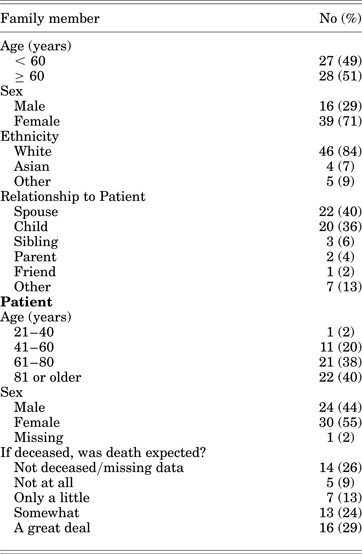
Of 78 vigils, 76 family members agreed to participate and 55 returned their survey for a response proportion of 71%. The majority of patients who received vigils were expected to die, though one-quarter did not die by the time the survey was completed (at times, vigils were performed at discharge from hospital to home hospice). Patient and family demographic characteristics are described in Table 1.
Characteristics of 55 Patients and Family Members Who Experienced Music Vigils

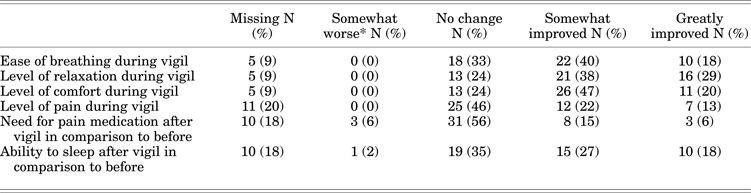
Family members perceived that the vigils resulted in modest improvement in the patients' breathing, relaxation, comfort, and ability to sleep, with between one-quarter and one-third noting no change, 27% to 40% somewhat improved, and 18% to 29% greatly improved (Table 2). There were fewer positive effects on pain, with 46% reporting no change, 22% somewhat improved and 13% greatly improved. There were very high correlations between responses reporting improvements with the correlation coefficients between ease of breathing, relaxation, and comfort, all over 0.85 (p < 0.001). Correlations between these measures and whether the patient slept more comfortably after the vigil ranged from 0.65-0.71 (all p < 0.001). Correlations were less strong between these factors and need for palliative medication after the vigil compared to before (r = 0.47-0.77, all p < 0.001), though all were still highly statistically significant.
Family Members' Ratings of Impact of Music Vigil on Ill Patient
*No ratings of “Greatly worse” on any measures.
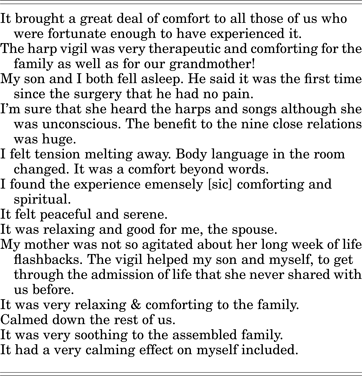
Analysis of written comments further indicated favorable impressions to patient palliation of music vigils as reported by family members. Only two respondents wrote comments after the question, “Did you notice any negative effects cause by the vigil?” One of the respondents wrote, “We did less talking, but I'm not sure there were useful things to say at that time” and another responded, “May have been too heavenly – end of life.” Thirty-nine respondents wrote positive comments. The most commonly used words (or related root words) were: relaxing (N = 8), calm (N = 7), comfort (N = 6), peace/peaceful (N = 4), enjoy (N = 5), soothe (N = 3), alert (N = 3), and ease (N = 2). For unconscious patients, family members were admittedly somewhat uncertain if the patient was perceiving the music. They indicated “No response.” “He was so close to death that at that point I could not really see any change.” “I am sure my grandma enjoyed the music. It is just hard to say for sure because unfortunately she was in a coma.” But family members experienced the music as therapeutic for themselves and the entire family. In fact, comments about how beneficial the music was for the family (N = 18) were almost as common as comments on perceived benefit for the patients (N = 21). Families particularly wrote about how the vigil soothed, calmed, and comforted them (Table 3), and brought them closer to the dying patient at a time when they felt the progressive loss of contact with the patient. Some family members commented on how the music caused a reaction in an otherwise unresponsive patient that was very important to the family.
“My husband was completely out (not sleeping), when the musicians began to play, he woke up, recognized my face and exclaimed: ‘I know you! You're my wife!’ That is a moment I will always cherish.”
“This was an awesome experience for my Mom (the patient) my daughter, & myself. My Mom's demeanor changed from immediate impending death to one of peace. It allowed for…my niece to come & be with my Mom.”
Family Members' Views on Benefits of Music Vigils for Themselves
DISCUSSION
Music-thanatology is a therapeutic palliative music modality developed especially for people who are terminally ill or dying. The founder of the field, Therese Schroeder-Sheker, was inspired by the “care of the body, cure of the soul” philosophy of medieval Benedictine monks who sang to their dying brothers (Chalise of Repose Project, 2013). Lane Community College in Eugene, Oregon has graduated two classes of music-thanatologists; most, if not all, have been certified through Music-Thanatology Association International (2013), the professional organization of music-thanatology. Currently most hospitals and hospices in Portland, Oregon, provide music-thanatology vigils by either hiring a staff music-thanatologist or contracting with SacredFlight. SacredFlight's contracted rate for each vigil is $175, but patients are not charged for the service; it is provided as a gift by either the referring institution or SacredFlight. An example of a vigil can be found at: http://www.oregonlive.com/living/oregonian/multimedia/index.ssf?sf_11sacr007
There is little empiric study of music-thanatology. Freeman and coauthors (Reference Freeman, Caserta and Lund2006), recorded observation indicators and vital signs before and after vigils in 55 patients. They found that after vigils, patients' respiratory rate and effort were decreased and patients were less agitated and wakeful, all consistent with a calming effect. There was no effect, however, on pulse rate. Murfin and Haberman (Reference Murfin and Haberman2007), presented clinical narratives written by music-thanatologists as a research project, although there was no qualitative methodology applied in analyzing these narratives. Cox and Roberts (Reference Cox and Roberts2007), recorded details of 21 vigils with six patients. Although no recognized scientific method was used to analyze the data, they concluded that prescriptive live harp music vigils “take people beyond the music into a silence that is deeply spiritual and profoundly comforting.”
Schroeder-Sheker is quoted (Cox & Roberts, Reference Cox and Roberts2007) as saying, “The sole focus of music-thanatology is to help the person move toward completion and to unbind from anything that prevents, impedes or clouds a tranquil passage.” Horrigan (Reference Horrigan2005), recounts that music-thanatology was developed particularly as a therapy for elderly people who died in nursing homes alone without family or friends to comfort them. Writers about music-thanatology discuss its role as decreasing suffering in the dying process primarily through its transformation of consciousness of the dying person to become more receptive to the passage of death (Horrigan, Reference Horrigan2005). However, we found that from the viewpoint of families, the benefits of music vigils are broader, because vigils also diminish the anxiety and distress of the family. Some family members feel more connected to the patient and, for a time, the patient seems to be more available to the family members. This is consistent with the goals of palliative care, which include both the patient and family as beneficiaries of palliative services. Further conceptual models of music-thanatology should consider beginning to incorporate the benefits to the family and other observers of the death.
Limitations of our study include that caregivers reported as a proxy for the patients' experience; we did not hear from the patients directly. However, we previously found that for some Likert measures such as pain, correlations between patients and family members were high, suggesting that caregivers are reasonable proxies for some measures (Ganzini et al., Reference Ganzini, Johnston and Hoffman1999). Other limitations include that we used simple ordinal scales to measure proxies' views of patient experience; the sample was small and the music thanatology experience was comprised of only five musicians at one hospital. A strength of our study was the high response proportion of family members and the frequency at which they volunteered qualitative views and experiences.
In summary, our survey found that family members perceive benefits of music vigils to ill and dying patients' breathing, relaxation, comfort, and ability to sleep, with lesser effects on pain, and almost no negative effects that we could elicit. There were very high correlations among the measures, suggesting that the effects are global, not specific. Qualitative comments underscore the additional positive effects on quelling family anxiety and distress, and decreasing the sense of distance and separation the family experiences as the patient moves toward death. The use of music-thanatology vigils in palliative care should be investigated more extensively as our study supports that this intervention has benefits, almost no risk, minimal cost, and may improve patient-family experience of the dying process.
DISCLOSURE AND ACKNOWLEDGEMENTS
The authors report no proprietary or commercial interest in any product mentioned or concept discussed in this article. This material is the result of work supported with resources and the use of facilities at the Portland Veterans Affairs Medical Center. The views expressed in this article are those of the authors and do not necessarily reflect the position or policy of the Department of Veterans Affairs or the United States government.